Results by title
1049 books match the query 'English, Irish, Scottish, Welsh' and 35 start with e
Economic Women
Essays on Desire and Dispossession in Nineteenth-Century British CultureEdited by Lana L. Dalley and Jill Rappoport
The Ohio State University Press, 2013
Economies of Praise
Value, Labor, and Form in Seventeenth-Century English PoetryRyan Netzley
Northwestern University Press, 2024
Reevaluates early modern poems of praise as, paradoxically, challenging an artistic economy that values exchange and productivity
Early modern poems of praise typically insist that they do not have a purpose or enact real labor beyond their effortless listing of laudable qualities. And yet the poets discussed in this study, including Ben Jonson, Andrew Marvell, Anne Bradstreet, Lucy Hutchinson, and John Milton, hint at an alternative aesthetic economy at work in their verse. Poetic praise, it turns out, might show us a social world outside the organizing principle of exchange.
In Economies of Praise: Value, Labor, and Form in Seventeenth‑Century English Poetry, Ryan Netzley explores how poems of praise imagine alternatives to market and gift economies and point instead to a self-contained aesthetic economy that works against a more expansive and productivist understanding of literary art. By depicting exchange as inconsequential, unproductive, and redundant rather than a necessary constituent of social order, these poems model for modern readers a world without the imperative to create, appraise, and repeatedly demonstrate one’s own value.
Edna O'Brien and the Art of Fiction
Maureen O'Connor
Bucknell University Press, 2022
Educating English Daughters
Late Seventeenth-Century DebatesBathsua Makin and Mary More
Iter Press, 2016
This edition offers texts from Bathsua Makin and Mary More, and Robert Whitehall’s response to More’s argument. Makin describes the appropriate education for London merchants’ daughters, arguing that girls should be educated and should aspire to follow learned women in history, and that educated women improve their families and themselves. More argues that women have the right to an education, and that such an education shows that the inequality of married women under English law is a man-made institution. More’s argument drew objections from her Oxford reader, Robert Whitehall, who preserved her manuscript with his own. Makin and More enjoyed a measure of public recognition and esteem, yet after their deaths, they and their texts were largely ignored until the late twentieth century.
Educating Seeta
The Anglo-Indian Family Romance and the Poetics of Indirect RuleShuchi Kapila
The Ohio State University Press, 2010
Educating Women
Cultural Conflict and Victorian LiteratureLaura Morgan Green
Ohio University Press, 2001
In 1837, when Queen Victoria came to the throne, no institution of higher education in Britain was open to women. By the end of the century, a quiet revolution had occurred: women had penetrated even the venerable walls of Oxford and Cambridge and could earn degrees at the many new universities founded during Victoria's reign. During the same period, novelists increasingly put intellectually ambitious heroines students, teachers, and frustrated scholars—at the center of their books. Educating Women analyzes the conflict between the higher education movement's emphasis on intellectual and professional achievement and the Victorian novel's continuing dedication to a narrative in which women's success is measured by the achievement of emotional rather than intellectual goals and by the forging of social rather than institutional ties.
Focusing on works by Charlotte Brontë, George Eliot, Anna Leonowens, and Thomas Hardy, Laura Morgan Green demonstrates that those texts are shaped by the need to mediate the conflict between the professionalism and publicity increasingly associated with education, on the one hand, and the Victorian celebration of women as emblems of domesticity, on the other. Educating Women shows that the nineteenth-century “heroines” of both history and fiction were in fact as indebted to domestic ideology as they were eager to transform it.
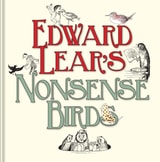
Edward Lear's Nonsense Birds
Edward Lear
Bodleian Library Publishing, 2013
Edward Lear’s Nonsense Birds collects more than sixty of Lear’s bird illustrations from across his entire body of work. Often, the birds have hilariously human characteristics. There is, for instance, a Good-Natured Grey Gull, a Hasty Hen, and a Querulous Quail. The Judicious Jay is chiefly concerned with good grooming. The Vicious Vulture, meanwhile, turns out to be a wordsmith whose verses on vellum celebrate veal. Each bird is endowed with a unique personality, while collectively they form a wonderfully amusing flock. Also included are a series of twenty-four hand-colored illustrations.
Bright and beautifully illustrated, this book will make a perfect gift for children of all ages and will also be welcomed by all who love Lear’s work or are interested in learning more about his fascination with birds.
Effeminism
The Economy of Colonial DesireRevathi Krishnaswamy
University of Michigan Press, 2011

Effeminism
The Economy of Colonial DesireRevathi Krishnaswamy
University of Michigan Press, 1999
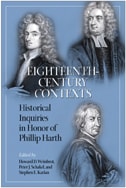
Eighteenth-Century Contexts
Historical Inquiries in Honor of Philip HarthHoward D. Weinbrot
University of Wisconsin Press, 2001
Eighteenth-Century Contexts offers a lively array of essays that consider literary, intellectual, political, theological, and cultural aspects of the years 1650–1800, in the British Isles and Europe. At the center of the book is Jonathan Swift; several essays delve into his poetry, his similarities to Bernard Mandeville, his response to Anthony Collins’s Discourse of Free-Thinking, and the relationship between his Gulliver’s Travels and Thomas More’s Utopia. Other essays discuss Alexander Pope, eighteenth-century music and poetry, William Congreve, James Boswell, Samuel Richardson, and women’s novels of the eighteenth century.
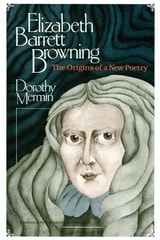
Elizabeth Barrett Browning
The Origins of a New PoetryDorothy Mermin
University of Chicago Press, 1989
Barrett Browning's place at the wellhead of a new female tradition remains the single most important fact about her in terms of literary history, and it was central to her self-consciousness as a poet. Mermin's study shows that Barrett Browning's anomalous situation was constantly present to her imagination and that questions of gender shaped almost everything she wrote. Mermin argues that Barrett Browning's poetry covertly inspects and dismantles the barriers set in her path by gender and that in her major works—Sonnets from the Portuguese, Aurora Leigh, her best political poems, "A Musical Instrument"—difficulty is turned into triumph, incorporating the author's femininity, her situation as a woman poet, and her increasingly substantial fame.
Mermin skillfully interweaves biography and close readings of the poems to show precisely how Barrett Browning's life as a woman writer is a part of the essential meaning of her art. Both her personal and her literary achievements are exceptionally well documented, especially for her formative years. Mermin makes extensive use of the poet's early essays, a diary covering most of her twenty-sixth year, and the enormous number of letters that have survived. Ranging from her earliest ambitions through her long periods of discouragement and illness to her happy married life with Robert Browning, this comprehensive study of Elizabeth Barrett Browning is essential reading for students of the Victorian period, English literature, and women's studies.
Elizabeth I
Translations, 1544-1589Elizabeth I
University of Chicago Press, 2008
Presenting original and modernized spellings in a facing-page format, these two volumes will answer the call to make all of Elizabeth’s writings available. They include her renderings of epistles of Cicero and Seneca, religious writings of John Calvin and Marguerite de Navarre, and Horace’s Ars poetica, as well as Elizabeth’s Latin Sententiae drawn from diverse sources, on the responsibilities of sovereign rule and her own perspectives on the monarchy. Editors Janel Mueller and Joshua Scodel offer introduction to each of the translated selections, describing the source text, its cultural significance, and the historical context in which Elizabeth translated it. Their annotations identify obscure meanings, biblical and classical references, and Elizabeth’s actual or apparent deviations from her sources.
The translations collected here trace Elizabeth’s steady progression from youthful evangelical piety to more mature reflections on morality, royal responsibility, public and private forms of grief, and the right way to rule. Elizabeth I: Translations is the queen’s personal legacy, an example of the very best that a humanist education can bring to the conduct of sovereign rule.
Elizabeth I
Translations, 1592-1598Elizabeth I
University of Chicago Press, 2009
Presenting original and modernized spellings in a facing-page format, these two volumes will answer the call to make all of Elizabeth’s writings available. They include her renderings of epistles of Cicero and Seneca, religious writings of John Calvin and Marguerite de Navarre, and Horace’s Ars poetica, as well as Elizabeth’s Latin Sententiae drawn from diverse sources, on the responsibilities of sovereign rule and her own perspectives on the monarchy. Editors Janel Mueller and Joshua Scodel offer introduction to each of the translated selections, describing the source text, its cultural significance, and the historical context in which Elizabeth translated it. Their annotations identify obscure meanings, biblical and classical references, and Elizabeth’s actual or apparent deviations from her sources.
The translations collected here trace Elizabeth’s steady progression from youthful evangelical piety to more mature reflections on morality, royal responsibility, public and private forms of grief, and the right way to rule. Elizabeth I: Translations is the queen’s personal legacy, an example of the very best that a humanist education can bring to the conduct of sovereign rule.
Elizabethan Poetry in Manuscript
An Edition of British Library Harley MS 7392(2)Edited by Jessica Edmondes
Iter Press, 2022
This edition preserves the appearance, spelling, and punctuation of the original manuscript while expanding antiquated contractions to provide an easily readable text. Textual notes appear on the page, and in-depth contextual notes and word glosses are provided in the commentary section. The analyses add to our knowledge of early modern manuscript culture and literary manuscript transmission, and a substantial introduction provides context for the compilation of the anthology.
Embodied
Victorian Literature and the SensesWilliam A. Cohen
University of Minnesota Press, 2008
Making sense of the body in Victorian literature
What does it mean to be human? British writers in the Victorian period found a surprising answer to this question. What is human, they discovered, is nothing more or less than the human body itself. In literature of the period, as well as in scientific writing and journalism, the notion of an interior human essence came to be identified with the material existence of the body. The organs of sensory perception were understood as crucial routes of exchange between the interior and the external worlds.
Anatomizing Victorian ideas of the human, William A. Cohen considers the meaning of sensory encounters in works by writers including Charles Dickens, Charlotte Brontë, Anthony Trollope, Thomas Hardy, and Gerard Manley Hopkins. Rather than regarding the bodily exterior as the primary location in which identity categories—such as gender, sexuality, race, and disability—are expressed, he focuses on the interior experience of sensation, whereby these politics come to be felt. In these elegant engagements with literary works, cultural history, and critical theory, Cohen advances a phenomenological approach to embodiment, proposing that we encounter the world not through our minds or souls but through our senses.
Emergency Writing
Irish Literature, Neutrality, and the Second World WarAnna Teekell
Northwestern University Press, 2018
Taking seriously Ireland’s euphemism for World War II, “the Emergency,” Anna Teekell’s Emergency Writing asks both what happens to literature written during a state of emergency and what it means for writing to be a response to an emergency.
Anchored in close textual analysis of works by Samuel Beckett, Elizabeth Bowen, Flann O’Brien, Louis MacNeice, Denis Devlin, and Patrick Kavanagh, and supported by archival material and historical research, Emergency Writing shows how Irish late modernism was a response to the sociopolitical conditions of a newly independent Irish Free State and to a fully emerged modernism in literature and art. What emerges in Irish writing in the wake of Independence, of the Gaelic Revival, of Yeats and of Joyce, is a body of work that invokes modernism as a set of discursive practices with which to counter the Free State’s political pieties.
Emergency Writing provides a new approach to literary modernism and to the literature of conflict, considering the ethical dilemma of performing neutrality—emotionally, politically, and rhetorically—in a world at war.
Emerson, Romanticism, and Intuitive Reason
The Transatlantic "Light of All Our Day"Patrick J. Keane
University of Missouri Press, 2005
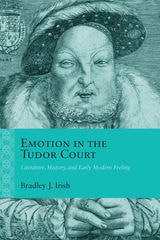
Emotion in the Tudor Court
Literature, History, and Early Modern FeelingBradley J. Irish
Northwestern University Press, 2018
Spanning the sixteenth century, Emotion in the Tudor Court explores Cardinal Thomas Wolsey and Henrician satire; Henry Howard, Earl of Surrey, and elegy; Sir Philip Sidney and Elizabethan pageantry; and Robert Devereux, Earl of Essex, and factional literature. It demonstrates how the dynamics of disgust,envy, rejection, and dread, as they are understood in the modern affective sciences, can be seen to guide literary production in the early modern court.
By combining Renaissance concepts of emotion with modern research in the social and natural sciences, Emotion in the Tudor Court takes a transdisciplinary approach to yield fascinating and robust ways to illuminate both literary studies and cultural history.
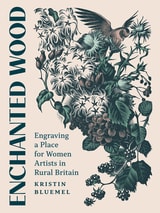
Enchanted Wood
Engraving a Place for Women Artists in Rural BritainKristin Bluemel
University of Minnesota Press, 2025
How women wood engravers helped reshape the visual and literary landscape of modern Britain
Amid the austerities of Depression-era publishing in Britain, urban editors and women artists recognized a unique opportunity to make and sell popular books illustrated with wood engravings. Enchanted Wood focuses on four of these artists—Gwen Raverat, Agnes Miller Parker, Clare Leighton, and Joan Hassall—weaving together their lives and work to tell a compelling and little-known story about a modern art that transformed the lives of both urban and rural women.
In this richly illustrated book, Kristin Bluemel demonstrates how women engravers used wood engraving to redraw professional and personal boundaries for themselves and other women. Depicting realistic scenes of country life, these illustrations are reminiscent of the aesthetic of eighteenth-century artist, naturalist, and print innovator Thomas Bewick even as they present distinctly modern reflections on gender, age, marriage, and motherhood. Reproducing and analyzing white-line engravings, pen and ink drawings, and rare color engravings from these four artists’ books for children and adults, Enchanted Wood reveals the magnified power and meaning of gentle arts for everyday people and for national patterns of work and play.
Integrating vignettes from Bewick’s natural history with formal, thematic, and cultural analysis of the women’s art as she recovers their medium, oeuvres, and stories, Bluemel shows how wood engraving led Raverat, Miller Parker, Leighton, and Hassall to achieve professional stature, public affirmation, and personal independence. A visually rich history of collective achievement, Enchanted Wood establishes these women engravers as important modern artists and literary figures in their own right.
Retail e-book files for this title are screen-reader friendly with images accompanied by short alt text and/or extended descriptions.
Enemies of Promise
Cyril Connolly
University of Chicago Press, 2008
“Whom the gods wish to destroy,” writes Cyril Connolly, “they first call promising.” First published in 1938 and long out of print, Enemies of Promise, an “inquiry into the problem of how to write a book that lasts ten years,” tests the boundaries of criticism, journalism, and autobiography with the blistering prose that became Connolly’s trademark. Connolly here confronts the evils of domesticity, politics, drink, and advertising as well as novelists such as Joyce, Proust, Hemingway, and Faulkner in essays that remain fresh and penetrating to this day.
“A fine critic, compulsive traveler, and candid autobiographer. . . . [Connolly] lays down the law for all writers who wanted to count. . . . He had imagination and decisive images flashed with the speed of wit in his mind.”—V. S. Pritchett, New York Review of Books
“Anyone who writes, or wants to write, will find something on just about every single page that either endorses a long-held prejudice or outrages, and that makes it a pretty compelling read. . . . You end up muttering back at just about every ornately constructed pensée that Connolly utters, but that’s one of the joys of this book.”—Nick Hornby, The Believer
“A remarkable book.”—Anthony Powell

England in 1819
The Politics of Literary Culture and the Case of Romantic HistoricismJames Chandler
University of Chicago Press, 1998
"1819? At first sight, it might not seem a 'hot date'; but as James Chandler argues in his powerful book, it would be a mistake to overlook a year of such exceptional political conflagration and literary pyrotechnics in British history. Chandler's study is a wide-ranging, enormously ambitious, densely packed, closely argued work."—John Brewer, New Republic
"The book's largest argument, and the source of its considerable revelations, is that late twentieth-century practices of cultural history-writing have their roots in the peculiar Romantic historicism born in post-Waterloo Britain."—Jon Klancher, Times Literary Supplement
"A monumental work of scholarship."—Terry Eagleton, The Independent
England's Asian Renaissance
Su Fang Ng
University of Delaware Press, 2022
Published by the University of Delaware Press. Distributed worldwide by Rutgers University Press.
English Theatrical Anecdotes, 1660-1800
Heather Ladd
University of Delaware Press, 2022
English Women Staging Islam, 1696-1707
Delarivier Manley and Mary Pix
Iter Press, 2012
Enigmas of Sacrifice
A Critique of Joseph M. Plunkett and the Dublin Insurrection of 1916W. J. Mc Cormack
Michigan State University Press, 2016
Enlightenment Orientalism
Resisting the Rise of the NovelSrinivas Aravamudan
University of Chicago Press, 2011
Srinivas Aravamudan here reveals how Oriental tales, pseudo-ethnographies, sexual fantasies, and political satires took Europe by storm during the eighteenth century. Naming this body of fiction Enlightenment Orientalism, he poses a range of urgent questions that uncovers the interdependence of Oriental tales and domestic fiction, thereby challenging standard scholarly narratives about the rise of the novel.
Enlistment
Lists in Medieval and Early Modern LiteratureEdited by Eva von Contzen and James Simpson
The Ohio State University Press, 2022
Contributors: Suzanne Conklin Akbari, Ingo Berensmeyer, Eva von Contzen, Alex Davis, Andrew James Johnston, Wolfram R. Keller, Alexis Kellner Becker, Kathryn Mogk Wagner, Martha Rust, James Simpson
Equivocal Beings
Politics, Gender, and Sentimentality in the 1790s--Wollstonecraft, Radcliffe, Burney, AustenClaudia L. Johnson
University of Chicago Press, 1995
Demonstrating the interrelationships among politics, gender, and feeling in the fiction of this period, Johnson provides detailed readings of Wollstonecraft, Radcliffe, and Burney, and treats the qualities that were once thought to mar their work—grotesqueness, strain, and excess—as indices of ideological conflict and as strategies of representation during a period of profound political conflict. She maintains that the reactionary reassertion of male sentimentality as a political duty displaced customary gender roles, rendering women, in Wollstonecraft's words, "equivocal beings."
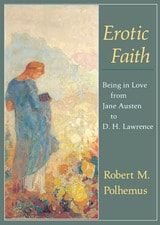
Erotic Faith
Being in Love from Jane Austen to D. H. LawrenceRobert M. Polhemus
University of Chicago Press, 1990
Drawing on a wide range of disciplines, Polhemus shows the reciprocity of love as subject, the novel as form, and faith as motive in important works by Jane Austen, Walter Scott, the Brontës, Dickens, George Eliot, Trollope, Thomas Hardy, Joyce, D. H. Lawrence, Virginia Woolf, and Samuel Beckett. Throughout, Polhemus relates the novelists' representation of love to that of such artists as Botticelli, Vermeer, Claude Lorrain, Redon, and Klimt. Juxtaposing their paintings with nineteenth- and twentieth-century texts both reveals the ways in which novels develop and individualize common erotic and religious themes and illustrates how the novel has influenced our perception of all art.
Error, Misuse, Failure
Object Lessons From The English RenaissanceJulian Yates
University of Minnesota Press, 2002
Every Intellectual's Big Brother
George Orwell's Literary SiblingsBy John Rodden
University of Texas Press, 2006
George Orwell has been embraced, adopted, and co-opted by everyone from the far left to the neoconservatives. Each succeeding generation of Anglo-American intellectuals has felt compelled to engage the life, work, and cultural afterlife of Orwell, who is considered by many to have been the foremost political writer of the twentieth century. Every Intellectual's Big Brother explores the ways in which numerous disparate groups, Orwell's intellectual "siblings," have adapted their views of Orwell to fit their own agendas and how in doing so they have changed our perceptions of Orwell himself. By examining the politics of literary reception as a dimension of cultural history, John Rodden gives us a better understanding of Orwell's unique and enduring role in Anglo-American intellectual life.
In Part One, Rodden opens the book with a section titled "Their Orwell, Left and Right," which focuses on Orwell's reception by several important literary circles of the latter half of the twentieth century. Beginning with Orwell's own contemporaries, Rodden addresses the ways various intellectual groups of the 1950s responded to Orwell. Rodden then moves on in Part Two to what he calls the "Orwell Confraternity Today," those contemporary intellectuals who have, in various ways, identified themselves with or reacted against Orwell. The author concludes by examining how Orwell's status as an object of admiration and detraction has complicated the way in which he has been perceived by readers since his death.
Everyday English 1500-1700
A ReaderBridget Cusack, Editor
University of Michigan Press, 1998
This unique source book of essential documents designed for courses on Early Modern English is designed as a teaching text with full guidance to each text, including glossary, explanatory and background notes, and suggested topics for linguistic evaluation. Everyday English takes an up-to-the-minute approach by focusing on language as it was used and spoken at the time.
This wide-ranging collection for the first time makes available to students a corpus of examples of the ordinary, nonstandard language of the man and woman in the street, coming from areas as diverse as England, Scotland, and America. The emphasis throughout is on providing as much assistance as possible to the reader to aid understanding and appreciation of both the linguistic features and the everyday lifestyles of the time.
"The only book a really conscientious teacher of the history and structure of Early Modern English would use for source texts." --Roger Lass, University of Cape Town
Bridget Cusack was lecturer in English Language, University of Edinburgh.
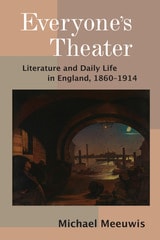
Everyone’s Theater
Literature and Daily Life in England, 1860–1914Michael Meeuwis
University of Michigan Press, 2019
Nearly all residents of England and its colonies between 1860 and 1914 were active theatergoers, and many participated in the amateur theatricals that defined late Victorian life. The Victorian theater was not an abstract figuration of the world as a stage, but a media system enmeshed in mass lived experience that fulfilled in actuality the concept of a theatergoing nation. Everyone’s Theater turns to local history, the words of everyday Victorians found in their diaries and production records, to recover this lost chapter of theater history in which amateur drama domesticates the stage. Professional actors and playwrights struggled to make their productions compatible with ideas and techniques that could be safely reproduced in the home—and in amateur performances from Canada to India. This became the first true English national theater: a society whose myriad classes found common ground in theatrical display. Everyone’s Theater provides new ways to extend Victorian literature into the dimension of voice, sound, and embodiment, and to appreciate the pleasures of Victorian theatricality.
Everywhere and Nowhere
Anonymity and Mediation in Eighteenth-Century BritainMark Vareschi
University of Minnesota Press, 2018
A fascinating analysis of anonymous publication centuries before the digital age
Everywhere and Nowhere considers the ubiquity of anonymity and mediation in the publication and circulation of eighteenth-century British literature—before the Romantic creation of the “author”—and what this means for literary criticism. Anonymous authorship was typical of the time, yet literary scholars and historians have been generally unable to account for it as anything more than a footnote or curiosity.
Mark Vareschi shows the entangled relationship between mediation and anonymity, revealing the nonhuman agency of the printed text. Drawing richly on quantitative analysis and robust archival work, Vareschi brings together philosophy, literary theory, and media theory in a trenchant analysis, uncovering a history of textual engagement and interpretation that does not hinge on the known authorial subject.
In discussing anonymous poetry, drama, and the novel along with anonymously published writers such as Daniel Defoe, Frances Burney, and Walter Scott, he unveils a theory of mediation that renews broader questions about agency and intention. Vareschi argues that textual intentionality is a property of nonhuman, material media rather than human subjects alone, allowing the anonymous literature of the eighteenth century to speak to contemporary questions of meaning in the philosophy of language. Vareschi closes by exploring dubious claims about the death of anonymity and the reexplosion of anonymity with the coming of the digital. Ultimately, Everywhere and Nowhere reveals the long history of print anonymity so central to the risks and benefits of the digital culture.
Experiencing the Novel
The Genre of Tender ConscienceEsther Yu
University of Chicago Press, 0
An innovative account of the novel's emergence across revolutionary England and beyond.
Esther Yu’s expansive study of the history of the novel charts the growth of the “tender conscience”—at once a new mode of subjectivity and a shared structure of ethical obligation—that gave rise to the novel’s characteristic features. At the heart of the early English novel is a strange character: a hyperconscious observer who continually transforms perception into ordered, written narrative. Against long-standing accounts that tie the novel’s subjects to the emergence of modern individualism, Experiencing the Novel traces these endlessly impressionable figures to the mid-seventeenth century and the English Revolution, when citizen-subjects made public declarations of tenderness. It is through the recovery of such “tender consciences” that a curious fact can be addressed anew. The first people in Europe to cut off the crown with the head of their king began to tell stories differently: They took to narrating through an acute, sensitive register of first-person prose.
A forceful, community-binding complex of cognition, sensation, and ethics, the tender conscience persisted well into the eighteenth century. It was a large-scale structure forged across decades, one that demands the wide-ranging literary-historical account it finally receives here. Experiencing the Novel opens among brilliantly inventive Tudor-era works—Beware the Cat (ca. 1553), the Marprelate project (1588-89), The Unfortunate Traveler (1594)—that by turns experiment with and reject sensitizing modes of conscience. Yu further takes up an extensive, first-person care of the conscience—a tenderizing process enacted by little-known practitioners that carries from John Milton’s Paradise Lost into the writings of John Locke, the novels of Daniel Defoe, the moral sentimentalism of David Hume and Adam Smith, as well as Laurence Sterne’s Tristram Shandy and Samuel Richardson’s Pamela.
Through its vision of the long seventeenth century, Experiencing the Novel reveals an improbable practice of consciousness that remade popular politics, philosophy, and the culture of sensibility from the margins.