Results by title
1201 books match the query 'Race relations' and 21 start with e
E. Franklin Frazier and Black Bourgeoisie
E. Franklin Frazier
University of Missouri Press, 2002
When E. Franklin Frazier was elected the first black president of the American Sociological Association in 1948, he was established as the leading American scholar on the black family and was also recognized as a leading theorist on the dynamics of social change and race relations. By 1948 his lengthy list of publications included over fifty articles and four major books, including the acclaimed Negro Family in the United States. Frazier was known for his thorough scholarship and his mastery of skills in both history and sociology.
With the publication of Bourgeoisie Noire in 1955 (translated in 1957 as Black Bourgeoisie), Frazier apparently set out on a different track, one in which he employed his skills in a critical analysis of the black middle class. The book met with mixed reviews and harsh criticism from the black middle and professional class. Yet Frazier stood solidly by his argument that the black middle class was marked by conspicuous consumption, wish fulfillment, and a world of make-believe. While Frazier published four additional books after 1948, Black Bourgeoisie remained by far his most controversial.
Given his status in American sociology, there has been surprisingly little study of Frazier's work. In E. Franklin Frazier and Black Bourgeoisie, a group of distinguished scholars remedies that lack, focusing on his often-scorned Black Bourgeoisie.
This in-depth look at Frazier's controversial publication is relevant to the growing concerns about racism, problems in our cities, the limitations of affirmative action, and the promise of self-help.

Earline's Pink Party
The Social Rituals and Domestic Relics of a Southern WomanElizabeth Findley Shores
University of Alabama Press, 2017
A compelling, genre-bending page-turner, Earline’s Pink Party: The Social Rituals and Domestic Relics of a Southern Woman analyzes the life of a small-city matron in the Deep South. A combination of biography, material culture analysis, social history, and memoir, this volume offers a new way of thinking about white racism through Shores’s conclusion that Earline’s earliest childhood experiences determined her worldview.
Set against a fully drawn background of geography and culture and studded with detailed investigations of social rituals (such as women’s parties) and objects (such as books, handwritten recipes, and fabric scraps), Earline’s Pink Party tells the story of an ordinary woman, the grandmother Shores never knew. Looking for more than the details and drama of bourgeois Southern life, however, the author digs into generations of family history to understand how Earline viewed the racial terror that surrounded her during the Jim Crow years in this fairly typical southern town.
Shores seeks to narrow a gap in the scholarship of the American South, which has tended to marginalize and stereotype well-to-do white women who lived after Emancipation. Exploring her grandmother’s home and its contents within the context of Tuscaloosa society and historical events, Shores evaluates the belief that women like Earline consciously engaged in performative rituals in order to sustain the “fantastical” view of the white nobility and the contented black underclass. With its engaging narrative, illustrations, and structure, this fascinating book should interest scholars of memory, class identity, and regional history, as well as sophisticated lay readers who enjoy Southern history, foodways, genealogy, and material culture.
Earth Politics
Religion, Decolonization, and Bolivia's Indigenous IntellectualsWaskar Ari
Duke University Press, 2014
Educating Milwaukee
How One City’s History of Segregation and Struggle Shaped Its SchoolsJames K. Nelsen
Wisconsin Historical Society Press, 2015
"Milwaukee's story is unique in that its struggle for integration and quality education has been so closely tied to [school] choice." --from the Introduction
"Educating Milwaukee: How One City's History of Segregation and Struggle Shaped Its Schools" traces the origins of the modern school choice movement, which is growing in strength throughout the United States. Author James K. Nelsen follows Milwaukee's tumultuous education history through three eras--"no choice," "forced choice," and "school choice." Nelsen details the whole story of Milwaukee's choice movement through to modern times when Milwaukee families have more schooling options than ever--charter schools, open enrollment, state-funded vouchers, neighborhood schools--and yet Milwaukee's impoverished African American students still struggle to succeed and stay in school. "Educating Milwaukee" chronicles how competing visions of equity and excellence have played out in one city's schools in the modern era, offering both a cautionary tale and a "choice" example.
Egypt Land
Race and Nineteenth-Century American EgyptomaniaScott Trafton
Duke University Press, 2004
Drawing on literary and cultural studies, art and architectural history, political history, religious history, and the histories of archaeology and ethnology, Trafton illuminates anxieties related to race in different manifestations of nineteenth-century American Egyptomania, including the development of American Egyptology, the rise of racialized science, the narrative and literary tradition of the imperialist adventure tale, the cultural politics of the architectural Egyptian Revival, and the dynamics of African American Ethiopianism. He demonstrates how debates over what the United States was and what it could become returned again and again to ancient Egypt. From visions of Cleopatra to the tales of Edgar Allan Poe, from the works of Pauline Hopkins to the construction of the Washington Monument, from the measuring of slaves’ skulls to the singing of slave spirituals—claims about and representations of ancient Egypt served as linchpins for discussions about nineteenth-century American racial and national identity.
Elsie Clews Parsons
Inventing Modern LifeDesley Deacon
University of Chicago Press, 1997
Emancipation without Equality
Pan-African Activism and the Global Color LineThomas E. Smith
University of Massachusetts Press, 2018
At the Pan–African Conference in London in 1900, W. E. B. Du Bois famously prophesied that the problem of the twentieth century would be the global color line, the elevation of “whiteness” that created a racially divided world. While Pan-Africanism recognized the global nature of the color line in this period, Thomas E. Smith argues that it also pushed against it, advocating for what Du Bois called "opportunities and privileges of modern civilization" to open up to people of all colors.
Covering a period roughly bookended by two international forums, the 1884–1885 Berlin Conference and the 1911 Universal Races Congress, Emancipation without Equality chronicles how activists of African descent fought globally for equal treatment and access to rights associated with post-emancipated citizenship. While Euro-American leaders created a standard to guide the course of imperialism at the Berlin Conference, the proceedings of the Universal Races Congress demonstrated that Pan-Africanism had become a visible part of a growing, global, anti-imperialist protest.
Emerging Intersections
Race, Class, and Gender in Theory, Policy, and PracticeDill, Bonnie Thornton
Rutgers University Press, 2009
Emerging Intersections, an anthology of ten previously unpublished essays, looks at the problems of inequality and oppression from new angles and promotes intersectionality as an interpretive tool that can be utilized to better understand the ways in which race, class, gender, ethnicity, and other dimensions of difference shape our lives today. The book showcases innovative contributions that expand our understanding of how inequality affects people of color, demonstrates the ways public policies reinforce existing systems of inequality, and shows how research and teaching using an intersectional perspective compels scholars to become agents of change within institutions. By offering practical applications for using intersectional knowledge, Emerging Intersections will help bring us one step closer to achieving positive institutional change and social justice.
Empire's End
Transnational Connections in the Hispanic WorldAkiko Tsuchiya
Vanderbilt University Press, 2015
Empire's End showcases the work of scholars of literature, cultural studies, and history, centering on four interrelated issues crucial to understanding the end of the Spanish empire: the mappings of the Hispanic Atlantic, race, human rights, and the legacies of empire.
Empire's Endgame
Racism and the British StateGargi Bhattacharyya
Pluto Press, 2021
Encountering American Faultlines
Race, Class, and the Dominican Experience in ProvidenceJose Itzigsohn
Russell Sage Foundation, 2009
Entering the Fray
Gender, Politics, and Culture in the New SouthEdited by Jonathan Daniel Wells & Sheila R. Phipps
University of Missouri Press, 2009

Envoy to the Archives
Ruth Anna Fisher and Hidden Transatlantic HistoryWilliam L. Fox
University of Massachusetts Press, 2026
How a pioneering manuscript librarian and intellectual uncovered buried records that reshaped America’s past
As the London-based agent of the US Library of Congress, Ruth Anna Fisher (1886–1975) profoundly shaped the field of US history. Working at the British Museum and Public Record Office between the world wars, she was responsible for a vast program of identifying and copying up to a million documents related to American history, with prescient attention to the transatlantic slave trade. This monumental achievement has provided countless scholars access to source materials that might have remained hidden in repositories throughout Britian without Fisher’s brilliant discernment and tireless labor.
In Envoy to the Archives, William L. Fox offers the first full-length biography of this remarkable American intellectual. Born to a prominent African American family in northern Ohio, Fisher was keenly aware of racial issues throughout her life. She was associated with key thinkers in the Harlem Renaissance and the twentieth century transatlantic world, including W. E. B. Du Bois, Harold Laski, and J. Franklin Jameson. A trailblazer in historical research, Fisher was among a small group of Black women who first joined the ranks of professional library work, and her efforts in London coincided with the creation and consolidation of the US National Archives in the 1930s. She also mastered technologies that were new at the time, including photostat reproduction and microfilm—precursors to the many historical digitization projects of our own era.
This engrossing biography adds to the growing body of work centered on Black women archivists, librarians, and curators. Fox draws on a wide range of archival sources, including the personal papers of prominent Black thinkers (Fisher’s were destroyed in the bombing of London in 1940), and various institutional records at the Library of Congress and the Carnegie Institution of Washington. Fox also knew Fisher personally, adding warmth and insight into this captivating portrait.
Ethnic Cues
The Role of Shared Ethnicity in Latino Political ParticipationMatt A. Barreto
University of Michigan Press, 2010
Ethnic Historians and the Mainstream
Shaping America's Immigration StoryAlan M. Kraut and David A. Gerber
Rutgers University Press, 2013
Do historians “write their biographies” with the subjects they choose to address in their research? In this collection, editors Alan M. Kraut and David A. Gerber compiled eleven original essays by historians whose own ethnic backgrounds shaped the choices they have made about their own research and writing as scholars. These authors, historians of American immigration and ethnicity, revisited family and personal experiences and reflect on how their lives helped shape their later scholarly pursuits, at times inspiring specific questions they asked of the nation’s immigrant past. They address issues of diversity, multiculturalism, and assimilation in academia, in the discipline of history, and in society at large. Most have been pioneers not only in their respective fields, but also in representing their ethnic group within American academia. Some of the women in the group were in the vanguard of gender diversity in the discipline of history as well as on the faculties of the institutions where they have taught.
The authors in this collection represent a wide array of backgrounds, spanning Europe, Africa, Asia, the Middle East, and Latin America. What they have in common is their passionate engagement with the making of social and personal identities and with finding a voice to explain their personal stories in public terms.
Contributors: Theresa Alfaro-Velcamp, John Bodnar, María C. García, David A. Gerber, Violet M. Showers Johnson, Alan M. Kraut, Timothy J. Meagher, Deborah Dash Moore, Dominic A. Pacyga, Barbara M. Posadas, Eileen H. Tamura, Virginia Yans, Judy Yung
Ethnic Los Angeles
Roger Waldinger
Russell Sage Foundation, 1996

Europe in Black and White
Immigration, Race, and Identity in the ‘Old Continent'Edited by Manuela Ribeiro Sanches, Fernando Clara, João Ferreira Duarte, and Leonor Pires Martins
Intellect Books, 2011
The essays in Europe in Black and White offer new critical perspectives on race, immigration, and identity on the Old Continent. In reconsidering the various forms of encounters with difference, such as multiculturalism and hybridity, the contributors address a number of issues, including the cartography of postcolonial Europe, its relation to the production of "difference" and "race," and national and identity politics and their dependence on linguistic practices inherited from imperial times. Featuring scholars from a wide variety of nationalities and disciplinary areas, this collection will speak to an equally wide readership.
Even Mississippi
Melany Neilson
University of Alabama Press, 1989
Ever Faithful
Race, Loyalty, and the Ends of Empire in Spanish CubaDavid Sartorius
Duke University Press, 2013
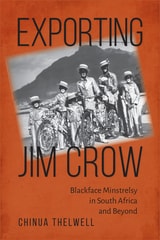
Exporting Jim Crow
Blackface Minstrelsy in South Africa and BeyondChinua Thelwell
University of Massachusetts Press, 2020
Chinua Thelwell brings blackface minstrelsy and performance culture into the discussion of apartheid's nineteenth-century origins and afterlife, employing a broad archive of South African newspapers and magazines, memoirs, minstrel songs and sketches, diaries, and interview transcripts. Exporting Jim Crow highlights blackface minstrelsy's cultural and social impact as it became a dominant form of entertainment, moving from its initial appearances on music hall stages to its troubling twentieth-century resurgence on movie screens and at public events. This carefully researched and highly original study demonstrates that the performance of race in South Africa was inherently political, contributing to racism and shoring up white racial identity.
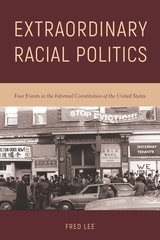
Extraordinary Racial Politics
Four Events in the Informal Constitution of the United StatesFred Lee
Temple University Press, 2018
Extraordinary racial politics rupture out of and reset everyday racial politics. In his cogent book, Fred Lee examines four unusual, episodic, and transformative moments in U.S. history: the 1830s–1840s southeastern Indian removals, the Japanese internment during World War II, the post-war civil rights movement, and the 1960s–1970s racial empowerment movements. Lee helps us connect these extraordinary events to both prior and subsequent everyday conflicts.
Extraordinary Racial Politics brings about an intellectual exchange between ethnic studies, which focuses on quotidian experiences and negotiations, and political theory, which emphasizes historical crises and breaks. In ethnic studies, Lee draws out the extraordinary moments in Michael Omi and Howard Winant’s as well as Charles Mills’s accounts of racial formation. In political theory, Lee considers the strengths and weaknesses of using Carl Schmitt’s and Hannah Arendt’s accounts of public constitution to study racial power.
Lee concludes that extraordinary racial politics represent both the promises of social emancipation and the perils of state power. This promise and peril characterizes our contentious racial present.