Results by title
2706 books match the query 'European' and 82 start with e
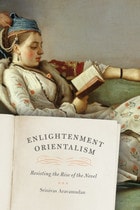
Enlightenment Orientalism
Resisting the Rise of the NovelSrinivas Aravamudan
University of Chicago Press, 2011
Srinivas Aravamudan here reveals how Oriental tales, pseudo-ethnographies, sexual fantasies, and political satires took Europe by storm during the eighteenth century. Naming this body of fiction Enlightenment Orientalism, he poses a range of urgent questions that uncovers the interdependence of Oriental tales and domestic fiction, thereby challenging standard scholarly narratives about the rise of the novel.
Enlistment
Lists in Medieval and Early Modern LiteratureEdited by Eva von Contzen and James Simpson
The Ohio State University Press, 2022
Contributors: Suzanne Conklin Akbari, Ingo Berensmeyer, Eva von Contzen, Alex Davis, Andrew James Johnston, Wolfram R. Keller, Alexis Kellner Becker, Kathryn Mogk Wagner, Martha Rust, James Simpson
Enraged Citizens, European Peace and Democratic Deficits
Or Why the Democracy Given to Us Must Become One We Fight ForRobert Menasse
Seagull Books, 2016
Spanning from the beginning of the transnational idea with 1951’s Montanunion—the European Coal and Steel Community—to the current financial crisis, Menasse focuses on the institutional structures and forces both advancing and obstructing the European project. Given the internal tensions among the European Commission, Parliament, and Council, Menasse argues that current problems that are frequently misunderstood as resulting from the financial crisis are, in fact, political. Along the way, he makes the bold claim that either the Europe of nation-states will perish—or the project of transcending the nation-states will.
A provocative book, Enraged Citizens, European Peace and Democratic Deficits deftly analyzes the financial and bureaucratic structures of the European Union and sheds much-needed light on the state of the debt crisis. Menasse brings his considerable literary expertise to the unraveling of the real state of the Union, along the way weaving an intriguing tale of one continent’s efforts to become a truly postnational democracy.
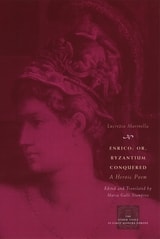
Enrico; or, Byzantium Conquered
A Heroic PoemLucrezia Marinella
University of Chicago Press, 2009
Lucrezia Marinella (1571–1653) is, by all accounts, a phenomenon in early modernity: a woman who wrote and published in many genres, whose fame shone brightly within and outside her native Venice, and whose voice is simultaneously original and reflective of her time and culture. In Enrico; or, Byzantium Conquered, one of the most ambitious and rewarding of her numerous narrative works, Marinella demonstrates her skill as an epic poet.
Now available for the first time in English translation, Enrico retells the story of the conquest of Byzantium in the Fourth Crusade (1202–04). Marinella intersperses historical events in her account of the invasion with numerous invented episodes, drawing on the rich imaginative legacy of the chivalric romance. Fast-moving, colorful, and narrated with the zest that characterizes Marinella’s other works, this poem is a great example of a woman engaging critically with a quintessentially masculine form and subject matter, writing in a genre in which the work of women poets was typically shunned.
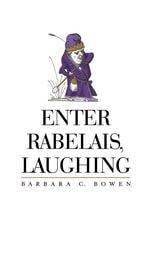
Enter Rabelais, Laughing
Barbara C. Bowen
Vanderbilt University Press, 1998
While most books about Rabelais have relatively little to say about his comedic genius, Enter Rabelais, Laughing analyzes the many sides of Rabelais's humor, focusing on why his writing was so hilariously funny to sixteenth-century readers. The author begins by discussing how the Renaissance defined laughter and situates Rabelais in a long tradition of literary laughter. Subsequent chapters examine specific contexts relevant to Gargantua and Pantagruel, beginning with the comic aspects of epic, chronicle, mock-epic, and farce, and proceeding to Renaissance and Reformation humanist satire, rhetoric, medicine, and law. All of these chapters combine information, much of it new, on the humanist message Rabelais wanted to convey to his readers, with an analysis of how he used his wit to reinforce his message.
Rarely is a writer's work treated in such illuminating detail. On a broad level, Enter Rabelais, Laughing serves as an excellent introduction to French Renaissance literature and exhibits a remarkably charming and lucid writing style, free of jargon. To Rabelais scholars in particular it offers a thorough and innovative analysis that corrects misconceptions and questions commonly held views.
Environment and Narrative
New Directions in EconarratologyEdited by Erin James and Eric Morel
The Ohio State University Press, 2020
To explore the methodological possibilities within “econarratology,” the contributors evaluate the mechanics of how narratives convey environmental understanding via building blocks such as the organization of time and space, characterization, focalization, description, and narration. They also query how readers emotionally and cognitively engage with such representations and how the process of encountering different environments in narratives stands to affect real-world attitudes and behaviors. By positioning narratives as important repositories of values, political and ethical ideas, and behaviors that determine how we engage with our ecological homes, the authors in this volume suggest that to change the way that we interact with the environment requires not only new stories but also a better understanding of the ones that have long been in circulation.
Epic and Exile
Novels of the German Popular Front, 1933-1945Hunter Bivens
Northwestern University Press, 2015
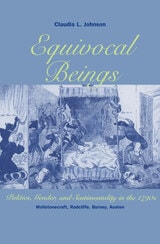
Equivocal Beings
Politics, Gender, and Sentimentality in the 1790s--Wollstonecraft, Radcliffe, Burney, AustenClaudia L. Johnson
University of Chicago Press, 1995
Demonstrating the interrelationships among politics, gender, and feeling in the fiction of this period, Johnson provides detailed readings of Wollstonecraft, Radcliffe, and Burney, and treats the qualities that were once thought to mar their work—grotesqueness, strain, and excess—as indices of ideological conflict and as strategies of representation during a period of profound political conflict. She maintains that the reactionary reassertion of male sentimentality as a political duty displaced customary gender roles, rendering women, in Wollstonecraft's words, "equivocal beings."

Ermione
Dramma per musica in Two Acts by Andrea Leone TottolaGioachino Rossini
University of Chicago Press, 1996
This critical edition is the first publication of Ermione in full score.
The originality and power of Rossini's score lie in the musical realization of the four principal characters in Tottola's libretto—four survivors of the Trojan war—based on Racine's tragedy Andromaque. Rossini's Ermione was one of the most fully developed characters in nineteenth-century opera. The work's musical structure also was unconventional for its day. All the solo numbers involve other characters, and there is only one scene for a single protagonist.
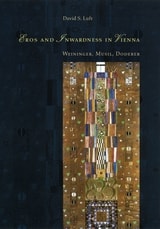
Eros and Inwardness in Vienna
Weininger, Musil, DodererDavid S. Luft
University of Chicago Press, 2003
According to Luft, Otto Weininger viewed human beings as bisexual and applied this theme to issues of creativity and morality. Robert Musil developed a creative ethics that was closely related to his open, flexible view of sexuality and gender. And Heimito von Doderer portrayed his own sexual obsessions as a way of understanding the power of total ideologies, including his own attraction to National Socialism. For Luft, the significance of these three writers lies in their understandings of eros and inwardness and in the roles that both play in ethical experience and the formation of meaningful relations to the world-a process that continues to engage artists, writers, and thinkers today.
Eros and Inwardness in Vienna will profoundly reshape our understanding of Vienna's intellectual history. It will be important for anyone interested in Austrian or German history, literature, or philosophy.
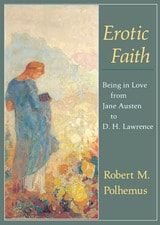
Erotic Faith
Being in Love from Jane Austen to D. H. LawrenceRobert M. Polhemus
University of Chicago Press, 1990
Drawing on a wide range of disciplines, Polhemus shows the reciprocity of love as subject, the novel as form, and faith as motive in important works by Jane Austen, Walter Scott, the Brontës, Dickens, George Eliot, Trollope, Thomas Hardy, Joyce, D. H. Lawrence, Virginia Woolf, and Samuel Beckett. Throughout, Polhemus relates the novelists' representation of love to that of such artists as Botticelli, Vermeer, Claude Lorrain, Redon, and Klimt. Juxtaposing their paintings with nineteenth- and twentieth-century texts both reveals the ways in which novels develop and individualize common erotic and religious themes and illustrates how the novel has influenced our perception of all art.
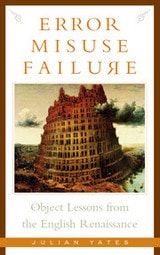
Error, Misuse, Failure
Object Lessons From The English RenaissanceJulian Yates
University of Minnesota Press, 2002

Eschatological Subjects
Divine and Literary Judgment in Fourteenth-Century French PoetryJ. M. Moreau
The Ohio State University Press, 2014
But Eschatological Subjects goes even further to demonstrate the largely unrecognized duality of this judge figure: not just God, the judge is also the imperious and imperfect human reader. The simultaneous divine and human judgments in (and of) French poetry reveal much about the ethical stakes of writing vernacular poetry in the later Middle Ages and, most importantly, about the relationships between authors and audiences.
Focusing on Guillaume de Deguileville, Guillaume de Machaut, and Jean Froissart (each of whom composed scenes in which they appear on trial before God), Moreau contributes important new insights on the complex “trial process” of later medieval literature, in which poetic authority and fame depended on the poet’s ability to defend himself before a fearful court of reader opinion.

Essay on the Origin of Languages and Writings Related to Music
Jean Jacques Rousseau
Dartmouth College Press, 2009
Establishment and Meritocracy
Peter Hennessy
Haus Publishing, 2014
With its penetrating examination of the British school system and postwar trends, Establishment and Meritocracy is an important resource for those concerned about the link between education and later success, both for individuals and their societies.
Ethics and the Dynamic Observer Narrator
Reckoning with Past and Present in German LiteratureKatra A. Byram
The Ohio State University Press, 2015
Ethics and the Dynamic Observer Narrator contributes to scholarship on both narrative theory and the historical and cultural context of German and Austrian literary studies. Narrative theory, according to Byram, should understand this form to register complex interactions between history and narrative form. Byram also juxtaposes new readings of works by Textor, Storm, and Raabe from the nineteenth century with analyses of twentieth-century works by Grass, Handke, and Sebald, ultimately reframing our understanding of literary Vergangenheitsbewältigung, or the struggle to come to terms with the past. Overall, Byram shows that neither the problem of reckoning with the past nor the dynamic observer form is unique to Germany’s post-WWII era. Both are products of the dynamics of modern identity, surfacing whenever critical change separates what was from what is.
Ethics of Life
Contemporary Iberian DebatesKatarzyna Beilin
Vanderbilt University Press, 2016
• What are the different rhetorical strategies employed by writers, artists, filmmakers, and activists to react to the degradation of life and climate change?
• How are urban movements using environmental issues to resist corporate privatization of the commons?
• What is the shape of Spanish debates on reproductive rights and biotechnology?
• What is the symbolic significance of the bullfighting debate and other human/animal issues in today's political turmoil in Spain?
Hispanic Issues Series
Nicholas Spadaccini, Editor-in-Chief
Hispanic Issues Online
hispanicissues.umn.edu/online_main.html
Ethics, Politics and Justice in Dante
Edited by Giulia Gaimari and Catherine Keen
University College London, 2019
Bringing together an international and interdisciplinary group of contributors, ranging across history, philology, classical studies, philosophy, and theology, Ethics, Politics and Justice in Dante presents new research on ethics, politics, and justice in the works of Dante Alighieri, including chapters on Dante’s conception of the afterlife. Contributors scrutinize the Divine Comedy and Dante’s other works in Italian and Latin, showing the evolution of his thought throughout his writing career, with chapters focusing especially on his early philosophical Convivio and on the two “Eclogues” of his final years. Other chapters tackle themes relating to judgment, justice, rhetoric, and literary ethics in the Divine Comedy, as well as the differing public reception and use of Dante’s work in Italy and Britain.
Etymologies and Genealogies
A Literary Anthropology of the French Middle AgesR. Howard Bloch
University of Chicago Press, 1983
"Bloch's Study is a genuinely interdisciplinary one, bringing together elements of history, ethnology, philology, philosophy, economics and literature, with the undoubted ambition of generating a new synthesis which will enable us to read the Middle Ages in a different light.
Stated simply, and in terms which do justice neither to the density nor the subtlety of his argument, Bloch's thesis is this: that medieval society perceived itself in terms of a vertical mode of descent from origins. This model is articulated etymologically in medieval theories of grammar and language, and is consequently reflected in historical and theological writings; it is also latent in the genealogical structure of the aristocratic family as it began to be organized in France in the twelfth century, and is made manifest in such systems of signs as heraldry and the adoption of patronymns. . . .
It is an ingenious and compelling synthesis which no medievalist, even on this side of the Atlantic, can afford to ignore." –Nicholas Mann, Times Literary Supplement
Europe and Its Shadows
Coloniality after EmpireHamid Dabashi
Pluto Press, 2019
Frantz Fanon’s assessment that 'Europe is literally the creation of the Third World' is still true today; but in more than one sense for the colonial has always been embedded in the capital, and the capital within the colonial. As the condition of coloniality shifts, so have the dividing lines between coloniser and colonised, and this shift calls for a reappraisal of our understanding of nationalism, xenophobia and sectarianism as the dangerous indices of the emerging worlds.
As the far-right populists captivate minds across Europe and Brexit upsets the balance of power in the European Union, this book, from a major scholar of postcolonial thought, is a timely and transformative intervention.
European Higher Education, Social Responsibility, and the Local Democratic Mission
Sjur Bergan
Temple University Press, 2025
Bergan outlines the political and institutional complexity of European universities. He explains how history, cultural traditions, and national identities impact education across Europe. He also describes the roles of the Council of Europe and U.S. higher education in the development of a transatlantic cooperation on the democratic mission of higher education. Other chapters explore education programs for developing and maintaining democracy and human rights, pragmatic and creative ways that European universities are working with their local communities, and the development of education opportunities for refugees.
Ultimately, Bergan’s book explores not only the local democratic mission of higher education as it has developed in Europe, but also how it could continue to develop, and why it is important it does so.
In the series Higher Education, Place, and Social Responsibility.

European Others
Queering Ethnicity in Postnational EuropeFatima El-Tayeb
University of Minnesota Press, 2011
European Others offers an interrogation into the position of racialized communities in the European Union, arguing that the tension between a growing nonwhite, non-Christian population and insistent essentialist definitions of Europeanness produces new forms of identity and activism. Moving beyond disciplinary and national limits, Fatima El-Tayeb explores structures of resistance, tracing a Europeanization from below in which migrant and minority communities challenge the ideology of racelessness that places them firmly outside the community of citizens.
Using a notable variety of sources, from drag performances to feminist Muslim activism and Euro hip-hop, El-Tayeb draws on the largely ignored archive of vernacular culture central to resistance by minority youths to the exclusionary nationalism that casts them as threatening outcasts. At the same time, she reveals the continued effect of Europe’s suppressed colonial history on the representation of Muslim minorities as the illiberal Other of progressive Europe.
Presenting a sharp analysis of the challenges facing a united Europe seen by many as a model for twenty-first-century postnational societies, El-Tayeb combines theoretical influences from both sides of the Atlantic to lay bare how Europeans of color are integral to the continent’s past, present, and, inevitably, its future.
Ever Green Is...
Selected ProsePavel Vilikovsky
Northwestern University Press, 2002
Every Intellectual's Big Brother
George Orwell's Literary SiblingsBy John Rodden
University of Texas Press, 2006
George Orwell has been embraced, adopted, and co-opted by everyone from the far left to the neoconservatives. Each succeeding generation of Anglo-American intellectuals has felt compelled to engage the life, work, and cultural afterlife of Orwell, who is considered by many to have been the foremost political writer of the twentieth century. Every Intellectual's Big Brother explores the ways in which numerous disparate groups, Orwell's intellectual "siblings," have adapted their views of Orwell to fit their own agendas and how in doing so they have changed our perceptions of Orwell himself. By examining the politics of literary reception as a dimension of cultural history, John Rodden gives us a better understanding of Orwell's unique and enduring role in Anglo-American intellectual life.
In Part One, Rodden opens the book with a section titled "Their Orwell, Left and Right," which focuses on Orwell's reception by several important literary circles of the latter half of the twentieth century. Beginning with Orwell's own contemporaries, Rodden addresses the ways various intellectual groups of the 1950s responded to Orwell. Rodden then moves on in Part Two to what he calls the "Orwell Confraternity Today," those contemporary intellectuals who have, in various ways, identified themselves with or reacted against Orwell. The author concludes by examining how Orwell's status as an object of admiration and detraction has complicated the way in which he has been perceived by readers since his death.
Everyday English 1500-1700
A ReaderBridget Cusack, Editor
University of Michigan Press, 1998
This unique source book of essential documents designed for courses on Early Modern English is designed as a teaching text with full guidance to each text, including glossary, explanatory and background notes, and suggested topics for linguistic evaluation. Everyday English takes an up-to-the-minute approach by focusing on language as it was used and spoken at the time.
This wide-ranging collection for the first time makes available to students a corpus of examples of the ordinary, nonstandard language of the man and woman in the street, coming from areas as diverse as England, Scotland, and America. The emphasis throughout is on providing as much assistance as possible to the reader to aid understanding and appreciation of both the linguistic features and the everyday lifestyles of the time.
"The only book a really conscientious teacher of the history and structure of Early Modern English would use for source texts." --Roger Lass, University of Cape Town
Bridget Cusack was lecturer in English Language, University of Edinburgh.
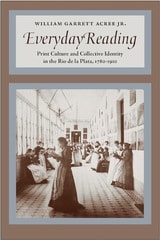
Everyday Reading
Print Culture and Collective Identity in the Rio de la Plata, 1780-1910William Garrett Acree
Vanderbilt University Press, 2011
Starting in the late nineteenth century, the region of South America known as the Rio de la Plata (containing modern-day Uruguay and Argentina) boasted the highest literacy rates in Latin America. In Everyday Reading, William Acree explores the history, events, and culture that gave rise to the region's remarkable progress. With a specific focus on its print culture, in the form of newspapers, political advertisements and documents, schoolbooks, and even stamps and currency, Acree creates a portrait of a literary culture that permeated every aspect of life.
Everyday Reading argues that the introduction of the printing press into the Rio de la Plata in the 1780s hastened the collapse of Spanish imperial control and played a major role in the transition to independence some thirty years later. After independence, print culture nurtured a new identity and helped sustain the region through the tumult of civil war in the mid-1800s. Acree concludes by examining the role of reading in formal education, which had grown exponentially by the early twentieth century as schoolchildren were taught to fulfill traditional roles in society.
Ultimately, Everyday Reading humanizes literary culture, demonstrating its unrecognized and unexpected influence in everyday lives.
Everyone’s Theater
Literature and Daily Life in England, 1860–1914Michael Meeuwis
University of Michigan Press, 2019
Nearly all residents of England and its colonies between 1860 and 1914 were active theatergoers, and many participated in the amateur theatricals that defined late Victorian life. The Victorian theater was not an abstract figuration of the world as a stage, but a media system enmeshed in mass lived experience that fulfilled in actuality the concept of a theatergoing nation. Everyone’s Theater turns to local history, the words of everyday Victorians found in their diaries and production records, to recover this lost chapter of theater history in which amateur drama domesticates the stage. Professional actors and playwrights struggled to make their productions compatible with ideas and techniques that could be safely reproduced in the home—and in amateur performances from Canada to India. This became the first true English national theater: a society whose myriad classes found common ground in theatrical display. Everyone’s Theater provides new ways to extend Victorian literature into the dimension of voice, sound, and embodiment, and to appreciate the pleasures of Victorian theatricality.
Everywhere and Nowhere
Anonymity and Mediation in Eighteenth-Century BritainMark Vareschi
University of Minnesota Press, 2018
A fascinating analysis of anonymous publication centuries before the digital age
Everywhere and Nowhere considers the ubiquity of anonymity and mediation in the publication and circulation of eighteenth-century British literature—before the Romantic creation of the “author”—and what this means for literary criticism. Anonymous authorship was typical of the time, yet literary scholars and historians have been generally unable to account for it as anything more than a footnote or curiosity.
Mark Vareschi shows the entangled relationship between mediation and anonymity, revealing the nonhuman agency of the printed text. Drawing richly on quantitative analysis and robust archival work, Vareschi brings together philosophy, literary theory, and media theory in a trenchant analysis, uncovering a history of textual engagement and interpretation that does not hinge on the known authorial subject.
In discussing anonymous poetry, drama, and the novel along with anonymously published writers such as Daniel Defoe, Frances Burney, and Walter Scott, he unveils a theory of mediation that renews broader questions about agency and intention. Vareschi argues that textual intentionality is a property of nonhuman, material media rather than human subjects alone, allowing the anonymous literature of the eighteenth century to speak to contemporary questions of meaning in the philosophy of language. Vareschi closes by exploring dubious claims about the death of anonymity and the reexplosion of anonymity with the coming of the digital. Ultimately, Everywhere and Nowhere reveals the long history of print anonymity so central to the risks and benefits of the digital culture.
Exemplary Tales of Love and Tales of Disillusion
María de Zayas y Sotomayor
University of Chicago Press, 2009
Exile, Non-Belonging and Statelessness in Grangaud, Jabès, Lubin and Luca
No Man's LanguageGreg Kerr
University College London, 2021
Poetry has often been understood as a powerful vector of collective belonging. The idea that certain poets are emblematic of a national culture is one of the chief means by which literature historicizes itself, inscribes itself in a shared cultural past, and supplies modes of belonging to those who consume it. But, how does the exiled, migrant, or translingual poet complicate this narrative? For Armen Lubin, Ghérasim Luca, Edmond Jabès, and Michelle Grangaud, the practice of poetry is inseparable from a sense of restlessness or unease. Ranging across borders within and beyond the Francosphere—from Algeria, Armenia, Egypt, and Romania—this book shows how a poetic practice inflected by exile, statelessness, or non-belonging has the potential to disrupt long-held assumptions about the relation between subjects, the language they use, and the place from which they speak.

Experiencing the Novel
The Genre of Tender ConscienceEsther Yu
University of Chicago Press, 0
An innovative account of the novel's emergence across revolutionary England and beyond.
Esther Yu’s expansive study of the history of the novel charts the growth of the “tender conscience”—at once a new mode of subjectivity and a shared structure of ethical obligation—that gave rise to the novel’s characteristic features. At the heart of the early English novel is a strange character: a hyperconscious observer who continually transforms perception into ordered, written narrative. Against long-standing accounts that tie the novel’s subjects to the emergence of modern individualism, Experiencing the Novel traces these endlessly impressionable figures to the mid-seventeenth century and the English Revolution, when citizen-subjects made public declarations of tenderness. It is through the recovery of such “tender consciences” that a curious fact can be addressed anew. The first people in Europe to cut off the crown with the head of their king began to tell stories differently: They took to narrating through an acute, sensitive register of first-person prose.
A forceful, community-binding complex of cognition, sensation, and ethics, the tender conscience persisted well into the eighteenth century. It was a large-scale structure forged across decades, one that demands the wide-ranging literary-historical account it finally receives here. Experiencing the Novel opens among brilliantly inventive Tudor-era works—Beware the Cat (ca. 1553), the Marprelate project (1588-89), The Unfortunate Traveler (1594)—that by turns experiment with and reject sensitizing modes of conscience. Yu further takes up an extensive, first-person care of the conscience—a tenderizing process enacted by little-known practitioners that carries from John Milton’s Paradise Lost into the writings of John Locke, the novels of Daniel Defoe, the moral sentimentalism of David Hume and Adam Smith, as well as Laurence Sterne’s Tristram Shandy and Samuel Richardson’s Pamela.
Through its vision of the long seventeenth century, Experiencing the Novel reveals an improbable practice of consciousness that remade popular politics, philosophy, and the culture of sensibility from the margins.
Extreme-Occident
French Intellectuals and AmericaJean-Philippe Mathy
University of Chicago Press, 1993
Western site that gives historical reality to the utopias of the Renaissance and the Enlightenment?
Jean-Philippe Mathy offers the first systematic examination of French texts that address the question of America. He shows how prominent French intellectuals have represented America as myth and metaphor, covering the entire ideological spectrum from Maurras to Duhamel, and from Sartre to Aron. The texts themselves range from novels and poems to travel narratives and philosophical essays by Claudel, Sartre, de Beauvoir, Lyotard, Baudrillard, Kristeva, and many others.
Mathy deftly situates these discourses on America against the background of French intellectual and political history since 1789. The judgments on American culture that originate in France, he contends, are also statements about France itself. Widespread condemnation of American
materialism and pragmatism cuts across deep ideological and political divides in France, primarily because French intellectuals still operate within a framework of critical and aesthetic models born in the late Middle Ages and the Renaissance and elaborated in the age of French classicism.
Mathy engages issues central to interpreting the American experience, such as the current controversies over multiculturalism and Eurocentrism. Although Mathy deals mainly with French authors, he does not limit himself to them. Rather, he uses a comparative, cross-cultural approach that also takes in accounts of America by Nietzsche, Heidegger, Junger, Gramsci, and other Europeans, as well as American self-interpretations from Emerson and Dewey to Cornel West and Christopher Lasch.
Because debates on American modernity have played a crucial intellectual role in France, Extrême-Occident is a major contribution to modern French cultural
history. It will be essential reading for anyone wishing to understand the main currents of twentieth-century French thought.