Results by title
8113 books match the query 'Literary Criticism' and 280 start with e
English Literary Renaissance, volume 53 number 1 (Winter 2023)
The University of Chicago Press
University of Chicago Press Journals, 2023
English Literary Renaissance, volume 53 number 2 (Spring 2023)
The University of Chicago Press
University of Chicago Press Journals, 2023
English Literary Renaissance, volume 53 number 3 (Autumn 2023)
The University of Chicago Press
University of Chicago Press Journals, 2023
English Literary Renaissance, volume 54 number 1 (Winter 2024)
The University of Chicago Press
University of Chicago Press Journals, 2024
English Literary Renaissance, volume 54 number 2 (Spring 2024)
The University of Chicago Press
University of Chicago Press Journals, 2024
English Literary Renaissance, volume 54 number 3 (Autumn 2024)
The University of Chicago Press
University of Chicago Press Journals, 2024
English Literary Renaissance, volume 55 number 1 (Winter 2025)
The University of Chicago Press
University of Chicago Press Journals, 2025
English Literary Renaissance, volume 55 number 2 (Spring 2025)
The University of Chicago Press
University of Chicago Press Journals, 2025
English Literary Renaissance, volume 55 number 3 (Autumn 2025)
The University of Chicago Press
University of Chicago Press Journals, 2025
English Literary Renaissance, volume 56 number 1 (Winter 2026)
The University of Chicago Press
University of Chicago Press Journals, 2026
English Literary Renaissance, volume 56 number 2 (Spring 2026)
The University of Chicago Press
University of Chicago Press Journals, 2026
English Literary Renaissance, volume 56 number 3 (Autumn 2026)
The University of Chicago Press
University of Chicago Press Journals, 2026
English Mercuries
Soldier Poets in the Age of ShakespeareAdam N. McKeown
Vanderbilt University Press, 2009
These misgivings are a powerful undercurrent in much of the literature of the period, even the most ostensibly patriotic works, but it is in the writings on war by soldier poets where they are most clearly pronounced. Fashioning themselves as servants of both Mars and Mercury (the god of war and the god of writing), Elizabethan soldier poets focused their war stories on the gritty realities of military campaigning, the price individuals paid for serving the state, and the difficulties of returning to civilian life. The book reconsiders some familiar writers like John Donne and Ben Jonson in the context of their military experiences and provides comprehensive studies of some important but underappreciated soldier poets like Thomas Churchyard, George Gascoigne, and John Harington.
English Theatrical Anecdotes, 1660-1800
Heather Ladd
University of Delaware Press, 2022
English in Print from Caxton to Shakespeare to Milton
Valerie Hotchkiss and Fred C. Robinson
University of Illinois Press, 2007
Engraven Desire
Eros, Image, and Text in the French Eighteenth CenturyPhilip Stewart
Duke University Press, 1992
Focusing on the objectification of women by the “male gaze,” Stewart analyzes the varous ways in which this masculine power is simultaneously represented and veiled: the fascination with women playing “male” roles, such as soldiers; the preponderance of voyeuristic images of the naked female body; the transformation of male power into hostile forces of nature that render women helpless. Further, Stewart shows how “indecent” engravings that purported to test the limits of eighteenth-century morality often merely reinforced prevailing images of women.
Addressing critical concerns about the societal enforcement of gender roles in literature along with essential questions about the function of illustration, Engraven Desire provides surprising insight into the culturally conditioned act of reading. Stewart’s work, itself richly illustrated with hundreds of arresting reproductions, makes a significant contribution to our understanding of the interplay of art, literature, and society.
Enigmas of Sacrifice
A Critique of Joseph M. Plunkett and the Dublin Insurrection of 1916W. J. Mc Cormack
Michigan State University Press, 2016
Enlightened Individualism
Buddhism and Hinduism in American Literature from the Beats to the PresentKyle Garton-Gundling
The Ohio State University Press, 2019
This “enlightened individualism” uses Buddhist and Hindu philosophy to reframe American freedom in terms of spiritual liberation, and it also reinterprets Asian teachings through Western traditions of political activism and countercultural provocation. Garton-Gundling argues that even though works by Kerouac, Walker, Kingston, and others wrestle with issues of exoticism and appropriation, their characters are also meaningfully challenged and changed by Asian faiths. These literary adaptations, then, can help Americans reenvision individualism in a more transcendent and cosmopolitan context.
Enlightenment Orientalism
Resisting the Rise of the NovelSrinivas Aravamudan
University of Chicago Press, 2011
Srinivas Aravamudan here reveals how Oriental tales, pseudo-ethnographies, sexual fantasies, and political satires took Europe by storm during the eighteenth century. Naming this body of fiction Enlightenment Orientalism, he poses a range of urgent questions that uncovers the interdependence of Oriental tales and domestic fiction, thereby challenging standard scholarly narratives about the rise of the novel.
Enlistment
Lists in Medieval and Early Modern LiteratureEdited by Eva von Contzen and James Simpson
The Ohio State University Press, 2022
Contributors: Suzanne Conklin Akbari, Ingo Berensmeyer, Eva von Contzen, Alex Davis, Andrew James Johnston, Wolfram R. Keller, Alexis Kellner Becker, Kathryn Mogk Wagner, Martha Rust, James Simpson

Enraptured Space
Gender, Class, and Ecology in the Work of Paula MeehanKathryn J. Kirkpatrick
West Virginia University Press, 2025
In Paula Meehan, Kirkpatrick has found a powerful poet to both study and love, and her reading of Meehan’s poetry and prose through the lenses of gender studies, the environmental humanities, and social class offers a passionate endorsement of Meehan’s radical interventions in the canon of Irish poetry. This work explores eight volumes of Meehan’s poetry, including Dharmakaya, Painting Rain, and Geomantic.
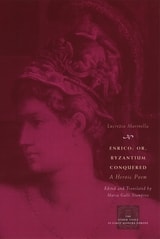
Enrico; or, Byzantium Conquered
A Heroic PoemLucrezia Marinella
University of Chicago Press, 2009
Lucrezia Marinella (1571–1653) is, by all accounts, a phenomenon in early modernity: a woman who wrote and published in many genres, whose fame shone brightly within and outside her native Venice, and whose voice is simultaneously original and reflective of her time and culture. In Enrico; or, Byzantium Conquered, one of the most ambitious and rewarding of her numerous narrative works, Marinella demonstrates her skill as an epic poet.
Now available for the first time in English translation, Enrico retells the story of the conquest of Byzantium in the Fourth Crusade (1202–04). Marinella intersperses historical events in her account of the invasion with numerous invented episodes, drawing on the rich imaginative legacy of the chivalric romance. Fast-moving, colorful, and narrated with the zest that characterizes Marinella’s other works, this poem is a great example of a woman engaging critically with a quintessentially masculine form and subject matter, writing in a genre in which the work of women poets was typically shunned.
Entanglements, or Transmedial Thinking about Capture
Rey Chow
Duke University Press, 2012
These questions are dispersively heterologous yet mutually implicated. This paradoxical character of their discursive relations is what Rey Chow intends with the word "entanglements," by which she means, first, an enmeshment of topics: the mediatized image in modernist reflexivity; captivation and identification; victimhood; the place of East Asia in globalized Western academic study. Beyond enmeshment, she asks, can entanglements be phenomena that are not defined by affinity or proximity? Might entanglements be about partition and disparity rather than about conjunction and similarity?
Across medial forms (including theater, film, narrative, digitization, and photographic art), and against more popular trends of declaring things and people to be in flux, Chow proposes conceptual frames that foreground instead aesthetic, ontological, and sentient experiences of force, dominance, submission, fidelity, antagonism, masochism, letting-go, and the attraction to self-annihilation. Boundary, trap, capture, captivation, sacrifice, and mimesis: these riveting terms serve as analytic pressure points in her readings, articulating perversity, madness, and terror to pursuits of freedom.
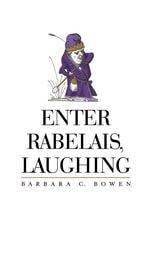
Enter Rabelais, Laughing
Barbara C. Bowen
Vanderbilt University Press, 1998
While most books about Rabelais have relatively little to say about his comedic genius, Enter Rabelais, Laughing analyzes the many sides of Rabelais's humor, focusing on why his writing was so hilariously funny to sixteenth-century readers. The author begins by discussing how the Renaissance defined laughter and situates Rabelais in a long tradition of literary laughter. Subsequent chapters examine specific contexts relevant to Gargantua and Pantagruel, beginning with the comic aspects of epic, chronicle, mock-epic, and farce, and proceeding to Renaissance and Reformation humanist satire, rhetoric, medicine, and law. All of these chapters combine information, much of it new, on the humanist message Rabelais wanted to convey to his readers, with an analysis of how he used his wit to reinforce his message.
Rarely is a writer's work treated in such illuminating detail. On a broad level, Enter Rabelais, Laughing serves as an excellent introduction to French Renaissance literature and exhibits a remarkably charming and lucid writing style, free of jargon. To Rabelais scholars in particular it offers a thorough and innovative analysis that corrects misconceptions and questions commonly held views.
Entitled to the Pedestal
Place, Race, and Progress in White Southern Women’s Writing, 1920–1945Nghana tamu Lewis
University of Iowa Press, 2007
In this searching study, Nghana Lewis offers a close reading of the works and private correspondences, essays, and lectures of five southern white women writers: Julia Peterkin, Gwen Bristow, Caroline Gordon, Willa Cather, and Lillian Smith. At the core of this work is a sophisticated reexamination of the myth of southern white womanhood.
Lewis overturns the conventional argument that white women were passive and pedestal-bound. Instead, she argues that these figures were complicit in the day-to-day dynamics of power and authorship and stood to gain much from these arrangements at the expense of others.
At the same time that her examination of southern mythology explodes received wisdom, it is also a journey of self-discovery. As Lewis writes in her preface, “As a proud daughter of the South, I have always been acutely aware of the region’s rich cultural heritage, folks, and foodstuffs. How could I not be? I was born and reared in Lafayette, Louisiana, where an infant’s first words are not ‘da-da’ and ‘ma-ma’ but ‘crawfish boil’ and ‘fais-do-do.’ . . . I have also always been keenly familiar with its volatile history.” Where these conflicting images—and specifically the role of white southern women as catalysts, vindicators, abettors, and antagonists—meet forms the crux of this study. As such, this study of the South by a daughter of the South offers a distinctive perspective that illuminates the texts in novel and provocative ways.
Entranced Earth
Art, Extractivism, and the End of LandscapeJens Andermann
Northwestern University Press, 2023
A sweeping analysis of the lasting effects of neocolonial extractivism in Latin American aesthetic modernity from 1920 to the present
Looking to the extractive frontier as a focal point of Latin American art, literature, music, and film, Jens Andermann asks what emerges at the other end of landscape. Art in the Global South has long represented and interrogated “insurgent nature”—organic and inorganic matter, human and nonhuman life, thrown into turmoil.
In Entranced Earth: Art, Extractivism, and the End of Landscape, Andermann traces the impact of despaisamiento—world-destroying un-landscaping—throughout the Latin American modernist archive. At the same time, he explores innovative, resilient modes of allyship forged between diverse actors through their shared experiences of destruction. From the literary regionalism of the 1930s to contemporary bio art, from modernist garden architecture to representations of migration and displacement in sound art and film, Entranced Earth tracks the crisis of landscape and environmental exhaustion beyond despair toward speculative, experimental forms of survival.
Enumerations
Data and Literary StudyAndrew Piper
University of Chicago Press, 2018
In Enumerations, Andrew Piper answers that question across a variety of domains fundamental to the study of literature. He focuses on the elementary particles of literature, from the role of punctuation in poetry, the matter of plot in novels, the study of topoi, and the behavior of characters, to the nature of fictional language and the shape of a poet’s career. How does quantity affect our understanding of these categories? What happens when we look at 3,388,230 punctuation marks, 1.4 billion words, or 650,000 fictional characters? Does this change how we think about poetry, the novel, fictionality, character, the commonplace, or the writer’s career? In the course of answering such questions, Piper introduces readers to the analytical building blocks of computational text analysis and brings them to bear on fundamental concerns of literary scholarship. This book will be essential reading for anyone interested in Digital Humanities and the future of literary study.
Environment and Narrative
New Directions in EconarratologyEdited by Erin James and Eric Morel
The Ohio State University Press, 2020
To explore the methodological possibilities within “econarratology,” the contributors evaluate the mechanics of how narratives convey environmental understanding via building blocks such as the organization of time and space, characterization, focalization, description, and narration. They also query how readers emotionally and cognitively engage with such representations and how the process of encountering different environments in narratives stands to affect real-world attitudes and behaviors. By positioning narratives as important repositories of values, political and ethical ideas, and behaviors that determine how we engage with our ecological homes, the authors in this volume suggest that to change the way that we interact with the environment requires not only new stories but also a better understanding of the ones that have long been in circulation.
Environment at the Margins
Literary and Environmental Studies in AfricaByron Caminero-Santangelo
Ohio University Press, 2011
Environment at the Margins brings literary and environmental studies into a robust interdisciplinary dialogue, challenging dominant ideas about nature, conservation, and development in Africa and exploring alternative narratives offered by writers and environmental thinkers. The essays bring together scholarship in geography, anthropology, and environmental history with the study of African and colonial literatures and with literary modes of analysis. Contributors analyze writings by colonial administrators and literary authors, as well as by such prominent African activists and writers as Ngugi wa Thiong’o, Mia Couto, Nadine Gordimer, Wangari Maathai, J. M. Coetzee, Zakes Mda, and Ben Okri. These postcolonial ecocritical readings focus on dialogue not only among disciplines but also among different visions of African environments. In the process, Environment at the Margins posits the possibility of an ecocriticism that will challenge and move beyond marginalizing, limiting visions of an imaginary Africa.
Contributors:
Jane Carruthers
Mara Goldman
Amanda Hammar
Jonathan Highfield
David McDermott Hughes
Roderick P. Neumann
Rob Nixon
Anthony Vital
Laura Wright
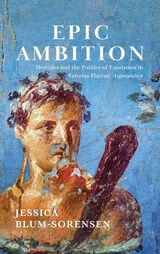
Epic Ambition
Hercules and the Politics of Emulation in Valerius Flaccus' ArgonauticaJessica Blum-Sorensen
University of Wisconsin Press, 2023
Focusing especially on Hercules, Blum-Sorensen explores how Valerius’ characters—and, by extension, their Roman audience—misinterpret exemplars of past achievement, or apply them to sad effect in changed circumstances. By reading such models as normative guides to epic triumph, Valerius’ Argonauts find themselves enacting tragic outcomes: effectively, the characters impose their nostalgic longing for epic triumph on the events before them, even as Valerius and his audience anticipate the tragedy awaiting his heroes. Valerius thus questions Rome’s reliance on the past as a guide to the present, allowing for doubt about the empire’s success under the new Flavian regime. It is the literary tradition’s exchange between triumphant epic and tragedy that makes the Argo’s voyage a perfect vehicle for Valerius’ exploration: the tensions between genres both raise and prohibit resolution of anxieties about how the new age—mythological or real—will turn out.
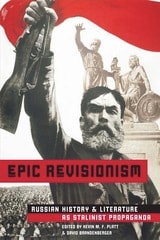
Epic Revisionism
Russian History and Literature as Stalinist PropagandaEdited by Kevin M. F. Platt and David Brandenberger
University of Wisconsin Press, 2006
Focusing on a number of historical and literary personalities who were regarded with disdain in the aftermath of the 1917 revolution—figures such as Peter the Great, Ivan the Terrible, Alexander Pushkin, Leo Tolstoy, and Mikhail Lermontov—Epic Revisionism tells the fascinating story of these individuals’ return to canonical status during the darkest days of the Stalin era.
An inherently interdisciplinary project, Epic Revisionism features pieces on literary and cultural history, film, opera, and theater. This volume pairs scholarly essays with selections drawn from Stalin-era primary sources—newspaper articles, unpublished archival documents, short stories—to provide students and specialists with the richest possible understanding of this understudied phenomenon in modern Russian history.“These scholars shed a great deal of light not only on Stalinist culture but on the politics of cultural production under the Soviet system.”—David L. Hoffmann, Slavic Review
Epic and Exile
Novels of the German Popular Front, 1933-1945Hunter Bivens
Northwestern University Press, 2015
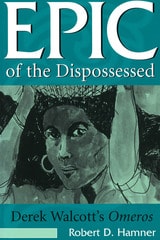
Epic of the Dispossessed
Derek Walcott's OmerosRobert D. Hamner
University of Missouri Press, 1997
In Epic of the Dispossessed, Robert D. Hamner offers an insightful, well-researched analysis of Omeros, the masterful epic poem by 1992 Nobel Laureate Derek Walcott. Rich and various, Omeros is an innovative extension of the epic tradition. Despite Walcott's insistence that he violates the formulaþhe notes his autobiographical presence in the poem and the absence of classical heroic figures and epic battlesþthe poem incorporates fragments of all the definitive characteristics of the genre. Hamner establishes that through its self-reflexive textuality, Omeros complements the time-honored tradition of the epic by giving voice to the marginalized peoples of the New World.
Hamner briefly explains his perception of the epic tradition and its viability in contemporary literature. He examines Walcott's writing career and traces his development of devices, themes, techniques, and a narrative style essential to epic poetry. Although Walcott could not have fully anticipated Omeros, a retrospective view of his writing reveals the consistent accumulation of the skills and broad scope required for such an undertaking. Hamner attempts also to show that Walcott has incorporated into his personal style not only the more obvious aspects of his formal education but also uniquely West Indian cultural material and forms of expression.
Hamner describes Omeros as an epic of the dispossessed because each of its protagonists is a castaway in one sense or another. Regardless of whether their ancestry is traced to the classical Mediterranean, Europe, Africa, or confined to the Americas, they are transplanted individuals whose separate quests all center on the fundamental human need to strike roots in a place where one belongs.
Walcott's vivid, lyrical verse is visually compelling and aurally appealing. He is, however, a richly complex, allusive writer dealing with a wide range of profound human problems. Given the exciting climate of postcolonial and postmodern criticism, Walcott offers students and scholars unparalleled opportunities for challenging, creatively interpretive insights. Epic of the Dispossessed will be a valuable companion to the work that may prove to be Walcott's crowning achievement. The fresh and original Omeros stands on its own merits; nevertheless, it deserves to be examined in light of both Western tradition and its Caribbean context.
Epideictic Rhetoric
Questioning the Stakes of Ancient PraiseBy Laurent Pernot
University of Texas Press, 2015
Speeches of praise and blame constituted a form of oratory put to brilliant and creative use in the classical Greek period (fifth to fourth century BC) and the Roman imperial period (first to fourth century AD), and they have influenced public speakers through all the succeeding ages. Yet unlike the other classical genres of rhetoric, epideictic rhetoric remains something of a mystery. It was the least important genre at the start of Greek oratory, but its role grew exponentially in subsequent periods, even though epideictic orations were not meant to elicit any action on the part of the listener, as judicial and deliberative speeches attempted to do. So why did the ancients value the oratory of praise so highly?
In Epideictic Rhetoric, Laurent Pernot offers an authoritative overview of the genre that surveys its history in ancient Greece and Rome, its technical aspects, and its social function. He begins by defining epideictic rhetoric and tracing its evolution from its first realizations in classical Greece to its eloquent triumph in the Greco-Roman world. No longer were speeches limited to tribunals, assemblies, and courts—they now involved ceremonies as well, which changed the political and social implications of public speaking. Pernot analyzes the techniques of praise, both as stipulated by theoreticians and as practiced by orators. He describes how epideictic rhetoric functioned to give shape to the representations and common beliefs of a group, render explicit and justify accepted values, and offer lessons on new values. Finally, Pernot incorporates current research about rhetoric into the analysis of praise.
Epidemic Empire
Colonialism, Contagion, and Terror, 1817–2020Anjuli Fatima Raza Kolb
University of Chicago Press, 2021
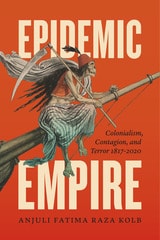
Terrorism is a cancer, an infection, an epidemic, a plague. For more than a century, this metaphor has figured insurgent violence as contagion in order to contain its political energies. In Epidemic Empire, Anjuli Fatima Raza Kolb shows that this trope began in responses to the Indian Mutiny of 1857 and tracks its tenacious hold through 9/11 and beyond. The result is the first book-length study to approach the global War on Terror from a postcolonial literary perspective.
Raza Kolb assembles a diverse archive from colonial India, imperial Britain, French and independent Algeria, the postcolonial Islamic diaspora, and the neoimperial United States. Anchoring her book are studies of four major writers in the colonial-postcolonial canon: Rudyard Kipling, Bram Stoker, Albert Camus, and Salman Rushdie. Across these sources, she reveals the tendency to imagine anticolonial rebellion, and Muslim insurgency specifically, as a virulent form of social contagion. Exposing the long history of this broken but persistent narrative, Epidemic Empire is a major contribution to the rhetorical history of our present moment.
Epistolary Responses
The Letter in Twentieth-Century American Fiction and CriticismAnne Bower
University of Alabama Press, 1996
Epistolary Responses explores the transformative nature of epistolary fiction and criticism in letter form from a largely feminist perspective. While most scholarly work to date has focused on 17th- and 18th-century manifestations of this genre, Bower's study concentrates on epistolary fiction by contemporary American writers published between 1912 and 1988. The novels discussed, all featuring women letter writers, include: Lee Smith's Fair and Tender Ladies, John Barth's LETTERS, Alice Walker's The Color Purple, John Updike's S., Jean Webster's Daddy-Long-Legs, Upton Sinclair's Another Pamela, and Ana Castillo's The Mixquiahuala Letters.
Bower explores the influence letters have on the act of writing and writing as act, their encoded desire for reply, their incompleteness as units of narrative information, their play on ideas of absence and presence, their apparently personal and private nature, and their foregrounding of the writer's agency and authority, all of which make letters a most useful genre both for novelists and for scholars. Several of the book's "fiction" chapters include a letter from the author of the text (sometimes a critic) that complements and supplements Bower's analysis. The final part of the book explores how seven scholars--men and women--have applied letters to their own critical writing, finding that this formal move allows them to question issues of public and private discourse, the authority of signature, and the "feminine" location.
Equal To The Occasion
Women Editors On The Nineteenth-Century WestSherilyn Cox Bennion
University of Nevada Press, 1990
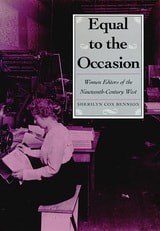
Bennion provides in-depth portraits of nineteenth-century women editors of the West and their diverse publications. The book's title takes its name from an 1898 editorial in the Wasatch Wave which described Piute Pioneer editor Candace Alice De Witt as a "maiden fair, fully equal to the occasion."Equal to the Occasion delves into the lives, publications, and historical contexts in which approximately thirty-five female editors of newspapers and other periodicals worked in the nineteenth-century West. The book covers the period from 1854, when the West's first woman editor began her work, through the turn of the century; it includes research gathered from thirteen western states. With its in-depth portraits of pioneering women editors and its appendix listing more than two hundred women and the major repositories where their extant publications are kept, Equal to the Occasion rescues from obscurity a whole panoply of nineteenth-century western women.
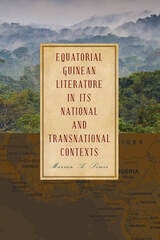
Equatorial Guinean Literature in its National and Transnational Contexts
Marvin A. Lewis
University of Missouri Press, 2017
Equatorial Guinea, a former Spanish colony, is the only African country in which Spanish is an official language and which has a tradition of literature in Spanish. This is a study of the literature produced by the nation’s writers from 2007 to 2013. Since its independence in 1968, Equatorial Guinea has been ruled by dictators under whom ethnic differences have been exacerbated, poverty and violence have increased, and critical voices have been silenced. The result has been an exodus of intellectuals—including writers who express their national and exile experiences in their poems, plays, short stories, and novels. The writers discussed include Juan Tomás Ávila Laurel, Donato Ndongo-Bidyogo, and Guillermina Mekuy, among others.
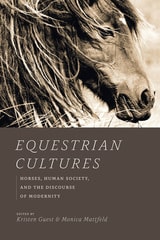
Equestrian Cultures
Horses, Human Society, and the Discourse of ModernityEdited by Kristen Guest and Monica Mattfeld
University of Chicago Press, 2019
Kristen Guest and Monica Mattfeld place the modern period front and center in this collection, illuminating the largely untold story of how the horse has responded to the accelerated pace of modernity. The book’s contributors explore equine cultures across the globe, drawing from numerous interdisciplinary sources to show how horses have unexpectedly influenced such distinctively modern fields as photography, anthropology, and feminist theory. Equestrian Cultures boldly steps forward to redefine our view of the most recent developments in our long history of equine partnership and sets the course for future examinations of this still-strong bond.
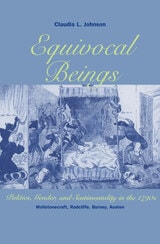
Equivocal Beings
Politics, Gender, and Sentimentality in the 1790s--Wollstonecraft, Radcliffe, Burney, AustenClaudia L. Johnson
University of Chicago Press, 1995
Demonstrating the interrelationships among politics, gender, and feeling in the fiction of this period, Johnson provides detailed readings of Wollstonecraft, Radcliffe, and Burney, and treats the qualities that were once thought to mar their work—grotesqueness, strain, and excess—as indices of ideological conflict and as strategies of representation during a period of profound political conflict. She maintains that the reactionary reassertion of male sentimentality as a political duty displaced customary gender roles, rendering women, in Wollstonecraft's words, "equivocal beings."
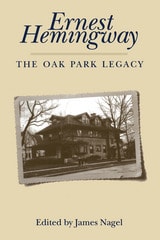
Ernest Hemingway
The Oak Park LegacyJames Nagel
University of Alabama Press, 1996
Ernest Hemingway: The Oak Park Legacy is the first extensive examination of the relationship of Hemingway to his hometown, Oak Park, Illinois, and the influence its people, places, and underlying values had on his early work. In this volume, 11 leading Hemingway scholars explore various aspects of these issues, from the migration of the Hemingway family from Connecticut to Illinois in the 1850s, to Hemingway's high-school stories and the dramatic breakthrough of In Our Time and The Sun Also Rises. With these books, Hemingway suddenly became one of the most influential writers of the 20th century. The essays in this collection explore the social and family background that provided the material and sensibility for these literary masterpieces.
In these essays, James Nagel provides the first account ever published of the move of the Hemingway family from Connecticut to Illinois. Writing his account after the discovery of a lost diary by one of Hemingway's ancestors, Nagel explores dates and places, the motivation for the move to the Midwest, and the tragedies that awaited the family there, including the death of two young men in the Civil War. Michael Reynolds, the premiere biographer of Ernest Hemingway, describes the culture of the village of Oak Park at the turn of the century, and Larry E. Grimes presents an important new assessment of the religious training the Hemingway children received. David Marut discusses the short stories Hemingway published while still a highschool student, and Carlos Azevedo, Mary Anne O'Neal, Abby H. P. Werlock, and George Monteiro examine the early stories about Nick Adams. In an insightful afterword, Morris Buske, the Historian of the Ernest Hemingway Foundation of Oak Park, reflects on the differing values of Ernest Hemingway's parents, the artistic, cultured Hall family as opposed to the scientific, more practical Hemingways, charting the influence the two traditions had on the young Ernest.
Ernest Hemingway
Thought in ActionMark Cirino
University of Wisconsin Press, 2012
In Cirino’s analysis of Hemingway’s work through this lens—including such celebrated classics as A Farewell to Arms, The Old Man and the Sea, and “Big Two-Hearted River” and less-appreciated works including Islands in the Stream and “Because I Think Deeper”—an entirely different Hemingway hero emerges: intelligent, introspective, and ruminative.
Eros and Inwardness in Vienna
Weininger, Musil, DodererDavid S. Luft
University of Chicago Press, 2003
According to Luft, Otto Weininger viewed human beings as bisexual and applied this theme to issues of creativity and morality. Robert Musil developed a creative ethics that was closely related to his open, flexible view of sexuality and gender. And Heimito von Doderer portrayed his own sexual obsessions as a way of understanding the power of total ideologies, including his own attraction to National Socialism. For Luft, the significance of these three writers lies in their understandings of eros and inwardness and in the roles that both play in ethical experience and the formation of meaningful relations to the world-a process that continues to engage artists, writers, and thinkers today.
Eros and Inwardness in Vienna will profoundly reshape our understanding of Vienna's intellectual history. It will be important for anyone interested in Austrian or German history, literature, or philosophy.
Erosion
American Environments and the Anxiety of DisappearanceGina Caison
Duke University Press, 2024
Erotic Faith
Being in Love from Jane Austen to D. H. LawrenceRobert M. Polhemus
University of Chicago Press, 1990
Drawing on a wide range of disciplines, Polhemus shows the reciprocity of love as subject, the novel as form, and faith as motive in important works by Jane Austen, Walter Scott, the Brontës, Dickens, George Eliot, Trollope, Thomas Hardy, Joyce, D. H. Lawrence, Virginia Woolf, and Samuel Beckett. Throughout, Polhemus relates the novelists' representation of love to that of such artists as Botticelli, Vermeer, Claude Lorrain, Redon, and Klimt. Juxtaposing their paintings with nineteenth- and twentieth-century texts both reveals the ways in which novels develop and individualize common erotic and religious themes and illustrates how the novel has influenced our perception of all art.
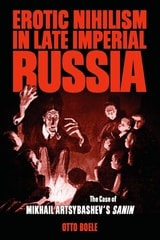
Erotic Nihilism in Late Imperial Russia
The Case of Mikhail Artsybashev's SaninOtto Boele
University of Wisconsin Press, 2009
Who were the Saninists, and what was their “teaching” all about? Delving into police reports, newspaper clippings, and amateur plays, Otto Boele finds that Russian youth were not at all swept away by the self-indulgent lifestyle of the novel’s hero. In fact, Saninism was more smoke than fire—a figment of the public imagination triggered by anxieties about the revolution of 1905 and the twilight of the Russian empire. The reception of the novel, Boele shows, reflected much deeper worries caused by economic reforms, an increase in social mobility, and changing attitudes toward sexuality.
Showing how literary criticism interacts with the age-old medium of rumor, Erotic Nihilism in Late Imperial Russia offers a meticulous analysis of the scandal’s coverage in the provincial press and the reactions of young people who appealed to their peers to resist the novel’s nihilistic message. By examining the complex dialogue between readers and writers, children and parents, this study provides fascinating insights into Russian culture on the eve of World War I.
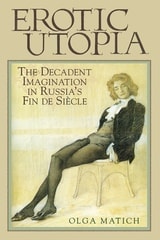
Erotic Utopia
The Decadent Imagination in Russia's Fin de SiecleOlga Matich
University of Wisconsin Press, 2007
The first generation of Russian modernists experienced a profound sense of anxiety resulting from the belief that they were living in an age of decline. What made them unique was their utopian prescription for overcoming the inevitability of decline and death both by metaphysical and physical means. They intertwined their mystical erotic discourse with European degeneration theory and its obsession with the destabilization of gender. In Erotic Utopia, Olga Matich suggests that same-sex desire underlay their most radical utopian proposal of abolishing the traditional procreative family in favor of erotically induced abstinence.
“Offers a fresh perspective and a wealth of new information on early Russian modernism. . . . It is required reading for anyone interested in fin-de-siècle Russia and in the history of sexuality in general.”—Bernice Glatzer Rosenthal, Slavic and East European Journal
“Thoroughly entertaining.”—Avril Pyman, Slavic Review
Erotics of Sovereignty
Queer Native Writing in the Era of Self-DeterminationMark Rifkin
University of Minnesota Press, 2012
In 1970 the Nixon administration inaugurated a new era in federal Indian policy. No more would the U.S. government seek to deny and displace Native peoples or dismantle Native governments; from now on federal policy would promote “the Indian’s sense of autonomy without threatening his sense of community.”
In The Erotics of Sovereignty, Mark Rifkin offers a telling perspective on what such a policy of self-determination has meant and looks at how contemporary queer Native writers use representations of sensation to challenge official U.S. accounts of Native identity. Rifkin focuses on four Native writers—Qwo-Li Driskill (Cherokee), Deborah Miranda (Esselen), Greg Sarris (Graton Rachería), and Chrystos (Menominee)—approaching their fiction and poetry as forms of political theory.
Rifkin shows how the work of these queer or two-spirit Native writers affirms the significance of the erotic as an exercise of individual and community sovereignty. In this way, we come to see how their work contests the homophobic, sexist, and exclusivist policies and attitudes of tribal communities as well as those of the nation-state.
Erotikon
Essays on Eros, Ancient and ModernEdited by Shadi Bartsch and Thomas Bartscherer
University of Chicago Press, 2005
An idea charged with paradox, eros has always defied categorization, and yet it cannot—it will not—be ignored. Erotikon aims to raise the difficult question of what, if anything, unifies the erotic manifold. How is eros in a sculpture like eros in a poem? Does the ancient story of Cupid and Psyche still speak meaningfully to modern readers, and if so, why? Is Plato's eros the same as Freud's? Or Proust's? And what is the erotic dimension in Nietzsche's thought? While each essay takes on a specific issue, together they constitute a wide-ranging conversation in which these broader questions are at play. A compilation of the latest, best efforts to reckon with eros, Erotikon will appeal not just to scholars and educators, but also to artists and critics, to the curious and the disillusioned, to the prurient and the prudent.
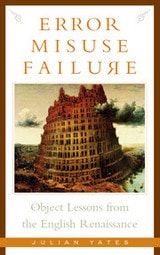
Error, Misuse, Failure
Object Lessons From The English RenaissanceJulian Yates
University of Minnesota Press, 2002