Results by title
22279 books match the query 'Social Science' and 684 start with e
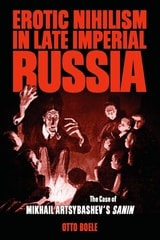
Erotic Nihilism in Late Imperial Russia
The Case of Mikhail Artsybashev's SaninOtto Boele
University of Wisconsin Press, 2009
Who were the Saninists, and what was their “teaching” all about? Delving into police reports, newspaper clippings, and amateur plays, Otto Boele finds that Russian youth were not at all swept away by the self-indulgent lifestyle of the novel’s hero. In fact, Saninism was more smoke than fire—a figment of the public imagination triggered by anxieties about the revolution of 1905 and the twilight of the Russian empire. The reception of the novel, Boele shows, reflected much deeper worries caused by economic reforms, an increase in social mobility, and changing attitudes toward sexuality.
Showing how literary criticism interacts with the age-old medium of rumor, Erotic Nihilism in Late Imperial Russia offers a meticulous analysis of the scandal’s coverage in the provincial press and the reactions of young people who appealed to their peers to resist the novel’s nihilistic message. By examining the complex dialogue between readers and writers, children and parents, this study provides fascinating insights into Russian culture on the eve of World War I.
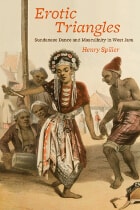
Erotic Triangles
Sundanese Dance and Masculinity in West JavaHenry Spiller
University of Chicago Press, 2010
In West Java, Indonesia, all it takes is a woman’s voice and a drum beat to make a man get up and dance. Every day, men there—be they students, pedicab drivers, civil servants, or businessmen—breach ordinary standards of decorum and succumb to the rhythm at village ceremonies, weddings, political rallies, and nightclubs. The music the men dance to varies from traditional gong ensembles to the contemporary pop known as dangdut, but they consistently dance with great enthusiasm. In Erotic Triangles, Henry Spiller draws on decades of ethnographic research to explore the reasons behind this phenomenon, arguing that Sundanese men use dance to explore and enact contradictions in their gender identities.
Framing the three crucial elements of Sundanese dance—the female entertainer, the drumming, and men’s sense of freedom—as a triangle, Spiller connects them to a range of other theoretical perspectives, drawing on thinkers from Eve Kosofsky Sedgwick, Lévi-Strauss, and Freud to Euclid. By granting men permission to literally perform their masculinity, Spiller ultimately concludes, dance provides a crucial space for both reinforcing and resisting orthodox gender ideologies.

Erotic Utopia
The Decadent Imagination in Russia's Fin de SiecleOlga Matich
University of Wisconsin Press, 2007
The first generation of Russian modernists experienced a profound sense of anxiety resulting from the belief that they were living in an age of decline. What made them unique was their utopian prescription for overcoming the inevitability of decline and death both by metaphysical and physical means. They intertwined their mystical erotic discourse with European degeneration theory and its obsession with the destabilization of gender. In Erotic Utopia, Olga Matich suggests that same-sex desire underlay their most radical utopian proposal of abolishing the traditional procreative family in favor of erotically induced abstinence.
“Offers a fresh perspective and a wealth of new information on early Russian modernism. . . . It is required reading for anyone interested in fin-de-siècle Russia and in the history of sexuality in general.”—Bernice Glatzer Rosenthal, Slavic and East European Journal
“Thoroughly entertaining.”—Avril Pyman, Slavic Review
Erotics of Sovereignty
Queer Native Writing in the Era of Self-DeterminationMark Rifkin
University of Minnesota Press, 2012
In 1970 the Nixon administration inaugurated a new era in federal Indian policy. No more would the U.S. government seek to deny and displace Native peoples or dismantle Native governments; from now on federal policy would promote “the Indian’s sense of autonomy without threatening his sense of community.”
In The Erotics of Sovereignty, Mark Rifkin offers a telling perspective on what such a policy of self-determination has meant and looks at how contemporary queer Native writers use representations of sensation to challenge official U.S. accounts of Native identity. Rifkin focuses on four Native writers—Qwo-Li Driskill (Cherokee), Deborah Miranda (Esselen), Greg Sarris (Graton Rachería), and Chrystos (Menominee)—approaching their fiction and poetry as forms of political theory.
Rifkin shows how the work of these queer or two-spirit Native writers affirms the significance of the erotic as an exercise of individual and community sovereignty. In this way, we come to see how their work contests the homophobic, sexist, and exclusivist policies and attitudes of tribal communities as well as those of the nation-state.
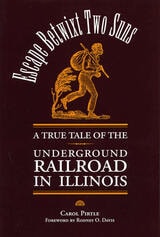
Escape Betwixt Two Suns
A True Tale of the Underground Railroad in IllinoisCarol Pirtle. Foreword by Rodney O. Davis
Southern Illinois University Press, 2000
Although the northern Illinois chapters of the story of Susan “Sukey” Richardson’s escape from slavery on the Underground Railroad are documented, the part played by southern Illinois in that historic episode has remained obscure. Carol Pirtle changes that with her investigation into the 1843 suit Andrew Borders lodged against William Hayes, charging his neighbor with helping slaves from the Borders estate escape to Galesburg. In conjunction with her probe into the past, Pirtle also discovered the Hayes correspondence.
Pirtle documents Hayes’s involvement in the Illinois Underground Railroad through approximately two hundred letters received by Hayes from the early 1820s until his death in 1849. Many of these letters specifically corroborate his participation in the escape of slaves from the Borders estate. One such letter came from T. A. Jones in 1843: “You Dear Sir are to me an unknown friend, yet I believe you are a friend to the poor down trodden Slave. This is as good an introduction as I want from any man. My brother, our cause is a holy one.” Letters written by Galesburg residents show that several prominent citizens of that community also assisted in the affair, proving that Knox College administrators and trustees were active in the Underground Railroad.
Pirtle also includes excerpts from the trial transcript from the 1844 civil case against Hayes, which was tried in Pinckneyville, Illinois. She researched newspaper accounts of the event, most notably those in the Western Citizen and the Sparta Herald. Records of the Covenanter Presbyterian church of which Hayes was a member provide partial explanations of Hayes’s motives.
Telling the story of Hayes and his involvement with Susan Richardson and the Underground Railroad, Pirtle provides insight into the work of abolitionists in Illinois. Escape Betwixt Two Suns, in fact, is one of the few books to substantiate the legends of the Underground Railroad. She tells the story of a quiet man who made a difference, of a man deserving the accolades of a hero.

Escape Routes
Control and Subversion in the Twenty-First CenturyDimitris Papadopoulos, Niamh Stephenson, and Vassilis Tsianos
Pluto Press, 2008
Illegal migrants who evade detection, creators of value in insecure and precarious working conditions and those who refuse the constraints of sexual and biomedical classifications: these are the people who manage to subvert power and to craft unexpected sociabilities and experiences. Escape Routes shows how people can escape control and create social change by becoming imperceptible to the political system of Global North Atlantic societies.

Escape Via Berlin
Eluding Franco In Hitler's EuropeJose Antonio Aguirre
University of Nevada Press, 1991

Escape from New York
The New Negro Renaissance beyond HarlemDavarian L. Baldwin
University of Minnesota Press, 2013
In the midst of vast cultural and political shifts in the early twentieth century, politicians and cultural observers variously hailed and decried the rise of the “New Negro.” This phenomenon was most clearly manifest in the United States through the outpouring of Black arts and letters and social commentary known as the Harlem Renaissance. What is less known is how far afield of Harlem that renaissance flourished—how much the New Negro movement was actually just one part of a collective explosion of political protest, cultural expression, and intellectual debate all over the world.
In this volume, the Harlem Renaissance “escapes from New York” into its proper global context. These essays recover the broader New Negro experience as social movements, popular cultures, and public behavior spanned the globe from New York to New Orleans, from Paris to the Philippines and beyond. Escape from New York does not so much map the many sites of this early twentieth-century Black internationalism as it draws attention to how New Negroes and their global allies already lived. Resituating the Harlem Renaissance, the book stresses the need for scholarship to catch up with the historical reality of the New Negro experience. This more comprehensive vision serves as a lens through which to better understand capitalist developments, imperial expansions, and the formation of brave new worlds in the early twentieth century.
Contributors: Anastasia Curwood, Vanderbilt U; Frank A. Guridy, U of Texas at Austin; Claudrena Harold, U of Virginia; Jeannette Eileen Jones, U of Nebraska–Lincoln; Andrew W. Kahrl, Marquette U; Shannon King, College of Wooster; Charlie Lester; Thabiti Lewis, Washington State U, Vancouver; Treva Lindsey, U of Missouri–Columbia; David Luis-Brown, Claremont Graduate U; Emily Lutenski, Saint Louis U; Mark Anthony Neal, Duke U; Yuichiro Onishi, U of Minnesota, Twin Cities; Theresa Runstedtler, U at Buffalo (SUNY); T. Denean Sharpley-Whiting, Vanderbilt U; Michelle Stephens, Rutgers U, New Brunswick; Jennifer M. Wilks, U of Texas at Austin; Chad Williams, Brandeis U.
Escape to Manila
From Nazi Tyranny to Japanese TerrorFrank Ephraim. Foreword by Stanley A. Karnow
University of Illinois Press, 2002
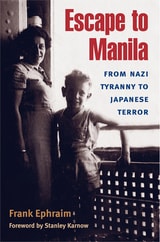
A harrowing account of Jewish refugees in the Philippines
With the rise of Nazism in the 1930s more than a thousand European Jews sought refuge in the Philippines, joining the small Jewish population of Manila. When the Japanese invaded the islands in 1941, the peaceful existence of the barely settled Jews filled with the kinds of uncertainties and oppression they thought they had left behind.
In this book Frank Ephraim, who fled to Manila with his parents, gathers the testimonies of thirty-six refugees, who describe the difficult journey to Manila, the lives they built there upon their arrival, and the events surrounding the Japanese invasion. Combining these accounts with historical and archival records, Manila newspapers, and U.S. government documents, Ephraim constructs a detailed account of this little-known chapter of world history.

Eskimo Essays
Yup'ik Lives and How We See ThemAnn Fienup-Riordan
Rutgers University Press, 1991
Eskimo Essays introduces the reader to important aspects of the ideology and practice of the Yup’ik Eskimos of western Alaska, past and present. The essays point the way toward a fuller recognition of how Yup’ik Eskimos differ from the popular Western image of the Eskimo that was born largely without reference to Yup’ik reality. By describing the reality of Yup’ik life, Eskimo Essays extends our understanding of Esimos in general and Yup’ik Eskimos in particular.
Ann Fienup-Riordan argues that Western observers have simultaneously naturalized Eskimos as paragons of simplicity and virtue and Western imperialism. This process has often ignored Eskimo concepts of society, history, and personhood. An original assumption of similarity to Western society has profoundly affected the current Euro-American view of Eskimo history and action. Non-natives have taken an idealized Western individual, dressed that person up in polar garb, and then assumed they understood the garment’s maker. The result is a presentation of Eskimo society that often tells us more about the meaning we seek in our own. Moreover, modern Eskimos have risen to the challenge and to some extent become what we have made them.
Bridging the gap between informed scholarships and popular concepts, Fienup-Riordan provides a compelling and fresh presentation of Yup’ik life—cosmology, the missionary experience, attitudes toward conservation, Eskimo art, the legal system, warfare, and ceremonies.
Eskimo Storyteller
Folktales from Noatak, Alaska New EditionEdwin Hall
University of Alaska Press, 1999

Espíritu Santo de Zúñiga
A Frontier Mission in South TexasBy Tamra Lynn Walter
University of Texas Press, 2007
San Antonio Conservation Society Citation, 2009
In the early part of the eighteenth century, the Spanish colonial mission Espíritu Santo de Zúñiga was relocated from far south Texas to a site along the Guadalupe River in Mission Valley, Victoria County. This mission, along with a handful of others in south Texas, was established by the Spaniards in an effort to Christianize and civilize the local Native American tribes in the hopes that they would become loyal Spanish citizens who would protect this new frontier from foreign incursions.
With written historical records scarce for Espíritu Santo, Tamra Walter relies heavily on material culture recovered at this site through a series of recent archaeological investigations to present a compelling portrait of the Franciscan mission system. By examining findings from the entire mission site, including the compound, irrigation system, quarry, and kiln, she focuses on questions that are rarely, if ever, answered through historical records alone: What was daily life at the mission like? What effect did the mission routine have on the traditional lifeways of the mission Indians? How were both the Indians and the colonizers changed by their frontier experiences, and what does this say about the missionization process?
Walter goes beyond simple descriptions of artifacts and mission architecture to address the role these elements played in the lives of the mission residents, demonstrating how archaeology is able to address issues that are not typically addressed by historians. In doing so, she presents an accurate portrait of life in South Texas at this time. This study of Mission Espíritu Santo will serve as a model for research at similar early colonial sites in Texas and elsewhere.
Essays of the Sadat Era
The Non-Fiction of Naguib Mahfouz: Volume IINaguib Mahfouz
Gingko, 2025
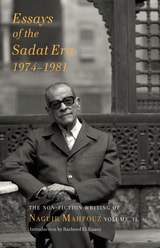
In these essays of the Sadat era, published in the state-owned Al-Ahram newspaper, Mahfouz seems an unreliable narrator. The tension between an author who rails against censorship, yet is bound within its confines, runs through this fascinating body of nonfiction writing. Nonetheless, Mahfouz’s own thoughts are unmistakably present. We gain his insight into diverse political topics, such as socioeconomic class, democracy and dictatorship, and Islam and extremism, topics which still seem highly pertinent to the situation in Egypt today.
A vital accompaniment to his literature, this collected work is contemporaneous with Mahfouz’s fictional works such as Karnak Café, The Harafish, and Arabian Nights and Days. Essays of the Sadat Era is the second of four volumes in which Mahfouz’s nonfiction work is translated into English for the first time.
Essays on Archaeological Methods
Edited by James B. Griffin
University of Michigan Press, 1951
Essays on Individualism
Modern Ideology in Anthropological PerspectiveLouis Dumont
University of Chicago Press, 1986
Essays on Sex Equality
John Stuart Mill and Harriet Taylor Mill
University of Chicago Press, 1970
Also contained in this volume is a major interpretative essay by Alice S. Rossi on Mill and Harriet Taylor which describes and analyzes their long personal and intellectual relationship.

Essays on Some Maladies of Angola (1799)
José Pinto De Azeredo
Tagus Press, 2016
This first English-language edition of Essays on Some Maladies of Angola was translated by Stewart Lloyd-Jones (University of Stirling) and includes scholarly essays by Timothy Walker (University of Massachusetts Dartmouth), Adelino Cardoso (Universidade Nova de Lisboa), António Braz de Oliveira (Biblioteca Nacional de Portugal) and Manuel Silvério Marques (Universidade de Lisboa).
Essays on the Modern Japanese Church
Christianity in Meiji JapanYamaji Aizan; Translated by Graham Squires, with Introductory Essays by Graham Squires and A. Hamish Ion
University of Michigan Press, 2000

Essential Essays (Two-volume set)
Foundations of Cultural Studies & Identity and DiasporaStuart Hall
Duke University Press, 2018
From his arrival in Britain in the 1950s and involvement in the New Left, to founding the field of cultural studies and examining race and identity in the 1990s and early 2000s, Stuart Hall has been central to shaping many of the cultural and political debates of our time. Essential Essays—a landmark two volume set—brings together Stuart Hall's most influential and foundational works. Spanning the whole of his career, these volumes reflect the breadth and depth of his intellectual and political projects while demonstrating their continued vitality and importance.
Volume 1: Foundations of Cultural Studies focuses on the first half of Hall's career, when he wrestled with questions of culture, class, representation, and politics. This volume's stand-out essays include his field-defining “Cultural Studies and Its Theoretical Legacies;” the prescient “The Great Moving Right Show,” which first identified the emergent mode of authoritarian populism in British politics; and “Encoding and Decoding in the Television Discourse,” one of his most influential pieces of media criticism. As a whole, Volume 1 provides a panoramic view of Hall's fundamental contributions to cultural studies.
Volume 2: Identity and Diaspora draws from Hall's later essays, in which he investigated questions of colonialism, empire, and race. It opens with “Gramsci's Relevance for the Study of Race and Ethnicity,” which frames the volume and finds Hall rethinking received notions of racial essentialism. In addition to essays on multiculturalism and globalization, black popular culture, and Western modernity's racial underpinnings, Volume 2 contains three interviews with Hall, in which he reflects on his life to theorize his identity as a colonial and diasporic subject.
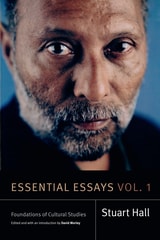
Essential Essays, Volume 1
Foundations of Cultural StudiesStuart Hall
Duke University Press, 2018
Volume 1: Foundations of Cultural Studies focuses on the first half of Hall's career, when he wrestled with questions of culture, class, representation, and politics. This volume's stand-out essays include his field-defining “Cultural Studies and Its Theoretical Legacies"; the prescient “The Great Moving Right Show,” which first identified the emergent mode of authoritarian populism in British politics; and “Encoding and Decoding in the Television Discourse,” one of his most influential pieces of media criticism. As a whole, Volume 1 provides a panoramic view of Hall's fundamental contributions to cultural studies.
Essential Essays, Volume 2
Identity and DiasporaStuart Hall
Duke University Press, 2018
Volume 2: Identity and Diaspora draws from Hall's later essays, in which he investigated questions of colonialism, empire, and race. It opens with “Gramsci's Relevance for the Study of Race and Ethnicity,” which frames the volume and finds Hall rethinking received notions of racial essentialism. In addition to essays on multiculturalism and globalization, black popular culture, and Western modernity's racial underpinnings, Volume 2 contains three interviews with Hall, in which he reflects on his life to theorize his identity as a colonial and diasporic subject.
Essential Tensions in Archaeological Method and Theory
Todd L. Vanpool
University of Utah Press, 2003
In that spirit of plurality, contributors to this volume identify an important theoretical or methodological problem and present an argument regarding its solution. They also provide a critical evaluation of the current state of archaeological method and theory, illustrating that such recurrent issues as the role of agency and the importance of social considerations in the formation of archaeological research dominate current theoretical development.
By presenting both the range of important questions and a variety of answers, this volume contributes to the 'essential tension' that will further the growth of archaeological theory.
Eternal Sovereigns
Indigenous Artists, Activists, and Travelers Reframing RomeGloria Jane Bell
Duke University Press, 2024

Eternally Eve
Images of Eve in the Hebrew Bible, Midrash, and Modern Jewish PoetryAnne Lapidus Lerner
University Press of New England, 2007
Eternity in the Ether
A Mormon Media HistoryGavin Feller
University of Illinois Press, 2023
Intriguing and original, Eternity in the Ether blends communications history with a religious perspective to examine the crossroads where mass media met Mormonism in the twentieth century.
Ethereal Queer
Television, Historicity, DesireAmy Villarejo
Duke University Press, 2013

Ethical Borders
NAFTA, Globalization, and Mexican MigrationAuthored by Bill Ong Hing
Temple University Press, 2010
In his topical new book, Ethical Borders, Bill Ong Hing asks, why do undocumented immigrants from Mexico continue to enter the United States and, what would discourage this surreptitious traffic? An expert on immigration law and policy, Hing examines the relationship between NAFTA, globalization, and undocumented migration, and he considers the policy options for controlling immigration. He develops an ethical rationale for opening up the U.S./Mexican border, as well as improving conditions in Mexico so that its citizens would have little incentive to migrate.
In Ethical Borders Hing insists that reforming NAFTA is vital to ameliorating much of the poverty that drives undocumented immigration and he points to the European Union's immigration and economic development policies as a model for North America. Hing considers the world-wide economic crisis and the social problems that attend labor migration into homogenous countries, arguing for a spectrum of changes, including stricter border enforcement and more effective barriers; a path to citizenship for undocumented migrants; or a guest worker program.
Hing also situates NAFTA and its effects in the larger, and rapidly shifting, context of globalization—particularly the recent rise of China as the world's economic giant. Showing how NAFTA’s unforeseen consequences have been detrimental to Mexico, Hing passionately argues that the United States is ethically bound to address the problems in a way that puts prosperity within the grasp of all North Americans.
Ethical Considerations in Educating Children Who Are Deaf or Hard of Hearing
Kathee Mangan Christensen
Gallaudet University Press, 2011
The education of deaf or hard of hearing children has become as complex as the varying needs of each individual child. Teachers face classrooms filled with students who are culturally Deaf, hard of hearing, or post-lingually deaf; they might use American Sign Language, cochlear implants, hearing aids/FM systems, speech, Signed English, sign-supported speech, contact signing, nonverbal communication, or some combination of methods. Educators who decide what tools are best for these children are making far-reaching ethical decisions in each case. This collection features ten chapters that work as constructive conversations to make the diverse needs of these deaf students the primary focus.
The initial essays establish fundamental points of ethical decision-making and emphasize that every situation should be examined not with regard for what is “right or wrong,” but for what is “useful.” Absolute objectivity is unattainable due to social influences, while “common knowledge” is ruled out in favor of “common awareness.” Other chapters deal with the reality of interpreting through the professional’s eyes, of how they are assessed, participate, and are valued in the total educational process, including mainstream environments. The various settings of education for deaf children are profiled, from residential schools to life in three cultures for deaf Latino students, to self-contained high school programs. Ethical Considerations in Educating Deaf Children Who Are Deaf or Hard of Hearing offers an invaluable set of guidelines for administrators and educators of children with hearing loss in virtually every environment in a postmodern world.
Ethical Encounters
Transnational Feminism, Human Rights, and War Cinema in BangladeshElora Halim Chowdhury
Temple University Press, 2022
Ethical Encounters is an exploration of the intersection of feminism, human rights, and memory to illuminate how visual practices of recollecting violent legacies in Bangladeshi cinema can conjure a global cinematic imagination for the advancement of humanity.
By examining contemporary, women-centered Muktijuddho cinema—features and documentaries that focus on the Bangladesh Liberation War of 1971—Elora Chowdhury shows how these films imagine, disrupt, and reinscribe a gendered nationalist landscape of trauma, freedom, and agency. Chowdhury analyzes Bangladeshi feminist films including Meherjaan, and Itihaash Konna (Daughters of History), as well as socially-engaged films by activist-filmmakers including Jonmo Shathi (Born Together), and Shadhinota (A Certain Liberation), to show how war films of Bangladesh can generate possibilities for gender justice.
Chowdhury argues that justice-driven films are critical to understanding and negotiating the layered meanings and consequences of catastrophic human suffering yet at the same time they hint at subjectivities and identities that are not reducible to the politics of suffering. Rather, they are key to creating an alternative and disruptive archive of feminist knowledge—a sensitive witnessing, responsible spectatorship, and just responsibility across time, and space.
Drawing on Black and transnational feminist critiques, Chowdhury explores questions around women’s place, social roles, and modes of participation in war as well as the visual language through which they become legible as victims/subjects of violence and agents of the nation. Ethical Encounters illuminates the possibilities of film as a site to articulate an ethics that acknowledges a founding violence of the birth of a nation, recuperates it even if in fragments, and imagines differently the irreconcilable relationship between humanity, liberty, and justice.
Ethical Programs
Hospitality and the Rhetorics of SoftwareJames J. Brown, Jr.
University of Michigan Press, 2015
Ethics from a Theocentric Perspective, Volume 2
Ethics and TheologyJames M. Gustafson
University of Chicago Press, 1984
"Breadth and subtlety, wisdom and insight . . . Gustafson is a first-rate theologian."—Commonweal
"The two-volume work, now complete, will be a benchmark for discussions of Christian ethics for years to come. With it Gustafson becomes one of the thinkers by whom others can, by agreement or divergence, define their own ethics."—Roger L. Shinn, Christianity and Crisis
"Gustafson's theocentrism is an original and creative contribution to modern ethical discussion."—Douglas Sturm, Ethics
Ethics in Action
Case Studies in Archaeological DilemmasChip Colwell-Chanthaphonh
University Press of Colorado, 2008

Ethics of Procreation and the Defense of Human Life
Contraception, Artficial Fertilization, and AbortionMartin Rhonheimer
Catholic University of America Press, 2010
Ethics or the Right Thing?
Corruption and Care in the Age of Good GovernanceSylvia Tidey
HAU, 2021
Combining ethnographic fieldwork in the city of Kupang with an acute historical sensibility, Sylvia Tidey shows how good governance initiatives paradoxically perpetuate civil service corruption while also facilitating the emergence of new forms of it. Importing critical insights from the anthropology of ethics to the burgeoning anthropology of corruption, Tidey exposes enduring developmentalist fallacies that treat corruption as endemic to non-Western subjects. In practice, it is often indistinguishable from the ethics of care and exchange, as Indonesian civil servants make worthwhile lives for themselves and their families. This book will be a vital text for anthropologists and other social scientists, particularly scholars of global studies, development studies, and Southeast Asia.
Ethnic Conflict
Religion, Identity, and PoliticsS. A. Giannakos
Ohio University Press, 2001
The outbreak of numerous and simultaneous violent conflicts around the globe in the past decade resulted in immense human suffering and countless lost lives. In part, both results were aided by inactivity or by belated and often misplaced responses by the international community to the embattled groups. The apparent inability of the international community to respond firmly and purposefully to violent conflicts can be attributed partially to a general confusion and misunderstanding of the root causes of such conflicts. In some cases, the international community argued that violent conflicts could be attributed to irreconcilable ethnic differences, which, like earthquakes, are impossible to prevent or control.
At other times, the argument was that such conflicts were the results of evil leaders capable of engineering mass violent acts. Ethnic Conflict presents an interdisciplinary and comparative effort to explain the root causes of ethnic conflicts in terms of political, economic, and social common denominators that characterize all such conflicts. It seeks to dispel misplaced assumptions about violent domestic conflicts and, by providing a clearer picture of the mechanics of such conflicts, it hopes to assist in the process of conflict resolution and prevention.
Ethnic Cues
The Role of Shared Ethnicity in Latino Political ParticipationMatt A. Barreto
University of Michigan Press, 2010
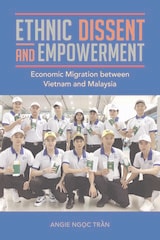
Ethnic Dissent and Empowerment
Economic Migration between Vietnam and MalaysiaAngie Ngoc Tran
University of Illinois Press, 2022
A rare study of labor migration in the Global South, Ethnic Dissent and Empowerment answers essential questions about why nations export and import migrant workers and how the workers protect themselves not only within the system, but by circumventing it altogether.
Ethnic Diversity and the Control of Natural Resources in Southeast Asia
A. Terry Rambo, Kathleen Gillogly, and Karl L. Hutterrer, Editors
University of Michigan Press, 1988
Ethnic Drag
Performing Race, Nation, Sexuality in West GermanyKatrin Sieg
University of Michigan Press, 2002
Using engaging case studies, Ethnic Drag traces the classical and travestied traditions of Jewish impersonation from the eighteenth century onward to construct a pre-history of postwar ethnic drag. It examines how, shortly after World War II, mass culture and popular practices facilitated the repression and refashioning of Nazi racial precepts. During a time when American occupation authorities insisted on remembrance and redress for the Holocaust, the Wild West emerged as a displaced theater of the racial imagination, where the roles of victim, avenger, and perpetrator of genocide were reassigned.
Ethnic Drag is an accessible and sophisticated, critical and entertaining book that examines the phenomenon of cultural masquerade in order to examine racial feeling, thought, and behavior in postwar German culture. Contributing to considerations of drag in postcolonial, feminist, and queer scholarships, this book will be of interest to people in German studies, theater performance, ethnic studies, and women's/queer studies.
Katrin Sieg is Associate Professor, Department of German and Center for German and European Studies, Georgetown University.

Ethnic Drag
Performing Race, Nation, Sexuality in West GermanyKatrin Sieg
University of Michigan Press, 2002
Ethnic Entrepreneurs, Crony Capitalism, and the Making of the Franco-Mexican Elite
José Galindo
University of Alabama Press, 2021
A groundbreaking historical narrative of corruption and economic success in Mexico.
Ethnic Entrepreneurs, Crony Capitalism, and the Making of the Franco-Mexican Elite provides a new way to understand the scope and impact of crony capitalism on institutional development in Mexico. Beginning with the Porfiriato, the period between 1876 and 1911 named for the rule of President Porfirio Díaz, José Galindo identifies how certain behavioral patterns of the Mexican political and economic elite have repeated over the years, and analyzes aspects of the political economy that have persisted, shaping and at times curtailing Mexico’s economic development.
Strong links between entrepreneurs and politicians have allowed elite businessmen to receive privileged support, such as cheap credit, tax breaks, and tariff protection, from different governments and to run their companies as monopolies. In turn, successive governments have obtained support from businesses to implement public policies, and, on occasion, public officials have received monetary restitution. Galindo notes that Mexico’s early twentieth-century institutional framework was weak and unequal to the task of reining in these systematic abuses. The cost to society was high and resulted in a lack of fair market competition, unequal income distribution, and stunted social mobility.
The most important investors in the banking, commerce, and manufacturing sectors at the beginning of the twentieth century in Mexico were of French origin, and Galindo explains the formation of the Franco-Mexican elite. This Franco-Mexican narrative unfolds largely through the story of one of the richest families in Mexico, the Jeans, and their cotton textile empire. This family has maintained power and wealth through the current day as Emilio Azcárraga Jean, a great-grandson of one of the members of the first generation of the Jean family to arrive in Mexico, owns Televisa, a major mass media company with one of the largest audiences for Spanish-language content in the world.
Ethnic Federalism
The Ethiopian Experience in Comparative PerspectiveDavid Turton
Ohio University Press, 2006
Since 1991, Ethiopia has gone further than any other country in using ethnicity as the fundamental organizing principle of a federal system of government. And yet this pioneering experiment in “ethnic federalism” has been largely ignored in the growing literature on democratization and ethnicity in Africa and on the accommodation of ethnic diversity in democratic states. Ethnic Federalism brings a much-needed comparative dimension to the discussion of this experiment in Ethiopia.
Ethnic Federalism closely examines aspects of the Ethiopean case and asks why the use of territorial decentralism to accommodate ethnic differences has been generally unpopular in Africa, while it is growing in popularity in the West.
The book includes case studies of Nigerian and Indian federalism and suggests how Ethiopia might learn from both the failures and successes of these older federations. In the light of these broader issues and cases, it identifies the main challenges facing Ethiopia in the next few years, as it struggles to bring political practice into line with constitutional theory and thereby achieve a genuinely federal division of powers.
Ethnic Historians and the Mainstream
Shaping America's Immigration StoryAlan M. Kraut and David A. Gerber
Rutgers University Press, 2013
Do historians “write their biographies” with the subjects they choose to address in their research? In this collection, editors Alan M. Kraut and David A. Gerber compiled eleven original essays by historians whose own ethnic backgrounds shaped the choices they have made about their own research and writing as scholars. These authors, historians of American immigration and ethnicity, revisited family and personal experiences and reflect on how their lives helped shape their later scholarly pursuits, at times inspiring specific questions they asked of the nation’s immigrant past. They address issues of diversity, multiculturalism, and assimilation in academia, in the discipline of history, and in society at large. Most have been pioneers not only in their respective fields, but also in representing their ethnic group within American academia. Some of the women in the group were in the vanguard of gender diversity in the discipline of history as well as on the faculties of the institutions where they have taught.
The authors in this collection represent a wide array of backgrounds, spanning Europe, Africa, Asia, the Middle East, and Latin America. What they have in common is their passionate engagement with the making of social and personal identities and with finding a voice to explain their personal stories in public terms.
Contributors: Theresa Alfaro-Velcamp, John Bodnar, María C. García, David A. Gerber, Violet M. Showers Johnson, Alan M. Kraut, Timothy J. Meagher, Deborah Dash Moore, Dominic A. Pacyga, Barbara M. Posadas, Eileen H. Tamura, Virginia Yans, Judy Yung

Ethnic Humor in Multiethnic America
Gillota, David
Rutgers University Press, 2013
Gillota investigates the manner in which various humorists respond to multiculturalism and the increasing diversity of the American population. Rather than looking at one or two ethnic groups at a time—as is common scholarly practice—the book focuses on the interplay between humorists from different ethnic communities. While some comic texts project a fantasy world in which diverse ethnic characters coexist in a rarely disputed harmony, others genuinely engage with the complexities and contradictions of multiethnic America.
The first chapter focuses on African American comedy with a discussion of such humorists as Paul Mooney and Chris Rock, who tend to reinforce a black/white vision of American race relations. This approach is contrasted to the comedy of Dave Chappelle, who looks beyond black and white and uses his humor to place blackness within a much wider multiethnic context.
Chapter 2 concentrates primarily on the Jewish humorists Sarah Silverman, Larry David, and Sacha Baron Cohen—three artists who use their personas to explore the peculiar position of contemporary Jews who exist in a middle space between white and other.
In chapter 3, Gillota discusses different humorous constructions of whiteness, from a detailed analysis of South Park to “Blue Collar Comedy” and the blog Stuff White People Like.
Chapter 4 is focused on the manner in which animated children’s film and the network situation comedy often project simplified and harmonious visions of diversity. In contrast, chapter 5 considers how many recent works, such as Harold and Kumar Go to White Castle and the Showtime series Weeds, engage with diversity in more complex and productive ways.
Ethnic Identity in Nahua Mesoamerica
The View from Archaeology, Art History, Ethnohistory, and Contemporary EthnographyFrances F Berdan
University of Utah Press, 2008
This book is the first to analyze ethnicity in a single place over a span that covers prehistory, colonial history, and contemporary life. The authors bring to their various case studies data, methodologies, and concepts of their respective fields to show how Nahuan concepts of ethnic identity are not based on the notion of shared descent but rather on conceptions of shared place of origin and common history.
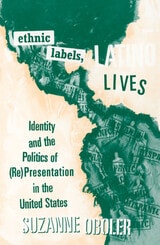
Ethnic Labels, Latino Lives
Identity and the Politics of (Re) Presentation in the United StatesSuzanne Oboler
University of Minnesota Press, 1995
Hispanic or Latino? Mexican American or Chicano? Social labels often take on a life of their own beyond the control of those who coin them or to whom they are applied. In Ethnic Labels, Latino Lives, Suzanne Oboler explores the history and current use of the label “Hispanic” as she illustrates the complex meanings that ethnicity has acquired in shaping our lives and identities.
Exploding the myth of cultural and national homogeneity among people of Latin American descent, Oboler interviews members of diverse groups who have traditionally been labeled “Hispanic” and records the many different meanings and social values they attribute to this label. For example, a person of Mexican descent has a different historical relationship with the United States and a different cultural background than an individual of Puerto Rican or Brazilian descent. The different meanings and social values those interviewed attribute to the label "Hispanic" also correspond to their gender and social class position, including racial prejudices and values stemming from their countries of origin. Though we have witnessed in recent years the fading of the idealized image of U.S. society as a melting pot, we have also realized that the possibility of recasting it in multicultural terms is problematic. Oboler discusses the historical process of labeling groups of individuals, illustrating how labels affect the meaning of citizenship and the struggle for full social participation in the United States. Ethnic Labels, Latino Lives aims to understand the role ethnic labels play in our society and brings us closer toward actualizing a society that values cultural diversity.
Ethnic Los Angeles
Roger Waldinger
Russell Sage Foundation, 1996
Ethnic Medicine in the Southwest
Edited by Edward H. Spicer; (by) Eleanor Bauwens, Margarita Artschwager Kay, Mary Elizabeth Shutler, and Loudell F. Snow
University of Arizona Press, 1977
Edward H. Spicer's informative Introduction sets the stage for comparing "popular" and "scientific" medicine. "Graduates of medical schools have been taught that their body of knowledge is the one true medical tradition. The world has many medicines and thousands of practitioners who do not believe that "Western" medicine is a universal cure-all. These practitioners may be as certain that what they practice is the one true medical tradition," says Spicer. In the communities studied, the belief is that illnesses may be caused by overwork, withcraft or sin, and treatment may include herbs, prayer, or massage. Practitioners are successful and respected although they are not licenses in the legal sense.
In these alternative medical traditions, "Western" medicine may find a key to new growth and effectiveness. Ethnic Medicine in the Southwest is a fascinating look at commonly practiced arts that will interest not only ethnic and health services specialists but all those interested in cultural traditions.
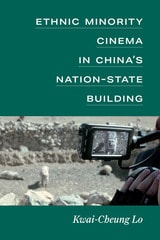
Ethnic Minority Cinema in China’s Nation-State Building
Kwai-Cheung Lo
University of Michigan Press, 2025
Lo understands these representations of ethnic minorities as part of a larger ecosystem and the cultures, values, and life practices of non-Han ethnic minorities as closely entwined with environmental issues and politics. This intertwining, Lo argues, suggests a crisis in “objectification and identification” of both people and the environment, that plays out in cinema featuring ethnic minorities. Lo traces these depictions of Chinese ethnic minority groups in films created by both Han-majority and non-Han filmmakers, examining how these representations became a site in which state authorities, Han and non-Han communities, and foreign agencies compete and interact under the larger context of building and imagining the Chinese nation-state.

Ethnic Music on Records
A Discography of Ethnic Recordings Produced in the United States, 1893-1942. Vol. 1: Western EuropeRichard K. Spottswood
University of Illinois Press, 1990