Results by title
1272 books match the query 'Asia' and 42 start with f

Fabrications, Volume 11
Tina Mai Chen and Paola Zamperini, eds.
Duke University Press, 0
By focusing on clothing and body practices in East Asia, this collection delves into the dynamic interplay between global trade, images, products, and standards as mediated through and on individual bodies. It investigates what fashion means in the Asian context, past and present, and enters into the debate on fashion as a modern phenomenon predicated upon capitalism and consumerism. One contributor critically assesses ideas about the proper proportions and display of breasts—including implants and other nonsurgical practices for enhancement—in Japan and how such norms may be affected and altered by the spread of a global Euro-American beauty ideology. Another essay debates the influence of globalization and cultural localization on the emergence and popularity of exposed short stockings in China. Fabrications also features a translation of Eileen Chang’s classic article "Chronicle of Changing Clothes," which has defined thinking on Chinese fashion since the 1920s.
Contributors. Peter Carroll, Tina Mai Chen, Matthew Chew, Antonia Finnane, Henrietta Harrison, Andrew Jones, Laura Miller, Henrietta Harrison, Paola Zamperini
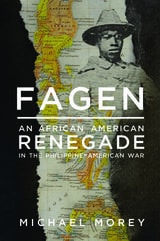
Fagen
An African American Renegade in the Philippine-American WarMichael Morey
University of Wisconsin Press, 2019
The outlines of Fagen's legend have been known for more than a century, but the details of his military achievements, his personal history, and his ultimate fate have remained a mystery—until now. Michael Morey tracks Fagen's life from his youth in Tampa as a laborer in a phosphate camp through his troubled sixteen months in the army, and, most importantly, over his long-obscured career as a guerrilla officer. Morey places this history in its larger military, political, and social context to tell the story of the young renegade whose courage and defiance challenged the supremacist assumptions of the time.
Faithful Education
Madrassahs in South AsiaRiaz, Ali
Rutgers University Press, 2008
Ali Riaz responds to these questions through an in-depth examination of the madraassahs in Pakistan, Bangladesh, and India. In Faithful Education, he examines these institutions and their roles in relation to current international politics.
Faking Liberties
Religious Freedom in American-Occupied JapanJolyon Baraka Thomas
University of Chicago Press, 2019
Through a fresh analysis of pre-war Japanese law, Jolyon Baraka Thomas demonstrates that the occupiers’ triumphant narrative obscured salient Japanese political debates about religious freedom. Indeed, Thomas reveals that American occupiers also vehemently disagreed about the topic. By reconstructing these vibrant debates, Faking Liberties unsettles any notion of American authorship and imposition of religious freedom. Instead, Thomas shows that, during the Occupation, a dialogue about freedom of religion ensued that constructed a new global set of political norms that continue to form policies today.
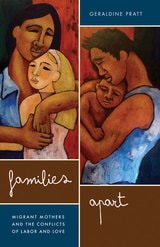
Families Apart
Migrant Mothers and the Conflicts of Labor and LoveGeraldine Pratt
University of Minnesota Press, 2012
In a developing nation like the Philippines, many mothers provide for their families by traveling to a foreign country to care for someone else’s. Families Apart focuses on Filipino overseas workers in Canada to reveal what such arrangements mean for families on both sides of the global divide.
The outcome of Geraldine Pratt’s collaboration with the Philippine Women Centre of British Columbia, this study documents the difficulties of family separation and the problems that children have when they reunite with their mothers in Vancouver. Aimed at those who have lived this experience, those who directly benefit from it, and those who simply stand by and watch, Families Apart shows how Filipino migrant domestic workers—often mothers themselves—are caught between competing neoliberal policies of sending and receiving countries and how, rather than paying rich returns, their ambitions as migrants often result in social and economic exclusion for themselves and for their children. This argument takes shape as an open-ended series of encounters, moving between a singular academic voice and the “we” of various research collaborations, between Vancouver and the Philippines, and between genres of “evidence-based” social scientific research, personal testimony, theatrical performance, and nonfictional narrative writing.
Through these experiments with different modes of storytelling, Pratt seeks to transform frameworks of perception, to create and collect sympathetic witnesses—in short, to promote a wide-ranging public discussion and debate about a massive worldwide shift in family (and nonfamily) relations of intimacy and care.
Fantasies of Ito Michio
Tara Rodman
University of Michigan Press, 2024
Winner of the 2025 Dance Studies Association Oscar Brockett Book Prize
Born in Japan and trained in Germany, dancer and choreographer Ito Michio (1893–1961) achieved prominence in London before moving to the U.S. in 1916 and building a career as an internationally acclaimed artist. During World War II, Ito was interned for two years, and then repatriated to Japan, where he contributed to imperial war efforts by creating propaganda performances and performing revues for the occupying Allied Forces in Tokyo. Throughout, Ito continually invented stories of voyages made, artists befriended, performances seen, and political activities carried out—stories later dismissed as false.
Fantasies of Ito Michio argues that these invented stories, unrealized projects, and questionable political affiliations are as fundamental to Ito’s career as his ‘real’ activities, helping us understand how he sustained himself across experiences of racialization, imperialism, war, and internment. Tara Rodman reveals a narrative of Ito’s life that foregrounds the fabricated and overlooked to highlight his involvement with Japanese artists, such as Yamada Kosaku and Ishii Baku, and global modernist movements. Rodman offers “fantasy” as a rubric for understanding how individuals such as Ito sustain themselves in periods of violent disruption and as a scholarly methodology for engaging the past.
Far Out
Countercultural Seekers and the Tourist Encounter in NepalMark Liechty
University of Chicago Press, 2017
Emerging from centuries of political isolation but eager to engage the world, Nepalis struggled to make sense of the hordes of exotic, enthusiastic foreigners. They quickly embraced the phenomenon, however, and harnessed it to their own ends by building tourists’ fantasies into their national image and crafting Nepal as a premier tourist destination. Liechty describes three distinct phases: the postwar era, when the country provided a Raj-like throwback experience for rich Americans; Nepal’s emergence as an exotic outpost of hippie counterculture in the 1960s; and its rebranding into a hip adventure destination, which began in the 1970s and continues today. He shows how Western projections of Nepal as an isolated place inspired creative enterprises and, paradoxically, allowed locals to participate in the global economy. Based on twenty-five years of research, Far Out blends ethnographic analysis, a lifelong passion for Nepal, and a touch of humor to produce the first comprehensive history of what tourists looked for—and found—on the road to Kathmandu.

Fatty
A NovelNatalie Rogers
Northwestern University Press, 2027
A poignant coming-of-age novel inspired by martial arts films and family lore about powerful ghost brides
Fatty Wong is a streetwise eleven-year-old in 1960s colonial Hong Kong who dreams of ruling the world. She fights daily for a better life, but in an era of great political turmoil, Fatty faces struggles in the streets of her working-class village—and inside her own home. As the city’s youth begins protesting British rule and local communists mimic the Cultural Revolution that has ignited chaos across mainland China, Fatty grapples with her own desire for freedom and spars with the neighborhood kids to discover her strength through kung fu. She takes a job at a convenience store to carve a space of her own, only to be sexually abused by the owner. Increasingly attuned to the spirit world, Fatty is visited by a neighbor boy who was shot and killed during a riot; his ghost offers to help her escape her anguish if she cares for his grieving mother. Now Fatty must embark on an adventure that will demand she discover her true identity—and raise a fist to anyone attempting to stifle her spirit.
Feeding Manila in Peace and War, 1850–1945
Daniel F. Doeppers
University of Wisconsin Press, 2019
Doeppers follows key commodities for the city—rice, produce, fish, fowl, meat, milk, flour, coffee—and their complex interconnections. In the process he considers the changing ecology of the surrounding region as well as the social fabric that weaves together farmers, merchants, transporters, storekeepers, and door-to-door vendors.
Feeling Media
Potentiality and the Afterlife of ArtMiryam Sas
Duke University Press, 2022

Fiery Cinema
The Emergence of an Affective Medium in China, 1915–1945Weihong Bao
University of Minnesota Press, 2015
What was cinema in modern China? It was, this book tells us, a dynamic entity, not strictly tied to one media technology, one mode of operation, or one system of aesthetic code. It was, in Weihong Bao’s term, an affective medium, a distinct notion of the medium as mediating environment with the power to stir passions, frame perception, and mold experience. In Fiery Cinema, Bao traces the permutations of this affective medium from the early through the mid-twentieth century, exploring its role in aesthetics, politics, and social institutions.
Mapping the changing identity of cinema in China in relation to Republican-era print media, theatrical performance, radio broadcasting, television, and architecture, Bao has created an archaeology of Chinese media culture. Within this context, she grounds the question of spectatorial affect and media technology in China’s experience of mechanized warfare, colonial modernity, and the shaping of the public into consumers, national citizens, and a revolutionary collective subject. Carrying on a close conversation with transnational media theory and history, she teases out the tension and affinity between vernacular, political modernist, and propagandistic articulations of mass culture in China’s varied participation in modernity.
Fiery Cinema advances a radical rethinking of affect and medium as a key insight into the relationship of cinema to the public sphere and the making of the masses. By centering media politics in her inquiry of the forgotten future of cinema, Bao makes a major intervention into the theory and history of media.
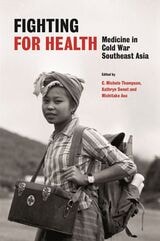
Fighting for Health
Medicine in Cold War Southeast AsiaEdited by C. Michele Thompson, Kathryn Sweet, and Michitake Aso
National University of Singapore Press, 2024
For far too long, Southeast Asia has been treated as a static backdrop for the exploits and discoveries of Western biomedical doctors. Yet, Southeast Asians have been vital to the significant developments in the prevention and treatment of diseases that have taken place in the region and beyond. Many of the institutions and people that shaped subsequent responses to outbreaks, epidemics, and pandemics first began their work in Southeast Asia during the Cold War. The diversity of approaches to health and medicine during that era also reminds us of the possibilities, and limits, of human intervention in the face of political, social, economic, and microbial realities. The people and places of Southeast Asia have provided clinical trials for different health regimes. Fighting for Health highlights new perspectives and methods that have evolved from research presented at regional conferences, including the History of Medicine in Southeast Asia (HOMSEA) series. These insights serve to challenge dominant models of the medical humanities.
Fighting from a Distance
How Filipino Exiles Helped Topple a DictatorJose V. Fuentecilla
University of Illinois Press, 2013
Flexible Citizenship
The Cultural Logics of TransnationalityAihwa Ong
Duke University Press, 1998
Explaining how intensified travel, communications, and mass media have created a transnational Chinese public, Aihwa Ong argues that previous studies have mistakenly viewed transnationality as necessarily detrimental to the nation-state and have ignored individual agency in the large-scale flow of people, images, and cultural forces across borders. She describes how political upheavals and global markets have induced Asian investors, in particular, to blend strategies of migration and of capital accumulation and how these transnational subjects have come to symbolize both the fluidity of capital and the tension between national and personal identities. Refuting claims about the end of the nation-state and about “the clash of civilizations,” Ong presents a clear account of the cultural logics of globalization and an incisive contribution to the anthropology of Asia-Pacific modernity and its links to global social change.
This pioneering investigation of transnational cultural forms will appeal to those in anthropology, globalization studies, postcolonial studies, history, Asian studies, Marxist theory, and cultural studies.
Fluent Bodies
Ayurvedic Remedies for Postcolonial ImbalanceJean M. Langford
Duke University Press, 2002
Interweaving theory with narrative, Langford explores the strategies of contemporary practitioners who reconfigure Ayurvedic knowledge through institutions and technologies such as hospitals, anatomy labs, clinical trials, and sonograms. She shows how practitioners appropriate, transform, or circumvent the knowledge practices implicit in these institutions and technologies, destabilizing such categories as medicine, culture, science, symptom, and self, even as they deploy them in clinical practice. Ultimately, this study points to the future of Ayurveda in a transnational era as a remedy not only for the wounds of colonialism but also for an imagined cultural emptiness at the heart of global modernity.
Flying Yoginis
Irwin Allan Sealy
Seagull Books, 2026
Irwin Allan Sealy—master chronicler of the Indian imagination—sets off on a singular quest: to follow in the wake of the yoginis, those fierce, flying, shape-shifting female adepts of yoga whose images were carved in stone a thousand years ago across India and who now sit, displaced, in American museums.
Part travelogue, part philosophical musing, part cultural excavation, Flying Yoginis is a meditation on art, power, devotion, and the subversive energy of women who step out of line. With wit and wonder, Sealy traces their transcontinental journey from lost temples near Kanchipuram to glass-walled galleries in Kansas City and Minneapolis—finding along the way unexpected kinship with rebels and visionaries, from Rosa Parks to Carson McCullers. Blending the spiritual with the personal, the mythic with the mundane, Sealy offers a dazzling, genre-defying reflection on how the sacred persists, how memory travels, and how history is always being rewritten by those bold enough to reclaim it.
For Dignity, Justice, and Revolution
An Anthology of Japanese Proletarian LiteratureEdited by Heather Bowen-Struyk and Norma Field
University of Chicago Press, 2015
Contextualized by introductory essays, forty expertly translated stories touch on topics like perilous factories, predatory bosses, ethnic discrimination, and the myriad indignities of poverty. Together, they show how even intensely personal issues form a pattern of oppression. Fostering labor consciousness as part of an international leftist arts movement, these writers, lovers of literature, were also challenging the institution of modern literature itself. This anthology demonstrates the vitality of the “red decade” long buried in modern Japanese literary history.
For the Record
On Sexuality and the Colonial Archive in IndiaAnjali Arondekar
Duke University Press, 2009
The logic and the interpretive resources of For the Record arise out of two entangled and minoritized historiographies: one in South Asian studies and the other in queer/sexuality studies. Focusing on late colonial India, Arondekar examines the spectacularization of sexuality in anthropology, law, literature, and pornography from 1843 until 1920. By turning to materials and/or locations that are familiar to most scholars of queer and subaltern studies, Arondekar considers sexuality at the center of the colonial archive rather than at its margins. Each chapter addresses a form of archival loss, troped either in a language of disappearance or paucity, simulacrum or detritus: from Richard Burton’s missing report on male brothels in Karáchi (1845) to a failed sodomy prosecution in Northern India, Queen Empress v. Khairati (1884), and from the ubiquitous India-rubber dildos found in colonial pornography of the mid-to-late nineteenth century to the archival detritus of Kipling’s stories about the Indian Mutiny of 1857.
Foreign Devils on the Silk Road
The Search for the Lost Cities and Treasures of Chinese Central AsiaPeter Hopkirk
University of Massachusetts Press, 1980
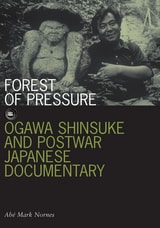
Forest of Pressure
Ogawa Shinsuke and Postwar Japanese DocumentaryAbe Mark Nornes
University of Minnesota Press, 2007
“Extraordinarily valuable, illuminating, and even entertaining, Forest of Pressure brims with the types of information that only a key insider can get his hands on.” —Mitsuhiro Yoshimoto, New York University
Ogawa Productions—known in Asia as Ogawa Pro—was an influential filmmaking collective that started in the 1960s under the direction of Ogawa Shinsuke (1936–1992). Between 1968 and the mid-1970s, Ogawa Pro electrified the Japanese student movement with its Sanrizuka documentary series—eight films chronicling the massive protests over the construction of the Narita airport—which has since become the standard against which documentaries are measured in Japan.
A critical biography of a collective, Forest of Pressure explores the emergence of socially committed documentary filmmaking in postwar Japan. Analyzing Ogawa Pro’s films and works by other Japanese filmmakers, Abé Mark Nornes addresses key issues in documentary theory and practice, including individual and collective cinema production modes and the relationship between subject and object. Benefiting from unprecedented access to Ogawa Pro’s archives and interviews with former members, Forest of Pressure is an innovative look at the fate of political filmmaking in the wake of the movement’s demise.
Abé Mark Nornes is associate professor of screen arts and cultures and Asian languages and cultures at the University of Michigan. He is a coordinator at the Yamagata International Documentary Film Festival and the author of Japanese Documentary Film: The Meiji Era through Hiroshima (Minnesota, 2003).
Formations of Colonial Modernity in East Asia
Tani E. Barlow, ed.
Duke University Press, 1997
Demonstrating an impatience with social science models of knowledge, the contributors show that binary categories focused on during the Cold War are no longer central to the project of history writing. By bringing together articles previously published in the journal positions: east asia cultures critique, editor Tani Barlow has demonstrated how scholars construct identity and history, providing cultural critics with new ways to think about these concepts—in the context of Asia and beyond.
Chapters address topics such as the making of imperial subjects in Okinawa, politics and the body social in colonial Hong Kong, and the discourse of decolonization and popular memory in South Korea. This is an invaluable collection for students and scholars of Asian studies, postcolonial studies, and anthropology.
Contributors. Charles K. Armstrong, Tani E. Barlow, Fred Y. L. Chiu, Chungmoo Choi, Alan S. Christy, Craig Clunas, James A. Fujii, James L. Hevia, Charles Shiro Inouye, Lydia H. Liu, Miriam Silverberg, Tomiyama Ichiro, Wang Hui
Forms of Knowledge in Early Modern Asia
Explorations in the Intellectual History of India and Tibet, 1500-1800Sheldon Pollock, ed.
Duke University Press, 2011
Contributors. Muzaffar Alam, Imre Bangha, Aditya Behl, Allison Busch, Sumit Guha, Janet Gyatso, Matthew T. Kapstein, Françoise Mallison, Sheldon Pollock, Velcheru Narayana Rao, Kurtis R. Schaeffer, Sunil Sharma, David Shulman, Sanjay Subrahmanyam, Mohamad Tavakoli-Targhi
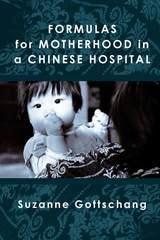
Formulas for Motherhood in a Chinese Hospital
Suzanne Gottschang
University of Michigan Press, 2018
Formulas for Motherhood follows a group of women over eighteen months as they visited a Beijing Baby- Friendly Hospital over the course of their pregnancies and throughout their postpartum recoveries. The book shows how the space of the hospital operates as a microcosm of the larger social, political, and economic forces that urban Chinese women navigate in the process of becoming a mother. Relations between biomedical practices, heightened expectations of femininity and sexuality demanded by a consumer culture, alongside international and national agendas to promote maternal and child health, reveal new agents of maternal governance emerging at the very moment China’s economy heats up. This ethnography provides insight into how women’s creative pragmatism in a rapidly changing society leads to their views and decisions about motherhood.
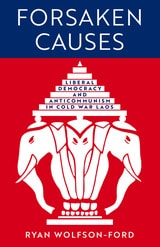
Forsaken Causes
Liberal Democracy and Anticommunism in Cold War LaosRyan Wolfson-Ford
University of Wisconsin Press, 2024
Forsaken Causes offers a groundbreaking intellectual history of the Royal Lao Government (RLG) from 1945 to 1975. In Ryan Wolfson-Ford’s account, the Lao people emerge as not merely pawns of the superpowers but agents in their own right, with the Lao elite wielding particular influence over the nation’s trajectory. Their prevailing ideologies—liberal democracy and anticommunism—were not imposed from outside, but rather established by Lao themselves in the fight against French colonialism. These ideologies were rooted in Lao culture, which prized its traditional monarchy, Buddhist faith, French learning, and nationalist conception of a Lao race. Against histories that have dismissed Lao elites as instruments of foreign powers, Wolfson-Ford shows that the RLG charted its own course, guided by complex motivations, rationales, and beliefs. During this time Lao enjoyed unprecedented democratic freedoms, many of which have not been seen since the government fell to communist takeover in 1975.
By recentering the Lao in their own history, Wolfson-Ford restores our understanding of this robust but often forgotten liberal democracy, recovers lost voices, and broadens our understanding of postcolonial and Cold War Southeast Asia as a whole.
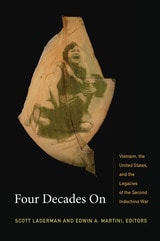
Four Decades On
Vietnam, the United States, and the Legacies of the Second Indochina WarScott Laderman and Edwin A. Martini, eds.
Duke University Press, 2013
Contributors. Alex Bloom, Diane Niblack Fox, H. Bruce Franklin, Walter Hixson, Heonik Kwon, Scott Laderman, Mariam B. Lam, Ngo Vinh Long, Edwin A. Martini, Viet Thanh Nguyen, Christina Schwenkel, Charles Waugh
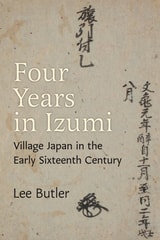
Four Years in Izumi
Village Japan in the Early Sixteenth CenturyLee Butler
University of Michigan Press, 2026
Four Years in Izumi takes an in-depth and critical approach to understanding Japanese village life through analysis of the diary of Kujō Masamoto, the former chancellor of the imperial court who resided briefly in one of his provincial estates from 1501 to 1504. For a high ranking courtier to travel to the countryside and manage a family estate was unheard of during the era of Sengoku, the “country at war.” The diary Masamoto kept offers a remarkably rich and vivid portrait of village Japan, which has seen no significant study in English-language scholarship.
Through extensive examination of the diary and close and critical reading of it and complementary sources, Lee Butler provides a window into the inner workings of late-medieval village life that challenges typical portrayals of the period. In Four Years in Izumi, we see the complexity of relations between commoners and elites in action. We also see the ways in which an estate functioned in practice at the heart of the medieval economy and local social structure.
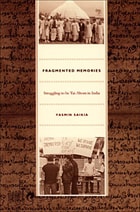
Fragmented Memories
Struggling to be Tai-Ahom in IndiaYasmin Saikia
Duke University Press, 2004
Assamese herself, Saikia lived in several different Tai-Ahom villages between 1994 and 1996. She spoke with political activists, intellectuals, militant leaders, shamans, and students and observed and participated in Tai-Ahom religious, social, and political events. She read Tai-Ahom sacred texts and did archival research—looking at colonial documents and government reports—in Calcutta, New Delhi, and London. In Fragmented Memories, Saikia reveals the different narratives relating to the Tai-Ahom as told by the postcolonial Indian government, British colonists, and various texts reaching back to the thirteenth century. She shows how Tai-Ahom identity is practiced in Assam and also in Thailand. Revealing how the “dead” history of Tai-Ahom has been transformed into living memory to demand rights of citizenship, Fragmented Memories is a landmark history told from the periphery of the Indian nation.
Francophonie and the Orient
French-Asian Transcultural Crossings (1840-1940)Mathilde Kang
Amsterdam University Press, 2018
Francophonie en Orient
Aux croisements France-Asie (1840-1940)Mathilde Kang
Amsterdam University Press, 2017
Free India in Asia
Werner Levi
University of Minnesota Press, 1952
Free India in Asia was first published in 1952. Minnesota Archive Editions uses digital technology to make long-unavailable books once again accessible, and are published unaltered from the original University of Minnesota Press editions.
The critical importance of India to the global future of democracy is recognized throughout the world, but perhaps less well understood is the significance to India's future political course of her relations with the other Asian nations. This carefully documented study surveys India's position in the whole of Asia and her relations with each of the countries in the area, with emphasis on developments since India's independence in 1947. Much of the material is based on Dr. Levi's personal observations and interviews with Indian leaders during a recent visit to the country.
In contrast to most studies of India's foreign policy, which are either speculative or partisan, Dr. Levi's work is based on factual findings, not on preconceived ideas.
Freedom in Entangled Worlds
West Papua and the Architecture of Global PowerEben Kirksey
Duke University Press, 2012
From Confinement to Containment
Japanese/American Arts during the Early Cold WarEdward Tang
Temple University Press, 2019
During the early part of the Cold War, Japan emerged as a model ally, and Japanese Americans were seen as a model minority. From Confinement to Containment examines the work of four Japanese and Japanese/American artists and writers during this period: the novelist Hanama Tasaki, the actor Yamaguchi Yoshiko, the painter Henry Sugimoto, and the children’s author Yoshiko Uchida. The backgrounds of the four figures reveal a mixing of nationalities, a borrowing of cultures, and a combination of domestic and overseas interests.
Edward Tang shows how the film, art, and literature made by these artists revealed to the American public the linked processes of U.S. actions at home and abroad. Their work played into—but also challenged—the postwar rehabilitated images of Japan and Japanese Americans as it focused on the history of transpacific relations such as Japanese immigration to the United States, the Asia-Pacific War, U.S. and Japanese imperialism, and the wartime confinement of Japanese Americans. From Confinement to Containment shows the relationships between larger global forces as well as how the artists and writers responded to them in both critical and compromised ways.
From Jail to Jail
Tan Malaka
Ohio University Press, 2020
From Jail to Jail is the political autobiography of Sutan Ibrahim gelar Tan Malaka, an enigmatic and colorful political thinker of twentieth-century Asia, who was one of the most influential figures of the Indonesian Revolution. Variously labeled a communist, Trotskyite, and nationalist, Tan Malaka managed to run afoul of nearly every political group and faction involved in the Indonesian struggle for independence. During his decades of political activity, he spent periods of exile and hiding in nearly every country in Southeast Asia. As a Marxist who was expelled from and became a bitter enemy of his country’s Communist Party and as a nationalist who was imprisoned and murdered by his own government’s forces as a danger to its anticolonial struggle, Tan Malaka was and continues to be soaked in contradiction and controversy.
Translated by Helen Javis and with a new introduction from Harry A. Poeze, this edition of From Jail to Jail contextualizes the life and political accomplishments of Tan Malaka in one of the few known autobiographies by a Marxist of this political era and region.
From Jail to Jail
Mis Sea#83 Tpg#8Tan Malaka
Ohio University Press, 1991
From Jail to Jail is the political autobiography of Sutan Ibrahim gelar Tan Malaka, an enigmatic and colorful political thinker of twentieth-century Asia, who was one of the most influential figures of the Indonesian Revolution. Variously labeled a communist, Trotskyite, and nationalist, Tan Malaka managed to run afoul of nearly every political group and faction involved in the Indonesian struggle for independence. During his decades of political activity, he spent periods of exile and hiding in nearly every country in Southeast Asia. As a Marxist who was expelled from and became a bitter enemy of his country’s Communist Party and as a nationalist who was imprisoned and murdered by his own government’s forces as a danger to its anticolonial struggle, Tan Malaka was and continues to be soaked in contradiction and controversy.
From Midnight to Glorious Morning?
India Since IndependenceMihir Bose
Haus Publishing, 2017
In From Midnight to Glorious Morning?, Bose travels the length and breadth of India to explore how a country that many doubted would survive has been transformed into one capable of rivaling China as the world’s preeminent economic superpower. Multifarious challenges still continue to plague the country: although inequality and corruption are issues not unique to India, such a rapid ascent to global prominence creates a precarious position. However, as Bose outlines, this rapid ascent provides evidence that India is ever capable of making great strides in the face of great adversity.
Bose’s penetrating analysis of the last seventy years asks what is yet to be done for India in order to fulfill the destiny with which it has been imbued. The predictions of doom in August 1947 have proved to be unfounded; the growth of the nation in population and capital has been exponential, and there is much to celebrate. But Bose’s nuanced, personal, and trenchant book shows that it is naïve to pretend the hoped-for bright morning has yet dawned.
From Modern Production to Imagined Primitive
The Social World of Coffee from Papua New GuineaPaige West
Duke University Press, 2012
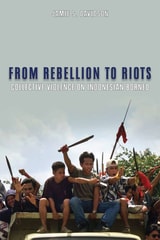
From Rebellion to Riots
Collective Violence on Indonesian BorneoJamie S. Davidson
University of Wisconsin Press, 2008
“A comprehensive case study . . . . Essential reading for students of the West Kalimantan violence.”—Dave McRae, Indonesia
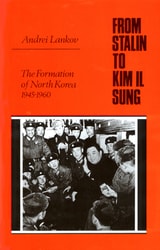
From Stalin to Kim Il Sung
The Formation of North Korea, 1945-1960Lankov, Andrei
Rutgers University Press, 2002
To understand how North Korea has survived as the worlds last Stalinist regime despite international isolationand at enormous human costs to its peopleone must look at how its political system was created. The countrys foundations were laid in the late 1940s and 1950s as a result of interaction between the Soviet Stalinist model, imposed from outside, and local traditions.
Andrei Lankov traces the formation of the North Korean state and the early years of Kim Il Sungs rule, when the future "Great Leader" and his entourage were consolidating their power base. Surveying the situation in North Korea after 1945, Lankov explores the internal composition of the ruling elite, the role of the Soviets, and the uneasy relations between various political groups. He also focuses on how in 1956 Kim Il Sung defeated the only known attempt to oust him and thereby established absolute personal rule beyond either Soviet or Chinese control.
The book is based on previously secret Soviet documents from Russian archives, as well as interviews with Russian and Korean participants.
From Stone to Flesh
A Short History of the BuddhaDonald S. Lopez Jr.
University of Chicago Press, 2013
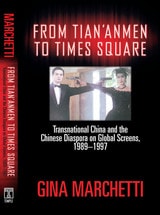
From Tian'anmen to Times Square
Transnational China and the Chinese Diaspora on Global Screens, 1989-1997Gina Marchetti
Temple University Press, 2006
In From Tian'anmen to Times Square, leading film scholar Gina Marchetti considers the complex changes in the ways that China and the Chinese have been portrayed in cinema and media arts since the Tian'anmen revolt. Drawing on her interviews with leading contemporary Chinese filmmakers, Marchetti looks at a wide range of work by Chinese and non-Chinese media artists working in China, Hong Kong, Taiwan, and Singapore and on transnational co-productions involving those places. Focusing on the intersections of race, ethnicity, gender, and sexuality on global screens, Marchetti traces the momentous political, cultural, social, and economic forces confronting contemporary media artists and filmmakers working within "Greater China."
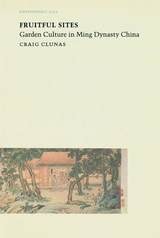
Fruitful Sites
Garden Culture in Ming Dynasty ChinaCraig Clunas
Reaktion Books, 1996
Who owned gardens? Who visited them? How were they represented in words, in paintings and in visual culture generally, and what meanings did these representations hold at different levels of Chinese society? Drawing on a wide range of recent work in cultural theory, Craig Clunas provides for the first time a historical and materialist account of Chinese garden culture, and replaces broad generalizations and orientalist fantasy with a convincing picture of the garden's role in social life.
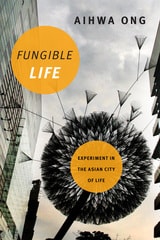
Fungible Life
Experiment in the Asian City of LifeAihwa Ong
Duke University Press, 2016