Results by title
808 books match the query 'Drama' and 26 start with f
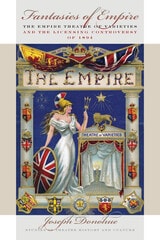
Fantasies of Empire
The Empire Theatre of Varieties and the Licensing Controversy of 1894Joseph Donohue
University of Iowa Press, 2005
Fantasies of Empire is the first book to recount in full the story of the Empire licensing controversy in all its captivating detail. Contemporaneous accounts are interwoven with Donohue’s identification and analysis of the larger issues raised: What the controversy reveals about contemporary sexual and social relations, what light it sheds on opposing views regarding the place of art and entertainment in modern society, and what it says about the pervasive effect of British imperialism on society’s behavior in the later years of Queen Victoria’s reign. Donohue connects the controversy to one of the most interesting developments in the history of modern theatre, the simultaneous emergence of a more sophisticated, varied, and moneyed audience and a municipal government insistent on its right to control and regulate that audience’s social and cultural character and even its moral behavior.
Rich in illustrations and entertainingly written, Fantasies of Empire will appeal to theatre, dance, and social historians and to students of popular entertainment, the Victorian period, urban studies, gender studies, leisure studies, and the social history of architecture.
Fashioning Femininity and English Renaissance Drama
Karen Newman
University of Chicago Press, 1991
Through the critical lens of poststructuralism, Newman reads anatomies, conduct and domesticity handbooks, sermons, homilies, ballads, and court cases to delineate the ideologies of femininity they represented and produced. Arguing that drama, as spectacle, provides a peculiarly useful locus for analyzing the management of femininity, Newman considers the culture of early modern London to reveal how female subjectivity was fashioned and staged in the plays of Shakespeare, Jonson, and others.
Faust
A Tragedy, Part IEugene Stelzig
Bucknell University Press, 2019
Published by Bucknell University Press. Distributed worldwide by Rutgers University Press.
Feminist Theories for Dramatic Criticism
Gayle Austin
University of Michigan Press, 1990
Feminist Theories for Dramatic Criticism provides a number of useful approaches for analyzing works for the stage from a feminist perspective. Each chapter outlines key feminist theories in a specific field, covering literary criticisms, anthropology, psychology, and film, and then applies these theories in a detailed criticism of one or two plays. Plays by Eugene O'Neill, Arthur Miller, Lillian Hellman, Jane Bowles, Sam Shepard, and Alice Childress—all produced after World War II—are reexamined through the lenses of feminist theorist Judith Fetterley, Gayle Rubin, Nancy Chodorow, and Laura Mulvey, each a key figure in her respective field.
The introduction provides a framework for the discussion of feminist dramatic criticism by presenting the multiple political perspectives within feminism. The contributions of black and lesbian feminists to the question of theory are explored, as are the evolutionary stages of feminist criticism as they have been occurring in other fields. Theater has been slower than most fields to move through these stages, and its trajectory thus far is briefly traced. For the sake of clarity, each of the central chapters treats theories from a particular discipline, but the conclusion reminds us that in practice the theories are most often combined.
The book will appeal to theater scholars and practitioners interested in finding their way into feminist theory for the first time, or in expanding their knowledge of its insights for use in teaching, research, and production. Those in women's studies and other fields will find it shows ways to include plays among the texts they analyze.
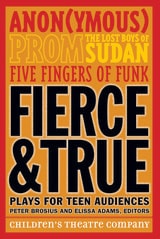
Fierce and True
Plays for Teen AudiencesChildren’s Theatre Children’s Theatre Company
University of Minnesota Press, 2010
In an effort to reach out to and engage these young people, the CTC began to commission and produce plays aimed at a twelve- to eighteen-year-old audience, focusing on the complexities, idiosyncrasies, and epic dilemmas in the lives of young people. Fierce and True collects four of these critically acclaimed plays: Anon(ymous) by Naomi Iizuka, The Lost Boys of Sudan by Lonnie Carter, Five Fingers of Funk by Will Power, and Prom by Whit MacLaughlin and New Paradise Laboratories.
Professional, full-length works not about teens so much as they are written for them. Ambitious, surprising, and complex, these plays speak directly to teens without pandering to them; they engage, challenge, and respect teenage minds. Diverse and utterly unique, these playwrights are bound together by the excellence of their craft and the power of their storytelling. Fierce and True both redefines the field of theater for young people and provides an invaluable resource for theater professionals, educators, and the teens they serve.

Film, Drama and the Break Up of Britain
Steve Blandford
Intellect Books, 1995
When the sun set on the British Empire, the resultant fragmentation of British identity emerged most tellingly in artistic works: cinematic works such as Howards End depicted a richly historical land steeped in tradition and tragedy, while the more modern Lock, Stock and Two Smoking Barrels revealed a brutal yet sharply humorous portrayal of contemporary English life. That relationship between nationalism, national identity, and postcolonialism remains central to many British dramatists’ works, and in Film, Drama and the Break Up of Britain, Steve Blandford explores how the “break up” of Britain has influenced contemporary British drama.
Breaking down the scholarly barriers between theater and film studies, Blandford examines British directors’ interpretations of their nation’s postcolonial age, tracing the various ways that auteurs have created dramatic narratives that explore the idea of being “British” and all its inherent complexity. From community-based theaters in Scotland and Wales to the blockbuster The Full Monty, Blandford probes the cultural impact of Britain’s struggle to form a new identity, making his book an essential read for all those interested in postcolonial studies and the history of British film.
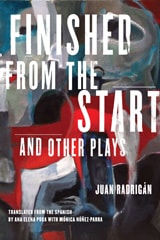
Finished from the Start and Other Plays
Juan Radrigan
Northwestern University Press, 2007
This collection of plays comes from one of Chile’s finest voices of the voiceless: Juan Radrigán. A history marked by personal and political hardship has equipped Radrigán to tell the stories of those his nation left behind. Seven years old when his father abandoned his family, he was forced to work from an early age. As an adult, he worked as a manual laborer during a very dark time for Chile: the demise of Salvador Allende and the rise of General Augusto Pinochet. In a time of torture, exile, and political “disappearances,” his plays stood as quietly powerful anti-regime statements that mourned the country’s loss. Translator Ana Elena Puga’s introduction places Radrigán’s work in its historical and cultural context and provides ample background for the six pieces.
The first work, Testimonies to the Deaths of Sabina, features a fruit seller who may lose her livelihood after she is accused of some mysterious infraction; but she doesn’t know what she has done—if she has truly done anything. The Beasts tells the story of three sisters living in the wilderness who, fearing they have been completely abandoned, devise a means of ultimate escape. Funeral Drums for Lambs and Wolves comes in three parts: Isabel Banished in Isabel, a monologue of a woman left to go mad alone; Without Apparent Motive, a monologue by a murderer who laments the spread of violence; and the dialogue The Guest, a confrontational piece that speaks directly to the spectators, implicating them in their silent, passive tolerance of Pinochet. The title play, Radrigán’s 1981 masterpiece, speaks directly to the specter of the many “disappeared” victims of the military regime.
Five Plays from the Children’s Theatre Company of Minneapolis
John Clark Donahue and Linda Walsh Jenkins, Editors
University of Minnesota Press, 1975
Five Plays from the Children's Theatre Company of Minneapolis was first published in
1975. Minnesota Archive Editions uses digital technology to make long-unavailable books once again accessible, and are published unaltered from the original University of Minnesota Press editions.Among the notable productions of the Children's Theatre Company of the Minneapolis Society of Fine Arts, a leading exponent of children's theater in this country, have been plays that are adaptations of classics in children's literature. This volume makes available the scripts of five of these adaptations, along with illuminating information about the productions and the company itself.
The plays include two adaptations by Frederick Gaines, two by Timothy Mason, and one by Richard Shaw. Mr. Gaines's plays are based on Washington Irving's The Legend of Sleepy Hollow and Charles Dickens's A Christmas Carol.One of Mr. Mason's plays, Kidnapped in London, is an adaptation of part of Master Skylark by John Bennett, and the other, Robin Hood: A Story of the Forest, is based on part of the Robin Hood legend. Mr. Shaw's play is an adaptation in Kabuki form of the Grimms' fairy tale Sleeping Beauty.
Linda Walsh Jenkins writes a general introduction and commentary. Background information about each play includes excerpts from discussions among directors, composers, designers, and playwrights about the plays themselves and about various phases of the development of the productions. Highlights of the history of the Children's Theatre Company and of the aims and accomplishments of its director, John Clark Donahue, are given, and these will be of particular interest to anyone in the children's theater field.
The photographic illustrations, which include a number in color, show various aspects of Children's Theatre Company productions. There are also musical examples from the original scores for the plays.
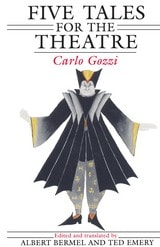
Five Tales for the Theatre
Carlo Gozzi
University of Chicago Press, 1989
In the ten works he called fiable or fairy tales, Gozzi intermingled characters from the traditional and improvised commedia dell'arte with exotic figures of his own invention. During Gozzi's lifetime, Goethe and Schiller translated and produced some of his dramas at the Weimar Theatre. In our century, the dramas have reasserted themselves under the direction of Max Reinhardt, Vsevolod Meyerhold, George Devine, and Benno Besson, as well as in operatic adaptations by Puccini and Prokofiev.
The powerful conflicts, the idyllic and fearsome settings, and the startling transformations in these plays offer exceptional opportunities to actors, directors, and designers. The lively translations are faithful to Gozzi's Italian, while being eminently playable for English-speaking audiences today. Two of the translations have already had highly successful stagings by Andrei Serban at the American Repertory Theatre and on tour.
Florentine Drama for Convent and Festival
Seven Sacred PlaysAntonia Pulci
University of Chicago Press, 1996
Available in English for the first time, this volume recovers the long muted voice of an early and important female Italian poet and playwright.
Flowers for Otello
On the Crimes That Came Out of JenaEsther Dischereit
Seagull Books, 2022
Between 1998 and 2007 a series of killings in Germany, disdainfully styled “doner murders” by the media, were attributed by German police to internecine rivalries among immigrants. The victims included eight citizens of Turkish origin, a Greek citizen, and a German policewoman. Not until 2011 did the German public learn not only that the police had ignored signs pointing to the real perpetrators, a neo-Nazi group called the National Socialist Underground, but also that important files, possibly containing evidence implicating state agencies, had disappeared from the archives of Federal Police and intelligence organizations.
Esther Dischereit, one of the preeminent German-Jewish voices of the post-Holocaust generation, takes that failure of the state to protect its citizens from racist violence as the core of her performance text Flowers for Otello: On the Crimes That Came Out of Jena. Seeking an appropriate language with which to meet the bereaved, she also finds a way to raise the blanket of silence that is used by those who would prefer that we forget. Combining witness testimony, myth, and incidents from a history of violence against minorities, Flowers for Otello, in Iain Galbraith’s translation, refuses chaos, instead revealing the chilling, patterned order of tragedy while bringing a great writer’s humanism to the fore.
Footpaths and Bridges
Voices from the Native American Women Playwrights ArchiveEdited by Shirley A. Huston-Findley and Rebecca Howard
University of Michigan Press, 2011
Footpaths and Bridges celebrates the vitality and diversity of Native American women, collecting plays ranging from ETHNOSTRESS—a humorous take on art and identity politics—to the biographical musical Te Ata to a retelling of the Thanksgiving story from the Wampanoag perspective. The dramatic works are accompanied by critical commentary that illuminates Native American women’s theater practices and perspectives, highlighting the issues of heritage, identity, and changing lifestyles that the plays imaginatively tackle.
Featuring work from a wide array of tribes and geographic regions, the collection affords the artist, scholar, and general reader access to previously unheard voices that communicate the complexity and the diversity of the Native American experience. The far-ranging genres and content of the plays suggest the many possibilities for communicating the past and the present, the personal and the political, and the stunning kaleidoscope of Native American life and art.
“Often thoughtful provocateurs, Native American playwrights are frequently overlooked . . . eminently readable, and possibly performable, the plays [in this collection] examine colonization, generational differences, ‘ethnostress,’ and cultural identity.”
—Choice
Foreplay
Hannah Arendt, the Two Adornos, and Walter BenjaminCarl Djerassi
University of Wisconsin Press, 2011
Hannah Arendt, Walter Benjamin, and Theodor W. Adorno were intellectual giants of the first half of the twentieth century. The drama Foreplay explores their deeply human and psychologically intriguing private lives, focusing on professional and personal jealousies, the mutual dislike of Theodor Adorno and Hannah Arendt, the association between Walter Benjamin and Georges Bataille, and the border between erotica and pornography.

Form and the Art of Theatre
Paul Newell Campbell
University of Wisconsin Press, 1984
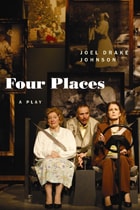
Four Places
A PlayJoel Drake Johnson
Northwestern University Press, 2009
Sketched together on a deceptively simple frame, this emotionally precise play uses its spare structure to devastating and darkly comic effect. A brother and sister have received word from their parents’ caretaker that their elderly parents may be a danger to each other. The brother breaks his routine to join his sister and mother on their weekly lunch date in hopes that together he and his sister can get a clearer picture of the situation. As the mother confronts the indignities of age and the children stare down a mounting list of losses and disappointments, an image of the family emerges that is true to life. Johnson gives readers an unwavering exploration of the ways that the love and knowledge family members have of one another creates both hurt and comfort.
Four by Euripides
Medea, Bakkhai, Hippolytos, and CyclopsRobert Bagg
University of Massachusetts Press, 2019
Framing Faust
Twentieth-Century Cultural StrugglesInez Hedges
Southern Illinois University Press, 2009
In this interdisciplinary cultural history that encompasses film, literature, music, and drama, Inez Hedges follows the thread of the Faustian rebel in the major intellectual currents of the last hundred years. She presents Faust and his counterpart Mephistopheles as antagonistic—yet complementary—figures whose productive conflict was integral to such phenomena as the birth of narrative cinema, the rise of modernist avant-gardes before World War II, and feminist critiques of Western cultural traditions.
Framing Faust: Twentieth-Century Cultural Struggles pursues a dialectical approach to cultural history. Using the probing lens of cultural studies, Hedges shows how claims to the Faustian legacy permeated the struggle against Nazism in the 1930s while infusing not only the search for socialist utopias in Russia, France, and Germany, but also the quest for legitimacy on both sides of the Cold War divide after 1945.
Hedges balances new perspectives on such well-known works as Thomas Mann’s Dr. Faustus and Jack Kerouac’s Dr. Sax with discussions of previously overlooked twentieth-century expressions of the Faust myth, including American film noir and the Faust films of Stan Brakhage. She evaluates musical compositions—Hanns Eisler’s Faust libretto, the opera Votre Faust by Henri Pousseur and Michel Butor, and Alfred Schnittke’s Faust Cantata—as well as works of fiction and drama in French and German, many of which have heretofore never been discussed outside narrow disciplinary confines.
Enhanced by twenty-four illustrations, Framing Faust provides a fascinating and focused narrative of some of the major cultural struggles of the past century as seen through the Faustian prism, and establishes Faust as an important present-day frame of reference.
Framing Shakespeare on Film
How the Frame Reveals MeaningKathy M. Howlett
Ohio University Press, 2000
The aesthetics of frame theory form the basis of Framing Shakespeare on Film. This groundbreaking work expands on the discussion of film constructivists in its claim that the spectacle of Shakespeare on film is a problem-solving activity.
Kathy Howlett demonstrates convincingly how viewers’ expectations for understanding Shakespeare on film can be manipulated by the director’s cinematic technique. Emphasizing that the successful film can transform Shakespeare’s text while remaining rooted in Shakespearean conceptions, Howlett raises the question of how directors and audiences understand the genre of Shakespeare on film and reveals how the medium alters the patterns through which the audience views Shakespeare.
Freaks of History
Two Performance TextsJames MacDonald
Intellect Books, 2017
MacDonald, who is cerebral palsied, recognizes that disability narratives are rarely written by and for disabled people. Therefore his plays, accompanied by critical essays and director’s notes, are a welcome addition to the emerging discourse of Crip theory, and essential reading for disability students and academics alike.
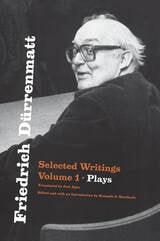
Friedrich Dürrenmatt
Selected Writings, Volume 1, PlaysFriedrich Dürrenmatt
University of Chicago Press, 2006
These translations of Friedrich Dürrenmatt’s plays introduce the writer to a new generation of readers.
The Swiss writer Friedrich Dürrenmatt (1921–90) was one of the most important literary figures of the second half of the twentieth century. During the years of the cold war, arguably only Beckett, Camus, Sartre, and Brecht rivaled him as a presence in European letters. Yet outside Europe, this prolific author is primarily known for only one work, The Visit.
Dürrenmatt’s concerns are timeless, but they are also the product of his Swiss vantage during the cold war: his key plays, gathered in the first volume of Selected Writings, explore such themes as guilt by passivity, the refusal of responsibility, greed and political decay, and the tension between justice and freedom. In The Visit, for instance, an old lady who becomes the wealthiest person in the world returns to the village that cast her out as a young woman and offers riches to the town in exchange for the life of the man, now its mayor, who once disgraced her. Joel Agee’s crystalline translation gives a fresh lease to this play, as well as four others: The Physicists, Romulus the Great, Hercules and the Augean Stables, and The Marriage of Mr. Mississippi.
Dürrenmatt has long been considered a great writer, but one unfairly neglected in the modern world of letters. With these elegantly conceived and expertly translated volumes, a new generation of readers will rediscover his greatest works.

Friends of Alice Wheeldon
Sheila Rowbotham
Pluto Press, 1986
From Metaphor to Direct Speech
Contemporary Russophone Drama and Performance TheoryE. Susanna Weygandt
University of Wisconsin Press, 2025
As a result, the Russophone New Dramatists speak dissent and dramatize resistance. Ultimately, they shift theatrical productions from something constrained and limited, in both place and time, to an ephemeral but unbounded gateway for social activism. The sonic stage thus effectively functions as a social forum, transposing action from the actors to the audience. From Metaphor to Direct Speech therefore contributes to cultural as well as performance studies, offering a compelling look not just at developments in theatrical modes but also at dissent and cultural aesthetics in Russia today.
From Page to Performance
Essays in Early English DramaJohn A. Alford
Michigan State University Press, 1995
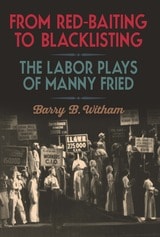
From Red-Baiting to Blacklisting
The Labor Plays of Manny FriedBarry B. Witham
Southern Illinois University Press, 2020
Author Barry B. Witham reclaims the work of Manny Fried, an essential American playwright so thoroughly blacklisted after he defied the House Committee on Un-American Activities in 1954, and again in 1964, that his work all but completely disappeared from the canon. Witham details Manny Fried’s work inside and outside the theatre and examines his three major labor plays and the political climate that both nurtured and disparaged their productions. Drawing on never-before-published interview materials, Witham reveals the details of how the United States government worked to ruin Fried’s career.
From Red-Baiting to Blacklisting includes the complete text of Fried’s major labor plays, all long out of print. In Elegy for Stanley Gorski, Fried depicts one of the many red-baiting campaigns that threatened countless unions in the wake of the Taft-Hartley Act and the collusion of the Catholic Church with these activities. In Drop Hammer, Fried tackles the issues of union dues, misappropriation, and potential criminal activities. In the third play, The Dodo Bird, perhaps his most popular, Fried achieves a remarkable character study of a man outsourced from his job by technology and plant closures.
Manny Fried’s plays portray the hard edges of capitalism and government power and illuminate present-day struggles with hostility to labor unions and the passage in several states of right-to-work laws. Fried had no illusions about the government’s determination to destroy communism and unionism—causes to which he was deeply committed.

Further on, Nothing
Tadeusz Kantor’s TheatreMichal Kobialka
University of Minnesota Press, 2009
A new encounter with the work of a master of avant-garde theatre
Tadeusz Kantor (1915–1990) was one of the twentieth century’s most innovative visual artists, stage directors, and theoreticians. His theatre productions and manifestos challenged the conventions of creating art in post–World War II culture and expanded the boundaries of Dada, surrealist, Constructivist, and happening theatre forms. Kantor’s most widely known productions—The Dead Class (1975), Wielopole, Wielopole (1980), Let the Artists Die (1985), and Today Is My Birthday (1990)—have had a profound impact on playwrights and artists who continue today to engage with his radical theatre.
In Further on, Nothing, Michal Kobialka explores Kantor’s theatre practice from the critical perspective of current debates about representation, memory, and history. He pursues the intriguing proposition that Kantor gave material form to a theatre practice that defined the very mode of postmodern operation and that many of its theoretical notions are still in circulation. According to Kobialka, Kantor’s theatre still offers an answer to reality rather than a portrayal of a utopian alternative. Further on, Nothing includes new translations of Kantor’s work, presented in conversation with Kobialka’s own theoretical analyses, to show us a Kantor who continues to offer—and deliver on—the promise of the avant-garde.
Fury
Elfriede Jelinek
Seagull Books, 2022
In Greek mythology, it is Hera who blinds the hero Heracles, so that, in a fit of fury, he kills his own family. In the twenty-first century, the gods have another name. So did the three young men who stormed a magazine’s editorial office and a Jewish supermarket in Paris in January 2015 and murdered twelve people. The blind fury, however, remained and more virulent than ever, not least because the weapons were so much more effective.
In this raging text, arguably one of her darkest, Nobel Prize winner Elfriede Jelinek investigates topical political events in the context of enduring history and myths. Fury expresses itself not only multi-voiced and from the changing perspective of Islamist terrorists (and their special hatred of Jews), in the shape of furious German citizens, individual narcissistic humiliation, or brutal distribution battles around the globe. Rather, fury also appears as the motor that has driven people with a devastating force for centuries.
With her characteristic linguistic power, Jelinek articulates her own disconcertedness in the face of these crimes. In passing, she returns repeatedly to the contradiction between religious laws against representation and the deluge of images online, where movies of assassination, severed heads, and other atrocities are exhibited for millions to see. Fury is a compact grand epic that starts in primal times and attempts to describe the indescribable, relating the inexplicable in our times.