Results by title
511 books match the query 'Government policy' and 23 start with f
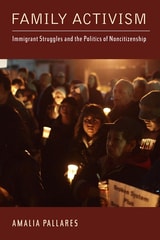
Family Activism
Immigrant Struggles and the Politics of NoncitizenshipPallares, Amalia
Rutgers University Press, 2014
Farm Policy and Trade Conflict
The Uruguay Round and CAP ReformAlan Swinbank and Carolyn Tanner
University of Michigan Press, 1996

Fathers Under Fire
The Revolution in Child Support EnforcementIrwin Garfinkel
Russell Sage Foundation, 1998

Fathers' Fair Share
Helping Poor Men Manage Child Support and FatherhoodEarl S. Johnson
Russell Sage Foundation, 1999
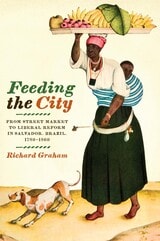
Feeding the City
From Street Market to Liberal Reform in Salvador, Brazil, 1780–1860By Richard Graham
University of Texas Press, 2010
Winner, Bolton-Johnson Prize, Conference on Latin American History, 2011
Murdo J. McLeod Book Prize, 2011
On the eastern coast of Brazil, facing westward across a wide magnificent bay, lies Salvador, a major city in the Americas at the end of the eighteenth century. Those who distributed and sold food, from the poorest street vendors to the most prosperous traders—black and white, male and female, slave and free, Brazilian, Portuguese, and African—were connected in tangled ways to each other and to practically everyone else in the city, and are the subjects of this book. Food traders formed the city's most dynamic social component during the late eighteenth and early nineteenth centuries, constantly negotiating their social place. The boatmen who brought food to the city from across the bay decisively influenced the outcome of the war for Brazilian independence from Portugal by supplying the insurgents and not the colonial army. Richard Graham here shows for the first time that, far from being a city sharply and principally divided into two groups—the rich and powerful or the hapless poor or enslaved—Salvador had a population that included a great many who lived in between and moved up and down.
The day-to-day behavior of those engaged in food marketing leads to questions about the government's role in regulating the economy and thus to notions of justice and equity, questions that directly affected both food traders and the wider consuming public. Their voices significantly shaped the debate still going on between those who support economic liberalization and those who resist it.

Fetal Rights, Women's Rights
Gender Equality in the WorkplaceSuzanne U. Samuels
University of Wisconsin Press, 1995
In the late 1970s and throughout the 1980s, many private employers in the United States enacted fetal protection policies that barred fertile women—that is, women who had not been surgically sterilized—from working in jobs that might expose fetuses to toxins. In Fetal Rights, Women’s Rights, Suzanne Samuels analyzes these policies and the ambiguous responses to them by federal and state courts, legislatures, administrative agencies, litigants, and interest groups. She poses provocative questions about the implicit links between social welfare concerns and paternalism in the workplace, including: are women workers or wombs?
Placing the fetal protection controversy within the larger societal debate about gender roles, Samuels argues that governmental decision-makers confuse sex, which is based solely on biological characteristics, with gender, which is based on societal conceptions. She contends that the debate about fetal protection policies brought this ambiguity into stark relief, and that the response of policy-makers was rooted in assumptions about gender roles. Judges, legislators, and regulators used gender as a proxy, she argues, to sidestep the question of whether fetal protection policies could be justified by the biological differences between women and men.
The fetal protection controversy raises a number of concerns about women's role in the workplace. Samuels discusses the effect on governmental policies of the ongoing controversy over abortion rights and the debates between egalitarian and relational feminists about the treatment of women at work. A timely and engrossing study, Fetal Rights, Women's Rights details the pattern of gender politics in the United States and demonstrates the broader ramifications of gender bias in the workplace.
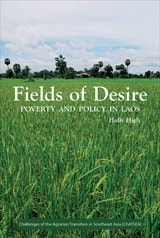
Fields of Desire
Poverty and Policy in LaosHolly High
National University of Singapore Press, 2014
Based on long-term fieldwork in a Lao village that has been the subject of multiple poverty reduction and development programs, High’s account looks at implementation on the ground. While these efforts were laudable in their aims of reducing poverty, they often failed to achieve their objectives. Local people received them with suspicion and disillusionment. Nevertheless, poverty reduction policies continued to be renewed by planners and even desired locally. High relates this to the force of aspirations among rural Lao, ambivalent understandings of power and the “post-rebellious” moment in contemporary Laos.
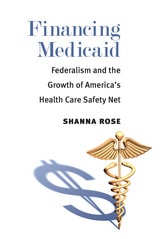
Financing Medicaid
Federalism and the Growth of America's Health Care Safety NetShanna Rose
University of Michigan Press, 2013
Conventional wisdom holds that programs for the poor are vulnerable to instability and retrenchment. Medicaid, however, has grown into the nation’s largest intergovernmental grant program, accounting for nearly half of all federal funding to state and local governments. Medicaid’s generous open-ended federal matching grants have given governors a powerful incentive to mobilize on behalf of its maintenance and expansion, using methods ranging from lobbying and negotiation to creative financing mechanisms and waivers to maximize federal financial assistance. Perceiving federal retrenchment efforts as a threat to states’ finances, governors, through the powerful National Governors’ Association, have repeatedly worked together in bipartisan fashion to defend the program against cutbacks.
Financing Medicaidengagingly intertwines theory, historical narrative, and case studies, drawing on sources including archival materials from the National Governors’ Association and gubernatorial and presidential libraries, Centers for Medicare and Medicaid Services data, the Congressional Record, and interviews.

Fit to Be Tied
Sterilization and Reproductive Rights in America, 1950-1980Kluchin, Rebecca M
Rutgers University Press, 2011
During the first half of the twentieth century, sterilization (tubal ligation and vasectomy) was a tool of eugenics. Individuals who endorsed crude notions of biological determinism sought to control the reproductive decisions of women they considered "unfit" by nature of race or class, and used surgery to do so. Incorporating first-person narratives, court cases, and official records, Rebecca M. Kluchin examines the evolution of forced sterilization of poor women, especially women of color, in the second half of the century and contrasts it with demands for contraceptive sterilization made by white women and men. She chronicles public acceptance during an era of reproductive and sexual freedom, and the subsequent replacement of the eugenics movement with "neo-eugenic" standards that continued to influence American medical practice, family planning, public policy, and popular sentiment.

Fluid Arguments
Five Centuries of Western Water ConflictEdited by Char Miller
University of Arizona Press, 2001
Seventeen contributors—representing history, geography, ethnography, political science, law, and urban studies—provide an interdisciplinary perspective on the many dimensions of water in the West: Spanish colonial water law, Native American water rights, agricultural concerns, and dam building. A concluding essay looks toward the future by examining the impact of cities on water and of water marketing on the western economy.
As farmers and ranchers from Kansas to California compete for water with powerful urban economies, the West will continue to be reshaped by this scarce and precious resource. Fluid Arguments clearly shows that many of the current disputes over water take place without a real appreciation for the long history of the debate. By shedding new light on how water allocation is established—and who controls it—this book makes a vital contribution to our understanding of water and growth in the region.
CONTENTS
Divining the Past: An Introduction / Char Miller
Part 1. Land and Water on New Spain’s Frontiers
1. "Only Fit for Raising Stock": Spanish and Mexican Land and Water Rights in the Tamaulipan Cession / Jesús F. de la Teja
2. Water, the Gila River Pimas, and the Arrival of the Spanish / Shelly C. Dudley
3. "Between This River and That": Establishing Water Rights in the Chama Basin of New Mexico / Sandra K. Mathews-Lamb
Part 2. The Native American Struggle for Water
4. Maggot Creek and Other Tales: Kiowa Identity and Water, 1870-1920 / Bonnie Lynn-Sherow
5. The Dilemmas of Indian Water Policy, 1887-1928 / Donald J. Pisani
6. First in Time: Tribal Reserved Water Rights and General Adjudications in New Mexico / Alan S. Newell
7. Winters Comes Home to Roost / Daniel McCool
Part 3. Agricultural Conundrums
8. Water, Sun, and Cattle: The Chisholm Trail as an Ephemeral Ecosystem / James E. Sherow
9. Private Irrigation in Colorado’s Grand Valley / Brad F. Raley
10. A Rio Grande "Brew": Agriculture, Industry, and Water Quality in the Lower Rio Grande Valley / John P. Tiefenbacher
11. Specialization and Diversification in the Agricultural System of Southwestern Kansas, 1887-1980 / Thomas C. Schafer
12. John Wesley Powell Was Right: Resizing the Ogallala High Plains / John Opie
Part 4. Dam those Waters!
13. Private Initiative, Public Works: Ed Fletcher, the Santa Fe Railway, and Phoenix’s Cave Creek Flood Control Dam / Donald C. Jackson
14. The Changing Fortunes of the Big Dam Era in the American West / Mark Harvey
15. Building Dams and Damning People in the Texas-Mexico Border Region: Mexico’s El Cuchillo Dam Project / Raúl M. Sánchez
Part 5. The Coming Fight
16. Water and the Western Service Economy: A New Challenge / Hal K. Rothman
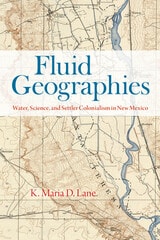
Fluid Geographies
Water, Science, and Settler Colonialism in New MexicoK. Maria D. Lane
University of Chicago Press, 2024
Maria Lane’s Fluid Geographies traces New Mexico’s transition from a community-based to an expert-led system of water management during the pre-statehood era. To understand this major shift, Lane carefully examines the primary conflict of the time, which pitted Indigenous and Nuevomexicano communities, with their long-established systems of irrigation management, against Anglo-American settlers, who benefitted from centralized bureaucratic management of water. The newcomers’ system eventually became settled law, but water disputes have continued throughout the district courts of New Mexico’s Rio Grande watershed ever since.
Using a fine-grained analysis of legislative texts and nearly two hundred district court cases, Lane analyzes evolving cultural patterns and attitudes toward water use and management in a pivotal time in New Mexico’s history. Illuminating complex themes for a general audience, Fluid Geographies helps readers understand how settler colonialism constructed a racialized understanding of scientific expertise and legitimized the dispossession of nonwhite communities in New Mexico.
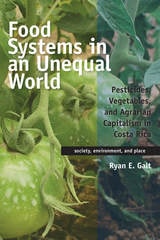
Food Systems in an Unequal World
Pesticides, Vegetables, and Agrarian Capitalism in Costa RicaRyan E. Galt
University of Arizona Press, 2014
Food Systems in an Unequal World examines the agrochemical-dependent agriculture of Costa Rica and how its uneven regulation in export versus domestic markets affects Costa Rican vegetable farmers. Examining pesticide-dependent vegetable production within two food systems, the author shows that pesticide use is shaped by three main forces: agrarian capitalism, the governance of food systems throughout the commodity chain, and ecological dynamics driving local food production. Those processes produce unequal outcomes that disadvantage less powerful producers who have more limited choices than larger farmers, who usually have access to better growing environments and thereby can reduce pesticide use and production costs.
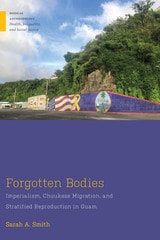
Forgotten Bodies
Imperialism, Chuukese Migration, and Stratified Reproduction in GuamSarah A. Smith
Rutgers University Press, 2024

Fraternal Critique
The Politics of Muslim Community in FranceKirsten Wesselhoeft
University of Chicago Press, 2025
The conversation about Islam in France is framed by the presumption that Muslim communities are a threat to secular solidarity or fraternité. In the face of state repression, French Muslims have not closed ranks around a narrow range of voices; instead, Kirsten Wesselhoeft finds that young Muslim activists have continued to purposefully spark debate about the values that anchor community life. Wesselhoeft argues that such disagreements, far from dividing communities, actually constitute a form of belonging. Some activists call this ethic “fraternal critique,” and Wesselhoeft finds in it profound insights about the place for critique in civic life. The French state has reacted to Muslim solidarity with repression, but Wesselhoeft argues that unity need not come at the expense of dissent. Instead, fraternal critique can teach us how to build communities that are worth fighting over and fighting for.
Free Trade & Uneven Development
North American Apparel Industry After Naftaedited by Gary Gereffi, David Spener and Jennifer Bair
Temple University Press, 2002

Freedom Is Not Enough
The War on Poverty and the Civil Rights Movement in TexasBy William S. Clayson
University of Texas Press, 2010
Led by the Office of Economic Opportunity, Lyndon Johnson's War on Poverty reflected the president's belief that, just as the civil rights movement and federal law tore down legalized segregation, progressive government and grassroots activism could eradicate poverty in the United States. Yet few have attempted to evaluate the relationship between the OEO and the freedom struggles of the 1960s. Focusing on the unique situation presented by Texas, Freedom Is Not Enough examines how the War on Poverty manifested itself in a state marked by racial division and diversity—and by endemic poverty.
Though the War on Poverty did not eradicate destitution in the United States, the history of the effort provides a unique window to examine the politics of race and social justice in the 1960s. William S. Clayson traces the rise and fall of postwar liberalism in the Lone Star State against a backdrop of dissent among Chicano militants and black nationalists who rejected Johnson's brand of liberalism. The conservative backlash that followed is another result of the dramatic political shifts revealed in the history of the OEO, completing this study of a unique facet in Texas's historical identity.
Freedom and Despair
Notes from the South Hebron HillsDavid Shulman
University of Chicago Press, 2018
David Shulman knows intimately what it takes to live your beliefs, to return, day after day, to the struggle, despite knowing you are often more likely to lose than win. Interweaving powerful stories and deep meditations, Freedom and Despair offers vivid firsthand reports from the occupied West Bank in Palestine as seen through the eyes of an experienced Israeli peace activist who has seen the Israeli occupation close up as it impacts on the lives of all Palestinian civilians.
Alongside a handful of beautifully written and often shocking tales from the field, Shulman meditates deeply on how to understand the evils around him, what it means to persevere as an activist decade after decade, and what it truly means to be free. The violent realities of the occupation are on full display. We get to know and understand the Palestinian shepherds and farmers and Israeli volunteers who face this situation head-on with nonviolent resistance. Shulman does not hold back on acknowledging the daily struggles that often leave him and his fellow activists full of despair. Inspired by these committed individuals who are not prepared to be silent or passive, Shulman suggests a model for ordinary people everywhere. Anyone prepared to take a risk and fight their oppressive political systems, he argues, can make a difference—if they strive to act with compassion and to keep hope alive.
This is the moving story of a man who continues to fight for good in the midst of despair. An indispensable book in our era of reactionary politics and refugee crises, political violence and ecological devastation, Freedom and Despair is a gripping memoir of struggle, activism, and hope for peace.

French DNA
Trouble in PurgatoryPaul Rabinow
University of Chicago Press, 1999
From Good Will To Civil Rights
Transforming Federal Disability PolicyRichard K. Scotch
Temple University Press, 2001
The first edition of From Good Will to Civil Rights traced the changes in federal disability policy, focusing on the development and implementation of Section 504 of the Rehabilitation Act of 1973. Richard K. Scotch's extensive interviews with policymakers, leaders of the disability rights movement, and other advocates, supplemented the sketchy official history of the legislation with the detailed, behind-the-scenes story, illuminating the role of the disability rights movement in shaping Section 504. Charting the shifts in policy and activist agendas through the 1990's, this new edition surveys the effects and disappointments associated with the Americans with Disabilities Act, passed in 1990, in the context of the continuing movement to secure civil rights for disabled people.

From good will to civil rights
transforming federal disability policyRichard K. Scotch
Temple University Press, 1984

Frontiers Of Illusion
Science, Technology, and the Politics of ProgressDaniel Sarewitz
Temple University Press, 1996
For the past fifty years, science and technology—supported with billions of dollars from the U.S. government—have advanced at a rate that would once have seemed miraculous, while society's problems have grown more intractable, complex, and diverse. Yet scientists and politicians alike continue to prescribe more science and more technology to cure such afflictions as global climate change, natural resource depletion, overpopulation, inadequate health care, weapons proliferation, and economic inequality.
Daniel Sarewitz scrutinizes the fundamental myths that have guided the formulation of science policy for half a century—myths that serve the professional and political interests of the scientific community, but often fail to advance the interests of society as a whole. His analysis ultimately demonstrates that stronger linkages between progress in science and progress in society will require research agendas that emerge not from the intellectual momentum of science, but from the needs and goals of society.
Fuel for Growth
Water and Arizona's Urban EnvironmentDouglas E. Kupel
University of Arizona Press, 2003
Fuel for Growth describes and interprets the history of water resource development and its relationship to urban development in Arizona's three signature cities: Phoenix, Tucson, and Flagstaff. These three urban areas could hardly be more different: a growth-oriented metropolis, an environmentally conscious city with deep cultural roots, and an outdoor-friendly mountain town. Despite these differences, their community leaders and public officials have taken similar approaches to developing water resources with varying degrees of success and acceptance.
Douglas Kupel has created a new vision of water history based on the Arizona experience. He challenges many of the traditional assumptions of environmental history by revealing that the West's aridity has had relatively little impact on the development of municipal water infrastructure in these cities. While urban growth in the West is often characterized as the product of an elite group of water leaders, the development of Arizona's cities is shown to reflect the broad aspirations of all their citizens.
The book traces water development from the era of private water service to municipal ownership of water utilities and examines the impact of the post-World War II boom and subsequent expansion. Taking in the Salt River Project, the Central Arizona Project, and the Groundwater Management Act of 1980, Kupel explores the ongoing struggle between growth and environmentalism. He advocates public policy measures that can sustain a water future for the state.
As the urban West enters a new century of water management, Arizona's progress will increasingly be tied to that of its ever-expanding cities. Fuel for Growth documents an earlier era of urban water use and provides important recommendations for the future path of water development in the West's key population centers.

Future Sea
How to Rescue and Protect the World’s OceansDeborah Rowan Wright
University of Chicago Press, 2020
The world’s oceans face multiple threats: the effects of climate change, pollution, overfishing, plastic waste, and more. Confronted with the immensity of these challenges and of the oceans themselves, we might wonder what more can be done to stop their decline and better protect the sea and marine life. Such widespread environmental threats call for a simple but significant shift in reasoning to bring about long-overdue, elemental change in the way we use ocean resources. In Future Sea, ocean advocate and marine-policy researcher Deborah Rowan Wright provides the tools for that shift. Questioning the underlying philosophy of established ocean conservation approaches, Rowan Wright lays out a radical alternative: a bold and far-reaching strategy of 100 percent ocean protection that would put an end to destructive industrial activities, better safeguard marine biodiversity, and enable ocean wildlife to return and thrive along coasts and in seas around the globe.
Future Sea is essentially concerned with the solutions and not the problems. Rowan Wright shines a light on existing international laws intended to keep marine environments safe that could underpin this new strategy. She gathers inspiring stories of communities and countries using ocean resources wisely, as well as of successful conservation projects, to build up a cautiously optimistic picture of the future for our oceans—counteracting all-too-prevalent reports of doom and gloom. A passionate, sweeping, and personal account, Future Sea not only argues for systemic change in how we manage what we do in the sea but also describes steps that anyone, from children to political leaders (or indeed, any reader of the book), can take toward safeguarding the oceans and their extraordinary wildlife.