Results by title
1031 books match the query 'Intellectual life' and 39 start with f
FEMALE TRADITION IN SOUTHERN LITERATURE
Carol S. Manning
University of Illinois Press, 1993
essays reclaim women's traditions which have been neglected by critics who ought to have known
better." -- Kathryn Lee Seidel, author of The Southern Belle in the American Novel
Facundo and the Construction of Argentine Culture
By Diana Sorensen Goodrich
University of Texas Press, 1996
Domingo F. Sarmiento's classic 1845 essay Facundo, Civilizacion y Barbarie opened an inquiry into the nature of Argentinian culture that continues to the present day. In this elegantly written study, Diana Sorensen Goodrich explores the varied, and often conflicting, readings that Facundo has received since its publication and shows how these readings have contributed to the making and remaking of the Argentine nation and its culture.
Goodrich's analysis sheds new light on the intersection between canon formation and nation-building. While much has been written about Facundo as a primary text in Latin American letters, this is the first study that locates it within the problematics of canon formation and the cultural, social, and political contexts in which conflicting interpretations are constructed.
This new approach to Facundo illuminates the interactions among institutions, cultural ideologies, and political life. This book will be important reading for everyone interested in questions of national identity and the institutionalization of a national tradition.
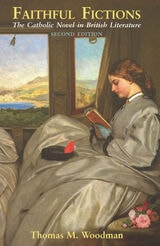
Faithful Fictions
The Catholic Novel in British LiteratureThomas M. Woodman
Catholic University of America Press, 2022
Faithful Passages
American Catholicism in Literary Culture, 1844–1931James Emmett Ryan
University of Wisconsin Press, 2013
Faithful Passages also reveals new dimensions in American religious literary culture by moving beyond the antebellum period to consider how the first important cohort of Catholic writers shaped their message for subsequent generations of readers in the late nineteenth and early twentieth centuries. Perhaps most strikingly, Ryan shows that by the early twentieth century, Roman Catholic themes and traditions in American literature would be advanced in complex ways by mainstream, non-Catholic modernist writers like Kate Chopin and Willa Cather.
Catholic literary culture in the United States took shape in a myriad of ways and at the hands of diverse participants. The process by which Roman Catholic ideas, themes, and moralities were shared and adapted by writers with highly differentiated beliefs, Ryan contends, illuminates a surprising fluidity of religious commitment and expression in early U.S. literary culture.
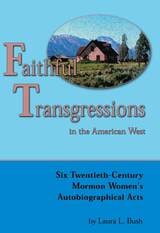
Faithful Transgressions In The American West
Six Twentieth-Century Mormon Women's Autobiographical ActsLaura L. Bush
Utah State University Press, 2004
The central issue Bush finds in these works is how their authors have dealt with the authority of Mormon Church leaders. As she puts it in her preface, "I use the phrase 'faithful transgression' to describe moments in the texts when each writer, explicitly or implicitly, commits herself in writing to trust her own ideas and authority over official religious authority while also conceiving of and depicting herself to be a 'faithful' member of the Church." Bush recognizes her book as her own act of faithful transgression. Writing it involved wrestling, she states, "with my own deeply ingrained religious beliefs and my equally compelling education in feminist theories that mean to liberate and empower women."
Faithful Transgressions examines a remarkable group of authors and their highly readable and entertaining books. In producing the first significant book-length study of Mormon women's autobiographical writing, Bush rides a wave of memoir publishing and academic interest in autobiography and other life narratives. As she elucidates these works in relation to the religious tradition that played a major role in shaping them, she not only positions them in relation to feminist theory and current work on women's life writings but ties them to the long literary tradition of spiritual autobiography.

Fault Lines and Controversies in the Study of Seventeenth-Century English Literature
Edited & Intro Claude J. Summers & Ted-Lary Pebworth
University of Missouri Press, 2002
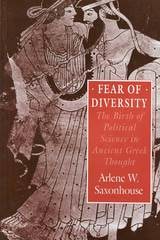
Fear of Diversity
The Birth of Political Science in Ancient Greek ThoughtArlene W. Saxonhouse
University of Chicago Press, 1992
Saxonhouse opens up fresh understandings of such issues as the Greeks' fear of the feminine and their attempts to ignore the demands that gender, reproduction, and the family inevitably make on the individual.
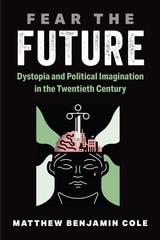
Fear the Future
Dystopia and Political Imagination in the Twentieth CenturyMatthew Benjamin Cole
University of Michigan Press, 2025
Offering a novel reading of major themes and thinkers, Fear the Future explores visions of the future from literary figures such as Yevgeny Zamyatin, Aldous Huxley, and George Orwell; political theorists such as Max Weber, Hannah Arendt, Herbert Marcuse, Jürgen Habermas, and Michel Foucault; and mid-century social scientists such as Erich Fromm, Max Horkheimer, Theodor Adorno, David Reisman, C. Wright Mills, and Jacques Ellul. It offers a comparative analysis of distinct intellectual and literary traditions, including modern utopianism and anti-utopianism, midcentury social science, Frankfurt School critical theory, and continental political philosophy. With detailed case studies of key thinkers from the Enlightenment to the late twentieth century, the book synthesizes secondary literature and research from a range of disciplinary areas, including in political theory, intellectual history, literary studies, and utopian studies. This wide-ranging reconstruction shows that while dystopian thinking has illustrated the dangers of domination and dehumanization, it has also illuminated new possibilities for freedom.
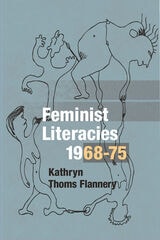
Feminist Literacies, 1968-75
Kathryn Thoms Flannery
University of Illinois Press, 2010
In the late 1960s and early 1970s, ordinary women affiliated with the women's movement were responsible for a veritable explosion of periodicals, poetry, and manifestos, as well as performances designed to support "do-it-yourself" education and consciousness-raising. Kathryn Thoms Flannery discusses this outpouring and the group education, brainstorming, and creative activism it fostered as the manifestation of a feminist literacy quite separate from women's studies programs at universities or the large-scale political workings of second-wave feminism. Seeking to break down traditional barriers such as the dichotomies of writer/reader or student/teacher, these new works also forged polemical alternatives to the forms of argumentation traditionally used to silence women, creating a space for fresh voices. Feminist Literacies explores these truly radical feminist literary practices and pedagogies that flourished during a brief era of volatility and hope.
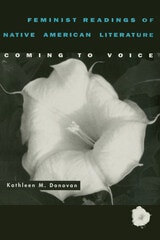
Feminist Readings of Native American Literature
Coming to VoiceKathleen M. Donovan
University of Arizona Press, 1998
The author demonstrates how Canadian women of mixed-blood ancestry achieve a voice through autobiographies and autobiographical novels. Using a framework of feminist reader response theory, she considers an underlying misogyny in the writings of N. Scott Momaday. And in examining commonalities between specific cultures, she discusses how two women of color, Paula Gunn Allen and Toni Morrison, explore representations of femaleness in their respective cultures. By synthesizing a broad spectrum of critical writing that overlaps women's voices and Native American literature, Donovan expands on the frame of dialogue within feminist literary and cultural theory. Drawing on the related fields of ethnography, ethnopoetics, ecofeminism, and post-colonialism, Feminist Readings of Native American Literature offers the first systematic study of the intersection between two dynamic arenas in literary studies today.
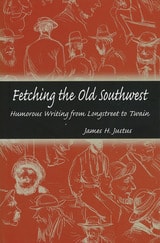
Fetching the Old Southwest
Humorous Writing from Longstreet to TwainJames H. Justus
University of Missouri Press, 2004
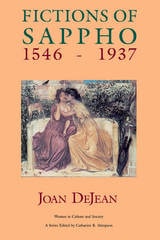
Fictions of Sappho, 1546-1937
Joan DeJean
University of Chicago Press, 1989
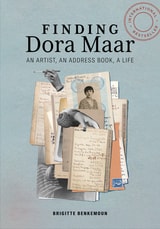
Finding Dora Maar
An Artist, an Address Book, a LifeBrigitte Benkemoun
J. Paul Getty Trust, The, 2020
“[A] spirited and deeply researched project…. [Benkemoun’s] affection for her subject is infectious. This book gives a satisfying treatment to a woman who has been confined for decades to a Cubist’s limited interpretation.” — Joumana Khatib, The New York Times
Merging biography, memoir, and cultural history, this compelling book, a bestseller in France, traces the life of Dora Maar through a serendipitous encounter with the artist’s address book.
In search of a replacement for his lost Hermès agenda, Brigitte Benkemoun’s husband buys a vintage diary on eBay. When it arrives, she opens it and finds inside private notes dating back to 1951—twenty pages of phone numbers and addresses for Balthus, Brassaï, André Breton, Jean Cocteau, Paul Éluard, Leonor Fini, Jacqueline Lamba, and other artistic luminaries of the European avant-garde.
After realizing that the address book belonged to Dora Maar—Picasso’s famous “Weeping Woman” and a brilliant artist in her own right—Benkemoun embarks on a two-year voyage of discovery to learn more about this provocative, passionate, and enigmatic woman, and the role that each of these figures played in her life.
Longlisted for the prestigious literary award Prix Renaudot, Finding Dora Maar is a fascinating and breathtaking portrait of the artist.
This work received support from the French Ministry of Foreign Affairs and the Cultural Services of the French Embassy in the United States through their publishing assistance program.
First Books
The Printed Word and Cultural Formation in Early AlabamaPhilip D. Beidler
University of Alabama Press, 1999
Early 19th-century Alabama was a society still in the making. Now Philip Beidler tells how the first books written and published in the state influenced the formation of Alabama's literary and political culture. As Beidler shows, virtually overnight early Alabama found itself in possession of the social, political, and economic conditions required to jump start a traditional literary culture in the old Anglo-European model: property-based class relationships, large concentrations of personal wealth, and professional and merchant classes of similar social, political, educational, and literary views.

Fleshing the Archive
An Intimate Genealogy of Chicana Knowledge PraxisMaría Eugenia Cotera
University of Texas Press, 2025
The history of the Chicana por mi Raza Digital Memory Collective, an archive dedicated to preserving Chicana feminist knowledge of the 1970s and memory work.
The late 1960s and early 1970s witnessed an explosion of publishing by Chicana activists as they took part in the Movimiento against oppression of ethnic Mexicans in the United States. Today, thousands of these documents, including written works and oral histories, have been assembled by the Chicana por mi Raza Digital Memory Collective. Drawing on these unique resources, Fleshing the Archive traces the innovative Chicana knowledge projects of the Movimiento years.
Seeking to think with the past rather than about it, María Cotera explores transgressive sites and discourses of Chicana knowledge, from poems and essays to newspapers, bibliographies, and testimonies. Often published independently and distributed by readers themselves, these works embodied a praxis of feminist and queer consciousness-raising. Observing the startling convergences between Chicana praxis of the 1970s and digital knowledge production in the present, Cotera argues that the Chicana archive enables transformative moments of recognition across time that unsettle supposedly objective accounts of history. The materials preserved by Chicana por mi Raza offer Chicana scholars a model of teaching and learning liberated from a corporate academy that is increasingly hostile to intellectual inquiry.
Folklore in New World Black Fiction
Writing and the Oral Traditional AestheticsChiji Akoma
The Ohio State University Press, 2007
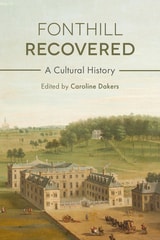
Fonthill Recovered
A Cultural HistoryEdited by Caroline Dakers
University College London, 2018
Fonthill Recovered draws on new research to explore the rich cultural history of this place where little remains today—a tower, a stable block, the ruins of what was once a kitchen, and an indentation in a field. The first half of the book traces the occupation of Fonthill from the Bronze Age to the twenty-first century. Some of the owners surpassed Beckford in terms of their wealth and political power—and even, in one case, their sexual proclivities. They include Charles I’s Chancellor of the Exchequer and the richest British commoner of the nineteenth century. The second half of the book consists of essays on specific topics, examining such crucial areas as the complex history of the designed landscape, the sources of the Beckfords’ wealth and their extensive art collection, and the recent appearance of the Abbey in a video game.

Forgotten Friendships
Yugoslavia and the Anticolonial Francophone WorldAlexandra Perišic
Amherst College Press, 2025
Forgotten Friendships: Yugoslavia and the Anticolonial Francophone World examines transnational friendships and alliances between intellectuals from Yugoslavia and the Francophone African and Caribbean world during the mid-twentieth century. The book argues that transnational political friendships helped shape major intellectual movements like Négritude, African socialism, and global socialist feminisms, which surged beyond national, regional, and even diasporic spaces. Blending archival research, literary analysis, and biography, the book fills a significant gap in our understanding of how intellectuals from the Global South and the socialist world collaborated on shared goals of decolonization, anti-racism, and socialist worldmaking.
Forgotten Friendships emphasizes the ways in which writers, intellectuals, and activists envisioned alternative futures rooted in collaboration across peripheries. Personal bonds of friendship were not mere footnotes to the anti-colonial struggle, but vital political tools for rethinking global solidarity.
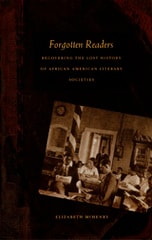
Forgotten Readers
Recovering the Lost History of African American Literary SocietiesElizabeth McHenry
Duke University Press, 2002
Forgotten Readers expands our definition of literacy and urges us to think of literature as broadly as it was conceived of in the nineteenth century. Elizabeth McHenry delves into archival sources, including the records of past literary societies and the unpublished writings of their members. She examines particular literary associations, including the Saturday Nighters of Washington, D.C., whose members included Jean Toomer and Georgia Douglas Johnson. She shows how black literary societies developed, their relationship to the black press, and the ways that African American women’s clubs—which flourished during the 1890s—encouraged literary activity. In an epilogue, McHenry connects this rich tradition of African American interest in books, reading, and literary conversation to contemporary literary phenomena such as Oprah Winfrey’s book club.
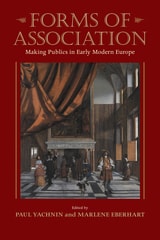
Forms of Association
Making Publics in Early Modern EuropePaul Yachnin
University of Massachusetts Press, 2015
In today's connected and interactive world, it is hard to imagine a time when cultural and intellectual interests did not lead people to associate with others who shared similar views and preoccupations. In this volume of essays, fifteen scholars explore how these kinds of relationships began to transform early modern European culture.
Forms of Association grows out of the “Making Publics: Media, Markets, and Association in Early Modern Europe” (MaPs) project, funded by the Social Sciences and Humanities Research Council of Canada. This scholarly initiative convened an interdisciplinary research team to consider how “publics”—new forms of association built on the shared interests of individuals—developed in Europe from 1500 to 1700. Drawing on a wide array of texts and histories, including the plays of Shakespeare, the legend of Robin Hood, paintings, and music as well as English gossip about France, the contributors develop a historical account of what publics were in early modern Europe. This collaborative study provides a dynamic way of understanding the political dimensions of artistic and intellectual works and opens the way toward a new history of early modernity.
Until his death in 2008, the great Renaissance scholar Richard Helgerson was a key participant in the MaPs project. The scholars featured in this volume originally met in Montreal to engage in a critical, commemorative conversation about Helgerson's work, the issues and questions coming out of the MaPs project, and how Helgerson's thinking advanced and could in turn be advanced by MaPs. This collection represents the fruits of that conversation.
Foundations of Black Epistemology
Knowledge Discourse in Africana PhilosophyAdebayo Oluwayomi
Temple University Press, 2025
Foundations of Black Epistemology examines writings by Phillis Wheatley, Frederick Douglass, Ida B. Wells, W.E.B. DuBois, Frantz Fanon, Steve Bantu Biko, Huey P. Newton, and Kathleen Neal Cleaver. Each chapter addresses issues of self-knowledge, self-assertion, Black consciousness, or anticolonialism and its relation to personal and political epistemologies.
Oluwayomi offers innovative perspectives on the formulation, deduction, and interrogation of epistemological themes within Black Africana philosophy. By considering the important epistemological theories and arguments in Black philosophy particularly in the last 150 to 200 years, Foundations of Black Epistemology promises to generate new discussions around this necessary field of Black Africana philosophy.

Fourth of July, Asbury Park
A History of the Promised LandDaniel Wolff
Rutgers University Press, 2022
Fourth of July, Asbury Park tells the tale of the city’s first 150 years, guiding us through the development of its lavish amusement parks and bandstands, as well as the decay of its working-class neighborhoods and spread of its racially-segregated ghettos. Featuring exclusive interviews with Springsteen and other prominent Asbury Park residents, Daniel Wolff uncovers the history of how this Jersey shore resort town came to epitomize both the promises of the American dream and the tragic consequences when those promises are broken.
Hailed by The New York Times as a “wonderfully evocative…grand, sad story” when first published in 2006, this revised and expanded edition considers how Asbury Park has changed in the twenty-first century, experiencing both gentrification and new forms of segregation.
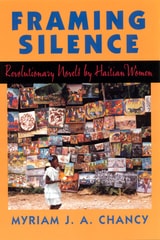
Framing Silence
Revolutionary Novels by Haitian WomenChancy, Myriam J
Rutgers University Press, 1992
Raped and colonized, coerced and silenced--this has been the position of Haitian women within their own society, as well as how they have been seen by foreign occupiers. Romanticized symbols of nationhood, they have served, however unwillingly, as a politicized site of contestation between opposing forces.
In this first book-length study in English devoted exclusively to Haitian women's literature, Myriam Chancy finds that Haitian women have their own history, traditions, and stories to tell, tales that they are unwilling to suppress or subordinate to narratives of national autonomy. Issues of race, class, color, caste, nationality, and sexuality are all central to their fiction--as is an urgent sense of the historical place of women between the two U.S. occupations of the country. Their novels interrogate women's social and political stance in Haiti from an explicitly female point of view, forcefully responding to overt sexual and political violence within the nation's ambivalent political climate. Through daring and sensitive readings, simultaneously historical, fictional and autobiographical, Chancy explores this literature, seeking to uncover answers to the current crisis facing these women today, both within their country and in exile.The writers surveyed include Anne-christine d'Adesky, Ghislaine Rey Charlier, Marie Chauvet, Jan J. Dominique, Nadine Magloire, and Edwidge Danticat, whose work has recently achieved such high acclaim.
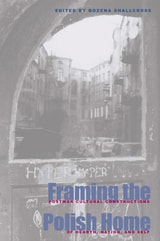
Framing the Polish Home
Postwar Cultural Constructions of Hearth, Nation, and SelfBozena Shallcross
Ohio University Press, 2002
As the subject of ideological, aesthetic, and existential manipulations, the Polish home and its representation is an ever-changing phenomenon that absorbs new tendencies and, at the same time, retains its centrality to Polish literature, whether written in Poland or abroad. Framing the Polish Home is a pioneering work that explores the idea of home as fundamental to the question of cultural and national identity within Poland's recent history and its tradition.
In this inaugural volume of the Polish and Polish-American Studies Series, the Polish home emerges in its rich verbal and visual representations and multiple material embodiments, as the discussion moves from the loss of the home during wartime to the Sovietized politics of housing and from the exilic strategies of having a home to the the idyllic evocation of the abodes of the past.
Although, as Bożena Shallcross notes in her introduction, “few concepts seem to have such universal appeal as the notion of the home,” this area of study is still seriously underdeveloped. In essays from sixteen scholars, Framing the Polish Home takes a significant step to correct that oversight, covering a broad range of issues pertinent to the discourse on the home and demonstrating the complexity of the home in Polish literature and culture.
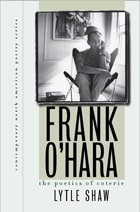
Frank O'Hara
The Poetics of CoterieLytle Shaw
University of Iowa Press, 2006
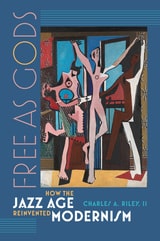
Free as Gods
How the Jazz Age Reinvented ModernismCharles A. Riley
University Press of New England, 2017

Free-Market Socialists
European Émigrés Who Made Capitalist Culture in America, 1918–1968Joseph Malherek
Central European University Press, 2022
The Hungarian artist-designer László Moholy-Nagy, the Austrian sociologist Paul Lazarsfeld, and his fellow Viennese Victor Gruen—an architect and urban planner—made careers in different fields. Yet they shared common socialist politics, Jewish backgrounds, and experience as refugees from the Nazis. This book tells the story of their intellectual migration from Central Europe to the United States, beginning with the collapse of the Habsburg Empire, and moving through the heady years of newly independent social-democratic republics before the descent into fascism. It follows their experience of exile and adaptation in a new country, and culminates with a surprising outcome of socialist thinking: the opening of the first fully enclosed, air-conditioned suburban shopping center in the United States. Although the American culture they encountered ostensibly celebrated entrepreneurial individualism and capitalistic “free enterprise,” Moholy-Nagy, Lazarsfeld, and Gruen arrived at a time of the progressive economic reforms of the New Deal and an extraordinary open-mindedness about social democracy. This period of unprecedented economic experimentation nurtured a business climate that, for the most part, did not stifle the émigrés’ socialist idealism but rather channeled it as the source of creative solutions to the practical problems of industrial design, urban planning, and consumer behavior.
Based on a vast array of original sources, Malherek interweaves the biographies of these three remarkable personalities and those of their wives, colleagues, and friends with whom they collaborated on innovative projects that would shape the material environment and consumer culture of their adopted home. The result is a narrative of immigration and adaptation that challenges the crude binary of capitalism and socialism with a story of creative economic hybridization.

Freedom with Violence
Race, Sexuality, and the US StateChandan Reddy
Duke University Press, 2011
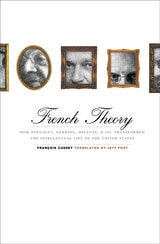
French Theory
How Foucault, Derrida, Deleuze, & Co. Transformed the Intellectual Life of the United StatesFrancois Cusset
University of Minnesota Press, 2008
“A great story, full of twists and turns. . . . Careers made and ruined, departments torn apart, writing programs turned into sensitivity seminars, political witch hunts, public opprobrium, ignorant media attacks, the whole ball of wax. Read it and laugh or read it and weep. I can hardly wait for the movie.” —Stanley Fish, Think Again, New York Times
“In such a difficult genre, full of traps and obstacles, French Theory is a success and a remarkable book in every respect: it is fair, balanced, and informed. I am sure this book will become the reference on both sides of the Atlantic.” —Jacques Derrida
“The Atlantic Ocean has two sides, and so does French Theory. Reinvented in America and betrayed in its own country, it has become the most radical intellectual movement in the West with global reach, rewriting Marx in light of late capitalism. Breathtakingly moving back and forth between the two cultures, Francois Cusset takes us through a dazzling intellectual adventure that illuminates the past thirty years, and many more decades to come.” —Sylvere Lotringer
During the last three decades of the twentieth century, a disparate group of radical French thinkers achieved an improbable level of influence and fame in the United States. Compared by at least one journalist to the British rock ‘n’ roll invasion, the arrival of works by Michel Foucault, Jacques Derrida, Jean-François Lyotard, Jean Baudrillard, Gilles Deleuze, and Félix Guattari on American shores in the late 1970s and 1980s caused a sensation.
Outside the academy, “French theory” had a profound impact on the era’s emerging identity politics while also becoming, in the 1980s, the target of right-wing propagandists. At the same time in academic departments across the country, their poststructuralist form of radical suspicion transformed disciplines from literature to anthropology to architecture. By the 1990s, French theory was woven deeply into America’s cultural and intellectual fabric.
French Theory is the first comprehensive account of the American fortunes of these unlikely philosophical celebrities. François Cusset looks at why America proved to be such fertile ground for French theory, how such demanding writings could become so widely influential, and the peculiarly American readings of these works. Reveling in the gossipy history, Cusset also provides a lively exploration of the many provocative critical practices inspired by French theory. Ultimately, he dares to shine a bright light on the exultation of these thinkers to assess the relevance of critical theory to social and political activism today-showing, finally, how French theory has become inextricably bound with American life.
François Cusset, a writer and intellectual historian, teaches contemporary French thought in Paris at the Institut d’Etudes Politiques and at Columbia University’s Reid Hall. His books include Queer Critics and La Décennie.
Jeff Fort is assistant professor of French at the University of California, Davis. He has translated works by Maurice Blanchot, Jean Genet, and Jean-Luc Nancy.

From Behind the Veil
A STUDY OF AFRO-AMERICAN NARRATIVERobert B. Stepto
University of Illinois Press, 1991

From Black to Schwarz
Cultural Crossovers Between African America and GermanyMaria I. Diedrich
Michigan State University Press, 2011
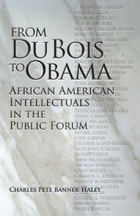
From Du Bois to Obama
African American Intellectuals in the Public ForumCharles Pete Banner-Haley
Southern Illinois University Press, 2014
In his groundbreaking new book Charles Pete Banner-Haley explores the history of African American intellectualism and reveals the efforts of black intellectuals in the ongoing struggle against racism, showing how they have responded to Jim Crow segregation, violence against black Americans, and the more subtle racism of the postintegration age. Banner-Haley asserts that African American intellectuals—including academicians, social critics, activists, and writers—serve to generate debate, policy, and change, acting as a moral force to persuade Americans to acknowledge their history of slavery and racism, become more inclusive and accepting of humanity, and take responsibility for social justice.
Other topics addressed in this insightful study include the disconnection over time between black intellectuals and the masses for which they speak; the ways African American intellectuals identify themselves in relation to the larger black community, America as a whole, and the rest of the world; how black intellectuals have gained legitimacy in American society and have accrued moral capital, especially in the area of civil rights; and how that moral capital has been expended. Among the influential figures covered in the book are W. E. B. Du Bois, Ralph Ellison, Richard Wright, James Weldon Johnson, E. Franklin Frazier, Ralph Bunche, Oliver C. Cox, George S. Schuyler, Zora Neale Hurston, Martin Luther King, Jr., Jesse Jackson, Cornel West, Toni Morrison, bell hooks, Charles Johnson, and Barack Obama.
African American intellectuals, as Banner-Haley makes clear, run the political gamut from liberal to conservative. He discusses the emergence of black conservatism, with its accompanying questions about affirmative action, government intervention on behalf of African Americans, and the notion of a color-blind society. He also looks at how popular music—particularly rap and hip-hop—television, movies, cartoons, and other media have functioned as arenas for investigating questions of identity, exploring whether African American intellectuals can also be authentically black.
A concluding discussion of the so-called browning of America, and the subsequent rise in visibility and influence of black intellectuals culminates with the historic election of President Barack Obama, an African American intellectual who has made significant contributions to American society through his books, articles, and speeches. Banner-Haley ponders what Obama’s election will mean for the future of race relations and black intellectualism in America.

From Mammies to Militants
Domestics in Black American Literature from Charles Chesnutt to Toni MorrisonTrudier Harris
University of Alabama Press, 2023
From Charles Chesnutt’s The Marrow of Tradition to Toni Morrison’s The Bluest Eye, Black writers, some of whom worked as maids themselves, have manipulated the stereotype in a strategic way as a figure to comment on Black-white relations or to dramatize the conflicts of the Black protagonists. In fact, the characters themselves, like real-life maids, often use the stereotype to their advantage or to trick their oppressors.
Harris combines folkloristic, sociological, historical, and psychological analyses with literary ones, drawing on her own interviews with Black women who worked as domestics. She explores the differences between Northern and Southern maids and between “mammy” and “militant.” Her invaluable book provides a sweeping exploration of Black American writers of the twentieth century, with extended discussion of works by Charles Chesnutt, Kristin Hunter, Toni Morrison, Richard Wright, Ann Petry, William Melvin Kelley, Alice Childress, John A. Williams, Douglas Turner Ward, Barbara Woods, Ted Shine, and Ed Bullins. Often privileging political statements over realistic characterization in the design of their texts, the authors in Harris’s study urged Black Americans to take action to change their powerless conditions, politely if possible, violently if necessary. Through their commitment to improving the conditions of Black people in America, these writers demonstrate the connectedness of art and politics.
In her new afterword, “From Militants to Movie Stars,” Harris looks at domestic workers in African American literature after the original publication of her book in 1982. Exploring five subsequent literary treatments of Black domestic workers from Ernest J. Gaines’s A Lesson Before Dying to Lynn Nottage’s By the Way, Meet Vera Stark, Harris tracks how the landscape of representation of domestic workers has broken with tradition and continues to transform into something entirely new.
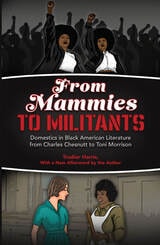
From Mammies to Militants
Domestics in Black American Literature from Charles Chesnutt to Toni MorrisonTrudier Harris
University of Alabama Press, 2023
Unmasking stereotypes and reclaiming identity of Black Womanhood in American Culture.
Welfare queen, hot momma, unwed mother: these stereotypes of Black women share their historical conception in the image of the Black woman as domestic. Focusing on the issue of stereotypes, the new edition of Trudier Harris’s classic 1982 study From Mammies to Militants examines the position of the domestic in Black American literature with a new afterword bringing her analysis into the present.
From Charles Chesnutt’s The Marrow of Tradition to Toni Morrison’s The Bluest Eye, Black writers, some of whom worked as maids themselves, have manipulated the stereotype in a strategic way as a figure to comment on Black-white relations or to dramatize the conflicts of the Black protagonists. In fact, the characters themselves, like real-life maids, often use the stereotype to their advantage or to trick their oppressors.
Harris combines folkloristic, sociological, historical, and psychological analyses with literary ones, drawing on her own interviews with Black women who worked as domestics. She explores the differences between Northern and Southern maids and between “mammy” and “militant.” Her invaluable book provides a sweeping exploration of Black American writers of the twentieth century, with extended discussion of works by Charles Chesnutt, Kristin Hunter, Toni Morrison, Richard Wright, Ann Petry, William Melvin Kelley, Alice Childress, John A. Williams, Douglas Turner Ward, Barbara Woods, Ted Shine, and Ed Bullins. Often privileging political statements over realistic characterization in the design of their texts, the authors in Harris’s study urged Black Americans to take action to change their powerless conditions, politely if possible, violently if necessary. Through their commitment to improving the conditions of Black people in America, these writers demonstrate the connectedness of art and politics.
In her new afterword, “From Militants to Movie Stars,” Harris looks at domestic workers in African American literature after the original publication of her book in 1982. Exploring five subsequent literary treatments of Black domestic workers from Ernest J. Gaines’s A Lesson Before Dying to Lynn Nottage’s By the Way, Meet Vera Stark, Harris tracks how the landscape of representation of domestic workers has broken with tradition and continues to transform into something entirely new.

From Page to Place
American Literary Tourism and the Afterlives of AuthorsJennifer Harris
University of Massachusetts Press, 2017
Literary tourism has existed in the United States since at least the early nineteenth century, and now includes sites in almost every corner of the country. From Page to Place examines how Americans have taken up this form of tourism, offering an investigation of the places and practices of literary tourism from literary scholars, historians, tour guides, and collectors. The essays here begin to trace for the first time the histories of some of these sites, the rituals associated with literary tourism, and the ways readers and visitors consume popular literature through touristic endeavors.
In addition to the editors, contributors include Rebecca Rego Barry, Susann Bishop, Ben de Bruyn, Erin Hazard, Caroline Hellman, Michelle McClellan, Mara Scanlon, and Klara-Stephanie Szlezák.
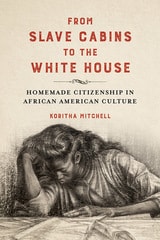
From Slave Cabins to the White House
Homemade Citizenship in African American CultureKoritha Mitchell
University of Illinois Press, 2021
Koritha Mitchell analyzes canonical texts by and about African American women to lay bare the hostility these women face as they invest in traditional domesticity. Instead of the respectability and safety granted white homemakers, black women endure pejorative labels, racist governmental policies, attacks on their citizenship, and aggression meant to keep them in "their place."
Tracing how African Americans define and redefine success in a nation determined to deprive them of it, Mitchell plumbs the works of Frances Harper, Zora Neale Hurston, Lorraine Hansberry, Toni Morrison, Michelle Obama, and others. These artists honor black homes from slavery and post-emancipation through the Civil Rights era to "post-racial" America. Mitchell follows black families asserting their citizenship in domestic settings while the larger society and culture marginalize and attack them, not because they are deviants or failures but because they meet American standards.
Powerful and provocative, From Slave Cabins to the White House illuminates the links between African American women's homemaking and citizenship in history and across literature.
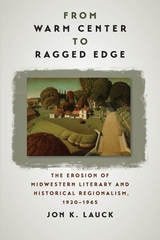
From Warm Center to Ragged Edge
The Erosion of Midwestern Literary and Historical Regionalism, 1920-1965Jon K. Lauck
University of Iowa Press, 2017
This book explains the factors that triggered the demise of the Midwest’s regionalist energies, from anti-midwestern machinations in the literary world and the inability of midwestern writers to break through the cultural politics of the era to the growing dominance of a coastal, urban culture. These developments paved the way for the proliferation of images of the Midwest as flyover country, the Rust Belt, a staid and decaying region. Yet Lauck urges readers to recognize persisting and evolving forms of midwestern identity and to resist the forces that squelch the nation’s interior voices.
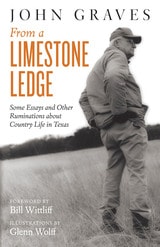
From a Limestone Ledge
Some Essays and Other Ruminations about Country Life in TexasBy John Graves<br>Foreword by Bill Wittliff<br>Illustrations by Glenn Wolff
University of Texas Press, 2016
“Another fine, reflective, anecdotal look at rural Texas.” —New Yorker
“Graves writes eloquently about a countryman’s concerns. There's not a false note in the book.” —Boston Globe
“Like the unmortared stone fences of Graves’s native hill country, From a Limestone Ledge is constructed of bits and pieces never designed to fit together, yet made to achieve a unity that is more enduring than the sum of its individual parts by the hands of a master craftsman.” —Southwestern Historical Quarterly
“The beauty of his work endures, and there is a greater pride in Texans’ hearts for their home, I think, than there would be if he hadn’t written the books he did.” —Rick Bass, Garden & Gun
“In describing the particulars of his surroundings, Graves often was describing the world in microcosm and the place and plight of humankind in it.” —Bryan Woolley, Dallas Morning News
From the Center of Tradition
Critical Perspective on Linda HoganBarbara J. Cook
University Press of Colorado, 2003