Results by title
593 books match the query 'Jews' and 14 start with f
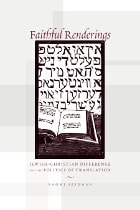
Faithful Renderings
Jewish-Christian Difference and the Politics of TranslationNaomi Seidman
University of Chicago Press, 2006
Bringing together central issues in translation studies with episodes in Jewish–Christian history, Naomi Seidman considers a range of texts, from the Bible to Elie Wiesel’s Night, delving into such controversies as the accuracy of various Bible translations, the medieval use of converts from Judaism to Christianity as translators, the censorship of anti-Christian references in Jewish texts, and the translation of Holocaust testimony. Faithful Renderings ultimately reveals that translation is not a marginal phenomenon but rather a crucial issue for understanding the relations between Jews and Christians and indeed the development of each religious community.
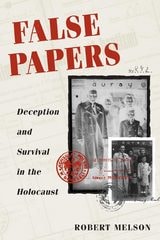
False Papers
DECEPTION AND SURVIVAL IN THE HOLOCAUSTRobert Melson
University of Illinois Press, 2000
Armed with their new lives and their new pasts, the Count and Countess Zamojski and their son, Count Bobi, took shelter in the very shadow of the Nazi machine, hiding day after day in plain sight behind a façade of elegant good manners and cultivated self-assurance, even arrogance: "you had to shout [the Gestapo] down or they would kill you." Melson's father took advantage of his flawless German to build a lucrative business career while working for a German businessman of the Schindler type. The Zamojskis acquired beautiful homes in the German quarter of Krakow and in Prague, where they had maids and entertained Nazi officials. Their masquerade enabled them to save not only themselves and their son but also an uncle and three Jewish women, one of whom became part of the family.
False Papers is a candid, sometimes funny account of a stylish couple who dazzled the Nazis with flamboyant theatrics then gradually, tragically fell apart after the war. Particularly arresting is Melson himself, who was just a child when his family embarked on their grand charade. A resilient boy who had to negotiate bewildering shifts of identify–-now Catholic, now Jewish; now European aristocrat, now penniless refugee who becomes an American college student--Melson closes each chapter of his parents' recollections with his childhood perceptions of the same events.
Against the totalizing, flattening, unrelenting Nazi behemoth, Melson says, "I wished to pit our very bodies, our quirky, sexy, funny, wicked, frail, ordinary selves." By balancing the adults' maneuvering with the perspective of a child, Melson crafts an account of the Holocaust that is at once poignant, entertaining, and troubling.
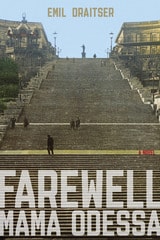
Farewell, Mama Odessa
A NovelEmil Draitser
Northwestern University Press, 2020
Set in the summer of 1979 at the height of the movement to free Soviet Jewry, Farewell, Mama Odessa is an autobiographical novel whose intertwined storylines follow a variety of people—dissidents, victims of ethnic discrimination, and black marketeers among them—as they bid farewell to their beloved hometown of Odessa, Ukraine, and make their way to the West. At the book’s center is Boris, a young writer thwarted by state censorship and antisemitism. With an Angora kitten for his companion and together with other émigrés, he puts the old country in his rear-view mirror and sets out on a journey that will take him to Bratislava, Vienna, Rome, and New York on his way to Los Angeles. Will Boris be able to rekindle his creative passion and inspiration in the West? Will other Jewish émigrés fit into the new society, so much different than the one they left behind? With humor and compassion, Farewell, Mama
Odessa describes the émigrés’ attempts at adjustment to the free world.
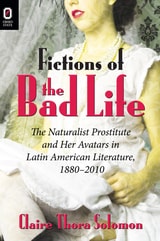
Fictions of the Bad Life
The Naturalist Prostitute and Her Avatars in Latin American Literature, 1880–2010Claire Thora Solomon
The Ohio State University Press, 2014
Fictions of the Bad Life illustrates how at very different moments—the turn of the twentieth century, the 1920s–30s, and finally the turn of the twenty-first century—the past is rewritten to accommodate contemporary desires for historical belonging and national identity, even as these efforts inevitably re-inscribe the repressed colonial history they wish to change.
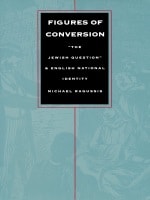
Figures of Conversion
“The Jewish Question” and English National IdentityMichael Ragussis
Duke University Press, 1995
—Daniel Defoe, The Farther Adventures of Robinson Crusoe (1719)
When the hero of Defoe’s novel listens skeptically to this anecdote related by a French Roman Catholic priest, he little suspects that in less than a century the conversion of the Jews would become nothing short of a national project—not in France but in England. In this book, Michael Ragussis explores the phenomenon of Jewish conversion—the subject of popular enthusiasm, public scandal, national debate, and dubbed "the English madness" by its critics—in Protestant England from the 1790s through the 1870s.
Moving beyond the familiar catalog of anti-Semitic stereotypes, Ragussis analyzes the rhetoric of conversion as it was reinvented by the English in sermons, stories for the young, histories of the Jews, memoirs by Jewish converts, and popular novels. Alongside these texts and the countertexts produced by English Jews, he situates such writers as Edgeworth, Scott, Disraeli, Arnold, Trollope, and Eliot within the debate over conversion and related issues of race, gender, and nation-formation. His work reveals how a powerful group of emergent cultural projects—including a revisionist tradition of the novel, the new science of ethnology, and the rewriting of European history—redefined English national identity in response to the ideology of conversion, the history of the Jews, and "the Jewish question."
Figures of Conversion offers an entirely new way of regarding Jewish identity in nineteenth-century British culture and will be of importance not only to literary scholars but also to scholars of Judaic and religious studies, history, and cultural studies.
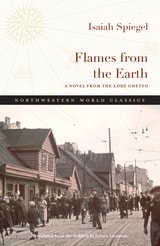
Flames from the Earth
A Novel from the Lódz GhettoIsaiah Spiegel, translated from the Yiddish by Julian Levinson
Northwestern University Press, 2023
Flames from the Earth: A Novel from the Łódź Ghetto is an autobiographical novel written by Isaiah Spiegel, one of the most revered Yiddish authors to survive the Holocaust. Originally published in Israel in 1966, the novel brings together material that Spiegel wrote while imprisoned in the Łódź Ghetto, which he recovered from a cellar when he returned from Auschwitz after the war. The only works by Spiegel previously available to English readers have been short stories.
In this, his first novel, Spiegel explores a complex web of characters in and around the Łódź Ghetto: Vigdor and Gitele, lovers who are involved in the ghetto resistance movement; Nicodem, a Polish priest, who hides a member of the Jewish underground; Stefan Kaczmarek, a Polish tavern keeper who betrays Nicodem to preserve his own smuggling business; Franz Jessike, a Nazi guard who blackmails local Poles for personal gain; and Chaim Vidaver, the heroic leader of the ghetto resistance. Based largely on historical events, the novel’s lyrical style echoes its emotional intensity.
Gripping and atmospheric, Flames from the Earth honors daring acts of heroism and human connections forged amid unthinkable conditions. Spiegel’s novel represents an important contribution to the archive of literary depictions of historical trauma.
Follow My Footprints
Changing Images of Women in American Jewish FictionEdited by Sylvia Barack Fishman
Brandeis University Press, 1992
For Decades I Was Silent
A Holocaust Survivor's Journey Back to FaithBaruch G. Goldstein
University of Alabama Press, 2008
A survivor's powerful testament to faith, memory, and the triumph of the human spirit.
A fascinating memoir about a Holocaust survivor's loss of and journey back to faith. In 1939, Baruch Goldstein was a religiously observant adolescent resident of the Jewish community in Mlawa, a town that was then in East Prussia. After war broke out, the Jewish community there was relatively sheltered, as that region was incorporated into the German Reich rather than into the General Government (the German run-fragment of pre-war Poland, where conditions were harsh for everyone). However in 1942, Goldstein was sent to Auschwitz, where he stayed two-and-a-half years. His family was scattered all to their deaths, but he survived the war--barely. For Decades I Was Silent is an account of life in a small Polish-German town and provides information on the religious life of the Jewish citizens. This book creates a direct sense of the random, mystifying personal violence individuals felt at the hands of Germans--not the anonymous industrial death machine, but immediate, face-to-face violence.
After the war, Goldstein drifted as a refugee to UNRR camps in Italy. Over time, young Goldstein had to face the fact that all of his extended family was lost and he had only the possibilities of Palestine or help from distant relatives in the United States as a future. His American relatives urged him to enter the United States as a yeshiva student, and eventually he became a rabbi and started a family. As a young rabbinical student, and then as a rabbi, Goldstein was forced to confront the events of the Holocaust and the damage done to his faith.
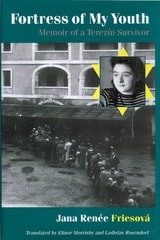
Fortress of My Youth
Memoir of a Terezín SurvivorJana Renée Friesová
University of Wisconsin Press, 2011
Jana Renée Friesová was fifteen when she was imprisoned by the Nazis in the Czech ghetto town of Terezín. Her memoir tells the poignantly familiar story of a young girl who, even under the most abominable circumstances, engages in intense adolescent friendships, worries with her companions over her looks, and falls in love.
Anne Frank’s diary ends with deportation to a concentration camp; Fortress of My Youth, in contrast, takes the reader deep into the horrors of daily life in a camp that were faced by a young girl and her family. But Friesová also tells of love, joy, sacrifice, and the people who shared in the most profound experiences of her life.
Framing the Holocaust
Edited by Valerie Hébert
University of Wisconsin Press, 2023
While photographs are central to our memory of modern historical events, they often inhabit an ambivalent intellectual space. What separates the sincere desire to understand from voyeuristic curiosity? Comprehending atrocity photographs requires viewers to place themselves in the very positions of the perpetrators who took the images. When we engage with these photographs, do we risk replicating the original violence? In this tightly organized book, scholars of history, photography, language, gender, photojournalism, and pedagogy examine the images of the Šķēde atrocity along with other difficult images, giving historical, political, and ethical depth to the acts of looking and interpreting.
With a foreword by Edward Anders, who narrowly escaped the December 1941 shooting, Framing the Holocaust represents an original approach to an iconic series of Holocaust photographs. This book will contribute to compelling debates in the emerging field of visual history, including the challenges and responsibilities of using photographs to teach about atrocity.
From Text to Context
The Turn to History in Modern JudaismIsmar Schorsch
Brandeis University Press, 1994

From that Place and Time
A Memoir, 1938-1947Dawidowicz, Lucy
Rutgers University Press, 2008
Nancy Sinkoff's new introduction explores the historical forces, particularly the dynamic world of secular Yiddish culture, which shaped Dawidowicz's decision to journey to Poland and her reassessment of those forces in the last years of her life.
From the Ashes of Sobibor
A Story of SurvivalThomas Toivi Blatt, Foreward by Christopher R. Browning
Northwestern University Press, 1997
This edition also includes the author's interview with Karl Frenzel, a former Nazi commandant at Sobibor.
From the Jewish Heartland
Two Centuries of Midwest FoodwaysEllen F. Steinberg and Jack H. Prost
University of Illinois Press, 2013