Results by title
57 books match the query 'Literature and science' and 5 start with f
Fiction Refracts Science
Modernist Writers from Proust to BorgesAllen Thiher
University of Missouri Press, 2005
Fiction Rivals Science
The French Novel from Balzac to ProustAllen Thiher
University of Missouri Press, 2001
In Fiction Rivals Science, Allen Thiher describes the epistemic rivalry that the major nineteenth-century French novelists felt in dealing with science. After brief considerations of Stendhal, Thiher focuses on the four most important "realist" novelists in France: Balzac, Flaubert, Zola, and, going into the twentieth century, Proust. According to Thiher, each of these novelists considered himself to be in competition with science to make the novel an instrument for knowledge.
The first chapter sets forth the understanding of science that dominated the early nineteenth century in order to make it plausible that literary minds, throughout the nineteenth century, thought that they could not only rival science, but even make positive contributions to knowledge. The Newtonian paradigm that had dominated the Enlightenment was slowly being challenged by new developments both in physics and in nonphysical sciences such as biology. Especially in biology the development of a scientific discourse using narrative temporality favored the idea that novelists could also use fiction to construct discourses that advanced knowledge.
Balzac wanted to construct a natural history of society and correct the chemical theory of his time. Flaubert drew upon medicine and physiology for the rhetoric of his realist fiction. Zola used unsuccessful medical paradigms for his doctrine of heredity, and models drawn from thermodynamics to describe the relation of the individual to societal forces. Finally, Proust drew upon thinkers such as Poincar‚ to elaborate an epistemology that put an end to the rivalry novelists might feel with scientists. Proust located certain knowledge within the realm of human subjectivity while granting the power of laws to rule over the contingent realm of physical reality, in which, after Poincar‚, neither mathematics nor Newton was any longer a source of absolute certainty. Proust's novel is thus the last great realist work of the nineteenth century and the first modernist work of consciousness taking itself as the object of knowledge.
By demonstrating that the great French realist novelists dealt with many of the same problems as did the scientists of the nineteenth century, Fiction Rivals Science attempts to show how culture unites literary and scientific inquiry into knowledge. Providing a new interpretation of the development of literary realism, this important new work will be welcomed not only by literary scholars, but by historians of science and culture as well.
Fictions of the Cosmos
Science and Literature in the Seventeenth CenturyFrédérique Aït-Touati
University of Chicago Press, 2011
Forgotten Tribe
Scientists as WritersLisa Emerson
University Press of Colorado, 2017
In The Forgotten Tribe: Scientists as Writers, Lisa Emerson offers an important corrective to the view that scientists are "poor writers, unnecessarily opaque, not interested in writing, and in need of remediation." She argues that scientists are among "the most sophisticated and flexible writers in the academy, often writing for a wider range of audiences (their immediate disciplinary peers, peers in adjacent fields, a broad scientific audience, industry, and a range of public audiences including social media) than most other faculty." Moreover, she notes, the often collaborative and multidisciplinary nature of their work results in writing practices that "may be more socially complex, and require more articulation, mediation, and interpersonal communication, and more use of advanced media and technology than those of faculty in other disciplines."
Drawing on extensive interviews with scientists, Emerson argues that writing scholars have "engaged in a form of cultural appropriation" that has worked against a deeper understanding of the contexts in which scientists work and the considerations they bring to their writing. Emerson grounds her analysis in the voices of scientists in a way that allows us to understand not only how they approach writing but also how we might usefully teach writing in the sciences. The Forgotten Tribe offers a valuable contribution to our understanding of scientific writing, allowing us to hear voices that are seldom included in our discussions of this critical area.
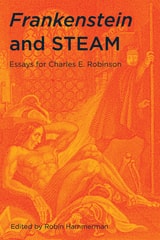
Frankenstein and STEAM
Essays for Charles E. RobinsonRobin Hammerman
University of Delaware Press, 2022
Charles E. Robinson, Professor Emeritus of English at The University of Delaware, definitively transformed study of the novel Frankenstein with his foundational volume The Frankenstein Notebooks and, in nineteenth century studies more broadly, brought heightened attention to the nuances of writing and editing. Frankenstein and STEAM consolidates the generative legacy of his later work on the novel's broad relation to topics in science, technology, engineering, arts, and mathematics (STEAM). Seven chapters written by leading and emerging scholars pay homage to Robinson's later perspectives of the novel and a concluding postscript contains remembrances by his colleagues and students. This volume not only makes explicit the question of what it means to be human, a question Robinson invited students and colleagues to examine throughout his career, but it also illustrates the depth of the field and diversity of those who have been inspired by Robinson's work. Frankenstein and STEAM offers direction for continuing scholarship on the intersections of literature, science, and technology.
Published by the University of Delaware Press. Distributed worldwide by Rutgers University Press.