Results by title
914 books match the query 'Medieval' and 28 start with f
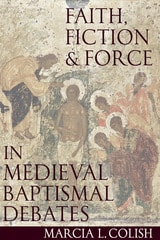
Faith, Force and Fiction in Medieval Baptismal Debates
Marcia L. Colish
Catholic University of America Press, 2014

Fan Phenomena
Game of ThronesEdited by Kavita Mudan Finn
Intellect Books, 2017
With the seventh season of the HBO series in production, Game of Thrones has been nominated for multiple awards, its cast has been catapulted to celebrity, and references to it proliferate throughout popular culture. Often positioned as the grittier antithesis to J. R. R. Tolkien’s Lord of the Rings, Martin’s narrative focuses on the darker side of chivalry and heroism, stripping away these higher ideals to reveal the greed, amorality, and lust for power underpinning them.
Fan Phenomena: Game of Thrones is an exciting new addition to the Intellect series, bringing together academics and fans of Martin’s universe to consider not just the content of the books and HBO series, but fan responses to both. From trivia nights dedicated to minutiae to forums speculating on plot twists to academics trying to make sense of the bizarre climate of Westeros, everyone is talking about Game of Thrones. Edited by Kavita Mudan Finn, the book focuses on the communities created by the books and television series and how these communities envision themselves as consumers, critics, and even creators of fanworks in a wide variety of media, including fiction, art, fancasting, and cosplay.
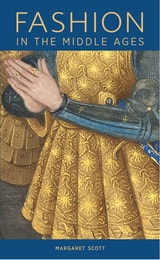
Fashion in the Middle Ages
Margaret Scott
J. Paul Getty Trust, The, 2018
From the costly velvets and furs worn by kings to the undyed wools and rough linens of the peasantry, the clothing worn by the various classes in the Middle Ages played an integral role in medieval society. In addition to providing clues to status, profession, and/or geographic origin, textiles were a crucial element in the economies of many countries and cities.
Much of what is known about medieval fashion is gleaned from the pages of manuscripts, which serve as a rich source of imagery. This volume provides a detailed look at both the actual fabrics and composition of medieval clothing as well as the period’s attitude toward fashion through an exploration of illuminated manuscripts in the collection of the J. Paul Getty Museum. The last portion of the book is dedicated to the depiction of clothing in biblical times and the ancient world as seen through a medieval lens. Throughout, excerpts from literary sources of the period help shed light on the perceived role and function of fashion in daily life.
Fashioning Change
The Trope of Clothing in High- and Late-Medieval EnglandAndrea Denny-Brown
The Ohio State University Press, 2012

Fasti Ecclesiae Anglicanae 1300-1541
II: Hereford DioceseEdited by Joyce M. Horn and revised by David Lepine
University of London Press, 2009
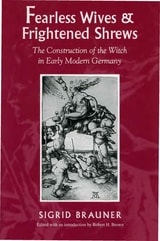
Fearless Wives and Frightened Shrews
The Construction of the Witch in Early Modern GermanyReinharde Brauner
University of Massachusetts Press, 1995
Feudal Society, Volume 1
Marc Bloch
University of Chicago Press, 1964
Feudal Society, Volume 2
Marc Bloch
University of Chicago Press, 1964
Fictions of Evidence
Witnessing, Literature, and Community in the Late Middle AgesJamie K. Taylor
The Ohio State University Press, 2013
Fixers
Agency, Translation, and the Early Global History of LiteratureZrinka Stahuljak
University of Chicago Press, 2024
In this book, Zrinka Stahuljak challenges scholars in both medieval and translation studies to rethink how ideas and texts circulated in the medieval world. Whereas many view translators as mere conduits of authorial intention, Stahuljak proposes a new perspective rooted in a term from journalism: the fixer. With this language, Stahuljak captures the diverse, active roles medieval translators and interpreters played as mediators of entire cultures—insider informants, local guides, knowledge brokers, art distributors, and political players. Fixers offers nothing less than a new history of literature, art, translation, and social exchange from the perspective not of the author or state but of the fixer.
Florentine Essays
Selected Writings of Marvin B. BeckerMarvin B. Becker
University of Michigan Press, 2002
In the capital of humanism, he initiated what was to be a lifelong examination of the Western civil tradition. In Florence he could study the interplay of ideas and action in what he was to call the "public world." The rise of this world out of the private, feudal and corporate structures of the medieval commune, its functioning and its eventual subversion by the authoritarian structures of the early modern state were, he thought, valuable information for modern political cultures. In the 1950s and 1960s, Becker produced approximately twenty papers dealing with a wide variety of themes and issues raised by the work of other scholars such as Davidson, Salvemini, Ottokar, Panella, Rodolico, Barbadoro, Baron, and others. He also introduced his own formulations on a range of subjects including the political role of Florence's minor guilds, usury, taxation, public debt, popular heresy, church-state relations, the city's chroniclers, the influence of "new men" upon Florentine government and changing mentalities.
These papers, in their originality, their richness of documentation and their suggestiveness, are still relevant for current scholarship. The editors of this volume have chosen the papers for the convenience of readers who may know Becker only through his books, or from the myriad of footnotes of other scholars who have drawn so much from his work. This volume will be of interest to scholars, students, and others interested in Renaissance history, whether it be social or political.
Marvin B. Becker is Professor Emeritus in the Department of History, University of Michigan. James Banker is Professor of History, North Carolina State University. Carol Lansing is Professor of History, University of California, Santa Barbara.
Folgore da San Gimignano and his Followers
The Complete PoemsFabian Alfie
Arizona Center for Medieval and Renaissance Studies, 2019
Following Chaucer
Offices of the Active LifeLynn Staley
University of Michigan Press, 2020
Following Chaucer: Offices of the Active Life explores three representative figures—the royal woman, the poet, and the merchant—in relation to the concept of “office,” which Cicero linked to the health of the republic, but Chaucer to that of the common good. Not usually conjoined to the term “office,” these three figures, situated in the active life, were not firmly mapped onto the body politic, which was used to figure a relational and ordered social body ruled by the king, the head. These figures are points of entry into a set of questions rooted in Chaucer’s understanding of his cultural and historical past and in his keen appraisal of the social dynamics of his own time that also reverberate in the centuries after Chaucer’s death.
Following Chaucer does not trace influence but uses Chaucer’s likely reading, circumstances, and literary and social affiliations as guides to understanding his poetry, within the context of late medieval English culture and the reshaping of the concept of these particular offices that suited the needs of a future whose dynamics he anticipated. His understanding of the importance of the Ciceronian concept of office within the active life, his profound cultural awareness, and his probing of the foundations of social change provide him with a keen sense of the persistent tensions and inconsistencies that are fundamental to his poetry.
Forgery, Replica, Fiction
Temporalities of German Renaissance ArtChristopher S. Wood
University of Chicago Press, 2008
But Wood shows that over the course of the fifteenth and early sixteenth centuries, emerging replication technologies—such as woodcut, copper engraving, and movable type—altered the relationship between artifacts and time. Mechanization highlighted the artifice, materials, and individual authorship necessary to create an object, calling into question the replica’s ability to represent a history that was not its own. Meanwhile, print catalyzed the new discipline of archaeological scholarship, which began to draw sharp distinctions between true and false claims about the past. Ultimately, as forged replicas lost their value as historical evidence, they found a new identity as the intentionally fictional image-making we have come to understand as art.
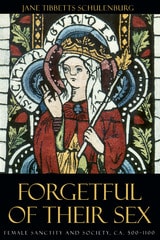
Forgetful of Their Sex
Female Sanctity and Society, ca. 500-1100Jane Tibbetts Schulenburg
University of Chicago Press, 1998
"A tremendous piece of scholarship. . . . This journey through more than 2,000 saints is anything but dull. Along the way, Schulenburg informs our ideas regarding the role of saints in the medieval psyche, gender-specific identification, and the heroics of virginity." —Library Journal
"[This book] will be a kind of 'roots' experience for some readers. They will hear the voices, haunted and haunting, of their distant ancestors and understand more about themselves." —Christian Science Monitor
"This fascinating book reaches far beyond the history of Christianity to recreate the 'herstory' of a whole gender." —Kate Saunders, The Independent
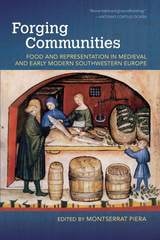
Forging Communities
Food and Representation in Medieval and Early Modern Southwestern EuropeMontserrat Piera
University of Arkansas Press, 2018
This interdisciplinary study of food in medieval and early modern communities connects threads of history conventionally examined separately or in isolation. The intersection of foodstuffs with politics, religion, economics, and culture enhances our understanding of historical developments and cultural continuities through the centuries, giving insight that today, as much as in the past, we are what we eat and what we eat is never devoid of meaning.
Form and Reform
Reading across the Fifteenth CenturyShannon Gayk and Kathleen Tonry
The Ohio State University Press, 2011
Form and Reform: Reading across the Fifteenth Century challenges the idea of any definitive late medieval moment and explores instead the provocatively diverse, notably untidy, and very rich literary culture of the age. These essays from leading medievalists, edited by Shannon Gayk and Kathleen Tonry, both celebrate and complicate the reemergence of the fifteenth century in literary studies. Moreover, this is the first collection to concentrate on the period between 1450 and 1500—the crucial five decades, this volume argues, that must be understood to comprehend the entire century’s engagement with literary form in shifting historical contexts.
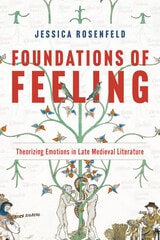
Foundations of Feeling
Theorizing Emotions in Late Medieval LiteratureJessica Rosenfeld
University of Chicago Press, 2026
A fresh reading of medieval literature as deeply concerned with thinking about feelings.
Are emotions primarily bodily or cognitive? Do “natural” emotions exist? What is the relationship between emotion and gender? In Foundations of Feeling, Jessica Rosenfeld shows how medieval literature informs contemporary ideas about how emotions operate. Ranging widely from love poetry to pastoral and theological writings, to political satire and more, Rosenfeld reveals a wealth of attention to emotions in both scientific and philosophical discourses of the time. By mining Latin, medieval French, and Middle English traditions, she relates medieval concerns to the most central, current debates (and impasses) in the fields of history of emotion and affect theory today, reframing how we think about and define feelings.
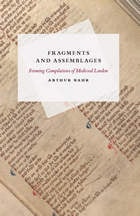
Fragments and Assemblages
Forming Compilations of Medieval LondonArthur Bahr
University of Chicago Press, 2013
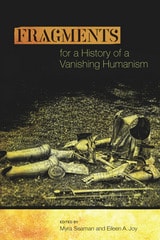
Fragments for a History of a Vanishing Humanism
Edited by Myra Seaman and Eileen A. Joy
The Ohio State University Press, 2016
This volume, edited by Myra Seaman and Eileen A. Joy, insists on the always provisional and contingent formations of the human, and of various humanisms, over time, while also aiming to demonstrate the different ways these formations emerge (and also disappear) in different times and places, from the most ancient past to the most contemporary present. The essays are offered as “fragments” because the authors do not believe there can ever be a “total history” of either the human or the post/human as they play themselves out in differing historical contexts. At the same time, the volume as a whole argues that defining what “the human” (or “post/human”) is has always been an ongoing, never finished cultural project.
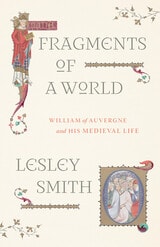
Fragments of a World
William of Auvergne and His Medieval LifeLesley Smith
University of Chicago Press, 2023
Today, William of Auvergne (1180?–1249) is remembered for his scholarship about the afterlife as well as the so-called Trial of the Talmud. But the medieval bishop of Paris also left behind nearly 600 sermons delivered to all manner of people—from the royal court to the poorest in his care. In Fragments of a World, Lesley Smith uses these sermons to paint a vivid picture of this extraordinary cleric, his parishioners, and their bustling world. The first modern biography of the influential teacher, bishop, and theologian, Fragments of a World casts a new image of William of Auvergne for our times—deeply attuned to both the spiritual and material needs of an ever-changing populace in the medieval city.
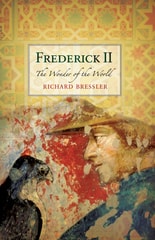
Frederick II
The Wonder of the WorldRichard Bressler
Westholme Publishing, 2010
One of the most remarkable personalities of the Middle Ages, Frederick II of Hohenstaufen was born in 1194. His parents—the reigning Holy Roman Emperor and the heiress to the Kingdom of Sicily—belonged to two of the leading ruling families in medieval Europe. The lands controlled by these two families extended from southern Denmark to Sicily, from modern Belgium to Bohemia. Frederick II eventually ruled the joint kingdom, and the story of how he gained and maintained this status is the primary thread running through his life. As a child in Sicily, Frederick was a ward of Pope Innocent III. When he came of age, he sought to be crowned Holy Roman Emperor but only succeeded in 1220 after many years of negotiations with the Vatican, which was reluctant to give up or share power. Resenting the influence and pressure from the papacy, Frederick became its leading opponent. As a result, the new pope, Gregory IX, condemned Frederick as the Antichrist. However, Frederick believed he was a sincere Christian, and led the Sixth Crusade to the Holy Land while under excommunication.
Friendship and Love, Ethics and Politics
Studies in Mediaeval and Early Modern HistoryEva Österberg
Central European University Press, 2010
From Lived Experience to the Written Word
Reconstructing Practical Knowledge in the Early Modern WorldPamela H. Smith
University of Chicago Press, 2022
In From Lived Experience to the Written Word, Pamela H. Smith considers how and why, beginning in 1400 CE, European craftspeople began to write down their making practices. Rather than simply passing along knowledge in the workshop, these literate artisans chose to publish handbooks, guides, treatises, tip sheets, graphs, and recipe books, sparking early technical writing and laying the groundwork for how we think about scientific knowledge today.
Focusing on metalworking from 1400–1800 CE, Smith looks at the nature of craft knowledge and skill, studying present-day and historical practices, objects, recipes, and artisanal manuals. From these sources, she considers how we can reconstruct centuries of largely lost knowledge. In doing so, she aims not only to unearth the techniques, material processes, and embodied experience of the past but also to gain insight into the lifeworld of artisans and their understandings of matter.
From Misa to Mise en Scène
Fra Francesc Moner’s Prototype of the Spanish Sacramental Theater of the Fifteenth CenturyPeter Cocozzella
Arizona Center for Medieval and Renaissance Studies, 2020
From Monastery to Hospital
Christian Monasticism and the Transformation of Health Care in Late AntiquityAndrew T. Crislip
University of Michigan Press, 2005
From Monastery to Hospital traces the origin of the late Roman hospital to the earliest groups of Christian monastics. Often characterized as holy men and miracle-workers who transformed late antique spirituality, monks held an equally significant impact on the development of medicine in Late Antiquity. Andrew Crislip illuminates the innovative approaches to health care within the earliest monasteries that provided the model for the greatest medical achievement of Late Antiquity: the hospital.
From Monastery to Hospital draws on some of the most vibrant areas of scholarship of the ancient world, including asceticism, the study of the body, history of the family, and the history of medicine. The book will be of interest to scholars and students of early Christianity, Roman History, the history of medicine, and Catholic, Coptic, and Eastern Orthodox history and theology. It will also be of interest to the broader field of history of Christianity, especially with its connections to charitable traditions in the church through the modern period.
Andrew Crislip is Assistant Professor of Religion at the University of Hawaii.
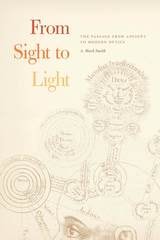
From Sight to Light
The Passage from Ancient to Modern OpticsA. Mark Smith
University of Chicago Press, 2014
Breaking from previous scholarship that sees Johannes Kepler as the culmination of a long-evolving optical tradition that traced back to Greek antiquity via the Muslim Middle Ages, Smith presents Kepler instead as marking a rupture with this tradition, arguing that his theory of retinal imaging, which was published in 1604, was instrumental in prompting the turn from sight to light. Kepler’s new theory of sight, Smith reveals, thus takes on true historical significance: by treating the eye as a mere light-focusing device rather than an image-producing instrument—as traditionally understood—Kepler’s account of retinal imaging helped spur the shift in analytic focus that eventually led to modern optics.
A sweeping survey, From Sight to Light is poised to become the standard reference for historians of optics as well as those interested more broadly in the history of science, the history of art, and cultural and intellectual history.
From Topic to Tale
Logic and Narrativity in the Middle AgesEugene VanceForeword by Wlad Godzich
University of Minnesota Press, 1987
From Topic to Tale was first published in 1987. Minnesota Archive Editions uses digital technology to make long-unavailable books once again accessible, and are published unaltered from the original University of Minnesota Press editions.
The transition from the Middle Ages to the Renaissance has been discussed since the 1940s as a shift from a Latinate culture to one based on a vernacular language, and, since the 1960s, as a shift from orality to literacy. From Topic to Tale focuses on this multifaceted transition, but it poses the problem in different terms: it shows how a rhetorical tradition was transformed into a textual one, and ends ultimately in a discussion of the relationship between discourse and society.
The rise of French vernacular literacy in the twelfth century coincided with the emergence of logic as a powerful instrument of the human mind. With logic come a new concern for narrative coherence and form, a concern exemplified by the work of Chretien de Troyes. Many brilliant poetic achievements crystallized in the narrative art of Chretien, establishing an enduring tradition of literary technique for all of Europe. Eugene Vance explores the intellectual context of Chretien's vernacular literacy, and in particular, the interaction between the three "arts of language" (grammar, logic, and rhetoric) compromising the trivium. Until Vance, few critics have studied the contribution of logic to Chretiens poetics, nor have they assessed the ethical bond between rationalism and the new heroic code of romance.
Vance takes Chretien de Troyes' great romance, Yvain ou le chevalier au lion,as the centerpiece of the Twelfth-Century Renaissance. It is also central to his own thesis, which shows how Chretien forged a bold new vision of humans as social beings situated between beasts and angels and promulgated the symbolic powers of language, money, and heraldic art to regulate the effects of human desire. Vance's reading of the Yvain contributes not only to the intellectual history of the Middle Ages, but also to the continuing dialogue between contemporary critical theory and medieval culture.
Eugene Vance is professor of French and comparative literature at Emory University and principal editor of a University of Nebraska series, Regents Studies in Medieval Culture. Wlad Godzich is director of the Center for Humanistic Studies at the University of Minnesota and co-editor of the series Theory and History of Literature.