Results by title
1066 books match the query 'Political' and 42 start with f
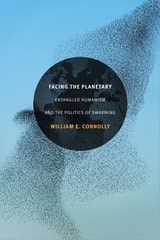
Facing the Planetary
Entangled Humanism and the Politics of SwarmingWilliam E. Connolly
Duke University Press, 2017
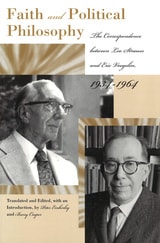
Faith and Political Philosophy
The Correspondence Between Leo Strauss and Eric Voegelin, 1934-1964Edited & Intro by Peter Emberley & Barry Cooper
University of Missouri Press, 2004
Faith and Political Philosophy consists of fifty-three letters between Leo Strauss and Eric Voegelin, two of the most important political theorists of the twentieth century. In this correspondence, Strauss and Voegelin explore the nature of their similarities and differences, offering insightful observations about one another's work, about the state of the discipline, and about the influences working on them. The letters shed light on many assumptions made in their published writings, often with an openness that removes all vestiges of uncertainty.

Fantastic Stories
Abram Tertz
Northwestern University Press, 1986
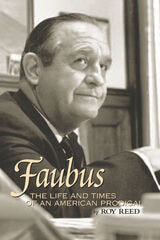
Faubus
The Life and Times of an American ProdigalRoy Reed
University of Arkansas Press, 1999
New York Times Book Review Notable Book for 1997
1998 Certificate of Commendation, American Association for State and Local History

Felix Guattari
A Critical IntroductionGary Genosko
Pluto Press, 2009
This is an introduction to the thought of the radical French thinker Félix Guattari. It is ideal for undergraduates and anyone studying political and cultural theory.
Guattari's main works were published in the 1970s and 1980s. His background was in psychoanalysis -- he was trained by Lacan and he practised as a psychoanalyst for much of his life. He developed a distinctive psychoanalytic method informed always by his revolutionary politics.
Guattari was actively involved in numerous political movements, from Trotskyism to Autonomism, tackling ecological and sexual politics along the way. A true believer in collectivity, much of his work was written in collaboration, most famously with Gilles Deleuze, with whom he wrote the hugely influential books Anti-Oedipus and A Thousand Plateaus. He also wrote with Antonio Negri and others.
This accessible introduction explores his highly original ideas -- including his ground-breaking conception of 'transversal politics' -- and the impact his concern with subjectivity had on wider political theory.

Felon for Peace
The Memoir of a Vietnam-Era Draft ResisterJerry Elmer
Vanderbilt University Press, 2005
This book is a blend of personal memoir, contemporary history, and astute political analysis. Elmer draws on a variety of sources, including never-before-released FBI files, and argues passionately for the practice of nonviolence. He describes the range of actions he took—from draft card burning to organizing draft board raids with Father Phil Berrigan; from vigils on the Capitol steps inside "tiger cages" used to torture Vietnamese political prisoners to jail time for protesting nuclear power plants; from a tour of the killing fields of Cambodia to meetings with Corazon Aquino in the Philippines.
A Vietnamese-language edition of Felon for Peace has also been published.
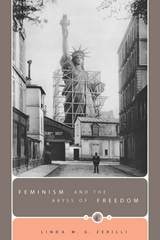
Feminism and the Abyss of Freedom
Linda M. G. Zerilli
University of Chicago Press, 2005
Offering both a discussion of feminism in its postmodern context and a critique of contemporary theory, Zerilli here challenges feminists to move away from a theory-based approach, which focuses on securing or contesting "women" as an analytic category of feminism, to one rooted in political action and judgment. She revisits the democratic problem of exclusion from participation in common affairs and elaborates a freedom-centered feminism as the political practice of beginning anew, world-building, and judging.
In a series of case studies, Zerilli draws on the political thought of Hannah Arendt to articulate a nonsovereign conception of political freedom and to explore a variety of feminist understandings of freedom in the twentieth century, including ones proposed by Judith Butler, Monique Wittig, and the Milan Women's Bookstore Collective. In so doing, Zerilli hopes to retrieve what Arendt called feminism's lost treasure: the original and radical claim to political freedom.
Feminism, Capitalism, and Ecology
Johanna Oksala
Northwestern University Press, 2023
In the face of ecological catastrophe, neither feminists nor environmentalists have the option of merely supporting an environmental politics that would preserve an imagined nature somewhere outside capitalism. As Johanna Oksala contends, the political goal must be more radical: to challenge the capitalist economic system itself and the mechanisms by which it expropriates life on the planet.
Feminism, Capitalism, and Ecology lays the critical groundwork for this political project. It develops a new way of bringing feminist and ecological responses to capitalism together into a cohesive framework. By exposing the systemic logic by which environmental destruction and gender oppression are jointly rooted in capitalism, Oksala establishes the theoretical foundations for an effective political alliance. The traditions of materialist ecofeminism and Marxist feminism are critical starting points. But the rapid rise of biotechnology and the steady increase of precarity necessitate a model of resistance that responds to the distinctive challenges of contemporary biocapitalism. Timely and urgent, this book articulates a theoretically sophisticated response and maps out our real-world options in this existential struggle.
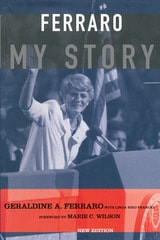
Ferraro
My StoryGeraldine Ferraro with Linda Bird Francke and with a foreword by Marie Wilson
Northwestern University Press, 2004
Ferraro's run for vice-president was an important moment in American history. The time is right for telling a new generation this story of women's collective political power and the difference women office holders can and do make to public policy.
Fighting Bob La Follette
The Righteous ReformerNancy C Unger
Wisconsin Historical Society Press, 2008
Fighting Son
A Biography of Philip F. La FolletteJonathan Kasparek
Wisconsin Historical Society Press, 2006
Former Wisconsin governor Philip F. La Follette forged a political path characterized by his progressive, innovative vision. Growing up in the shadow of revered senator "Fighting Bob" La Follette made for a politically charged childhood and laid the groundwork for Phil's emergence as a powerful figure in Wisconsin politics. A gregarious and fiery politician, Phil's efforts led to the passage of the country's first unemployment compensation act, aid programs for workers and farmers, and the reorganization of state government.
This approachable, comprehensive book traces La Follette's journey through public office as well as his life after the waning of the Progressive era. Phil La Follette’s is a history of continuing progressivism, of innovative solutions to social problems, and of loyalty to a political ethos that goes far beyond love of country. Kasparek's treatment of this Fighting Son is a monument not only to La Follette but to progressive politics in Wisconsin.

Fire on Water
Porgess and The AbyssArnost Lustig
Northwestern University Press, 2005
It occurred to me why I was able to forgive the Italians, but never the Germans. Was it because the Italians never slept on mattresses stuffed with the hair of Luster Leibling or Weltfeind Flusser?
In this pair of short novels, Arnošt Lustig continues his lifelong project of creating a universe-at once concrete and dreamlike-to examine the horrors of the Holocaust and the impossible burden of living as a survivor.
The Abyss is the fragmented memories of David Wiesenthal, aged twenty, tortured by what he has witnessed and by the knowledge that luck-not skill, not courage, certainly not goodness-separated the survivors from the doomed. He seeks solace remembering the women he's loved or desired, even the one who represents his death.
In Porgess, the narrator recounts the life of the title character, "the most handsome boy in Jewish Prague" who was paralyzed on the last day of World War II. The two discuss their mutual fascinations-women, jazz, the significance of numbers-in sometimes bitter, sometimes sardonic voices, but always with the specters of the dead and the guilt of survival close at hand.
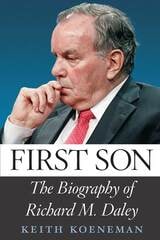
First Son
The Biography of Richard M. DaleyKeith Koeneman
University of Chicago Press, 2013
"Mayor Richard M. Daley dropped the bomb at a routine news conference at City Hall on Tuesday. With no prelude or fanfare, Mr. Daley announced that he would not seek re-election when his term expires next year. 'Simply put, it's time,' he said." New York Times, September 7, 2010
With those four words, an era ended. After twenty-two years, the longest-serving and most powerful mayor in the history of Chicago—and, arguably, America—stepped down, leaving behind a city that was utterly transformed, and a complicated legacy we are only beginning to evaluate.
With Koeneman as our guide, we follow young Daley from his beginnings as an average Bridgeport kid thought to lack his father's talent and charisma to his unlikely transformation into an iron-fisted leader. Daley not only escaped the giant shadow of his father but also transformed Chicago from a gritty, post-industrial Midwestern capital into a beautiful, sophisticated global city widely recognized as a model for innovative metropolises throughout the world.
But in spite of his many accomplishments, Richard M. Daley's record is far from flawless. First Son sets the dramatic improvement of certain parts of the city against the persistent realities of crime, financial stress , failing public housing, and dysfunctional schools. And it reveals that while in many ways Daley broke with the machine politics of his father, he continued to reward loyalty with favors, use the resources of city government to overwhelm opponents, and tolerate political corruption.
A nuanced portrait of a complex man, First Son shows Daley to be sensitive yet tough, impatient yet persistent, a street-smart fighter and detail-driven policy expert who not only ran Chicago, but was Chicago.
Five Public Philosophies of Walter Lippmann
By Benjamin F. Wright
University of Texas Press, 1973
Essayist, editor, columnist, author of many books, and winner of a special Pulitzer Prize citation in 1958 for his powers of news analysis, Walter Lippmann both appraised and influenced twentieth-century American politics. No other author of the century dealt with the persistent problems of politics from so many approaches, was so widely read, or varied so widely in his conclusions.
Benjamin F. Wright’s study is the first book devoted to an exposition and analysis of Lippmann’s nine “books of political philosophy,” as James Reston called them. These books provide a fascinating study of changes in the political and economic ideas of the most important journalist of his time.
Lippmann’s books published in 1913 and 1914 reflect the optimism of the Progressive Era, of faith in science and in the ability of people to choose their goals and attain them. In 1922 and 1925, while editor of the New York World, Lippmann wrote searching, often pessimistic analyses of what he believed to be the prevailing assumptions regarding the nature and role of public opinion. Although in the Coolidge era he relegated government to a minor role as mediator, he became an enthusiastic defender of the achievements of the early New Deal. Two years later in a longer look, he found the same New Deal following the path toward totalitarianism. Keynes was discarded and his place taken by the economics of Adam Smith, bolstered by the common law of Coke and the Constitution of the founders. Finally, in 1955, in the extremely popular and very engaging Public Philosophy, there is a lament for the “decline of the West” and a plea to return to the age of civility and natural law.
In a final analytical chapter, Wright presents a critique of Lippmann’s historical understanding and the modern applications of the tradition of natural law. He also assesses Lippmann’s inability to translate the “public philosophy” into programs or institutional changes and the failure to account for the expansion of governmental functions together with the continued strength of constitutional democracy in the West.
Flying Against the Arrow
An Intellectual in Ceausescu's RomaniaHoria-Roman Patapievici
Central European University Press, 2003
The ‘unbearable 80s’, as the last decade of the Ceauşescu era has been called in Romania, are in the focus of this quasi-autobiographical work. The book vividly portrays the difficulties encountered by a young intellectual trying to shape himself under the oppressive regime and provides a stark depiction of a man’s intellectual suffocation under hard-line socialist rule.

For Glory and Bolívar
The Remarkable Life of Manuela SáenzBy Pamela S. Murray
University of Texas Press, 2008
She was a friend, lover, and confidante of charismatic Spanish American independence hero Simón Bolívar and, after her death, a nationalist icon in her own right. Yet authors generally have chosen either to romanticize Manuela Sáenz or to discount her altogether. For Glory and Bolivar: The Remarkable of Life of Manuela Sáenz, by contrast, offers a comprehensive and clear-eyed biography of her. Based on unprecedented archival research, it paints a vivid portrait of the Quito-born "Libertadora," revealing both an exceptional figure and a flesh-and-blood person whose life broadly reflected the experiences of women during Spanish America's turbulent Age of Revolution.
Already married at the time of her meeting with the famous Liberator, Sáenz abandoned her husband in order to become not only Bolívar's romantic companion, but also his official archivist, a member of his inner circle, and one of his most loyal followers. She played a central role in Spanish South America's independence drama and eventually in developments leading to the consolidation of new nations. Pamela Murray, for the first time, closely examines Sáenz's political trajectory including her vital, often-overlooked years in exile. She exposes the myths that still surround her. She offers, in short, a nuanced and much-needed historical perspective, one that balances recognition of Sáenz's uniqueness with awareness of the broader forces that shaped this dynamic nineteenth-century woman.
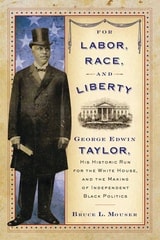
For Labor, Race, and Liberty
George Edwin Taylor, His Historic Run for the White House, and the Making of Independent Black PoliticsBruce L. Mouser
University of Wisconsin Press, 2010
More than one hundred years before Barack Obama, George Edwin Taylor made presidential history. Born in the antebellum South to a slave and a freed woman, Taylor became the first African American ticketed as a political party’s nominee for president of the United States, running against Theodore Roosevelt in 1904.
Orphaned as a child at the peak of the Civil War, Taylor spent several years homeless before boarding a Mississippi riverboat that dropped him in La Crosse, Wisconsin. Taken in by an African American farm family, Taylor attended a private school and eventually rose to prominence as the owner/editor of a labor newspaper and as a vocal leader in Wisconsin’s People’s Party. At a time when many African Americans felt allegiance to the Republican Party for its support of abolition, Taylor’s sympathy with the labor cause drew him first to the national Democratic Party and then to an African American party, the newly formed National Liberty Party, which in 1904 named him its presidential candidate. Bruce L. Mouser follows Taylor’s life and career in Arkansas, Illinois, Wisconsin, Iowa, and Florida, giving life to a figure representing a generation of African American idealists whose initial post-slavery belief in political and social equality in America gave way to the despair of the Jim Crow decades that followed.
Best Books for Special Interests, selected by the American Association for School Libraries
Best Books for Professional Use, selected by the American Association for School Libraries
Best Books for General Audiences, selected by the Public Library Association
Second Place, Biography, Society of Midland Authors
Honorable Mention, Benjamin F. Shambough Award, the State Historical Society of Iowa
For the Good of Humanity
Ludwik Rajchman, Medical StatesmanMarta A. Balinska
Central European University Press, 1998
Forbes Burnham
The Life and Times of the Comrade LeaderLinden F. Lewis
Rutgers University Press, 2024
Forbes Burnham: The Life and Times of the Comrade Leader is the first political biography of this complex and influential figure. It charts how the political party he founded, the People’s National Congress, combined nationalist rhetoric, socialist policies, and Pan-Africanist philosophies. It also explores how, in a country already deeply divided between the descendants of African slaves and Indian indentured servants, Burnham consolidated political power by intensifying ethnic polarizations. Drawing from historical archives as well as new interviews with the people who knew Burnham best, sociologist Linden F. Lewis examines how his dictatorial tendencies coexisted with his progressive convictions. Forbes Burnham is a compelling study of the nature of postcolonial leadership and its pitfalls.
Forgiveness & Reconciliation
Public Policy & Conflict TransformationRaymond G. Helmick
Templeton Press, 2001
This book brings together a unique combination of experts in conflict resolution and focuses on the role forgiveness can play in the process. It deals with theology, public policy, psychological and social theory, and social policy implementation of forgiveness. This book is essential for libraries, scholars, conflict negotiators, and all people who hope to understand the role of forgiveness in the peace process.
The book's first section explores how ideas like "forgiveness" and "reconciliation" are moving out from the seminary and academy into the world of public policy and how these terms have been used and defined in the past. The second section looks at forgiveness and public policy. One of the chapters, by Donald W. Shriver Jr., addresses forgiveness in a secular political forum.
The third section of the book draws us to a more thorough analysis of the relationship between forgiveness and reconciliation from voices in the academic and theological community, and the final section highlights the work of practitioners currently working with religion, public policy, and conflict transformation, particularly in areas such as Ireland and Africa.
Contributors include Desmond M. Tutu, Rodney L. Petersen, Miroslav Volf, Stanley S. Harakas, Raymond G. Helmick, SJ, Joseph V. Montville, Douglas M. Johnston, Donna Hicks, Donald W. Shriver, Jr., Everett L. Worthington, Jr., John Paul Lederach, Ervin Staub, Laurie Anne Pearlman, John Dawson, Audrey R. Chapman, Olga Botcharova, Anthony da Silva, SJ, Geraldine Smythe, OP, Andrea Bartoli, Ofelia Ortega, and George F. R. Ellis.
Fortune and Faith in Old Chicago
A Dual Biography of Mayor Augustus Garrett and Seminary Founder Eliza Clark GarrettCharles H. Cosgrove
Southern Illinois University Press, 2020
This engaging biography of Augustus Garrett and Eliza Clark Garrett tells two equally compelling stories: an ambitious man’s struggle to succeed and the remarkable spiritual journey of a woman attempting to overcome tragedy. By contextualizing the couple’s lives within the rich social, political, business, and religious milieu of Chicago’s early urbanization, author Charles H. Cosgrove fills a gap in the history of the city in the mid-nineteenth century.
The Garretts moved from the Hudson River Valley to a nascent Chicago, where Augustus made his fortune in the land boom as an auctioneer and speculator. A mayor during the city’s formative period, Augustus was at the center of the first mayoral election scandal in Chicago. To save his honor, he resigned dramatically and found vindication in his reelection the following year. His story reveals much about the inner workings of Chicago politics and business in the antebellum era.
The couple had lost three young children to disease, and Eliza arrived in Chicago with deep emotional scars. Her journey exemplifies the struggles of sincere, pious women to come to terms with tragedy in an age when most people attributed unhappy events to divine punishment. Following Augustus’s premature death, Eliza developed plans to devote her estate to founding a women’s college and a school for ministerial training, and in 1853 she endowed a Methodist theological school, the Garrett Biblical Institute (now the Garrett-Evangelical Theological Seminary), thereby becoming the first woman in North America to found an institution of higher learning.
In addition to illuminating our understanding of Chicago from the 1830s to the 1850s, Fortune and Faith in Old Chicago explores American religious history, particularly Presbyterianism and Methodism, and its attention to gender shows how men and women experienced the same era in vastly different ways. The result is a rare, fascinating glimpse into old Chicago through the eyes of two of its important early residents.
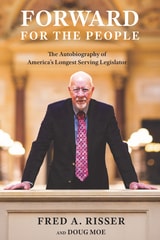
Forward for the People
The Autobiography of America's Longest Serving LegislatorFred A. Risser and Doug Moe
Wisconsin Historical Society Press, 2025
When Fred Risser retired from the Wisconsin Senate in 2021, his sixty-four years in state government made him the longest serving legislator in US history. Now, in this candid and illuminating autobiography, Risser shares his singular perspective on events that transformed the state and the nation over the course of his remarkable career. From his role in the “Joe Must Go” drive to recall US Senator Joseph McCarthy in the 1950s to his position as the senior senator among the “Fab Fourteen” Wisconsin Democrats who opposed Governor Scott Walker’s Act 10 legislation against collective bargaining in 2011, Risser was a leader in state politics for decades, always maintaining an unwavering belief that political action can change people’s lives for the better.
Forward for the People provides a unique peek behind the political curtain from the viewpoint of someone who saw it all. Risser worked with thirteen governors and authored more than 240 bills that became law, championing public health and safety, environmental protection, women’s and reproductive rights, organized labor, civil rights, and social justice, among many other causes. Risser also recounts interactions with prominent national politicians, including Robert La Follette Jr., Hubert Humphrey, Jimmy Carter, and Bill Clinton. More than forty photographs from Risser’s personal collection and the Wisconsin Senate paint a vivid picture of his six-decade journey through Wisconsin politics.
Forward for the People details Risser’s experiences out of state, from a stint in the Panama Canal Zone as a navy hospital corpsman to his undergraduate debate-team days at Minnesota’s Carleton College to his years studying law at the University of Oregon and his travels to all seven continents. The book also depicts the quirky habits that made Risser a memorable and beloved politician: biking his age in miles every birthday and never taking the elevator in his sixty-four years at the Wisconsin State Capitol. Enhanced with details sourced from correspondence, personal notes, newspaper accounts, and recollections from friends and former colleagues, Risser and coauthor Doug Moe have crafted an engaging account of an extraordinary life in public service.
Forward for the People
The Autobiography of America's Longest Serving LegislatorFred A. Risser and Doug Moe
Wisconsin Historical Society Press, 2026
When Fred Risser retired from the Wisconsin Senate in 2021, his sixty-four years in state government made him the longest serving legislator in US history. Now, in this candid and illuminating autobiography, Risser shares his singular perspective on events that transformed the state and the nation over the course of his remarkable career. From his role in the “Joe Must Go” drive to recall US Senator Joseph McCarthy in the 1950s to his position as the senior senator among the “Fab Fourteen” Wisconsin Democrats who opposed Governor Scott Walker’s Act 10 legislation against collective bargaining in 2011, Risser was a leader in state politics for decades, always maintaining an unwavering belief that political action can change people’s lives for the better.
Forward for the People provides a unique peek behind the political curtain from the viewpoint of someone who saw it all. Risser worked with thirteen governors and authored more than 240 bills that became law, championing public health and safety, environmental protection, women’s and reproductive rights, organized labor, civil rights, and social justice, among many other causes. Risser also recounts interactions with prominent national politicians, including Robert La Follette Jr., Hubert Humphrey, Jimmy Carter, and Bill Clinton.
Forward for the People details Risser’s experiences out of state, from a stint in the Panama Canal Zone as a navy hospital corpsman to his undergraduate debate-team days at Minnesota’s Carleton College to his years studying law at the University of Oregon and his travels to all seven continents. The book also depicts the quirky habits that made Risser a memorable and beloved politician: biking his age in miles every birthday and never taking the elevator in his sixty-four years at the Wisconsin State Capitol. Enhanced with details sourced from correspondence, personal notes, newspaper accounts, and recollections from friends and former colleagues, Risser and coauthor Doug Moe have crafted an engaging account of an extraordinary life in public service.

Foucault and His Interlocutors
Edited by Arnold I. Davidson
University of Chicago Press, 1997
This volume also includes several important works by Foucault previously unpublished in English. The other contributors are Georges Canguilhem, Gilles Deleuze, Jacques Derrida, Pierre Hadot, Michel Serres, and Paul Veyne.
Here for the first time is the French Foucault.
This volume offers lucid and important texts that will appeal to students and professors at every level of study. It is essential reading for all scholars of twentieth-century philosophy and critical theory.
Foucault in Iran
Islamic Revolution after the EnlightenmentBehrooz Ghamari-Tabrizi
University of Minnesota Press, 2016
Were the thirteen essays Michel Foucault wrote in 1978–1979 endorsing the Iranian Revolution an aberration of his earlier work or an inevitable pitfall of his stance on Enlightenment rationality, as critics have long alleged? Behrooz Ghamari-Tabrizi argues that the critics are wrong. He declares that Foucault recognized that Iranians were at a threshold and were considering if it were possible to think of dignity, justice, and liberty outside the cognitive maps and principles of the European Enlightenment.
Foucault in Iran centers not only on the significance of the great thinker’s writings on the revolution but also on the profound mark the event left on his later lectures on ethics, spirituality, and fearless speech. Contemporary events since 9/11, the War on Terror, and the Arab Uprisings have made Foucault’s essays on the Iranian Revolution more relevant than ever. Ghamari-Tabrizi illustrates how Foucault saw in the revolution an instance of his antiteleological philosophy: here was an event that did not fit into the normative progressive discourses of history. What attracted him to the Iranian Revolution was precisely its ambiguity.
Theoretically sophisticated and empirically rich, this interdisciplinary work will spark a lively debate in its insistence that what informed Foucault’s writing was not an effort to understand Islamism but, rather, his conviction that Enlightenment rationality has not closed the gate of unknown possibilities for human societies.
Francis Warrington Dawson and the Politics of Restoration
South Carolina, 1874-1889E. Culpepper Clark
University of Alabama Press, 1980
A revealing biography of a powerful Southern editor at the center of South Carolina’s post‑Reconstruction political transformation.
In the decades following the Civil War, South Carolina—like much of the South—struggled to redefine its political identity amid the collapse of Reconstruction and the rise of conservative “Redeemer” governments. In Francis Warrington Dawson and the Politics of Restoration, historian E. Culpepper Clark offers a deeply researched and incisive study of this transformation through the life and work of Francis Warrington Dawson, one of the state’s most influential newspaper editors.
Dawson was far more than a chronicler of events. As a powerful voice in South Carolina’s political press, he helped shape public opinion, broker alliances among conservative factions, and articulate the ideological foundations of post‑Reconstruction governance. Clark situates Dawson at the center of the struggles among Redeemers, Straight‑Out Democrats, agrarian reformers, and emerging political leaders such as Ben Tillman, revealing a political landscape marked by rivalry, class conflict, and competing visions of the New South.
Drawing on extensive manuscript collections, newspapers, and political correspondence, Clark explores the close relationship between journalism and power in the late nineteenth century and demonstrates how newspapers functioned as active political actors rather than neutral observers. The result is both a compelling political biography and a broader analysis of how restoration politics operated at the state level.
Francis Warrington Dawson and the Politics of Restoration is an essential work for readers interested in Southern history, Reconstruction and its aftermath, the history of American journalism, and the forces that shaped the political culture of the modern South.
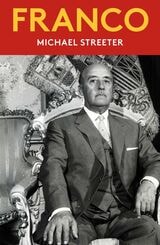
Franco
Michael Streeter
Haus Publishing, 2025
A narrative of the life of Francisco Franco, Spanish general and dictator.
Growing up in the wake of the Spanish military’s shattering defeat at the hands of the United States in 1898 over Cuba and having survived a bullet to the stomach while serving his country in Morocco, Francisco Franco’s fame and notoriety were eventually guaranteed by his ruthless pursuit of victory for the Nationalists in the Spanish Civil War.
Franco played a major role on the world stage until his death in 1975. At once intensely sentimental and affecting cool indifference at times of bad news, he emphasized the need to obey orders, the importance of individual bravery, absolute loyalty to the Fatherland, and the crucial role of the army. Franco was variously courted by the liberal democracies of Britain and France, the Fascist alliance of Hitler and Mussolini, and then by anti-communist administrations in Washington, but the memory of his successful policies, leading to rapid growth during a time of economic depression, is tempered by his government’s extreme repression of political opponents and perpetration of mass violence during the White Terror.
In this updated edition of Franco, featuring a new introduction by the author, Michael Streeter explores the Generalissimo’s legacy as the subject of a cult of personality in one of Europe’s longest-lasting modern dictatorships and considers his genesis, his successes (decades of relative stability and prosperity during a period of great European conflict), and the terrible cost at which they came.
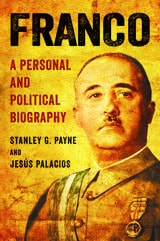
Franco
A Personal and Political BiographyStanley G. Payne and Jesús Palacios
University of Wisconsin Press, 2018
Franco: A Personal and Political Biography depicts his early life, explains his career and rise to prominence as an army officer who became Europe's youngest interwar brigadier general in 1926, and then discusses his role in the affairs of the troubled Second Spanish Republic (1931–36). Stanley G. Payne and Jesús Palacios examine in detail how Franco became dictator and how his leadership led to victory in the Spanish Civil War that consolidated his regime. They also explore Franco's role in the great repression that accompanied the Civil War—resulting in tens of thousands of executions—and examine at length his controversial role in World War II. This masterful biography highlights Franco's metamorphoses and adaptations to retain power as politics, culture, and economics shifted in the four decades of his dictatorship.
Best Books for General Audiences, selected by the American Association of School Librarians
Best Books for General Audiences, selected by the Public Library Reviewers
“An important book, destined to elicit a heated academic debate surrounding the man who ruled Spain for forty years and whose figure still casts a long shadow four decades after his death.”—Journal of Modern History
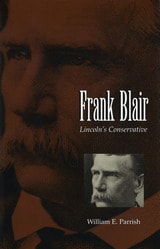
Frank Blair
Lincoln's ConservativeWilliam E. Parrish
University of Missouri Press, 1998
Known for his fearlessness in both the political arena and the battlefield, Frank Blair is a Missouri legend. As a member of one of the most prominent and powerful political families in America during the nineteenth century, possibly the equivalent of the twentieth-century Kennedys, Frank was steeped in politics at an early age. The youngest son of Francis Preston Blair, editor of Andrew Jackson's Washington Globe and adviser to Presidents Andrew Jackson through Andrew Johnson, Frank Blair was greatly influenced by his father, who had high political expectations of him.
Volatile and combative, Blair was either strongly admired or hated by the public figures of his day. He held adamantly to his opinions and fought hard for his political causes. He was an ardent supporter of Abraham Lincoln and championed the president's program in Congress and in Missouri against the frequent assaults of the Radicals. Credited with being the principal leader in saving Missouri for the Union in 1861, Blair later served with great distinction at Vicksburg, Chattanooga, and in the Sherman campaigns throughout Georgia and the Carolinas. He is one of only two Missourians ever honored by his state in Statuary Hall in the U.S. Capitol.
Frank Blair: Lincoln's Conservative reveals the full extent of Blair's importance as a national political figure. Specialists in nineteenth-century America, students of Missouri history, and Civil War buffs will welcome this study, which will long stand as the definitive work on this influential and colorful character.
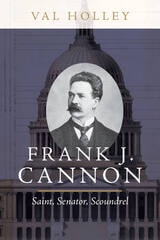
Frank J. Cannon
Saint, Senator, ScoundrelVal Holley
University of Utah Press, 2020
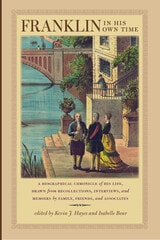
Franklin in His Own Time
A Biographical Chronicle of His Life, Drawn from Recollections, Interviews, and Memoirs by Family, Friends, and AssociatesKevin J. Hayes
University of Iowa Press, 2011
@font-face { font-family: "Courier New";}@font-face { font-family: "Times";}@font-face { font-family: "Cambria";}@font-face { font-family: "Palatino";}p.MsoNormal, li.MsoNormal, div.MsoNormal { margin: 0in 0in 0.0001pt; font-size: 12pt; font-family: "Times New Roman"; }div.Section1 { page: Section1; }
In his time Benjamin Franklin (1706–1790) was the most famous American in the world. Even those personally unacquainted with the man knew him as the author of Poor Richard’s Almanack, as a pioneer in the study of electricity and a major figure in the American Enlightenment, as the creator of such life-changing innovations as the lightning rod and America’s first circulating library, and as a leader of the American Revolution. His friends also knew him as a brilliant conversationalist, a great wit, an intellectual filled with curiosity, and most of all a master anecdotist whose vast store of knowledge complemented his conversational skills. In Franklin in His Own Time, by reprinting the original documents in which those anecdotes occur, Kevin Hayes and Isabelle Bour restore those oft-told stories to their cultural contexts to create a comprehensive narrative of his life and work.
The thirty-five recollections gathered in Franklin in His Own Time form an animated, collaborative biography designed to provide a multitude of perspectives on the “First American.” Opening with an account by botanist Peter Kalm showing that Franklin was doing all he could to encourage the development of science in North America, it includes on-the-spot impressions from Daniel Fisher’s diary, the earliest surviving interview with Franklin, recollections from James Madison and Abigail Adams, Manasseh Cutler’s detailed description of the library at Franklin Court, and extracts from Alexander Hamilton’s unvarnished Minutes of the Tuesday Club. Franklin’s political missions to Great Britain and France, where he took full advantage of rich social and intellectual opportunities, are a source of many reminiscences, some published here in new translations. Genuine memories from such old friends as Thomas Jefferson and John Adams, as opposed to memories influenced by the Autobiography, clarify Franklin’s reputation. Robert Carr may have been the last remaining person who knew Franklin personally, and thus his recollections are particularly signific
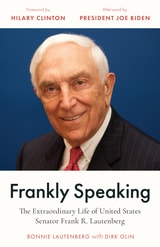
Frankly Speaking
The Extraordinary Life of United States Senator Frank R. LautenbergBonnie Lautenberg
Rutgers University Press, 2024
Told by one of the people who knew him best, his widow Bonnie, Frankly Speaking reveals the political strategies that made Lautenberg one of the Senate’s most powerful advocates for the health and safety of America’s citizens. He championed seemingly minor, unglamorous reforms that made a big difference to everyday lives, from raising the national drinking age to preventing domestic abusers from purchasing guns. These campaigns earned him powerful enemies in the alcohol, tobacco, and firearms industries, and he was subjected to some of the most brutal campaign mudslinging in American history. Yet, as this inspiring biography reveals, New Jersey’s longest-serving senator was not afraid to take big political risks if it meant standing up for his principles, whether that meant opposing the Iraq War or protecting LGBTQ and women’s rights.
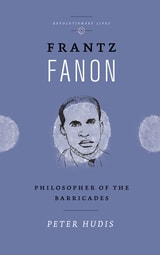
Frantz Fanon
Philosopher of the BarricadesPeter Hudis
Pluto Press, 2015
With FranzFanon, Peter Hudis presents a penetrating critical biography of the activist’s life and work. Countering the prevailing belief that Fanon’s contributions to modern thought can be wholly defined by an advocacy of violence, Hudis presents his work instead as an integrated whole, showing that its nuances—and thus its importance—can only be appreciated in light of Fanon’s efforts to fuse philosophical theory and actual practice. By taking seriously Fanon’s philosophical and psychological contributions, as well as his political activism, Hudis presents a powerful and perceptive new view of the man and his achievement.
This brief, richly perceptive introduction to Fanon will give new force to his ideas, his life, and his example for people engaged in radical political theory and taking action against oppression around the world today.
Fredric Jameson
The Project of Dialectical CriticismRobert T. Tally
Pluto Press, 2014
Fredric Jameson is the most important Marxist critic in the world today. While consistently operating at the cutting edge of literary and cultural studies, Jameson has remained committed to seemingly old-fashioned philosophical discourses, most notably dialectical criticism and utopian thought.
In Fredric Jameson: The Project of Dialectical Criticism, Robert Tally surveys Jameson’s entire oeuvre, from his early studies of Sartre and formal criticism through his engagements with postmodernism and globalisation to his recent readings of Hegel, Marx and the valences of the dialectic.
The book is both a comprehensive critical guide to Jameson’s theoretical project and itself a convincing argument for the power of dialectical criticism to understand the world today.
Freedom
Zygmunt Bauman
University of Minnesota Press, 1989
Freedom Beyond Sovereignty
Reconstructing Liberal IndividualismSharon R. Krause
University of Chicago Press, 2015
In Freedom Beyond Sovereignty, Sharon R. Krause shows that individual agency is best conceived as a non-sovereign experience because our ability to act and affect the world depends on how other people interpret and respond to what we do. The intersubjective character of agency makes it vulnerable to the effects of social inequality, but it is never in a strict sense socially determined. The agency of the oppressed sometimes surprises us with its vitality. Only by understanding the deep dynamics of agency as simultaneously non-sovereign and robust can we remediate the failed freedom of those on the losing end of persistent inequalities and grasp the scope of our own responsibility for social change. Freedom Beyond Sovereignty brings the experiences of the oppressed to the center of political theory and the study of freedom. It fundamentally reconstructs liberal individualism and enables us to see human action, personal responsibility, and the meaning of liberty in a totally new light.

Freedom In Our Lifetime
The Collected Writings Of Anton Muziwakhe LembedeAnton Muziwakhe Lembede
Ohio University Press, 1996
When a group of young political activists met in 1944 to launch the African National Congress Youth League, it included the nucleus of a remarkable generation of leaders who forged the struggle for freedom and equality in South Africa for the next half century: Nelson Mandela, Oliver Tambo, Walter Sisulu, Jordan Ngubane, Ellen Kuzwayo, Albertina Smith, A. P. Mda, Dan Tloome, and David Bopape. It was Anton Lembede, however whom they chose as their first president.
Lembede, who had just begun practicing law in Johannesburg, was known for his sharp intellect, fiery personality, and unwavering commitment to the struggle at hand. The son of farm laborers from the district of Georgedale, Natal, Lembede had worked tirelessly to put himself through school and college, and then to qualify for the bachelor of laws degree. When he began law practice in 1943, he had also earned the respect of his fellows, not only for his intellectual achievements (which were many), but also for his dedication to the cause of freedom in South Africa. “I am,” he explained, “Africa’s own child.”
His untimely death in 1947 at the age of 33 sent a wave of grief through the Congress Youth, who had looked to him for moral as well as political leadership. With the publication of Freedom In Our Lifetime, the editors acknowledge Lembede’s early contribution to the freedom movement, in particular his passionate and eloquent articulation of the African-centered philosophy he called “Africanism.”
Freedom as Marronage
Neil Roberts
University of Chicago Press, 2015
Roberts examines the liminal and transitional space of slave escape in order to develop a theory of freedom as marronage, which contends that freedom is fundamentally located within this space—that it is a form of perpetual flight. He engages a stunning variety of writers, including Hannah Arendt, W. E. B. Du Bois, Angela Davis, Frederick Douglass, Samuel Taylor Coleridge, and the Rastafari, among others, to develop a compelling lens through which to interpret the quandaries of slavery, freedom, and politics that still confront us today. The result is a sophisticated, interdisciplinary work that unsettles the ways we think about freedom by always casting it in the light of its critical opposite.
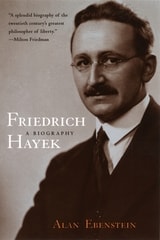
Friedrich Hayek
A BiographyAlan Ebenstein
University of Chicago Press, 2003
From Liberal Values to Democratic Transition
Essays in Honor of Janos KisRonald Dworkin
Central European University Press, 2004
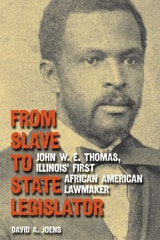
From Slave to State Legislator
John W. E. Thomas, Illinois' First African American LawmakerDavid A. Joens
Southern Illinois University Press, 2012
As the first African American elected to the Illinois General Assembly, John W. E. Thomas was the recognized leader of the state’s African American community for nearly twenty years and laid the groundwork for the success of future Black leaders in Chicago politics. Despite his key role in the passage of Illinois’ first civil rights act and his commitment to improving his community against steep personal and political barriers, Thomas’s life and career have been long forgotten by historians and the public alike. This fascinating full-length biography—the first to address the full influence of Thomas or any Black politician from Illinois during the Reconstruction Era—is also a pioneering effort to explain the dynamics of African American politics and divisions within the Black community in post–Civil War Chicago.
In From Slave to State Legislator, David A. Joens traces Thomas’s trajectory from a slave owned by a doctor’s family in Alabama to a prominent attorney believed to be the wealthiest African American man in Chicago at the time of his death in 1899. Providing one of the few comprehensive looks at African Americans in Chicago during this period, Joens reveals how Thomas’s career represents both the opportunities available to African Americans in the postwar period and the limits still placed on them. When Thomas moved to Chicago in 1869, he started a grocery store, invested in real estate, and founded the first private school for African Americans before becoming involved in politics.
From Slave to State Legislator provides detailed coverage of Thomas’s three terms in the legislature during the 1870s and 1880s, his multiple failures to be nominated for reelection, and his loyalty to the Republican Party at great political cost, calling attention to the political differences within a Black community often considered small and homogenous. Even after achieving his legislative legacy—the passage of the first state civil rights law—Thomas was plagued by patronage issues and an increasingly bitter split with the African American community frustrated with slow progress toward true equality. Drawing on newspapers and an array of government documents, Joens provides the most thorough review to date of the first civil rights legislation and the two controversial “colored conventions” chaired by Thomas.
Joens cements Thomas’s legacy as a committed and conscientious lawmaker amid political and personal struggles. In revealing the complicated rivalries and competing ambitions that shaped Black northern politics during the Reconstruction Era, Joens shows the long-term impact of Thomas’s friendship with other burgeoning African American political stars and his work to get more black representatives elected. The volume is enhanced by short biographies of other key Chicago African American politicians of the era.
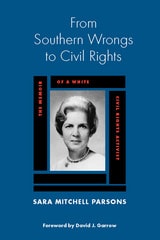
From Southern Wrongs to Civil Rights
The Memoir of a White Civil Rights ActivistSara Mitchell Parsons
University of Alabama Press, 2009
This first-hand account tells the story of turbulent civil rights era Atlanta through the eyes of a white upper-class woman who became an outspoken advocate for integration and racial equality
As a privileged white woman who grew up in segregated Atlanta, Sara Mitchell Parsons was an unlikely candidate to become a civil rights agitator. After all, her only contacts with blacks were with those who helped raise her and those who later helped raise her children. As a young woman, she followed the conventional path expected of her, becoming the dutiful wife of a conservative husband, going to the country club, and playing bridge. But unlike many of her peers, Parsons harbored an increasing uneasiness about racial segregation.In a memoir that includes candid diary excerpts, Parsons chronicles her moral awakening. With little support from her husband, she runs for the Atlanta Board of Education on a quietly integrationist platform and, once elected, becomes increasingly outspoken about inequitable school conditions and the slow pace of integration. Her activities bring her into contact with such civil rights leaders as Martin Luther King, Jr., and his wife, Coretta Scott King. For a time, she leads a dual existence, sometimes traveling the great psychic distance from an NAACP meeting on Auburn Avenue to an all-white party in upscale Buckhead. She eventually drops her ladies' clubs, and her deepening involvement in the civil rights movement costs Parsons many friends as well as her first marriage.