Results by title
967 books match the query 'Theater' and 24 start with f
Fancy's Image
Contexts, Settings, and Perspectives in Shakespeare and His ContemporariesCharles R Forker
Southern Illinois University Press, 1990
In ten essays spanning more than three decades of scholarship, Charles R. Forker, the author of Skull Beneath the Skin: The Achievement of John Webster, explores the dramatic and poetic styles of Shakespeare and his contemporaries in relation to Elizabethan ideas of space and time, image patterns and aesthetic form in drama, cultural contexts (the family, the state, the individual), and political and religious values.
Forker has divided his essays into three sections. The essays in the first section, "The Stage," explore theatrical self-consciousness; those in "The Green World" examine the use of pastoral and natural settings as significant factors in dramatization; the essays in the final section, "The Family," discuss ideas of dramatic engagement and disengagement in major Elizabethan playwrights other than Shakespeare.
Fangs Of Malice
Hypocrisy Sincerity And ActingMatthew H Wikander
University of Iowa Press, 2002
The idea that actors are hypocrites and fakes and therefore dangerous to society was widespread in the seventeenth and eighteenth centuries. Fangs of Malice examines the equation between the vice of hypocrisy and the craft of acting as it appears in antitheatrical tracts, in popular and high culture, and especially in plays of the period. Rousseau and others argue that actors, expert at seeming other than they are, pose a threat to society; yet dissembling seems also to be an inevitable consequence of human social intercourse. The “antitheatrical prejudice” offers a unique perspective on the high value that modern western culture places on sincerity, on being true to one's own self.
Taking a cue from the antitheatrical critics themselves, Matthew Wikander structures his book in acts and scenes, each based on a particular slander against actors. A prologue introduces his main issues. Act One deals with the proposition “They Dress Up”: foppish slavery to fashion, cross-dressing, and dressing as clergy. Act Two treats the proposition “They Lie” by focusing on social dissembling and the phenomenon of the self-deceiving hypocrite and the public, princely hypocrite. Act Three, “They Drink,” examines a wide range of antisocial behavior ascribed to actors, such as drinking, gambling, and whoring. An epilogue ties the ancient ideas of possession and the panic that actors inspire to contemporary anxieties about representation not only in theatre but also in the visual and literary arts.
Fangs of Malice will be of great interest to scholars and students of drama as well as to theatre professionals and buffs.
Fantasies of Empire
The Empire Theatre of Varieties and the Licensing Controversy of 1894Joseph Donohue
University of Iowa Press, 2005
Fantasies of Empire is the first book to recount in full the story of the Empire licensing controversy in all its captivating detail. Contemporaneous accounts are interwoven with Donohue’s identification and analysis of the larger issues raised: What the controversy reveals about contemporary sexual and social relations, what light it sheds on opposing views regarding the place of art and entertainment in modern society, and what it says about the pervasive effect of British imperialism on society’s behavior in the later years of Queen Victoria’s reign. Donohue connects the controversy to one of the most interesting developments in the history of modern theatre, the simultaneous emergence of a more sophisticated, varied, and moneyed audience and a municipal government insistent on its right to control and regulate that audience’s social and cultural character and even its moral behavior.
Rich in illustrations and entertainingly written, Fantasies of Empire will appeal to theatre, dance, and social historians and to students of popular entertainment, the Victorian period, urban studies, gender studies, leisure studies, and the social history of architecture.
Fashioning Celebrity
Eighteenth-Century British Actresses and Strategies for Image MakingLaura Engel
The Ohio State University Press, 2011
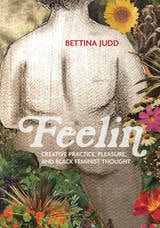
Feelin
Creative Practice, Pleasure, and Black Feminist ThoughtBettina Judd
Northwestern University Press, 2023
How creativity makes its way through feeling—and what we can know and feel through the artistic work of Black women
Feeling is not feelin. As the poet, artist, and scholar Bettina Judd argues, feelin, in African American Vernacular English, is how Black women artists approach and produce knowledge as sensation: internal and complex, entangled with pleasure, pain, anger, and joy, and manifesting artistic production itself as the meaning of the work. Through interviews, close readings, and archival research, Judd draws on the fields of affect studies and Black studies to analyze the creative processes and contributions of Black women—from poet Lucille Clifton and musician Avery*Sunshine to visual artists Betye Saar, Joyce J. Scott, and Deana Lawson.
Feelin: Creative Practice, Pleasure, and Black Feminist Thought makes a bold and vital intervention in critical theory’s trend toward disembodying feeling as knowledge. Instead, Judd revitalizes current debates in Black studies about the concept of the human and about Black life by considering how discourses on emotion as they are explored by Black women artists offer alternatives to the concept of the human. Judd expands the notions of Black women’s pleasure politics in Black feminist studies that include the erotic, the sexual, the painful, the joyful, the shameful, and the sensations and emotions that yet have no name. In its richly multidisciplinary approach, Feelin calls for the development of research methods that acknowledge creative and emotionally rigorous work as productive by incorporating visual art, narrative, and poetry.
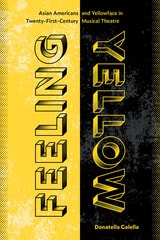
Feeling Yellow
Asian Americans and Yellowface in Twenty-First-Century Musical TheatreDonatella Galella
University of Michigan Press, 2026
Feeling Yellow examines how yellowface has persisted on the contemporary musical stage and how Asian Americans have contested yellowface, as they stake their own claim to the theatrical stage and nation state. Donatella Galella boldly argues that the pleasures of musical theatre and the disavowal of systemic anti-Asian racism enable the ongoing portrayal of Asian and Asian American characters by non-Asian actors. Galella offers two concepts to understand these phenomena: feeling yellow and yellowface without yellowed faces. Feeling yellow encapsulates the racialized anger, despair, and alienation of Asian American artists and audiences. Yellowface without yellowed faces denotes subtle ways of conveying Asianness, such as performing Asianness with exaggerated irony, using racialized costumes rather than yellow skin and slanted eye makeup, and setting musicals in fantasy Asian lands populated by multiracial casts.
Galella utilizes musicals such as Thoroughly Modern Millie, Anything Goes, The Mikado, and Soft Power, to understand how Asian and Asian American representation is connected to larger questions: How does racial identity shape emotional reactions to musical theatre? Why does yellowface and anti-Asian racism persist? What are the terms for Asian Americans belonging in the United States? Using a range of approaches from dramaturgy to auto-ethnography and materials from interviews to Reddit posts, Feeling Yellow spotlights Asian American affect, artistry, and activism.
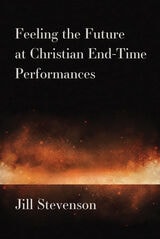
Feeling the Future at Christian End-Time Performances
Jill Stevenson
University of Michigan Press, 2022
The book’s main focus is contemporary Christian End-Time performances and how they theatrically construct encounters with future time—not just images or ideas of a future, but viscerally and immediately real experiences of future time. Author Jill Stevenson’s examples are Hell Houses and Judgement Houses; Rapture House, a similarly styled “walk through drama” in North Carolina; Hell’s Gates, an “outdoor reality drama” in Dawsonville, Georgia; Ark Encounter, a full-size recreation of Noah’s Ark; and Tribulation Trail, an immersive thirteen-scene drama ministry based on the Book of Revelation. The book’s coda considers similarities between these Christian performances and secular survivalist prepper events, especially with respect to constructions of and language about time. In doing so, the author situates these performances within a larger tradition that challenges traditional secular/sacred distinctions and illuminates how the End Times has been employed in our current social and political moment.
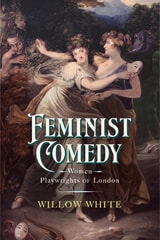
Feminist Comedy
Women Playwrights of LondonWillow White
University of Delaware Press, 2024
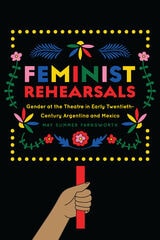
Feminist Rehearsals
Gender at the Theatre in Early Twentieth-Century Argentina and MexicoMay Summer Farnsworth
University of Iowa Press, 2023
2023 George Freedley Memorial Award, Finalist
As feminism gained prominence in twentieth-century popular culture, dramatic conventions progressed accordingly, offering larger and more diverse roles for women characters. Feminist Rehearsals documents the early stages of feminist theatre in Argentina and Mexico, revealing how various aspects of performance culture—spectator formation, playwriting, professional acting and directing, and dramatic techniques—paralleled political activism and championed the goals of the women’s rights movement. Through performance and protest, feminists enacted new identities and pushed for myriad social and legislative reforms during a time when women were denied suffrage and full citizenship status. Together, feminist theatre and demonstrations politicized women spectators’ collective presence and promoted women’s rights in the public sphere.
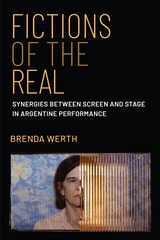
Fictions of the Real
Synergies Between Screen and Stage in Argentine PerformanceBrenda Werth
University of Michigan Press, 2026
Brenda Werth’s Fictions of the Real traces the transformation of “the real” and its transnational conceptualization by Argentine artists in the twenty-first century, focusing on artists who engage in both documentary theater and filmmaking. Werth places the work of Lola Arias, Romina Paula, Federico León, Mariano Pensotti, and Grupo Krapp in dialogue with the distinct but intertwined lineages of theater and film, exploring the intermedial dimensions of these artists’ theatrical work, resonances in their documentary films, and the transmedial relationships between their documentary plays and films. Focusing on the dynamic and shifting context of Argentina between 1998 and 2023, a period roughly bookmarked by the economic crisis of 2001 and the COVID-19 pandemic, this book explores how these artists disrupt the relations of power and counter political manipulation with their own evocative fictions of the real as they engage in the roles of translators, curators, researchers, archivists, and collaborators.

Following the Score
The Ravel TrilogyOliver Smith
Intellect Books, 2024
This book frames the playtexts of The Ravel Trilogy—Bolero (2014), Concerto (2016), and Solo (2018)—alongside a series of reflective essays and provocations on contemporary dramaturgy and musicology from academics and artists in drama, music, linguistics, and fine art. It contextualizes the themes and approaches of the trilogy and serves as a critical companion to a body of devised work, stimulating a debate about dramaturgy and composition and inviting discussion about post-dramatic theater's relationship to music.
This publication marks the culmination of the trilogy and its critical legacy, exploring the work through the dual lenses of postdramatic theater and research questions articulated and addressed by the practice-research undertaken by its co-creators. The dramaturgical context for The Ravel Trilogy and the reflective essays around it allow the editors to explore the relationship between theater and music, raising questions about practice-research and notions of creating playtexts from musical scores. In this volume, Michael Pinchbeck and Ollie Smith reflect on making and performing The Ravel Trilogy and the process of researching, devising, and presenting work inspired by music where score becomes script and dynamics become stage directions.
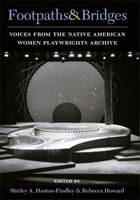
Footpaths and Bridges
Voices from the Native American Women Playwrights ArchiveEdited by Shirley A. Huston-Findley and Rebecca Howard
University of Michigan Press, 2011
Footpaths and Bridges celebrates the vitality and diversity of Native American women, collecting plays ranging from ETHNOSTRESS—a humorous take on art and identity politics—to the biographical musical Te Ata to a retelling of the Thanksgiving story from the Wampanoag perspective. The dramatic works are accompanied by critical commentary that illuminates Native American women’s theater practices and perspectives, highlighting the issues of heritage, identity, and changing lifestyles that the plays imaginatively tackle.
Featuring work from a wide array of tribes and geographic regions, the collection affords the artist, scholar, and general reader access to previously unheard voices that communicate the complexity and the diversity of the Native American experience. The far-ranging genres and content of the plays suggest the many possibilities for communicating the past and the present, the personal and the political, and the stunning kaleidoscope of Native American life and art.
“Often thoughtful provocateurs, Native American playwrights are frequently overlooked . . . eminently readable, and possibly performable, the plays [in this collection] examine colonization, generational differences, ‘ethnostress,’ and cultural identity.”
—Choice

Form and the Art of Theatre
Paul Newell Campbell
University of Wisconsin Press, 1984

Fornes
Theater in the Present TenseDiane Lynn Moroff
University of Michigan Press, 1996
Diane Lynn Moroff focuses on Fornes's major plays, providing illuminating readings of her unique and irreverent body of work. The book traces the career of this influential playwright, director, and teacher, including the reception of her plays, the range of critical responses (particularly those of feminist critics), and an introduction to Fornes's theatrical philosophies. It looks at such critical issues in Fornes's work as the representation of female subjectivity, theater as metaphor and context, art as ritual, and the role of the spectator. In a final chapter, Fornes's plays including Abingdon Square and her most recent work, What of the Night? are examined in the context of the sexualization of character, an ongoing theme for Fornes.
Fornes: Theater in the Present Tense will appeal to scholars and students in theater studies and women's studies and to anyone interested or engaged in contemporary theater.
Diane Lynn Moroff is Assistant Professor of English, Oglethorpe University.
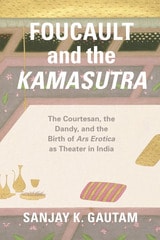
Foucault and the Kamasutra
The Courtesan, the Dandy, and the Birth of Ars Erotica as Theater in IndiaSanjay K. Gautam
University of Chicago Press, 2016
Gautam shows how closely intertwined the history of erotics in Indian culture is with the history of theater-aesthetics grounded in the discourse of love, and Foucault provides the framework for opening up an intellectual horizon of Indian thought. To do this, Gautam looks to the history of three inglorious characters in classical India: the courtesan and her two closest male companions—her patron, the dandy consort; and her teacher and advisor, the dandy guru. Foucault’s distinction between erotic arts and the science of sexuality drives Gautam’s exploration of the courtesan as a symbol of both sexual-erotic and aesthetic pleasure. In the end, by entwining together Foucault’s works on the history of sexuality in the West and the classical Indian texts on eros, Gautam transforms our understanding of both, even as he opens up new ways of investigating erotics, aesthetics, gender relations, and subjectivity.
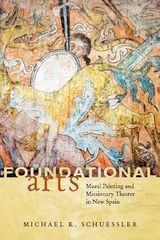
Foundational Arts
Mural Painting and Missionary Theater in New SpainMichael K. Schuessler
University of Arizona Press, 2013
In Foundational Arts Michael K. Schuessler asserts that the literature of New Spain begins with missionary theater and its intimate relationship to mural painting. In particular, he examines the relationships between texts and visual images that emerged in Mexico at two Augustinian monasteries in Hidalgo, Mexico, during the century following the Spanish Conquest. The forced combination of the ideographical tradition of Nahuatl with Latin-based language alphabets led to a fascinating array of new cultural expressions.
Missionary theater was organized by ingenious friars with the intent to convert and catechize indigenous populations. Often performed in Nahuatl or other local languages, the actors combined Latin-based language texts with visual contexts that corresponded to indigenous ways of knowing: murals, architectural ornamentation, statuary, altars, and other modes of visual representation. By concentrating on the interrelationship between mural painting and missionary theater, Foundational Arts explores the artistic and ideological origins of Mexican plastic arts and literature.
Frances Burney and Narrative Prior to Ideology
Brian McCrea
University of Delaware Press, 2014
Frances Burney and Narrative Prior to Ideology works between Burney’s Journals and Letters and her fiction more thoroughly than any study of her in the past twenty-five years. By doing so, it offers significant reinterpretations of Burney’s four novels: Evelina, Cecilia, Camilla, and The Wanderer. It describes Burney’s eluding the major modern–isms through which critics have tried to read her: Feminism (with its “gendering” of beauty and reversal of gender roles); Capitalism and its Marxist critique (here the details of Burney’s housekeeping become important); Professionalism (as a response to status inconsistency and class conflict); and Ian Watt’s “Formal Realism” (Burney perhaps saved the novel from a sharp decline it suffered in the 1770s, even as she tried to distance herself from the genre).
Burney’s most successful writing appeared before the coining of “ideology.” But her standing “prior to ideology” is not a matter of chronological accident. Rather, she quietly but forcefully resisted shared explanations—domesticity as model for household management, debt as basis for family finance, professional status as a means to social confidence, the novel as the dominant literary genre—that became popular during her long and eventful life.
Frederic Jameson has described Paul de Man, “in private conversation,” claiming, “Marxism . . . has no way of understanding the eighteenth century.” Frances Burney and Narrative Prior to Ideology conjoins Burney’s “eighteenth-centuryness” with her modernity.
Published by University of Delaware Press. Distributed worldwide by Rutgers University Press.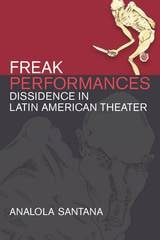
Freak Performances
Dissidence in Latin American TheaterAnalola Santana
University of Michigan Press, 2018
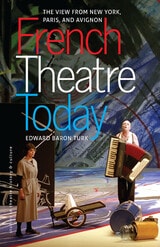
French Theatre Today
The View from New York, Paris, and AvignonTurk, Edward B.
University of Iowa Press, 2011
@font-face { font-family: "Times";}@font-face { font-family: "Palatino";}p.MsoNormal, li.MsoNormal, div.MsoNormal { margin: 0in 0in 0.0001pt; font-size: 12pt; font-family: "Times New Roman"; }div.Section1 { page: Section1; }
In 2005 literary and film critic Edward Turk immersed himself in New York City’s ACT FRENCH festival, a bold effort to enhance American contact with the contemporary French stage. This dizzying crash course on numerous aspects of current French theatre paved the way for six months of theatregoing in Paris and a month’s sojourn at the 2006 Avignon Festival. In French Theatre Today he turns his yearlong involvement with this rich topic into an accessible, intelligent, and comprehensive overview of contemporary French theatre. Situating many of the nearly 150 stage pieces he attended within contexts and timeframes that stretch backward and forward over a number of years, he reveals French theatre during the first decade of the twenty-first century to be remarkably vital, inclined toward both innovation and concern for its audience, and as open to international influence as it is respectful of national tradition.
French Theatre Today provides a seamless mix of critical analysis with lively description, theoretical considerations with reflexive remarks by the theatremakers themselves, and matters of current French and American cultural politics. In the first part, “New York,” Turk offers close-ups of French theatre works singled out during the ACT FRENCH festival for their presumed attractiveness to American audiences and critics. The second part, “Paris,” depicts a more expansive range of French theatre pieces as they play out on their own soil. In the third part, “Avignon,” Turk captures the subject within a more fluid context that is, most interestingly, both eminently French and resolutely international. The Paris and Avignon chapters contain valuable and well-informed contextual and background information as well as descriptions of the milieus of the Avignon Festival and the various neighborhoods in Paris where he attended performances, information that readers cannot find easily elsewhere. Finally, in the spirit of inclusiveness that characterizes so much new French theatre and to give a representative account of his own experiences as a spectator, Turk rounds out his survey with observations on Paris’s lively opera scene and France’s wealth of circus entertainments, both traditional and newly envisioned
With his shrewd assessments of contemporary French theatre, Turk conveys an excitement and an affection for his topic destined to arouse similar responses in his readers. His book’s freshness and openness will reward theatre enthusiasts who are curious about an aspect of French culture that is inadequately known in this country, veteran scholars and students of contemporary world theatre, and those American theatre professionals who have the ultimate authority and good fortune to determine which new French works will reach audie
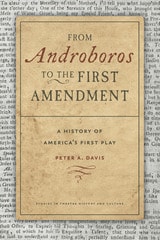
From Androboros to the First Amendment
A History of America's First PlayPeter A. Davis
University of Iowa Press, 2015
Androboros was not just the first of its kind, it was also ahead of its time in many ways, preceding the harsh political satires and farces of the later eighteenth century by some fifty years. Such plays served a small but essential role in promoting political thought among the colonists. Written by anonymous authors and passed from hand to hand, these short, crude, and often bawdy plays and dialogues were rarely acted due to their inflammatory lampoonery. Nevertheless, they provided an opportunity for disgruntled colonists to vent their grievances and promote their ideas to fellow citizens. The farces of the late eighteenth century drove home the meaning and message of the American Revolution.
Equally significant is that Androboros may have influenced a few of the key political discourses published in the 1730s, and these works in turn may well have shaped the future of the American political landscape for the next several decades and even into the modern era. But as a closet drama intended only to be read by close friends and political supporters, this play has languished as a minor footnote in American intellectual history. Scholarly research published to date has been, for the most part, inadequate and occasionally inaccurate. This study remedies that oversight, providing a full analysis as well as an annotated typescript and facsimiles of the original printing.
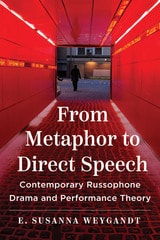
From Metaphor to Direct Speech
Contemporary Russophone Drama and Performance TheoryE. Susanna Weygandt
University of Wisconsin Press, 2025
As a result, the Russophone New Dramatists speak dissent and dramatize resistance. Ultimately, they shift theatrical productions from something constrained and limited, in both place and time, to an ephemeral but unbounded gateway for social activism. The sonic stage thus effectively functions as a social forum, transposing action from the actors to the audience. From Metaphor to Direct Speech therefore contributes to cultural as well as performance studies, offering a compelling look not just at developments in theatrical modes but also at dissent and cultural aesthetics in Russia today.
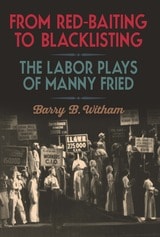
From Red-Baiting to Blacklisting
The Labor Plays of Manny FriedBarry B. Witham
Southern Illinois University Press, 2020
Author Barry B. Witham reclaims the work of Manny Fried, an essential American playwright so thoroughly blacklisted after he defied the House Committee on Un-American Activities in 1954, and again in 1964, that his work all but completely disappeared from the canon. Witham details Manny Fried’s work inside and outside the theatre and examines his three major labor plays and the political climate that both nurtured and disparaged their productions. Drawing on never-before-published interview materials, Witham reveals the details of how the United States government worked to ruin Fried’s career.
From Red-Baiting to Blacklisting includes the complete text of Fried’s major labor plays, all long out of print. In Elegy for Stanley Gorski, Fried depicts one of the many red-baiting campaigns that threatened countless unions in the wake of the Taft-Hartley Act and the collusion of the Catholic Church with these activities. In Drop Hammer, Fried tackles the issues of union dues, misappropriation, and potential criminal activities. In the third play, The Dodo Bird, perhaps his most popular, Fried achieves a remarkable character study of a man outsourced from his job by technology and plant closures.
Manny Fried’s plays portray the hard edges of capitalism and government power and illuminate present-day struggles with hostility to labor unions and the passage in several states of right-to-work laws. Fried had no illusions about the government’s determination to destroy communism and unionism—causes to which he was deeply committed.
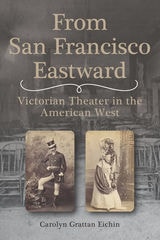
From San Francisco Eastward
Victorian Theater in the American WestCarolyn Grattan Eichin
University of Nevada Press, 2020
Finalist for the 2021 Will Rogers Medallion Award in Western Non-Fiction
Carolyn Grattan Eichin’s From San Francisco Eastward explores the dynamics and influence of theater in the West during the Victorian era. San Francisco, Eichin argues, served as the nucleus of the western theatrical world, having attained prominence behind only New York and Boston as the nation’s most important theatrical center by 1870. By focusing on the West’s hinterland communities, theater as a capitalist venture driven by the sale of cultural forms is illuminated against the backdrop of urbanization.
Using the vagaries of the West’s notorious boom-bust economic cycles, Eichin traces the fiscal, demographic, and geographic influences that shaped western theater. With an emphasis on the 1860s and 70s, this thoroughly researched work uses distinct notions of ethnicity, class, and gender to examine a cultural institution driven by a market economy. From San Francisco Eastward is a thorough analysis of the ever-changing theatrical personalities and strategies that shaped Victorian theater in the West, and the ways in which theater as a business transformed the values of a region.
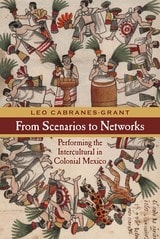
From Scenarios to Networks
Performing the Intercultural in Colonial MexicoLeo Cabranes-Grant
Northwestern University Press, 2016
In this innovative study, Leo Cabranes-Grant analyzes four intercultural events in the Viceroyalty of New Spain that took place between 1566 and 1690. Rather than relying on racial labels to describe alterations of identity, Cabranes-Grant focuses on experimentation, rehearsal, and the interaction between bodies and objects. His analysis shows how scenarios are invested with affective qualities, which in turn enable cultural and semiotic change. Central to his argument is Bruno Latour’s Actor-Network Theory, which figures society as a constantly evolving web of relationships among objects, people, and spaces. In examining these scenarios, Cabranes-Grant attempts to discern the reasons why the conditions of an intensified moment within this ceaseless flow take on a particular value and inspire their re-creation. Cabranes-Grant offers a fresh perspective on Latour’s theory and reorients debates concerning history and historiography in the field of performance studies.