Results by title
18284 books match the query 'United States' and 783 start with f
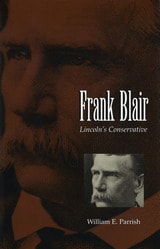
Frank Blair
Lincoln's ConservativeWilliam E. Parrish
University of Missouri Press, 1998
Known for his fearlessness in both the political arena and the battlefield, Frank Blair is a Missouri legend. As a member of one of the most prominent and powerful political families in America during the nineteenth century, possibly the equivalent of the twentieth-century Kennedys, Frank was steeped in politics at an early age. The youngest son of Francis Preston Blair, editor of Andrew Jackson's Washington Globe and adviser to Presidents Andrew Jackson through Andrew Johnson, Frank Blair was greatly influenced by his father, who had high political expectations of him.
Volatile and combative, Blair was either strongly admired or hated by the public figures of his day. He held adamantly to his opinions and fought hard for his political causes. He was an ardent supporter of Abraham Lincoln and championed the president's program in Congress and in Missouri against the frequent assaults of the Radicals. Credited with being the principal leader in saving Missouri for the Union in 1861, Blair later served with great distinction at Vicksburg, Chattanooga, and in the Sherman campaigns throughout Georgia and the Carolinas. He is one of only two Missourians ever honored by his state in Statuary Hall in the U.S. Capitol.
Frank Blair: Lincoln's Conservative reveals the full extent of Blair's importance as a national political figure. Specialists in nineteenth-century America, students of Missouri history, and Civil War buffs will welcome this study, which will long stand as the definitive work on this influential and colorful character.
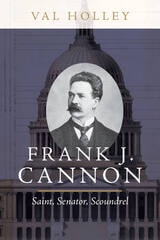
Frank J. Cannon
Saint, Senator, ScoundrelVal Holley
University of Utah Press, 2020
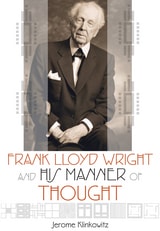
Frank Lloyd Wright and His Manner of Thought
Jerome Klinkowitz
University of Wisconsin Press, 2014
Klinkowitz presents a critical biography driven by the architect's own work and intellectual growth, focusing on the evolution of Wright's thinking and writings from his first public addresses in 1894 to his last essay in 1959. Did Wright reject all of Victorian thinking about the home, or do his attentions to a minister's sermon on "the house beautiful" deserve closer attention? Was Wright echoing the Transcendentalism of Ralph Waldo Emerson, or was he more in step with the philosophy of William James? Did he reject the Arts and Crafts movement, or repurpose its beliefs and practices for new times? And, what can be said of his deep dissatisfaction with architectural concepts of his own era, the dominant modernism that became the International Style? Even the strongest advocates of Frank Lloyd Wright have been puzzled by his objections to so much that characterized the twentieth century, from ideas for building to styles of living.
In Frank Lloyd Wright and His Manner of Thought, Klinkowitz, a widely published authority on twentieth-century literature, thought, and culture, examines the full extent of Wright's books, essays, and lectures to show how he emerged from the nineteenth century to anticipate the twenty-first.
Outstanding Book, selected by the American Association of School Librarians
Best Books for General Audiences, selected by the Public Library Reviewers
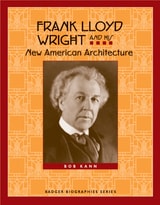
Frank Lloyd Wright and His New American Architecture
Bob Kann
Wisconsin Historical Society Press, 2010
From boyhood adventures to the creation of visionary buildings like the Guggenheim Museum, Frank Lloyd Wright and His New American Architecture chronicles the vibrant life of one of the world's most famous architects.
Wright's love of architecture was nurtured early on-from paintings of European cathedrals hung in his childhood room; to "Froebel Gifts" building blocks, which he crafted into crude structures; to long walks near the Wisconsin River, where his mother pointed out patterns and colors in nature. Wright also learned, from summers spent on his uncle's Spring Green farm, that adversity is part of life. And perhaps this helped him weather a life beset with both tragedy and triumph.
Wright's prolific career spanned more than 70 years, and he created more than 1,100 designs. Author Bob Kann brings readers into the eccentric stories behind some of Wright's landmark buildings. Find out about Wright's Oak Park home, known to locals as "the house with a tree growing through it;" the Robie House, which is shaped like a battleship; and Fallingwater, which is built on a waterfall. Learn how Wright successfully built the Imperial Hotel in Tokyo to withstand earthquakes, and how the Johnson Wax Building and Guggenheim Museum set new standards in institutional architecture.
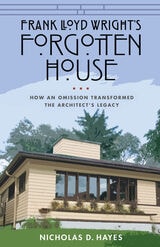
Frank Lloyd Wright's Forgotten House
How an Omission Transformed the Architect's LegacyNicholas D. Hayes
University of Wisconsin Press, 2021
When Nicholas and Angela Hayes became stewards of the unassuming Elizabeth Murphy House near Milwaukee, they began to unearth evidence that ultimately revealed a one-hundred-year-old fiasco fueled by competing ambitions and conflicting visions of America. The couple’s forensic pursuit of the truth untangled the ways Wright’s ASBH experiment led to the architect’s most productive, creative period. Frank Lloyd Wright’s Forgotten House includes a wealth of drawings and photographs, many of which have never been previously published. Historians, architecture buffs, and Wrightophiles alike will be fascinated by this untold history that fills a crucial gap in the architect’s oeuvre.
Frank Lloyd Wright
A BiographyMeryle Secrest
University of Chicago Press, 1998
The result is the most engaging and thorough account ever of Wright's life, work, and professional and personal circle, a gripping account of a complicated, challenging genius.
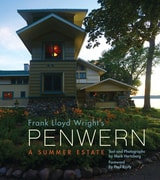
Frank Lloyd Wright’s Penwern
A Summer EstateMark Hertzberg
Wisconsin Historical Society Press, 2019
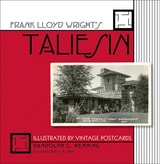
Frank Lloyd Wright’s Taliesin
Illustrated by Vintage PostcardsRandolph C. Henning
University of Wisconsin Press, 2011
The Wisconsin-born Frank Lloyd Wright (1867–1959) is recognized worldwide as an iconic architectural genius. In 1911 he designed Taliesin to use as his personal residence, architectural studio, and working farm. A century later Randolph C. Henning has assembled a splendid collection of rare vintage postcards, some never before published, that provides a revealing and visually unique journey through Wright’s work at Taliesin. Included are intimate images of Taliesin at various stages and views of the building just after the tragic 1914 fire. The postcards also depict nearby buildings designed by Wright, including the Romeo and Juliet windmill and two buildings for the Hillside Home School. Henning provides useful explanations that highlight relevant details and accompany each image. Frank Lloyd Wright’s Taliesin documents and celebrates Wright’s 100-year-old masterpiece.
Best Books for General Audiences, selected by the American Association of School Librarians
Best Books for General Audiences, selected by the Public Library Reviewers
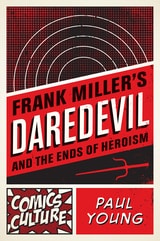
Frank Miller's Daredevil and the Ends of Heroism
Young, Paul
Rutgers University Press, 2016
In the late 1970s and early 1980s, writer-artist Frank Miller turned Daredevil from a tepid-selling comic into an industry-wide success story, doubling its sales within three years. Lawyer by day and costumed vigilante by night, the character of Daredevil was the perfect vehicle for the explorations of heroic ideals and violence that would come to define Miller’s work.
Frank Murphy
The Detroit YearsSidney Fine
University of Michigan Press, 1975
Frank Norris Remembered
Edited by Jesse S. Crisler and Joseph R. McElrath Jr.
University of Alabama Press, 2013
Frank Norris Remembered is a collection of reminiscences by Norris’s contemporaries, friends, and family that illuminate the life of a popular American novelist.
Considering his undergraduate education spent studying art at Académie Julian in Paris and creative writing at Harvard and his journalism career reporting from the far reaches of South Africa and Cuba, it is difficult to fathom how Frank Norris also found time to compose seven novels during the course of his brief life. But despite his adventures abroad, Norris turned out novels at a dizzying pace. He published Moran of the Lady Letty in 1898, McTeague early in 1899, Blix later that year, A Man’s Woman in February 1900, and The Octopus, the first in his ultimately unfinished “Epic of the Wheat” trilogy, in 1901. By informing his novels with his own experiences abroad, Norris composed works that were politically charged and culturally relevant and that made considerable contributions to the character of American literature in the twentieth century.
Frank Norris died at the age of thirty-two in 1902 from peritonitis resulting from a burst appendix, leaving behind a wife, a daughter, and an unfinished series of novels (two of which, The Pit and Vandover and the Brute, were published posthumously). The aim of Frank Norris Remembered, edited by Jesse S. Crisler and Joseph R. McElrath Jr., is to re-create the short, spectacular life of this American author through the eyes of those who knew him best. The fifty reminiscences included in this book feature the voices of Frank N. Doubleday; William Dean Howells; Hamlin Garland; Norris’s wife, Jeannette; and many others who were lucky enough to form a relationship with this vital twentieth-century American author, artist, and adventurer.
Frank O'Hara
Poet Among PaintersMarjorie Perloff
University of Chicago Press, 1997
"A groundbreaking study. [This book] is a genuine work of criticism. . . . Through Marjorie Perloff's book we see an O'Hara perhaps only his closer associates saw before: a poet fully aware of the traditions and techniques of his craft who, in a life tragically foreshortened, produced an adventurous if somewhat erratic body of American verse."—David Lenson, Chronicle of Higher Education
"Perloff is a reliable, well-informed, discreet, sensitive . . . guide. . . . She is impressive in the way she deals with O'Hara's relationship to painters and paintings, and she does give first-rate readings of four major poems."—Jonathan Cott, New York Times Book Review
Frank O'Hara
The Poetics of CoterieLytle Shaw
University of Iowa Press, 2006
Frankie Manning
Ambassador of Lindy HopFrankie Manning
Temple University Press, 2008
In the early days of swing dancing, Frankie Manning stood out for his moves and his innovative routines; he created the "air step" in the Lindy hop, a dance that took the U.S. and then the world by storm. In this fascinating autobiography, the choreographer and Tony Award winner (Black and Blue) Frankie Manning recalls how his first years of dancing as a teenager at Harlem's Savoy Ballroom led to his becoming chief choreographer and a lead dancer for Whitey's Lindy Hoppers, a group that appeared on Broadway, in Hollywood musicals, and on stages around the globe. Manning brings the Swing Era vividly back to life with his recollections of the crowded ballrooms, and of Lindy hoppers trying to outdo each other in spectacular performances. His memories of the many headliners and film stars, as well as uncelebrated dancers with whom he shared the stage, create a unique portrait of an era in which African American performers enjoyed the spotlight if not a star's prerogatives and salary.
With collaborator Cynthia Millman, Manning traces the evolution of swing dancing from its early days in Harlem through the post-World War II period, until it was eclipsed by rock 'n' roll and then disco. When swing made a comeback, Manning's 30-year hiatus ended. He has been performing, choreographing, and teaching ever since.
Frankie and Johnny
Race, Gender, and the Work of African American Folklore in 1930s AmericaBy Stacy I. Morgan
University of Texas Press, 2017
Winner, Wayland D. Hand Prize, American Folklore Society, 2018
Originating in a homicide in St. Louis in 1899, the ballad of “Frankie and Johnny” became one of America’s most familiar songs during the first half of the twentieth century. It crossed lines of race, class, and artistic genres, taking form in such varied expressions as a folk song performed by Huddie Ledbetter (Lead Belly); a ballet choreographed by Ruth Page and Bentley Stone under New Deal sponsorship; a mural in the Missouri State Capitol by Thomas Hart Benton; a play by John Huston; a motion picture, She Done Him Wrong, that made Mae West a national celebrity; and an anti-lynching poem by Sterling Brown.
In this innovative book, Stacy I. Morgan explores why African American folklore—and “Frankie and Johnny” in particular—became prized source material for artists of diverse political and aesthetic sensibilities. He looks at a confluence of factors, including the Harlem Renaissance, the Great Depression, and resurgent nationalism, that led those creators to engage with this ubiquitous song. Morgan’s research uncovers the wide range of work that artists called upon African American folklore to perform in the 1930s, as it alternately reinforced and challenged norms of race, gender, and appropriate subjects for artistic expression. He demonstrates that the folklorists and creative artists of that generation forged a new national culture in which African American folk songs featured centrally not only in folk and popular culture but in the fine arts as well.
Franklin D. Israel
A Life in ArchitectureTodd Gannon
J. Paul Getty Trust, The, 2024
Acclaimed Los Angeles architect Franklin D. Israel (1945–1996) created innovative residential projects and office interiors that made him one of the most talked-about designers of his generation. In this vivid account, architectural historian Todd Gannon draws on archival resources, analyses of Israel’s buildings, and recent interviews with the architect’s colleagues, clients, and contemporaries, including Frank Gehry, Thom Mayne, and Robert A. M. Stern. Gannon traces Israel’s development from his early years and career on the East Coast to his formative world travels and residence at the American Academy in Rome. The author guides readers through the Los Angeles architectural context, Israel’s influential teaching at UCLA, his dalliance with Hollywood, and the personal motivations behind his architecture and design work—all aspects of an influential career that was cut short by his death from AIDS-related complications at the age of fifty.
Franklin D. Israel is a compelling work of architectural history and biography, chronicling one gay man’s engagement with the largely heteronormative world of American architectural culture. It explores the achievement of this central figure in the still largely unstudied history of late twentieth-century avant-garde Los Angeles architecture.
Franklin D. Roosevelt
Road to the New Deal, 1882-1939Roger Daniels
University of Illinois Press, 2015
Franklin D. Roosevelt
The War Years, 1939-1945Roger Daniels
University of Illinois Press, 2016

Franklin Furnace and the Spirit of the Avant-Garde
A History of the FutureToni Sant
Intellect Books, 2011
Franklin Furnace is a renowned New York–based artsorganization whose mission is to preserve, document, and present works of avant-garde art by emerging artists—particularly those whose works may be vulnerable due to institutional neglect or politically unpopular content. Over more than thirty years, Franklin Furnace has exhibited works by hundreds of avant-garde artists, some of whom—Laurie Anderson, Vito Acconci, Karen Finley, Guillermo Gómez-Peña, Jenny Holzer, and the Blue Man Group, to name a few—are now established names in contemporary art.
Here, for the first time, is a comprehensive history of this remarkable organization from its conception to the present. Organized around the major art genres that emerged in the second half of the twentieth century, this book intersperses first-person narratives with readings by artists and scholars on issues critical to the organization's success as well as Franklin Furnace's many contributions to avant-garde art.
Franklin in His Own Time
A Biographical Chronicle of His Life, Drawn from Recollections, Interviews, and Memoirs by Family, Friends, and AssociatesKevin J. Hayes
University of Iowa Press, 2011
@font-face { font-family: "Courier New";}@font-face { font-family: "Times";}@font-face { font-family: "Cambria";}@font-face { font-family: "Palatino";}p.MsoNormal, li.MsoNormal, div.MsoNormal { margin: 0in 0in 0.0001pt; font-size: 12pt; font-family: "Times New Roman"; }div.Section1 { page: Section1; }
In his time Benjamin Franklin (1706–1790) was the most famous American in the world. Even those personally unacquainted with the man knew him as the author of Poor Richard’s Almanack, as a pioneer in the study of electricity and a major figure in the American Enlightenment, as the creator of such life-changing innovations as the lightning rod and America’s first circulating library, and as a leader of the American Revolution. His friends also knew him as a brilliant conversationalist, a great wit, an intellectual filled with curiosity, and most of all a master anecdotist whose vast store of knowledge complemented his conversational skills. In Franklin in His Own Time, by reprinting the original documents in which those anecdotes occur, Kevin Hayes and Isabelle Bour restore those oft-told stories to their cultural contexts to create a comprehensive narrative of his life and work.
The thirty-five recollections gathered in Franklin in His Own Time form an animated, collaborative biography designed to provide a multitude of perspectives on the “First American.” Opening with an account by botanist Peter Kalm showing that Franklin was doing all he could to encourage the development of science in North America, it includes on-the-spot impressions from Daniel Fisher’s diary, the earliest surviving interview with Franklin, recollections from James Madison and Abigail Adams, Manasseh Cutler’s detailed description of the library at Franklin Court, and extracts from Alexander Hamilton’s unvarnished Minutes of the Tuesday Club. Franklin’s political missions to Great Britain and France, where he took full advantage of rich social and intellectual opportunities, are a source of many reminiscences, some published here in new translations. Genuine memories from such old friends as Thomas Jefferson and John Adams, as opposed to memories influenced by the Autobiography, clarify Franklin’s reputation. Robert Carr may have been the last remaining person who knew Franklin personally, and thus his recollections are particularly signific
Franklin's Thrift
The Lost History of an American VirtueDavid Blankenhorn
Templeton Press, 2009
Americans today often think of thrift as a negative value—a miserly hoarding of resources and a denial of pleasure. Even more telling, many Americans don’t even think of thrift at all anymore. Franklin’s Thrift challenges this state of mind by recovering the rich history of thrift as a quintessentially American virtue.
The contributors to this volume trace how the idea and practice of thrift have been a vital part of the American vision of economic freedom and social abundance. For Benjamin Franklin, who personified and promoted the idea, thrift meant working productively, consuming wisely, saving proportionally, and giving generously. Franklin’s thrift became the cornerstone of a new kind of secular faith in the ordinary person’s capacity to shape his lot and fortune in life. Later chapters document how thrift moved into new domains in the nineteenth and twentieth centuries. It became the animating idea behind social movements to promote children’s school savings, create mutual savings banks and credit unions for working men and women, establish a federal savings bond program, and galvanize the nation to conserve resources during two world wars.
Historians, enthusiasts of Americana or traditional American virtues, and anyone interested in resolving our society’s current financial woes will find much to treasure in this diverse collection, with topics ranging from the inspirational lessons we can learn from the film It’s a Wonderful Life to a history of the roles played by mutual savings banks, credit unions, and thrift stores in America’s national thrift movement. It also includes actual policy recommendations for our present situation.
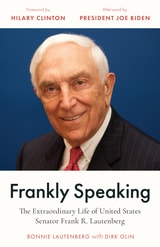
Frankly Speaking
The Extraordinary Life of United States Senator Frank R. LautenbergBonnie Lautenberg
Rutgers University Press, 2024
Told by one of the people who knew him best, his widow Bonnie, Frankly Speaking reveals the political strategies that made Lautenberg one of the Senate’s most powerful advocates for the health and safety of America’s citizens. He championed seemingly minor, unglamorous reforms that made a big difference to everyday lives, from raising the national drinking age to preventing domestic abusers from purchasing guns. These campaigns earned him powerful enemies in the alcohol, tobacco, and firearms industries, and he was subjected to some of the most brutal campaign mudslinging in American history. Yet, as this inspiring biography reveals, New Jersey’s longest-serving senator was not afraid to take big political risks if it meant standing up for his principles, whether that meant opposing the Iraq War or protecting LGBTQ and women’s rights.
Fray
Art and Textile PoliticsJulia Bryan-Wilson
University of Chicago Press, 2017
Closely examining how amateurs and fine artists in the United States and Chile turned to sewing, braiding, knotting, and quilting amid the rise of global manufacturing, Julia Bryan-Wilson argues that textiles unravel the high/low divide and urges us to think flexibly about what the politics of textiles might be. Her case studies from the 1970s through the 1990s—including the improvised costumes of the theater troupe the Cockettes, the braided rag rugs of US artist Harmony Hammond, the thread-based sculptures of Chilean artist Cecilia Vicuña, the small hand-sewn tapestries depicting Pinochet’s torture, and the NAMES Project AIDS Memorial Quilt—are often taken as evidence of the inherently progressive nature of handcrafted textiles. Fray, however, shows that such methods are recruited to often ambivalent ends, leaving textiles very much “in the fray” of debates about feminized labor, protest cultures, and queer identities; the malleability of cloth and fiber means that textiles can be activated, or stretched, in many ideological directions.
The first contemporary art history book to discuss both fine art and amateur registers of handmaking at such an expansive scale, Fray unveils crucial insights into how textiles inhabit the broad space between artistic and political poles—high and low, untrained and highly skilled, conformist and disobedient, craft and art.
Fraying Fabric
How Trade Policy and Industrial Decline Transformed AmericaJames C. Benton
University of Illinois Press, 2022
Freak Show
Presenting Human Oddities for Amusement and ProfitRobert Bogdan
University of Chicago Press, 1990
Robert Bogdan's fascinating social history brings to life the world of the freak show and explores the culture that nurtured and, later, abandoned it. In uncovering this neglected chapter of show business, he describes in detail the flimflam artistry behind the shows, the promoters and the audiences, and the gradual evolution of public opinion from awe to embarrassment. Freaks were not born, Bogdan reveals; they were manufactured by the amusement world, usually with the active participation of the freaks themselves. Many of the "human curiosities" found fame and fortune, becoming the celebrities of their time, until the ascent of professional medicine transformed them from marvels into pathological specimans.
Freaks Talk Back
Tabloid Talk Shows and Sexual NonconformityJoshua Gamson
University of Chicago Press, 1998
"This entertaining, accessible, sobering discussion should make every viewer sit up and ponder the effects and possibilities of America's daily talk-fest with newly sharpened eyes."—Publishers Weekly
"Bold, witty. . . . There's a lot of empirical work behind this deceptively easy read, then, and it allows for the most sophisticated and complex analysis of talk shows yet."—Elayne Rapping, Women's Review of Books
"Funny, well-researched, fully theorized. . . . Engaged and humane scholarship. . . . A pretty inspiring example of what talking back to the mass media can be."—Jesse Berrett, Village Voice
"An extraordinarily well-researched volume, one of the most comprehensive studies of popular media to appear in this decade."—James Ledbetter, Newsday
Fred Allen's Radio Comedy
Alan Havig
Temple University Press, 1991

Fred in Love
Felice Picano
University of Wisconsin Press, 2005
But when an acquaintance brought his female cat to be serviced by Fred, an entire new set of experiences opened up for the cat-and for Picano, who'd never had the nerve to befriend her owner, his ideal man. The course of love seldom runs straight for cats or for men, and this time would prove (hilariously) no different.
This is another of Picano's distinguished portraits of a vanished era, when a new gay domain was solidifying only a few years after the Stonewall Riots, and the still nascent gay literary world that Picano would help invent was just a conception. Fred in Love is a charming, nostalgic, funny, gossipy, involving, and ultimately enlightening story about how we learn and grow, and how we love-whether the object of our affection is a cat or another human being. It's sure to take its place next to Picano's now classic literary memoirs Ambidextrous, Men Who Loved Me, and A House on the Ocean, a House on the Bay.
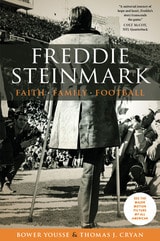
Freddie Steinmark
Faith, Family, FootballBy Bower Yousse and Thomas J. Cryan
University of Texas Press, 2015
Freddie Steinmark tells the story of a legendary University of Texas football player whose courage on the field and in battling cancer still inspires the Longhorn nation.
Freddie Steinmark started at safety for the undefeated University of Texas Longhorns in 1969. In the thrilling “Game of the Century,” a come-from-behind victory against Arkansas that ensured Texas the national championship, Steinmark played with pain in his left leg. Two days later, X-rays revealed a bone tumor so large that it seemed a miracle Steinmark could walk, let alone play football. Within a week of the Arkansas game, his leg was amputated.
A gritty, undersized player, Steinmark had quickly become a fan favorite at Texas. What he endured during the Longhorns’ memorable 1969 season, and what he encountered afterward, captivated not only Texans but the country at large. Americans watched closely as Steinmark confronted life’s ultimate challenge, and his openness during his battle against savage odds helped reframe the national conversation surrounding cancer and the ongoing race for a cure.
Written with unfettered access to the Steinmark family and archives, Freddie Steinmark: Faith, Family, Football is the exploration of a brief but full life, one that began humbly but ended on a grand stage. It is a fitting tribute to a legendary Longhorn whose photograph, emblazoned with the word “Heart,” flashes on the Freddie Steinmark Scoreboard’s Jumbotron prior to each home football game in UT’s Darrell K Royal–Texas Memorial Stadium at Joe Jamail Field.
Frederick Douglass
Freedom's Voice, 1818-1845Gregory P. Lampe
Michigan State University Press, 1998
This work in the MSU Press Rhetoric and Public Affairs Series chronicles Frederick Douglass's preparation for a career in oratory, his emergence as an abolitionist lecturer in 1841, and his development and activities as a public speaker and reformer from 1841 to 1845. Lampe's meticulous scholarship overturns much of the conventional wisdom about this phase of Douglass's life and career uncovering new information about his experiences as a slave and as a fugitive; it provokes a deeper and richer understanding of this renowned orator's emergence as an important voice in the crusade to end slavery.
Contrary to conventional wisdom, Douglass was well prepared to become a full-time lecturer for the Massachusetts Anti-Slavery Society in 1841. His emergence as an eloquent voice from slavery was not as miraculous as scholars have led us to believe. Lampe begins by tracing Douglass's life as slave in Maryland and as fugitive in New Bedford, showing that experiences gained at this time in his life contributed powerfully to his understanding of rhetoric and to his development as an orator. An examination of his daily oratorical activities from the time of his emergence in Nantucket in 1841 until his departure for England in 1845 dispels many conventional beliefs surrounding this period, especially the belief that Douglass was under the wing of William Lloyd Garrison. Lampe's research shows that Douglass was much more outspoken and independent than previously thought and that at times he was in conflict with white abolitionists.
Included in this work is a complete itinerary of Douglass's oratorical activities, correcting errors and omissions in previously published works, as well as two newly discovered complete speech texts, never before published.
Frederick Jackson Turner
Wisconsin’s Historian of the FrontierMartin Ridge
Wisconsin Historical Society Press, 1986
Fredric Jameson and Film Theory
Marxism, Allegory, and Geopolitics in World CinemaKeith B. Wagner
Rutgers University Press, 2022
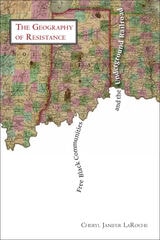
Free Black Communities and the Underground Railroad
The Geography of ResistanceCheryl Janifer LaRoche
University of Illinois Press, 2013
Free Burma
Transnational Legal Action and Corporate AccountabilityJohn G. Dale
University of Minnesota Press, 2010
Through the experience of the Free Burma movement, John G. Dale demonstrates how social movements create and appropriate legal mechanisms for generating new transnational political opportunities. He presents three corporate accountability campaigns waged by the Free Burma movement. The cases focus on the legislation of “Free Burma” laws in local governments throughout the United States; the effort to force the state of California to de-charter Unocal Oil Corporation for its flagrant abuse of human rights; and the first-ever use of the U.S. Alien Tort Claims Act to sue a corporation in a U.S. court for human rights abuses committed abroad. Dale’s work also raises the issue of how foreign policies of so-called constructive engagement actually pose a threat to the hope of Burma’s activists—and others worldwide—for more democratic economic development.
Free Expression and Democracy in America
A HistoryStephen M. Feldman
University of Chicago Press, 2008
Charting the course of free expression alongside the nation’s political evolution, from the birth of the Constitution to the quagmire of the Vietnam War, Stephen M. Feldman argues that our level of freedom is determined not only by the Supreme Court, but also by cultural, social, and economic forces. Along the way, he pinpoints the struggles of excluded groups—women, African Americans, and laborers—to participate in democratic government as pivotal to the development of free expression. In an age when our freedom of speech is once again at risk, this momentous book will be essential reading for legal historians, political scientists, and history buffs alike.
Free Labor
The Civil War and the Making of an American Working ClassMark A. Lause
University of Illinois Press, 2015
Mark A. Lause describes how the working class radicalized during the war as a response to economic crisis, the political opportunity created by the election of Abraham Lincoln, and the ideology of free labor and abolition. His account moves from battlefield and picket line to the negotiating table, as he discusses how leaders and the rank-and-file alike adapted tactics and modes of operation to specific circumstances. His close attention to women and African Americans, meanwhile, dismantles notions of the working class as synonymous with whiteness and maleness.
In addition, Lause offers a nuanced consideration of race's role in the politics of national labor organizations, in segregated industries in the border North and South, and in black resistance in the secessionist South, creatively reading self-emancipation as the largest general strike in U.S. history.
Free Spaces
The Sources of Democratic Change in AmericaSara M. Evans and Harry C. Boyte
University of Chicago Press, 1992
In Free Spaces, Sara M. Evans and Harry C. Boyte argue for a new understanding of the foundations for democratic politics by analyzing the settings in which people learn to participate in democracy. In their new Introduction, the authors link the concept of free spaces to recent theoretical discussions about community, public life, civil society, and social movements.
Free Speech On Trial
Communication Perspectives on Landmark Supreme Court DecisionsEdited by Richard A. Parker
University of Alabama Press, 2008
Describes landmark free speech decisions of the Supreme Court while highlighting the issues of language, rhetoric, and communication that underlie them.
At the intersection of communication and First Amendment law reside two significant questions: What is the speech we ought to protect, and why should we protect it? The 20 scholars of legal communication whose essays are gathered in this volume propose various answers to these questions, but their essays share an abiding concern with a constitutional guarantee of free speech and its symbiotic relationship with communication practices.
Free Speech on Trial fills a gap between textbooks that summarize First Amendment law and books that analyze case law and legal theory. These essays explore questions regarding the significance of unregulated speech in a marketplace of goods and ideas, the limits of offensive language and obscenity as expression, the power of symbols, and consequences of restraint prior to publication versus the subsequent punishment of sources. As one example, Craig Smith cites Buckley vs. Valeo to examine how the context of corruption in the 1974 elections shaped the Court's view of the constitutionality of campaign contributions and expenditures.
Collectively, the essays in this volume suggest that the life of free speech law is communication. The contributors reveal how the Court's free speech opinions constitute discursive performances that fashion, deconstruct, and reformulate the contours and parameters of the Constitution’s guarantee of free expression and that, ultimately, reconstitute our government, our culture, and our society.
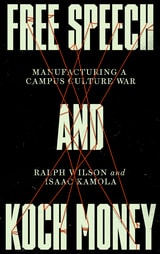
Free Speech and Koch Money
Manufacturing a Campus Culture WarRalph Wilson
Pluto Press, 2021
In recent years hundreds of high-profile ‘free speech’ incidents have rocked US college campuses. Milo Yiannopoulos, Ben Shapiro, Ann Coulter and other right-wing speakers have faced considerable protest, with many being disinvited from speaking. These incidents are widely circulated as examples of the academy’s intolerance towards conservative views.
But this response is not the spontaneous outrage of the liberal colleges. There is a darker element manufacturing the crisis, funded by political operatives, and designed to achieve specific political outcomes. If you follow the money, at the heart of the issue lies the infamous and ultra-libertarian Koch donor network.
Grooming extremist celebrities, funding media platforms that promote these controversies, developing legal organzations to sue universities and corrupting legislators, the influence of the Koch network runs deep. We need to abandon the ‘campus free speech’ narrative and instead follow the money if we ever want to root out this dangerous network from our universities.
Free Speech, The People's Darling Privilege
Struggles for Freedom of Expression in American HistoryMichael Kent Curtis
Duke University Press, 2000
Curtis analyzes three crucial political struggles: the controversy that surrounded the 1798 Sedition Act, which raised the question of whether criticism of elected officials would be protected speech; the battle against slavery, which raised the question of whether Americans would be free to criticize a great moral, social, and political evil; and the controversy over anti-war speech during the Civil War. Many speech issues raised by these controversies were ultimately decided outside the judicial arena—in Congress, in state legislatures, and, perhaps most importantly, in public discussion and debate. Curtis maintains that modern proposals for changing free speech doctrine can usefully be examined in the light of this often ignored history. This broader history shows the crucial effect that politicians, activists, ordinary citizens—and later the courts—have had on the American understanding of free speech.
Filling a gap in legal history, this enlightening, richly researched historical investigation will be valuable for students and scholars of law, U.S. history, and political science, as well as for general readers interested in civil liberties and free speech.
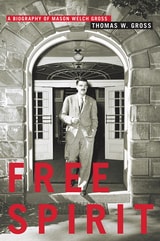
Free Spirit
A Biography of Mason Welch GrossThomas W. Gross
Rutgers University Press, 2022
Free Spirit explores how Gross helped reshape Rutgers from a sleepy college into a world-renowned public research university. It also reveals how he steered the university through the tumult of the Red Scare, civil rights era, and the Vietnam War by taking principled stands in favor of both racial equality and academic freedom. This biography tells the story of how, from an early age, Gross came to believe in the importance of doing what was right, even when the backlash took a toll on his own health.
Written by his youngest son Thomas, this book offers a uniquely well-rounded portrait of Gross as both a public figure and a private person. Covering everything from his service in World War II to his stints as a game-show personality, Free Spirit introduces the reader to a remarkable academic leader.
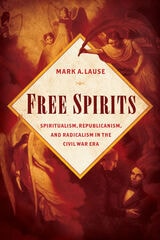
Free Spirits
Spiritualism, Republicanism, and Radicalism in the Civil War EraMark A. Lause
University of Illinois Press, 2016
Free Time
The Forgotten American DreamBenjamin Hunnicutt
Temple University Press, 2013
Hunnicutt provides an incisive intellectual, cultural, and political history of the original "American Dream" from the colonial days to the present. Taking his cue from Walt Whitman's "higher progress," he follows the traces of that dream, cataloging the myriad voices that prepared for and lived in an opening "realm of freedom."
Free Time reminds Americans of the forgotten, best part of the "American Dream"-that more and more of our lives might be lived freely, with an enriching family life, with more time to enjoy nature, friendship, and the adventures of the mind and of the spirit.
Free Women
Ethics and Aesthetics in Twentieth-Century Women's FictionKate Fullbrook
Temple University Press, 1990
Free to All
Carnegie Libraries & American Culture, 1890-1920Abigail A. Van Slyck
University of Chicago Press, 1996
"The whole story is told here in this book. Carnegie's wishes, the conflicts among local groups, the architecture, development of female librarians. It's a rich and marvelous story, lovingly told."—Alicia Browne, Journal of American Culture
"This well-written and extensively researched work is a welcome addition to the history of architecture, librarianship, and philanthropy."—Joanne Passet, Journal of American History
"Van Slyck's book is a tremendous contribution for its keenness of scholarship and good writing and also for its perceptive look at a familiar but misunderstood icon of the American townscape."—Howard Wight Marshall, Journal of the Society of Architectural Historians
"[Van Slyck's] reading of the cultural coding implicit in the architectural design of the library makes a significant contribution to our understanding of the limitations of the doctrine 'free to all.'"—Virginia Quarterly Review
Free to Die for Their Country
The Story of the Japanese American Draft Resisters in World War IIEric L. Muller
University of Chicago Press, 2001
In the spring of 1942, the federal government forced West Coast Japanese Americans into detainment camps on suspicion of disloyalty. Two years later, the government demanded even more, drafting them into the same military that had been guarding them as subversives. Most of these Americans complied, but Free to Die for Their Country is the first book to tell the powerful story of those who refused. Based on years of research and personal interviews, Eric L. Muller re-creates the emotions and events that followed the arrival of those draft notices, revealing a dark and complex chapter of America's history.
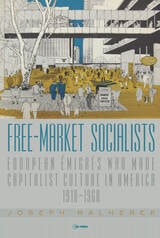
Free-Market Socialists
European Émigrés Who Made Capitalist Culture in America, 1918–1968Joseph Malherek
Central European University Press, 2022
The Hungarian artist-designer László Moholy-Nagy, the Austrian sociologist Paul Lazarsfeld, and his fellow Viennese Victor Gruen—an architect and urban planner—made careers in different fields. Yet they shared common socialist politics, Jewish backgrounds, and experience as refugees from the Nazis. This book tells the story of their intellectual migration from Central Europe to the United States, beginning with the collapse of the Habsburg Empire, and moving through the heady years of newly independent social-democratic republics before the descent into fascism. It follows their experience of exile and adaptation in a new country, and culminates with a surprising outcome of socialist thinking: the opening of the first fully enclosed, air-conditioned suburban shopping center in the United States. Although the American culture they encountered ostensibly celebrated entrepreneurial individualism and capitalistic “free enterprise,” Moholy-Nagy, Lazarsfeld, and Gruen arrived at a time of the progressive economic reforms of the New Deal and an extraordinary open-mindedness about social democracy. This period of unprecedented economic experimentation nurtured a business climate that, for the most part, did not stifle the émigrés’ socialist idealism but rather channeled it as the source of creative solutions to the practical problems of industrial design, urban planning, and consumer behavior.
Based on a vast array of original sources, Malherek interweaves the biographies of these three remarkable personalities and those of their wives, colleagues, and friends with whom they collaborated on innovative projects that would shape the material environment and consumer culture of their adopted home. The result is a narrative of immigration and adaptation that challenges the crude binary of capitalism and socialism with a story of creative economic hybridization.
Freebooters and Smugglers
The Foreign Slave Trade in the United States after 1808Ernest Obadele-Starks
University of Arkansas Press, 2007
Freedom Beyond Sovereignty
Reconstructing Liberal IndividualismSharon R. Krause
University of Chicago Press, 2015
In Freedom Beyond Sovereignty, Sharon R. Krause shows that individual agency is best conceived as a non-sovereign experience because our ability to act and affect the world depends on how other people interpret and respond to what we do. The intersubjective character of agency makes it vulnerable to the effects of social inequality, but it is never in a strict sense socially determined. The agency of the oppressed sometimes surprises us with its vitality. Only by understanding the deep dynamics of agency as simultaneously non-sovereign and robust can we remediate the failed freedom of those on the losing end of persistent inequalities and grasp the scope of our own responsibility for social change. Freedom Beyond Sovereignty brings the experiences of the oppressed to the center of political theory and the study of freedom. It fundamentally reconstructs liberal individualism and enables us to see human action, personal responsibility, and the meaning of liberty in a totally new light.
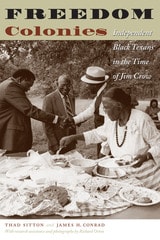
Freedom Colonies
Independent Black Texans in the Time of Jim CrowBy Thad Sitton and James H. Conrad
University of Texas Press, 2005
Friends of the Dallas Public Library Award, 2006
Best Book on East Texas, East Texas Historical Association, 2007
In the decades following the Civil War, nearly a quarter of African Americans achieved a remarkable victory—they got their own land. While other ex-slaves and many poor whites became trapped in the exploitative sharecropping system, these independence-seeking individuals settled on pockets of unclaimed land that had been deemed too poor for farming and turned them into successful family farms. In these self-sufficient rural communities, often known as "freedom colonies," African Americans created a refuge from the discrimination and violence that routinely limited the opportunities of blacks in the Jim Crow South.
Freedom Colonies is the first book to tell the story of these independent African American settlements. Thad Sitton and James Conrad focus on communities in Texas, where blacks achieved a higher percentage of land ownership than in any other state of the Deep South. The authors draw on a vast reservoir of ex-slave narratives, oral histories, written memoirs, and public records to describe how the freedom colonies formed and to recreate the lifeways of African Americans who made their living by farming or in skilled trades such as milling and blacksmithing. They also uncover the forces that led to the decline of the communities from the 1930s onward, including economic hard times and the greed of whites who found legal and illegal means of taking black-owned land. And they visit some of the remaining communities to discover how their independent way of life endures into the twenty-first century.