Results by title
18284 books match the query 'United States' and 783 start with f
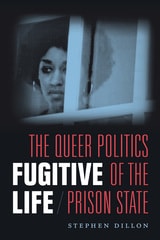
Fugitive Life
The Queer Politics of the Prison StateStephen Dillon
Duke University Press, 2018
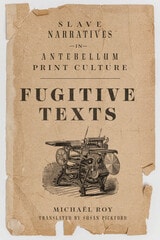
Fugitive Texts
Slave Narratives in Antebellum Print CultureMichaël Roy, translated by Susan Pickford
University of Wisconsin Press, 2024
In Fugitive Texts, Michaël Roy offers the first book-length study of the slave narrative as a material artifact. Drawing on a wide range of sources, he reconstructs the publication histories of a number of famous and lesser-known narratives, placing them against the changing backdrop of antebellum print culture. Slave narratives, he shows, were produced through a variety of print networks. Remarkably few were published under the full control of white-led antislavery societies; most were self-published and distributed by the authors, while some were issued by commercial publishers who hoped to capitalize on the success of Harriet Beecher Stowe’s Uncle Tom’s Cabin. The material lives of these texts, Roy argues, did not end within the pages. Antebellum slave narratives were “fugitive texts” apt to be embodied in various written, oral, and visual forms.
Published to rave reviews in French, Fugitive Texts illuminates the heterogeneous nature of a genre often described in monolithic terms and ultimately paves the way for a redefinition of the literary form we have come to recognize as “the slave narrative.”
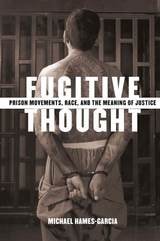
Fugitive Thought
Prison Movements, Race, And The Meaning Of JusticeMichael Hames-Garcia
University of Minnesota Press, 2004
Looks to the philosophy and experience of prisoners to reinvigorate our concepts of justice, solidarity, and freedom
In Fugitive Thought, Michael Hames-García argues that writings by prisoners are instances of practical social theory that seek to transform the world. Unlike other authors who have studied prisons or legal theory, Hames-García views prisoners as political and social thinkers whose ideas are as valuable as those of lawyers and philosophers.
As key moral terms like “justice,” “solidarity,” and “freedom” have come under suspicion in the post–Civil Rights era, political discussions on the Left have reached an impasse. Fugitive Thought reexamines and reinvigorates these concepts through a fresh approach to philosophies of justice and freedom, combining the study of legal theory and of prison literature to show how the critiques and moral visions of dissidents and participants in prison movements can contribute to the shaping and realization of workable ethical conceptions. Fugitive Thought focuses on writings by black and Latina/o lawyers and prisoners to flesh out the philosophical underpinnings of ethical claims within legal theory and prison activism.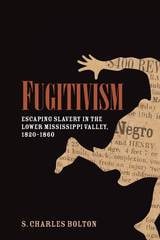
Fugitivism
Escaping Slavery in the Lower Mississippi Valley, 1820-1860S. Charles Bolton
University of Arkansas Press, 2019
Winner, 2020 Booker Worthen Literary Prize
During the antebellum years, over 750,000 enslaved people were taken to the Lower Mississippi Valley, where two-thirds of them were sold in the slave markets of New Orleans, Natchez, and Memphis. Those who ended up in Louisiana found themselves in an environment of swamplands, sugar plantations, French-speaking creoles, and the exotic metropolis of New Orleans. Those sold to planters in the newly-opened Mississippi Delta cleared land and cultivated cotton for owners who had moved west to get rich as quickly as possible, driving this labor force to harsh extremes.
Like enslaved people all over the South, those in the Lower Mississippi Valley left home at night for clandestine parties or religious meetings, sometimes “laying out” nearby for a few days or weeks. Some of them fled to New Orleans and other southern cities where they could find refuge in the subculture of slaves and free blacks living there, and a few attempted to live permanently free in the swamps and forests of the surrounding area. Fugitives also tried to returnto eastern slave states to rejoin families from whom they had been separated. Some sought freedom on the northern side of the Ohio River; othersfled to Mexico for the same purpose.
Fugitivism provides a wealth of new information taken from advertisements, newspaper accounts, and court records. It explains how escapees made use of steamboat transportation, how urban runaways differed from their rural counterparts, how enslaved people were victimized by slave stealers, how conflicts between black fugitives and the white people who tried to capture them encouraged a culture of violence in the South, and how runaway slaves from the Lower Mississippi Valley influenced the abolitionist movement in the North.
Readers will discover that along with an end to oppression, freedom-seeking slaves wanted the same opportunities afforded to most Americans.
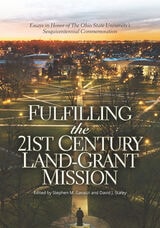
Fulfilling the 21st Century Land-Grant Mission
Essays in Honor of The Ohio State University’s Sesquicentennial CommemorationEdited by Stephen M. Gavazzi and David J. Staley
The Ohio State University Press, 2020
Gathered in honor of The Ohio State University’s sesquicentennial celebration, this collection of essays highlights the significant contributions that Ohio State continues to make as part of its twenty-first-century land-grant mission. Authors from across the university—representing fields as various as agriculture, dance, English, engineering, family science, geography, medicine, social work, and veterinary science—provide contributions that highlight the preeminent status of The Ohio State University. In addition, the perspectives of alumni, staff members, and senior administrators (both present and former) round out the picture of Ohio State as the first among equals regarding its land-grant peers. Overall, contributors draw on rich and varied institutional backgrounds to offer invaluable insights for higher education administrators and scholars across the US.
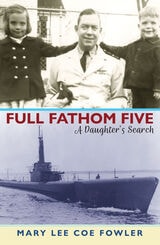
Full Fathom Five
A Daughter's SearchMary Lee Coe Fowler
University of Alabama Press, 2008
One woman’s quest for knowledge of her father lost at sea
Mary Lee Coe Fowler was a posthumous child, born after her father, a submarine skipper in the Pacific, was lost at sea in 1943. Her mother quickly remarried into a difficult and troubled relationship, and Mary Lee’s biological father was never mentioned. It was not until her mother died and Mary Lee was a middle-aged adult that she set out to learn not only who her father was, but what happened to him and his crew, and why—and also to confront why she had shied away from asking these questions until it was nearly too late.
Fowler searched through old ships’ logs, letters, and naval communiqués; visited submarine museums, the Naval Academy, and other pertinent sites; interviewed old friends and crew members who knew her dad and mom or served concurrently; and slowly reconstructed the world in which they lived. Beautifully written, Fowler’s memoir reveals what she eventually learned: of the perils and harships of submarine service in wartime, of the tragic irony of how her father’s sub was probably lost, and of the long-term damage experienced by the families of those who do not come home from war.
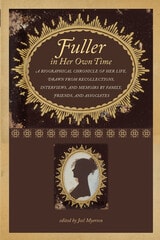
Fuller in Her Own Time
A Biographical Chronicle of Her Life, Drawn from Recollections, Interviews, and Memoirs by Family, Friends, and AssociatesJoel Myerson
University of Iowa Press, 2008
The forty-one remembrances from Nathaniel Hawthorne, Oliver Wendell Holmes, Ralph Waldo Emerson, Thomas Carlyle, Harriet Martineau, Henry James, and twenty-four others chart Fuller’s expanding influence from schooldays in Boston, meetings at the Transcendental Club, teaching in Providence and Boston, work on the New York Tribune, publications and conversations, travels in the British Isles, and life and love in Italy before her tragic early death. Joel Myerson’s perceptive introduction assesses the pre- and postmortem building of Fuller’s reputation as well as her relationship to the prominent Transcendentalists, reformers, literati, and other personalities of her time, and his headnotes to each selection present valuable connecting contexts.
The woman who admitted that “at nineteen she was the most intolerable girl that ever took a seat in a drawing-room,” whose Woman in the Nineteenth Century is considered the first major book-length feminist call to action in America, never conformed to nineteenth-century expectations of self-effacing womanhood. The fascinating contradictions revealed by these narratives create a lively, lifelike biography of Fuller’s “rare gifts and solid acquirements . . . and unfailing intellectual sympathy.”
Fully Grown
Why a Stagnant Economy Is a Sign of SuccessDietrich Vollrath
University of Chicago Press, 2020
Most economists would agree that a thriving economy is synonymous with GDP growth. The more we produce and consume, the higher our living standard and the more resources available to the public. This means that our current era, in which growth has slowed substantially from its postwar highs, has raised alarm bells. But should it? Is growth actually the best way to measure economic success—and does our slowdown indicate economic problems?
The counterintuitive answer Dietrich Vollrath offers is: No. Looking at the same facts as other economists, he offers a radically different interpretation. Rather than a sign of economic failure, he argues, our current slowdown is, in fact, a sign of our widespread economic success. Our powerful economy has already supplied so much of the necessary stuff of modern life, brought us so much comfort, security, and luxury, that we have turned to new forms of production and consumption that increase our well-being but do not contribute to growth in GDP.
In Fully Grown, Vollrath offers a powerful case to support that argument. He explores a number of important trends in the US economy: including a decrease in the number of workers relative to the population, a shift from a goods-driven economy to a services-driven one, and a decline in geographic mobility. In each case, he shows how their economic effects could be read as a sign of success, even though they each act as a brake of GDP growth. He also reveals what growth measurement can and cannot tell us—which factors are rightly correlated with economic success, which tell us nothing about significant changes in the economy, and which fall into a conspicuously gray area.
Sure to be controversial, Fully Grown will reset the terms of economic debate and help us think anew about what a successful economy looks like.
Functions of Victorian Culture at the Present Time
Christine L. Krueger
Ohio University Press, 2002
Fundamental Development of the Social Sciences
Rockefeller Philanthropy and the United States Social Science Research CouncilDonald Fisher
University of Michigan Press, 1993
The United States Social Science Research Council (SSRC), founded in 1923, was the first national social science institution in the world and might be said to represent the creation of a "science of society." In Fundamental Development of the Social Sciences , Donald Fisher shows how this institution, under the considerable influence of Rockefeller philanthropy, shaped an entire discipline.
Fisher demonstrates that the creation and growth of the SSRC during the 1920s and 1930s is essential to our understanding of the major developments in the social sciences since World War II. He shows that during this period, the place of social science and social scientists in American society was fixed in a way that has had substantial, lasting impact.
The author weaves a number of larger, related issues into his account of the wide-ranging influence of the SSRC: the role of social scientists in the political life of the societies in which they live; the way in which knowledge systems develop and change; the role of philanthropy in industrialized societies; and the formation and preservation of the modern capitalist state.
Donald Fisher's discussion of how an American institution sculpted an entire discipline will be of interest to all social scientists and historians of social science.

Fundamentals of Children's Services
Michael Sullivan
American Library Association, 2013
Fundamentals of Children's Services
Michael Sullivan
American Library Association, 2005
Fundamentals of Collection Development and Management
Peggy Johnson
American Library Association, 2009
Fundamentals of Collection Development and Management
Peggy Johnson
American Library Association, 2014
Fundamentals of Government Information
Mining, Finding, Evaluating, and Using Government ResourcesCassandra J. Hartnett
American Library Association, 2016

Fundamentals of Library Supervision
Beth McNeil
American Library Association, 2017
Fundamentals of Library Supervision
Joan Giesecke
American Library Association, 2010
Fundamentals of Library Supervision, Fourth Edition
Beth McNeil; Foreword by Janice Welburn
American Library Association, 2026
Supervising a library, managing people, stepping forward as a mentor, and being a leader in your community, whether you run a small, one-person library or work in a large research university library, is no small feat. The new fourth edition of this "classic text" (Library Journal) shares practical advice on many of today’s management opportunities and challenges. Whether you're new to supervision or already have experience, you will find that the topics covered here, along with examples from various libraries, provide an overview of the many tasks and responsibilities of a manager and supervisor. Packed with clear and concise wisdom that will give you confidence in the role, inside this handbook you will discover
- step-by-step guidance on fundamental skills such as hiring, onboarding and orientation, scheduling and service provision, performance appraisal and management, budgeting, space planning and safety, and conducting meetings;
- insights on core leadership competencies essential for supervisors to balance organizational priorities with the individual needs and desires of staff;
- guidance on helping library employees to learn and grow in their jobs, becoming adept at change management, setting priorities and managing time effectively and efficiently, being a good collaborator, modeling self-awareness and emotional intelligence, and other keys to success as a supervisor;
- a new discussion of the changed organizational climate and how to create and sustain environments that foster a sense of belonging among all staff;
- chapter summaries with critical takeaways; and
- helpful extras like a positive messaging worksheet, new employee welcome email template, and information about additional resources.
Fundamentals of Managing Reference Collections
Carol A. Singer
American Library Association, 2012
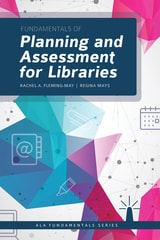
Fundamentals of Planning and Assessment for Libraries
Rachel A. Fleming-May and Regina Mays
American Library Association, 2021
The concepts of planning and assessment are intrinsically linked—and understanding them is essential for raising the library’s profile and strengthening its position among stakeholders and the community. Even if you're an LIS student or are new to the profession, or if planning or assessment are not your primary areas of responsibility, you still have a role to play in the success of organizational efforts. Fleming-May has more than a decade of experience in planning and assessment initiatives and instruction, and Mays was her institution’s first assessment librarian; their primer draws from theory, research, and their first-hand observations to illuminate such topics as
- characteristics of bad planning strategy that can help to illustrate a better approach;
- reasons why using economic models, like ROI, fall short;
- how to mix the three types of planning;
- guidelines to ensure that assessment is meaningful and actionable;
- tips for creating effective surveys;
- emphasizing users’ needs with a critical assessment framework;
- data analysis for surveys, interviews, focus groups, and observation;
- four questions to ask about audience level before you develop a report;
- a sample 3-year assessment plan that can be customized; and
- seven steps for developing a culture of ongoing assessment.
Fundamentals of Reference
Carolyn M. Mulac
American Library Association, 2012
Fundamentals of School Library Media Management
Barbara Stein Martin
American Library Association, 2009
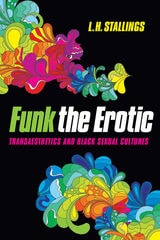
Funk the Erotic
Transaesthetics and Black Sexual CulturesL.H. Stallings
University of Illinois Press, 2015
Stallings uses funk to highlight the importance of the erotic and eroticism in Black cultural and political movements, debunking "the truth of sex" and its histories. Brandishing funk as a theoretical tool, Stallings argues that Western theories of the erotic fail as universally applicable terms or philosophies, and thus lack utility in discussions of black bodies, subjects, and culture. In considering the Victorian concept of freak in black funk, Stallings proposes that black artists across all media have fashioned a tradition that embraces the superfreak, sexual guerrilla, sexual magic, mama's porn, black trans narratives, and sex work in a post-human subject position. Their goal: to ensure survival and evolution in a world that exploits black bodies in capitalist endeavors, imperialism, and colonization.
Revitalizing and wide-ranging, Funk the Erotic offers a needed examination of black sexual cultures, a discursive evolution of black ideas about eroticism, a critique of work society, a reexamination of love, and an articulation of the body in black movements.
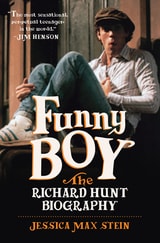
Funny Boy
The Richard Hunt BiographyJessica Max Stein
Rutgers University Press, 2024
"The most sensational, perpetual teenager in the world.” —Jim Henson
"To know him was to love him, and we do." —Mark Hamill
Funny Boy: The Richard Hunt Biography tells the life story of a gifted performer whose gleeful irreverence, sharp wit and generous spirit inspired millions. Richard Hunt was one of the original main five performers in the Muppet troupe. He brought to life an impressive range of characters on The Muppet Show, Sesame Street, Fraggle Rock and various Muppet movies, everyone from eager gofer Scooter to elderly heckler Statler, groovy girl Janice to freaked-out lab helper Beaker, even early versions of Miss Piggy and Elmo. Hunt also acted, directed and mentored the next generation of performers. His accomplishments are all the more remarkable in that he crammed them all into only 40 years.
Richard Hunt was just 18 years old when he joined Jim Henson’s company, where his edgy humor quickly helped launch the Muppets into international stardom. Hunt lived large, savoring life’s delights, amassing a vivid, disparate community of friends. Even when the AIDS epidemic wrought its devastation, claiming the love of Hunt’s life and threatening his own life, he showed an extraordinary sense of resilience, openness and joy. Hunt’s story exemplifies how to follow your passion, foster your talents, adapt to life’s surprises, genuinely connect with everyone from glitzy celebrities to gruff cab drivers – and have a hell of a lot of fun along the way.
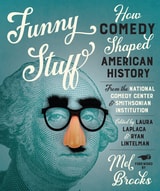
Funny Stuff
How Comedy Shaped American HistoryLaura LaPlaca
Rutgers University Press, 2026
A Junior Library Guild Gold Standard Selection
The National Comedy Center and Smithsonian Institution hold unparalleled collections of artifacts that illustrate the vitality and importance of comedy in American life, from vaudeville, silent films, and TV sitcoms to stand-up, sketch, and cartoons. Now, for the first time, these collections are brought together in vibrant photographs and illuminating essays that tell the story of how comedy shaped American history.
Written by historians responsible for safeguarding these cultural treasures, the book takes readers behind the scenes to uncover the stories behind American heirlooms like Groucho Marx’s tailcoat, George Carlin’s joke files, Carol Burnett’s “Went with the Wind” dress, Johnny Carson’s monologues, and the very first Saturday Night Live script, alongside materials from cultural touchstones like The Simpsons, The Muppet Show, In Living Color, All In the Family, and I Love Lucy.
With a foreword by comedy legend Mel Brooks, this dynamic work offers pop culture aficionados, history lovers, and comedy nerds alike a new perspective on America’s past and who we are as a nation through our comedy.

Fur Farms of Alaska
Two Centuries of History and a Forgotten StampedeSarah Crawford Isto
University of Alaska Press, 2012

Fur Trappers Traders Of The Far Southwest
Matthew Despain
Utah State University Press, 1997
Further To Fly
Black Women and the Politics of EmpowermentSheila Radford-Hill
University of Minnesota Press, 2000
How feminism has failed African American women and why they must fight back.
Amid the longest-running economic boom in American history and despite the emergence of a significant black middle class, the lot of low-income black people in general-and black women in particular-seems more troubling than ever. Their plight, Sheila Radford-Hill argues in this book, is directly related to the diminution of black women’s traditional power as culture bearers and community builders. A cogent critique of feminist theory and practice, Further to Fly identifies the failure of feminism to connect with the social realities it should seek to explain, in particular the decline of black women’s empowerment.
Further to Fly searches out the causes and effects of this decline, describing the ways in which, since the 1960s, black women have been stripped of their traditional status as agents of change in the community-and how, as a result, the black community has faltered. Radford-Hill explores the shortcomings of second-wave black and white feminism, revealing how their theoretical underpinnings have had unintended (and often unacknowledged) negative consequences for black women’s lives and their communities.While acknowledging that African American women have made significant contributions to the black struggle for justice in America, Radford-Hill argues that more needs to be done. She combines social criticism and critical analysis to argue that black women must revive their legacy of activism and reclaim the tradition of nurturing in the black community, proposing specific tactics that can be used to revive the support networks that help determine the obligations of community members and guide how people interact on an everyday level. As a deft account of genesis and effects of black women’s diminishing power, and as a sobering analysis of the devastating blunders of feminist theory and practice, this work makes a compelling argument for an "authentic feminism," one that aggressively connects the realities of women’s experiences, needs, aspirations, and responsibilities.
Furthering Fair Housing
Prospects for Racial Justice in America's NeighborhoodsEdited by Justin P. Steil, Nicholas F. Kelly, Lawrence J. Vale and Maia S. Woluchem
Temple University Press, 2021
The 2015 Affirmatively Furthering Fair Housing Rule was the most significant federal effort to increase equality of access to place-based resources and opportunities, such as high-performing schools or access to jobs, since the 1968 Fair Housing Act. However, in an effort to appeal to suburban voters, the Trump administration repealed the rule in 2020, leaving its future in doubt.
Furthering Fair Housing analyzes multiple dimensions of this rule, identifying failures of past efforts to increase housing choice, exploring how the AFFH Rule was crafted, measuring the initial effects of the rule before its rescission, and examining its interaction with other contemporary housing issues, such as affordability, gentrification, anti-displacement, and zoning policies.
The editors and contributors to this volume—a mix of civil rights advocates, policymakers, and public officials—provide critical perspectives and identify promising new directions for future policies and practices. Placing the history of fair housing in the context of the centuries-long struggle for racial equity, Furthering Fair Housing shows how this policy can be revived and enhanced to advance racial equity in America’s neighborhoods.
Future Libraries
Dreams, Madness and RealityAmerican Library Association, 1995
Future
A Recent HistoryBy Lawrence R. Samuel
University of Texas Press, 2009
The future is not a fixed idea but a highly variable one that reflects the values of those who are imagining it. By studying the ways that visionaries imagined the future—particularly that of America—in the past century, much can be learned about the cultural dynamics of the time.
In this social history, Lawrence R. Samuel examines the future visions of intellectuals, artists, scientists, businesspeople, and others to tell a chronological story about the history of the future in the past century. He defines six separate eras of future narratives from 1920 to the present day, and argues that the milestones reached during these years—especially related to air and space travel, atomic and nuclear weapons, the women's and civil rights movements, and the advent of biological and genetic engineering—sparked the possibilities of tomorrow in the public's imagination, and helped make the twentieth century the first century to be significantly more about the future than the past.
The idea of the future grew both in volume and importance as it rode the technological wave into the new millennium, and the author tracks the process by which most people, to some degree, have now become futurists as the need to anticipate tomorrow accelerates.
Futures At Stake
Youth, Gambling, And SocietyHoward J. Shaffer
University of Nevada Press, 2003
The widespread legalization of gambling across the U.S. has produced concerns for serious social, economic, and health problems. For the first time in this country, an entire generation of young people has reached adulthood within a context of approval and endorsement of gambling as a source of entertainment and recreation. Compared with their adult counterparts, these young people have evidenced a higher level of gambling related problems. In Futures at Stake, specialists in psychology, medicine, law, public health, economics, casino management, psychiatry, and criminal justice examine this problem from the perspective of their various disciplines, producing an intelligent, thought-provoking, and valuable survey of what is fast becoming a leading social-health problem across the nation. Foreword by Thomas N. Cummings.
Futuring Black Lives
Independent Black Institutions and the Literary ImaginationMaisha T. Winn
Vanderbilt University Press, 2025
The rationale for establishing and valuing IBIs remains highly relevant, given the sociopolitical landscape of education today. In addition to persistent racial disparities in academic achievement and Black students’ highly disproportionate experiences of punishment and “discipline,” friction and legislation against critical examination of race, racism, and racist ideas in school settings are front and center, and children’s and young adult literature are under attack through censorship and outright book bans. Yet Black institution builders left useful maps of and for the educational future/s of Black children that remain available in journals, newspapers, pamphlets, and other ephemera. Author Maisha T. Winn demonstrates how and why the historiography-grounded futuring of Black education can and should inform current pursuits of equity, justice, and liberation through education.