Results by title
28167 books match the query 'History' and 1092 start with f
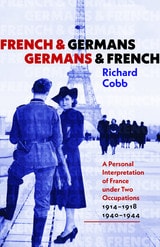
French and Germans, Germans and French
A Personal Interpretation of France under Two Occupations, 1914–1918/1940–1944Richard Cobb
Brandeis University Press, 2018
French and Indians in the Heart of North America, 1630-1815
Robert Englebert
Michigan State University Press, 2013
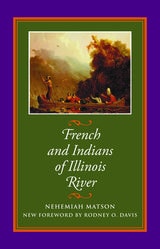
French and Indians of Illinois River
Nehemiah Matson. Foreword by Rodney O. Davis
Southern Illinois University Press, 2001
Complex and paradoxical, Nehemiah Matson (1816–1873) celebrated the occupation of the Middle West by European pioneers even as he labored to preserve the memory of the natives these pioneers replaced. He perpetuated the memory of the Indians who were driven out of the territory, but he nevertheless accumulated wealth selling their land to the pioneers. Rodney O. Davis notes in his new foreword to this book that Matson combined the attributes of a scholar with those of a salesman and promoter.
Matson settled in Princeton, Illinois, in 1836. He left behind a library partially endowed by him, named for him, and finally completed in 1913. According to Davis, however, Matson’s other legacy, “of equal significance in his own eyes, consisted of the five books he authored on northern Illinois and Illinois River history and cartography, volumes based not only on conscientious scholarship but also on both Indian and white reminiscence and on local folklore.”
Matson’s historical writings are valuable even when he deals with well-known events because his personal perspective makes his observations unique. Without the stories and reminiscences he collected, much valuable information would have been lost, especially since many of his informants, both Indian and European, were illiterate. Because his informants often told conflicting stories, Matson admitted that “harmonizing all conflicting accounts . . . has not been a success.”
Although Matson’s sources may not always have agreed, and sometimes his heart may have overruled his head and colored his accounts, he was a conscientious and committed author. “Obviously,” Davis explains, “this book must be evaluated as what it is, a piece of colorful local history, romantically anchored in legend yet rooted also in invaluable research and produced by a dedicated amateur whose standards were high. . . . French and Indians of Illinois River is a model of its type, indeed a minor classic.”
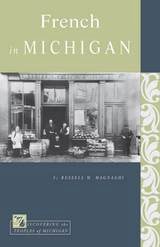
French in Michigan
Russell M. Magnaghi
Michigan State University Press, 2016
The colonial French served as explorers, soldiers, missionaries, fur traders, and colonists. Later, French priests and nuns were influential in promoting Catholicism in the state and in developing schools and hospitals. Father Gabriel Richard fled the violence of the French Revolution and became a prominent and influential citizen of the state as a U.S. Congressman and one of the founders of the University of Michigan. French observers of Michigan life included Alexis de Tocqueville. French entrepreneurs opened copper mines and a variety of service-oriented businesses. Louis Fasquelle became the first foreign-language instructor at the University of Michigan, and François A. Artault introduced photography to the Upper Peninsula. As pioneers of the early automobile, the French made a major contribution to the language used in auto manufacturing.
Frenchman, Chaplain, Rebel
The Civil War Letters of Pere Louis-Hippoltye Gache, 10th Louisiana InfantryPere Louis-Hippolyte Gache, S.J.
University of Alabama Press, 2007
The American Civil War through the eyes of a French Jesuit chaplain.
"This book has a tantalizing quality, and it certainly is fresh literature for those who have watched the story of the Civil War unfold. . . . One cannot help but marvel at the research undertaken by Fr. Buckley. These letters of Fr. Gache cover such subjects as the duties of a chaplain, the lack of stimulating conversation in camp, whiskey as medication for diarrhea, the chaplain’s uniform, the oversupply of Catholic chaplains, descriptions of battles—Chancellorsville, Fredericksburg—chaplains as prisoners of war, the possibility of General Lee being chosen as the second president of the Confederacy, making candles for the alter and bleaching wax, procuring sacramental wine, conflicts with Protestant preachers, and the surrender of Richmond. Such subjects allow the personality and character of Hippolyte to stand out. . . . [The book] is interesting reading for all who love and admire the Jesuits. Its wealth of information makes it a must for others whose concern is the Confederate soldier and his God."
—Journal of Southern History
Frenchtown Chronicles of Prairie du Chien
History and Folklore from Wisconsin's FrontierMary Elise Antoine
Wisconsin Historical Society Press, 2016
Albert Coryer, the grandson of a fur trade voyageur-turned-farmer, had a gift for storytelling. Born in 1877, he grew up in Prairie du Chien hearing tales of days gone by from his parents, grandparents, and neighbors who lived in the Frenchtown area. Throughout his life, Albert soaked up the local oral traditions, including narratives about early residents, local landmarks, interesting and funny events, ethnic customs, myths, and folklore.
Late in life, this lively man who had worked as a farm laborer and janitor drew a detailed illustrated map of the Prairie du Chien area and began to write his stories out longhand, in addition to sharing them in an interview with a local historian and folklore scholar. The map, stories, and interview transcript provide a colorful account of Prairie du Chien in the late nineteenth century, when it was undergoing significant demographic, social, and economic change. With sharp historical context provided by editors Lucy Eldersveld Murphy and Mary Elise Antoine, Coryer’s tales offer an unparalleled window into the ethnic community comprised of the old fur trade families, Native Americans, French Canadian farmers, and their descendants.

Freud's Couch, Scott's Buttocks, Brontë's Grave
Simon Goldhill
University of Chicago Press, 2011
The Victorian era was the high point of literary tourism. Writers such as Charles Dickens, George Eliot, and Sir Walter Scott became celebrities, and readers trekked far and wide for a glimpse of the places where their heroes wrote and thought, walked and talked. Even Shakespeare was roped in, as Victorian entrepreneurs transformed quiet Stratford-upon-Avon into a combination shrine and tourist trap.
Stratford continues to lure the tourists today, as do many other sites of literary pilgrimage throughout Britain. And our modern age could have no better guide to such places than Simon Goldhill. In Freud's Couch, Scott’s Buttocks, Brontë's Grave, Goldhill makes a pilgrimage to Sir Walter Scott's baronial mansion, Wordsworth's cottage in the Lake District, the Bront ë parsonage, Shakespeare's birthplace, and Freud's office in Hampstead. Traveling, as much as possible, by methods available to Victorians—and gamely negotiating distractions ranging from broken bicycles to a flock of giggling Japanese schoolgirls—he tries to discern what our forebears were looking for at these sites, as well as what they have to say to the modern mind. What does it matter that Emily Brontë’s hidden passions burned in this specific room? What does it mean, especially now that his fame has faded, that Scott self-consciously built an extravagant castle suitable for Ivanhoe—and star-struck tourists visited it while he was still living there? Or that Freud's meticulous recreation of his Vienna office is now a meticulously preserved museum of itself? Or that Shakespeare’s birthplace features student actors declaiming snippets of his plays . . . in the garden of a house where he almost certainly never wrote a single line?
Goldhill brings to these inquiries his trademark wry humor and a lifetime's engagement with literature. The result is a travel book like no other, a reminder that even today, the writing life still has the power to inspire.

Friar Bringas Reports to the King
Methods of Indoctrination on the Frontier of New Spain, 1796–97Translated and Edited by Daniel S. Matson and Bernard L. Fontana
University of Arizona Press, 1977
Friar and the Maya
Diego de Landa and the Account of the Things of Yucatanby Matthew Restall, Amara Solari, John F. Chuchiak IV & Traci Ardren
University Press of Colorado, 2023
For generations, scholars used (and misused) the Account as the sole eyewitness insight into an ancient civilization. It is credited to the sixteenth-century Spanish Franciscan, monastic inquisitor, and bishop Diego de Landa, whose legacy is complex and contested. His extensive writings on Maya culture and history were lost in the seventeenth century, save for the fragment that is the Account, discovered in the nineteenth century, and accorded near-biblical status in the twentieth as the first “ethnography” of the Maya. However, the Account is not authored by Landa alone; it is a compilation of excerpts, many from writings by other Spaniards—a significant revelation made here for the first time.
This new translation accurately reflects the style and vocabulary of the original manuscript. It is augmented by a monograph—comprising an introductory chapter, seven essays, and hundreds of notes—that describes, explains, and analyzes the life and times of Diego de Landa, the Account, and the role it has played in the development of modern Maya studies. The Friar and the Maya is an innovative presentation on an important and previously misunderstood primary source.
Friars, Nobles and Burghers – Sermons, Images and Prints
Studies of Culture and Society in Early-Modern Europe - In Memoriam István György TóthLászló Kontler
Central European University Press, 2010
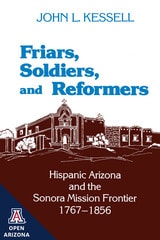
Friars, Soldiers, and Reformers
Hispanic Arizona and the Sonora Mission Frontier, 1767–1856John L. Kessell
University of Arizona Press, 1976
Kessell provides exciting accounts of the explorations of Francisco Garcés, de Anza's expeditions, and the Yuma massacre. Drawing from widely scattered archival materials, he vividly describes the epic struggle between Bishop Reyes and Father President Barbastro, the missionary scandals of 1815–18, and the bloody victory of Mexican civilian volunteers over Apaches in Arivaipa Canyon in 1832. Numerous missionaries, presidials, and bureaucrats—nameless in histories until now—emerge as living, swearing, praying, individuals.
This authoritative chronicle offers an engrossing picture of the continually threatened mission frontier. Reformers championing civil rights for mission Indians time and again challenged the friars' "tight-fisted paternalistic control" over their wards. Expansionists repeatedly saw their plans dashed by Indian raids, uncooperative military officials, or lack of financial support.
Frairs, Soldiers, and Reformers brings into sharp focus the long, blurry period between Jesuit Sonora and Territorial Arizona.

Friday Night Fighter
Gaspar "Indio" Ortega and the Golden Age of Television BoxingTroy Rondinone
University of Illinois Press, 2013
Friday Night Fighter relives a lost moment in American postwar history, when boxing ruled as one of the nation's most widely televised sports. During the 1950s and 1960s, viewers tuned in weekly, sometimes even daily, to watch widely recognized fighters engage in primordial battle; the Gillette Cavalcade of Sports Friday Night Fights was the most popular fight show. Troy Rondinone follows the dual narratives of the Friday Night Fights show and the individual story of Gaspar "Indio" Ortega, a boxer who appeared on prime-time network television more than almost any other boxer in history. From humble beginnings growing up poor in Tijuana, Mexico, Ortega personified the phenomenon of postwar boxing at its greatest, appearing before audiences of millions to battle the biggest names of the time, such as Carmen Basilio, Tony DeMarco, Chico Vejar, Benny "Kid" Paret, Emile Griffith, Kid Gavilan, Florentino Fernández, and Luis Manuel Rodriguez.
Rondinone explores the factors contributing to the success of televised boxing, including the rise of television entertainment, the role of a "reality" blood sport, Cold War masculinity, changing attitudes toward race in America, and the influence of organized crime. At times evoking the drama and spectacle of the Friday Night Fights themselves, this volume is a lively examination of a time in history when Americans crowded around their sets to watch the main event.
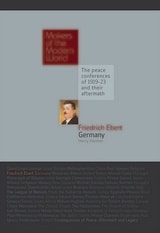
Friedrich Ebert
GermanyHarry Harmer
Haus Publishing, 2009

Friedrich Schleiermacher
The Evolution of a NationalistBy Jerry F. Dawson
University of Texas Press, 1966
Nationalism was a driving, moving spirit in the nineteenth-century Germany of Friedrich Schleiermacher. Jerry F. Dawson, through his thoughtful and well-wrought study of Friedrich Schleiermacher, provides an insight into contemporary nationalistic movements and the people who have a part in them. Schleiermacher, a prominent theologian and educator, was also a leading contributor to the tide of nationalism which swept Germany during the Napoleonic era. Dawson does not present Schleiermacher as an archetype for nationalists, but rather as an example of one man who was willing to sacrifice everything for the good of the nation.
Examining the influence of Pietism, rationalism, and romanticism on Schleiermacher, the author explains the origins of his subject's nationalistic activities and traces the evolution of his patriotic point of view. Dawson depicts the development of Schleiermacher's patriotism from Prussian particularism to German nationalism—an allegiance to an idealized Germany unified in religion, language, folkways. He describes the diverse approaches utilized by Schleiermacher to achieve a patriotic awakening among his countrymen: "…he preached nationalistic sermons; he delivered scholarly lectures; he repeatedly risked his life on dangerous missions which would help free Germany from France; he used his journalistic talents to try to stimulate the national consciousness of the German people; and he even served in the government of Prussia in an attempt to reconstruct the educational system so that nationalism might be advanced."
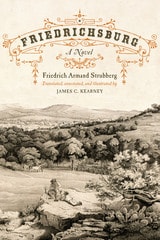
Friedrichsburg
A NovelBy Friedrich Armand Strubberg
University of Texas Press, 2012
Summerfield G. Roberts Award for a Work of Creative Writing, Sons of the Texas Republic, 2013
First published in Germany in 1867, this fascinating autobiographical novel of German immigrants on the antebellum Texas frontier provides a trove of revelations about the myriad communities that once called the Hill Country home.
Founded in 1846, Fredericksburg, Texas, was established by German noblemen who enticed thousands of their compatriots to flee their overcrowded homeland with the prospect of free land in a place that was portrayed as a new Garden of Eden. Few of the settlers, however, were prepared for the harsh realities of the Texas frontier or for confrontation with the Comanche. In his 1867 novel Friedrichsburg, Friedrich Armand Strubberg, a.k.a. Dr. Schubbert, interwove his personal story with a fictional romance to capture the flavor of Fredericksburg, Texas, during its founding years when he served as the first colonial director.
Now available in a contemporary translation, Friedrichsburg brings to life the little-known aspects of life among these determined but often ill-equipped settlers who sought to make the transition to a new home and community on the Texas frontier. Opening just as a peace treaty is being negotiated between the German newcomers and the Comanches, the novel describes the unlikely survival of these fledgling homesteads and provides evidence that support from the Delaware Indians, as well as the nearby Mormon community of Zodiac, was key to the Germans’ success. Along the way, Strubberg also depicts the laying of the cornerstone to the Vereinskirche, the blazing of an important new road to Austin, exciting hunting scenes, and an admirable spirit of cultural cohesion and determined resilience. In so doing, he resurrects a fascinating lost world.
Friending the Past
The Sense of History in the Digital AgeAlan Liu
University of Chicago Press, 2018
In Friending the Past, Alan Liu proposes fresh answers to these innovative questions of connection. He explores how we can learn from the relationship between past societies whose media forms fostered a communal and self-aware sense of history—such as prehistorical oral societies with robust storytelling cultures, or the great print works of nineteenth-century historicism—and our own instantaneous present. He concludes with a surprising look at how the sense of history exemplified in today’s JavaScript timelines compares to the temporality found in Romantic poetry.
Interlaced among these inquiries, Liu shows how extensive “network archaeologies” can be constructed as novel ways of thinking about our affiliations with time and with each other. These conceptual architectures of period and age are also always media structures, scaffolded with the outlines of what we mean by history. Thinking about our own time, Liu wonders if the digital, networked future can sustain a similar sense of history.

Friendly Fallout 1953
Ann Ronald
University of Nevada Press, 2011
Friendly Fallout 1953 is a hybrid work of literature that combines the actual history of aboveground atomic testing in the Nevada desert in 1953 with fictional vignettes that explore the impact of the tests on the people who participated in them and on civilian "downwinders." The book brings to life a turbulent era when Cold War fears, patriotic enthusiasm, scientific progress, and unacknowledged political agendas often collided with the welfare of ordinary citizens and the environment.
Friends Disappear
The Battle for Racial Equality in EvanstonMary Barr
University of Chicago Press, 2014
In Friends Disappear Barr goes back to her old neighborhood and pieces together a history of Evanston with a particular emphasis on its neighborhoods, its schools, and its work life. She finds that there is a detrimental myth of integration surrounding Evanston despite bountiful evidence of actual segregation, both in the archives and from the life stories of her subjects. Curiously, the city’s own desegregation plan is partly to blame. The initiative called for the redistribution of students from an all-black elementary school to institutions situated in white neighborhoods. That, however, required busing, and between the tensions it generated and obvious markers of class difference, the racial divide, far from being closed, was widened. Friends Disappear highlights how racial divides limited the life chances of blacks while providing opportunities for whites, and offers an insider’s perspective on the social practices that doled out benefits and penalties based on race—despite attempts to integrate.

Friends of Alice Wheeldon
Sheila Rowbotham
Pluto Press, 1986
Friends of the Unrighteous Mammon
Northern Christians and Market Capitalism, 1815-1860Stewart Davenport
University of Chicago Press, 2008
Drawing on diverse primary sources, Davenport identifies three distinct Christian responses to market capitalism: assurance from clerical economists who believed in the righteousness of economic development; opposition from contrarians who resisted the changes around them; and adaptation by the pastoral moralists who modified their faith to meet the ethical challenges of the changing economy. Delving into the minds of antebellum Christians as they considered themselves, their God, and their developing American economy, Friends of the Unrighteous Mammon is an ambitious intellectual history of an important development in American religious and economic life.
Friendship and Benefaction in James
Alicia J. Batten
SBL Press, 2017
Now available from SBL Press
Employing social description, social scientific models, and rhetorical analysis, Alicia J. Batten argues that the letter of James is conversant with the topic of friendship within Greek and Roman literature, as well as within various texts of early Christianity. She illustrates how James drew upon some of the language and concepts related to friendship with an intriguing density to advocate resistance to wealth, avoidance of rich patrons, and reliance upon God.
Features:
- Use of friendship, benefaction, and patronage as lenses through which James and related texts can be viewed
- A strong case for how the letter appels to the language and ideas of friendship with regard to God's relationships with humans
- Exploration of the relationship between the book of James and the teachings of Jesus
Friendship and Love, Ethics and Politics
Studies in Mediaeval and Early Modern HistoryEva Österberg
Central European University Press, 2010

Frigate HMS Leander
Jantinus Mulder
Amsterdam University Press, 2023
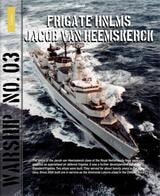
Frigate HNLMS Jacob van Heemskerck
Rindert van Zinderen-Bakker
Amsterdam University Press, 2023

Frigate USS Clark
Rindert van Zinderen-Bakker
Amsterdam University Press, 2023
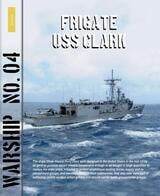
Frigate USS Clark
Rindert van Zinderen-Bakker
Amsterdam University Press, 2023

Frigid Embrace
Politics, Economics, and Environment in AlaskaStephen Haycox
Oregon State University Press, 2002
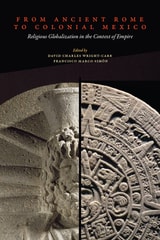
From Ancient Rome to Colonial Mexico
Religious Globalization in the Context of EmpireDavid Charles Wright-Carr
University Press of Colorado, 2023
An international team of specialists in classical scholarship and Mesoamerican studies engage in an interdisciplinary discussion involving ideas from history, anthropology, archaeology, art history, iconography, and philology. Key themes include the role of religion in processes of imperial domination; religion’s use as an instrument of resistance or the imposition, appropriation, incorporation, and adaptation of various elements of religious systems by hegemonic groups and subaltern peoples; the creative misunderstandings that can arise on the “middle ground”; and Christianity’s rejection of ritual violence and its use of this rejection as a pretext for inflicting other kinds of violence against peoples classified as “barbarian,” “pagan,” or “diabolical.”
From Ancient Rome to Colonial Mexico presents a sympathetic vantage point for discussing and attempting to decipher past processes of social communication in multicultural contexts of present-day realities. It will be significant for scholars and specialists in the history of religions, ethnohistory, classical antiquity, and Mesoamerican studies.
Publication supported, in part, by Spain’s Ministry of Economy and Competitiveness.
Contributors: Sergio Botta,Maria Celia Fontana Calvo, Martin Devecka, György Németh, Guilhem Olivier, Francisco Marco Simón, Paolo Taviani, Greg Woolf, David Charles Wright-Carr, Lorenzo Pérez Yarza
Translators: Emma Chesterman, Benjamin Adam Jerue, Layla Wright-Contreras
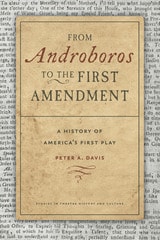
From Androboros to the First Amendment
A History of America's First PlayPeter A. Davis
University of Iowa Press, 2015
Androboros was not just the first of its kind, it was also ahead of its time in many ways, preceding the harsh political satires and farces of the later eighteenth century by some fifty years. Such plays served a small but essential role in promoting political thought among the colonists. Written by anonymous authors and passed from hand to hand, these short, crude, and often bawdy plays and dialogues were rarely acted due to their inflammatory lampoonery. Nevertheless, they provided an opportunity for disgruntled colonists to vent their grievances and promote their ideas to fellow citizens. The farces of the late eighteenth century drove home the meaning and message of the American Revolution.
Equally significant is that Androboros may have influenced a few of the key political discourses published in the 1730s, and these works in turn may well have shaped the future of the American political landscape for the next several decades and even into the modern era. But as a closet drama intended only to be read by close friends and political supporters, this play has languished as a minor footnote in American intellectual history. Scholarly research published to date has been, for the most part, inadequate and occasionally inaccurate. This study remedies that oversight, providing a full analysis as well as an annotated typescript and facsimiles of the original printing.
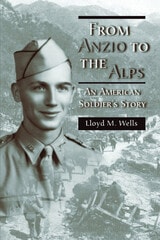
From Anzio to the Alps
An American Soldier's StoryLloyd M. Wells
University of Missouri Press, 2019
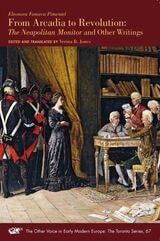
From Arcadia to Revolution
The Neapolitan Monitor and Other WritingsEleonora Fonseca Pimentel
Iter Press, 2019
The Other Voice in Early Modern Europe: The Toronto Series, Volume 67
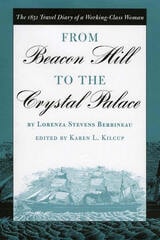
From Beacon Hill to the Crystal Palace
The 1851 Travel Diary of a Working-Class WomanLorenza Stevens Berbineau
University of Iowa Press, 2002
Because prior studies of American women’s travel writing have focused exclusively on middle-class and wealthy travelers, it has been difficult to assess the genre and its participants in a holistic fashion. One of the very few surviving working-class travel diaries, Lorenza Stevens Berbineau’s account provides readers with a unique perspective of a domestic servant in the wealthy Lowell family in Boston. Staying in luxurious hotels and caring for her young charge Eddie during her six-month grand tour, Berbineau wrote detailed and insightful entries about the people and places she saw.
Contributing to the traditions of women’s, diary, and travel literature from the perspective of a domestic servant, Berbineau's narrative reveals an arresting and intimate outlook on both her own life and the activities, places, and people she encounters. For example, she carefully records Europeans’ religious practices, working people and their behavior, and each region’s aesthetic qualities. Clearly writing in haste and with a pleasing freedom from the constraints of orthographic and stylistic convention, Berbineau offers a distinctive voice and a discerning perspective. Alert to nuances of social class, her narrative is as appealing and informative to today's readers as it no doubt was to her fellow domestics in the Lowell household.
Unobtrusively edited to retain as much as possible the individuality and texture of the author’s original manuscript, From Beacon Hill to the Crystal Palace offers readers brief framing summaries, informative endnotes, and a valuable introduction that analyzes Berbineau’s narrative in relation to gender and class issues and compares it to the published travel writing of her famous contemporary, Harriet Beecher Stowe.
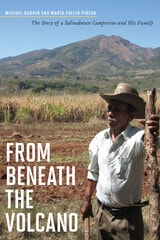
From Beneath the Volcano
The Story of a Salvadoran Campesino and His FamilyMichael Gorkin and Marta Evelyn Pineda
University of Arizona Press, 2011
Luis, his mother, his wife, his in-laws, his children, and some neighbors recall in a simple and often eloquent manner their experiences of everyday life before, during, and after the civil war. Nina Bonafacia, Luis’s mother, tells of the days before the war when two of her daughters were murdered and she fled with her family to a refugee camp. Julia, Luis’s wife, recounts her life as a guerrillera during which, incidentally, she gave birth to the first two of her eight children. Joaquin, a neighbor and comrade-in-arms, discusses how he and others took control of the land of Comunidad Guazapa and began rebuilding in those turbulent days and months right after the war. Margarita and Francisco, the two oldest children, with candor and insight discuss the trajectory of their lives and that of the postwar generation. And at the center of all these stories stands Luis, the guerrillero, farmer, neighbor, husband, father—and raconteur par excellence.
In sum, the multiple voices in From Beneath the Volcano combine to form a rich tapestry displaying a story of war, family, and community and provide a never-before-seen view of both the past and present El Salvador.
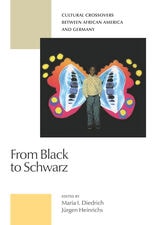
From Black to Schwarz
Cultural Crossovers Between African America and GermanyMaria I. Diedrich
Michigan State University Press, 2011
From Blackjacks to Briefcases
A History of Commercialized Strikebreaking and Unionbusting in the United StatesRobert Michael Smith
Ohio University Press, 2003
From the beginning of the Industrial Age and continuing into the twenty-first century, companies faced with militant workers and organizers have often turned to agencies that specialized in ending strikes and breaking unions. Although their secretive nature has made it difficult to fully explore the history of this industry, From Blackjacks to Briefcases does just that.
By digging through subpoenaed documents of strike-bound companies, their mercenaries, and the testimony of executive officers and rank-and-file strikebreakers, Robert Smith examines the inner workings of the antiunion industry. In a clear and lively style, he brings to life the violent armed guards employed on the picket line or in the coal camps; the ruffians who filled the armies marshaled by the “King of the Strikebreakers,” Pearl Bergoff; the labor spies who wrecked countless unions; and, after the Wagner Act, those who manipulated national labor law to serve their clients.
In From Blackjacks to Briefcases, Smith follows the history of this ongoing struggle and tells a compelling story that parallels the history of the United States over the last century and a half.
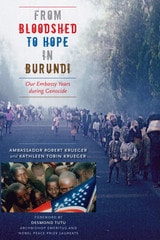
From Bloodshed to Hope in Burundi
Our Embassy Years during GenocideBy Ambassador Robert Krueger and Kathleen Tobin Krueger
University of Texas Press, 2007
In 1994, while nations everywhere stood idly by, 800,000 people were slaughtered in eight weeks in Rwanda. Arriving as U.S. Ambassador to neighboring Burundi a few weeks later, Bob Krueger began drawing international attention to the genocide also proceeding in Burundi, where he sought to minimize the killing and to preserve its fledgling democratic government from destruction by its own army. From Bloodshed to Hope in Burundi is a compelling eyewitness account of both a horrific and persistent genocide and of the ongoing efforts of many courageous individuals to build a more just society.
Krueger and his wife Kathleen graphically document the slaughter occurring all around them, as well as their repeated efforts to get the U.S. government and the international community to take notice and take action. Bob Krueger reconstructs the events of the military coup that precipitated the Burundi genocide and describes his efforts to uncover the truth by digging up graves and interviewing survivors. In straightforward and powerful language, Kathleen Krueger recounts her family's experience living amid civil war, including when she faced down a dozen AK-47-wielding African soldiers to save the life of a household worker.
From Bloodshed to Hope in Burundi shines a piercing light on a genocide that has gone largely unreported, and identifies those responsible for it. It also offers hope that as the truth emerges and the perpetrators are brought to account, the people of Burundi will at last achieve peace and reconciliation.
From Blue Mills to Columbia
Cedar Falls and the Civil WarRobert K. Martin
University of Iowa Press, 1992
From Blue Mills to Columbia
Cedar Falls and the Civil WarKenneth L. Lyftogt
University of Iowa Press, 1993
From Blue to Red
The Rise of the GOP in ArkansasJohn C. Davis
University of Arkansas Press, 2024
John C. Davis’s From Blue to Red: The Rise of the GOP in Arkansas provides a rigorous yet accessible study of this partisan shift, tracking changes in voter preference at the top of the ticket in the 1960s, generational replacement in Arkansas’ political power structure in the 1990s, and the emergence of a more nationalized and polarized electorate in the 2000s, among other developments. From Blue to Red is a fascinating look at how Arkansas went from being one of the country’s most solidly Democratic states to one of its most ardently Republican in just a few years.
From Bondage to Belonging
The Worcester Slave NarrativesB. Eugene McCarthy
University of Massachusetts Press, 2007
First published between 1842 and 1895, the autobiographical narratives gathered in this volume document the experiences of eight former slaves who eventually took up residence in Worcester, Massachusetts. Each narrative tells a gripping individual story, its author clearly visible in the dress of his or her own words. Together they illuminate not only the inhumanity of slavery but also the dreams and dilemmas of emancipation, tracing the personal journeys of seven men and one woman from bondage to freedom.
In their well-researched introduction, B. Eugene McCarthy and Thomas L. Doughton situate the Worcester slave narratives within a broader historical framework and analyze their meaning and significance. Drawing on a wide range of sources, they reconstruct the black community of Worcester and compare it with other New England black communities of the time, describing how the town evolved from a society with slaves in the colonial era to a hub for free blacks by the eve of the Civil War. They explain why these writings must be understood as part of a long-established tradition of African American self-representation, and show how the four narratives published before 1865 focus on the experience of slavery, while the four written after the war offer the fresh perspective of living in freedom. Headnotes describe the distinctive literary features of each narrative and provide additional information about the lives of the authors. The editors discuss why these ex-slaves came to Worcester, the circumstances in which each wrote his or her narrative, and the audiences they had in mind. No other collection of slave narratives offers such a diverse range of testimony within a specific historical and literary context, or a more compelling account of the transition from bondage to belonging.
From Boom to Bubble
How Finance Built the New ChicagoRachel Weber
University of Chicago Press, 2015
In From Boom to Bubble, Rachel Weber debunks the idea that booms occur only when cities are growing and innovating. Instead, she argues, even in cities experiencing employment and population decline, developers rush to erect new office towers and apartment buildings when they have financial incentives to do so. Focusing on the main causes of overbuilding during the early 2000s, Weber documents the case of Chicago’s “Millennial Boom,” showing that the Loop’s expansion was a response to global and local pressures to produce new assets. An influx of cheap cash, made available through the use of complex financial instruments, helped transform what started as a boom grounded in modest occupant demand into a speculative bubble, where pricing and supply had only tenuous connections to the market. From Boom to Bubble is an innovative look at how property markets change and fail—and how that affects cities.
From Borderland to Burgenland
Science, Geopolitics, Identity, and the Making of a RegionFerenc Jankó
Central European University Press, 2024
The area that constitutes the Austrian federal province of Burgenland belonged to the Hungarian part of the Habsburg empire until the end of World War I. This book helps us realize that geographical knowledge does not come ready-made. Instead, it is created by knowledge makers: geographers, historians, statisticians etc. This knowledge-making helped to legitimatize the area transferred between Austria and Hungary, shape the Burgenland identity, and depict its geopolitical role in the rise of national socialism. This book is about how those studying Burgenland, the creators of its geographical knowledge, saw and represented the province. It explores how they grasped the geographical characteristics of the region through their own perspective, influenced by their own professional positions, individual careers, motivations, and by the broader historical and social medium.
The way the area between the provinces of Lower Austria and Styria came about as Burgenland is enthralling, as is how the people there experienced this change of sovereignty and how everyday social and economic relationships were transformed. Tracing the geographical discourses in the interwar period and beyond, the book argues that Burgenland became a successful geographical project, and departs from thoughts of subdivision, unviability, and backwardness, concentrating instead on fertility, unity, and modernization.

From Broadway to The Bronx
New York City’s History through SongVeronika Keller and Sabrina Mittermeier
Intellect Books, 2026
From Broadway to the Bronx tells the history of New York City in song across a variety of different genres that the city has been home to and instrumental in developing, covering everything from early twentieth-century sheet music to Broadway’s musical theater, hip-hop, disco, punk, dancehall, but also contemporary metal, rock, and pop. It features an analysis of the work of artists with intimate connections to the city, like Billy Joel, Lin-Manuel Miranda, Debbie Harry, Shinehead, and the Wu-Tang Clan, as well as an exclusive interview with RENT original cast member Anthony Rapp. The collection includes essays from authors across the disciplines of cultural studies, media studies, cultural history, and musicology, resulting in a far-ranging treatment of the interconnection of the city space and its musical history.
From Bureaucracy to Bullets
Extreme Domicide and the Right to HomeBree Akesson
Rutgers University Press, 2022
From California's Gold Fields to the Mendocino Coast
A Settlement History Across Time and PlaceSamuel M. Otterstrom
University of Nevada Press, 2017
The development of San Francisco’s outlying region from a wilderness into a prosperous village and farming mecca shows how quickly in-migration coupled with economic diversification can establish a stable settlement structure upon the landscape. Otterstrom describes an intricately woven tapestry of interrelated people who were contributing creators of a wide variety of prosperous northern California environs. He uncovers the processes that converted this sleepy post-Mexican outpost into a focal point of nearly hyperactive youthful growth. The narrative follows this crucial story of settlement development until the dawn of the twentieth century, through the interconnected framework of individual and family ingenuity, migration trajectories, and diverse geographical scales.
Multiplying individualistic experiences from across far-flung appendages of the Northern California system into larger and larger scales, Otterstrom has achieved a matchless historical and sociological study that will form the basis for any future studies of the area.
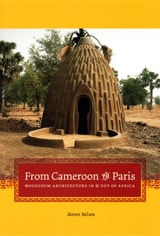
From Cameroon to Paris
Mousgoum Architecture In and Out of AfricaSteven Nelson
University of Chicago Press, 2007
The kind of extraordinary domed house constructed by Chad and Cameroon’s Mousgoum peoples has long held sway over the Western imagination. In fact, as Steven Nelson shows here, this prototypical beehive-shaped structure known as the teleukhas been cast as everything from a sign of authenticity to a tourist destination to a perfect fusion of form and function in an unselfconscious culture. And in this multifaceted history of the teleuk, thought of by the Mousgoum themselves as a three-dimensional symbol of their culture, Nelson charts how a singular building’s meaning has the capacity to change over time and in different places.
Drawing on fieldwork in Cameroon and Japan as well as archival research in Africa, the United States, and Europe, Nelson explores how the teleuk has been understood by groups ranging from contemporary tourists to the Cameroonian government and—most importantly—today’s Mousgoum people. In doing so, he moves in and out of Africa to provide a window into a changing Mousgoum culture and to show how both African and Western peoples use the built environment to advance their own needs and desires. Highlighting the global impact of African architecture, From Cameroon to Paris will appeal to scholars and students of African art history and architectural history, as well as those interested in Western interactions with Africa.
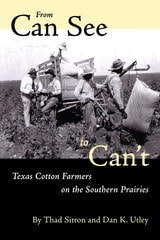
From Can See to Can’t
Texas Cotton Farmers on the Southern PrairiesBy Thad Sitton and Dan K. Utley
University of Texas Press, 1997
Cotton farming was the only way of life that many Texans knew from the days of Austin's Colony up until World War II. For those who worked the land, it was a dawn-till-dark, "can see to can't," process that required not only a wide range of specialized skills but also a willingness to gamble on forces often beyond a farmer's control—weather, insects, plant diseases, and the cotton market.
This unique book offers an insider's view of Texas cotton farming in the late 1920s. Drawing on the memories of farmers and their descendants, many of whom are quoted here, the authors trace a year in the life of south central Texas cotton farms. From breaking ground to planting, cultivating, and harvesting, they describe the typical tasks of farm families—as well as their houses, food, and clothing; the farm animals they depended on; their communities; and the holidays, activities, and observances that offered the farmers respite from hard work.
Although cotton farming still goes on in Texas, the lifeways described here have nearly vanished as the state has become highly urbanized. Thus, this book preserves a fascinating record of an important part of Texas' rural heritage.

From Canton Restaurant to Panda Express
A History of Chinese Food in the United StatesLiu, Haiming
Rutgers University Press, 2015
Finalist in the Culinary History category of the 2016 Gourmand World Cookbook Awards
From Canton Restaurant to Panda Express takes readers on a compelling journey from the California Gold Rush to the present, letting readers witness both the profusion of Chinese restaurants across the United States and the evolution of many distinct American-Chinese iconic dishes from chop suey to General Tso’s chicken. Along the way, historian Haiming Liu explains how the immigrants adapted their traditional food to suit local palates, and gives readers a taste of Chinese cuisine embedded in the bittersweet story of Chinese Americans.
Treating food as a social history, Liu explores why Chinese food changed and how it has influenced American culinary culture, and how Chinese restaurants have become places where shared ethnic identity is affirmed—not only for Chinese immigrants but also for American Jews. The book also includes a look at national chains like P. F. Chang’s and a consideration of how Chinese food culture continues to spread around the globe.
Drawing from hundreds of historical and contemporary newspaper reports, journal articles, and writings on food in both English and Chinese, From Canton Restaurant to Panda Express represents a groundbreaking piece of scholarly research. It can be enjoyed equally as a fascinating set of stories about Chinese migration, cultural negotiation, race and ethnicity, diverse flavored Chinese cuisine and its share in American food market today.
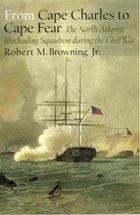
From Cape Charles to Cape Fear
The North Atlantic Blockading Squadron during the Civil WarRobert M. Browning
University of Alabama Press, 2003
A definitive study of Union naval power and the blockade that reshaped the Civil War.
In From Cape Charles to Cape Fear, acclaimed historian Robert M. Browning, Jr. offers a vivid and authoritative account of the Union Navy’s North Atlantic Blockading Squadron, a critical force in the American Civil War. Charged with enforcing the blockade along the Atlantic coastline from Virginia to North Carolina, the squadron played a decisive role in crippling the Confederacy’s economy and restricting its access to vital supplies.
Browning reveals the blockade as far more than a passive defensive strategy. Through detailed analysis of naval operations, coastal engagements, and strategic planning, he demonstrates how Union forces exerted control over key waterways and ports, including Norfolk and Wilmington. These contested hubs became focal points in a high-stakes struggle involving daring blockade runners, shifting naval tactics, and constant pressure on Southern trade networks.
Blending operational history with compelling narrative, Browning also captures the human dimension of naval warfare. Sailors and officers faced unpredictable weather, dangerous missions, and the relentless demands of maintaining control over an expansive coastline. Their experiences illuminate the challenges and complexities of maritime warfare during one of America’s defining conflicts.
Accessible yet richly researched, this book highlights the central importance of naval power in shaping Civil War outcomes. From Cape Charles to Cape Fear stands as an essential work for readers interested in Civil War history, naval strategy, and the enduring impact of maritime operations on the American past.
From Central Planning to the Market
Transformation of the Czech Economy 1989 – 2004Libor Zidek
Central European University Press, 2018