Results by title
4155 books match the query 'State & Local' and 177 start with f

Fort Ticonderoga, The Last Campaigns
The War in the North, 1777–1783Mark Edward Lender
Westholme Publishing, 2027
During the War for Independence, Fort Ticonderoga’s guns, sited critically between Lakes Champlain and George, dominated north-south communications in upstate New York that were vital to both the British and American war efforts. In the public mind Ticonderoga was the “American Gibraltar” or the “Key to the Continent,” and patriots considered holding the fort essential to the success of the Revolutionary cause. Ticonderoga was a primary target in British Lieutenant General John Burgoyne’s 1777 campaign to crush American resistance in the north and end the rebellion in a decisive stroke. American efforts to defend the fort in June against overwhelming odds entailed political and military intrigue, bungling, heroism, and ultimately a narrow escape for the Continental and provincial forces under Major General Arthur St. Clair. The loss of Ticonderoga stunned patriot morale and ignited one of the greatest political firestorms of the war. But the fortunes of war turned. Two months later, the rebels mounted a sensational—if little known—counter-attack on Ticonderoga that had major implications for Burgoyne’s eventual defeat at Saratoga in October. Yet Saratoga brought no peace, and Ticonderoga would be central to additional military and political maneuverings—many of them known only to specialist historians—that would keep the region on edge until the end of the war in 1783.
Based on new archival research and taking advantage of the latest scholarship, Fort Ticonderoga, The Last Campaigns: The War in the North, 1777-1783 by distinguished historian Mark Edward Lender highlights the strategic importance of the fort as British, American, and regional forces (including those of an independent Vermont Republic) fought for control of the northern front at a critical point in the war. The book tells the Ticonderoga story in all of its complexity and drama, correcting misconceptions embedded in many previous accounts, and sheds vital new light on this key chapter in America’s struggle for independence.
Fort Toulouse
The French Outpost at the Alabamas on the CoosaDaniel H Thomas, with an introduciton by Gregory A. Waselkov
University of Alabama Press, 1989
Situated at the head of the Alabama River system—at the juncture of the Coosa and Tallapoosa rivers—Fort Toulouse in 1717 was planned to keep the local Indians neutral, if not loyal, to the French and contain the British in their southernmost Atlantic colonies. Unlike the usual frontier settlements, Fort Toulouse was both a diplomatic post, since its officers acted as resident ministers, and a military post. Because it was located in a friendly territory adjoining an area under a rival (British) influence, the post participated in psychological warfare rather than in blood-letting. It used trade and aid, and was familiar with spies and double-agents—welcoming and debriefing British defectors; no cannon was discharged in anger at Toulouse.
The most eminent figure to have been connected directly with Fort Toulouse was General Andrew Jackson, who established a military post there during the War of 1812 after his victory over the Indians at Horseshoe Bend. The outpost was named Fort Jackson in his honor and played a key role in the treaty negotiations and eventual settlement of the Indian land by Americans.
In addition to discussing geopolitical and military affairs and diplomatic relations with Indian chiefs, Thomas describes daily life at the post and the variety of interactions between residents and visitors. Waselkov's introduction places the original 1960 book within the context of the existing scholarship of that time and adds an extensive and enlightening review of the most recent archaeological and historical research to Thomas' pioneering work.

Forth to the Mighty Conflict
Alabama and World War IIAllen Cronenberg
University of Alabama Press, 1995
From the home front to the front lines—Alabama’s pivotal role in shaping victory in World War II.
Alabama and its people played a conspicuous role in World War II. Not only were thousands of servicemen trained at military facilities in the state—at Fort McClellan, Camp Rucker, Camp Sibert, Maxwell Air Field, and Tuskegee Army Air Field—but Axis prisoners of war were interned in camps on Alabama soil. The state of Alabama held a significant number of these prisoners, over seventeen thousand in four camps across the state: Camp Aliceville, Camp Opelika, Fort McClellan, and Fort Rucker. This study focuses on Camp Aliceville and Camp Opelika which provide a sample that frames and highlights the national prisoner of war program. Through this example, one can see the lasting legacy of the prisoner of war program and its role in transforming the United States and forever changing the lives of thousands of prisoners, guards, and local citizens. An analysis of the Alabama camps also reveals how memory is constructed and how one narrative can ultimately emerge as the dominant story. In addition, a survey of the landscape reveals the importance of place and its role in the process of remembering and forgetting.

Fortunate People in a Fortunate Land
At Home in Santa Monica's Rent-Controlled HousingLauren E. M. Everett
Temple University Press, 2025
Everett seeks to understand the extent to which individuals feel at home or not at home and what factors contribute to those experiences. She also explores the nexus of Santa Monica’s tenant protection policies, infrastructure, and resources and the extent to which they inform stability—both perceived and actual—and life decisions.
The first scholarly book to take a tenant-centered approach to examining the benefits and problems of rent control, Fortunate People in a Fortunate Land examines the residential experience in this specific local context and explains how it relates to policy and other externalities in cities where homeownership is not financially viable for most renters.
In the series Urban Life, Landscape, and Policy
Forty Years In The Wilderness
Impressions Of Nevada, 1940-1980James W. Hulse
University of Nevada Press, 1986
A view of Nevada history by native Nevadan and historian Hulse that suggests prosperity be based on diverse businesses rather than on a gaming-financed economy.

Forward for the People
The Autobiography of America's Longest Serving LegislatorFred A. Risser and Doug Moe
Wisconsin Historical Society Press, 2025
When Fred Risser retired from the Wisconsin Senate in 2021, his sixty-four years in state government made him the longest serving legislator in US history. Now, in this candid and illuminating autobiography, Risser shares his singular perspective on events that transformed the state and the nation over the course of his remarkable career. From his role in the “Joe Must Go” drive to recall US Senator Joseph McCarthy in the 1950s to his position as the senior senator among the “Fab Fourteen” Wisconsin Democrats who opposed Governor Scott Walker’s Act 10 legislation against collective bargaining in 2011, Risser was a leader in state politics for decades, always maintaining an unwavering belief that political action can change people’s lives for the better.
Forward for the People provides a unique peek behind the political curtain from the viewpoint of someone who saw it all. Risser worked with thirteen governors and authored more than 240 bills that became law, championing public health and safety, environmental protection, women’s and reproductive rights, organized labor, civil rights, and social justice, among many other causes. Risser also recounts interactions with prominent national politicians, including Robert La Follette Jr., Hubert Humphrey, Jimmy Carter, and Bill Clinton. More than forty photographs from Risser’s personal collection and the Wisconsin Senate paint a vivid picture of his six-decade journey through Wisconsin politics.
Forward for the People details Risser’s experiences out of state, from a stint in the Panama Canal Zone as a navy hospital corpsman to his undergraduate debate-team days at Minnesota’s Carleton College to his years studying law at the University of Oregon and his travels to all seven continents. The book also depicts the quirky habits that made Risser a memorable and beloved politician: biking his age in miles every birthday and never taking the elevator in his sixty-four years at the Wisconsin State Capitol. Enhanced with details sourced from correspondence, personal notes, newspaper accounts, and recollections from friends and former colleagues, Risser and coauthor Doug Moe have crafted an engaging account of an extraordinary life in public service.

Forward for the People
The Autobiography of America's Longest Serving LegislatorFred A. Risser and Doug Moe
Wisconsin Historical Society Press, 2026
When Fred Risser retired from the Wisconsin Senate in 2021, his sixty-four years in state government made him the longest serving legislator in US history. Now, in this candid and illuminating autobiography, Risser shares his singular perspective on events that transformed the state and the nation over the course of his remarkable career. From his role in the “Joe Must Go” drive to recall US Senator Joseph McCarthy in the 1950s to his position as the senior senator among the “Fab Fourteen” Wisconsin Democrats who opposed Governor Scott Walker’s Act 10 legislation against collective bargaining in 2011, Risser was a leader in state politics for decades, always maintaining an unwavering belief that political action can change people’s lives for the better.
Forward for the People provides a unique peek behind the political curtain from the viewpoint of someone who saw it all. Risser worked with thirteen governors and authored more than 240 bills that became law, championing public health and safety, environmental protection, women’s and reproductive rights, organized labor, civil rights, and social justice, among many other causes. Risser also recounts interactions with prominent national politicians, including Robert La Follette Jr., Hubert Humphrey, Jimmy Carter, and Bill Clinton.
Forward for the People details Risser’s experiences out of state, from a stint in the Panama Canal Zone as a navy hospital corpsman to his undergraduate debate-team days at Minnesota’s Carleton College to his years studying law at the University of Oregon and his travels to all seven continents. The book also depicts the quirky habits that made Risser a memorable and beloved politician: biking his age in miles every birthday and never taking the elevator in his sixty-four years at the Wisconsin State Capitol. Enhanced with details sourced from correspondence, personal notes, newspaper accounts, and recollections from friends and former colleagues, Risser and coauthor Doug Moe have crafted an engaging account of an extraordinary life in public service.
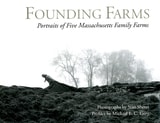
Founding Farms
Portraits of Five Massachusetts Family FarmsStanley E. Sherer
University of Massachusetts Press, 1993
With each passing year, the number of family farms in the United States diminishes. Fewer people have the persistence and ingenuity to wrest a livelihood from the land in an era of corporate ownership and mass production. Yet some family farms survive.
Through words and photographs, this book documents the long lives of five of the oldest farms in Massachusetts. Each has remained in the same family for more than two, sometimes three, centuries and each has a distinctive history. The devotion to the land and family heritage is palpable in the stories these five families tell.
Stan Sherer’s remarkable photographs depict the activities of the family members as they go about their daily labors, planting crops, feeding animals, applying new technologies to ancient tasks, and coping with the vagaries of weather and state regulations. Michael E. C. Gery’s narrative traces how the farms began, what has sustained them through the generations, and how the families who run them today feel about their past, present, and future. These stories are told largely through the words of the people themselves.
The result is a complex portrait that moves beyond traditional stereotypes to reveal the realities of family farm life in an increasingly urbanized society.

Four Classic Mormon Village Studies
Howard M. Bahr
University of Utah Press, 2014
Fourth of July, Asbury Park
A History of the Promised LandDaniel Wolff
Rutgers University Press, 2022
Fourth of July, Asbury Park tells the tale of the city’s first 150 years, guiding us through the development of its lavish amusement parks and bandstands, as well as the decay of its working-class neighborhoods and spread of its racially-segregated ghettos. Featuring exclusive interviews with Springsteen and other prominent Asbury Park residents, Daniel Wolff uncovers the history of how this Jersey shore resort town came to epitomize both the promises of the American dream and the tragic consequences when those promises are broken.
Hailed by The New York Times as a “wonderfully evocative…grand, sad story” when first published in 2006, this revised and expanded edition considers how Asbury Park has changed in the twenty-first century, experiencing both gentrification and new forms of segregation.

Francis Warrington Dawson and the Politics of Restoration
South Carolina, 1874-1889E. Culpepper Clark
University of Alabama Press, 1980
A revealing biography of a powerful Southern editor at the center of South Carolina’s post‑Reconstruction political transformation.
In the decades following the Civil War, South Carolina—like much of the South—struggled to redefine its political identity amid the collapse of Reconstruction and the rise of conservative “Redeemer” governments. In Francis Warrington Dawson and the Politics of Restoration, historian E. Culpepper Clark offers a deeply researched and incisive study of this transformation through the life and work of Francis Warrington Dawson, one of the state’s most influential newspaper editors.
Dawson was far more than a chronicler of events. As a powerful voice in South Carolina’s political press, he helped shape public opinion, broker alliances among conservative factions, and articulate the ideological foundations of post‑Reconstruction governance. Clark situates Dawson at the center of the struggles among Redeemers, Straight‑Out Democrats, agrarian reformers, and emerging political leaders such as Ben Tillman, revealing a political landscape marked by rivalry, class conflict, and competing visions of the New South.
Drawing on extensive manuscript collections, newspapers, and political correspondence, Clark explores the close relationship between journalism and power in the late nineteenth century and demonstrates how newspapers functioned as active political actors rather than neutral observers. The result is both a compelling political biography and a broader analysis of how restoration politics operated at the state level.
Francis Warrington Dawson and the Politics of Restoration is an essential work for readers interested in Southern history, Reconstruction and its aftermath, the history of American journalism, and the forces that shaped the political culture of the modern South.
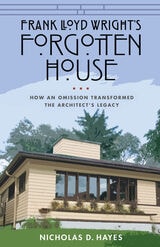
Frank Lloyd Wright's Forgotten House
How an Omission Transformed the Architect's LegacyNicholas D. Hayes
University of Wisconsin Press, 2021
When Nicholas and Angela Hayes became stewards of the unassuming Elizabeth Murphy House near Milwaukee, they began to unearth evidence that ultimately revealed a one-hundred-year-old fiasco fueled by competing ambitions and conflicting visions of America. The couple’s forensic pursuit of the truth untangled the ways Wright’s ASBH experiment led to the architect’s most productive, creative period. Frank Lloyd Wright’s Forgotten House includes a wealth of drawings and photographs, many of which have never been previously published. Historians, architecture buffs, and Wrightophiles alike will be fascinated by this untold history that fills a crucial gap in the architect’s oeuvre.

Frank Lloyd Wright’s Penwern
A Summer EstateMark Hertzberg
Wisconsin Historical Society Press, 2019
Frank Norris Remembered
Edited by Jesse S. Crisler and Joseph R. McElrath Jr.
University of Alabama Press, 2013
Frank Norris Remembered is a collection of reminiscences by Norris’s contemporaries, friends, and family that illuminate the life of a popular American novelist.
Considering his undergraduate education spent studying art at Académie Julian in Paris and creative writing at Harvard and his journalism career reporting from the far reaches of South Africa and Cuba, it is difficult to fathom how Frank Norris also found time to compose seven novels during the course of his brief life. But despite his adventures abroad, Norris turned out novels at a dizzying pace. He published Moran of the Lady Letty in 1898, McTeague early in 1899, Blix later that year, A Man’s Woman in February 1900, and The Octopus, the first in his ultimately unfinished “Epic of the Wheat” trilogy, in 1901. By informing his novels with his own experiences abroad, Norris composed works that were politically charged and culturally relevant and that made considerable contributions to the character of American literature in the twentieth century.
Frank Norris died at the age of thirty-two in 1902 from peritonitis resulting from a burst appendix, leaving behind a wife, a daughter, and an unfinished series of novels (two of which, The Pit and Vandover and the Brute, were published posthumously). The aim of Frank Norris Remembered, edited by Jesse S. Crisler and Joseph R. McElrath Jr., is to re-create the short, spectacular life of this American author through the eyes of those who knew him best. The fifty reminiscences included in this book feature the voices of Frank N. Doubleday; William Dean Howells; Hamlin Garland; Norris’s wife, Jeannette; and many others who were lucky enough to form a relationship with this vital twentieth-century American author, artist, and adventurer.

Frankly Speaking
The Extraordinary Life of United States Senator Frank R. LautenbergBonnie Lautenberg
Rutgers University Press, 2024
Told by one of the people who knew him best, his widow Bonnie, Frankly Speaking reveals the political strategies that made Lautenberg one of the Senate’s most powerful advocates for the health and safety of America’s citizens. He championed seemingly minor, unglamorous reforms that made a big difference to everyday lives, from raising the national drinking age to preventing domestic abusers from purchasing guns. These campaigns earned him powerful enemies in the alcohol, tobacco, and firearms industries, and he was subjected to some of the most brutal campaign mudslinging in American history. Yet, as this inspiring biography reveals, New Jersey’s longest-serving senator was not afraid to take big political risks if it meant standing up for his principles, whether that meant opposing the Iraq War or protecting LGBTQ and women’s rights.

Freddie Steinmark
Faith, Family, FootballBy Bower Yousse and Thomas J. Cryan
University of Texas Press, 2015
Freddie Steinmark tells the story of a legendary University of Texas football player whose courage on the field and in battling cancer still inspires the Longhorn nation.
Freddie Steinmark started at safety for the undefeated University of Texas Longhorns in 1969. In the thrilling “Game of the Century,” a come-from-behind victory against Arkansas that ensured Texas the national championship, Steinmark played with pain in his left leg. Two days later, X-rays revealed a bone tumor so large that it seemed a miracle Steinmark could walk, let alone play football. Within a week of the Arkansas game, his leg was amputated.
A gritty, undersized player, Steinmark had quickly become a fan favorite at Texas. What he endured during the Longhorns’ memorable 1969 season, and what he encountered afterward, captivated not only Texans but the country at large. Americans watched closely as Steinmark confronted life’s ultimate challenge, and his openness during his battle against savage odds helped reframe the national conversation surrounding cancer and the ongoing race for a cure.
Written with unfettered access to the Steinmark family and archives, Freddie Steinmark: Faith, Family, Football is the exploration of a brief but full life, one that began humbly but ended on a grand stage. It is a fitting tribute to a legendary Longhorn whose photograph, emblazoned with the word “Heart,” flashes on the Freddie Steinmark Scoreboard’s Jumbotron prior to each home football game in UT’s Darrell K Royal–Texas Memorial Stadium at Joe Jamail Field.
Frederick Jackson Turner
Wisconsin’s Historian of the FrontierMartin Ridge
Wisconsin Historical Society Press, 1986

Free Spirit
A Biography of Mason Welch GrossThomas W. Gross
Rutgers University Press, 2022
Free Spirit explores how Gross helped reshape Rutgers from a sleepy college into a world-renowned public research university. It also reveals how he steered the university through the tumult of the Red Scare, civil rights era, and the Vietnam War by taking principled stands in favor of both racial equality and academic freedom. This biography tells the story of how, from an early age, Gross came to believe in the importance of doing what was right, even when the backlash took a toll on his own health.
Written by his youngest son Thomas, this book offers a uniquely well-rounded portrait of Gross as both a public figure and a private person. Covering everything from his service in World War II to his stints as a game-show personality, Free Spirit introduces the reader to a remarkable academic leader.
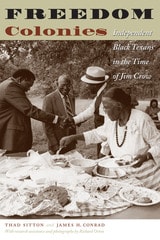
Freedom Colonies
Independent Black Texans in the Time of Jim CrowBy Thad Sitton and James H. Conrad
University of Texas Press, 2005
Friends of the Dallas Public Library Award, 2006
Best Book on East Texas, East Texas Historical Association, 2007
In the decades following the Civil War, nearly a quarter of African Americans achieved a remarkable victory—they got their own land. While other ex-slaves and many poor whites became trapped in the exploitative sharecropping system, these independence-seeking individuals settled on pockets of unclaimed land that had been deemed too poor for farming and turned them into successful family farms. In these self-sufficient rural communities, often known as "freedom colonies," African Americans created a refuge from the discrimination and violence that routinely limited the opportunities of blacks in the Jim Crow South.
Freedom Colonies is the first book to tell the story of these independent African American settlements. Thad Sitton and James Conrad focus on communities in Texas, where blacks achieved a higher percentage of land ownership than in any other state of the Deep South. The authors draw on a vast reservoir of ex-slave narratives, oral histories, written memoirs, and public records to describe how the freedom colonies formed and to recreate the lifeways of African Americans who made their living by farming or in skilled trades such as milling and blacksmithing. They also uncover the forces that led to the decline of the communities from the 1930s onward, including economic hard times and the greed of whites who found legal and illegal means of taking black-owned land. And they visit some of the remaining communities to discover how their independent way of life endures into the twenty-first century.
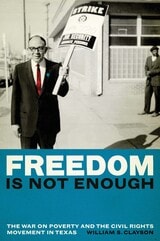
Freedom Is Not Enough
The War on Poverty and the Civil Rights Movement in TexasBy William S. Clayson
University of Texas Press, 2010
Led by the Office of Economic Opportunity, Lyndon Johnson's War on Poverty reflected the president's belief that, just as the civil rights movement and federal law tore down legalized segregation, progressive government and grassroots activism could eradicate poverty in the United States. Yet few have attempted to evaluate the relationship between the OEO and the freedom struggles of the 1960s. Focusing on the unique situation presented by Texas, Freedom Is Not Enough examines how the War on Poverty manifested itself in a state marked by racial division and diversity—and by endemic poverty.
Though the War on Poverty did not eradicate destitution in the United States, the history of the effort provides a unique window to examine the politics of race and social justice in the 1960s. William S. Clayson traces the rise and fall of postwar liberalism in the Lone Star State against a backdrop of dissent among Chicano militants and black nationalists who rejected Johnson's brand of liberalism. The conservative backlash that followed is another result of the dramatic political shifts revealed in the history of the OEO, completing this study of a unique facet in Texas's historical identity.
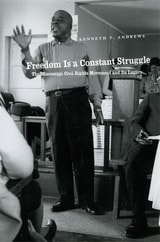
Freedom Is a Constant Struggle
The Mississippi Civil Rights Movement and Its LegacyKenneth T. Andrews
University of Chicago Press, 2004
Freedom Is a Constant Struggle is also the first book of its kind to detail the activities of white supremacists in Mississippi, revealing how white repression and intimidation sparked black activism and simultaneously undermined the movement's ability to achieve far-reaching goals. Andrews shows that the federal government's role was important but reactive as federal actors responded to the sustained struggles between local movements and their opponents. He tracks the mobilization of black activists by the NAACP, the creation of Freedom Summer, efforts to galvanize black voters, the momentous desegregation of public schools and the rise of all-white private academies, and struggles over the economic development of black communities. From this complex history, Andrews shows how the civil rights movement built innovative organizations and campaigns that empowered local leadership and had a lasting legacy in Mississippi and beyond.
Based on an original and creative research design that combines extensive archival research, interviews with activists, and quantitative historical data, Freedom Is a Constant Struggle provides many new insights into the civil rights struggle, and it presents a much broader theory to explain whether and how movements have enduring impacts on politics and society. What results is a work that will be invaluable to students of social movements, democratic politics, and the struggle for racial freedom in the U.S.

Freedom's Ballot
African American Political Struggles in Chicago from Abolition to the Great MigrationMargaret Garb
University of Chicago Press, 2014
Freedom’s Ballot is the history of three generations of African American activists—the ministers, professionals, labor leaders, clubwomen, and entrepreneurs—who transformed twentieth-century urban politics. This is a complex and important story of how black political power was institutionalized in Chicago in the half-century following the Civil War. Margaret Garb explores the social and political fabric of Chicago, revealing how the physical makeup of the city was shaped by both political corruption and racial empowerment—in ways that can still be seen and felt today.
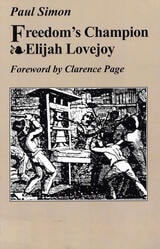
Freedom's Champion
Elijah LovejoyElijah Lovejoy. Revised by Paul Simon. Foreword by Clarence Page
Southern Illinois University Press, 1994
In this revised edition of his earlier biography, Paul Simon provides an inspiring account of the life and work of Elijah Lovejoy, an avid abolitionist in the 1830s and the first martyr to freedom of the press in the United States.
Lovejoy was a native New Englander, the son of a Congregational minister. He came to the Midwest in 1827 in pursuit of a teaching career and succeeded in running his own school for two years in St. Louis. Teaching failed to challenge Lovejoy, however, so he bought a half interest in the St. Louis Times and became its editor. In 1832, after experiencing a religious conversion, he returned east to study for the ministry at Princeton Theological Seminary. After his graduation, Lovejoy was called back to St. Louis by a group of Christian businessmen to serve as the editor of a new religious newspaper, the Observer, promoting religion, morality, and education. It was through this forum that Lovejoy took an ever stronger stance against slavery.
In the slave state of Missouri, such a view was not onlyunpopular, but in the eyes of many, criminal. As a result, Lovejoy and his family suffered repeated persecution and acts of violence from angry mobs. In July 1836, in hopes of finding a more tolerant community in a "free" state, he moved both his printing press and his family across the Mississippi River to Alton, Illinois.
The move to Alton was a fateful one. Lovejoy’s press was dismantled and thrown into the river by a mob on the night of its arrival. Lovejoy ordered a new printing press, and it, too, was destroyed eleven months later. A determined and dedicated man, Lovejoy ordered a third press, and city officials took special precautions to ensure its safety after delivery. Nevertheless, an organized and angry mob rolled this third press, still in its crate, into the river exactly one month after Lovejoy’s second press had been destroyed. A fourth press, housed in a large stone warehouse and guarded by Lovejoy and his supporters, met the same fate but only after a drunken mob had killed Lovejoy himself. He was buried two days later, 9 November 1837, on his thirty-fifth birthday. No one was ever convicted of his murder.
Rather than suppressing the abolitionist movement, Lovejoy’s death caused an eruption of antislavery activity throughout the nation. At a protest meeting in Ohio, John Brown dedicated his life to fighting slavery, and Wendell Phillips emerged from a Lovejoy protest meeting in Boston to become a leader in the antislavery fight.
Simon defines Lovejoy’s fight as a struggle for human dignity and the oppressed. He distinguishes Lovejoy as a courageous and admirable individual and his story as an important and enduring one for both the cause of freedom for the slaves and the cause of freedom of the press.
Fremont
Explorer For A Restless NationFerol Egan
University of Nevada Press, 1985
French Canadians in Michigan
John P. DuLong
Michigan State University Press, 2001
As the first European settlers in Michigan, the French Canadians left an indelible mark on the place names and early settlement patterns of the Great Lakes State. Because of its importance in the fur trade, many French Canadians migrated to Michigan, settling primarily along the Detroit- Illinois trade route, and throughout the fur trade avenues of the Straits of Mackinac. When the British conquered New France in 1763, most Europeans in Michigan were Francophones. John DuLong explores the history and influence of these early French Canadians, and traces, as well, the successive 19th- and 20th-century waves of industrial migration from Quebec, creating new communities outside the old fur trade routes of their ancestors.
French and Indians of Illinois River
Nehemiah Matson. Foreword by Rodney O. Davis
Southern Illinois University Press, 2001
Complex and paradoxical, Nehemiah Matson (1816–1873) celebrated the occupation of the Middle West by European pioneers even as he labored to preserve the memory of the natives these pioneers replaced. He perpetuated the memory of the Indians who were driven out of the territory, but he nevertheless accumulated wealth selling their land to the pioneers. Rodney O. Davis notes in his new foreword to this book that Matson combined the attributes of a scholar with those of a salesman and promoter.
Matson settled in Princeton, Illinois, in 1836. He left behind a library partially endowed by him, named for him, and finally completed in 1913. According to Davis, however, Matson’s other legacy, “of equal significance in his own eyes, consisted of the five books he authored on northern Illinois and Illinois River history and cartography, volumes based not only on conscientious scholarship but also on both Indian and white reminiscence and on local folklore.”
Matson’s historical writings are valuable even when he deals with well-known events because his personal perspective makes his observations unique. Without the stories and reminiscences he collected, much valuable information would have been lost, especially since many of his informants, both Indian and European, were illiterate. Because his informants often told conflicting stories, Matson admitted that “harmonizing all conflicting accounts . . . has not been a success.”
Although Matson’s sources may not always have agreed, and sometimes his heart may have overruled his head and colored his accounts, he was a conscientious and committed author. “Obviously,” Davis explains, “this book must be evaluated as what it is, a piece of colorful local history, romantically anchored in legend yet rooted also in invaluable research and produced by a dedicated amateur whose standards were high. . . . French and Indians of Illinois River is a model of its type, indeed a minor classic.”

French in Michigan
Russell M. Magnaghi
Michigan State University Press, 2016
The colonial French served as explorers, soldiers, missionaries, fur traders, and colonists. Later, French priests and nuns were influential in promoting Catholicism in the state and in developing schools and hospitals. Father Gabriel Richard fled the violence of the French Revolution and became a prominent and influential citizen of the state as a U.S. Congressman and one of the founders of the University of Michigan. French observers of Michigan life included Alexis de Tocqueville. French entrepreneurs opened copper mines and a variety of service-oriented businesses. Louis Fasquelle became the first foreign-language instructor at the University of Michigan, and François A. Artault introduced photography to the Upper Peninsula. As pioneers of the early automobile, the French made a major contribution to the language used in auto manufacturing.
Frenchtown Chronicles of Prairie du Chien
History and Folklore from Wisconsin's FrontierMary Elise Antoine
Wisconsin Historical Society Press, 2016
Albert Coryer, the grandson of a fur trade voyageur-turned-farmer, had a gift for storytelling. Born in 1877, he grew up in Prairie du Chien hearing tales of days gone by from his parents, grandparents, and neighbors who lived in the Frenchtown area. Throughout his life, Albert soaked up the local oral traditions, including narratives about early residents, local landmarks, interesting and funny events, ethnic customs, myths, and folklore.
Late in life, this lively man who had worked as a farm laborer and janitor drew a detailed illustrated map of the Prairie du Chien area and began to write his stories out longhand, in addition to sharing them in an interview with a local historian and folklore scholar. The map, stories, and interview transcript provide a colorful account of Prairie du Chien in the late nineteenth century, when it was undergoing significant demographic, social, and economic change. With sharp historical context provided by editors Lucy Eldersveld Murphy and Mary Elise Antoine, Coryer’s tales offer an unparalleled window into the ethnic community comprised of the old fur trade families, Native Americans, French Canadian farmers, and their descendants.

Friar Bringas Reports to the King
Methods of Indoctrination on the Frontier of New Spain, 1796–97Translated and Edited by Daniel S. Matson and Bernard L. Fontana
University of Arizona Press, 1977
Friars, Soldiers, and Reformers
Hispanic Arizona and the Sonora Mission Frontier, 1767–1856John L. Kessell
University of Arizona Press, 1976
Kessell provides exciting accounts of the explorations of Francisco Garcés, de Anza's expeditions, and the Yuma massacre. Drawing from widely scattered archival materials, he vividly describes the epic struggle between Bishop Reyes and Father President Barbastro, the missionary scandals of 1815–18, and the bloody victory of Mexican civilian volunteers over Apaches in Arivaipa Canyon in 1832. Numerous missionaries, presidials, and bureaucrats—nameless in histories until now—emerge as living, swearing, praying, individuals.
This authoritative chronicle offers an engrossing picture of the continually threatened mission frontier. Reformers championing civil rights for mission Indians time and again challenged the friars' "tight-fisted paternalistic control" over their wards. Expansionists repeatedly saw their plans dashed by Indian raids, uncooperative military officials, or lack of financial support.
Frairs, Soldiers, and Reformers brings into sharp focus the long, blurry period between Jesuit Sonora and Territorial Arizona.

Friendly Fallout 1953
Ann Ronald
University of Nevada Press, 2011
Friendly Fallout 1953 is a hybrid work of literature that combines the actual history of aboveground atomic testing in the Nevada desert in 1953 with fictional vignettes that explore the impact of the tests on the people who participated in them and on civilian "downwinders." The book brings to life a turbulent era when Cold War fears, patriotic enthusiasm, scientific progress, and unacknowledged political agendas often collided with the welfare of ordinary citizens and the environment.

Friends Disappear
The Battle for Racial Equality in EvanstonMary Barr
University of Chicago Press, 2014
In Friends Disappear Barr goes back to her old neighborhood and pieces together a history of Evanston with a particular emphasis on its neighborhoods, its schools, and its work life. She finds that there is a detrimental myth of integration surrounding Evanston despite bountiful evidence of actual segregation, both in the archives and from the life stories of her subjects. Curiously, the city’s own desegregation plan is partly to blame. The initiative called for the redistribution of students from an all-black elementary school to institutions situated in white neighborhoods. That, however, required busing, and between the tensions it generated and obvious markers of class difference, the racial divide, far from being closed, was widened. Friends Disappear highlights how racial divides limited the life chances of blacks while providing opportunities for whites, and offers an insider’s perspective on the social practices that doled out benefits and penalties based on race—despite attempts to integrate.

From Blue Mills to Columbia
Cedar Falls and the Civil WarRobert K. Martin
University of Iowa Press, 1992
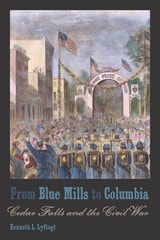
From Blue Mills to Columbia
Cedar Falls and the Civil WarKenneth L. Lyftogt
University of Iowa Press, 1993
From Blue to Red
The Rise of the GOP in ArkansasJohn C. Davis
University of Arkansas Press, 2024
John C. Davis’s From Blue to Red: The Rise of the GOP in Arkansas provides a rigorous yet accessible study of this partisan shift, tracking changes in voter preference at the top of the ticket in the 1960s, generational replacement in Arkansas’ political power structure in the 1990s, and the emergence of a more nationalized and polarized electorate in the 2000s, among other developments. From Blue to Red is a fascinating look at how Arkansas went from being one of the country’s most solidly Democratic states to one of its most ardently Republican in just a few years.
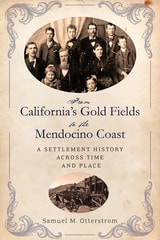
From California's Gold Fields to the Mendocino Coast
A Settlement History Across Time and PlaceSamuel M. Otterstrom
University of Nevada Press, 2017
The development of San Francisco’s outlying region from a wilderness into a prosperous village and farming mecca shows how quickly in-migration coupled with economic diversification can establish a stable settlement structure upon the landscape. Otterstrom describes an intricately woven tapestry of interrelated people who were contributing creators of a wide variety of prosperous northern California environs. He uncovers the processes that converted this sleepy post-Mexican outpost into a focal point of nearly hyperactive youthful growth. The narrative follows this crucial story of settlement development until the dawn of the twentieth century, through the interconnected framework of individual and family ingenuity, migration trajectories, and diverse geographical scales.
Multiplying individualistic experiences from across far-flung appendages of the Northern California system into larger and larger scales, Otterstrom has achieved a matchless historical and sociological study that will form the basis for any future studies of the area.
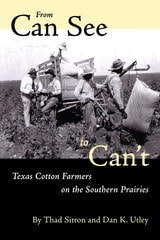
From Can See to Can’t
Texas Cotton Farmers on the Southern PrairiesBy Thad Sitton and Dan K. Utley
University of Texas Press, 1997
Cotton farming was the only way of life that many Texans knew from the days of Austin's Colony up until World War II. For those who worked the land, it was a dawn-till-dark, "can see to can't," process that required not only a wide range of specialized skills but also a willingness to gamble on forces often beyond a farmer's control—weather, insects, plant diseases, and the cotton market.
This unique book offers an insider's view of Texas cotton farming in the late 1920s. Drawing on the memories of farmers and their descendants, many of whom are quoted here, the authors trace a year in the life of south central Texas cotton farms. From breaking ground to planting, cultivating, and harvesting, they describe the typical tasks of farm families—as well as their houses, food, and clothing; the farm animals they depended on; their communities; and the holidays, activities, and observances that offered the farmers respite from hard work.
Although cotton farming still goes on in Texas, the lifeways described here have nearly vanished as the state has become highly urbanized. Thus, this book preserves a fascinating record of an important part of Texas' rural heritage.
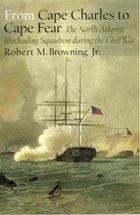
From Cape Charles to Cape Fear
The North Atlantic Blockading Squadron during the Civil WarRobert M. Browning
University of Alabama Press, 2003
A definitive study of Union naval power and the blockade that reshaped the Civil War.
In From Cape Charles to Cape Fear, acclaimed historian Robert M. Browning, Jr. offers a vivid and authoritative account of the Union Navy’s North Atlantic Blockading Squadron, a critical force in the American Civil War. Charged with enforcing the blockade along the Atlantic coastline from Virginia to North Carolina, the squadron played a decisive role in crippling the Confederacy’s economy and restricting its access to vital supplies.
Browning reveals the blockade as far more than a passive defensive strategy. Through detailed analysis of naval operations, coastal engagements, and strategic planning, he demonstrates how Union forces exerted control over key waterways and ports, including Norfolk and Wilmington. These contested hubs became focal points in a high-stakes struggle involving daring blockade runners, shifting naval tactics, and constant pressure on Southern trade networks.
Blending operational history with compelling narrative, Browning also captures the human dimension of naval warfare. Sailors and officers faced unpredictable weather, dangerous missions, and the relentless demands of maintaining control over an expansive coastline. Their experiences illuminate the challenges and complexities of maritime warfare during one of America’s defining conflicts.
Accessible yet richly researched, this book highlights the central importance of naval power in shaping Civil War outcomes. From Cape Charles to Cape Fear stands as an essential work for readers interested in Civil War history, naval strategy, and the enduring impact of maritime operations on the American past.

From Civil War to Civil Rights, Alabama 1860–1960
An Anthology from The Alabama ReviewSarah Woolfolk Wiggins
University of Alabama Press, 1987
To understand Alabama history one must appreciate the impact of the failure of secession of the state in the subsequent half century as well as the causes for the success of the Civil Rights Movement in the state in the mid-twentieth century. The prophet of the first revolution was William Lowndes Yancey and the prophet of the second was Martin Luther King, Jr., two Southerners who set in motion forces that shaped American history beyond the borders of the state and region. In the years between their two lives Alabama changed dramatically.
In the new century, progressives had a distinct sense that they could take on outside forces larger than themselves. National currents swept Alabama into movements for the regulation of railroads, women’s suffrage, child labor reform, and welfare capitalism. Still, progressive reform coexisted with the most frightening political and social movement of early twentieth-century Alabama, the Ku Klux Klan, whose blessing or curse made or broke the careers of powerful politicians.
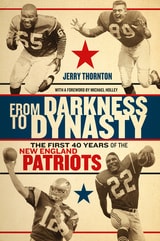
From Darkness to Dynasty
The First 40 Years of the New England PatriotsJerry Thornton
University Press of New England, 2016
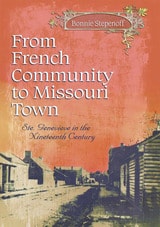
From French Community to Missouri Town
Ste. Genevieve in the Nineteenth CenturyBonnie Stepenoff
University of Missouri Press, 2024

From Frontier to Plantation In Tennessee
A Study in Frontier DemocracyThomas Perkins Abernethy
University of Alabama Press, 1967
A reprint of Abernethy's excellent historical study of the state of Tennesse from its founding through the antebellum years. In documenting the development of an agrarian society on the frontier, Abernethy develops important and controversial theses on the relation between frontier life and the development of American democracy, calling into question the mythology and motives previously associated with leaders such as William Blount, Andrew Jackson, James K. Polk, and Andrew Johnson.
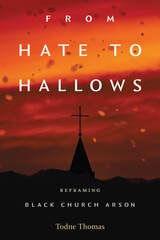
From Hate to Hallows
Reframing Black Church ArsonTodne Thomas
Duke University Press, 2026

From Home Guards to Heroes
The 87th Pennsylvania and Its Civil War CommunityDennis W. Brandt
University of Missouri Press, 2007
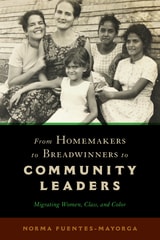
From Homemakers to Breadwinners to Community Leaders
Migrating Women, Class, and ColorNorma Fuentes-Mayorga
Rutgers University Press, 2022
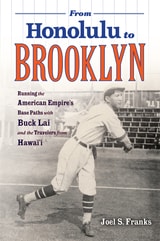
From Honolulu to Brooklyn
Running the American Empire’s Base Paths with Buck Lai and the Travelers from Hawai’iJoel S. Franks
Rutgers University Press, 2022
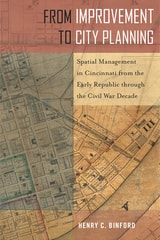
From Improvement to City Planning
Spatial Management in Cincinnati from the Early Republic through the Civil War DecadeHenry C. Binford
Temple University Press, 2021
From Improvement to City Planning emphasizes the ways people in nineteenth-century America managed urban growth. Historian Henry Binford shows how efforts to improve space were entwined with the evolution of urban governance (i.e., regulation)—and also influenced by a small group of advantaged families.
Binford looks specifically at Cincinnati, Ohio, then the largest and most important interior city west of the Appalachian Mountains. He shows that it was not just industrialization, but also beliefs about morality, race, health, poverty, and “slum” environments, that demanded an improvement of urban space. As such, movements for public parks and large-scale sanitary engineering in the 1840s and ’50s initiated the beginning of modern city planning. However, there were limitations and consequences to these efforts..
Many Americans believed that remaking city environments could also remake citizens. From Improvement to City Planning examines how the experiences of city living in the early republic prompted city dwellers to think about and shape urban space.

From Knights to Pioneers
One German Family in Westphalia and MissouriAnita M. Mallinckrodt
Southern Illinois University Press, 1994
Anita M. Mallinckrodt traces the 750-year history of the Mallinckrodt family from its earliest documented beginnings in thirteenth-century Westphalia (in the Dortmund area) through immigration to Missouri in 1831 and beyond.
In part 1, Mallinckrodt tells the story of some of her family’s leading personalities in order to explicate the history and society of medieval and early modern Germany: the life and times of knight Ludwig (c. 1241) and crusader Gerd (c. 1450–1504); the 1451 and 1492 adventures of the mercenary knight Hermann and his son Wilhelm; the 1594 feuding of the noble brothers Dietrich and Hermann, which led to a double murder; the liberal Dortmund publisher Arnold’s struggles in the early 1800s to establish freedom of the press and to free Westphalian farmers from serfdom; and the wealthy, aristocratic Sister Pauline (b. 1817), founder of the Sisters of Charity and recently beatified for her efforts on behalf of the poor and blind children of her day.
In parts 2 and 3, Mallinckrodt focuses on the first of her forebears to immigrate to the New World—Julius and Emil in 1831, followed by Conrad, Hermann, August, Helene, Sophie, and Luise in 1838—and their immediate families and descendants in Missouri. These early pioneers cleared the forests, built schools and churches, supported German-language periodicals, and founded social and cultural organizations that would benefit later waves of immigrants. In the 1860s, they participated in their adopted country’s Civil War and held strong views toward slavery and the Union. Mallinckrodt ends her family’s history with the deaths of the Dortmund pioneers in the 1890s.
But From Knights to Pioneers is much more than a single family’s history. The experiences Mallinckrodt relates reflect those of many German families who left their mark on centuries of history and of many midwestern families transplanted from the Old World. Especially interesting is the continuity between the old and new ways of life—entries on genealogical tables need not end with the comment "immigrated to the USA," for immigrants often wrote notable chapters of family history that deserve recognition in their old homelands. Similarly, knowledge of pre-immigration history is essential for those Americans whose traditions surely did not begin, as oral history often suggests, with the fact that "great-grandfather arrived in the Midwest from Germany in 1831." Thus the purpose of this book is to set a family’s immigration chapter against its European background, without passing judgment on the cultural influence of outstanding individuals in the United States or of German immigration per se.
Drawing on her extensive research in both Europe and the United States, Mallinckrodt presents an exceptionally detailed picture of the social and political contexts of each of her subjects. The richness of her exposition of both the Old World background and the lives of the immigrants to the New World offers important insights into aspects of European and American history.
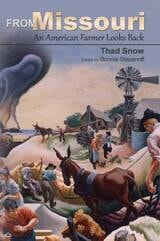
From Missouri
An American Farmer Looks BackThad Snow, Edited by Bonnie Stepenoff
University of Missouri Press, 2012
After years of subjecting the editors of St. Louis newspapers to eloquent letters on subjects as diverse as floods, tariffs, and mules, Thad Snow published his memoir From Missouri in his mid-seventies in 1954. He was barely retired from farming for more than half a century, mostly in the Missouri Bootheel, or “Swampeast Missouri,” as he called it. Now back in print with a new introduction by historian Bonnie Stepenoff, these sketches of a life, a region, and an era will delight readers new to this distinctive American voice as well as readers already familiar with this masterpiece of the American Midwest.
Snow purchased a thousand acres of southeast Missouri swampland in 1910, cleared it, drained it, and eventually planted it in cotton. Although he employed sharecroppers, he grew to become a bitter critic of the labor system after a massive flood and the Great Depression worsened conditions for these already-burdened workers. Shocking his fellow landowners, Snow invited the Southern Tenant Farmers Union to organize the workers on his land. He was even once accused of fomenting a strike and publicly threatened with horsewhipping.
Snow’s admiration for Owen Whitfield, the African American leader of the Sharecroppers’ Roadside Demonstration, convinced him that nonviolent resistance could defeat injustice. Snow embraced pacifism wholeheartedly and denounced all war as evil even as America mobilized for World War II after the attack on Pearl Harbor. In the late 1940s and early 1950s, he became involved with creating Missouri’s conservation movement. Near the end of his life, he found a retreat in the Missouri Ozarks, where he wrote this recollection of his life.
This unique and honest series of personal essays expresses the thoughts of a farmer, a hunter, a husband, a father and grandfather, a man with a soft spot for mules and dogs and all kinds of people. Snow’s prose reveals much about a way of life in the region during the first half of the twentieth century, as well as the social and political events that affected the entire nation. Whether arguing that a good stock dog should be left alone to do its work, explaining the process of making swampland suitable for agriculture, or putting forth his case for world peace, Snow’s ideas have a special authenticity because they did not come from an ivory tower or a think tank—they came From Missouri.
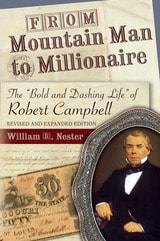
From Mountain Man to Millionaire
The "Bold and Dashing Life" of Robert Campbell, Revised and Expanded EditionWilliam R. Nester
University of Missouri Press, 2011
Campbell came to America from Ireland in 1822 and entered the fur trade soon after. He quickly rose from trapper to brigade leader to partner, all within a half dozen years, and this new edition includes an expanded narrative of his adventures in the Rocky Mountain fur trade. In the mid-1830s, having amassed considerable wealth, Campbell retired from the mountains and embarked on a new career. He returned to St. Louis and built up a business empire that embraced mercantile, steamboat, railroad, and banking interests, thus becoming a leading force behind the region’s economic development. A more extensive account of the cutthroat business world in which Campbell operated now enriches this portion of the book.
Nester masterfully depicts the “sterling character” for which Campbell was renowned. Campbell enjoyed deep and enduring friendships and strong familial ties, both in America and abroad. Although he was an outstanding businessman and philanthropist, his personal life was marred by tragedy. Ten of his thirteen children died prematurely. Despite those tragic losses, his faith in God never faltered. He believed that all worldly successes should honor God and once wrote that , “all worldly gain is but dross.” This edition elucidates the complex relations among his family and chronicles both tragic events and humorous incidents in more depth.
Exploring the letters, journals, and account books that Campbell left behind, Nester places him in the context of the times in which he lived, showing the economic, political, social, and cultural forces that provided the opportunities and challenges that shaped his life. Nester provides new insights into Campbell’s ownership of slaves, his attitudes toward slavery, and his behind-the-scenes political and economic activities during the Civil War. This comprehensive exploration of Robert Campbell’s life depicts a fascinating era in American history.