Results by title
28167 books match the query 'History' and 1092 start with f

Feminists Who Changed America, 1963-1975
Edited by Barbara J. Love: Foreword by Nancy F. Cott
University of Illinois Press, 2006
Documenting key feminists who ignited the second wave women's movement
Barbara J. Love’s Feminists Who Changed America, 1963-1975 will be the first comprehensive directory to document many of the founders and leaders (including both well-known and grassroots organizers) of the second wave women's movement. It tells the stories of more than two thousand individual women and a few notable men who together reignited the women's movement and made permanent changes to entrenched customs and laws.
The biographical entries on these pioneering feminists represent their many factions, all parts of the country, all races and ethnic groups, and all political ideologies. Nancy Cott's foreword discusses the movement in relation to the earlier first wave and presents a brief overview of the second wave in the context of other contemporaneous social movements.
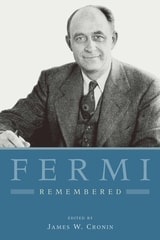
Fermi Remembered
Edited by James W. Cronin
University of Chicago Press, 2004
Born out of a symposium held to commemorate the hundredth anniversary of Fermi's birth, Fermi Remembered combines essays and newly commissioned reminiscences with private material from Fermi's research notebooks, correspondence, speech outlines, and teaching to document the profound and enduring significance of Fermi's life and labors. The volume also features extensives archival material—including correspondence between Fermi and biophysicist Leo Szilard and a letter from Harry Truman—with new introductions that provide context for both the history of physics and the academic tradition at the University of Chicago.
Edited by James W. Cronin, a University of Chicago physicist and Nobel laureate himself, Fermi Remembered is a tender tribute to one of the greatest scientists of the twentieth century.
Contributors:
Harold Agnew
Nina Byers
Owen Chamberlain
Geoffrey F. Chew
James W. Cronin
George W. Farwell
Jerome I. Friedman
Richard L. Garwin
Murray Gell-Mann
Maurice Glicksman
Marvin L. Goldberger
Uri Haber-Schaim
Roger Hildebrand
Tsung Dao Lee
Darragh Nagle
Jay Orear
Marshall N. Rosenbluth
Arthur Rosenfeld
Robert Schluter
Jack Steinberger
Valentine Telegdi
Al Wattenberg
Frank Wilczek
Lincoln Wolfenstein
Courtenay Wright
Chen Ning Yang
Gaurang Yodh

Fermilab
Physics, the Frontier, and MegascienceLillian Hoddeson, Adrienne W. Kolb, and Catherine Westfall
University of Chicago Press, 2008
Fermi National Accelerator Laboratory, located in the western suburbs of Chicago, has stood at the frontier of high-energy physics for forty years. Fermilab is the first history of this laboratory and of its powerful accelerators told from the point of view of the people who built and used them for scientific discovery.
Focusing on the first two decades of research at Fermilab, during the tenure of the laboratory’s charismatic first two directors, Robert R. Wilson and Leon M. Lederman, the book traces the rise of what they call “megascience,” the collaborative struggle to conduct large-scale international experiments in a climate of limited federal funding. In the midst of this new climate, Fermilab illuminates the growth of the modern research laboratory during the Cold War and captures the drama of human exploration at the cutting edge of science.
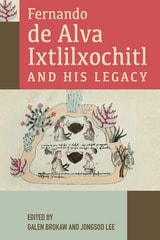
Fernando de Alva Ixtlilxochitl and His Legacy
Edited by Galen Brokaw and Jongsoo Lee
University of Arizona Press, 2016
His seventeenth-century writings have had a lasting effect on the understanding of Mexican culture and history from the colonial period to the present. But because Alva Ixtlilxochitl frequently used Tetzcocan oral traditions and pictorial codices of his ancestors’ heroic achievements, scholars have long said that his writings exhibit a Tetzcocan bias that distorts representations and understandings of Prehispanic Mexican history and culture.
Fernando de Alva Ixtlilxochitl and His Legacy is a collection of essays providing deeper perspective on the life, work, and legacy of Alva Ixtlilxochitl. The contributors revise and broaden previous understandings of Alva Ixtlilxochitl’s racial and cultural identity, including his method of transcribing pictorial texts, his treatment of gender, and his influence on Mexican nationalism. Chapter authors coming from the fields of anthropology, history, linguistics, and literature offer valuable new perspectives on the complexities of Alva Ixtlilxochitl’s life and his contributions to the history and scholarship of Mexico.

Fernando
A Song by ABBAKay Dickinson
Duke University Press, 2025
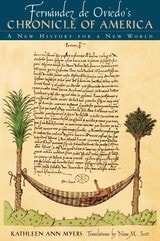
Fernández de Oviedo's Chronicle of America
A New History for a New WorldBy Kathleen Ann Myers
University of Texas Press, 2007
Gonzalo Fernández de Oviedo (1478-1557) wrote the first comprehensive history of Spanish America, the Historia general y natural de las Indias, a sprawling, constantly revised work in which Oviedo attempted nothing less than a complete account of the Spanish discovery, conquest, and colonization of the Americas from 1492 to 1547, along with descriptions of the land's flora, fauna, and indigenous peoples. His Historia, which grew to an astounding fifty volumes, includes numerous interviews with the Spanish and indigenous leaders who were literally making history, the first extensive field drawings of America rendered by a European, reports of exotic creatures, ethnographic descriptions of indigenous groups, and detailed reports about the conquest and colonization process.
Fernández de Oviedo's Chronicle of America explores how, in writing his Historia, Oviedo created a new historiographical model that reflected the vastness of the Americas and Spain's enterprise there. Kathleen Myers uses a series of case studies—focusing on Oviedo's self-portraits, drawings of American phenomena, approaches to myth, process of revision, and depictions of Native Americans—to analyze Oviedo's narrative and rhetorical strategies and show how they relate to the politics, history, and discursive practices of his time. Accompanying the case studies are all of Oviedo's extant field drawings and a wide selection of his text in English translation.
The first study to examine the entire Historia and its evolving rhetorical and historical context, this book confirms Oviedo's assertion that "the New World required a different kind of history" as it helps modern readers understand how the discovery of the Americas became a catalyst for European historiographical change.

Ferris Wheels
An Illustrated HistoryNorman Anderson
University of Wisconsin Press, 1993

Fertile Matters
The Politics of Mexican-Origin Women's ReproductionBy Elena R. Gutiérrez
University of Texas Press, 2008
While the stereotype of the persistently pregnant Mexican-origin woman is longstanding, in the past fifteen years her reproduction has been targeted as a major social problem for the United States. Due to fear-fueled news reports and public perceptions about the changing composition of the nation's racial and ethnic makeup—the so-called Latinization of America—the reproduction of Mexican immigrant women has become a central theme in contemporary U. S. politics since the early 1990s.
In this exploration, Elena R. Gutiérrez considers these public stereotypes of Mexican American and Mexican immigrant women as "hyper-fertile baby machines" who "breed like rabbits." She draws on social constructionist perspectives to examine the historical and sociopolitical evolution of these racial ideologies, and the related beliefs that Mexican-origin families are unduly large and that Mexican American and Mexican immigrant women do not use birth control.
Using the coercive sterilization of Mexican-origin women in Los Angeles as a case study, Gutiérrez opens a dialogue on the racial politics of reproduction, and how they have developed for women of Mexican origin in the United States. She illustrates how the ways we talk and think about reproduction are part of a system of racial domination that shapes social policy and affects individual women's lives.

Festival of the Poor
Fertility Decline and the Ideology of ClassJane C. Schneider
University of Arizona Press, 1996
By examining population changes in a single community between 1860 and 1980, the authors offer an extended review and critique of existing models of fertility decline in Europe, proposing a new interpretation that emphasizes historical context and class relations. They show how the spread of capitalism in Sicily induced an unprecedented rate of population growth, with boom-and-bust cycles creating the class experiences in which "reputational networks" came to redefine family life; how Sicilians began to control their fertility in response to class-mediated ideas about gender relations and respectable family size; and how the town's gentry, artisan, and peasant classes adopted family planning methods at different times in response to different pressures.
Jane and Peter Schneider's anthropologically oriented political-economy perspective challenges the position of Western Europe as a model for fertility decline on which every other case should converge, looking instead at the diversity of cultural ideals and practices--such as those found in Sicily--that influence the spread and form of birth control. Combining anthropological, oral historical, and archival methods in new and insightful ways, the authors' synthesis of a particular case study with a broad historical and theoretical discussion will play a major role in the ongoing debates over the history of European fertility decline and point the way toward integrating the analysis of demographic upheaval with the study of class formation and ideology.
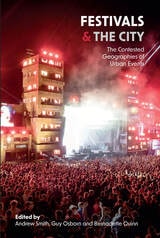
Festivals and the City
The Contested Geographies of Urban EventsAndrew Smith, Guy Osborn, Bernadette Quinn, Andrew Smith, Guy Osborn and Bernadette Quinn
University of Westminster Press, 2022
This book explores how festivals and events affect urban places and public spaces, with a particular focus on their role in fostering inclusion. The ‘festivalisation’ of culture, politics and space in cities is often regarded as problematic, but this book examines the positive and negative ways that festivals affect cities by examining festive spaces as contested spaces. The book focuses on Western European cities, a particularly interesting context given the social and cultural pressures associated with high levels of in-migration and concerns over the commercialisation and privatisation of public spaces.
The key themes of this book are the quest for more inclusive urban spaces and the contested geographies of festival spaces and places. Festivals are often used by municipal authorities to break down symbolic barriers that restrict who uses public spaces and what those spaces are used for. However, the rise of commercial festivals and ticketed events means that they are also responsible for imposing physical and financial obstacles that reduce the accessibility of city parks, streets and squares.
Alongside addressing the contested effects of urban festivals on the character and inclusivity of public spaces, the book addresses more general themes including the role of festivals in culture-led regeneration. Several chapters analyse festivals and events as economic development tools, and the book also covers contested representations of festival cities and the ways related images and stories are used in place marketing.
A range of cases from Western Europe are used to explore these issues, including chapters on some of the world’s most significant and contested festival cities: Venice, Edinburgh, London and Barcelona. The book covers a wide range of festivals, including those dedicated to music and the arts, but also events celebrating particular histories, identities and pastimes. A series of fascinating cases are discussed - from the Venice Biennale and Dublin Festival of History, to Rotterdam’s music festivals and craft beer festivals in Manchester. The diverse and innovative qualities of the book are also evident in the range of urban spaces covered: obvious examples of public spaces – such as parks, streets, squares and piazzas – are addressed, but the book includes chapters on enclosed public spaces (e.g., libraries) and urban blue spaces (waterways) too. This reflects the interpretation of public spaces as socio-material entities: they are produced informally through their use (including for festivals and events), as well as through their formal design and management.
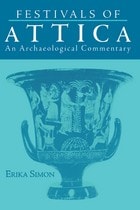
Festivals of Attica
An Archaeological CommentaryErika Simon
University of Wisconsin Press, 2002
The festivals of the Athenian sacred calendar constitute a vital key to classical Greek culture and religion. Erika Simon sets out here to explicate those complex and often obscure festivals. By careful marshaling of a variety of proofs from literary, historical, and archaeological sources, she is able to justify some startling conclusions and achieve a comprehensive and truly original synthesis that clarifies, as never before, the probable origins and meanings of the Attic cults.
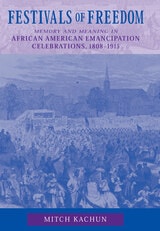
Festivals of Freedom
Memory and Meaning in African American Emancipation Celebrations, 1808-1915Mitch Kachun
University of Massachusetts Press, 2003
With the abolition of the transatlantic slave trade in 1808, many African Americans began calling for “a day of publick thanksgiving” to commemorate this important step toward freedom. During the ensuing century, black leaders built on this foundation and constructed a distinctive and vibrant tradition through their celebrations of the end of slavery in New York State, the British West Indies, and eventually the United States as a whole. In this revealing study, Mitch Kachun explores the multiple functions and contested meanings surrounding African American emancipation celebrations from the abolition of the slave trade to the fiftieth anniversary of U.S. emancipation.
Excluded from July Fourth and other American nationalist rituals for most of this period, black activists used these festivals of freedom to encourage community building and race uplift. Kachun demonstrates that, even as these annual rituals helped define African Americans as a people by fostering a sense of shared history, heritage, and identity, they were also sites of ambiguity and conflict. Freedom celebrations served as occasions for debate over black representations in the public sphere, struggles for group leadership, and contests over collective memory and its meaning.
Based on extensive research in African American newspapers and oration texts, this book retraces a vital if often overlooked tradition in African American political culture and addresses important issues about black participation in the public sphere. By illuminating the origins of black Americans' public commemorations, it also helps explain why there have been increasing calls in recent years to make the "Juneteenth" observance of emancipation an American—not just an African American—day of commemoration.
Fetch the Devil
The Sierra Diablo Murders and Nazi Espionage in AmericaClint Richmond
University Press of New England, 2014

Fetter'd or Free?
British Women Novelists, 1670-1815Mary Anne Schofield
Ohio University Press, 1986
Feudal Society, Volume 1
Marc Bloch
University of Chicago Press, 1964
Feudal Society, Volume 2
Marc Bloch
University of Chicago Press, 1964
Fevered Measures
Public Health and Race at the Texas-Mexico Border, 1848–1942John Mckiernan-González
Duke University Press, 2012
Few Returned
Twenty-eight Days on the Russian Front, Winter 1942-1943Eugenio Corti, Translated by Peter Edward Levy, & Foreword by Carlo D'Este
University of Missouri Press, 1997
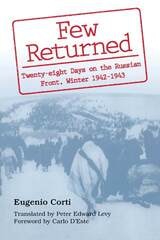
After World War II more than one hundred books appeared that dealt with the experience of the Italian army in Russia, and particularly the terrible winter retreat of 1942-1943. Few Returned (I piu' non ritornano) is the only one of these that is still regularly reissued in Italy.
Eugenio Corti, who was a twenty-one-year-old second lieutenant at the time, found himself, together with 30,000 Italians and a smaller contingent of Germans, encircled on the banks of the River Don by enemy forces who far outnumbered them. To break out of this encirclement, these men undertook a desperate march across the snow, with constant engagements and in temperatures ranging from -20 to -30 degrees Fahrenheit. Whereas supplies were air-dropped to the Germans, the predicament of the Italians was far more difficult: lacking gasoline, they were compelled to abandon their vehicles and to proceed without heavy arms, equipment, ammunition, or provisions. Even the wounded had to be abandoned, though it was well known that the soldiers of the Red Army"enraged by the brutality of the German invasion"killed all the enemy wounded who fell into their hands. After twenty-eight days of encirclement, only 4,000 of the 30,000 Italians made it out of the pocket.
Why is it that Corti's book, which was first published in 1947, continues after fifty years to be reprinted in Italy? Because, as Mario Apollonio of the University of Milan said, when the book first appeared: "It is a chronicle . . . but it is much more than that: behind the physical reality, there is the truth" about man at his most tragic hour. Apollonio adds: "The power of the writing immediately transforms the document into drama"; the result is a "novel-poem-drama-history." The philosopher Benedetto Croce found in Corti's book "the not infrequent gleam of human goodness and nobility." Few Returned is a classic of war literature that succeeds in bringing home the full hatefulness of war.
Eugenio Corti began writing his diary at a military hospital immediately after being repatriated from the Russian front. When in September 1943 Italy found itself cut in two by the Armistice, Corti, loyal to his officer's oath, joined up with what remained of the Italian army in the south and with those few troops participated in driving the Germans off Italian soil, fighting at the side of the British Eighth and the American Fifth Armies.
Fiat Flux
The Writings of Wilson R. Bachelor, Nineteenth-Century Country Doctor and PhilosopherWilliam D. Lindsey
University of Arkansas Press, 2013

Fiat G.91
Arno Landewers
Amsterdam University Press, 2023
It was in production for nineteen years. 756 aircraft were completed, including the prototypes and pre-production models. The assembly lines were finally closed in 1977. The Fiat G.91 enjoyed a long service life that extended over 35 years. It was widely used by Portugal in the Portuguese Colonial War in Africa.

Fiction And Incarnation
Rhetoric, Theology, and Literature in the Middle AgesAlexandre Leupin
University of Minnesota Press, 2002
A fresh look at the relationship between theology and rhetoric.
Focusing on the Incarnation-the only dogma original to Christianity, in which God becomes man and history-this book offers a wide-ranging and theoretically sophisticated investigation of the relationship between Christian discourse and literature from Roman antiquity to the fourteenth century through a look at texts by Cicero, Quintilian, Martianus Capella, Tertullian, Saint Augustine, Alain of Lille, Guillaume de Machaut, and others.
Alexandre Leupin asks if it is possible to go beyond the dialectics of the Incarnated God and the Devil without harking back to the beautiful but partially obsolete truths of paganism and sophistry. Employing a method inspired by psychoanalysis, Leupin repudiates the sophistry and relativism of postmodern theory while calling into question old commonplaces that have been invalidated by modernity. He does so by attending to the larger and deeper structures hidden within the discourses of theology, rhetoric, literature, and psychoanalysis. The result is an innovative perspective on the Middle Ages, an original and promising view of the problems of Western literature in relation to theology and rhetoric. Alexandre Leupin is Gregorie Professor in French studies at Louisiana State University. He is the author of many books, including, in English translation, Barbarolexis: Medieval Literature and Sexuality (1989).David Laatsch is a Ph.D. candidate in the French department of Louisiana State University.
Fictions Inc.
The Corporation in Postmodern Fiction, Film, and Popular CultureClare, Ralph
Rutgers University Press, 2014
Fictions of Affliction
Physical Disability in Victorian CultureMartha Stoddard Holmes
University of Michigan Press, 2010

Fictions of Certitude
Science, Faith, and the Search for Meaning, 1840–1920John S. Haller Jr.
University of Alabama Press, 2020
The search for belief and meaning among nineteenth-century intellectuals
The nineteenth century’s explosion of scientific theories and new technologies undermined many deep-seated beliefs that had long formed the basis of Western society, making it impossible for many to retain the unconditional faith of their forebears. A myriad of discoveries—including Faraday’s electromagnetic induction, Joule’s law of conservation of energy, Pasteur’s germ theory, Darwin’s and Wallace’s theories of evolution by natural selection, and Planck’s work on quantum theory—shattered conventional understandings of the world that had been dictated by traditional religious teachings and philosophical systems for centuries.
Fictions of Certitude: Science, Faith, and the Search for Meaning, 1840–1920 investigates the fin de siècle search for truth and meaning in a world that had been radically transformed. John S. Haller Jr. examines the moral and philosophical journeys of nine European and American intellectuals who sought deeper understanding amid such paradigmatic upheaval. Auguste Comte, John Henry Newman, Herbert Spencer, Alfred Russel Wallace, Thomas Henry Huxley, John Fiske, William James, Lester Frank Ward, and Paul Carus all belonged to an age in which one world was passing while another world that was both astounding and threatening was rising to take its place.
For Haller, what makes the work of these nine thinkers worthy of examination is how they strove in different ways to find certitude and belief in the face of an epochal sea change. Some found ways to reconceptualize a world in which God and nature coexist. For others, the challenge was to discern meaning in a world in which no higher power or purpose can be found. As explained by D. H. Meyer, “The later Victorians were perhaps the last generation among English-speaking intellectuals able to believe that man was capable of understanding his universe, just as they were the first generation collectively to suspect that he never would.”

Fictions of Consciousness
Mill, Newman, and the Reading of Victorian ProseJonathan Loesberg
Rutgers University Press, 1986
Fictions of God
English Renaissance Literature and the Invention of the Biblical NarratorRaphael Magarik
University of Chicago Press, 2025
We often identify secularization's characteristic literary form as the modern novel: out with divine scripture, in with human fictions. In Fictions of God, Raphael Magarik argues that this story overlooks the cultural upheavals of the Protestant Reformation. Early reformers imagined a Bible that was neither infallible nor inerrant but fictional, composed by a divine counterfactual: God crafted the text, they said, as if it had been written by the prophets. Early modern Protestants now found in their Bibles not a source of foundational truths but a model for unreliable narration, even fiction.
Fictions of God traces how this approach to literature passed from biblical commentators to poets like Abraham Cowley, John Milton, and Lucy Hutchinson amid the violent emergence of a new religious and political order—long before the eighteenth-century rise of the English novel. The result is a transformative account of the Reformation’s effect on imaginative literature and the secularization of the Bible itself.
Fictions of Land and Flesh
Blackness, Indigeneity, SpeculationMark Rifkin
Duke University Press, 2019

Fictions of the Bad Life
The Naturalist Prostitute and Her Avatars in Latin American Literature, 1880–2010Claire Thora Solomon
The Ohio State University Press, 2014
Fictions of the Bad Life illustrates how at very different moments—the turn of the twentieth century, the 1920s–30s, and finally the turn of the twenty-first century—the past is rewritten to accommodate contemporary desires for historical belonging and national identity, even as these efforts inevitably re-inscribe the repressed colonial history they wish to change.

Fictions of the Cosmos
Science and Literature in the Seventeenth CenturyFrédérique Aït-Touati
University of Chicago Press, 2011

Fictive Kinship
Family Reunification and the Meaning of Race and Nation in American ImmigrationCatherine Lee
Russell Sage Foundation, 2013

Fidel between the Lines
Paranoia and Ambivalence in Late Socialist Cuban CinemaLaura-Zoë Humphreys
Duke University Press, 2019
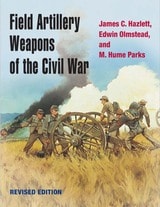
Field Artillery Weapons of the Civil War, revised edition
James C. Hazlett, Edwin Olmstead, and M. Hume Parks
University of Illinois Press, 1983

Field Guide to New England Barns and Farm Buildings
Thomas Durant Visser
University Press of New England, 1997

Field Notes on the Visual Arts
Edited by Karen Lang
Intellect Books, 2019
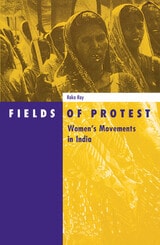
Fields Of Protest
Women’s Movement in IndiaRaka Ray
University of Minnesota Press, 1999
A comparative analysis of women’s struggle for change in India.
The women’s movement in India has a long and rich history in which millions of women live, work, and struggle to survive in order to remake their family, home, and social lives. Whether fighting for safe contraception, literacy, water, and electricity or resisting sexual harassment, they are participating in vibrant and active women’s movements that are thriving in many parts of India today.
Fields of Protest explores the political and cultural circumstances under which groups of women organize to fight for their rights and self-worth. Starting with Bombay and Calcutta, Raka Ray discusses the creation of “political fields”-structured, unequal, and socially constructed political environments within which organizations exist, flourish, or fail. Women’s organizations are not autonomous or free agents; rather, they inherit a “field” and its accompanying social relations, and when they act, they act in response to it and within it. Drawing on the literature of both social movements and feminism, Ray analyzes the striking differences between the movements in these two cities.Using an innovative and comparative perspective, Ray offers a unique look at Indian activist women and adds a new dimension to the study of women’s movements on a global level.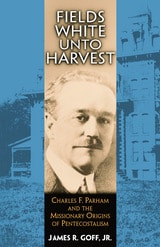
Fields White Unto Harvest
Charles F. Parham and the Missionary Origins of PentecostalismJames Goff
University of Arkansas Press, 1988
With fifty-one million people worldwide actively worshiping in Pentecostal circles, Pentecostalism is not only the single largest movement in Protestantism, but is arguably the single most important religious movement in modern times. But where did these Pentecostals come from? And how did a movement that began obscurely in turn-of-the-century Kansas come to have so much meaning for so many millions of people?
This biographical study of Charles Fox Parham offers a fascinating account of this movement’s origins in the American Midwest and of the one man most responsible for giving that movement its identity. An inspired itinerant preacher from the Kansas prairies, Parham pieced together the unique Pentecostal theology and dedicated his short life to spreading his message of divine hope—a message that was to strike a responsive chord in the hearts of a hard-working people discouraged by frequent economic depression. His story is one of both triumph and defeat, the saga of a sickly farm boy who by the age of thirty-three had converted almost ten thousand followers and yet, less than five years later, had fallen into obscurity, his name besmirched by scandal and his leadership repudiated by the very movement he had struggled so tirelessly to inspire.
Exhaustively researched, Fields White Unto Harvest is an in-depth study of the sociological significance of the Pentecostal movement, its roots in the evangelical thought of the late nineteenth century, and the several directions of its growth in the twentieth. Through Parham’s story, woven into a fascinating narrative by James Goff, we achieve a new understanding of the man behind the movement that would eventually alter the landscape of American religious history.
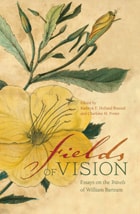
Fields of Vision
Essays on the Travels of William BartramEdited by Kathryn E. Holland Braund and Charlotte M. Porter
University of Alabama Press, 2010
A classic work of history, ethnography, and botany, and an examination of the life and environs of the 18th-century south
William Bartram was a naturalist, artist, and author of Travels through North and South Carolina, Georgia, East and West Florida, the Cherokee Country, the ExtensiveTerritories of the Muscogulees, or Creek Confederacy, and the Country of the Choctaws. The book, based on his journey across the South, reflects a remarkable coming of age. In 1773, Bartram departed his family home near Philadelphia, Pennsylvania, as a British colonist; in 1777, he returned as a citizen of an emerging nation of the United States. The account of his journey, published in 1791, established a national benchmark for nature writing and remains a classic of American literature, scientific writing, and history. Brought up as a Quaker, Bartram portrayed nature through a poetic lens of experience as well as scientific observation, and his work provides a window on 18th-century southern landscapes. Particularly enlightening and appealing are Bartram’s detailed accounts of Seminole, Creek, and Cherokee peoples.The Bartram Trail Conference fosters Bartram scholarship through biennial conferences held along the route of his travels. This richly illustrated volume of essays, a selection from recent conferences, brings together scholarly contributions from history, archaeology, and botany. The authors discuss the political and personal context of his travels; species of interest to Bartram; Creek architecture; foodways in the 18th-century south, particularly those of Indian groups that Bartram encountered; rediscovery of a lost Bartram manuscript; new techniques for charting Bartram’s trail and imaging his collections; and a fine analysis of Bartram’s place in contemporary environmental issues.
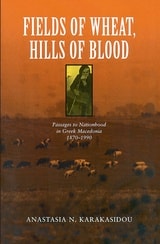
Fields of Wheat, Hills of Blood
Passages to Nationhood in Greek Macedonia, 1870-1990Anastasia N. Karakasidou
University of Chicago Press, 1997
"Combining the thoughtful use of theory with a vivid historical ethnography, this is an important, courageous, and pioneering work which opens up the whole issue of nation-building in northern Greece."—Mark Mazower, University of Sussex

Fields of the Tzotzil
The Ecological Bases of Tradition in Highland ChiapasBy George A. Collier
University of Texas Press, 1975
Fields of the Tzotzil is the first study of social processes in contemporary highland Maya communities to encompass a regional view of the highlands of Chiapas as a system. In viewing tradition, not as a survival of traits, but as a dynamic process of adaptation by local systems to their placement in larger social and economic systems, it lays to rest the theory that tribal peoples apparently are politically and economically isolated. In addition, its broad regional perspective sheds light on the problems of understanding the position of traditional ethnic groups in contemporary society.
The approach of the book is ecological in two senses. First, all the topics dealt with concern the traditional behavior of Indian groups as revealed in their relationship to the land. Second, the analysis seeks out factors that condition land use, not just locally, but as part of a larger system that includes influences of the market and the impact of nationalist agrarian policy. Thus, the author examines land inheritance patterns and food production, as well as the interethnic relations in the region in which Indians are subordinate to mestizos. He discusses in detail corn farming, craft specialization, wage labor, and Indian colonization efforts under the Mexican ejido—all factors that directly affect land use and are thus part of the environment in highland Chiapas.
The study is unique in its use of previously inaccessible historical source material and its use of novel methodological aids. Aerial photography was used in data collection, and the computer was used in ethnographic census analysis. The result is a book that reveals the Indian groups of Chiapas as apparent enclaves whose ethnicity is a dynamic, adaptive response to their position of marginal dependency. While their plight is extreme, it is nevertheless structurally similar to the position of ethnic groups in most large social systems.
Fieldworks
From Place to Site in Postwar PoeticsLytle Shaw
University of Alabama Press, 2013
Fieldworks offers a historical account of the social, rhetorical, and material attempts to ground art and poetry in the physicality of a site.
Arguing that place-oriented inquiries allowed poets and artists to develop new, experimental models of historiography and ethnography, Lytle Shaw draws out the shifting terms of this practice from World War II to the present through a series of illuminating case studies. Beginning with the alternate national genealogies unearthed by William Carlos Williams in Paterson and Charles Olson in Gloucester, Shaw demonstrates how subsequent poets sought to ground such inquiries in concrete social formations—to in effect live the poetics of place: Gary Snyder in his back-to-the-land familial compound, Kitkitdizze; Amiri Baraka in a black nationalist community in Newark; Robert Creeley and the poets of Bolinas, California, in the capacious “now” of their poet-run town. Turning to the work of Robert Smithson—who called one of his essays an “appendix to Paterson,” and who in turn has exerted a major influence on poets since the 1970s—Shaw then traces the emergence of site-specific art in relation both to the poetics of place and to the larger linguistic turn in the humanities, considering poets including Clark Coolidge, Bernadette Mayer, and Lisa Robertson.
By putting the poetics of place into dialog with site-specificity in art, Shaw demonstrates how poets and artists became experimental explicators not just of concrete locations and their histories, but of the discourses used to interpret sites more broadly. It is this dual sense of fieldwork that organizes Shaw’s groundbreaking history of site-specific poetry.

Fiery Cinema
The Emergence of an Affective Medium in China, 1915–1945Weihong Bao
University of Minnesota Press, 2015
What was cinema in modern China? It was, this book tells us, a dynamic entity, not strictly tied to one media technology, one mode of operation, or one system of aesthetic code. It was, in Weihong Bao’s term, an affective medium, a distinct notion of the medium as mediating environment with the power to stir passions, frame perception, and mold experience. In Fiery Cinema, Bao traces the permutations of this affective medium from the early through the mid-twentieth century, exploring its role in aesthetics, politics, and social institutions.
Mapping the changing identity of cinema in China in relation to Republican-era print media, theatrical performance, radio broadcasting, television, and architecture, Bao has created an archaeology of Chinese media culture. Within this context, she grounds the question of spectatorial affect and media technology in China’s experience of mechanized warfare, colonial modernity, and the shaping of the public into consumers, national citizens, and a revolutionary collective subject. Carrying on a close conversation with transnational media theory and history, she teases out the tension and affinity between vernacular, political modernist, and propagandistic articulations of mass culture in China’s varied participation in modernity.
Fiery Cinema advances a radical rethinking of affect and medium as a key insight into the relationship of cinema to the public sphere and the making of the masses. By centering media politics in her inquiry of the forgotten future of cinema, Bao makes a major intervention into the theory and history of media.

Fiery Dragons
Banks, Moneylenders and Microfinance in BurmaSean Turnell
National University of Singapore Press, 2009
Fifties Television
THE INDUSTRY AND ITS CRITICSWilliam Boddy
University of Illinois Press, 1990

Fifty Fables of La Fontaine
Jean de La Fontaine. Translated by Norman R. Shapiro. Illustrated by Alan James Robinson
University of Illinois Press, 1988
Fifty Maps and the Stories they Tell
Jerry Brotton and Nick Millea
Bodleian Library Publishing, 2019
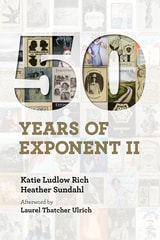
Fifty Years of Exponent II
Katie Ludlow Rich
Signature Books, 2024
On a sweltering day in June 1974, a group of housewives, graduate students, and young professionals gathered in the Boston suburbs. Their mission: to produce the first issue of Exponent II, a “humble yet sincere” newspaper “poised on the dual platforms of Mormonism and Feminism.” They viewed their work as an act of devotion, not rebellion, and were naïve of the cold reception they would soon receive from LDS Church leaders. Nevertheless, the paper became a national platform connecting Mormon feminists. It provided a vital space for them to question and integrate different aspects of their dual—and sometimes dueling—identities. From the Equal Rights Amendment to queer identity, Exponent II has hosted some of the most urgent conversations of its time while also embracing life’s dailiness.
This comprehensive history and anthology celebrate five decades of Exponent II. Through meticulous research and compelling storytelling, the authors chronicle the organization’s evolution from a kitchen-table-style newspaper to a quarterly magazine, blog, and annual retreat. Its transformative impact on the lives of its participants stands as a testament to the power of connection, resilience, and community over ideological purity.
Fifty-Eight Lonely Men
Southern Federal Judges and School DesegregationJ. W. Peltason
University of Illinois Press, 1971

Fight Like a Tiger
Conway Barbour and the Challenges of the Black Middle Class in Nineteenth-Century AmericaVictoria L. Harrison
Southern Illinois University Press, 2018
Born a slave in western Virginia about 1815, Barbour was a free man by the late 1840s. His adventurous life took him through Lexington and Louisville, Kentucky; Cleveland, Ohio; Alton, Illinois; and Little Rock and Lake Village, Arkansas. In search of upward mobility, he worked as a steamboat steward, tried his hand at several commercial ventures, and entered politics. He sought, but was denied, a Civil War military appointment that would have provided financial stability. Blessed with intelligence, competence, and energy, Barbour was quick to identify opportunities as they appeared in personal relationships—he was simultaneously married to two women—business, and politics.
Despite an unconventional life, Barbour found in each place he lived that he was one of many free black people who fought to better themselves alongside their white countrymen. Harrison’s argument about black class formation reframes the customary narrative of downtrodden free African Americans in the mid-nineteenth century and engages current discussions of black inclusion, the concept of “otherness,” and the breaking down of societal barriers. Demonstrating that careful research can reveal the stories of people who have been invisible to history, Fight Like a Tiger complicates our understanding of the intersection of race and class in the Civil War era.
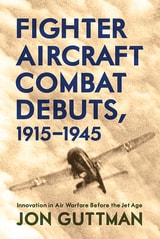
Fighter Aircraft Combat Debuts, 1915–1945
Innovation in Air Warfare Before the Jet AgeJon Guttman
Westholme Publishing, 2014
Of all military aircraft, fighter planes hold a mystique all their own. Perhaps it is because fighters can afford the least compromise: when the goal is to seize and maintain control of the air, the confrontation is direct. During World War I, the concept of air superiority took hold and in the ensuing decades the development of fighter aircraft became an ongoing back-and-forth battle, with adversaries trying to gain an upper hand through innovations in aerodynamics, powerplants, and armament. Fighter Aircraft Combat Debuts, 1915–1945: Innovation in Air Warfare Before the Jet Age by prominent aviation expert Jon Guttman explores the first combats for a variety of fighters of World War I, the conflicts of the so-called "interwar years," and World War II—a thirty-year period that saw the birth of the fighter concept and its maturity on the threshold of the Jet Age. Most of the aircraft described are fairly well known to aviation historians and a few names, such as Sopwith Camel, Fokker Triplane, Messerschmitt Me-109, Mitsubishi Zero, North American Mustang, and Supermarine Spitfire, are familiar even to the most nonaviation- minded persons. Not so well-known are the circumstances of their combat debuts, in which some, such as the Zero, made their mark almost from the outset, but in which others, like the British Bristol F.2A, showed rather less promise than they would ultimately realize. While a certain amount of space must be devoted to the technical development of these famous fighters, these studies of first combats serve as a reminder that it is the human factor, with all its special quirks, that inevitably came into play when these deadly flying machines first fired their guns. Profusely illustrated, Fighter Aircraft Combat Debuts is an authoritative history of one of the most enduring subjects in military aviation.

Fighter in Velvet Gloves
Alaska Civil Rights Hero Elizabeth PeratrovichAnnie Boochever with Roy Peratrovich Jr.
University of Alaska Press, 2019
In 1945, Peratrovich stood before the Alaska Territorial Legislative Session and gave a powerful speech about her childhood and her experiences being treated as a second-class citizen. Her heartfelt testimony led to the passing of the landmark Alaska Anti-Discrimination Act, America’s first civil rights legislation. Today, Alaska celebrates Elizabeth Peratrovich Day every February 16, and she was honored on the gold one-dollar coin in 2020.
Annie Boochever worked with Elizabeth’s eldest son, Roy Peratrovich Jr., to bring Elizabeth’s story to life in the first book written for young teens on this remarkable Alaska Native woman.