Results by title
5448 books match the query 'History and criticism' and 217 start with f
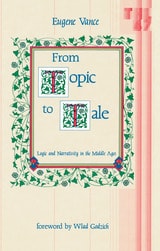
From Topic to Tale
Logic and Narrativity in the Middle AgesEugene VanceForeword by Wlad Godzich
University of Minnesota Press, 1987
From Topic to Tale was first published in 1987. Minnesota Archive Editions uses digital technology to make long-unavailable books once again accessible, and are published unaltered from the original University of Minnesota Press editions.
The transition from the Middle Ages to the Renaissance has been discussed since the 1940s as a shift from a Latinate culture to one based on a vernacular language, and, since the 1960s, as a shift from orality to literacy. From Topic to Tale focuses on this multifaceted transition, but it poses the problem in different terms: it shows how a rhetorical tradition was transformed into a textual one, and ends ultimately in a discussion of the relationship between discourse and society.
The rise of French vernacular literacy in the twelfth century coincided with the emergence of logic as a powerful instrument of the human mind. With logic come a new concern for narrative coherence and form, a concern exemplified by the work of Chretien de Troyes. Many brilliant poetic achievements crystallized in the narrative art of Chretien, establishing an enduring tradition of literary technique for all of Europe. Eugene Vance explores the intellectual context of Chretien's vernacular literacy, and in particular, the interaction between the three "arts of language" (grammar, logic, and rhetoric) compromising the trivium. Until Vance, few critics have studied the contribution of logic to Chretiens poetics, nor have they assessed the ethical bond between rationalism and the new heroic code of romance.
Vance takes Chretien de Troyes' great romance, Yvain ou le chevalier au lion,as the centerpiece of the Twelfth-Century Renaissance. It is also central to his own thesis, which shows how Chretien forged a bold new vision of humans as social beings situated between beasts and angels and promulgated the symbolic powers of language, money, and heraldic art to regulate the effects of human desire. Vance's reading of the Yvain contributes not only to the intellectual history of the Middle Ages, but also to the continuing dialogue between contemporary critical theory and medieval culture.
Eugene Vance is professor of French and comparative literature at Emory University and principal editor of a University of Nebraska series, Regents Studies in Medieval Culture. Wlad Godzich is director of the Center for Humanistic Studies at the University of Minnesota and co-editor of the series Theory and History of Literature.

From Utopia to Apocalypse
Science Fiction and the Politics of CatastrophePeter Y. Paik
University of Minnesota Press, 2010
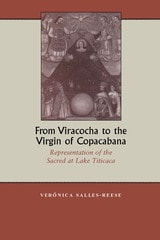
From Viracocha to the Virgin of Copacabana
Representation of the Sacred at Lake TiticacaBy Verónica Salles-Reese
University of Texas Press, 1997
Surrounded by the peaks of the Andean cordillera, the deep blue waters of Lake Titicaca have long provided refreshment and nourishment to the people who live along its shores. From prehistoric times, the Andean peoples have held Titicaca to be a sacred place, the source from which all life originated and the site where the divine manifests its presence.
In this interdisciplinary study, Verónica Salles-Reese explores how Andean myths of cosmic and ethnic origins centered on Lake Titicaca evolved from pre-Inca times to the enthronement of the Virgin of Copacabana in 1583. She begins by describing the myths of the Kolla (pre-Inca) people and shows how their Inca conquerors attempted to establish legitimacy by reconciling their myths of cosmic and ethnic origin with the Kolla myths. She also shows how a similar pattern occurred when the Inca were conquered in turn by the Spanish.
This research explains why Lake Titicaca continues to occupy a central place in Andean thought despite the major cultural disruptions that have characterized the region's history. This book will be a touchstone in the field of Colonial literature and an important reference for Andean religious and intellectual history.
From Walden Pond to Jurassic Park
Activism, Culture, and American StudiesPaul Lauter
Duke University Press, 2001
With anecdote peppered discussions ranging from specific literary texts and movies to the future of higher education and the efficacy of unions, From Walden Pond to Jurassic Park entertains even as it offers a twenty-first century account of how and why Americanists at home and abroad now do what they do. Drawing on his forty-five years of teaching and research as well as his experience as a political activist and a cultural radical, Lauter shows how a multifaceted increase in the United States’ global dominion has infused a particular political urgency into American Studies. With its military and economic influence, its cultural and linguistic reach, the United States is—for better or for worse—too formidable and potent not to be understood clearly and critically.
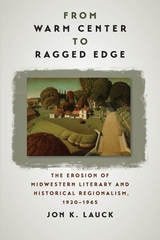
From Warm Center to Ragged Edge
The Erosion of Midwestern Literary and Historical Regionalism, 1920-1965Jon K. Lauck
University of Iowa Press, 2017
This book explains the factors that triggered the demise of the Midwest’s regionalist energies, from anti-midwestern machinations in the literary world and the inability of midwestern writers to break through the cultural politics of the era to the growing dominance of a coastal, urban culture. These developments paved the way for the proliferation of images of the Midwest as flyover country, the Rust Belt, a staid and decaying region. Yet Lauck urges readers to recognize persisting and evolving forms of midwestern identity and to resist the forces that squelch the nation’s interior voices.

From the Civil War to the Apocalypse
Postmodern History and American FictionTimothy Parrish
University of Massachusetts Press, 2008
In addressing the postmodernist claim that history works no differently than fiction, Timothy Parrish rejects the implication that history is dead or hopelessly relativistic. Rather, he shows how the best postmodern novelists compel their readers to accept their narratives as true in the same way that historians expect their readers to accept their narratives as true. These novelists write history as a form of fiction.
If the great pre-modernist American historians are Francis Parkman, George Bancroft, and Henry Adams, who are the great modernist or postmodernist historians? In the twentieth century, Parrish argues, the most powerful works of American history were written by William Faulkner, Toni Morrison, Thomas Pynchon, Don DeLillo, Joan Didion, and Cormac McCarthy. What survives a reading of these novels is the sense that writers otherwise identified as multicultural or postmodern share the view that nothing matters more than history and what one believes its possibilities to be. In other words, Parrish concludes, history, not identity, is the ground of postmodern American fiction.

From the Edge
Chicana/o Border Literature and the Politics of PrintFagan, Allison E
Rutgers University Press, 2016
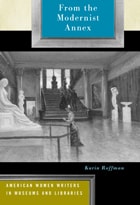
From the Modernist Annex
American Women Writers in Museums and LibrariesKarin Roffman
University of Alabama Press, 2010
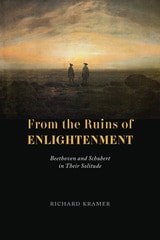
From the Ruins of Enlightenment
Beethoven and Schubert in Their SolitudeRichard Kramer
University of Chicago Press, 2023
Here is Vienna, hosting a congress in 1815 that would redraw national boundaries and reconfigure the European community for a full century. A snapshot captures two of its citizens, each seemingly oblivious to this momentous political environment: Franz Schubert, not yet twenty years old and in the midst of his most prolific year—some 140 songs, four operas, and much else; and Ludwig van Beethoven, struggling through a midlife crisis that would yield the song cycle An die ferne Geliebte, two strikingly original cello sonatas, and the two formidable sonatas for the “Hammerklavier,” opp. 101 and 106. In Richard Kramer’s compelling reading, each seemed to be composing “against”—Beethoven, against the Enlightenment; Schubert, against the looming presence of the older composer even as his own musical imagination took full flight.
From the Ruins of Enlightenment begins in 1815, with the discovery of two unique projects: Schubert’s settings of the poems of Ludwig Hölty in a fragmentary cycle and Beethoven’s engagement with a half dozen poems by Johann Gottfried Herder. From there, Kramer unearths previously undetected resonances and associations, illuminating the two composers in their “lonely and singular journeys” through the “rich solitude of their music.”
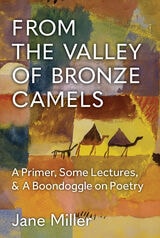
From the Valley of Bronze Camels
A Primer, Some Lectures, & A Boondoggle on PoetryJane Miller
University of Michigan Press, 2022
Jane Miller loves poetry. In these provocative and deeply insightful essays, she unpacks the work of giants like Adrienne Rich, Paul Celan, Marina Tsvetaeva, Osip Mandelstam, and Federico García Lorca alongside painters such as Caravaggio and Paul Klee, as well as ancient Chinese music and techniques of the contemporary poem. Miller explores the use of the question mark in the history of poetry and its function as a revelation of poetic voice. She considers the positive and negative aspects of surrealism on the contemporary poem, its anti-feminist origins in France, its contemporary usage, and the benefits of super-real images. Miller examines how identity politics might affect the imagination. She describes ancient Chinese musical instruments to show how their sounds resonate off/in American poems and on the aural integrity of the lyric poem. She interrogates the political implications of language and the degeneration and regeneration of words. Finally, in an essay about what she dares not say about poetry, she comes out against forms of surrealism, narrative, jargon, rhetoric, irony, and appropriation. This masterful work can be read as advice to a young writer, but it also invites us into the mind of a writer who has developed her craft through the course of a lifetime of writing, reading, and exploring the world, showing not only the ideas that influenced her—feminist, lesbian, and international works—but also how Miller has, in turn, influenced ideas.
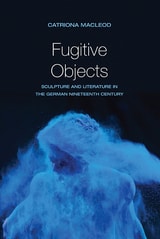
Fugitive Objects
Sculpture and Literature in the German Nineteenth CenturyCatriona MacLeod
Northwestern University Press, 2014
Winner of the 2014 Jean-Pierre Barricelli Prize for Best Book on Romanticism
In Fugitive Objects, Catriona MacLeod examines the question of why sculpture is both intensively discussed and yet rendered immaterial in German literature. She focuses on three forms of disappearance: sculpture’s vanishing as a legitimate art form at the beginning of the nineteenth century in German aesthetics, statues’ migration from the domain of high art into mass reproduction and popular culture, and sculpture’s dislodging and relocation into literary discourse. Through original readings of Clemens Brentano, Achim von Arnim, Adalbert Stifter, Leopold von Sacher-Masoch, and others, MacLeod reveals that if sculpture has disappeared from much of nineteenth-century German literature and aesthetics, it is a vanishing act that paradoxically relocates the statue back onto another cultural pedestal, attesting to the powerful force of the medium.
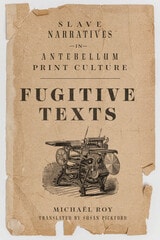
Fugitive Texts
Slave Narratives in Antebellum Print CultureMichaël Roy, translated by Susan Pickford
University of Wisconsin Press, 2024
In Fugitive Texts, Michaël Roy offers the first book-length study of the slave narrative as a material artifact. Drawing on a wide range of sources, he reconstructs the publication histories of a number of famous and lesser-known narratives, placing them against the changing backdrop of antebellum print culture. Slave narratives, he shows, were produced through a variety of print networks. Remarkably few were published under the full control of white-led antislavery societies; most were self-published and distributed by the authors, while some were issued by commercial publishers who hoped to capitalize on the success of Harriet Beecher Stowe’s Uncle Tom’s Cabin. The material lives of these texts, Roy argues, did not end within the pages. Antebellum slave narratives were “fugitive texts” apt to be embodied in various written, oral, and visual forms.
Published to rave reviews in French, Fugitive Texts illuminates the heterogeneous nature of a genre often described in monolithic terms and ultimately paves the way for a redefinition of the literary form we have come to recognize as “the slave narrative.”
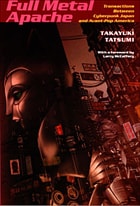
Full Metal Apache
Transactions Between Cyberpunk Japan and Avant-Pop AmericaTakayuki Tatsumi
Duke University Press, 2006
Full Metal Apache introduces English-language readers to a vast array of Japanese writers and performers and considers their work in relation to the output of William Gibson, Thomas Pynchon, H. G. Wells, Jack London, J. G. Ballard, and other Westerners. Tatsumi moves from the poetics of metafiction to the complex career of Madame Butterfly stories and from the role of the Anglo-American Lafcadio Hearn in promoting Japanese folklore within Japan during the nineteenth century to the Japanese monster Godzilla as an embodiment of both Japanese and Western ideas about the Other. Along the way, Tatsumi develops original arguments about the self-fashioning of “Japanoids” in the globalist age, the philosophy of “creative masochism” inherent within postwar Japanese culture, and the psychology of “Mikadophilia” indispensable for the construction of a cyborg identity. Tatsumi’s exploration of the interplay between Japanese and American cultural productions is as electric, ebullient, and provocative as the texts and performances he analyzes.
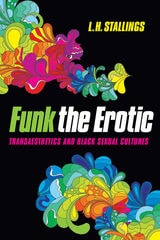
Funk the Erotic
Transaesthetics and Black Sexual CulturesL.H. Stallings
University of Illinois Press, 2015
Stallings uses funk to highlight the importance of the erotic and eroticism in Black cultural and political movements, debunking "the truth of sex" and its histories. Brandishing funk as a theoretical tool, Stallings argues that Western theories of the erotic fail as universally applicable terms or philosophies, and thus lack utility in discussions of black bodies, subjects, and culture. In considering the Victorian concept of freak in black funk, Stallings proposes that black artists across all media have fashioned a tradition that embraces the superfreak, sexual guerrilla, sexual magic, mama's porn, black trans narratives, and sex work in a post-human subject position. Their goal: to ensure survival and evolution in a world that exploits black bodies in capitalist endeavors, imperialism, and colonization.
Revitalizing and wide-ranging, Funk the Erotic offers a needed examination of black sexual cultures, a discursive evolution of black ideas about eroticism, a critique of work society, a reexamination of love, and an articulation of the body in black movements.
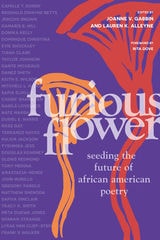
Furious Flower
Seeding the Future of African American PoetryEdited by Joanne V. Gabbin and Lauren K. Alleyne; Foreword by Rita Dove
Northwestern University Press, 2020
Future of Modernism
Hugh Witemeyer, Editor
University of Michigan Press, 1997
Futurity
Contemporary Literature and the Quest for the PastAmir Eshel
University of Chicago Press, 2012