1566 books match the query 'Christianity' and 40 start with g
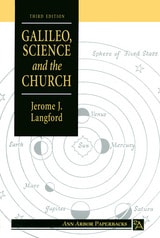
cover of Galileo, Science and the Church

Galileo, Science and the Church

Jerome J. Langford

University of Michigan Press, 1992

Jerome J. Langford's Galileo, Science, and the Church is widely recognized as a classic, balanced account of Galileo Galilei’s legendary 1633 confrontation with the Roman Catholic Inquisition. Moving past the overly polarized arguments of traditional polemicists and apologists, Langford contextualizes the "Galileo Affair" within its proper 17th-century historical, theological, and philosophical milieu. The book meticulously explores how the clash was less a fundamental war between science and faith, and more a complex dispute over scriptural interpretation, ecclesiastical authority, and the academic rigidities of Aristotelian philosophy. Through objective research, Langford demonstrates that this momentous historical drama still serves as a timeless case study on the enduring friction between institutional authority and the freedom of individual thought and expression.

[more]
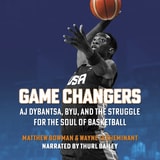
cover of Game Changers: AJ Dybantsa, BYU, and the Struggle for the Soul of Basketball

Game Changers

AJ Dybantsa, BYU, and the Struggle for the Soul of Basketball

Matthew Bowman, Wayne LeCheminant

Signature Books, 2025

In one of the most unlikely coups in college basketball history, a religious school in Utah signed basketball phenomenon AJ Dybantsa. He will play for Brigham Young University—hardly the sort of basketball powerhouse that typically attracts exceptional and non-Mormon players like him.

Game Changers explores how BYU managed this stunning feat. A year before signing Dybantsa, the university lured coaching star Kevin Young from the NBA to run its basketball program. In the decade before, court rulings and institutional reform put money at the forefront of college sports in ways the American public had never seen. And for generations before that, The Church of Jesus Christ of Latter-day Saints built a theological structure and institutional commitment to basketball that put the sport front and center at BYU.

Game Changers places Dybantsa in the context of this history and culture and explores the tensions in the sport. For Latter-day Saints and many other basketball fans, the sport is about personal discipline, character, and a commitment to success. But more and more, universities, the NCAA, and the professional leagues place money above everything else. These dual impulses have pulled the sport in general, and the church-owned BYU in particular, in opposite directions. The book reveals why Dybantsa decided to attend BYU and what he means to the sports world—in Provo, in the United States, and around the globe—as his career unfolds.
[more]
cover of Game Changers: AJ Dybantsa, BYU, and the Struggle for the Soul of Basketball

Game Changers

AJ Dybantsa, BYU, and the Struggle for the Soul of Basketball

Matthew Bowman, Wayne LeCheminant

Signature Books, 2026

In one of the most unlikely coups in college basketball history, a religious school in Utah signed basketball phenomenon AJ Dybantsa. He will play for Brigham Young University—hardly the sort of basketball powerhouse that typically attracts exceptional and non-Mormon players like him.

Game Changers explores how BYU managed this stunning feat. A year before signing Dybantsa, the university lured coaching star Kevin Young from the NBA to run its basketball program. In the decade before, court rulings and institutional reform put money at the forefront of college sports in ways the American public had never seen. And for generations before that, The Church of Jesus Christ of Latter-day Saints built a theological structure and institutional commitment to basketball that put the sport front and center at BYU.

Game Changers places Dybantsa in the context of this history and culture and explores the tensions in the sport. For Latter-day Saints and many other basketball fans, the sport is about personal discipline, character, and a commitment to success. But more and more, universities, the NCAA, and the professional leagues place money above everything else. These dual impulses have pulled the sport in general, and the church-owned BYU in particular, in opposite directions. The book reveals why Dybantsa decided to attend BYU and what he means to the sports world—in Provo, in the United States, and around the globe—as his career unfolds.
[more]
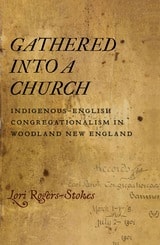
cover of Gathered into a Church: Indigenous-English Congregationalism in Woodland New England

Gathered into a Church

Indigenous-English Congregationalism in Woodland New England

Lori Rogers-Stokes

University of Massachusetts Press, 2025

Uncovering how and where Indigenous and settler communities found common ground using newly public church records

Puritans in the American colonies created Congregationalism, a Protestant denomination where power rested in each congregation rather than a larger central body. As has often been told, the official Puritan mission included outreach to Indigenous people. This may appear as nothing more than forced conversion under colonization, but church records from Massachusetts—digitized and made public for the first time—reveal the authenticity of this Indigenous religious experience, as evidenced by commonalities between the Congregational way and some aspects of local Native American cultures. The records also show how the decentralized churches stood in contrast to a growing civil government in the colonies.

Lori Rogers-Stokes focuses on the Massachusetts Bay Colony during the decades around the turn of the eighteenth century, a period bookended by King Philip’s War and the First Great Awakening. She uses as her primary source the many records kept by individual Congregational churches of the time. These records, accumulated over generations, have been missing from the historical record, allowing overly simplistic accounts of this religious community to circulate. With church records now available, Rogers-Stokes reveals a more realistic picture of diverse congregations and contrasts their internal workings—which show inherent flexibility and a focus on a shared creation of community—with a developing civil government focused on consolidating power around white landowners. The result is a story that can expand how scholars write about this period, this region, and these communities, both settler and Indigenous.
[more]
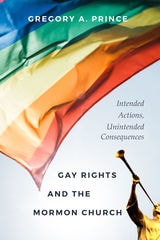
cover of Gay Rights and the Mormon Church: Intended Actions, Unintended Consequences

Gay Rights and the Mormon Church

Intended Actions, Unintended Consequences

Gregory A. Prince

University of Utah Press, 2019

[more]
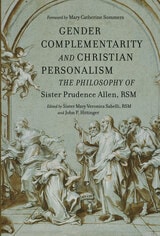
cover of Gender Complementarity and Christian Personalism: The Philosophy of Sister Prudence Allen, RSM

Gender Complementarity and Christian Personalism

The Philosophy of Sister Prudence Allen, RSM

Sister Mary Veronica Sabelli, RSM

Catholic University of America Press, 2025
When, in the 1970’s, Sister Prudence Allen, RSM began to investigate philosophical thought on woman, the question was considered to be, at best, a marginal area for philosophical research. Rather, it was seen as a sociological, anthropological, psychological, or political issue. This book confirms that today, partly due to Allen’s groundbreaking work, the complementarity of man and woman is an important and fruitful area of research in philosophy providing an evaluative framework that enriches and challenges many other disciplines. No one could have foreseen the centrality of her research for questions of gender theory that are, in the third decade of the 21st century, in the forefront of public attention. In the present volume, leading authors in the area of sex/gender complementarity reflect upon and further develop various aspects of Allen’s research. In 16 original, scholarly essays, some contributors build upon Allen’s project of exploring “the concept of woman” throughout the history of philosophy. Others explore the work of 20th century philosophers, most of them Christian Personalists, whom Allen credits with significant influence on the development of integral gender complementarity, such as Karol Wojtyła/ John Paul II, Jacques Maritain, Edith Stein, Emmanuel Mounier, W. Norris Clarke, SJ, and Bernard Lonergan, SJ. Still other contributors consider Marian spirituality, analogies between Benedictine spirituality and the physiological realities of a woman’s body during pregnancy, seminary education in the writings of Allen and others, and the impact of Allen’s work on the real lives of women in families, the Church, and professional life. Upon completing her magisterial, three-volume work, The Concept of Woman, Allen passed the baton to a new generation of scholars, stating, “The next phases will be developed by those who themselves take the argument further and deeper in their own research, writing, living, and lecturing.” The present volume takes up the baton, carrying Allen’s work forward and paying tribute to the lifetime achievement of a great scholar.
[more]
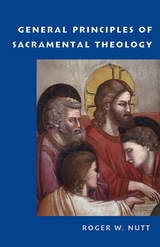
cover of General Principles of Sacramental Theology

General Principles of Sacramental Theology

Roger W. Nutt

Catholic University of America Press, 2017
General Principles of Sacramental Theology addresses a current lacuna in English language theological literature. Bernard Leeming’s highly respected book Principles of Sacramental Theology was published more than sixty years ago. Since that time, there has been a noted decrease, especially in English language sacramental theology, in treatments of the basic topics and principles – such as the nature of the sacraments of signs, sacramental grace, sacramental character, sacramental causality, sacramental intention, the necessity and number of the sacraments, sacramental matter and form, inter alia – which apply to all of the sacraments. This book will be of use in seminary, graduate, and undergraduate courses. The sacraments play an irreplaceable role in pursuing a Universal Call to Holiness that is so central to Vatican II’s teaching.
[more]
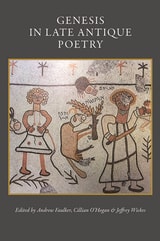
cover of Genesis in Late Antique Poetry

Genesis in Late Antique Poetry

Andrew Faulkner

Catholic University of America Press, 2022
The biblical book of Genesis stands nearly without parallel in the shared history of Judaism, Christianity, and Islam. Because of its abiding importance to late antique theology and practical life across religious boundaries, it gave rise to a wide range of literary responses. The essays in this book study an array of Jewish and Christian responses to Genesis as they took shape in specific literary forms—the unique genres of late antique poetry. While late antique and early medieval Jews and Christians did not always agree in their interpretations of Genesis, they participated broadly in a shared culture of poetic production. Some of these poetic genres paralleled one another simply as distinct examples of metered speech, while others emerged in conversation and through mutual influence. Though late antique poems developed in a variety of languages and across religious boundaries, scholarly study of late antique poetry has tended to isolate the phenomenon according to language. As a corrective to this linguistic isolation, this book initiates a comparative conversation around the Jewish and Christian poetry that emerged in late antique Aramaic, Greek, Hebrew, Latin, and Syriac. Tending equally to exegetical content and literary form, the essays in this book sit at the intersection of a variety of scholarly conversations—around the history of biblical exegesis, the formation of late antique and early medieval literature and literary culture, and the comparative study of Judaism and Christianity.
[more]
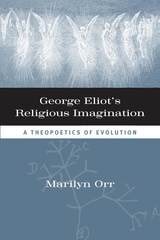
cover of George Eliot's Religious Imagination: A Theopoetics of Evolution

George Eliot's Religious Imagination

A Theopoetics of Evolution

Marilyn Orr

Northwestern University Press, 2018

George Eliot's Religious Imagination addresses the much-discussed question of Eliot’s relation to Christianity in the wake of the sociocultural revolution triggered by the spread of theories of evolution. The standard view is that the author of Middlemarch and Silas Marner “lost her faith” at this time of religious crisis. Orr argues for a more nuanced understanding of the continuity of Eliot’s work, as one not shattered by science, but shaped by its influence.

Orr’s wide-ranging and fascinating analysis situates George Eliot in the fertile intellectual landscape of the nineteenth century, among thinkers as diverse as Ludwig Feuerbach, David Strauss, and Søren Kierkegaard. She also argues for a connection between George Eliot and the twentieth-century evolutionary Christian thinker Pierre Teilhard de Chardin. Her analysis draws on the work of contemporary philosopher Richard Kearney as well as writers on mysticism, particularly Karl Rahner.

The book takes an original look at questions many believe settled, encouraging readers to revisit George Eliot’s work. Orr illuminates the creative tension that still exists between science and religion, a tension made fruitful through the exercise of the imagination. Through close readings of Eliot's writings, Orr demonstrates how deeply the novelist's religious imagination continued to operate in her fiction and poetry.
[more]
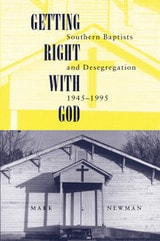
cover of Getting Right With God: Southern Baptists and Desegregation, 1945-1995

Getting Right With God

Southern Baptists and Desegregation, 1945-1995

Mark Newman

University of Alabama Press, 2001

This groundbreaking study finds Southern Baptists more diverse in their attitudes toward segregation than previously assumed

Focusing on the eleven states of the old Confederacy, Getting Right with God examines the evolution of Southern Baptists’ attitudes toward African Americans during a tumultuous period of change in the United States. Mark Newman not only offers an in-depth analysis of Baptist institutions from the Southern Baptist Convention (SBC) and state conventions to colleges and churches but also probes beyond these by examining the response of pastors and lay people to changing race relations.
 
The SBC long held that legal segregation was in line with biblical teachings, but after the Supreme Court's 1954 Brown vs. Board of Education decision in favor of desegregating public institutions, some Southern Baptists found an inconsistency in their basic beliefs. Newman identifies three major blocs of Baptist opinion about race relations: a hard-line segregationist minority that believed God had ordained slavery in the Bible; a more moderate majority that accepted the prevailing social order of racial segregation; and a progressive group of lay people, pastors, and denominational leaders who criticized and ultimately rejected discrimination as contrary to biblical teachings.
 
According to Newman, the efforts of the progressives to appeal to Baptists’ primary commitments and the demise of de jure segregation caused many moderate and then hard-line segregationists to gradually relinquish their views, leading to the 1995 apology by the SBC for its complicity in slavery and racism. Comparing Southern Baptists with other major white denominations, Newman concludes that lay Baptists differed little from other white southerners in their response to segregation.
 
[more]
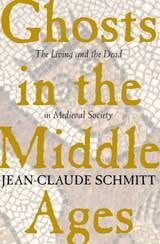
cover of Ghosts in the Middle Ages: The Living and the Dead in Medieval Society

Ghosts in the Middle Ages

The Living and the Dead in Medieval Society

Jean-Claude Schmitt

University of Chicago Press, 1998

Through this vivid study, Jean-Claude Schmitt examines medieval religious culture and the significance of the widespread belief in ghosts, revealing the ways in which the dead and the living related to each other during the middle ages. Schmitt also discusses Augustine's influence on medieval authors; the link between dreams and autobiographical narratives; and monastic visions and folklore. Including numerous color reproductions of ghosts and ghostly trappings, this book presents a unique and intriguing look at medieval culture.

"Valuable and highly readable. . . . [Ghosts in the Middle Ages] will be of interest to many students of medieval thought and culture, but especially to those seeking a general overview of this particularly conspicuous aspect of the medieval remembrance of the dead."—Hans Peter Broedel, Medieval Review

"A fascinating study of the growing prevalence of ghost imagery in ecclesiastical and popular writing from the fifth to the fifteenth century."—Choice
[more]
cover of Gift and Communion

Gift and Communion

Jaroslaw Kupczak

Catholic University of America Press, 2014
Gift and Communion offers a critical presentation of John Paul II's theology of the body, understood in the light of Christian theological tradition. The main thesis of the book is that John Paul II's theology of the body forms a new, inspiring approach to Christian ethics and the theology of marriage and family, as well as to theological anthropology. A central thrust of Gift and Communion is to treat theology of the body - as it deserves - in all its philosophical and theological seriousness and to present it as an important stage in the historical development of Catholic theology
[more]
cover of Gifts of Power: The Writings of Rebecca Jackson, Black Visionary, Shaker Eldress

Gifts of Power

The Writings of Rebecca Jackson, Black Visionary, Shaker Eldress

Jean M. Humez

University of Massachusetts Press, 1981

A free black woman in antebellum America, Rebecca Cox Jackson (1795–1871) was an independent itinerant preacher and religious visionary who founded a Shaker community in Philadelphia that survived her death by twenty-five years. Gifts of Power contains her complete extant writings, covering the period 1830 to 1864.
[more]
cover of Giving One's Word: Interpersonal Love, Knowledge, and Self-Giving in Aquinas's Psychological Analogy for the Trinity

Giving One's Word

Interpersonal Love, Knowledge, and Self-Giving in Aquinas's Psychological Analogy for the Trinity

Michael Joseph Higgins

Catholic University of America Press, 2025
According to the vast majority of recent Trinitarian theologians, to believe in the Trinity is to believe that God is Love: it is to believe in three divine Persons who know each other, love each other, and give themselves to each other. St. Thomas Aquinas is rarely invoked as a patron of such a social approach to the Trinity. Aquinas’s Trinitarian theology, after all, revolves around the immanent processions of a Word and Love within the unity of the divine essence. Many have assumed that this “psychological analogy” is removed from—or even incompatible with—interpersonal knowledge, love, and self-giving. Some have concluded that Aquinas is therefore unable to accommodate a social Trinity. Others have argued that he is open to a social Trinity, but that his psychological categories need to be complemented by a more overtly social framework. This study, however, shows that these psychological categories themselves are shot through with interpersonal knowledge, love, and self-giving. More specifically, Aquinas’s psychological analogy is often accused of emphasizing the unity of the divine essence at the expense of the distinction of the divine Persons. In fact, it emphasizes distinction just as basically as it emphasizes unity, and it ensures that the distinction between the divine Persons is a radical one. Similarly, it is criticized for being a matter of self-knowledge instead of interpersonal knowledge, self-love instead of interpersonal love, and self-regard instead of self-giving. In fact, it is a matter of self-knowledge as interpersonal knowledge, self-love as interpersonal love, and self-regard as self-giving: it ensures that there can be no self-knowledge or self-love in God that is not just as basically interpersonal knowledge, interpersonal love, and interpersonal self-giving. Aquinas’s psychological analogy, then, does not shut down the possibility of interpersonal Trinity. Nor does it need to be complemented from the outside by an interpersonal Trinity. Instead, it contains within itself an intensely interpersonal Trinity.
[more]
cover of Glaphyra on the Pentateuch, Volume 1

Glaphyra on the Pentateuch, Volume 1

Nicholas P. St. Cyril of Alexandria

Catholic University of America Press, 2019
Cyril of Alexandria (ca. 376–444) is best known for his defense of orthodoxy at the time of the Nestorian controversy over the nature of Christ. However, by far the larger part of Cyril’s literary output consisted of commentaries on books of both Old and New Testaments, written before the Christological debate was sparked off in 428. One of these works, of major proportions, was the so-called Glaphyra (“elegant comments”) on the Pentateuch. This comprises a total of thirteen separate “books,” or volumes: seven on Genesis, three on Exodus, and one each on Leviticus, Numbers and Deuteronomy. The comments primarily concern the narrative portions of the Pentateuch, hence the greater space given to Genesis, though a number of the legal prescriptions are also treated. This present volume, containing all seven books on Genesis, is the first of a projected two-volume set which will offer a translation of the whole Glaphyra for the first time in English. Cyril’s aims within the commentary are both theological and pastoral. His chosen method begins with a consideration of the historia. Here the Alexandrian patriarch deals with the text at the literal level. At this stage he explains any historical, cultural, and at times even linguistic and textual issues presented within the passage, which is then followed by some theological instruction or lessons of a more practical nature based upon the literal interpretation. The exposition then moves on to the theoria. This is Cyril’s preferred term for the contemplation of the spiritual sense, that is to say, the mystery of Christ which he firmly held lay hidden beneath the surface of the Old Testament text. With great adeptness and consistency Cyril identifies elements within the ancient narratives as figures, or “types and shadows,” of the Lord Jesus Christ, the Church, and the teachings of the gospel.
[more]
cover of Glaphyra on the Pentateuch, Volume 2

Glaphyra on the Pentateuch, Volume 2

St. Cyril of Alexandria

Catholic University of America Press, 2019
The translation of the commentary of Cyril of Alexandria (ca. 376-444) on the Pentateuch, known as the Glaphyra, or “elegant comments,” is now completed by this second volume. Volume 1 contained the whole of his remarks on Genesis, and now Volume 2 presents his comments on Exodus, Leviticus, Numbers, and Deuteronomy, along with indices for the entire work. At this early stage in his patriarchate Cyril was an avid expositor of Scripture, on books of both Testaments, possibly undertaking this work as a model and guide for the clergy under his direction. While Cyril’s other large-scale commentaries on Old Testament books, such as Isaiah and the Minor Prophets (the latter commentary also published in translation by CUA Press), followed a verse-by-verse approach, the Glaphyra is more thematic. As Cyril works through the narrative passages of the Pentateuch, he pauses to explain those elements within the text that present possible difficulties or admit alternative interpretations, and invariably concludes each section by bringing out spiritual lessons of benefit to the congregation. Many of these latter relate to Christ, since, for Cyril, a Christological reading of the Old Testament was unavoidable. While in the Glaphyra it was not Cyril’s purpose to tackle the legal passages within the Pentateuch, a task that he wished to reserve for a separate work of an entirely different character (De adoratione et cultu in spiritu et veritate, “Concerning Worship and Service in Spirit and in Truth”), he does nevertheless here depart from his own remit on occasion and deal with some of the more prominent ceremonial passages. Cyril gives considerable space, for example, to the sacrifice of the Passover lamb and the levitical ritual for the cleansing of the leper, among others. As with Volume 1, Cyril’s treatment of these books is published here for the first time in English translation.
[more]
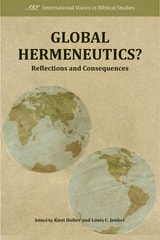
cover of Global Hermeneutics. Reflections and Consequences

Global Hermeneutics. Reflections and Consequences

Knut Holter

SBL Press, 2010

A collection of essays from the International Cooperation Initiative of the Society of Biblical Literature

This first volume in the International Voices in Biblical Studies series stimulates and facilitates a global hermeneutic in which centers and margins fade. The collection explores the global context within which biblical studies and interpretation take place, includes three case studies from different regions, and reflections on the consequences of global hermeneutics on biblical interpretation and on translation.

Features

  • Case studies from different regions
  • Essays explore both the positive and negative aspects of globalization
  • Seven essays represent scholarship from Africa and Latin America
  • [more]
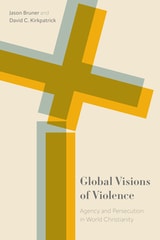
    cover of Global Visions of Violence: Agency and Persecution in World Christianity

    Global Visions of Violence

    Agency and Persecution in World Christianity

    Jason Bruner

    Rutgers University Press, 2023
    In Global Visions of Violence, the editors and contributors argue that violence creates a lens, bridge, and method for interdisciplinary collaboration that examines Christianity worldwide in the twentieth and twenty-first centuries. By analyzing the myriad ways violence, persecution, and suffering impact Christians and the imagination of Christian identity globally, this interdisciplinary volume integrates the perspectives of ethicists, historians, anthropologists, and ethnographers to generate new conversations. Taken together, the chapters in this book challenge scholarship on Christian growth that has not accounted for violence while analyzing persecution narratives that can wield data toward partisan ends.  This allows Global Visions of Violence to push urgent conversations forward, giving voice to projects that illuminate wide and often hidden landscapes that have been shaped by global visions of violence, and seeking solutions that end violence and turn toward the pursuit of justice, peace, and human rights among suffering Christians. 
    [more]
    cover of Globalizing Family Values: The Christian Right In International Politics

    Globalizing Family Values

    The Christian Right In International Politics

    Doris Buss

    University of Minnesota Press, 2003

    A timely exposé of the efforts of the religious right to influence global policy

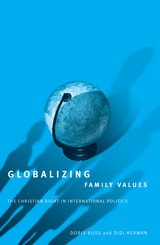
    With little fanfare and profound effect, “family values” have gone global, and the influence of the Christian Right is increasingly felt internationally. This is the first comprehensive study of the Christian Right’s global reach and its impact on international law and politics.

    Doris Buss and Didi Herman explore tensions, contradictions, victories, and defeats for the Christian Right’s global project, particularly in the United Nations. The authors consult Christian Right materials, from pamphlets to novels; conduct interviews with people in the movement; and provide a firsthand account of the World Congress of Families II in 1999, a key event in formulating Christian Right global policy and strategy. The result is a detailed look at a new global player—its campaigns against women’s rights, population policy, and gay and lesbian rights; its efforts to build an alliance of orthodox faiths with non-Christians; and the tensions and strains as it seeks to negotiate a role for conservative Christianity in a changing global order.
    [more]
    cover of Glossolalia and the Problem of Language

    Glossolalia and the Problem of Language

    Nicholas Harkness

    University of Chicago Press, 2021

    Speaking in tongues, also known as glossolalia, has long been a subject of curiosity as well as vigorous theological debate. A worldwide phenomenon that spans multiple Christian traditions, glossolalia is both celebrated as a supernatural gift and condemned as semiotic alchemy. For some it is mystical speech that exceeds what words can do, and for others it is mere gibberish, empty of meaning. At the heart of these differences is glossolalia’s puzzling relationship to language.
    ​
    Glossolalia and the Problem of Language investigates speaking in tongues in South Korea, where it is practiced widely across denominations and congregations. Nicholas Harkness shows how the popularity of glossolalia in Korea lies at the intersection of numerous, often competing social forces, interwoven religious legacies, and spiritual desires that have been amplified by Christianity’s massive institutionalization. As evangelicalism continues to spread worldwide, Glossolalia and the Problem of Language analyzes one of its most enigmatic practices while marking a major advancement in our understanding of the power of language and its limits.
    [more]
    cover of God Gave Us The Right: Conservative Catholic, Evangelical Protestant, and Orthodox Jewish Women Grapple with Feminism

    God Gave Us The Right

    Conservative Catholic, Evangelical Protestant, and Orthodox Jewish Women Grapple with Feminism

    Manning, Christel

    Rutgers University Press, 1999
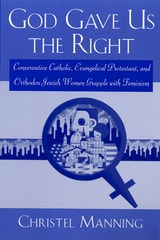
    What does it mean to be a religious conservative, particularly for women, in America today? While it appears that people are returning to conservative religion because they are fed up with the excesses of liberalism, including feminism, a closer look at the lives of religious conservatives reveals a more complex reality. Drawing on two years of ethnographic research in Catholic, Jewish, and Protestant communities, Christel Manning explores the diversity among women who have returned to tradition. Arguing that America has undergone profound cultural and economic changes in the last thirty years, which create tension between women's lives and traditional gender roles, she demonstrates that conservative Catholics, Orthodox Jews, and Evangelical Protestants negotiate those tensions in different ways. Manning also shows that women in conservative religious communities share many of the same concerns as secular women.
    Manning looks at how the religious communities profiled have been influenced by feminist values and describes the ways in which these women negotiate gender roles at work, religious services, and at home. She explains how they deal with the inconsistencies created by their attempts to integrate feminist and traditionalist norms. In highly accessible prose, Manning examines their attitudes towards the feminist movement, its impact on American culture, and the extent to which the women seek to resist it. God Gave Us the Right explains how these different views of feminism reflect the diverse theologies and historical experiences of the three communities.
    [more]
    cover of God Is Love: Thomas Aquinas on the Being and Action of the Holy Spirit

    God Is Love

    Thomas Aquinas on the Being and Action of the Holy Spirit

    Michael D. Torre

    Catholic University of America Press, 2026
    This book dedicates three essays each to three different theological problems regarding the Holy Spirit: In God and for Us (The "Filioque" and "Uncreated Grace"); Thomas's Understanding (Not His Commentators) of the Relation between nature and sanctifying grace; and our ability (and that of the angels at their creation) in fact to resist God' grace and thus be the first cause of sin. This later problem is developed in an "excursus" on the way God moves the free will, one that takes into consideration much recent work on this issue and situates the essays' position in relation to it. The book ends with a brief epilogue on the credibility of God, again giving Thomas's account of this. The principal aim throughout is to understand the doctrine of Thomas Aquinas. It places his views in relation to three audiences: chiefly to the orthodox regarding the first issue; to Catholics in relation to the second; and to Protestants in relation to the third. Thus, its second aim is to join "ecumenical debate" about these matters. The essays were mostly written to be delivered orally, to an informed audience of philosophers and theologians., but one that consisted of "generalists" and serious students of Thomas, as well as of "professional" philosophers and theologians. All three of the debated issues discussed have generated an enormous amount of disagreement and debate, not a little of it being quite "technical." Thus, each issue would easily require a long and significant book to be addressed as it deserves. The essays do not do this, but they do indicate what Torre holds is the "directive line" of Thomas's thought that deserves to be defended and developed in each case, and, in each case, this line is held to be markedly different than many have thought it to be.
    [more]
    cover of God and Evolution: Fundamental Questions of Christian Evolutionism

    God and Evolution

    Fundamental Questions of Christian Evolutionism

    Jozef Zycinski

    Catholic University of America Press, 2006
    Written by Archbishop Józef Zycinski of Lublin, this book offers an important and insightful examination of the basic philosophical questions involved in the relation between evolutionary theory and the Christian religion.
    [more]
    cover of God's Businessmen: Entrepreneurial Evangelicals in Depression and War

    God's Businessmen

    Entrepreneurial Evangelicals in Depression and War

    Sarah Ruth Hammond

    University of Chicago Press, 2017

    How evangelical businessmen in the 1930s and 1940s joined their religious and business lives.

    The evangelical embrace of conservatism is a familiar feature of the contemporary political landscape. What’s less well-known, however, is that the connection predates the Reagan revolution, going all the way back to the Depression and World War II. Evangelical businessmen at the time were quite active in opposing the New Deal—on both theological and economic grounds—and in doing so claimed a place alongside other conservatives in the public sphere. Like previous generations of devout laymen, they self-consciously merged their religious and business lives, financing and organizing evangelical causes with the kind of visionary pragmatism that they practiced in the boardroom.

    In God’s Businessmen, Sarah Ruth Hammond explores not only these men’s personal trajectories but also those of the service clubs and other institutions that, like them, believed that businessmen were God’s instrument for the Christianization of the world. Hammond presents a capacious portrait of the relationship between the evangelical business community and the New Deal—and in doing so makes important contributions to American religious history, business history, and the history of the American state.
    [more]
    cover of God's Gift of the Universe: An Introduction to Creation Theology

    God's Gift of the Universe

    An Introduction to Creation Theology

    Paul O'Callaghan

    Catholic University of America Press, 2021
    There are many ways of understanding the reality of the world we live in and experience. Science, philosophy, art all offer us ample descriptions, explanations and intuitions. But Christian believers go beyond all that, for they attempt to understand the origins of the universe in terms of the creation of the world by God. Revelation tells us what God had in mind when he made the world ex nihilo, without presuppositions of any kind. God’s Gift of the Universe attempts to present the principal elements and stages of creation theology. The doctrine is to be found fundamentally, of course, in Scripture, both Old and New Testament, which describes the world in the light of God’s word. Yet since God actually gave existence to the world, down to the last detail, our reflection on God’s word not only explains the reality of creation, how it works, its nature, as science does. It also explains how creation came into being in the mind and heart of the Triune God, and, ultimately, why God created the world. In God’s Gift of the Universe, a considerable effort has been spent throughout the book on the Christological and Trinitarian aspects of creation, particularly in the theology of Church Fathers. Creation is presented besides in a deeply eschatological key, for God created the world for purpose of making his glory eternally manifest. The book also considers the way God ‘intervenes’ in the life of the created world, through conservation in being and providence. The meaning of time, matter and spirit are considered. The need for ecological awareness is central. One aspect of the mystery of creation that receives special attention is the presence of evil in the world. This is of particular importance once we accept that God made the world, whole and entire, thus assuming responsibility for the world as it is. The origin of evil through the sin of spiritual creatures provides the ultimate though not the only explanation of the mystery of evil. Particular consideration is given to the reality of ‘original sin’.
    [more]
    cover of God's Love through the Spirit

    God's Love through the Spirit

    Kenneth M. Loyer

    Catholic University of America Press, 2014
    Although the doctrine of the Holy Spirit has often been a neglected subject in theology, it remains vital for understanding both the Christian confession of God as Trinity and the nature of the Christian life. In view of those two topics, God's Love through the Spirit examines the relationship between love and the person and work of the Holy Spirit in Thomas Aquinas and John Wesley - two very different figures whose teachings on the Spirit and the Christian life are found to be, on the whole, surprisingly compatible. An investigation into Aquinas's amor-based pneumatology, including a groundbreaking analysis of his recently discovered Pentecost sermon, and a fresh assessment of the doctrine of sanctification in Wesley show that in distinctive yet largely complementary ways, Aquinas and Wesley provide resources that can be used to reclaim a richer pneumatology, specifically in relation to the theological virtue of love.
    [more]
    cover of God's Plagiarist: Being an Account of the Fabulous Industry and Irregular Commerce of the Abbe Migne

    God's Plagiarist

    Being an Account of the Fabulous Industry and Irregular Commerce of the Abbe Migne

    R. Howard Bloch

    University of Chicago Press, 1994

    God's Plagiarist is an entertaining account of the abbe Jacques-Paul Migne, one of the great entrepreneurs of the nineteenth century. A priest in Orleans from 1824 to 1833, Migne then moved to Paris, where, in the space of a decade, he built one of the most extensive publishing ventures of all time.

    How did he do it?

    Migne harnessed a deep well of personal energy and a will of iron to the latest innovations in print technology, advertising, and merchandising. His assembly-line production and innovative marketing of the massive editions of the Church Fathers placed him at the forefront of France's new commerce. Characterized by the police as one of the great "schemers" of the century, this priest-entrepreneur put the most questionable of business practices in the service of his devotion to Catholicism.

    Part detective novel, part morality tale, Bloch's narrative not only will interest scholars of nineteenth-century French intellectual history but will appeal also to general readers interested in the history of publishing or just a good historical yarn.

    "An unforgettable, Daumier-like portrait, sharp and satirical, of this enterprising, austere and somewhat crazed merchandiser of sacred learning. . . . Bloch deserves great credit for the wit and style of his effort to explore the Pedantic Park of nineteenth-century learning, that island of monsters which scholars have found, as yet, no escape."—Anthony Grafton, New Republic

    "Bloch is an exhilarating guide to the methods which made Migne the Napoleon of the Prospectus, a publicist of genius, Buffalo Bill and P.T. Barnum rolled into one."—David Coward, Times Literary Supplement

    "Mercifully, Bloch's sense of humour has none of that condescending mock-bewilderment commonly applied to the foreign or ancient. . . . It enables Bloch to promote Migne as a forerunner of the department store and to place him on a continuum running from St. Paul to the Tupperware party: the quality of the merchandise is increasingly irrelevant, still more the nature of its contents."—Graham Robb, London Review of Books
    [more]
    cover of God, He Who Is: De Deo ut uno

    God, He Who Is

    De Deo ut uno

    Serge-Thomas Bonino

    Catholic University of America Press, 2026
    "What is God?" asked Thomas Aquinas as a child. Contemplation of the mystery of God, in the light of reason enlightened by faith, is the heart of the theological enterprise. It is based on the Revelation that God has made of himself in the history of salvation and, in order to foster the understanding of faith, it assumes the best of metaphysical reflection, since the saving God revealed in Jesus Christ is not another God than the Creator of heaven and earth, the subsisting Being, the First Cause of all being. The One God deals with a first "part" of the mystery of God: God contemplated in the unity of the essence common to the three persons of the Holy Trinity. It explores the ways of our knowledge (section 1) and presents the theological question of his existence (section 2). It then sets out the perfections of God's very being (simplicity, goodness, infinity, eternity, etc.)(section 3) and, after a critical review of the value of theoretical knowledge and language (section 4), presents the principles of his action (knowledge, will, omnipotence) (section 5). The One God is a continuation of the treatises De Deo ut uno, which, in the form of a systematic, historical and doctrinal commentary on questions 2-26 of the Prima pars of the Summa Theologiae of Saint Thomas Aquinas, have succeeded one another throughout the history of the Thomist tradition. Its aim is to update a theology treatise that is unjustly neglected today and to offer teachers and students a solid and informed manual on this fundamental subject.
    [more]
    cover of God, Science, Sex, Gender: An Interdisciplinary Approach to Christian Ethics

    God, Science, Sex, Gender

    An Interdisciplinary Approach to Christian Ethics

    Edited by Patricia Beattie Jung and Aana Marie Vigen with John Anderson

    University of Illinois Press, 2010

    God, Sex, Science, Gender: An Interdisciplinary Approach to Christian Ethics is a timely, wide-ranging attempt to rescue dialogues on human sexuality, sexual diversity, and gender from insular exchanges based primarily on biblical scholarship and denominational ideology. Too often, dialogues on sexuality and gender devolve into the repetition of party lines and defensive postures, without considering the interdisciplinary body of scholarly research on this complex subject. This volume expands beyond the usual parameters, opening the discussion to scholars in the humanities, social sciences, and natural sciences to foster the development of Christian sexual ethics for contemporary times.

    Essays by prominent and emerging scholars in the fields of anthropology, sociology, psychology, philosophy, literary studies, theology, and ethics reveal how faith and reason can illuminate our understanding of human sexual and gender diversity. Focusing on the intersection of theology and science and incorporating feminist theory, God, Science, Sex, Gender is a much-needed call for Christian ethicists to map the origins and full range of human sexual experience and gender identity. Essays delve into why human sexuality and gender can be so controversial in Christian contexts, investigate the complexity of sexuality in humans and other species, and reveal the implications of diversity for Christian moral theology.

    Contributors are Joel Brown, James Calcagno, Francis J. Catania, Pamela L. Caughie, Robin Colburn, Robert Di Vito, Terry Grande, Frank Fennell, Anne E. Figert, Patricia Beattie Jung, Fred Kniss, John McCarthy, Jon Nilson, Stephen J. Pope, Susan A. Ross, Joan Roughgarden, and Aana Marie Vigen.
    [more]
    cover of God, Sex, and Politics: Homosexuality and Everyday Theologies

    God, Sex, and Politics

    Homosexuality and Everyday Theologies

    Dawne Moon

    University of Chicago Press, 2004

    God, Sex, and Politics examines both sides of the church controversy over homosexuality to consider the ways in which people develop, in everyday thought and interaction, their beliefs about God and justice. Dawne Moon explores how members of Protestant congregations determine what is just and what is not, what is right and what is wrong, what is loving and what is sinful.

    Through this compelling work we learn that the considerable turmoil surrounding homosexuality in churches has less to do with homosexuality than with the fear of weakening the church's spiritual, communal solidarity. We learn too how the church mirrors the secular world—the fear of division and politics leads members to avoid conflict in the congregations Moon examines. And so, the Protestants who are the subject of her study avoid debating the key issue of whether homosexuality is sinful because of its potentially polarizing effects. The religious culture Moon uncovers is ultimately critical of politics and of the intense moral and social discord that members believe it entails.

    God, Sex, and Politics will be of enormous value to sociologists of religion and anyone interested in religious controversies over sexuality.
    [more]
    cover of Grace and Freedom in a Secular Age: Contingency, Vulnerability, and Hospitality

    Grace and Freedom in a Secular Age

    Contingency, Vulnerability, and Hospitality

    Philip J. Rossi

    Catholic University of America Press, 2022
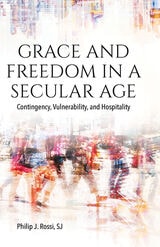
    In the course of a long and distinguished academic and civic career, the Canadian philosopher Charles Taylor has been, for articulate atheists and learned believers alike, an incisive, insightful, gracious, and challenging conversation partner on issues that arise at the intersection and interaction of religion, society, and culture. Grace and Freedom in a Secular Age offers a concise exposition of key ideas – contingency, otherness, freedom, vulnerability and mutuality – that inform his probing analyses of the dynamics of religious belief and religious denial in the pervasive contemporary culture he calls a “a secular age,” within which religious belief and practice have, for many, become just an option. Those ideas provide the basis from which Rossi argues that, despite a clear-eyed recognition of the deep fractures of meaning and the pervasive fragmentation of once stable societal connections that a secular age has brought in its wake, Taylor also sees and affirms strong grounds for hope in a healing of our broken and fractured world and for the possibilities—and the importance of—active human participation in that healing. Taylor points to signs indicative of potent re-compositions and renewals taking place in religious belief and practice from its interaction with the dynamics of secular culture, particularly ones that make possible radical enactments of deeper human solidarity and mutuality, of which the one most often potent is the reconciliation of enemies. In pointing out these signs, Taylor suggests a richly expansive reading of the Christian doctrine of Creation, as it marks the radical contingency of all that is upon a freely bestowed divine self-giving: Creation is the ongoing enactment of the divine hospitality of the Triune God.
    [more]
    cover of Grace for Grace

    Grace for Grace

    Alexander Y. Hwang

    Catholic University of America Press, 2014

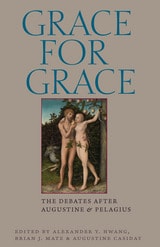
    The contributors to Grace for Grace focus on the debates on grace and free will inspired by Augustine's later teachings on grace and the various reactions to it. In both popular and scholarly literature, the conflict has been traditionally referred to as the "Semi-Pelagian Controversy." For several decades, scholars have distanced themselves from that overly-simplistic and inaccurate portrayal. This book intends to solidify a disparate movement of scholarly thought and offer a secure basis for renewed study of the persons, texts, and events of this critical period in the reception of Augustine in the Early Middle Ages. This volume brings together new perspectives, based on fresh study of a wealth of primary sources, from an international team of scholars to explore the intra-church debates over grace and free will, after Augustine and Pelagius.
    [more]
    cover of Grace: A Play

    Grace

    A Play

    Craig Wright

    Northwestern University Press, 2012

    The difference between belief and knowledge and the con­sequences of mistaking one for the other are at the heart of Craig Wright’s play Grace. An evangelical Christian couple, Sara and Steve, leave a dreary life in Minnesota for sunny Florida and the hope of fast money from turn­ing abandoned hotels into a chain of gospel-themed inns. Their new neighbor, Sam, is struggling to emerge from the trauma of a car accident that killed his fiancée and left him badly maimed. And the building’s pest exterminator, Karl, is still tormented by a dark childhood episode. As their stories converge, Wright’s characters find themselves face-to-face with the most eternally vexing questions—the nature of faith, the meaning of suffering, and the possibil­ity of redemption. Acidly funny and relentlessly search­ing, Grace is a trenchant work from an immensely gifted playwright.
    [more]
    cover of Great Basin Kingdom: An Economic History of the Latter-day Saints, 1830-1900,  New Edition

    Great Basin Kingdom

    An Economic History of the Latter-day Saints, 1830-1900, New Edition

    Leonard J. Arrington

    University of Illinois Press, 2004

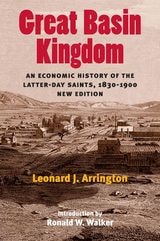
    Leonard Arrington, who died in 1999, is considered by most, if not all, serious scholars of Mormon and western history as the single most important figure to write on LDS history. Great Basin Kingdom is perhaps his greatest work.

    A classic in Mormon studies and western history, Great Basin Kingdom offers insights into the ‘underdeveloped' American economy, a comprehensive treatment of one of the few native American religious movements, and detailed, exciting stories from little-known phases of Mormon and American history.

    This edition includes thirty new photographs and an introduction by Ronald W. Walker that provides a brief biography of Arrington, as well as the history of the work, its place in Mormon and western historiography, and its lasting impact.
    [more]
    cover of Great Salt Lake: A Perspective from the Church of Jesus Christ of Latter-day Saints

    Great Salt Lake

    A Perspective from the Church of Jesus Christ of Latter-day Saints

    Bishop W. Christopher Waddell

    University of Utah Press, 2024
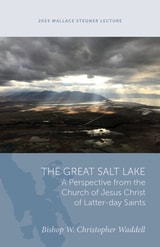
    The Great Salt Lake is deeply tied to the identity and history of the Church of Jesus Christ of Latter-day Saints. As Latter-day Saints settled in the Great Basin, they relied on the Great Salt Lake for industry and recreation. Bishop W. Christopher Waddell explains that today, given the crisis faced by the lake, leaders of the LDS Church consider preserving the Great Salt Lake to be a sacred duty to care for God’s creations and a “critical issue for our state and citizens of Utah.” The LDS Church strives to positively impact the lake and continually improve its water-wise practices by working with local and community leaders, reducing water use at meetinghouses and facilities by utilizing sustainable landscaping principles and effective water management, and donating permanent water shares that will preserve water currently flowing into the lake in perpetuity.
    [more]
    cover of Grieving Pregnancy: Memorializing Loss in Japanese Buddhism and American Catholicism

    Grieving Pregnancy

    Memorializing Loss in Japanese Buddhism and American Catholicism

    Maureen L. Walsh

    Rutgers University Press, 2025
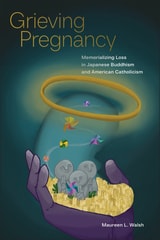
    In Grieving Pregnancy: Memorializing Loss in Japanese Buddhism and American Catholicism, Maureen L. Walsh compares how the two religious traditions respond ritually and discursively to miscarriage, stillbirth, and abortion experiences marked by grief for the women involved. The experience of pregnancy loss has always been a part of women’s lives, yet only recently has it garnered attention from religious leaders and scholars commensurate with its prevalence. This book examines pregnancy loss as a theological problem for both Buddhism and Catholicism and analyzes the rites and memorials that have developed to address it, such as Japanese Buddhist mizuko kuyō (water children rites) and emergent American Catholic memorial practices focused on pregnancy loss. These parallel practices have emerged within distinct religious landscapes—a fact reflected in their forms and purposes—and when considered together, they raise questions of keen interest to theological and religious studies about the goals of religious practice and the imagination of human life at its earliest stages.
     
    [more]
    cover of Growing Up Protestant: Parents, Children and Mainline Churches

    Growing Up Protestant

    Parents, Children and Mainline Churches

    Margaret Lamberts Bendroth

    Rutgers University Press, 2002

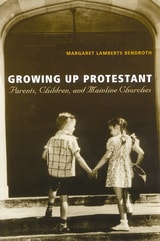
    Home and family are key, yet relatively unexplored, dimensions of religion in the contemporary United States. American cultural lore is replete with images of saintly nineteenth-century American mothers and their children. During the twentieth century, however, the form and function of the American family have changed radically, and religious beliefs have evolved under the challenges of modernity. As these transformations took place, how did religion manage to “fit” into modern family life?

    In this book, Margaret Lamberts Bendroth examines the lives and beliefs of white, middle-class mainline Protestants (principally northern Presbyterians, Baptists, Methodists, and Congregationalists) who are theologically moderate or liberal. Mainliners have pursued family issues for most of the twentieth century, churning out hundreds of works on Christian childrearing. Bendroth’s book explores the role of family within a religious tradition that sees itself as America’s cultural center. In this balanced analysis, the author traces the evolution of mainliners’ roles in middle-class American culture and sharpens our awareness of the ways in which the mainline Protestant experience has actually shaped and reflected the American sense of self.
    [more]
    cover of Growing into God: The Fathers of the Church on Christian Maturity

    Growing into God

    The Fathers of the Church on Christian Maturity

    John Gavin

    Catholic University of America Press, 2025

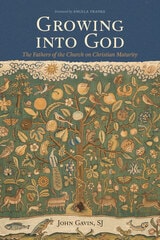
    Many studies of spiritual development exist under the heading of “Christian Perfection.” However, John Gavin revisits such topics as asceticism, prayer, sacraments, virtues, and spiritual combat through scriptural and patristic texts that present the Christian life as one of growth from spiritual infancy to a particular fulfillment or end (telos): divinized humanity as formed and revealed in Jesus Christ. Thus, though Christian maturity does incorporate such things as physical and cognitive development, its true distinction lies in its gifted, supernatural end that does not exclude human freedom. Part One establishes the pillars of Christian maturity – form and finality; virtue and character; vocation and mission – and explores the opposition to maturation in the form of demonic infantilism. Part Two examines the means of maturity given to us in the life of the Church: the Scriptures, the Mysteries (Sacraments), and asceticism. Finally, Part Three reviews four figures of Christian adulthood: the Witness, the Teacher, the Servant, and the Fool. A concluding chapter applies the insights from the previous chapters to our modern world to see in what ways our times need to “grow up.” Growing into God includes a variety of early Christian voices: Irenaeus of Lyons, Origen of Alexandria, Gregory of Nazianzus, Gregory of Nyssa, Basil of Caeserea, Augustine of Hippo, Ambrose of Milan, John Cassian, Dionysius the Areopagite, Mark the Monk, John Moschos, Maximus the Confessor, Symeon the Holy Fool, and others. Their collective insights, all the fruits of great learning and the contemplation of God’s Word, describe a wondrous figure: the mature saint transformed by union with the Father, Son, and Spirit.
    [more]
    cover of Guadalupe in New Spain: Sermons, 1731-1747

    Guadalupe in New Spain

    Sermons, 1731-1747

    Bartolome Felipe de Ita y Parra

    Catholic University of America Press, 2027
    Bartolomé Felipe de Ita y Parra was the most influential preacher in New Spain on Our Lady of Guadalupe. His orations helped advance expansive growth in Guadalupan devotion. The advocacy of Ita y Parra and his fellow Guadalupan promoters culminated in Pope Benedict XIV’s 1754 endorsement of Guadalupe as the patroness of New Spain, the first major international recognition of the Guadalupe tradition. While Guadalupan studies have tended to focus on the origins of her cult in the sixteenth century, the most pivotal turning points in Guadalupe’s devotional ascent occurred in the eighteenth century. A monograph dedicated to Ita y Parra’s impact on this decisive evolution is long overdue. Moreover, his sermons illuminate the theology of divine providence at the heart of colonial Guadalupan sermons and devotion, indeed at the core of colonial Catholicism and society. Guadalupe in New Spain breaks new ground through a critical examination of Ita y Parra’s Guadalupan sermons and their significance for understanding the most renowned Christian tradition indigenous to the American hemisphere.
    [more]
    cover of Guiding to a Blessed End: Andrew of Caesarea and His Apocalypse Commentary in the Ancient Church

    Guiding to a Blessed End

    Andrew of Caesarea and His Apocalypse Commentary in the Ancient Church

    Eugenia Scarvelis Constantinou

    Catholic University of America Press, 2013

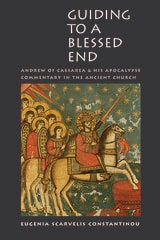
    In this interesting and insightful work, Eugenia Scarvelis Constantinou, the leading expert on Andrew of Caesarea and the first to translate his Apocalypse commentary into any modern language, identifies an exact date for the commentary and a probable recipient. Her groundbreaking book, the first ever written about Andrew, analyzes his historical milieu, education, style, methodology, theology, eschatology, and pervasive and lasting influence. She explains the direct correlation between Andrew of Caesarea and fluctuating status of the Book of Revelation in Eastern Christianity through the centuries.
    [more]