Results by title
4531 books match the query 'Cultural & Ethnic Studies' and 85 start with g
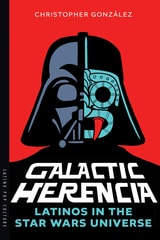
Galactic Herencia
Latinos in the Star Wars UniverseChristopher González
University of Arizona Press, 2027
In 1977, George Lucas created a galaxy far, far away that somehow contained no Latinos. Forty-seven years later, Diego Luna’s Cassian Andor speaks unapologetically accented English as he leads a rebel cell against the Empire, Pedro Pascal’s Din Djarin anchors Disney’s flagship series, and Oscar Isaac’s Poe Dameron commands X-wing squadrons with a confidence that refuses to apologize for difference. The transformation didn’t happen by accident—it was fought for character by character, film by film, against resistance both corporate and cultural.
In Galactic Herencia, Christopher González uses personal, historical, and critical reflection to trace this long arc from erasure to visibility, examining how Latinx actors bring cultural resonance to roles in a fictional universe that never explicitly acknowledges their heritage—and what it means when so few performers must carry the hopes of so many. The book moves from the painful absences of the original trilogy through the breakthrough moments of Rogue One and The Mandalorian, to the current struggles over authentic representation in an era of franchise expansion and toxic fandom. By centering Latinx perspectives on a globally dominant franchise, Galactic Herencia makes visible the cultural work that representation does—demonstrating that genuine inclusion isn’t about quotas but about empowering stories that affirm our full humanity.
Gang Nation
Delinquent Citizens In Puerto Rican, Chicano, And Chicana NarrativesMonica Brown
University of Minnesota Press, 2002
Explores how Latino gang culture mirrors the most destructive aspects of the American Dream through a look at novels and memoirs
"There’s a place for us / Somewhere a place for us." With the emergence of a rich body of literature chronicling the experiences of Latino and Latina gang members, popular understanding of this outlaw culture has advanced far beyond West Side Story. However, the diverse works discussed in this important book—ranging from the breakthrough 1967 memoir Down These Mean Streets and the crime novel Carlito’s Way to the play Zoot Suit and the World War II-era historical novel Don’t Spit on My Corner, to more recent works such as Always Running/La Vida Loca: Gang Days in L.A. and Chicana gang narratives like Locas and Two Badges—all share with the award-winning musical a crucial discourse on nationality, citizenship, and belonging.
In Gang Nation, Monica Brown offers a sophisticated analysis of these narratives produced by former gang members and by "outside" observers writing within the Latino community. She examines the ubiquity of language and behavior within this literature that reveal the frustrated longings within gangs for greater participation in America’s national culture and the desire of members to craft an alternative environment in which they are welcome. Through literature and memoirs written from within the culture, Brown illustrates how these youth mimic the rhetoric and rituals of American nationalism’s most destructive aspects—intense territoriality, justification of violence, and cultural chauvinism—to assert their citizenship in an alternative nation. Before now, studies of gang culture have centered on either the choices of individual members or the social forces that inspire their unfocused rage. But through Latino and Chicano gang literature, Brown provides a more nuanced portrait of that culture, one that raises broader concerns about dominant nationalism, civil rights, the criminalization of urban youth of color, and the often unfulfilled sense of communal identity and acceptance among American youth.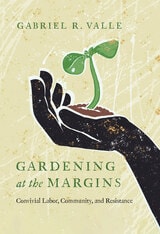
Gardening at the Margins
Convivial Labor, Community, and ResistanceGabriel R. Valle
University of Arizona Press, 2022
Participants in La Mesa Verde home garden program engage in the practices of growing and sharing food to envision and continuously work to enact alternative food systems that connect people to their food and communities. They are building on ancestral knowledge, as well as learning new forms of farming, gardening, and healing through convivial acts of sharing.
The individuals featured in the book are imagining and building alternative worlds and futures amid the very real challenges they embody and endure. Climate change, for example, is forcing thousands of migrants to urban areas, which means recent immigrants’ traditional environmental, nutritional, and healing knowledge will continue to be threatened by the pervasiveness of modernity and the homogenization of global capitalism. Moreover, once rural people migrate to urban areas, their ability to retain traditional foodways will remain difficult without spaces of autonomy. The stories in this book reveal how people create the physical space to grow food and the political space to enact autonomy to revive and restore agroecological knowledge needed for an uncertain future.
Gary Snyder and the Pacific Rim
Creating Countercultural CommunityTimothy Gray
University of Iowa Press, 2006
Gray’s introduction tracks the increased use of “Pacific Rim discourse” by politicians and business leaders following World War II. Ensuing chapters analyze Snyder’s countercultural invocation of this regional idea, concentrating on the poet’s migratory or “creaturely” sensibility, his gift for literary translation, his physical embodiment of trans-Pacific ideals, his role as tribal spokesperson for Haight-Ashbury hippies, and his burgeoning interest in environmental issues. Throughout, Gray’s citations of such writers as Allen Ginsberg, Philip Whalen, and Joanne Kyger shed light on Snyder’s communal role, providing an amazingly intimate portrait of the west coast counterculture. An interdisciplinary project that utilizes models of ecology, sociology, and comparative religion to supplement traditional methods of literary biography, Gary Snyder and the Pacific Rim offers a unique perspective on Snyder’s life and work.
This book will fascinate literary and Asian studies scholars as well as the general reader interested in the Beat movement and multicultural influences on poetry.
Gay Latino Studies
A Critical ReaderMichael Hames-García and Ernesto Javier Martínez, eds.
Duke University Press, 2011
Contributors. Tomás Almaguer, Luz Calvo, Lionel Cantú,, Daniel Contreras, Catriona Rueda Esquibel, Ramón García, Ramón A. Gutiérrez, Michael Hames-García, Lawrence La Fountain-Stokes, María Lugones, Ernesto J. Martínez, Paula M. L. Moya, José Esteban Muñoz, Frances Negrón-Muntaner, Ricardo L. Ortiz, Daniel Enrique Pérez, Ramón H. Rivera-Servera, Richard T. Rodríguez, David Román, Horacio N. Roque Ramírez, Antonio Viego
Gaza on Screen
Nadia Yaqub, editor
Duke University Press, 2023
Contributors. Nayrouz Abu Hatoum, Shahd Abusalama, Samirah Alkassim, Basma Alsharif, Hadeel Assali, Azza El-Hassan, Hatim El-Hibri, Mohamed Jabaly, Ahmed Mansour, Arab Nasser, Tarzan Nasser, Kamran Rastegar, Viviane Saglier, Abdelsalam Shehada, Yaron Shemer, Rebecca L. Stein, Helga Tawil-Souri, Shaira Vadasaria, Nadia Yaqub

Gender Is a Weapon
Liberalism, Difference, and US CounterinsurgencyElizabeth Mesok
University of Michigan Press, 2026
Following the end of the draft in 1973, the US military increasingly offered women the opportunity to transform their lives—to obtain an education, receive healthcare, provide for their families, and prove their worth to the nation. By the time the US invaded Iraq and Afghanistan at the turn of the twenty-first century, the labor of women—and Black women in particular—was critical to the military’s ability to simultaneously wage two wars. Within the context of counterinsurgencies fought amid civilian populations, the US military discovered the value of women’s gender difference as a weapon of war.
Through ethnographic and archival research with women soldiers and Marines, as well as military and government officials, Gender Is a Weapon contextualizes women’s service in Iraq and Afghanistan against the promises of liberal inclusion unfolding throughout the late twentieth and early twenty-first century. Centered on narratives of Black and Indigenous women, women of color, immigrant women, and queer women, the book analyzes the transformations of martial citizenship; the racialized language of cultural difference in the US’s revitalized counterinsurgency doctrine; the gendered performances of women in combat and civilian engagement missions; and ultimately, the irreparable injuries of body and mind with which these women returned home. The epilogue discusses the recent dismantling of DEI in the military and US government more broadly, reflecting on what we can learn from the violent history of military liberal inclusion to help us better understand our contemporary moment. By carefully attending to both the discursive construction and performative enactment of gender in militarized and securitized contexts, the book advances theoretical frames for studying gender in state militaries, militarism, and late liberalism.
Gender Violence at the U.S.–Mexico Border
Media Representation and Public ResponseEdited by Héctor Domínguez-Ruvalcaba and Ignacio Corona
University of Arizona Press, 2012
Gender in Latin America
Chant, Sylvia
Rutgers University Press, 2002
In Latin America, gender is a fundamental dimension of virtually every aspect of contemporary social, economic, and political life. Gender in Latin America is a comprehensive state-of-the-art review of gender in the region at the start of the twenty-first century. The authors draw on a wide range of research, including their own field-based expertise, to illuminate the importance of diversity in gender in this region. Debunking traditional stereotypes, the book charts changes and continuities in gender roles, relations and identities associated with the growing evidence produced by feminist scholarship and activism in the continent.
Chapters are arranged around themes such as gender and poverty, gender and population, gender and health, and gender and employment. Each chapter begins with an introduction to the core issues, and debates in the relevant field in order to set specific regional experiences within their global as well as regional contexts. The authors also refer to new bodies of literature on the subject, including those on men and masculinity, fatherhood, and sexuality.
Gendered Fortunes
Divination, Precarity, and Affect in Postsecular TurkeyZeynep K. Korkman
Duke University Press, 2023
Gendered Memories
An Imaginary Museum for Ding Ling and Chinese Female Revolutionary MartyrsXian Wang
University of Michigan Press, 2025
Gendering Politics
Women in IsraelHanna Herzog
University of Michigan Press, 1999
Genealogies of Joy
The Pleasure of Latinx LiteratureEdited by Leigh Johnson and Erin Murrah-Mandril; Foreword by Melina Vizcaíno-Alemán
University of Arizona Press, 2027
What does it mean to center joy in a world that insists on Latinx suffering? Genealogies of Joy: The Pleasure of Latinx Literature argues that joy is not a luxury or distraction but a radical, sustaining force woven through Latinx literature and culture. From humor and food to protest, friendship, sexuality, and aging, the essays gathered here reveal joy as an embodied, communal practice—one that refuses racialized shame and imagines liberatory futures.
Organized into three sections—Memory, Method, and Maps—the volume traces a genealogy of joy across time and space. Contributors explore how writers such as Gloria Anzaldúa, Julia de Burgos, Erika Sánchez, Javier Zamora, Myriam Gurba, Aidan Thomas, and Sandra Cisneros transform grief into resilience, invert dominant narratives, and reclaim pleasure as political praxis. Whether through irreverent laughter, queer desire, culinary memory, or vulnerable resistance, Latinx authors insist that pleasure and politics are bound together.
Engaging affect theory, Black joy scholarship, borderlands studies, and archival studies, this collection asserts that Latinx joy resists the quantification and commodification of late-stage capitalism. At once rigorous and celebratory, Genealogies of Joy invites readers to recognize joy as a human right and a vital source of connection, creativity, and collective flourishing.
Contributors
Soffía Blystra
Norma Cantú
Margaret Cantú-Sánchez
Karina Diaz
Stephanie Fetta
Elena Foulis
Eva Maria Geicht
Leigh Johnson
Mark J. Mascia
Regina Marie Mills
Erin Murrah-Mandril
Jeannine Ortega
Nancy Ríos
Rey M. Rodríguez
Rosarito Rodríguez-González
Alexandra Rodríguez Sabogal
Karen Roybal
Bianca S. Rubalcava
Suzanne Uzzilia
Natalia Villanueva-Nieves
Melina Vizcaíno-Alemán
Generations of Exclusion
Mexican-Americans, Assimilation, and RaceEdward E. Telles
Russell Sage Foundation, 2008

Generous Betrayal
Politics of Culture in the New EuropeUnni Wikan
University of Chicago Press, 2002
Comparing her native Norway to Western Europe and the United States, Wikan focuses on people caught in turmoil, how institutions function, and the ways in which public opinion is shaped and state policies determined. Contradictions arise between policies of respect for minority cultures, welfare, and freedom, but the goal is the same: to create a society committed to both social justice and respect for human rights.
Writing with power and grace, Wikan makes a plea for a renewed moral vitality and human empathy that can pave the way for more effective social policies and create change.
Genetic Afterlives
Black Jewish Indigeneity in South AfricaNoah Tamarkin
Duke University Press, 2020
Genetics and the Unsettled Past
The Collision of DNA, Race, and HistoryWailoo, Keith
Rutgers University Press, 2012
Our genetic markers have come to be regarded as portals to the past. Analysis of these markers is increasingly used to tell the story of human migration; to investigate and judge issues of social membership and kinship; to rewrite history and collective memory; to right past wrongs and to arbitrate legal claims and human rights controversies; and to open new thinking about health and well-being. At the same time, in many societies genetic evidence is being called upon to perform a kind of racially charged cultural work: to repair the racial past and to transform scholarly and popular opinion about the “nature” of identity in the present.
Genetics and the Unsettled Past considers the alignment of genetic science with commercial genealogy, with legal and forensic developments, and with pharmaceutical innovation to examine how these trends lend renewed authority to biological understandings of race and history.
This unique collection brings together scholars from a wide range of disciplines—biology, history, cultural studies, law, medicine, anthropology, ethnic studies, sociology—to explore the emerging and often contested connections among race, DNA, and history. Written for a general audience, the book’s essays touch upon a variety of topics, including the rise and implications of DNA in genealogy, law, and other fields; the cultural and political uses and misuses of genetic information; the way in which DNA testing is reshaping understandings of group identity for French Canadians, Native Americans, South Africans, and many others within and across cultural and national boundaries; and the sweeping implications of genetics for society today.
Genital Cutting and Transnational Sisterhood
DISPUTING U.S. POLEMICSEdited by Stanlie M. James and Claire C. Robertson
University of Illinois Press, 2002
In five provocative essays, the contributors to this timely volume challenge representations of FGC through a range of perspectives: history, human rights, law, missionary feminism, cultural relativism, anthropology, and the intersex movement. Balancing feminist ideals with culturally conscious approaches, they dispel sensationalized and widely accepted concepts that influence Western media, law, and feminist thought on FGC, including the ignorance and oversimplification of African history, cultures, and religions, and an exaggeration of the extent and geographical distribution of the various procedures performed. The assumption that FGC does not occur presently in the United States is also considered. From Alice Walker and Pratibha Parmar's documentary film Warrior Marks to mainstream media and prime time television, Genital Cutting and Transnational Sisterhood critiques the sources that perpetuate the harmful myths that all African women have been mutilated and promote doing so to their children, that those who perform it are barbaric, and that families who allow it are abusive.
With sensitivity and clarity, the contributors to Genital Cutting and Transnational Sisterhood provide necessary and alternative suggestions for the eradication of the most harmful procedures--which they feel can only occur when the leadership of African women in the ongoing campaigns is acknowledged and supported, and when income generation for African women and education of the U.S. public, rather than criminalization, become primary strategies.
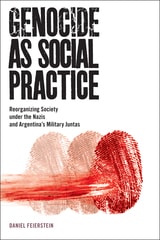
Genocide as Social Practice
Reorganizing Society under the Nazis and Argentina's Military Juntasby Daniel Feierstein, Translated by Douglas Andrew Town
Rutgers University Press, 2014
The Nazis resorted to ruthless methods in part to stifle dissent but even more importantly to reorganize German society into a Volksgemeinschaft, or people’s community, in which racial solidarity would supposedly replace class struggle. The situation in Argentina echoes this. After seizing power in 1976, the Argentine military described its own program of forced disappearances, torture, and murder as a “process of national reorganization” aimed at remodeling society on “Western and Christian” lines.
For Feierstein, genocide can be considered a technology of power—a form of social engineering—that creates, destroys, or reorganizes relationships within a given society. It influences the ways in which different social groups construct their identity and the identity of others, thus shaping the way that groups interrelate. Feierstein establishes continuity between the “reorganizing genocide” first practiced by the Nazis in concentration camps and the more complex version—complex in terms of the symbolic and material closure of social relationships —later applied in Argentina. In conclusion, he speculates on how to construct a political culture capable of confronting and resisting these trends.
First published in Argentina, in Spanish, Genocide as Social Practice has since been translated into many languages, now including this English edition. The book provides a distinctive and valuable look at genocide through the lens of Latin America as well as Europe.
Download open access ebook here.
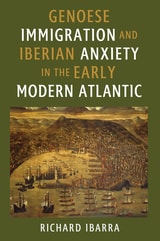
Genoese Immigration and Iberian Anxiety in the Early Modern Atlantic
Richard Ibarra
University of Delaware Press, 2027
This book explores the experiences of Genoese immigrants in the sixteenth-century Iberian Atlantic, focusing on how they navigated issues of identity and community membership across generations and transnational movement. Moving to cities like Seville, as well as Santo Domingo and Mexico City, Genoese families encountered both tremendous opportunities and significant challenges in establishing their lives, reaching a communal apogee—the “Genoese Century”—while they faced increasing Iberian anxieties. While some found ways to integrate into Iberian society through religious and charitable activities, retaining references to their Genoese past, others dissimulated or renounced their Genoese identity. Through a combination of notarial and inquisition records, litigation to prove nobility (hidalguía) and purity of blood (limpieza de sangre), literary narratives, and funerary monuments, Richard Ibarra provides insights into the changing identity claims of Genoese families and the broader attitudes toward foreigners in Iberian society that reached beyond perceived religious and ethnic difference.
Geographical Sources of Ming-Qing History
Timothy Brook
University of Michigan Press, 2002
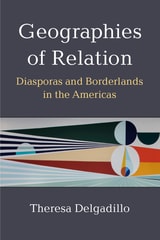
Geographies of Relation
Diasporas and Borderlands in the AmericasTheresa Delgadillo
University of Michigan Press, 2024
Not only does Delgadillo offer a rare extended analysis of Black Latinidades in Chicanx literature and theory, but she also considers over a century’s worth of literary, cinematic, and performative texts to support her argument about the significance of these cultural sites and overlaps. Chapters illuminate the significance of Toña La Negra in the Golden Age of Mexican cinema, reconsider feminist theorist Gloria Anzaldúa’s work in revising exclusionary Latin American ideologies of mestizaje, delve into the racial and gender frameworks Sandra Cisneros attempts to rewrite, unpack encounters between African Americans and Black Puerto Ricans in texts by James Baldwin and Marta Moreno Vega, explore the African diaspora in colonial and contemporary Peru through Daniel Alarcón’s literature and the documentary Soy Andina, and revisit the centrality of Black power in ending colonialism in Cuban narratives. Geographies of Relation demonstrates the long histories of networks and exchanges across the Americas as well as the interrelationships among Indigenous, Black, African American, mestizx, Chicanx, and Latinx peoples. It offers a compelling argument that geographies of relation are as significant as national frameworks in structuring cultural formation and change in this hemisphere.
Geographies of the Ear
The Cultural Politics of Sound in Contemporary BarcelonaTania Gentic
Duke University Press, 2025
Georges Woke Up Laughing
Long-Distance Nationalism and the Search for HomeNina Glick Schiller and Georges Eugene Fouron
Duke University Press, 2001
According to a long-standing myth, once emigrants leave their homelands—particularly if they emigrate to the United States—they sever old nationalistic ties, assimilate, and happily live the American dream. In fact, many migrants remain intimately and integrally tied to their ancestral homeland, sometimes even after they become legal citizens of another country. In Georges Woke Up Laughing the authors reveal the realities and dilemmas that underlie the efforts of long-distance nationalists to redefine citizenship, race, nationality, and political loyalty. Through discussions of the history and economics that link the United States with countries around the world, Glick Schiller and Fouron highlight the forces that shape emigrants’ experiences of government and citizenship and create a transborder citizenry. Arguing that governments of many countries today have almost no power to implement policies that will assist their citizens, the authors provide insights into the ongoing sociological, anthropological, and political effects of globalization.
Georges Woke up Laughing will entertain and inform those who are concerned about the rights of people and the power of their governments within the globalizing economy.
“In my dream I was young and in Haiti with my friends, laughing, joking, and having a wonderful time. I was walking down the main street of my hometown of Aux Cayes. The sun was shining, the streets were clean, and the port was bustling with ships. At first I was laughing because of the feeling of happiness that stayed with me, even after I woke up. I tried to explain my wonderful dream to my wife, Rolande. Then I laughed again but this time not from joy. I had been dreaming of a Haiti that never was.”—from Georges Woke Up Laughing

German Orientalisms
Todd Kontje
University of Michigan Press, 2004
-Russell Berman, Stanford University
"Intellectually rigorous and conceptually nuanced, Todd Kontje's German Orientalisms is a valuable contribution to the debate on identity politics in German cultural history. Through an erudite and insightful analysis of the German fictions of a broadly defined 'Orient' from the Middle Ages to the present, Kontje illustrates how German literature situated itself within a 'symbolic geography,' whose coordinates are defined by both its representations of the Orient and its affiliation with the Occident. German Orientalisms offers not only an admirable synthesis of the scholarship on German linguistic and cultural nationalism but also sophisticated interpretive strategies for a better understanding of our perceptions and misconceptions of alterity."
-Azade Seyhan, Bryn Mawr College
"This is a fascinating topic, and the book opens new scholarly vistas. In an age of increased specialization, Kontje takes a macro view, looking at German literature almost
from its beginnings to the present, from Wolfram to Özdamar. He also has the courage to link his well-researched work to topics like globalization, the culture wars, and canon formation. He doesn't merely proclaim literature's importance, he shows by example how the literary imagination-creative as it is, dodging dogmatism, and able to confound ideologies-can thrive in an era of cultural studies."
-Sara Friedrichsmeyer, University of Cincinnati
Todd Kontje's German Orientalisms offers a fresh examination of the role of the East in German literary imagination, ranging from the Middle Ages to the present. In its wide historical sweep, this book offers important new insights into many of the most famous writers in the German language, from Goethe to Thomas Mann to Günter Grass.
Building on Edward Said's Orientalism-which defined Orientalism as a form of Western knowledge directly linked to imperial power-Kontje offers a more nuanced version as seen through the lens of German literature of the last thousand years.
Said's focus was on British and French Orientalists-two nations with colonial interests in the East. Germany was different in that it had no stake in the Orient. Far from diminishing an Orientalist perspective, however, the absence of a German empire in the East produced a peculiarly German brand of Orientalism, one in which German writers alternated between identification with the rest of Europe and allying themselves with parts of the East against the West.
Above all, Kontje asks how German writers conceived of their place in "the land of the center" (das Land der Mitte) and how their literary works help to create the imagined community of the German nation.
Germans in Illinois
Miranda E. Wilkerson and Heather Richmond
Southern Illinois University Press, 2019
The promise of cheap land and fertile soil in rural areas and emerging industries in cities attracted three major waves of German-speaking immigrants to Illinois in search of freedom and economic opportunities. Before long the state was dotted with German churches, schools, cultural institutions, and place names. German churches served not only as meeting places but also as a means of keeping language and culture alive. Names of Illinois cities and towns of German origin include New Baden, Darmstadt, Bismarck, and Hamburg. In Chicago, many streets, parks, and buildings bear German names, including Altgeld Street, Germania Place, Humboldt Park, and Goethe Elementary School. Some of the most lively and ubiquitous organizations, such as Sängerbunde, or singer societies, and the Turnverein, or Turner Society, also preserved a bit of the Fatherland.
Exploring the complex and ever-evolving German American identity in the growing diversity of Illinois’s linguistic and ethnic landscape, this book contextualizes their experiences and corrects widely held assumptions about assimilation and cultural identity. Federal census data, photographs, lively biographical sketches, and newly created maps bring the complex story of German immigration to life. The generously illustrated volume also features detailed notes, suggestions for further reading, and an annotated list of books, journal articles, and other sources of information.

Germany
A Modern HistoryMarshall Dill
University of Michigan Press, 1961

Gernika, 1937
The Market Day MassacreXabier Irujo
University of Nevada Press, 2015
To produce this detailed analysis of the political and military background of the attack and its subsequent international impact, Xabier Irujo examined archives and official government documents in several countries and conducted numerous interviews with Basques who survived. His account of the assault itself, based on eyewitness reports from both victims and attackers, vividly recalls the horror of that first example of the blitz bombing that served the Germans during the first years of World War II. He reveals the US and British governments’ reaction to the bombing and also discusses efforts to prosecute the perpetrators for war crimes. Irujo relates the ways in which the massacre has been remembered and commemorated in Gernika and throughout the worldwide Basque diaspora.
Gernika, 1937: The Market Day Massacre is an important contribution to the history of the Spanish Civil War and to our understanding of the military strategies and decisions that shaped this war and would later be employed by the Nazis during World War II.
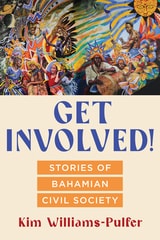
Get Involved!
Stories of Bahamian Civil SocietyKim Williams-Pulfer
Rutgers University Press, 2024
Junkanoo is the national cultural festival of The Bahamas. It fosters a sense of community pride, identity, companionship, spirituality and unity. Watch a video about Junknoo:
https://www.youtube.com/watch?v=tnMpMesNb1Q&t=14s

Get Yo' Life
Black Queer PlacemakingR. J. Millhouse
The Ohio State University Press, 2025

Getting Around in Chinese
Chinese Skits for BeginnersHilda H. Tao
University of Michigan Press, 2000
Ghost Woman
A RisingCrystal Simone Smith
Duke University Press, 2026

Ghostlife of Third Cinema
Asian American Film and VideoGlen M. Mimura
University of Minnesota Press, 2009
An interpretive history of Asian American independent media since the 1960s
Asian American filmmakers and video artists have created a substantial, diverse, and challenging body of work that reimagines the cultural and political representation of Asian Americans. Yet much of this work remains unknown.
For Glen M. Mimura, Asian American cinema is the spectral, ghostly return of the international film movement known as Third Cinema. Tracing contemporary Asian American cinema as a continuation of Third Cinema’s radical enterprise of making marginalized subjects visible in the First World, Ghostlife of Third Cinema examines such potent issues as diasporic identity, historical memory, and queer sexuality through sophisticated readings of a wide range of film and video projects, including Trinh T. Minh-ha’s experimental documentary Surname Viet Given Name Nam; avant-garde works by Japanese American filmmakers Rea Tajiri, Lise Yasui, and Janice Tanaka; and queer videos exploring the intersection of race, nation, and sexuality by Pablo Bautista, Ming-Yuen Ma, and Nguyen Tan Hoang. In Ghostlife of Third Cinema, Mimura confronts the ongoing erasure of Asian American independent media andilluminates its cultural and political significance today.
Ghosts Of Slavery
A Literary Archaeology of Black Women’s LivesJenny Sharpe
University of Minnesota Press, 2002
Questions traditional assumptions about power and agency in slave women’s everyday lives.
Through their open defiance, women like Harriet Tubman and Sojourner Truth had a significant impact on the institution of slavery. But what of the countless other women who did not commit public or even private acts of resistance? Are their stories worthy of our attention? While some scholars imply that only the struggle for freedom was legitimate, Jenny Sharpe complicates the linear narrative-from slavery to freedom and literacy-that emerged from the privileging of autobiographical accounts like that of Frederick Douglass. She challenges a paradigm that equates agency with resistance and self-determination, and introduces new ways to examine negotiations for power within the constraints of slavery.
In Ghosts of Slavery, Sharpe introduces a wider range of everyday practices by examining the lives of three distinctive Caribbean women: a maroon leader, a mulatto concubine, and a fugitive slave. Through them she explains how the diasporic experience of slavery enabled black women to claim an authority that they didn’t possess in Africa, how concubines empowered themselves through their mimicry of white women, and how less-privileged slave women manipulated situations that they were powerless to change. Finding the highly mediated portrayal of slave women in the historical records limited and sometimes misleading, Sharpe turns to unconventional sources for investigating these women’s lives. In this fascinating and historically rich account, she calls for new strategies of reading that question traditional narratives of history, and she finds alternative ways to integrate oral storytelling, slave songs, travel writing, court documents, proslavery literature, and contemporary literature into black history. Ultimately, this layered approach not only produces a more complex picture of the slave women’s agency than conventional readings, it encourages a more nuanced understanding of the roles of slaves in the history of slavery.
Ghosts in the Schoolyard
Racism and School Closings on Chicago's South SideEve L. Ewing
University of Chicago Press, 2018
That’s how Eve L. Ewing opens Ghosts in the Schoolyard: describing Chicago Public Schools from the outside. The way politicians and pundits and parents of kids who attend other schools talk about them, with a mix of pity and contempt.
But Ewing knows Chicago Public Schools from the inside: as a student, then a teacher, and now a scholar who studies them. And that perspective has shown her that public schools are not buildings full of failures—they’re an integral part of their neighborhoods, at the heart of their communities, storehouses of history and memory that bring people together.
Never was that role more apparent than in 2013 when Mayor Rahm Emanuel announced an unprecedented wave of school closings. Pitched simultaneously as a solution to a budget problem, a response to declining enrollments, and a chance to purge bad schools that were dragging down the whole system, the plan was met with a roar of protest from parents, students, and teachers. But if these schools were so bad, why did people care so much about keeping them open, to the point that some would even go on a hunger strike?
Ewing’s answer begins with a story of systemic racism, inequality, bad faith, and distrust that stretches deep into Chicago history. Rooting her exploration in the historic African American neighborhood of Bronzeville, Ewing reveals that this issue is about much more than just schools. Black communities see the closing of their schools—schools that are certainly less than perfect but that are theirs—as one more in a long line of racist policies. The fight to keep them open is yet another front in the ongoing struggle of black people in America to build successful lives and achieve true self-determination.

Girl Power?
A History of Girl-Focused Development from NairobiSarah Bellows-Blakely
University of Chicago Press, 2025
Girl-focused education programs have long been at the heart of international policymaking—when girls’ access to education is ensured, the reasoning goes, they are more likely to turn into productive adults who can drive economic growth. These ideas combine strands of feminism and capitalism that have a specific and understudied origin. In this book, historian Sarah Bellows-Blakely shows how a doctored study of girls’ education in East and Southern Africa led to the creation of international norms in the United Nations that would go on to guide policymaking on women’s rights and economic growth, promoting neoliberal feminist policy at the expense of other forms of gender-based justice.
Focusing on the growth of free-market feminism and girl-focused economic development planning through the relationship between UNICEF and the Nairobi-based NGO FEMNET, Bellows-Blakely reveals how their joint efforts set the blueprints for linked movements of economic development and women’s rights that are still ongoing. Through a narrative of the UNICEF-FEMNET lobbying campaign, Bellows-Blakely shows how multiple, contested girl-focused visions of economic programming and gender justice became selectively erased in favor of an approach to global policy centered on the free-market construction and strategic deployment of the African “girl child.”
Giving Back
Filipino America and the Politics of Diaspora GivingL. Joyce Zapanta Mariano
Temple University Press, 2021
Many Filipino Americans feel obligated to give charitably to their families, their communities, or social development projects and organizations back home. Their contributions provide relief to poor or vulnerable Filipinos, and address the forces that maintain poverty, vulnerability, and exploitative relationships in the Philippines. This philanthropy is a result of both economic globalization and the migration of Filipino professionals to the United States. But it is also central to the moral economies of Filipino migration, immigration, and diasporic return. Giving-related practices and concerns—and the bonds maintained through giving—infuse what it means to be Filipino in America.
Giving Back shows how integral this system is for understanding Filipino diaspora formation. Joyce Mariano “follows the money” to investigate the cultural, social, economic, and political conditions of diaspora giving. She takes an interdisciplinary approach to reveal how power operates through this charity and the ways the global economic and cultural dimensions of this practice reinforce racial subordination and neocolonialism. Giving Back explores how this charity can stabilize overlapping systems of inequality as well as the contradictions of corporate social responsibility programs in diaspora.
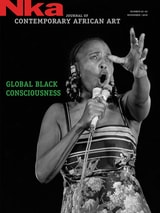
Global Black Consciousness
Natalie Natalie Crawford and Salah M. Hassan, special issue editors
Duke University Press, 2018
Contributors: Hisham Aidi, Souleymane Bachir Diagne, Ahmed Bedjaoui, Margo Natalie Crawford, Romi Crawford, Lydie Diakhaté, Manthia Diawara, Amanda Gilvin, Salah M. Hassan, Shannen Hill, Tsitsi Jaji, Barbara Murray, Zita Nunes, Ugochukwu-Smooth C. Nzewi, Richard J. Powell, Holiday Powers, Shana L. Redmond, Penny M. Von Eschen, Dagmawi Woubshet
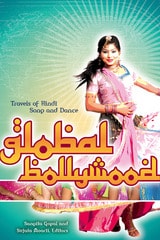
Global Bollywood
Travels of Hindi Song and DanceSangita Gopal
University of Minnesota Press, 2008
Bollywood movies and their signature song-and-dance spectacles are an aesthetic familiar to people around the world, and Bollywood music now provides the rhythm for ads marketing goods such as computers and a beat for remixes and underground bands. These musical numbers have inspired scenes in Western films such as Vanity Fair and Moulin Rouge.
Global Bollywood shows how this currency in popular culture and among diasporic communities marks only the latest phase of the genre’s world travels. This interdisciplinary collection describes the many roots and routes of the Bollywood song-and-dance spectacle. Examining the reception of Bollywood music in places as diverse as Indonesia and Israel, the essays offer a stimulating redefinition of globalization, highlighting the cultural influence of Hindi film music from its origins early in the twentieth century to today.
Contributors: Walter Armbrust, Oxford U; Anustup Basu, U of Illinois, Urbana-Champaign; Nilanjana Bhattacharjya, Colorado College; Edward K. Chan, Kennesaw State U; Bettina David, Hamburg U; Rajinder Dudrah, U of Manchester; Shanti Kumar, U of Texas, Austin; Monika Mehta, Binghamton U; Anna Morcom, Royal Holloway College; Ronie Parciack, Tel Aviv U; Biswarup Sen, U of Oregon; Sangita Shrestova; Richard Zumkhawala-Cook, Shippensburg U.
Sangita Gopal is assistant professor of English at the University of Oregon. Sujata Moorti is professor of women’s and gender studies at Middlebury College.
Global Storytelling, vol. 4, no. 2
Netflix and East Asian Audiovisual Culture (Winter 2024)Special Issue Editor: Dal Yong Jin
Michigan Publishing Services, 2024
Global Storytelling, vol. 5, no. 1
Digital Narratives in Transnational Circulation: Power, Vulnerability, and Creative PossibilitySpecial Issue Editors: Jun Lei and Shaohua Guo
Michigan Publishing Services, 2025
Global Storytelling: Journal of Digital and Moving Images, housed at the Academy of Film and published by Michigan Publishing, is an open access, peer-reviewed international and interdisciplinary journal for intellectual debates concerning the politics, economics, culture, media, and technology of the moving image.
Global Storytelling, vol. 5, no. 2
Visual Storytelling and Entrepreneurship: The Representations of Daily LifeSpecial Issue Editors: Erick Behar-Villegas and Víctor Manuel Jiménez-Rodríguez
Michigan Publishing Services, 2026
Global Storytelling: Journal of Digital and Moving Images, housed at the Academy of Film and published by Michigan Publishing, is an open access, peer-reviewed international and interdisciplinary journal for intellectual debates concerning the politics, economics, culture, media, and technology of the moving image.
Globalization and Race
Transformations in the Cultural Production of BlacknessKamari Maxine Clarke and Deborah A. Thomas, eds.
Duke University Press, 2006
A number of the essays bring to light the formative but not unproblematic influence of African American identity on other populations within the black diaspora. Among these are an examination of the impact of “black America” on racial identity and politics in mid-twentieth-century Liverpool and an inquiry into the distinctive experiences of blacks in Canada. Contributors investigate concepts of race and space in early-twenty-first century Harlem, the experiences of trafficked Nigerian sex workers in Italy, and the persistence of race in the purportedly non-racial language of the “New South Africa.” They highlight how blackness is consumed and expressed in Cuban timba music, in West Indian adolescent girls’ fascination with Buffy the Vampire Slayer, and in the incorporation of American rap music into black London culture. Connecting race to ethnicity, gender, sexuality, nationality, and religion, these essays reveal how new class economies, ideologies of belonging, and constructions of social difference are emerging from ongoing global transformations.
Contributors. Robert L. Adams, Lee D. Baker, Jacqueline Nassy Brown, Tina M. Campt, Kamari Maxine Clarke, Raymond Codrington, Grant Farred, Kesha Fikes, Isar Godreau, Ariana Hernandez-Reguant, Jayne O. Ifekwunigwe, John L. Jackson Jr., Oneka LaBennett, Naomi Pabst, Lena Sawyer, Deborah A. Thomas
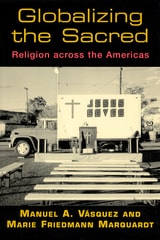
Globalizing the Sacred
Religion Across the AmericasVásquez, Manuel A
Rutgers University Press, 2003
French and German tourists join Mexican migrant workers to venerate the image of the Virgin Mary at a strip mall in Florida; Latino gang members, deported from the United States to home countries they barely know, find Jesus in transnational churches; U.S. evangelicals use electronic media to preach a “neo liberal” gospel of wealth and health to landless peasants in remote indigenous villages in Guatemala. These are just some examples of how religion in the Americas today intersects in complex ways with the economic, political, and cultural dimensions of globalization.
Drawing on case studies in the United States and Latin America, Manuel A. Vásquez and Marie Friedmann Marquardt explore the evolving roles of religion in the Americas in the face of globalization, transnational migration, the rapid growth of culture industries, the rise of computer mediated technologies, and the crisis of modernity. Combining ethnographic research in local congregations, studies of material culture and sacred space, textual analyses, and approaches to mass and electronic media, the authors challenge dominant paradigms in sociology of religion, such as the secularization and rational choice models. Further, the book offers alternative theoretical and methodological tools to understand the increasing complexity of religious life in the Americas.
By illustratingthe challenges that scholars and students must confront in order to understand the complexity of today’s religious landscape, Globalizing the Sacred makes both important theoretical and methodological contributions to the study of religion’s role in social change.

Globetrotting
African American Athletes and Cold War PoliticsDamion L. Thomas
University of Illinois Press, 2012
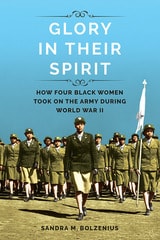
Glory in Their Spirit
How Four Black Women Took On the Army during World War IISandra M Bolzenius
University of Illinois Press, 2018
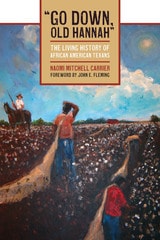
Go Down, Old Hannah
The Living History of African American TexansBy Naomi Mitchell Carrier
University of Texas Press, 2010
Living history is a style of instructive and entertaining performance that seeks to bring history to life with the use of costumes, tools, and reenactments appropriate to a specific time period. Done well, living history performances illuminate human experience in powerful, unforgettable ways.
The fifteen living history plays in this collection were commissioned by museums and historic sites in Texas to show the interdependence of African American experiences and contributions to the living history of Texas. The plays cover subject matter ranging from slave celebrations, family breakups, and running away, to the Civil War, emancipation, and Reconstruction. Each play is research based and performed by Talking Back Living History Theatre as a festival production. These scripts are easily performed, and author Naomi Mitchell Carrier has included production notes in the overviews that precede each play. Lesson plans are also included, which add to the collection's appeal as a classroom tool.
Carrier's talent for bringing historical figures to life is exceptional. The names of most primary characters in these plays are real. By giving them faces, feelings, intelligence, and dignity, Carrier aims to give them new life.
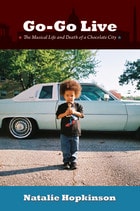
Go-Go Live
The Musical Life and Death of a Chocolate CityNatalie Hopkinson
Duke University Press, 2012
Go-Go Live is a social history of black Washington told through its go-go music and culture. Encompassing dance moves, nightclubs, and fashion, as well as the voices of artists, fans, business owners, and politicians, Natalie Hopkinson's Washington-based narrative reflects the broader history of race in urban America in the second half of the twentieth century and the early twenty-first. In the 1990s, the middle class that had left the city for the suburbs in the postwar years began to return. Gentrification drove up property values and pushed go-go into D.C.'s suburbs. The Chocolate City is in decline, but its heart, D.C.'s distinctive go-go musical culture, continues to beat. On any given night, there's live go-go in the D.C. metro area.
God and Government in the Ghetto
The Politics of Church-State Collaboration in Black AmericaMichael Leo Owens
University of Chicago Press, 2007
But as Michael Leo Owens demonstrates in God and Government in the Ghetto, this alliance also serves as a means for black clergy to reaffirm their political leadership and reposition moral authority in black civil society. Drawing on both survey data and fieldwork in New York City, Owens reveals that African American churches can use these newly forged connections with public agencies to influence policy and government responsiveness in a way that reaches beyond traditional electoral or protest politics. The churches and neighborhoods, Owens argues, can see a real benefit from that influence—but it may come at the expense of less involvement at the grassroots.
Anyone with a stake in the changing strategies employed by churches as they fight for social justice will find God and Government in the Ghetto compelling reading.

God's Waiting Room
Racial Reckoning at Life's EndCasey Golomski
Rutgers University Press, 2025
Winner of the Elliott P. Skinner Award from the Association of Africanist Anthropology, part of the American Anthropological Association
Third Place in the Victor Turner Prize in Ethnographic Writing from the American Anthropological Association's Society for Humanistic Anthropology
Can older racists change their tune, or will they haunt us further once they're gone? Rich in mystery and life's lessons, God's Waiting Room considers what matters in the end for older white adults and the younger Black nurses who care for them. An innovation in creative nonfiction, Casey Golomski's story of his years of immersive research at a nursing home in South Africa, thirty years after the end of apartheid, is narrated as a one-day, room-by-room tour. The story is told in breathtakingly intimate and witty conversations with the home's residents and nurses, including the untold story of Nelson Mandela's Robben Island prison nurse, and readers learn how ageism, sexism, and racism intersect and impact health care both in South Africa and in the United States, as well as create conditions in which people primed to be enemies find grace despite the odds.
Course or Book Club Reading and Discussion Guide (https://dhjhkxawhe8q4.cloudfront.net/rup-wp-v2/wp-content/uploads/2025/02/04135941/gods-waiting-room_reading-questions.pdf)
For copyright reasons, this edition is not available in the South African Development Community and Kenya.