Results by title
1993 books match the query 'Latin America' and 35 start with g
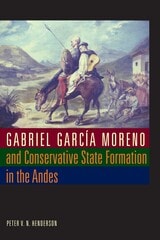
Gabriel García Moreno and Conservative State Formation in the Andes
By Peter V. N. Henderson
University of Texas Press, 2008
This book explores the life and times of Ecuador's most controversial politician within the broader context of the new political history, addressing five major themes of nineteenth-century Latin American history: the creation of political networks, the divisiveness of regionalism, the bitterness of the liberal-conservative ideological divide, the complicating problem of caudillismo, and the quest for progress and modernization.
Two myths traditionally associated with García Moreno's rule are debunked. The first is that he created a theocracy in Ecuador. Instead, the book argues that he negotiated a concordat with the Papacy giving the national government control over the church's secular responsibilities, and subordinated the clergy, many of whom were highly critical of García Moreno, to the conservative state. A second, frequently repeated generalization is that he created a conservative dictatorship out of touch with the liberal age in which he lived. Instead, the book argues that moderates held sway during the first nine years of García Moreno's period of influence, and only during his final term did he achieve the type of conservative state he thought necessary to advance his progressive nation-building agenda.
In sum, this book enriches our understanding of many of the notions of state formation by suggesting that conservatives like García Moreno envisioned a program of material progress and promoting national unity under a very different formula from that of nineteenth-century liberals.

Gender and Sexuality in Latin America, Volume 81
Gilbert M. Joseph, ed.
Duke University Press, 0
Sueann Caulfield, one of the most distinguished scholars of Latin American gender studies, leads off with an insightful historiographical analysis of the field. Building on the foundation laid by Caulfield, a forum of four younger scholars—Heidi Tinsman, Karin Rosemblatt, Elizabeth Hutchinson, and Thomas Klubock—examines the construction of gender and power in a variety of politically contested arenas, including agrarian reform, welfarism, and leftist activism. Focusing on twentieth-century Chile, the collection also includes essays by Pablo Piccato and Christina Rivera that analyze gender dynamics, class relations, and sexual violence in the context of the medical-legal state that emerged in early-twentieth-century Mexico. The issue concludes with Martin Nesvig’s essay, which negotiates the complex terrain of Latin American homosexuality and bisexuality.
This special issue will be a valuable resource for anyone teaching women’s history, gender history, the history of sexuality, or any course on Latin American history with a focus on gender and sexuality.
Contributors. Sueann Caulfield, Elizabeth Quay Hutchison, Gilbert M. Joseph, Thomas J. Klubock, Martin Nesvig, Pablo Piccato, Cristina Rivera Garza, Karin Rosemblatt, Heidi Tinsman
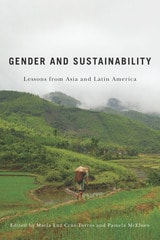
Gender and Sustainability
Lessons from Asia and Latin AmericaEdited by María Luz Cruz-Torres and Pamela McElwee
University of Arizona Press, 2012
Bringing together case studies from Asia and Latin America, this valuable collection adds new knowledge to our understanding of the interplay between local and global processes. Organized broadly by three major issues—forests, water, and fisheries—the scholarship ranges widely: the gender dimensions of the illegal trade in wildlife in Vietnam; women and development issues along the Ganges River; the role of gender in sustainable fishing in the Philippines; women’s inclusion in community forestry in India; gender-based confrontations and resistance in Mexican fisheries; environmentalism and gender in Ecuador; and women’s roles in managing water scarcity in Bolivia and addressing sustainability in shrimp farming in the Mekong Delta.
Together these chapters show why gender issues are important for understanding how communities and populations deal daily with the challenges of globalization and environmental change. Through their rich ethnographic research, the contributors demonstrate that gender analysis offers useful insights into how a more sustainable world can be negotiated—one household and one community at a time.
Contributors
Stephanie Buechler
María Luz Cruz-Torres
Linda D’Amico
Georgina Drew
James Eder
Lisa L. Gezon
Pamela McElwee
Neera Singh
Hong Anh Vu
Amber Wutich
Gender in Latin America
Chant, Sylvia
Rutgers University Press, 2002
In Latin America, gender is a fundamental dimension of virtually every aspect of contemporary social, economic, and political life. Gender in Latin America is a comprehensive state-of-the-art review of gender in the region at the start of the twenty-first century. The authors draw on a wide range of research, including their own field-based expertise, to illuminate the importance of diversity in gender in this region. Debunking traditional stereotypes, the book charts changes and continuities in gender roles, relations and identities associated with the growing evidence produced by feminist scholarship and activism in the continent.
Chapters are arranged around themes such as gender and poverty, gender and population, gender and health, and gender and employment. Each chapter begins with an introduction to the core issues, and debates in the relevant field in order to set specific regional experiences within their global as well as regional contexts. The authors also refer to new bodies of literature on the subject, including those on men and masculinity, fatherhood, and sexuality.
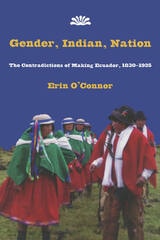
Gender, Indian, Nation
The Contradictions of Making Ecuador, 1830–1925Erin O'Connor
University of Arizona Press, 2007
O’Connor begins her investigations by examining the multilayered links between gender and Indian-state relations in nineteenth-century Ecuador. Disentangling issues of class and culture from issues of gender, she uncovers overlapping, conflicting, and ever-evolving patriarchies within both indigenous communities and the nation’s governing bodies. She finds that gender influenced sociopolitical behavior in a variety of ways, mediating interethnic struggles and negotiations that ultimately created the modern nation. Her deep research into primary sources—including congressional debates, ministerial reports, court cases, and hacienda records—allows a richer, more complex, and better informed national history to emerge.
Examining gender during Ecuadorian state building from “above” and “below,” O’Connor uncovers significant processes of interaction and agency during a critical period in the nation’s history. On a larger scale, her work suggests the importance of gender as a shaping force in the formation of nation-states in general while it questions recountings of historical events that fail to demonstrate an awareness of the centrality of gender in the unfolding of those events.
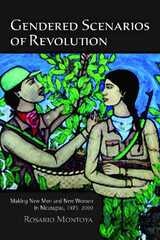
Gendered Scenarios of Revolution
Making New Men and New Women in Nicaragua, 1975–2000Rosario Montoya
University of Arizona Press, 2012
In 1979, toward the end of the Cold War era, Nicaragua's Sandinista movement emerged on the world stage claiming to represent a new form of socialism. Gendered Scenarios of Revolution is a historical ethnography of Sandinista state formation from the perspective of El Tule-a peasant village that was itself thrust onto a national and international stage as a "model" Sandinista community. This book follows the villagers´ story as they joined the Sandinista movement, performed revolution before a world audience, and grappled with the lessons of this experience in the neoliberal aftermath.
Employing an approach that combines political economy and cultural analysis, Montoya argues that the Sandinistas collapsed gender contradictions into class ones, and that as the Contra War exacerbated political and economic crises in the country, the Sandinistas increasingly ruled by mandate as vanguard party instead of creating the participatory democracy that they professed to work toward. In El Tule this meant that even though the Sandinistas created new roles and possibilities for women and men, over time they upheld pre-revolutionary patriarchal social structures. Yet in showing how the revolution created opportunities for Tuleños to assert their agency and advance their interests, even against the Sandinistas´ own interests, this book offers a reinterpretation of the revolution´s supposed failure.
Examining this community’s experience in the Sandinista and post-Sandinista periods offers perspective on both processes of revolutionary transformation and their legacies in the neoliberal era. Gendered Scenarios of Revolution will engage graduate and undergraduate students and scholars in anthropology, sociology, history, and women’s and gender studies, and appeal to anyone interested in modern revolution and its aftermath.
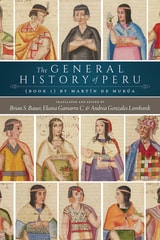
General History of Peru
Book 1Martín de Murúa
University Press of Colorado, 2024
Book 1 covers both the history of the Inca Empire and the first forty years of the Spanish occupation, up to and including the fall of Vilcabamba in 1572. While the J. Paul Getty Museum produced a digital facsimile of Murúa’s full Historia in 2008, it remained underused and, until now, untranslated. This translation revitalizes the momentous early volume with an introduction offering a window into Murúa’s life and the writing of his Historia, and extensive footnotes that provide the scholarly context of Murúa’s work.
This edition of The General History of Peru: Book 1 provides long-awaited access to Murúa’s contribution to Indigenous Andean history and early colonial Peru. The book is valuable for English-speaking students and scholars of pre-Hispanic Andean history, especially those interested in the ancient Andean world and colonial Peru’s literary production.
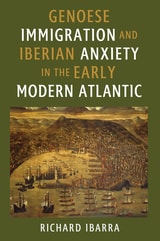
Genoese Immigration and Iberian Anxiety in the Early Modern Atlantic
Richard Ibarra
University of Delaware Press, 2027
This book explores the experiences of Genoese immigrants in the sixteenth-century Iberian Atlantic, focusing on how they navigated issues of identity and community membership across generations and transnational movement. Moving to cities like Seville, as well as Santo Domingo and Mexico City, Genoese families encountered both tremendous opportunities and significant challenges in establishing their lives, reaching a communal apogee—the “Genoese Century”—while they faced increasing Iberian anxieties. While some found ways to integrate into Iberian society through religious and charitable activities, retaining references to their Genoese past, others dissimulated or renounced their Genoese identity. Through a combination of notarial and inquisition records, litigation to prove nobility (hidalguía) and purity of blood (limpieza de sangre), literary narratives, and funerary monuments, Richard Ibarra provides insights into the changing identity claims of Genoese families and the broader attitudes toward foreigners in Iberian society that reached beyond perceived religious and ethnic difference.

Genres of Listening
An Ethnography of Psychoanalysis in Buenos AiresXochitl Marsilli-Vargas
Duke University Press, 2022
Geographies of Philological Knowledge
Postcoloniality and the Transatlantic National EpicNadia R. Altschul
University of Chicago Press, 2012
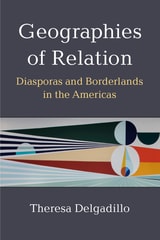
Geographies of Relation
Diasporas and Borderlands in the AmericasTheresa Delgadillo
University of Michigan Press, 2024
Not only does Delgadillo offer a rare extended analysis of Black Latinidades in Chicanx literature and theory, but she also considers over a century’s worth of literary, cinematic, and performative texts to support her argument about the significance of these cultural sites and overlaps. Chapters illuminate the significance of Toña La Negra in the Golden Age of Mexican cinema, reconsider feminist theorist Gloria Anzaldúa’s work in revising exclusionary Latin American ideologies of mestizaje, delve into the racial and gender frameworks Sandra Cisneros attempts to rewrite, unpack encounters between African Americans and Black Puerto Ricans in texts by James Baldwin and Marta Moreno Vega, explore the African diaspora in colonial and contemporary Peru through Daniel Alarcón’s literature and the documentary Soy Andina, and revisit the centrality of Black power in ending colonialism in Cuban narratives. Geographies of Relation demonstrates the long histories of networks and exchanges across the Americas as well as the interrelationships among Indigenous, Black, African American, mestizx, Chicanx, and Latinx peoples. It offers a compelling argument that geographies of relation are as significant as national frameworks in structuring cultural formation and change in this hemisphere.
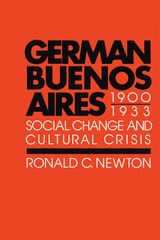
German Buenos Aires, 1900–1933
Social Change and Cultural CrisisBy Ronald C. Newton
University of Texas Press, 1977
This study of the German community of early twentieth-century Buenos Aires is a major contribution to the literature on Argentine history and on the New World immigrant experience. Beginning with the first wave of immigration in the late nineteenth century and continuing to the outbreak of World War II, Ronald C. Newton reconstructs the growth, development, and influence of a powerful foreign population in what was then the largest city in South America.
In the three decades before World War I, Argentina became a major food-producing and exporting country. Through the port of Buenos Aires was funneled the bulk of the Pampas’ foodstuff and fiber in one direction and Europe’s capital, technology, and surplus labor in the other. The German speakers made up one of the smaller Western European communities within the Argentine metropolis, but their cultural and economic influence was far out of proportion to their numbers. Based in a large and occupationally diverse middle class, the German community was represented at all social levels. Newton analyzes the experience of this well-demarcated group during a period of rapid demographic growth and increasing pressure to assimilate. He constructs working hypotheses that may be applied and refined in further investigations.
The book draws substantially on materials from within the Buenos Aires German community—newspapers, memoirs, the records of associations and welfare agencies—to reconstruct its intense daily life. The author highlights, for instance, the sharp economic reversals German-speaking residents suffered during World War I and shows how their fortunes declined further after continued Germanic immigration in the 1920s. Especially significant is his finding that the German community, which until 1914 had seemed impervious to the currents of Argentine nationalism, became susceptible to assimilation into Argentine society. In concluding chapters Newton demonstrates the way the German economic elite came to terms with the Nazis for opportunistic reasons; thus, the volume also serves as an introduction to the question of Nazism’s diffusion in Argentina.

Germany in Central America
Competitive Imperialism, 1821-1929Thomas Schoonover
University of Alabama Press, 1999
Analyzes the German role in Central American domestic and international relations
Using previously untapped resources including private collections, the records of cultural institutions, and federal and state government archives, Schoonover analyzes the German role in Central American domestic and international relations.Of the four countries most active in independent Central America-Britain, the United States, France, and Germany- historians know the least about the full extent of the involvement of the Germans.German colonial expansion was based on its position as an industrialized state seeking economic well-being and security in a growing world market. German leaders were quick to recognize that ties to the cheap labor of overseas countries could compensate for some of the costs and burdens of conceding material and social privileges to their domestic labor force. The Central American societies possessed limited resource bases; smaller and poorly educated populations; and less capital, communications, and technological development than Germany. They saw the borrowing of development as a key to their social, economic, and political progress. Wary Central American leaders also saw the influx of German industrialists as assurance against excessive U.S. presence in their political economies and cultures.
Although the simplistic bargain to trade economic development for cheap labor appeared to succeed in the short term, complex issues of German domestic unemployment and social disorder filtered to Central American countries and added to their own burdens. By 1929, Germany had recovered most of its pre-World War I economic position.
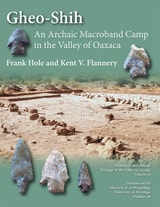
Gheo-Shih
An Archaic Macroband Camp in the Valley of OaxacaFrank Hole and Kent V. Flannery
University of Michigan Press, 2024

Global Impact, Local Action
New Environmental Policy in Latin AmericaEdited by Anthony Hall
University of London Press, 2005
Contributors include Martin Coy (Geographical Institute, University of Innsbruck, Austria), Herve Thery (Ecole Normal Superieur, Paris and Centre for Sustainable Development, University of Brasilia), David Cleary (Nature Conservancy, Brazil), Phil Fearnside (National Institute for Amazonian Studies, Brazil), Neli Aparecida de Mello (Centre for Sustainable Development, University of Brasilia), John Redwood (Environmentally and Socially Sustainable Development for Latin America and the Caribbean, World Bank), Martina Neuburger (University of Tuebingen, Germany), Dan Pasca (University of Tuebingen), Judith Lisansky (World Bank), Sergio Rosendo (Centre for Social and Economic Research on the Global Environment, University of East Anglia, UK), Fabio de Castro (Anthropological Center for Training and Research on Global Environmental Change, Indiana University, and Nucleo de Estudos e Pesquisa Ambiental, University of Campinas, Brazil), and Larissa Chermont (London School of Economics and Political Science, and Federal University of Para, Belem, Brazil).
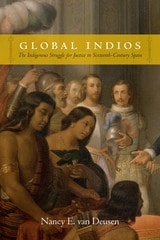
Global Indios
The Indigenous Struggle for Justice in Sixteenth-Century SpainNancy E. van Deusen
Duke University Press, 2015

Global Mental Health
Latin America and Spanish-Speaking PopulationsJavier I Escobar
Rutgers University Press, 2020

Globalizing Chocolate and Tobacco
Medical Exchange in the Early Modern WorldSusan G. Polansky
Bucknell University Press, 2026
This groundbreaking volume explores two early and opposing Spanish medical perspectives on chocolate and other New World substances. In the early 1600s, doctors Bartolomé Marradón and Antonio Colmenero de Ledesma returned from travels to the Americas with starkly different views: Marradón cautioned against tobacco and offered only limited approval of chocolate, while Colmenero vigorously defended chocolate’s health benefits. Their writings, translated and circulated across Europe, helped transform chocolate from a medicinal drink into a global commodity. Featuring the first bilingual edition of Marradón’s Dialogue (1618)—in full Spanish and English—and a new bilingual presentation of Colmenero’s influential Curious Treatise (1631), this book provides rare insight into early modern medical thought, cultural exchange, and the globalization of taste. Essential for readers of food history, early modern medicine, and transatlantic interchange, it uniquely reveals how debates over health, culture, and commerce brewed in a cup of chocolate.
Published by Bucknell University Press. Distributed worldwide by Rutgers University Press.
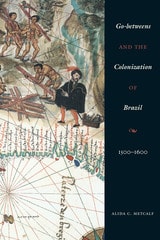
Go-betweens and the Colonization of Brazil
1500–1600By Alida C. Metcalf
University of Texas Press, 2006
Doña Marina (La Malinche) ...Pocahontas ...Sacagawea—their names live on in historical memory because these women bridged the indigenous American and European worlds, opening the way for the cultural encounters, collisions, and fusions that shaped the social and even physical landscape of the modern Americas. But these famous individuals were only a few of the many thousands of people who, intentionally or otherwise, served as "go-betweens" as Europeans explored and colonized the New World.
In this innovative history, Alida Metcalf thoroughly investigates the many roles played by go-betweens in the colonization of sixteenth-century Brazil. She finds that many individuals created physical links among Europe, Africa, and Brazil—explorers, traders, settlers, and slaves circulated goods, plants, animals, and diseases. Intercultural liaisons produced mixed-race children. At the cultural level, Jesuit priests and African slaves infused native Brazilian traditions with their own religious practices, while translators became influential go-betweens, negotiating the terms of trade, interaction, and exchange. Most powerful of all, as Metcalf shows, were those go-betweens who interpreted or represented new lands and peoples through writings, maps, religion, and the oral tradition. Metcalf's convincing demonstration that colonization is always mediated by third parties has relevance far beyond the Brazilian case, even as it opens a revealing new window on the first century of Brazilian history.

Gods and Vampires
Return to ChipayaNathan Wachtel
University of Chicago Press, 1994
Wachtel discovered that a series of recent deaths and misfortunes in Chipaya had been attributed to the evil powers of the Urus, a group usually regarded with suspicion by the other ethnic groups. Those incarcerated were believed to be the chief sorcerers and vampires whose paganistic practices had brought death to Chipaya by upsetting the social order. Wachtel's investigation, told in Gods and Vampires: Back to Chipaya, reveals much about relations between the Urus and the region's dominant ethnic groups and confronts some of the most trenchant issues in contemporary anthropology. His analysis shows that the Urus had become victims of the same set of ideals the Spanish had used, centuries before, to establish their hegemony in the region.
Presented as a personal detective story, Gods and Vampires is Wachtel's latest work in a series studying the ongoing impact of the Spanish conquest on the Andean consciousness and social system. Its insight into Bolivian society and the legacy of hegemony confronts some of the most trenchant issues in contemporary anthropologyand will be of great interest to scholars of anthropology, Latin American studies, and Native American studies.
Good Faith and Truthful Ignorance
A Case of Transatlantic BigamyAlexandra Parma Cook and Noble David Cook
Duke University Press, 1991
So begins the labyrinthine legal tale and engrossing drama of an explorer and his two wives, skillfully reconstructed through the expert and original archival research of Alexandra Parma Cook and Noble David Cook. Drawing on the remarkable records from the trial, the narrative of Francisco’s adventures provides a window into daily life in sixteenth-century Spain, as well as the mentalité and experience of conquest and settlement of the New World. Told from the point of view of the conquerors, Francisco’s story reveals not only the lives of the middle class and minor nobility but also much about those at the lower rungs of the social order and relations between the sexes.
In the tradition of Carlo Ginzberg’s The Cheese and the Worms and Natalie Zemon Davis’ The Return of Martin Guerre, Good Faith and Truthful Ignorance illuminates an historical period—the world of sixteenth-century Spain and Peru—through the wonderful and unusual story of one man and his two wives.
Good Maya Women
Migration and Revitalization of Clothing and Language in Highland Guatemalaby Joyce N. Bennett
University of Alabama Press, 2022
Good Maya Women: Migration and Revitalization of Clothing and Language in Highland Guatemala analyzes how Indigenous women’s migration contributes to women’s empowerment in their home communities in Guatemala. This decolonial ethnographic analysis of Kaqchikel Maya women’s linguistic and cultural activism demonstrates that marginalized people can and do experience empowerment and hope for the future of their communities, even while living under oppressive neoliberal regimes. Joyce N. Bennett contests dominant frameworks of affect theory holding that marginalized peoples never truly experience unrestricted hope or empowerment, and she contributes new understandings of the intimate connections between Indigenous women, migration, and language and clothing revitalization.
Based on more than twenty months of fieldwork, the study begins with an ethnographic investigation of how economic policies force Indigenous women into migration for wage work. To survive, many, like the three young women profiled in this ethnography, are forced to leave their schooling, families, and highland homes to work in cities or other countries. They might work, for example, as vendors, selling crafts to tourists, or as housekeepers or waitresses. Their work exposes them to structural violence, including anti-Indigenous slurs, sexual harassment and violence, and robbery.
Furthermore, the women are pressured to wear Western clothing and to speak Spanish, which endangers Indigenous culture and language in Guatemala. Yet the Indigenous migrant women profiled do not abandon their Indigenous clothing and language, in this case Kaqchikel Maya. Instead, they find inspiration and pride in revitalizing Kaqchikel traditions in their hometowns post-migration. As women attempt to revitalize Kaqchikel Maya language and clothing, they seek to earn the title of “good” women in their home communities.
Unpacking women’s daily activisms reveals that women attempt to retain their language and clothing and also collectively seek to make space for Indigenous people in the modern world. Bennett reveals that women find their attempts at revitalization to be personally empowering, even when their communities do not support them.

Goodbye, Brazil
Émigrés from the Land of Soccer and SambaMaxine L. Margolis
University of Wisconsin Press, 2013
Goodbye, Brazil is the first book to provide a global perspective on Brazilian emigration. Drawing and synthesizing data from a host of sociological and anthropological studies, preeminent Brazilian immigration scholar Maxine L. Margolis surveys and analyzes this greatly expanded Brazilian diaspora, asking who these immigrants are, why they left home, how they traveled abroad, how the Brazilian government responded to their exodus, and how their host countries received them. Margolis shows how Brazilian immigrants, largely from the middle rungs of Brazilian society, have negotiated their ethnic identity abroad. She argues that Brazilian society abroad is characterized by the absence of well-developed, community-based institutions—with the exception of thriving, largely evangelical Brazilian churches.
Margolis looks to the future as well, asking what prospects at home and abroad await the new generation, children of Brazilian immigrants with little or no familiarity with their parents' country of origin. Do Brazilian immigrants develop such deep roots in their host societies that they hesitate to return home despite Brazil's recent economic boom—or have they become true transnationals, traveling between Brazil and their adopted lands but feeling not quite at home in either one?
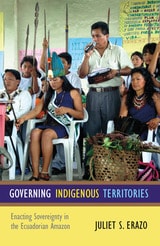
Governing Indigenous Territories
Enacting Sovereignty in the Ecuadorian AmazonJuliet S. Erazo
Duke University Press, 2013
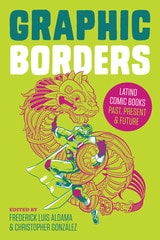
Graphic Borders
Latino Comic Books Past, Present, and FutureEdited by Frederick Luis Aldama and Christopher González
University of Texas Press, 2016
From the influential work of Los Bros Hernandez in Love & Rockets, to comic strips and political cartoons, to traditional superheroes made nontraditional by means of racial and sexual identity (e.g., Miles Morales/Spider-Man), comics have become a vibrant medium to express Latino identity and culture. Indeed, Latino fiction and nonfiction narratives are rapidly proliferating in graphic media as diverse and varied in form and content as is the whole of Latino culture today.
Graphic Borders presents the most thorough exploration of comics by and about Latinos currently available. Thirteen essays and one interview by eminent and rising scholars of comics bring to life this exciting graphic genre that conveys the distinctive and wide-ranging experiences of Latinos in the United States. The contributors’ exhilarating excavations delve into the following areas: comics created by Latinos that push the boundaries of generic conventions; Latino comic book author-artists who complicate issues of race and gender through their careful reconfigurations of the body; comic strips; Latino superheroes in mainstream comics; and the complex ways that Latino superheroes are created and consumed within larger popular cultural trends. Taken as a whole, the book unveils the resplendent riches of comics by and about Latinos and proves that there are no limits to the ways in which Latinos can be represented and imagined in the world of comics.
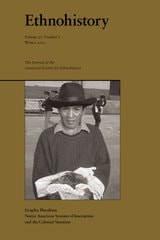
Graphic Pluralism, Volume 57
Frank L. Salomon
Duke University Press, 0
One contributor shows how the Spanish colonial powers and the traditional Maya nobility in the Yucatán struggled over alphabetic literacy and the continued use of hieroglyphics. Another contributor documents how the Natick speakers of Martha’s Vineyard adopted alphabetic literacy for their own purposes in the seventeenth and eighteenth centuries, incorporating writing as a tool of traditional governance. In another article, a Spanish translation is compared to the original Nahua text to show how the two versions provide very different views of the Spanish conquest of the city-state of Mexico-Tenochtitlán. Yet another contributor examines how competing language ideologies in the Andes were used to characterize khipus (Andean knotted strings) and alphabetic script.

Greening Brazil
Environmental Activism in State and SocietyKathryn Hochstetler and Margaret E. Keck
Duke University Press, 2007
The authors present a multilevel analysis encompassing institutions and individuals within the government—at national, state, and local levels—as well as the activists, interest groups, and nongovernmental organizations that operate outside formal political channels. They emphasize the importance of networks linking committed actors in the government bureaucracy with activists in civil society. Portraying a gradual process marked by periods of rapid advance, Hochstetler and Keck show how political opportunities have arisen from major political transformations such as the transition to democracy and from critical events, including the well-publicized murders of environmental activists in 1988 and 2004. Rather than view foreign governments and organizations as the instigators of environmental policy change in Brazil, the authors point to their importance at key moments as sources of leverage and support.
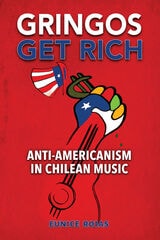
Gringos Get Rich
Anti-Americanism in Chilean MusicEunice Rojas
University of Alabama Press, 2024
Documents counterimperialism in Chilean music since the 1960s
Gringos Get Rich: Anti-Americanism in Chilean Music examines anti-Americanism in Latin America as manifested in Chilean music in recent history. From a folk-based movement in the 1960s and early 1970s to underground punk rock groups during the Pinochet regime, to socially conscious hip-hop artists of postdictatorship Chile, Chilean music has followed several left-leaning transnational musical trends to grapple with Chile’s fluctuating relationship with the United States. Eunice Rojas’s innovative analysis introduces US readers to a wide swath of Chilean musicians and their powerful protest songs and provides a representative and long view of the negative influences of the United States in Latin America.
Much of the criticism of the United States in Chile’s music centers on the perception of the United States as a heavy-handed source of capitalist imperialism that is exploitative of and threatening to Chile’s poor and working-class public and to Chilean cultural independence and integrity. Rojas incorporates Antonio Gramsci’s theories about the difficulties of struggles for cultural power within elitist capitalist systems to explore anti-Americanism and anti-capitalist music. Ultimately, Rojas shows how the music from various genres, time periods, and political systems attempts to act as a counterhegemonic alternative to Chile’s political, cultural, and economic status quo.
Rojas’s insight is timely with recent political trends toward the right in the Americas. There is also increased interest in and acceptance of popular song lyrics as literary texts. The book will appeal to Latin Americanists, ethnomusicologists, scholars of popular culture and international relations, students, and general readers.
.

Guatemala
Past and PresentChester Lloyd Jones
University of Minnesota Press, 1940
Guatemala was first published in 1940. Minnesota Archive Editions uses digital technology to make long-unavailable books once again accessible, and are published unaltered from the original University of Minnesota Press editions.
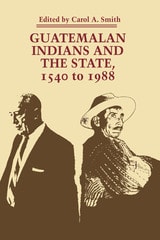
Guatemalan Indians and the State
1540 to 1988Edited by Carol A. Smith
University of Texas Press, 1990
Violence in Central America, especially when directed against Indian populations, is not a new phenomenon. Yet few studies of the region have focused specifi cally on the relationship between Indians and the state, a relationship that may hold the key to understanding these conflicts. In this volume, noted historians and anthropologists pool their considerable expertise to analyze the situation in Guatemala, working from the premise that the Indian/state relationship is the single most important determinant of Guatemala’s distinctive history and social order. In chapters by such respected scholars as Robert Cormack, Ralph Lee Woodward, Christopher Lutz, Richard Adams, and Arturo Arias, the history of Indian activism in Guatemala unfolds. The authors reveal that the insistence of Guatemalan Indians on maintaining their distinctive cultural practices and traditions in the face of state attempts to eradicate them appears to have fostered the development of an increasingly oppressive state.
This historical insight into the forces that shaped modern Guatemala provides a context for understanding the extraordinary level of violence that enveloped the Indians of the western highlands in the 1980s, the continued massive assault on traditional religious and secular culture, the movement from a militarized state to a militarized civil society, and the major transformations taking place in Guatemala’s traditional export-oriented economy. In this sense, Guatemalan Indians and the State, 1540 to 1988 provides a revisionist social history of Guatemala.

Guerrilla Auditors
The Politics of Transparency in Neoliberal ParaguayKregg Hetherington
Duke University Press, 2011
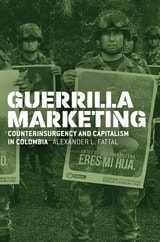
Guerrilla Marketing
Counterinsurgency and Capitalism in ColombiaAlexander L. Fattal
University of Chicago Press, 2018
Full of rich, unforgettable ethnographic stories, Guerrilla Marketing is a stunning and troubling analysis of the mediation of global conflict.

Guide to the Hispanic American Historical Review, 1956–1975
Stanley R. Ross and Wilber Chaffee, eds.
Duke University Press, 1980
Guns, Drugs, and Development in Colombia
By Jennifer S. Holmes, Sheila Amin Gutiérrez de Piñeres, and Kevin M. Curtin
University of Texas Press, 2009
For decades, Colombia has contended with a variety of highly publicized conflicts, including the rise of paramilitary groups in response to rebel insurgencies of the 1960s, the expansion of an illegal drug industry that has permeated politics and society since the 1970s, and a faltering economy in the 1990s. An unprecedented analysis of these struggles, Guns, Drugs, and Development in Colombia brings together leading scholars from a variety of fields, blending previously unseen quantitative data with historical analysis for an impressively comprehensive assessment. Culminating in an inspiring plan for peace, based on Four Cornerstones of Pacification, this landmark work is sure to spur new calls for change in this corner of Latin America and beyond.
Gunshots at the Fiesta
Literature and Politics in Latin AmericaMaarten van Delden
Vanderbilt University Press, 2009
Yet the authors of this book argue that the relationship between the two realms is much more complex and fraught with tension than is nowadays recognized. In examining these tensions, and in revealing the diverse ways in which literature and politics intersect in the Latin American cultural tradition, Gunshots at the Fiesta offers a lively challenge to the current tendency--especially strong in the U.S. academy--to read Latin American literature through a narrowly political prism.
The authors argue that one can only understand the nature of the dialogue between literature and politics if one begins by recognizing the different logics that operate in these different domains. Using this idea of the different logics of politics and literature as a guiding thread, Van Delden and Grenier offer bold new readings of major authors such as José Martí, Octavio Paz, Carlos Fuentes, Gabriel García Márquez, and Mario Vargas Llosa, as well as compelling interpretations of works by less-frequently-discussed figures such as Claribel Alegría, Marisol Martín del Campo and Víctor Hugo Rascón Banda.