Results by title
262 books match the query 'Sex role' and 32 start with g

Gaming at the Edge
Sexuality and Gender at the Margins of Gamer CultureAdrienne Shaw
University of Minnesota Press, 2015
Video games have long been seen as the exclusive territory of young, heterosexual white males. In a media landscape dominated by such gamers, players who do not fit this mold, including women, people of color, and LGBT people, are often brutalized in forums and in public channels in online play. Discussion of representation of such groups in games has frequently been limited and cursory. In contrast, Gaming at the Edge builds on feminist, queer, and postcolonial theories of identity and draws on qualitative audience research methods to make sense of how representation comes to matter.
In Gaming at the Edge, Adrienne Shaw argues that video game players experience race, gender, and sexuality concurrently. She asks: How do players identify with characters? How do they separate identification and interactivity? What is the role of fantasy in representation? What is the importance of understanding market logic? In addressing these questions Shaw reveals how representation comes to matter to participants and offers a perceptive consideration of the high stakes in politics of representation debates.
Putting forth a framework for talking about representation, difference, and diversity in an era in which user-generated content, individualized media consumption, and the blurring of producer/consumer roles has lessened the utility of traditional models of media representation analysis, Shaw finds new insight on the edge of media consumption with the invisible, marginalized gamers who are surprising in both their numbers and their influence in mainstream gamer culture.
Gather Your Ancestors
Gender, Language, and Belonging in Southeast AfricaRaevin Jimenez
University of Wisconsin Press, 2026
Historically, southeasternmost Africa has been home to a large variety of speech communities, including Nguni, East Bantu, Khoi, and San—the legacy of a long and complicated history of migration, interaction, assimilation, and disaggregation between many peoples. With detailed, careful analysis, Raevin Jimenez guides readers through a thousand years of human movement, cultural contact, and social development in this region. Taking a historical linguistics approach, she sheds new light on this history by focusing on Nguni speakers’ use of gendered practices—including initiation, marriage, and avoidant speech known as hlónipha—to blend multilingual and diverse communities.
Use of gendered institutions inaugurated variable social spaces that could either elide or accommodate difference and thus enabled a multiplicity of community types. Contrary to previous assumptions about the roles of men and women in precolonial southeasternmost Africa, Jimenez shows that gender impacted life and social interactions across a large variety of important domains and became a way of forming, negotiating, and maintaining community. These developments shaped and remain visible in southeastern African speech communities today, and understanding them is vital to understanding the region’s long history and current linguistic society.
Gender Knot Revised Ed
Unraveling Our Patriarchal LegacyAllan Johnson
Temple University Press, 2005
* the core characteristics of patriarchy and its power as a social system
* the relationship between individuals and social systems
* "men's movement" assessments of patriarchy and gender inequality
* key—and controversial—terms such as sexism, privilege, and political correctness
Gender Matters
Rereading Michelle Z. RosaldoAlejandro Lugo and Bill Maurer, Editors
University of Michigan Press, 2000
With the publication of Woman, Culture, and Society in 1974, Michelle Rosaldo initiated nothing less than a reconstruction of anthropology that placed feminist analysis at the center of the discipline. Through a rereading of Rosaldo's ideas and arguments, this collection provides in-depth analysis of Rosaldo's many contributions to anthropology and feminism. Each of the essays derives theoretically and politically useful insights from Rosaldo's work and sets them in motion for new intellectual and political practices. The authors do not always share Rosaldo's perspectives, nor do they necessarily agree with each other. But, together, they point to exciting syntheses of old and new feminist theory and practice.
Alejandro Lugo is Assistant Professor of Anthropology and Latina/o Studies, University of Illinois at Urbana-Champaign. Bill Maurer is Assistant Professor of Anthropology, University of California at Irvine.
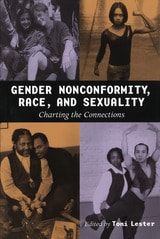
Gender Nonconformity, Race, and Sexuality
Charting the ConnectionsToni Lester
University of Wisconsin Press, 2002
How are culturally constructed stereotypes about appropriate sex-based behavior formed? If a person who is biologically female behaves in a stereotypically masculine manner, what are the social, political, and cultural forces that may police her behavior? And how will she manage her gendered image in response to that policing? Finally, how do race, ethnicity, or sexuality inform the way that sex-based roles are constructed, policed, or managed?
The chapters in this book address such questions from social science perspectives and then examine personal stories of reinvention and transformation, including discussions of the lives of dancers Isadora Duncan and Bill T. Jones, playwright Lorraine Hansberry, and surrealist artist Claude Cahun.Writers from fields as diverse as history, art, psychology, law, literature, sociology, and the activist community look at gender nonconformity from conceptual, theoretical, and empirical perspectives. They emphasize that gender nonconformists can be gay, lesbian, bisexual, transgender, or anyone else who does not fit a model of Caucasian heterosexual behavior characterized by binary masculine and feminine roles.
Gender Relations in German History
Power, Agency, and Experience from the Sixteenth to the Twentieth CenturyLynn Abrams and Elizabeth Harvey, eds.
Duke University Press, 1997
Topics include childbirth, abortion, and the female body in early modern Germany; the roots of German feminism; gender, class, and medicine during World War I and during the Weimar republic; female homosexuality during the Nazi period; East and West German reconstruction following World War II and the formation of a gendered consumer culture.
This book will stimulate readers to think more deeply about the importance of gender in German history, and prove to be an invaluable resource for those interested in women’s studies and in German and European history.
Contributors. Lynn Abrams, Elizabeth Harvey, Dagmar Herzog, Kate Lacey, Katherine Pence, Ulinka Rublack, Claudia Schoppman, Regina Schulte, Cornelie Usborne, Heide Wunder
Gender Roles and Faculty Lives in Rhetoric and Composition
Theresa Enos
Southern Illinois University Press, 1997
Combining anecdotal evidence (the personal stories of rhetoric and composition teachers) with hard data, Theresa Enos offers documentation for what many have long suspected to be true: lower-division writing courses in colleges and universities are staffed primarily by women who receive minimal pay, little prestige, and lessened job security in comparison to their male counterparts. Male writing faculty, however, also are affected by factors such as low salaries because of the undervaluation of a field considered feminized. As Enos notes in her preface: "The rhetoric of our institutional lives is connected especially to the negotiations of gender roles in rhetoric and composition."
Enos describes and classifies narratives gathered from surveys, interviews, and campus visits and interweaves these narratives with statistical data gathered from national surveys that show gendered experiences in the profession. Enos discusses the ways in which these experiences affect the working conditions of writing teachers and administrators in various programs at different types of institutions.
Enos points out that fields in which women excel—and are acknowledged—receive less prestige than other fields. On the university level, those genres in which women have demonstrated competence are not taken as seriously as those dominated by men. In practical terms, academia affords more glory for teaching literature than for teaching rhetoric and composition.
Within the field of rhetoric and composition, however, Enos finds it difficult to determine why the accomplishments of women receive less credit than those of men. She speculates as to whether it is part of the larger pattern in society—and in academia—to value men more than women or something in the field itself that keeps women from real power, even though women make up the majority of composition and rhetoric teachers.
Enos provides fascinating personal histories of composition and rhetoric teachers whose work has been largely disregarded. She also provides information about writing programs, teaching, administrative responsibilities, ranks among teachers, ages, salary, tenure status, distribution of research, service responsibilities, records of publication, and promotion and tenure guidelines.

Gender Thinking
Steven G. Smith
Temple University Press, 1992
How can we accept the gender system in view of its ills? Yet, are we really at liberty to abolish gender differences, "when the gender system gives us benchmarks of personal identity and worth along with primary channels in which to pursue the rewards of love?" With this double question, Steven G. Smith introduces his inquiry into the idea of gender and how it is implicated in love, respect, equality, and personal character. Gender Thinking is the first comprehensive philosophical exploration of the concept of gender Asking the question, what is gender?—that is, what sort of thing do we take femininity and masculinity to be?—Smith considers how gender thinking is interwoven with ideas about human nature. He suggests ways in which ideas about race, class, culture age, temperament, and sexual orientation can be understood from clues found in gender thinking. And he calls for a renegotiated procreative partnership between women and men as the key to the redemption of gender.
Gender and Difference in the Middle Ages
Sharon Farmer
University of Minnesota Press, 2002
Exposes complex intersections between genders and other identities in medieval cultures.
Nothing less than a rethinking of what we mean when we talk about "men" and "women" of the medieval period, this volume demonstrates how the idea of gender-in the Middle Ages no less than now-intersected in subtle and complex ways with other categories of difference. Responding to the insights of postcolonial and feminist theory, the authors show that medieval identities emerged through shifting paradigms-that fluidity, conflict, and contingency characterized not only gender, but also sexuality, social status, and religion. This view emerges through essays that delve into a wide variety of cultures and draw on a broad range of disciplinary and theoretical approaches. Scholars in the fields of history as well as literary and religious studies consider gendered hierarchies in western Christian, Jewish, Byzantine, and Islamic areas of the medieval world.
Contributors: Daniel Boyarin, U of California, Berkeley; Ruth Mazo Karras, U of Minnesota; Mathew Kuefler, San Diego State U; Martha Newman, U of Texas; Kathryn M. Ringrose, U of California, San Diego; Elizabeth Robertson, U of Colorado; Everett Rowson, U of Pennsylvania; Michael Uebel, U of Kentucky; Ulrike Wiethaus, Wake Forest U.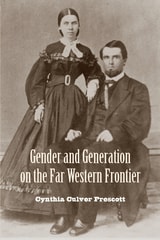
Gender and Generation on the Far Western Frontier
Cynthia Culver Prescott
University of Arizona Press, 2007
In Gender and Generation on the Far Western Frontier, Cynthia Culver Prescott expertly explores the shifting gender roles and ideologies that countless Anglo-American settlers struggled with in Oregon’s Willamette Valley between 1845 and 1900. Drawing on traditional social history sources as well as divorce records, married women’s property records, period photographs, and material culture, Prescott reveals that Oregon settlers pursued a moving target of middle-class identity in the second half of the nineteenth century.
Prescott traces long-term ideological changes, arguing that favorable farming conditions enabled Oregon families to progress from accepting flexible frontier roles to participating in a national consumer culture in only one generation. As settlers’ children came of age, participation in this new culture of consumption and refined leisure became the marker of the middle class. Middle-class culture shifted from the first generation’s emphasis on genteel behavior to a newer genteel consumption.
This absorbing volume reveals the shifting boundaries of traditional women’s spheres, the complicated relationships between fathers and sons, and the second generation’s struggle to balance their parents’ ideology with a changing national sense of class consciousness.
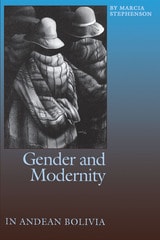
Gender and Modernity in Andean Bolivia
By Marcia Stephenson
University of Texas Press, 1999
In Andean Bolivia, racial and cultural differences are most visibly marked on women, who often still wear native dress and speak an indigenous language rather than Spanish. In this study of modernity in Bolivia, Marcia Stephenson explores how the state's desire for a racially and culturally homogenous society has been deployed through images of womanhood that promote the notion of an idealized, acculturated female body.
Stephenson engages a variety of texts—critical essays, novels, indigenous testimonials, education manuals, self-help pamphlets, and position papers of diverse women's organizations—to analyze how the interlocking tropes of fashion, motherhood, domestication, hygiene, and hunger are used as tools for the production of dominant, racialized ideologies of womanhood. At the same time, she also uncovers long-standing patterns of resistance to the modernizing impulse, especially in the large-scale mobilization of indigenous peoples who have made it clear that they will negotiate the terms of modernity, but always "as Indians."
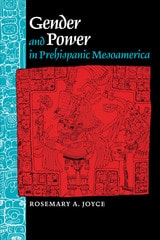
Gender and Power in Prehispanic Mesoamerica
By Rosemary A. Joyce
University of Texas Press, 2001
Gender was a fluid potential, not a fixed category, before the Spaniards came to Mesoamerica. Childhood training and ritual shaped, but did not set, adult gender, which could encompass third genders and alternative sexualities as well as "male" and "female." At the height of the Classic period, Maya rulers presented themselves as embodying the entire range of gender possibilities, from male through female, by wearing blended costumes and playing male and female roles in state ceremonies.
This landmark book offers the first comprehensive description and analysis of gender and power relations in prehispanic Mesoamerica from the Formative Period Olmec world (ca. 1500-500 BC) through the Postclassic Maya and Aztec societies of the sixteenth century AD. Using approaches from contemporary gender theory, Rosemary Joyce explores how Mesoamericans created human images to represent idealized notions of what it meant to be male and female and to depict proper gender roles. She then juxtaposes these images with archaeological evidence from burials, house sites, and body ornaments, which reveals that real gender roles were more fluid and variable than the stereotyped images suggest.

Gender and Sexuality in Modern Ireland
Anthony Bradley
University of Massachusetts Press, 1997
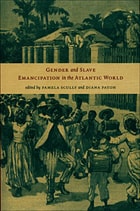
Gender and Slave Emancipation in the Atlantic World
Pamela Scully and Diana Paton, eds.
Duke University Press, 2005
Offering detailed analyses of slave emancipation in specific societies, the contributors discuss all of the diverse actors in emancipation: slaves, abolitionists, free people of color, state officials, and slave owners. Whether considering the construction of a postslavery masculine subjectivity in Jamaica, the work of two white U.S. abolitionist women with the Freedmen’s Bureau after the Civil War, freedwomen’s negotiations of labor rights in Puerto Rico, slave women’s contributions to the slow unraveling of slavery in French West Africa, or the ways that Brazilian abolitionists deployed representations of femininity as virtuous and moral, these essays demonstrate the gains that a gendered approach offers to understanding the complex processes of emancipation. Some chapters also explore theories and methodologies that enable a gendered reading of postslavery archives. The editors’ substantial introduction traces the reasons for and patterns of women’s and men’s different experiences of emancipation throughout the Atlantic world.
Contributors. Martha Abreu, Sheena Boa, Bridget Brereton, Carol Faulkner, Roger Kittleson, Martin Klein, Melanie Newton, Diana Paton, Sue Peabody, Richard Roberts, Ileana M. Rodriguez-Silva, Hannah Rosen, Pamela Scully, Mimi Sheller, Marek Steedman, Michael Zeuske
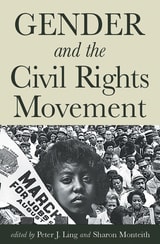
Gender and the Civil Rights Movement
Ling, Peter J
Rutgers University Press, 2004
Gender in Latin America
Chant, Sylvia
Rutgers University Press, 2002
In Latin America, gender is a fundamental dimension of virtually every aspect of contemporary social, economic, and political life. Gender in Latin America is a comprehensive state-of-the-art review of gender in the region at the start of the twenty-first century. The authors draw on a wide range of research, including their own field-based expertise, to illuminate the importance of diversity in gender in this region. Debunking traditional stereotypes, the book charts changes and continuities in gender roles, relations and identities associated with the growing evidence produced by feminist scholarship and activism in the continent.
Chapters are arranged around themes such as gender and poverty, gender and population, gender and health, and gender and employment. Each chapter begins with an introduction to the core issues, and debates in the relevant field in order to set specific regional experiences within their global as well as regional contexts. The authors also refer to new bodies of literature on the subject, including those on men and masculinity, fatherhood, and sexuality.

Gender in medieval places, spaces and thresholds
Edited by Victoria Blud, Diane Heath, and Einat Klafter
University of London Press, 2019
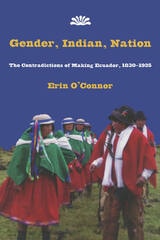
Gender, Indian, Nation
The Contradictions of Making Ecuador, 1830–1925Erin O'Connor
University of Arizona Press, 2007
O’Connor begins her investigations by examining the multilayered links between gender and Indian-state relations in nineteenth-century Ecuador. Disentangling issues of class and culture from issues of gender, she uncovers overlapping, conflicting, and ever-evolving patriarchies within both indigenous communities and the nation’s governing bodies. She finds that gender influenced sociopolitical behavior in a variety of ways, mediating interethnic struggles and negotiations that ultimately created the modern nation. Her deep research into primary sources—including congressional debates, ministerial reports, court cases, and hacienda records—allows a richer, more complex, and better informed national history to emerge.
Examining gender during Ecuadorian state building from “above” and “below,” O’Connor uncovers significant processes of interaction and agency during a critical period in the nation’s history. On a larger scale, her work suggests the importance of gender as a shaping force in the formation of nation-states in general while it questions recountings of historical events that fail to demonstrate an awareness of the centrality of gender in the unfolding of those events.
Gender, Law, and Resistance in India
Erin P. Moore
University of Arizona Press, 1988

Gender, Sexuality, and the Cold War
A Global PerspectivePhilip E. Muehlenbeck
Vanderbilt University Press, 2017
Gender, Sexuality, and the Cold War brings together a diverse group of scholars whose combined research spans fifteen countries across five continents, claiming a place as the first volume to examine how issues of gender and sexuality impacted both the domestic and foreign policies of states, far beyond the borders of the United States, during the tumult of the Cold War.
Table of Contents
Preface
Introduction: Hidden in Plain Sight: The Histories of Gender and Sexuality during the Cold War
Marko Dumančić
Part I: Sexuality
Faceless and Stateless: French Occupation Policy toward Women and Children in Postwar Germany (1945-1949)
Katherine Rossy
Patriarchy and Segregation: Policing Sexuality in US-Icelandic Military Relations
Valur Ingimundarson
Queering Subversives in Cold War Canada
Patrizia Gentile
"Nonreligious Activities": Sex, Anticommunism, and Progressive Christianity in Late Cold War Brazil
Benjamin A. Cowan
Manning the Enemy: US Perspectives on International Birthrates during the Cold War
Kathleen A. Tobin
Part II: Femininities
Indian Peasant Women's Activism in a Hot Cold War
Elisabeth Armstrong
The Medicalization of Childhood in Mexico during the Early Cold War, 1945-1960
Nichole Sanders
Africa's Kitchen Debate: Ghanaian Domestic Space in the Age of the Cold War
Jeffrey S. Ahlman
Mobilizing Women? State Feminisms in Communist Czechoslovakia and Socialist Egypt
May Hawas and Philip E. Muehlenbeck
A Vietnamese Woman Directs the War Story: Duc Hoan, 1937-2003
Karen Turner
Global Feminism and Cold War Paradigms: Women's International NGOs and the United Nations, 1970-1985
Karen Garner
Part III: Masculinities
"Men of the World" or "Uniformed Boys"? Hegemonic Masculinity and the British Army in the Era of the Korean War
Grace Huxford
Yuri Gagarin and Celebrity Masculinity in Soviet Culture
Erica L. Fraser

Gender/Body/Knowledge
Feminist Reconstructions of Being and KnowingJaggar, Alison M
Rutgers University Press, 1989

Gender
An Ethnomethodological ApproachSuzanne J. Kessler and Wendy McKenna
University of Chicago Press, 1985
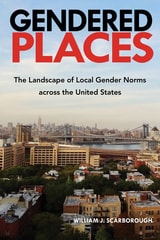
Gendered Places
The Landscape of Local Gender Norms across the United StatesWilliam J. Scarborough
Temple University Press, 2023
Every place has its quirky attributes, cultural reputation, and distinctive flair. But when we travel across America, do we also experience distinct gender norms and expectations? In his groundbreaking Gendered Places, William Scarborough examines metropolitan commuting zones to see how each region’s local culture reflects gender roles and gender equity. He uses surveys and social media data to measure multiple dimensions of gender norms, including expectations toward women in leadership, attitudes toward working mothers, as well as the division of household labor.
Gendered Places reveals that different locations, even within the same region of the country, such as Milwaukee and Madison Wisconsin, have distinct gender norms and highly influential cultural environments. Scarboroughshows how these local norms shape the attitudes and behaviors of residents with implications on patterns of inequality such as the gender wage gap. His findings offer valuable insight for community leaders and organizers making efforts to promote equality in their region.
Scarboroughrecognizes local culture as not value-neutral, but highly crucial to the gender structure that perpetuates, or challenges, gender inequality. Gendered Places questions how these gender norms are sustained and their social consequences.
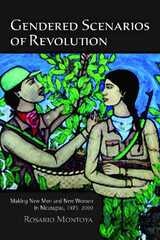
Gendered Scenarios of Revolution
Making New Men and New Women in Nicaragua, 1975–2000Rosario Montoya
University of Arizona Press, 2012
In 1979, toward the end of the Cold War era, Nicaragua's Sandinista movement emerged on the world stage claiming to represent a new form of socialism. Gendered Scenarios of Revolution is a historical ethnography of Sandinista state formation from the perspective of El Tule-a peasant village that was itself thrust onto a national and international stage as a "model" Sandinista community. This book follows the villagers´ story as they joined the Sandinista movement, performed revolution before a world audience, and grappled with the lessons of this experience in the neoliberal aftermath.
Employing an approach that combines political economy and cultural analysis, Montoya argues that the Sandinistas collapsed gender contradictions into class ones, and that as the Contra War exacerbated political and economic crises in the country, the Sandinistas increasingly ruled by mandate as vanguard party instead of creating the participatory democracy that they professed to work toward. In El Tule this meant that even though the Sandinistas created new roles and possibilities for women and men, over time they upheld pre-revolutionary patriarchal social structures. Yet in showing how the revolution created opportunities for Tuleños to assert their agency and advance their interests, even against the Sandinistas´ own interests, this book offers a reinterpretation of the revolution´s supposed failure.
Examining this community’s experience in the Sandinista and post-Sandinista periods offers perspective on both processes of revolutionary transformation and their legacies in the neoliberal era. Gendered Scenarios of Revolution will engage graduate and undergraduate students and scholars in anthropology, sociology, history, and women’s and gender studies, and appeal to anyone interested in modern revolution and its aftermath.

Gendered Strife and Confusion
The Political Culture of ReconstructionLaura F. Edwards
University of Illinois Press, 1997

Gendered Tradeoffs
Women, Family, and Workplace Inequality in Twenty-One CountriesBecky Pettit
Russell Sage Foundation, 2009

Gendering the Fair
Histories of Women and Gender at World's FairsEdited by TJ Boisseau and Abigail M. Markwyn
University of Illinois Press, 2010
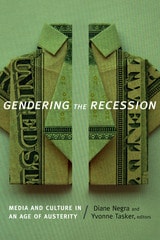
Gendering the Recession
Media and Culture in an Age of AusterityDiane Negra and Yvonne Tasker, eds.
Duke University Press, 2014
Contributors. Sarah Banet-Weiser, Hamilton Carroll, Hannah Hamad, Anikó Imre, Suzanne Leonard, Isabel Molina-Guzmán, Sinéad Molony, Elizabeth Nathanson, Diane Negra, Tim Snelson, Yvonne Tasker, Pamela Thoma
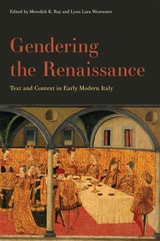
Gendering the Renaissance
Text and Context in Early Modern ItalyMeredith K. Ray
University of Delaware Press, 2023
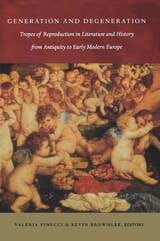
Generation and Degeneration
Tropes of Reproduction in Literature and History from Antiquity through Early Modern EuropeValeria Finucci and Kevin Brownlee, eds.
Duke University Press, 2001
The discourses on reproduction, biology, degeneration, legacy, and lineage that this book broaches not only bring to the forefront concepts of sexual identity and gender politics but also show how they were culturally constructed and reconstructed through the centuries by medicine, philosophy, the visual arts, law, religion, and literature. The contributors reflect on a wide range of topics—from what makes men “manly” to the identity of Christ’s father, from what kinds of erotic practices went on among women in sixteenth-century seraglios to how men’s hemorrhoids can be variously labeled. Essays scrutinize stories of menstruating males and early writings on the presumed inferiority of female bodily functions. Others investigate a psychomorphology of the clitoris that challenges Freud’s account of lesbianism as an infantile stage of sexual development and such topics as the geographical origins of medicine and the materialization of genealogy in the presence of Renaissance theatrical ghosts.
This collection will engage those in English, comparative, Italian, Spanish, and French studies, as well as in history, history of medicine, and ancient and early modern religious studies.
Contributors. Kevin Brownlee, Marina Scordilis Brownlee, Elizabeth Clark, Valeria Finucci, Dale Martin, Gianna Pomata, Maureen Quilligan, Nancy Siraisi, Peter Stallybrass,Valerie Traub

Goddesses and Monsters
Women, Myth, Power, and Popular CultureJane Caputi
University of Wisconsin Press, 2004
The essays in Goddesses and Monsters recognize popular culture as a primary repository of ancient mythic energies, images, narratives, personalities, icons, and archetypes. Together, they take on the patriarchal myth, where serial killers are heroes, where goddesses—in the form of great white sharks, femmes fatales, and aliens—are ritually slaughtered, and where pornography is the core story underlying militarism, environmental devastation, and racism. They also point to an alternative imagination of female power that still can be found behind the cult devotion given to Princess Diana and animating all the goddesses disguised as popular monsters, queen bitches, mammies, vamps, cyborgs, and sex bombs.

Gridiron Gourmet
Gender and Food at the Football TailgateMaria J. Veri
University of Arkansas Press, 2019
Tailgating, which began in the early 1900s as a quaint picnic lunch outside of the stadium, has evolved into a massive public social event with complex menus, extravagant creative fare, and state-of-art grilling equipment. Unlike traditional notions of the home kitchen, the blacktop is a highly masculine culinary environment in which men and the food they cook are often the star attractions.
Gridiron Gourmet examines tailgating as shown in television, film, advertising, and cookbooks, and takes a close look at the experiences of those tailgaters who are as serious about their brisket as they are about cheering on their favorite team, demonstrating how and why the gendered performances on the football field are often matched by the intensity of the masculine displays in front of grills, smokers, and deep fryers.