Results by title
991 books match the query 'Writing' and 24 start with g
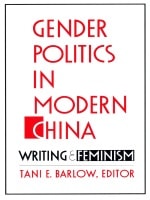
Gender Politics in Modern China
Writing and FeminismTani E. Barlow, ed.
Duke University Press, 1993
Ranging from interviews with contemporary writers, to historical accounts of gendered writing in Taiwan and semi-colonial China, to close feminist readings of individual authors, these essays confront the degree to which textual stategies construct notions of gender. Among the specific themes discussed are: how femininity is produced in texts by allocating women to domestic space; the extent to which textual production lies at the base of a changing, historically specific code of the feminine; the extent to which women in modern Chinese societies are products of literary canons; the ways in which the historical processes of gendering have operated in Chinese modernity vis à vis modernity in the West; the representation of feminists as avengers and as westernized women; and the meager recognition of feminism as a serious intellectual current and a large body of theory.
Originally published as a special issue of Modern Chinese Literature (Spring & Fall 1988), this expanded book represents some of the most compelling new work in post-Mao feminist scholarship and will appeal to all those concerned with understanding a revitalized feminism in the Chinese context.
Contributors. Carolyn Brown, Ching-kiu Stephen Chan, Sung-sheng Yvonne Chang, Yu-shih Chen, Rey Chow, Randy Kaplan, Richard King, Wolfgang Kubin, Wendy Larson, Lydia Liu, Seung-Yeun Daisy Ng, Jon Solomon, Meng Yue, Wang Zheng
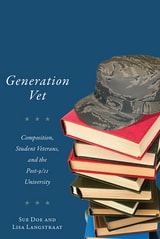
Generation Vet
Composition, Student Veterans, and the Post-9/11 UniversitySue Doe
Utah State University Press, 2014
Institutions of higher education are experiencing the largest influx of enrolled veterans since World War II, and these student veterans are transforming post-secondary classroom dynamics. While many campus divisions like admissions and student services are actively moving to accommodate the rise in this demographic, little research about this population and their educational needs is available, and academic departments have been slower to adjust. In Generation Vet, fifteen chapters offer well-researched, pedagogically savvy recommendations for curricular and programmatic responses to student veterans for English and writing studies departments.
In work with veterans in writing-intensive courses and community contexts, questions of citizenship, disability, activism, community-campus relationships, and retention come to the fore. Moreover, writing-intensive courses can be sites of significant cultural exchanges—even clashes—as veterans bring military values, rhetorical traditions, and communication styles that may challenge the values, beliefs, and assumptions of traditional college students and faculty.
This classroom-oriented text addresses a wide range of issues concerning veterans, pedagogy, rhetoric, and writing program administration. Written by diverse scholar-teachers and written in diverse genres, the essays in this collection promise to enhance our understanding of student veterans, composition pedagogy and administration, and the post-9/11 university.
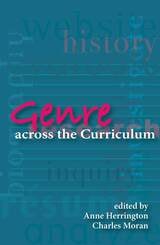
Genre Across The Curriculum
edited by Anne Herrington and Charles Moran
Utah State University Press, 2005
Genre across the Curriculum will function as a "good" textbook, one not for the student, but for the teacher, and one with an eye on the context of writing. Here you will find models of practice, descriptions written by teachers who have integrated the teaching of genre into their pedagogy in ways that both support and empower the student writer.
While authors here look at courses across disciplines and across a range of genres, they are similar in presenting genre as situated within specific classrooms, disciplines, and institutions. Their assignments embody the pedagogy of a particular teacher, and student responses here embody students' prior experiences with writing. In each chapter, the authors define a particular genre, define the learning goals implicit in assigning that genre, explain how they help their students work through the assignment, and, finally, discuss how they evaluate the writing their students do in response to their teaching.
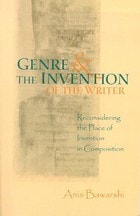
Genre And The Invention Of The Writer
Reconsidering the Place of Invention in CompositionAnis Bawarshi
Utah State University Press, 2003
Instead of mastering notions of "good" writing, Bawarshi feels that students gain more from learning how to adapt socially and rhetorically as they move from one "genred" site of action to the next.
Genre and Second Language Writing
Ken Hyland
University of Michigan Press, 2004
Genre and the Performance of Publics
Mary Jo Reiff
Utah State University Press, 2016
In recent decades, genre studies has focused attention on how genres mediate social activities within workplace and academic settings. Genre and the Performance of Publics moves beyond institutional settings to explore public contexts that are less hierarchical, broadening the theory of how genres contribute to the interconnected and dynamic performances of public life.
Chapters examine how genres develop within publics and how genres tend to mediate performances in public domains, setting up a discussion between public sphere scholarship and rhetorical genre studies. The volume extends the understanding of genres as not only social ways of organizing texts or mediating relationships within institutions but as dynamic performances themselves.
By exploring how genres shape the formation of publics, Genre and the Performance of Publicsbrings rhetoric/composition and public sphere studies into dialogue and enhances the understanding of public genre performances in ways that contribute to research on and teaching of public discourse.
Geographies of Writing
Inhabiting Places and Encountering DifferenceNedra Reynolds
Southern Illinois University Press, 2004
Twenty-first-century technological innovations have revolutionized the way we experience space, causing an increased sense of fragmentation, danger, and placelessness. In Geographies of Writing: Inhabiting Places and Encountering Difference, Nedra Reynolds addresses these problems in the context of higher education, arguing that theories of writing and rhetoric must engage the metaphorical implications of place without ignoring materiality.
Geographies of Writing makes three closely related contributions: one theoretical, to reimagine composing as spatial, material, and visual; one political, to understand the sociospatial construction of difference; and one pedagogical, to teach writing as a set of spatial practices. Aided by seven maps and illustrations that reinforce the book’s visual rhetoric, Geographies of Writing shows how composition tasks and electronic space function as conduits for navigating reality.
Getting It Published, Fourth Edition
A Guide for Scholars and Anyone Else Serious About Serious BooksWilliam Germano
University of Chicago Press, 2026
For more than two decades, writers have turned to William Germano’s Getting It Published as a guide to the world of serious book publishing, including university presses. A professor, author, and thirty-year veteran of the book industry, Germano knows what editors want and what writers need to do to get their work published.
This fourth, thoroughly updated edition of Getting It Published accounts for new challenges facing authors and changed conditions in the publishing industry. From open access to peer review, from approaching a press to considering an agent, publishing can be confusing for authors trying to understand their options. This new edition continues to offer the clear, practicable guidance on choosing the best path to publication that has made the book such a trusted resource. Its latest revisions include an expanded chapter on proposals (and their covering emails) as well as current information on the shifting landscape of ebook publishing. But this book is more than a nuts-and-bolts guide. It takes up a writer’s biggest challenges: how to frame a book-length project, shape its argument, conceive its audience, and pitch it convincingly to an editor.
Getting It Published reflects the latest changes and technologies in the publishing industry but keeps its eye on what remains constant: Whether working on their first book or their fifth, writers can make their work stronger by knowing what publishers do and why they do it.
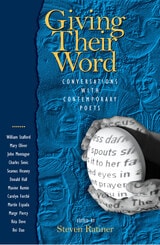
Giving Their Word
Conversations with Contemporary PoetsSteven Ratiner
University of Massachusetts Press, 2002
Based on a three-year series of interviews conducted by Steven Ratiner for the Christian Science Monitor, this book offers extended conversations with twelve of the most influential poets writing today. Their comments are wonderfully detailed, refreshingly honest, and provide the sort of intimate introduction to both poet and text that readers are rarely privileged to enjoy. Included are conversations with William Stafford, Mary Oliver, John Montague, Charles Simic, Seamus Heaney, Donald Hall, Maxine Kumin, Carolyn Forché, Martín Espada, Marge Piercy, Rita Dove, and Bei Dao. In the book's closing interview, Steven Ratiner makes a return visit to Donald Hall's New Hampshire farm shortly before the publication of Hall's collection Without, which focused on the death of his wife, poet Jane Kenyon.
Giving their word is what poets do; it is their stock-in-trade, their daily bread. In the hands of the most accomplished, a poet's words are transformed into a kind of window: looking inward toward the territory of memory, dream, personal mythology and opening out onto the landscape of the shared world where life and work are rooted. For each poet there is an intricate relationship between these two realms and poetry's third domain, the language that bridges both experiences and becomes the body of the poem. Giving Their Word shows us that the poet's fidelity to that relationship sustains his or her development over time, urges the writing toward new levels of discovery, and bestows on readers that most prized of commodities: a feeling of the authentic.
For poets, students of poetry, and that far-flung community of readers for whom the contemporary poem still provides a journey worth taking, this book will present a host of pleasures. Giving Their Word enlarges the frame through which we view the poet's text and yields significant insights into the craft and character of each of these writers.
Go Deep. Take Chances.
Embracing the Muse and Creative WritingRoger Armbrust
Parkhurst Brothers, Inc., 2018
What are the drivers of creative writing:: passion, drive, and fear of rejection? What is the cardinal rule: honesty (to a vision, a voice)? Armbrust, an editor and creative-writing instructor, argues that the struggle to write is reflective of the deeper spiritual consciousness of the writer.
He challenges writers to address their inner demons, being honest to their truest selves, and to wrestle their eepest doubts in their quest to produce the best literature.
“One semester, my creative mentor William Packard asked me to teach his poetry-writing course at New York University’s School of Continuing Education and Professional Studies. He did so because I had taken the course, he considered me a good poet, and knew I was teaching a professional-writing course of my own at NYU. Each time I’d walk in to instruct his poetry-writing class, I’d scratch on the chalkboard two brief sentences: Go Deep. Take Chances. These two suggestions represent, I believe, the keys to creativity.” Many nutsand- bolts pointers (gleaned from decades of writing and advising others) benefit writers of all experience levels.
This book leads writers to better understand and execute the extremely focused work of creative writing, while at the same time enjoying a fuller sense of self, serenity and fulfillment.
Going North Thinking West
The Intersections of Social Class, Critical Thinking, and Politicized Writing InstructionIrvin Peckham
Utah State University Press, 2010
Going Public
A Guide for Social ScientistsArlene Stein and Jessie Daniels
University of Chicago Press, 2017
While there has been an increasing call for social scientists to engage more broadly with the public, concrete advice for starting the conversation has been in short supply. Arlene Stein and Jessie Daniels seek to change this with Going Public, the first guide that truly explains how to be a public scholar. They offer guidance on writing beyond the academy, including how to get started with op-eds and articles and later how to write books that appeal to general audiences. They then turn to the digital realm with strategies for successfully building an online presence, cultivating an audience, and navigating the unique challenges of digital world. They also address some of the challenges facing those who go public, including the pervasive view that anything less than scholarly writing isn’t serious and the stigma that one’s work might be dubbed “journalistic.”
Going Public shows that by connecting with experts, policymakers, journalists, and laypeople, social scientists can actually make their own work stronger. And by learning to effectively add their voices to the conversation, researchers can help make sure that their knowledge is truly heard above the digital din.
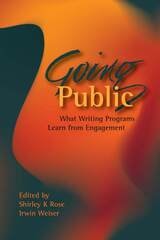
Going Public
What Writing Programs Learn from EngagementShirley Rose
Utah State University Press, 2010
In Going Public, Rose and Weiser locate their discussion in the context of three current conversations in higher education: 1) the engagement movement, particularly as this movement serves to address and respond to calls for greater accountability to broader publics; 2) recent interest in public discourse/civic rhetoric among scholars of rhetorical history and contemporary rhetorical theory; 3) the service learning movement in higher education, especially the ways in which college and university writing programs have contributed to this movement.
While there have been a number of publications describing service-learning and community leadership programs, most of these focus on curricular elements and address administrative issues, if at all, primarily from a curricular perspective. The emphasis of the current book is on the ways that engagement-focused programs change conceptions of WPA identity. Going Public, then, is not only a significant contribution to the scholarly literature, but also supplies an important new resource for WPA preparation courses in rhetoric and composition PhD programs.
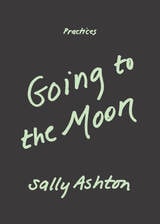
Going to the Moon
Sally Ashton
Duke University Press, 2026
In 2022, poet Sally Ashton learned that one of her poems would be included in a time capsule to be sent to the Moon via Astrobotic’s 2024 Griffin/VIPER as part of the Lunar Codex project. For her, this event seemed like the high point in a life spent chasing the Moon, from a childhood inspired by the space race of the 1960s to an adulthood spent in contemplation and conversation with the sky. In Going to the Moon, Ashton marvels at the Moon’s powerful influence since the dawn of humanity—how we have, in our own ways, gone to the Moon, and what we have found. Contemplating lunar settlement in the light of history, culture, the rise of the space industry, and geopolitical conflict, Ashton shares her sense of wonder at the simple beauty of our unchanged Moon and reveals what is at stake in our contemporary attempts to colonize it.

Going to the Tigers
Essays and ExhortationsRobert Cohen
University of Michigan Press, 2022
In this funny and perceptive collection, novelist and essayist Robert Cohen shares his thoughts on the writing process and then puts these prescriptions into practice—from how to rant effectively as an essayist and novelist (“The Piano Has Been Drinking”), how to achieve your own style, naming characters (and creating them), how one manages one’s own identity with being “a writer” in time and space, to the use of reference and allusion in one’s work. Cohen is a deft weaver of allusion himself. In lieu of telling the reader how to master the elements of writing fiction, he shows them through the work of the writers who most influenced his own development, including Roth, Ellison, Kafka, and Robinson. Rooted in his own experiences, this collection of essays shows readers how to use their influences and experiences to create bold, personal, and individual work. While the first part of the book teaches writing, the essays in the second part show how these elements come together.

Gone Gone
Todd Meyers
Duke University Press, 2025
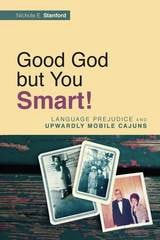
Good God but You Smart!
Language Prejudice and Upwardly Mobile CajunsNichole E. Stanford
Utah State University Press, 2016
The study investigates the complicated motivations and cultural concessions of upwardly mobile Cajuns who “choose” to self-censor—to speak Standardized English over the Cajun English that carries their cultural identity. Drawing on surveys of English teachers in four Louisiana colleges, previously unpublished archival data, and Pierre Bourdieu’s theory of the legitimate language, author Nichole Stanford explores how socioeconomic and political pressures rooted in language prejudice make code switching, or self-censoring in public, seem a responsible decision. Yet teaching students to skirt others’ prejudice toward certain dialects only puts off actually dealing with the prejudice. Focusing on what goes on outside classrooms, Stanford critiques code switching and cautions users of code meshing that pedagogical responses within the educational system are limited by the reproductive function of schools. Each theory section includes parallel memoir sections in the Cajun tradition of storytelling to open an experiential window to the study without technical language.
Through its explication of language legitimacy and its grounding in lived experience, Good God but You Smart! is an essential addition to the pedagogical canon of language minority studies like those of Villanueva, Gilyard, Smitherman, and Rose.
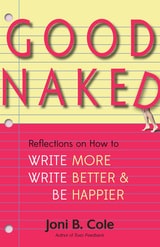
Good Naked
Reflections on How to Write More, Write Better, and Be HappierJoni B. Cole
University Press of New England, 2017
Good with Words
Writing and EditingPatrick Barry
Michigan Publishing Services, 2019

Good with Words
Writing and EditingPatrick Barry
Michigan Publishing Services, 2019
Graduate Writing Across the Disciplines
Identifying, Teaching, and SupportingMarilee Brooks-Gillies
University Press of Colorado, 2020
Grounded Literacies in a Transnational WAC/WID Ecology
A Korean-U.S. StudyJay Jordan
University Press of Colorado, 2022
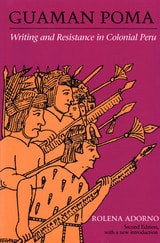
Guaman Poma
Writing and Resistance in Colonial PeruBy Rolena Adorno
University of Texas Press, 2000
In the midst of native people's discontent following Spanish conquest, a native Andean born after the fall of the Incas took up the pen to protest Spanish rule. Felipe Guaman Poma de Ayala wrote his Nueva corónica y buen gobierno to inform Philip III of Spain about the evils of colonialism and the need for governmental and societal reform. By examining Guaman Poma's verbal and visual engagement with the institutions of Western art and culture, Rolena Adorno shows how he performed a comprehensive critique of the colonialist discourse of religion, political theory, and history. She argues that Guaman Poma's work chronicles the emergence of a uniquely Latin American voice, characterized by the articulation of literary art and politics.
Following the initial appearance of Guaman Poma: Writing and Resistance in Colonial Peru, the 1990s witnessed the creation of a range of new studies that underscore the key role of the Nueva corónica y buen gobierno in facilitating our understanding of the Andean and Spanish colonial pasts. At the same time, the documentary record testifying to Guaman Poma's life and work has expanded dramatically, thanks to the publication of long-known but previously inaccessible drawings and documents. In a new, lengthy introduction to this second edition, Adorno shows how recent scholarship from a variety of disciplinary perspectives sheds new light on Guaman Poma and his work, and she offers an important new assessment of his biography in relation to the creation of the Nueva corónica y buen gobierno.
Guide to College Writing Assessment
Peggy O'Neill, Cindy Moore, and Brian Huot
Utah State University Press, 2009
A Guide to College Writing Assessment is designed as an introduction and source book for WPAs, department chairs, teachers, and administrators. Always cognizant of the critical components of particular teaching contexts, O’Neill, Moore, and Huot have written sophisticated but accessible chapters on the history, theory, application and background of writing assessment, and they offer a dozen appendices of practical samples and models for a range of common assessment needs.
Because there are numerous resources available to assist faculty in assessing the writing of individual students in particular classrooms, A Guide to College Writing Assessment focuses on approaches to the kinds of assessment that typically happen outside of individual classrooms: placement evaluation, exit examination, programmatic assessment, and faculty evaluation. Most of all, the argument of this book is that creating the conditions for meaningful college writing assessment hinges not only on understanding the history and theories informing assessment practice, but also on composition programs availing themselves of the full range of available assessment practices.