Results by title
4030 books match the query 'Language Arts & Disciplines' and 99 start with g

Going Mobile
Developing Apps for Your Library Using Basic HTML ProgrammingScott American Library Association
American Library Association, 2012
Going North Thinking West
The Intersections of Social Class, Critical Thinking, and Politicized Writing InstructionIrvin Peckham
Utah State University Press, 2010
Going Public
A Guide for Social ScientistsArlene Stein and Jessie Daniels
University of Chicago Press, 2017
While there has been an increasing call for social scientists to engage more broadly with the public, concrete advice for starting the conversation has been in short supply. Arlene Stein and Jessie Daniels seek to change this with Going Public, the first guide that truly explains how to be a public scholar. They offer guidance on writing beyond the academy, including how to get started with op-eds and articles and later how to write books that appeal to general audiences. They then turn to the digital realm with strategies for successfully building an online presence, cultivating an audience, and navigating the unique challenges of digital world. They also address some of the challenges facing those who go public, including the pervasive view that anything less than scholarly writing isn’t serious and the stigma that one’s work might be dubbed “journalistic.”
Going Public shows that by connecting with experts, policymakers, journalists, and laypeople, social scientists can actually make their own work stronger. And by learning to effectively add their voices to the conversation, researchers can help make sure that their knowledge is truly heard above the digital din.
Going Public
What Writing Programs Learn from EngagementShirley Rose
Utah State University Press, 2010
In Going Public, Rose and Weiser locate their discussion in the context of three current conversations in higher education: 1) the engagement movement, particularly as this movement serves to address and respond to calls for greater accountability to broader publics; 2) recent interest in public discourse/civic rhetoric among scholars of rhetorical history and contemporary rhetorical theory; 3) the service learning movement in higher education, especially the ways in which college and university writing programs have contributed to this movement.
While there have been a number of publications describing service-learning and community leadership programs, most of these focus on curricular elements and address administrative issues, if at all, primarily from a curricular perspective. The emphasis of the current book is on the ways that engagement-focused programs change conceptions of WPA identity. Going Public, then, is not only a significant contribution to the scholarly literature, but also supplies an important new resource for WPA preparation courses in rhetoric and composition PhD programs.
Going Solo
Doing Videojournalism in the 21st CenturyG. Stuart Smith
University of Missouri Press, 2011
Going Virtual
Programs and Insights from a Time of CrisisSarah Ostman
American Library Association, 2021
- COVID-19 Misinformation Challenge, featuring an email quiz, to encourage participants to separate fact from fiction;
- weekly virtual storytimes;
- community cooking demonstrations via Zoom;
- an online grocery store tour, complete with tips about shopping healthy on a budget;
- a virtual beer tasting that boasted 80 attendees;
- socially distanced "creativity crates" for summer reading;
- an online Minecraft club for kids ages 6 and up;
- a Zoom presentation about grieving and funerals during COVID, featuring the director of a local funeral home;
- Art Talk Tuesday, a one-hour, docent-led program;
- a virtual lecture on the history of witchcraft, presented by a public library in partnership with a university rare book room, that drew thousands of viewers;
- "knitting for knewbies" kits for curbside pickup;
- Songs from the Stacks, an ongoing virtual concert series in the style of NPR’s “Tiny Desk”;
- a pink supermoon viewing party that included people howling at the moon together from their homes on Facebook Live;
- and many others
Going to War in Iraq
When Citizens and the Press MatterStanley Feldman, Leonie Huddy, and George E. Marcus
University of Chicago Press, 2015
Drawing on the most comprehensive survey of public reactions to the war, Stanley Feldman, Leonie Huddy, and George E. Marcus revisit this critical period and come back with a very different story. Polling data from that critical period shows that the Bush administration’s carefully orchestrated campaign not only failed to raise Republican support for the war but, surprisingly, led Democrats and political independents to increasingly oppose the war at odds with most prominent Democratic leaders. More importantly, the research shows that what constitutes the news matters. People who read the newspaper were more likely to reject the claims coming out of Washington because they were exposed to the sort of high-quality investigative journalism still being written at traditional newspapers. That was not the case for those who got their news from television. Making a case for the crucial role of a press that lives up to the best norms and practices of print journalism, the book lays bare what is at stake for the functioning of democracy—especially in times of crisis—as newspapers increasingly become an endangered species.
Going to the Moon
Sally Ashton
Duke University Press, 2026
In 2022, poet Sally Ashton learned that one of her poems would be included in a time capsule to be sent to the Moon via Astrobotic’s 2024 Griffin/VIPER as part of the Lunar Codex project. For her, this event seemed like the high point in a life spent chasing the Moon, from a childhood inspired by the space race of the 1960s to an adulthood spent in contemplation and conversation with the sky. In Going to the Moon, Ashton marvels at the Moon’s powerful influence since the dawn of humanity—how we have, in our own ways, gone to the Moon, and what we have found. Contemplating lunar settlement in the light of history, culture, the rise of the space industry, and geopolitical conflict, Ashton shares her sense of wonder at the simple beauty of our unchanged Moon and reveals what is at stake in our contemporary attempts to colonize it.

Going to the Tigers
Essays and ExhortationsRobert Cohen
University of Michigan Press, 2022
In this funny and perceptive collection, novelist and essayist Robert Cohen shares his thoughts on the writing process and then puts these prescriptions into practice—from how to rant effectively as an essayist and novelist (“The Piano Has Been Drinking”), how to achieve your own style, naming characters (and creating them), how one manages one’s own identity with being “a writer” in time and space, to the use of reference and allusion in one’s work. Cohen is a deft weaver of allusion himself. In lieu of telling the reader how to master the elements of writing fiction, he shows them through the work of the writers who most influenced his own development, including Roth, Ellison, Kafka, and Robinson. Rooted in his own experiences, this collection of essays shows readers how to use their influences and experiences to create bold, personal, and individual work. While the first part of the book teaches writing, the essays in the second part show how these elements come together.

Gone Gone
Todd Meyers
Duke University Press, 2025
Good God but You Smart!
Language Prejudice and Upwardly Mobile CajunsNichole E. Stanford
Utah State University Press, 2016
The study investigates the complicated motivations and cultural concessions of upwardly mobile Cajuns who “choose” to self-censor—to speak Standardized English over the Cajun English that carries their cultural identity. Drawing on surveys of English teachers in four Louisiana colleges, previously unpublished archival data, and Pierre Bourdieu’s theory of the legitimate language, author Nichole Stanford explores how socioeconomic and political pressures rooted in language prejudice make code switching, or self-censoring in public, seem a responsible decision. Yet teaching students to skirt others’ prejudice toward certain dialects only puts off actually dealing with the prejudice. Focusing on what goes on outside classrooms, Stanford critiques code switching and cautions users of code meshing that pedagogical responses within the educational system are limited by the reproductive function of schools. Each theory section includes parallel memoir sections in the Cajun tradition of storytelling to open an experiential window to the study without technical language.
Through its explication of language legitimacy and its grounding in lived experience, Good God but You Smart! is an essential addition to the pedagogical canon of language minority studies like those of Villanueva, Gilyard, Smitherman, and Rose.
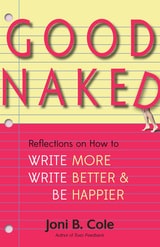
Good Naked
Reflections on How to Write More, Write Better, and Be HappierJoni B. Cole
University Press of New England, 2017
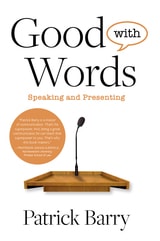
Good with Words
Speaking and PresentingPatrick Barry
Michigan Publishing Services, 2021
This book is designed to help you find out. Based on an award-winning course and workshop series at the University of Michigan taken by students training to enter a wide range of fields—law, business, medicine, social work, public policy, design, engineering, and many more—it removes the guesswork from figuring out how to communicate clearly and compellingly. All of us have ideas that are worth sharing. Why not learn how to convey yours in a way that people will appreciate, enjoy, and remember?
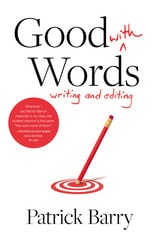
Good with Words
Writing and EditingPatrick Barry
Michigan Publishing Services, 2019

Good with Words
Writing and EditingPatrick Barry
Michigan Publishing Services, 2019
Google Search Secrets
Christa Burns
American Library Association, 2013
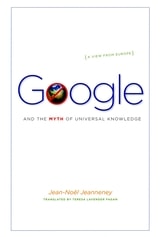
Google and the Myth of Universal Knowledge
A View from EuropeJean-Noël Jeanneney
University of Chicago Press, 2006
The recent announcement that Google will digitize the holdings of several major libraries sent shock waves through the book industry and academe. Google presented this digital repository as a first step towards a long-dreamed-of universal library, but skeptics were quick to raise a number of concerns about the potential for copyright infringement and unanticipated effects on the business of research and publishing.
Jean-Noël Jeanneney, president of France’s Bibliothèque Nationale, here takes aim at what he sees as a far more troubling aspect of Google’s Library Project: its potential to misrepresent—and even damage—the world’s cultural heritage. In this impassioned work, Jeanneney argues that Google’s unsystematic digitization of books from a few partner libraries and its reliance on works written mostly in English constitute acts of selection that can only extend the dominance of American culture abroad. This danger is made evident by a Google book search the author discusses here—one run on Hugo, Cervantes, Dante, and Goethe that resulted in just one non-English edition, and a German translation of Hugo at that. An archive that can so easily slight the masters of European literature—and whose development is driven by commercial interests—cannot provide the foundation for a universal library.
As a leading librarian, Jeanneney remains enthusiastic about the archival potential of the Web. But he argues that the short-term thinking characterized by Google’s digital repository must be countered by long-term planning on the part of cultural and governmental institutions worldwide—a serious effort to create a truly comprehensive library, one based on the politics of inclusion and multiculturalism.
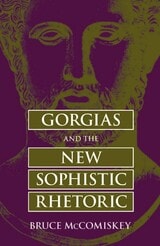
Gorgias and the New Sophistic Rhetoric
Bruce McComiskey
Southern Illinois University Press, 2002
In Gorgias and the New Sophistic Rhetoric, Bruce McComiskey achieves three rhetorical goals: he treats a single sophist's rhetorical technê (art) in the context of the intellectual upheavals of fifth-century bce Greece, thus avoiding the problem of generalizing about a disparate group of individuals; he argues that we must abandon Platonic assumptions regarding the sophists in general and Gorgias in particular, opting instead for a holistic reading of the Gorgianic fragments; and he reexamines the practice of appropriating sophistic doctrines, particularly those of Gorgias, in light of the new interpretation of Gorgianic rhetoric offered in this book.
In the first two chapters, McComiskey deals with a misconception based on selective and Platonic readings of the extant fragments: that Gorgias's rhetorical technê involves the deceptive practice of manipulating public opinion. This popular and ultimately misleading interpretation of Gorgianic doctrines has been the basis for many neosophistic appropriations. The final three chapters deal with the nature and scope of neosophistic rhetoric in light of the non-Platonic and holistic interpretation of Gorgianic rhetoric McComiskey postulates in his opening chapters. He concludes by examining the future of communication studies to discover what roles neosophistic doctrines might play in the twenty-first century.
McComiskey also provides a selective bibliography of scholarship on sophistic rhetoric and philosophy in English since 1900.
Governing With the News, Second Edition
The News Media as a Political InstitutionTimothy E. Cook
University of Chicago Press, 2005
"Provocative and often wise. . . . Cook, who has a complex understanding of the relationship between governing and the news, provides a fascinating account of the origins of this complicity."—James Bennet, Washington Monthly
"[Governing with the News] addresses central issues of media impact and power in fresh, illuminating ways. . . . Cook mines a wealth of historical and organizational literature to assert that the news media are a distinct political institution in our democratic system."—Robert Schmuhl, Commonweal

Governing with the News
The News Media as a Political InstitutionTimothy E. Cook
University of Chicago Press, 1998
The formation of the press as a political institution began in the early days of the republic when newspapers were sponsored by political parties; the relationship is now so central that press offices are found wherever one turns. Cook demonstrates not only how the media are structured as an institution that exercises collective power but also how the role of the media has become institutionalized within the political process, affecting policy and instigating, rather than merely reflecting, political actions. Cook's analysis is a powerful and fascinating guide to our age when newsmaking and governing are inseparable.
"This is a wonderful analysis of a highly important topic. Tim Cook is resoundingly right that we need to look at the media as political institutions and their operatives as political actors."—David R. Mayhew, author of Divided We Govern
"This meticulously researched and well reasoned work proposes to take seriously a thesis which flies in the face of both journalistic lore and political myth. Governing with the News is an innovative contribution to our understanding of media."—W. Lance Bennett, author of News: The Politics of Illusion
"This book should be read by journalists . . . by mass communication faculty teaching courses in media structure or effects and journalism faculty as a supplemental text to courses in media history and media management."—Benjamin J. Burns, Journalism & Mass Communication Quarterly
Government Information Essentials
Susanne Caro
American Library Association, 2017
Graduate Writing Across the Disciplines
Identifying, Teaching, and SupportingMarilee Brooks-Gillies
University Press of Colorado, 2020
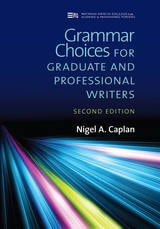
Grammar Choices for Graduate and Professional Writers, Second Edition
Nigel A. Caplan
University of Michigan Press, 2019
Each of the eight units in Grammar Choices contains: an overview of the grammar topic; a preview test that allows students to assess their control of the target grammar and teachers to diagnose areas of difficulty; an authentic example of graduate-student writing showing the unit grammar in use; clear descriptions of essential grammar structures using the framework of functional grammar, cutting-edge research in applied linguistics, and corpus studies; vocabulary relevant to the grammar point is introduced—for example, common verbs in the passive voice, summary nouns used with this/these, and irregular plural nouns; authentic examples for every grammar point from corpora and published texts; exercises for every grammar point that help writers develop grammatical awareness and use, including completing sentences, writing, revising, paraphrasing, and editing; and a section inviting writers to investigate discipline-specific language use and apply it to an academic genre.
Among the changes in the Second Edition are:
- new sections on parallel form (Unit 2) and possessives (Unit 5)
- revised and expanded explanations, but particularly regarding verb complementation, complement noun clauses, passive voice, and stance/engagement
- a restructured Unit 2 and significantly revised/updated Unit 7
- new Grammar Awareness tasks in Units 3, 5, and 6
- new exercises plus revision/updating of many others
- self-editing checklists in the Grammar in Your Discipline sections at the end of each unit
- representation of additional academic disciplines (e.g., engineering, management) in example sentences and texts and in exercises.
Grammar and Discourse Principles
Functional Syntax and GB TheorySusumu Kuno and Ken-ichi Takami
University of Chicago Press, 1993
Kuno and Takami begin by looking at extraction phenomena, including extraction from complement clauses, the overt subject requirement, and subjacency, and provide functional accounts that improve on the Barriers analysis. Next, they discuss multiple wh questions in English and Japanese, with special reference to why and naze. The authors also examine and ultimately reject the major arguments in support of Larson's "light predicate raising" analysis. Finally, Kuno and Takami discuss coreferentiality of picture noun reflexives and the relation of quantifier scope interpretations, particularly those in sentences involving psychological verbs such as bother, worry, and please.
In this subtly argued book, the authors raise questions of critical importance for theoretical linguists of all persuasions.
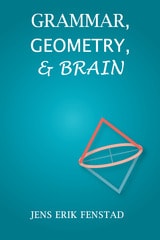
Grammar, Geometry, and Brain
Jens Erik Fenstad
CSLI, 2010
This original study considers the effects of language and meaning on the brain. Jens Erik Fenstad—an expert in the fields of recursion theory, nonstandard analysis, and natural language semantics—combines current formal semantics with a geometric structure in order to trace how common nouns, properties, natural kinds, and attractors link with brain dynamics.
Grammatical Competence and Parsing Performance
Bradley L. Pritchett
University of Chicago Press, 1992
Pritchett critiques the major performance-based parsing models to argue that the principles of grammar drive the parser; the parser, furthermore, is the apparatus that tries to enforce the conditions of the grammar at every point in the processing of a sentence. In comparing garden path phenomena, those instances when the parser fails on the first reading of a sentence and must reanalyze it, with occasions when the parser successfully functions the first time around, Pritchett makes a convincing case for a grammar-derived parsing theory.
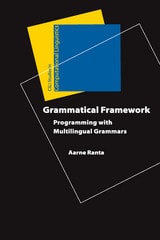
Grammatical Framework
Programming with Multilingual GrammarsAarne Ranta
CSLI, 2011
Grammatical Framework is a programming language designed for writing grammars, which has the capability of addressing several languages in parallel. This thorough introduction demonstrates how to write grammars in Grammatical Framework and use them in applications such as tourist phrasebooks, spoken dialogue systems, and natural language interfaces. The examples and exercises presented here address several languages, and the readers are shown how to look at their own languages from the computational perspective.
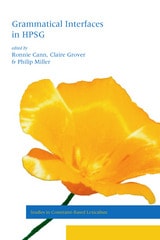
Grammatical Interfaces in HPSG
Edited by Ronnie Cann, Claire Grover, and Philip H. Miller
CSLI, 2001
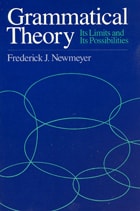
Grammatical Theory
Its Limits and Its PossibilitiesFrederick J. Newmeyer
University of Chicago Press, 1983
Newmeyer's formidable scholarship raises the level of debate on transformational generative grammar. He stresses the central importance of an autonomous formal grammar, discusses the limitations of "discourse-based" approaches to syntax, cites support for generativist theory in recent research, and clarifies misunderstood concepts associated with generative grammar.
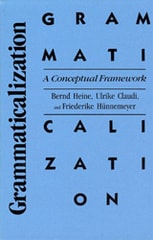
Grammaticalization
A Conceptual FrameworkBernd Heine, Ulrike Claudi, and Friederike Hünnemeyer
University of Chicago Press, 1991
This volume challenges theories which describe language as a static system, as well as those which assume that linguistic categorization is based on discrete morpheme types, word classes, or sentence constituents. In contrast, the book's central argument is that both language structure and language use are dynamic phenomena and that linguistic behavior is essentially a creative activity. That creativity manifests itself, for example, in conceptual transfer leading to the encoding of more abstract concepts and of grammatical categories. Another key element of this theory is captured in the term "grammaticalization chain," which refers to a specific kind of linguistic category which cuts across morpheme types and word classes and has both a synchronic and diachronic dimension.
Grant Money Through Collaborative Partnerships
Nancy Kalikow American Library Association
American Library Association, 2012
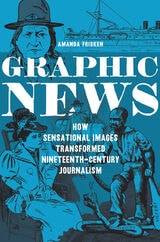
Graphic News
How Sensational Images Transformed Nineteenth-Century JournalismAmanda Frisken
University of Illinois Press, 2020
Graphic Novels in Your School Library
Jesse Karp
American Library Association, 2012
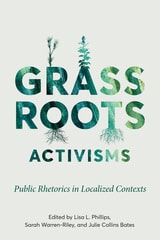
Grassroots Activisms
Public Rhetorics in Localized ContextsEdited by Lisa L. Phillips, Sarah Warren-Riley, and Julie Collins Bates
The Ohio State University Press, 2024
What is the nature of grassroots activism? How and why do individuals get involved or attempt to make change for themselves, others, or their own communities? What motivates activists to maintain momentum when their efforts to redress injustices or paths toward change seem difficult or personally risky to navigate? These questions and more are addressed in Grassroots Activisms: Public Rhetorics in Localized Contexts. Featuring a diverse array of both local activist profiles and original scholarly essays, the collection amplifies and analyzes the tactics of grassroots activists working locally to intervene in a variety of social injustices—from copwatching and policy reform to Indigenous resistance against land colonization to #RageAgainstRape.
Attuned to the demanding—and often underappreciated—work of grassroots activism, this book interrogates how such efforts unfold within and against existing historical, cultural, social, and political realities of local communities; are informed by the potentials and constraints of coalition-building; and ultimately shape different facets of society at the local level. This collection acknowledges and celebrates the complexity of grassroots activist work, showing how these less-recognized efforts often effect change where institutions have failed.
Grassroots Library Advocacy
Lauren Comito
American Library Association, 2012
Greek Inscriptions
Ancient ScriptsPeter Liddel
J. Paul Getty Trust, The, 2025
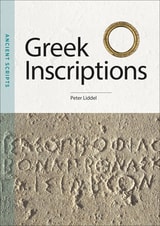
Ancient Greek inscriptions are crucially important in understanding the cultures of Greece and the Mediterranean in antiquity. They provide glimpses of the behavior of the people of the time, including clues about their mindsets and aspirations. These public records combine word and image in a multitude of ways and are rich in the insights they offer.
The inscriptions examined in this volume come from a range of objects on metal or stone that include laws, decrees, accounts and inventories, honorific texts, dedications to deities, and funerary epitaphs. They give a broad view of interstate relations, historical narratives, and the political administration of various city-states while also providing new perspectives on concepts such as democracy, citizenship, gender, ethnicity, religion, and the supernatural. Peter Liddel emphasizes the physical form of the texts alongside their importance in understanding ancient Greek culture. Accessible and insightful, Greek Inscriptions both highlights the significance and history of these artifacts and examines their reception in the modern world.
Green Communication and China
On Crisis, Care, and Global FuturesJingfang Liu
Michigan State University Press, 2020
Grit and Ink
An Oregon Family’s Adventures in Newspapering, 1908–2018William F. Willingham
Oregon State University Press, 2018

Grounded Literacies in a Transnational WAC/WID Ecology
A Korean-U.S. StudyJay Jordan
University Press of Colorado, 2022
Guide to College Writing Assessment
Peggy O'Neill, Cindy Moore, and Brian Huot
Utah State University Press, 2009
A Guide to College Writing Assessment is designed as an introduction and source book for WPAs, department chairs, teachers, and administrators. Always cognizant of the critical components of particular teaching contexts, O’Neill, Moore, and Huot have written sophisticated but accessible chapters on the history, theory, application and background of writing assessment, and they offer a dozen appendices of practical samples and models for a range of common assessment needs.
Because there are numerous resources available to assist faculty in assessing the writing of individual students in particular classrooms, A Guide to College Writing Assessment focuses on approaches to the kinds of assessment that typically happen outside of individual classrooms: placement evaluation, exit examination, programmatic assessment, and faculty evaluation. Most of all, the argument of this book is that creating the conditions for meaningful college writing assessment hinges not only on understanding the history and theories informing assessment practice, but also on composition programs availing themselves of the full range of available assessment practices.
Guide to Ethics in Acquisitions
Wyoma vanDuinkerken
American Library Association, 2015
Guide to Reference in Business and Economics
Steven W. American Library Association
American Library Association, 2014
Guide to Reference in Essential General Reference and Library Science Sources
Jo Bell American Library Association
American Library Association, 2014
Guide to Reference in Genealogy and Biography
Mary K. American Library Association
American Library Association, 2015
Guide to Reference in Medicine and Health
Denise Beaubien Bennett
American Library Association, 2014

Guide to Security Considerations and Practices for Rare Book, Manuscript, and Special Collection Libraries
Everett Wilkie, Jr
Assoc of College & Research Libraries, 2011
Guide to Streaming Video Acquisitions
Eric Hartnett
American Library Association, 2019
Guidelines for Multilingual Deaf Education Teacher Preparation Programs
Christopher Kurz
Gallaudet University Press, 2021
The key goals and anticipated outcomes of this volume are:
- to increase the number of multilingual Deaf education teacher preparation programs;
- to increase the number of fluent language and cultural models for Deaf children in varying educational environments;
- to increase the number of high quality teachers with competencies in multilingual strategies;
- to increase collaboration between teacher training programs; and
- to increase research and professional development focused in multilingual pedagogies.
Guidelines on Subject Access to Individual Works of Fiction, Drama, Etc.
American Library Association, 2000