Results by title
5448 books match the query 'History and criticism' and 153 start with h
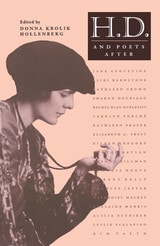
H.D. and Poets After
Donna Krolik Hollenberg
University of Iowa Press, 2000
Twenty essays—half by eminent American poets writing about their literary engagement with H.D. and half by critics writing about H.D. in relation to these same poets—provide a fruitful exchange of perceptions and interpretations. The dialogue between these two perspectives—the first autobiographical testimony and the second critical analysis by scholars attuned to both modern and contemporary poetries and poetics—calls into question both traditional notions of literary criticism and earlier theories of literary influence.
The volume includes a range of contemporary responses to H.D.'s work—from Alicia Ostriker's radical eroticism to Brenda Hillman's epistemological restlessness to Carolyn Forché's response to moral disasters of the century. H.D. and Poets After demonstrates key aspects of the poet's continuing importance as a "poet's poet" in the best sense.
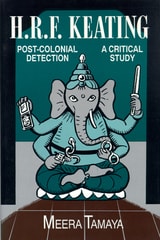
H.R.F. Keating
Post-Colonial Detection, A Critical StudyMeera Tamaya
University of Wisconsin Press, 1993
HARLAN ELLISON
THE EDGE OF FOREVERGary K. Wolfe and Ellen Weil
The Ohio State University Press, 2002
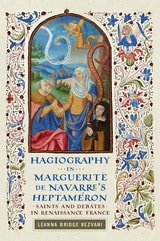
Hagiography in Marguerite de Navarre’s Heptaméron
Saints and Debates in Renaissance FranceLeanna Bridge Rezvani
University of Delaware Press, 2026
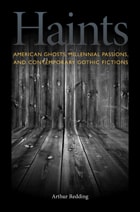
Haints
American Ghosts, Millennial Passions, and Contemporary Gothic FictionsArthur Redding
University of Alabama Press, 2011
In Haints: American Ghosts, Millennial Passions, and Contemporary Gothic Fictions, Arthur Redding argues that ghosts serve as lasting witnesses to the legacies of slaves and indigenous peoples whose stories were lost in the remembrance or mistranslation of history.
Authors such as Toni Morrison and Leslie Marmon Silko deploy the ghost as a means of reconciling their own violently repressed heritage with their identity as modern Americans. And just as our ancestors were haunted by ghosts of the past, today their descendants are haunted by ghosts of contemporary crises: urban violence, racial hatred, and even terrorism. In other cases that Redding studies—such as James Baldwin’s The Evidence of Things Not Seen and Toni Cade Bambara’s Those Bones Are Not My Child—gothic writers address similar crises to challenge traditional American claims of innocence and justice.
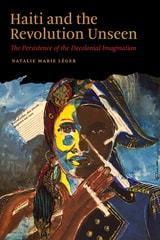
Haiti and the Revolution Unseen
The Persistence of the Decolonial ImaginationNatalie Marie Léger
Vanderbilt University Press, 2025
Léger writes against a Haiti- and Haitians-less idea of the Revolution. She asks scholars and artists of the Revolution to know Haitians as Ginens (African Haitians) and Haiti as Ayiti Ginen (Africa Haiti). This form of knowing demands a decolonial understanding of the Haitian Revolution and a reevaluation of its stories as told by influential twentieth-century Caribbean writers. The story she tells showcases the immense political impact of the African Haitian revolutionist’s philosophies of freedom in Saint Domingue and Haiti thereafter; and she argues that the absence of these philosophies in Caribbean classics of the Revolution demands consideration of why these classics continue to shape how the Revolution and Haiti are discussed in Caribbean Studies, Black Studies, Postcolonial Studies and Haitian Studies. More pressingly, Léger calls on artists and scholars of the Revolution to be mindful of how Haiti and Haitians are figured in narratives of the Revolution. The immense space Haiti holds in Caribbean imaginings of freedom and revolution makes mediating it, its Revolution, and peoples through a prejudiced gaze that serves the West hugely problematic, since a denigrated Haiti yields stunted visions of the Caribbean’s future. These conditions require attention to the pervasive presence of colonial paradigms for being in classic literatures of the Revolution and the way they undermine the generative manner Caribbean writers have used Haiti to think through their past, present, and future.

Hamlet Vocation Coleridge And Wordsworth
Martin Greenberg
University of Iowa Press, 1986

Han Heroes and Yamato Warriors
Competing Masculinities in Chinese and Japanese War CinemaAmanda Weiss
Hong Kong University Press, 2023
Taking the “tidal wave” of memory in the late twentieth and early twenty-first century as its starting point, this monograph explores the collective memory of World War II in East Asia (1937–1945) through film. Weiss argues that Chinese, Japanese, and American remembrance of World War II is intertwined in what she terms a “memory loop,” the transnational mediation and remediation of war narratives. Gender is central to this process, as the changing representation of male soldiers, political leaders, and patriarchal father figures within these narratives reveals Japanese and Chinese challenges to each other and to the perceived “foundational” American narrative of the war. This process continues to intensify due to the globally visible nature of the memory loop, which drives this cycle of transmission, translation, and reassessment.
This volume is the first to bring together a collection of Chinese and Japanese war films that have received little attention in English-language literature. It also produces new readings of popular war memory in East Asia by revealing the gendered dimensions of collective remembrance in these films.
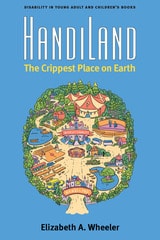
HandiLand
The Crippest Place on EarthElizabeth A. Wheeler
University of Michigan Press, 2019
HandiLand looks at young adult novels, fantasy series, graphic memoirs, and picture books of the last 25 years in which characters with disabilities take center stage for the first time. These books take what others regard as weaknesses—for instance, Harry Potter’s headaches or Hazel Lancaster’s oxygen tank—and redefine them as part of the hero’s journey. HandiLand places this movement from sidekick to hero in the political contexts of disability rights movements in the United States, the United Kingdom, and Ghana.
Elizabeth A. Wheeler invokes the fantasy of HandiLand, an ideal society ready for young people with disabilities before they get there, as a yardstick to measure how far we’ve come and how far we still need to go toward the goal of total inclusion. The book moves through the public spaces young people with disabilities have entered, including schools, nature, and online communities. As a disabled person and parent of children with disabilities, Wheeler offers an inside look into families who collude with their kids in shaping a better world. Moving, funny, and beautifully written, HandiLand: The Crippest Place on Earth is the definitive study of disability in contemporary literature for young readers.
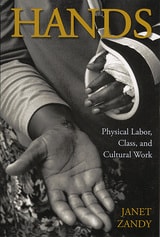
Hands
Physical Labor, Class, and Cultural WorkZandy, Janet
Rutgers University Press, 2004
In linking forms of cultural expression to labor, occupational injuries, and deaths, Hands: Physical Labor, Class, and Cultural Work centers what is usually decentered--the complex culture of working-class people. Janet Zandy begins by examining the literal loss of lives to unsafe jobs and occupational hazards. She asks critical and timely questions about worker representation--who speaks for employees when the mills, mines, factories, and even white-collar cubicles shut down? She presents the voices of working-class writers and artists, and discusses their contribution to knowledge and culture.
This innovative study reveals the flesh and bone beneath the abstractions of labor, class, and culture. It is an essential contribution to the emerging field of working-class studies, offering a hybrid model for bridging communities and non-academic workers to scholars and institutions of knowledge.
Handsomely Done
Aesthetics, Politics, and Media after MelvilleEdited by Daniel Hoffman-Schwartz
Northwestern University Press, 2019
The volume thus engages not only Melville reception across media (Jorge Luis Borges, John Huston, Jean-Luc Godard, Led Zeppelin, Claire Denis) but also the Melvillean resonances and echoes of various political events and movements, such as the Attica uprising, the Red Army Faction, Occupy Wall Street, and Black Lives Matter. This consideration of Melville’s afterlife opens onto theorizations of intermediality, un/translatability, and material intensity even as it also continually faces the most concrete and pressing questions of history and politics.
Hansberry's Drama
COMMITMENT AMID COMPLEXITYSteven R. Carter
University of Illinois Press, 1991
Haphazard Families
Romanticism, Nation, and the Prehistory of Modern AdoptionEric C. Walker
The Ohio State University Press, 2024
There are no provisions for adoption in English common law, and adoption wasn't legally formalized in England and Wales until 1926. But a century earlier, untimely adoptions navigated the new exceptionalism of childhood in Romanticism. In Haphazard Families, Eric C. Walker explores the history of the adopted child in Romantic-era England. Taking up the stories of both fictional and historical adoptees, he demonstrates how these children, diminished to nonpersons, shouldered the burden of social constructs of nation, family, gender, and class. Walker further demonstrates how Rousseau’s infamous failure to follow his own ideals of parenthood shaped British reactions in famous texts such as Frankenstein and Emma. Incorporating perspectives from Romantic scholarship and critical adoption studies and examining the stories of adopted children associated with Queen Caroline, Anna Letitia Barbauld, Jane Austen, the Wordsworth siblings, Mary Shelley, Charles and Mary Lamb, Letitia Landon, and others, Haphazard Families considers how Romantic constructions of childhood supply foundational structures of modern adoptee subjectivity.
Hard-Boiled
Erin A. Smith
Temple University Press, 2000
Relying on pulp magazine advertising, the memoirs of writers and publishers, Depression-era studies of adult reading habits, social and labor history, Smith offers an innovative account of how these popular stories were generated and read. She shows that although the work of pulp fiction authors like Dashiell Hammett, Raymond Chandler, and Erle Stanley Gardner have become “classics” of popular culture, the hard-boiled genre was dominated by hack writers paid by the word, not self-styled artists. Pulp magazine editors and writers emphasized a gritty realism in the new genre. Unlike the highly rational and respectable British protagonists (Miss Marple and Hercule Poirot, for instance), tough-talking American private eyes relied as much on their fists as their brains as they made their way through tangled plotlines.
Casting working-class readers of pulp fiction as “poachers,” Smith argues that they understood these stories as parables about Taylorism, work, and manhood; as guides to navigating consumer culture; as sites for managing anxieties about working women. Engaged in re-creating white, male privilege for the modern, heterosocial world, pulp detective fiction shaped readers into consumers by selling them what they wanted to hear – stories about manly artisan-heroes who resisted encroaching commodity culture and the female consumers who came with it. Commenting on the genre’s staying power, Smith considers contemporary detective fiction by women, minority, and gay and lesbian writers.
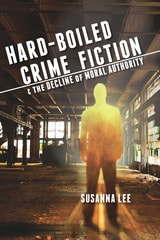
Hard-Boiled Crime Fiction and the Decline of Moral Authority
Susanna Lee
The Ohio State University Press, 2016
Lee traces the history of the hard-boiled detective through the twentieth century and on both sides of the Atlantic (France and the United States), tying the idea of morality to the character model in nuanced, multifaceted ways. When the heroic model devolves, the very conceptual validity of individual moral authority can seem to devolve as well. Hard-Boiled Crime Fiction and the Decline of Moral Authority charts the evolution of that character model of the hard-boiled hero, the mid-century deterioration of his exemplarity, and twenty-first-century endeavors to resuscitate the accountable hero. The history of hard-boiled crime fiction tells nothing less than the story of individual autonomy and accountability in modern Western culture.
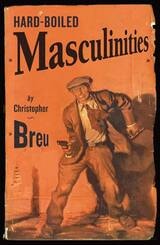
Hard-Boiled Masculinities
Christopher Breu
University of Minnesota Press, 2005
Looking closely at this transformation, Christopher Breu offers a complex account of how and why hard-boiled masculinity emerged during an unsettled time of increased urbanization and tenuous peace and traces the changes in its cultural conception as it moved back and forth across the divide between high and low culture as well as the color line that bifurcated American society.
Examining the work of Ernest Hemingway, Dashiell Hammett, Chester Himes, and William Faulkner, as well as many lesser-known writers for the hypermasculine pulp magazines of the 1920s and 1930s, Breu illustrates how the tough male was a product of cultural fantasy, one that shored up gender and racial stereotypes as a way of lashing out at the destabilizing effects of capitalism and social transformation.
Christopher Breu is assistant professor of English at Illinois State University.
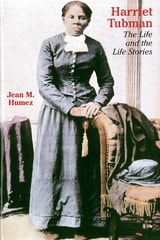
Harriet Tubman
The Life and the Life StoriesJean M. Humez
University of Wisconsin Press, 2005
Harriet Tubman’s name is known world-wide and her exploits as a self-liberated Underground Railroad heroine are celebrated in children’s literature, film, and history books, yet no major biography of Tubman has appeared since 1943. Jean M. Humez’s comprehensive Harriet Tubman is both an important biographical overview based on extensive new research and a complete collection of the stories Tubman told about her life—a virtual autobiography culled by Humez from rare early publications and manuscript sources. This book will become a landmark resource for scholars, historians, and general readers interested in slavery, the Underground Railroad, the Civil War, and African American women.
Born in slavery in Maryland in or around 1820, Tubman drew upon deep spiritual resources and covert antislavery networks when she escaped to the north in 1849. Vowing to liberate her entire family, she made repeated trips south during the 1850s and successfully guided dozens of fugitives to freedom. During the Civil War she was recruited to act as spy and scout with the Union Army. After the war she settled in Auburn, New York, where she worked to support an extended family and in her later years founded a home for the indigent aged. Celebrated by her primarily white antislavery associates in a variety of private and public documents from the 1850s through the 1870s, she was rediscovered as a race heroine by woman suffragists and the African American women’s club movement in the early twentieth century. Her story was used as a key symbolic resource in education, institutional fundraising, and debates about the meaning of "race" throughout the twentieth century.
Humez includes an extended discussion of Tubman’s work as a public performer of her own life history during the nearly sixty years she lived in the north. Drawing upon historiographical and literary discussion of the complex hybrid authorship of slave narrative literature, Humez analyzes the interactive dynamic between Tubman and her interviewers. Humez illustrates how Tubman, though unable to write, made major unrecognized contributions to the shaping of her own heroic myth by early biographers like Sarah Bradford. Selections of key documents illustrate how Tubman appeared to her contemporaries, and a comprehensive list of primary sources represents an important resource for scholars.

Harvester of Hearts
Motherhood under the Sign of FrankensteinRachel Feder
Northwestern University Press, 2018
In the period between 1815 and 1820, Mary Shelley wrote her most famous novel, Frankenstein; or, The Modern Prometheus, as well as its companion piece, Mathilda, a tragic incest narrative that was confiscated by her father, William Godwin, and left unpublished until 1959. She also gave birth to four—and lost three—children.
In this hybrid text, Rachel Feder interprets Frankenstein and Mathilda within a series of provocative frameworks including Shelley’s experiences of motherhood and maternal loss, twentieth-century feminists’ interests in and attachments to Mary Shelley, and the critic’s own experiences of pregnancy, childbirth, and motherhood. Harvester of Hearts explores how Mary Shelley’s exchanges with her children—in utero, in birth, in life, and in death—infuse her literary creations. Drawing on the archives of feminist scholarship, Feder theorizes “elective affinities,” a term she borrows from Goethe to interrogate how the personal attachments of literary critics shape our sense of literary history. Feder blurs the distinctions between intellectual, bodily, literary, and personal history, reanimating the classical feminist discourse on Frankenstein by stepping into the frame.
The result—at once an experimental book of literary criticism, a performative foray into feminist praxis, and a deeply personal lyric essay—not only locates Mary Shelley’s monsters within the folds of maternal identity but also illuminates the connections between the literary and the quotidian.
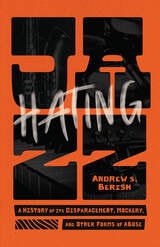
Hating Jazz
A History of Its Disparagement, Mockery, and Other Forms of AbuseAndrew S. Berish
University of Chicago Press, 2025
A rock guitarist plays four notes in front of one thousand people, while a jazz guitarist plays one thousand notes in front of four people. You might laugh or groan at this jazz joke, but what is it about jazz that makes people want to disparage it in the first place?
Andrew S. Berish’s Hating Jazz listens to the voices who have denounced, disparaged, and mocked the music. By focusing on the rejection of the music, Berish says, we see more holistically jazz’s complicated place in American cultural life. Jazz is a display of Black creativity and genius, an art form that is deeply embedded in African American life. Though the explicit racial tenor of jazz jokes has become muted over time, making fun of jazz, either in a lighthearted or aggressive way, is also an engagement with the place of Blackness in America. An individual’s taste in music may seem personal, but Berish’s analysis of jazz hatred demonstrates that musical preferences and trends are a social phenomenon. Criticism of jazz has become inextricable from the ways we understand race in America, past and present. In addition to this form of criticism, Berish also considers jazz hate as a form of taste discrimination and as a conflict over genre boundaries within different jazz cultures.
Both enlightening and original, Hating Jazz shows that our response to music can be a social act, unique to our historical moment and cultural context—we react to music in certain ways because of who we are, where we are, and when we are.

Haunted By Waters
Fly Fishing In North American LiteratureMark Browning
Ohio University Press, 1998
As his own story unfolds, Mark Browning analyzes angling literature from the Bible to Norman Maclean, always bringing his inquiry back to the same source: the enigma of this sport.
Haunted by Waters is an exploration of the apparent compulsion of those who fish not only to read about the sport, but to write about it as well. Mark Browning's personal account as a fly fisherman and his perspective as a critic make him uniquely qualified to navigate these waters.
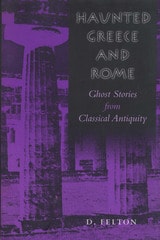
Haunted Greece and Rome
Ghost Stories from Classical AntiquityBy D. Felton
University of Texas Press, 1998
Stories of ghostly spirits who return to this world to warn of danger, to prophesy, to take revenge, to request proper burial, or to comfort the living fascinated people in ancient times just as they do today. In this innovative, interdisciplinary study, the author combines a modern folkloric perspective with literary analysis of ghost stories from classical antiquity to shed new light on the stories' folk roots.
The author begins by examining ancient Greek and Roman beliefs about death and the departed and the various kinds of ghost stories which arose from these beliefs. She then focuses on the longer stories of Plautus, Pliny, and Lucian, which concern haunted houses. Her analysis illuminates the oral and literary transmission and adaptation of folkloric motifs and the development of the ghost story as a literary form. In her concluding chapter, the author also traces the influence of ancient ghost stories on modern ghost story writers, a topic that will interest all readers and scholars of tales of hauntings.

Haunted Man's Report
Reading Charles PortisRobert Cochran
University of Arkansas Press, 2024
Haunted Man’s Report, a deeply insightful literary exploration of Portis’s singular and underexamined oeuvre, celebrates this novelist’s great achievement and is certain to prove a valuable guide for readers new to Portis as well as aficionados.
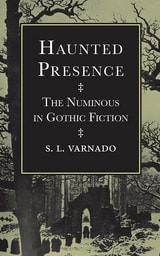
Haunted Presence
The Numinous in Gothic FictionS. L. Varnado
University of Alabama Press, 1987
Varnado offers a fresh and audacious analysis of the literature of the supernatural by employing insights derived from the philosophy of religious experience. Ranging from the Gothic novel of the eighteenth century to ghostly tales from the nineteenth and twentieth centuries, Varnado frames ghost stories as ontological challenge to the reader. The challenge is not in the form of philosophical proposition, however. Rather it is in the form of feelings and emotions that maintain a connection with the sense of reality. It is this area of reality that Rudolph Otto called the numinous—the feeling of the supernatural—that stands at the center of Gothic literature.
An understanding of this unique category of experience, aligned with its associated concept of “the sacred and the profane,” exposes the purpose of ghostly literature and demonstrates the enduring relevance of this mesmerizing genre.
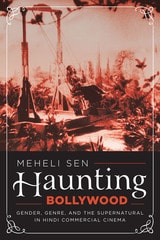
Haunting Bollywood
Gender, Genre, and the Supernatural in Hindi Commercial CinemaBy Meheli Sen
University of Texas Press, 2017
Haunting Bollywood is a pioneering, interdisciplinary inquiry into the supernatural in Hindi cinema that draws from literary criticism, postcolonial studies, queer theory, history, and cultural studies. Hindi commercial cinema has been invested in the supernatural since its earliest days, but only a small segment of these films have been adequately explored in scholarly work; this book addresses this gap by focusing on some of Hindi cinema’s least explored genres.
From Gothic ghost films of the 1950s to snake films of the 1970s and 1980s to today’s globally influenced zombie and vampire films, Meheli Sen delves into what the supernatural is and the varied modalities through which it raises questions of film form, history, modernity, and gender in South Asian public cultures. Arguing that the supernatural is dispersed among multiple genres and constantly in conversation with global cinematic forms, she demonstrates that it is an especially malleable impulse that routinely pushes Hindi film into new formal and stylistic territories. Sen also argues that gender is a particularly accommodating stage on which the supernatural rehearses its most basic compulsions; thus, the interface between gender and genre provides an exceptionally productive lens into Hindi cinema’s negotiation of the modern and the global. Haunting Bollywood reveals that the supernatural’s unruly energies continually resist containment, even as they partake of and sometimes subvert Hindi cinema’s most enduring pleasures, from songs and stars to myth and melodrama.
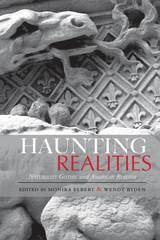
Haunting Realities
Naturalist Gothic and American RealismEdited by Monika Elbert and Wendy Ryden
University of Alabama Press, 2017
An innovative collection of essays examining the sometimes paradoxical alignment of Realism and Naturalism with the Gothic in American literature to highlight their shared qualities
Following the golden age of British Gothic in the late eighteenth century, the American Gothic’s pinnacle is often recognized as having taken place during the decades of American Romanticism. However, Haunting Realities explores the period of American Realism—the end of the nineteenth century—to discover evidence of fertile ground for another age of Gothic proliferation.
At first glance, “Naturalist Gothic” seems to be a contradiction in terms. While the Gothic is known for its sensational effects, with its emphasis on horror and the supernatural, the doctrines of late nineteenth-century Naturalism attempted to move away from the aesthetics of sentimentality and stressed sobering, mechanistic views of reality steeped in scientific thought and the determinism of market values and biology. Nonetheless, what binds Gothicism and Naturalism together is a vision of shared pessimism and the perception of a fearful, lingering presence that ominously haunts an impending modernity. Indeed, it seems that in many Naturalist works reality is so horrific that it can only be depicted through Gothic tropes that prefigure the alienation and despair of modernism.
In recent years, research on the Gothic has flourished, yet there has been no extensive study of the links between the Gothic and Naturalism, particularly those which stem from the early American Realist tradition. Haunting Realities is a timely volume that addresses this gap and is an important addition to scholarly work on both the Gothic and Naturalism in the American literary tradition.
Hawaiian Music in Motion
Mariners, Missionaries, and MinstrelsJames Revell Carr
University of Illinois Press, 2014
Hawking Women
Falconry, Gender, and Control in Medieval Literary CultureSara Petrosillo
The Ohio State University Press, 2023
Hawthorne and Women
Engendering and Expanding the Hawthorne TraditionJohn L. Idol
University of Massachusetts Press, 1999
This collection of original essays presents a more complex and positive view of Hawthorne's attitudes toward women, demonstrating his recognition of the crucial role that women played--as critics, reviewers, readers, and authors--in building a national readership that made his writing career so successful.
The book begins with an examination of the influence exerted by the women in Hawthorne's immediate family. It goes on to explore his links to a broad range of women writers, as well as his attitudes toward the female characters he created. Among the authors discussed are Margaret Fuller, Harriet Beecher Stowe, Louisa May Alcott, Emily Dickinson, Sarah Orne Jewett, Willa Cather, Charlotte Perkins Gilman, George Eliot, Virginia Woolf, Flannery O'Connor, and Toni Morrison.
Haydn and the Performance of Rhetoric
Edited by Tom Beghin and Sander M. Goldberg
University of Chicago Press, 2007
In this volume, a distinguished group of contributors in fields from classics to literature to musicology restores the rhetorical model to prominence and shows what can be achieved by returning to the idea of music as a rhetorical process. An accompanying DVD, specially designed for this project, presents performances and illustrations keyed to its chapters, making musicological arguments accessible to nonspecialists and advancing additional arguments of its own through the medium of performance. The volume thus reaches beyond musicology to enrich and complicate the larger debate over rhetoric's role in eighteenth-century culture.
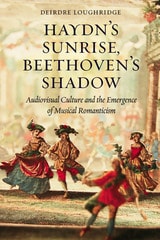
Haydn’s Sunrise, Beethoven’s Shadow
Audiovisual Culture and the Emergence of Musical RomanticismDeirdre Loughridge
University of Chicago Press, 2016
Deirdre Loughridge reveals that allusions in musical writings to optical technologies reflect their spread from fairgrounds and laboratories into public consciousness and a range of discourses, including that of music. She demonstrates how concrete points of intersection—composers’ treatments of telescopes and peepshows in opera, for instance, or a shadow-play performance of a ballad—could then fuel new modes of listening that aimed to extend the senses. An illuminating look at romantic musical practices and aesthetics, this book yields surprising relations between the past and present and offers insight into our own contemporary audiovisual culture.
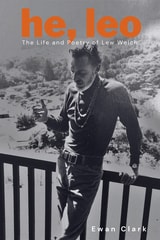
He, Leo
The Life and Poetry of Lew WelchEwan Clark
Oregon State University Press, 2023
He, Leo investigates Welch’s life and work in a chronological fashion, structured around Welch’s own notion of how three main aspects of his life—The Man, The Mountain, and The City—were interdependent. From his birth until his disappearance and presumed death, Welch’s life was often defined by problems, including a complex relationship with his mother, a long struggle with alcohol, and a fluctuating mental state. Yet he was open and candid about everything, a fact that is evident in all aspects of his work.
Each of the three main sections of He, Leo includes key poems, essays, and events—both personal and cultural—to help establish Welch’s importance as a prominent poet and figure during the San Francisco Renaissance. Despite his crushing self-criticism and his reputation as a “friend of,” he was bona fide poet with a strong voice and message of his own. With this first full-length biography, Ewan Clark restores Lew Welch to his rightful place as an important member of a significant American literary and cultural movement.
Head Hunters
The Making of Jazz's First Platinum AlbumSteven F. Pond
University of Michigan Press, 2010
---Jazzwise Magazine
---Travis Jackson, Associate Professor of American Music, University of Chicago
Healing Narratives
Women Writers Curing Cultural Dis-easeWilentz, Gay
Rutgers University Press, 2000
Hearing the Hurt
Rhetoric, Aesthetics, and Politics of the New Negro MovementEric King Watts
University of Alabama Press, 2012
Heartless Immensity
Literature, Culture, and Geography in Antebellum AmericaAnne Baker
University of Michigan Press, 2010
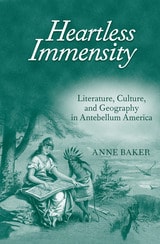
Building on extensive archival research as well as insights from cultural geographers and theorists of nationhood, Heartless Immensity demonstrates that national expansion had a far more complicated, multifaceted impact on antebellum American culture than has previously been recognized. Baker shows that Americans developed a variety of linguistic strategies for imagining the form of the United States and its position in relation to other geopolitical entities. Comparisons
to European empires, biblical allusions, body politic metaphors, and metaphors derived from science all reflected—and often attempted to assuage—fears that the nation was becoming either monstrously large or else misshapen in ways that threatened cherished beliefs and national self-images.
Heartless Immensity argues that, in order to understand the nation’s shift from republic to empire and to understand American culture in a global context, it is first necessary to pay close attention to the processes by which the physical entity known as the United States came into being. This impressively thorough study will make a valuable contribution to the fields of American studies and literary studies.
Anne Baker is Assistant Professor of English at North Carolina State University.

Hearts and Minds
Bodies, Poetry, and Resistance in the Vietnam EraMichael Bibby
Rutgers University Press, 1996
The early 1960s to the mid-1970s was one of the most turbulent periods in American history. The U.S. military was engaged in its longest, costliest overseas conflict, while the home front was torn apart by riots, protests, and social activism. In the midst of these upheavals, an underground and countercultural press emerged, giving activists an extraordinary forum for a range of imaginative expressions. Poetry held a prominent place in this alternative media. The poem was widely viewed by activists as an inherently anti-establishment form of free expression, and poets were often in the vanguards of political activism.
Hearts and Minds is the first book-length study of the poems of the Black Liberation, Women's Liberation, and GI Resistance movements during the Vietnam era. Drawing on recent cultural and literary theories, Bibby investigates the significance of images, tropes, and symbols of human bodies in activist poetry. Many key political slogans of the period––"black is beautiful," "off our backs"––foreground the body. Bibby demonstrates that figurations of bodies marked important sites of social and political struggle.
Although poetry played such an important role in Vietnam-era activism, literary criticism has largely ignored most of this literature. Bibby recuperates the cultural-historical importance of Vietnam-era activist poetry, highlighting both its relevant contexts and revealing how it engaged political and social struggles that continue to motivate contemporary history. Arguing for the need to read cultural history through these "underground" texts, Hearts and Minds offers new grounds for understanding the recent history of American poetry and the role poetry has played as a medium of imaginative political expression.
Hearts of Darkness
White Women Write RaceMarcus, Jane
Rutgers University Press, 2004
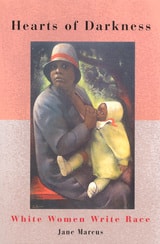
The centerpiece of the book is Marcus's dialogue with one of her best-known essays, "Britannia Rules The Waves." In that piece, she argues that The Waves makes a strong anti-imperialist statement. Although many already support that argument, she now goes further in order to question the moral value of such a buried critique on Woolf's part. In "A Very Fine Negress" she analyzes the painful subject of Virginia Woolf's racism in A Room of One's Own. Other chapters traverse the connected issues of modernism, race, and imperialism. In two of them, we follow Nancy Cunard through the making of the Negro anthology and her appearance in a popular novel of the freewheeling Jazz Age. Elsewhere, Marcus delivers a complex analysis of A Passage to India, in a reading that interrogates E. M. Forster's displacement of his fear of white Englishwomen struggling for the vote.
Marcus, as always, brings considerable gifts as both researcher and writer to this collection of new and reprinted essays, a combination resulting in a powerful interpretation of many of modernism's most cherished figures.
Heggie and Scheer's Moby-Dick
A Grand Opera for the Twenty-first CenturyRobert K. Wallace
University of North Texas Press, 2013
Hellenistic Aesthetic
Barbara Hughes Fowler
University of Wisconsin Press, 1989
“Fowler’s . . . own insights are apparent throughout, and they seem to distill the personal appreciation and understanding of a scholar who has devoted much of her career to both contemplating and enjoying Hellenistic poetry. . . . [This book] would make an excellent background text for courses in later Greek and Roman art, and it can be read with profit by anyone interested in exploring the character of Hellenistic culture.”—J. J. Pollitt, American Journal of Archaeology
“Outstanding is the range of examples discussed both in poetry and art. Theocritus, Callimachus, Appolonius, the epigrammatists, and others—that is, the major figures of the time—are considered at length and in several different contexts. Passages are quoted in the original Greek, translated, and analyzed. Fowler’s sensitivity to poetic forms, evident in her other published writings, is again evident here. In addition, however, the philosophical context is not overlooked. . . . Also highly commendable are the liberal references to works of art. Sculpture in the round and in relief, portraits, terracotta figurines, original paintings (grave stelai) and Campanian murals, mosaics, gold and silver vessels, and jewelry are introduced at various points. Every work of art discussed is illustrated in astonishingly clear photographs, which are interspersed in the body of the text.”—Christine Mitchell Havelock
“The Hellenistic Aesthetic provides classicists with their first thorough discussion of the aesthetic unity found in Hellenistic art and literature. . . . Fowler examines parallels both in subject matter and in artistic approach among a diverse group of literary genres and artistic forms. In twelve chapters, The Hellenistic Aesthetic surveys Alexandrian epigrams, pastorals, epics, sculptural groups, mosaics, paintings, and jewelry to supply a convincing, and frequently unexpected, picture of a unified aesthetic vision.”—Jeffrey Buller, Classical Outlook
Hellenistic Poetry
A SelectionDavid Sider, Editor
University of Michigan Press, 2017
The text of each poem is presented, together with basic help on obscure vocabulary, morphology, dialect, meter, syntax, and similar philological issues. The modern commentators also offer guidance on a poem’s literary significance and a brief introduction to the scholarship.
Among the 44 named and anonymous poets represented here are Apollonius of Rhodes, Archimedes, Aristotle, Callimachus, Cercidas, Corinna, Eratosthenes, Erinna, Ezekiel, Hermesianax, Herodas, Lycophron, and Phanocles.
Contributors to the volume in addition to David Sider include: Silvia Barbantani, James Clauss, Dee Clayman, Christophe Cusset, Claudio De Stefani, Marco Fantuzzi, Andrew Ford, Kathryn Gutzwiller, Johanna Hanink, Regina Hoeschele, Richard Hunter, David Konstan, Pauline LeVen, Kelly MacFarlane, Enrico Magnelli, Jackie Murray, Pura Nieto, Maria Noussia, Douglas Olson, Floris Overduin, Richard Rawles, Ralph Rosen, Chad Schroeder, Alexander Sens, Evina Sistakou, Michael Tueller, and Athanassios Vergados.
Although designed primarily as a textbook for graduate students and upper-level undergraduates, the book offers texts and subsidiary information not easily found (if at all) elsewhere. Since Latin poets made constant allusion to Hellenistic poetry, it will also be an important resource for Latinists.
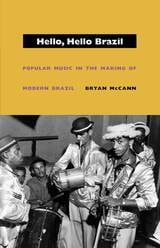
Hello, Hello Brazil
Popular Music in the Making of Modern BrazilBryan McCann
Duke University Press, 2004
McCann explores the links between the growth of the culture industry, rapid industrialization, and the rise and fall of Getúlio Vargas’s Estado Novo dictatorship. He argues that these processes opened a window of opportunity for the creation of enduring cultural patterns and demonstrates that the understandings of popular music cemented in the mid–twentieth century continue to structure Brazilian cultural life in the early twenty-first.
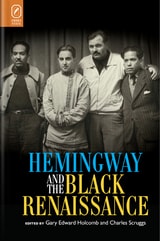
Hemingway and the Black Renaissance
Edited by Gary Edward Holcomb and Charles Scruggs
The Ohio State University Press, 2012
Hemingway and the Black Renaissance, edited by Gary Edward Holcomb and Charles Scruggs, explores a conspicuously overlooked topic: Hemingway’s wide-ranging influence on writers from the Harlem Renaissance to the present day. An observable who’s who of black writers—Ralph Ellison, James Baldwin, Langston Hughes, Claude McKay, Wallace Thurman, Chester Himes, Alex la Guma, Derek Walcott, Gayl Jones, and more—cite Hemingway as a vital influence. This inspiration extends from style, Hemingway’s minimalist art, to themes of isolation and loneliness, the dilemma of the expatriate, and the terrifying experience of living in a time of war. The relationship, nevertheless, was not unilateral, as in the case of Jean Toomer’s 1923 hybrid, short-story cycle Cane, which influenced Hemingway’s collage-like 1925 In Our Time.
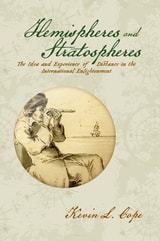
Hemispheres and Stratospheres
The Idea and Experience of Distance in the International EnlightenmentKevin L. Cope
Bucknell University Press, 2021
Published by Bucknell University Press. Distributed worldwide by Rutgers University Press.
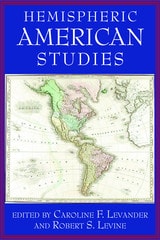
Hemispheric American Studies
Levander, Caroline F
Rutgers University Press, 2007
With essays that examine stamps, cartoons, novels, film, art, music, travel documents, and governmental publications, Hemispheric American Studies seeks to excavate the complex cultural history of texts and discourses across the ever-changing and stratified geopolitical and cultural fields that collectively comprise the American hemisphere. This collection promises to chart new directions in American literary and cultural studies.
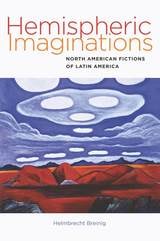
Hemispheric Imaginations
North American Fictions of Latin AmericaHelmbrecht Breinig
Dartmouth College Press, 2016
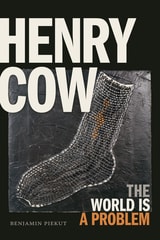
Henry Cow
The World Is a ProblemBenjamin Piekut
Duke University Press, 2019
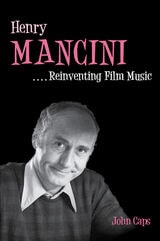
Henry Mancini
Reinventing Film MusicJohn Caps
University of Illinois Press, 2012
A volume in the series Music in American Life
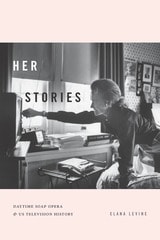
Her Stories
Daytime Soap Opera and US Television HistoryElana Levine
Duke University Press, 2020
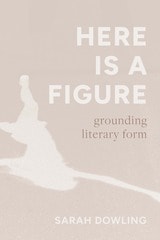
Here Is a Figure
Grounding Literary FormSarah Dowling
Northwestern University Press, 2025
A study of supine, prone, and recumbent figures in contemporary literature
The prostitute, the protester, the murder victim, the invalid, the layabout, the depressive: all are associated with lying down. Skewing and flattening the perpendicular axis that defines the human in Western philosophy, art, and humanist inquiry, these downward-directed figures’ refusals or failures to hew to the moral and postural logics of uprightness enable a reassessment of subjectivity, ecological relation, and representation—that last of which is, after all, a process of standing-in-for. Here Is a Figure: Grounding Literary Form works across an array of well-known and counter-canonical texts, showing that recumbent figures saturate the literary arts of the present and respond to the proliferation of contemporary forms of grounding, in all its meanings. Reading these figures in dialogue with critical Indigenous studies, disability studies, and horizontalist feminisms, Sarah Dowling reveals the potential in thinking with and through a position stretched out across, dependent on, and undetachable from the earth.
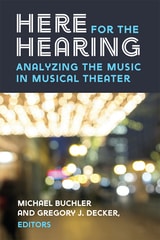
Here for the Hearing
Analyzing the Music in Musical TheaterMichael Buchler and Gregory J. Decker, Editors
University of Michigan Press, 2023
Winner of the Society for Music Theory's Outstanding Multi-Author Collection Award
This book offers a series of essays that show the integrated role that musical structure (including harmony, melody, rhythm, meter, form, and musical association) plays in making sense of what transpires onstage in musicals. Written by a group of music analysts who care deeply about musical theater, this collection provides new understanding of how musicals are put together, how composers and lyricists structure words and music to complement one another, and how music helps us understand the human relationships and historical and social contexts. Using a wide range of musical examples, representing the history of musical theater from the 1920s to the present day, the book explores how music interacts with dramatic elements within individual shows and other pieces within and outside of the genre. These essays invite readers to consider issues that are fundamental both to our understanding of musical theater and to the multiple ways we engage with music.