Results by title
395 books match the query 'How' and 153 start with h
Harnessing Farms and Forests in the Low-Carbon Economy
How to Create, Measure, and Verify Greenhouse Gas OffsetsNicholas Institute for Environmental Policy Solutions and Zach Willey and Bill Chameides, editors, eds.
Duke University Press, 2007
This guide is the first comprehensive technical publication providing direction to landowners for sequestering carbon and information for traders and others who will need to verify the sequestration. It will provide invaluable direction to farmers, foresters, land managers, consultants, brokers, investors, regulators, and others interested in creating consistent, credible greenhouse gas offsets as a tradable commodity in the United States.
The guide contains a non-technical section detailing methodologies for scoping of the costs and benefits of a proposed project, quantifying offsets of various sorts under a range of situations and conditions, and verifying and registering the offsets. The technical section provides specific information for quantifying, verifying, and regulating offsets from agricultural and forestry practices.
Visit the Nicholas Institute for Environmental Policy Solutions website for audio from the press conference announcing the book.
Read the press release announcing the book.
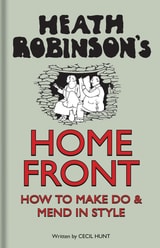
Heath Robinson's Home Front
How to Make Do and Mend in StyleW. Heath Robinson and Cecil Hunt
Bodleian Library Publishing, 2016
Heath Robinson was a household name in Britain, and millions of readers around the world continue to thoroughly enjoy his cartoons today. A classic military-themed compendium, Heath Robinson’s Home Front will be a favorite with fans of the cartoonist’s complicated, fanciful contraptions.
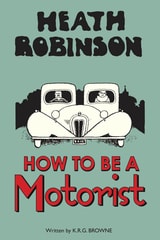
Heath Robinson
How to Be a MotoristW. Heath Robinson
Bodleian Library Publishing, 2015
For the car enthusiast, How to Be a Motorist offers a compendium of Robinson’s wonderfully inventive car-based contraptions, with innovations like a handy “zip-opening bonnet,” a rear wheel to turn the car around with one movement, and a fork attachment to help rural motorists to avoid the occasional chicken on the roadway. The days of unsolicited driving advice could be over with the realization of Robinson’s “duo car for the incompatible,” and the book also includes a parody of a production line demonstrating how cars are made.
A side-splittingly funny collection from the man whose “absurd, beautiful drawings” H. G. Wells claimed “give me a peculiar pleasure of the mind like nothing else in the world,” this book make a perfect gift for anyone looking to have a laugh at our complicated and increasingly mechanical modern life.
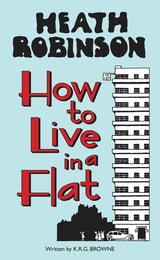
Heath Robinson
How to Live in a FlatW. Heath Robinson
Bodleian Library Publishing, 2015
How to Live in a Flat brings together a series of patently Robinsonesque space-saving solutions for city dwellers looking to make the most of modest square footage. Some of the solutions involve furniture made to serve multiple—and often opposing—purposes, like a combination bath-and-writing desk for businessmen. Others reimagine the workings of entire apartment complexes, including one cutaway explaining the use of the communal bath.
A side-splittingly funny collection from the man whose “absurd, beautiful drawings” H. G. Wells claimed “give me a peculiar pleasure of the mind like nothing else in the world,” this book make a perfect gift for anyone looking to have a laugh at our complicated and increasingly mechanical modern life.
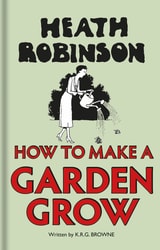
Heath Robinson
How to Make a Garden GrowW. Heath Robinson (1872-1944) is best known for his hilarious drawings of outlandish contraptions, though his work ranged across a wide variety of topics covering many aspects of British life.
Bodleian Library Publishing, 2016
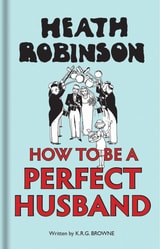
Heath Robinson
How to be a Perfect HusbandW. Heath Robinson & K.R.G. Browne
Bodleian Library Publishing, 2017
The cartoons in Heath Robinson: How to be a Perfect Husband provide sage advice for how to succeed in almost all aspects of married life—and, of course, it often features a complicated Robinsonian gadget. The perfect husband, for example, will take advantage of two simple attachments to the garden roller to tend the lawn and entertain the baby simultaneously. Likewise, he can peel onions with no fear of tears using a mirror and construct a cost-effective vacuum cleaner using items found around the house. Most importantly, he will devise a device to help him climb the stairs silently after a late night out with the boys.
A gently satirical collection, this book make a perfect gift for anyone looking to have a laugh at our complicated and increasingly mechanical modern life.
Heidegger and the Destruction of Aristotle
On How to Read the TraditionSean D. Kirkland
Northwestern University Press, 2023
A bold new conception of Heidegger’s project of Destruktion as a method of interpreting history
For Martin Heidegger, our inherited traditions provide the concepts through which we make our world intelligible. Concepts we can also oppose, disrupt, and even exceed. First, however, if Western philosophy is our inheritance, we must submit it to Destruktion—starting with Aristotle. Heidegger and the Destruction of Aristotle: On How to Read the Tradition presents a new conception of Heidegger’s “destruction” as a way of reading.
Situated between Nietzschean genealogy and Derridean deconstruction, this method uncovers in Aristotle the most vital originating articulations of the Western tradition and gives us the means to confront it. Sean D. Kirkland argues this is not a rejection of the past but a sophisticated and indeed timely hermeneutic tool—a complex, illuminating, and powerful method for interpreting historical texts at our present moment. Acknowledging the historical Heidegger as a politically compromised and still divisive figure, Kirkland demonstrates that Heideggerian destruction is a method of interpreting history that enables us to reorient and indeed transform its own most troubling legacies.
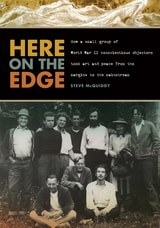
Here on the Edge
How a Small Group of World War II Conscientious Objectors Took Art and Peace from the Margins to the MainstreamSteve McQuiddy
Oregon State University Press, 2013
They worked six days a week—planting trees, crushing rock, building roads, and fighting forest fires—in exchange for only room and board. At night, they published books under the imprint of the Untide Press. They produced plays, art, and music—all during their limited non-work hours, with little money and few resources. This influential group included poet William Everson, later known as Brother Antoninus, “the Beat Friar”; violinist Broadus Erle, founder of the New Music Quartet; fine arts printer Adrian Wilson; Kermit Sheets, co-founder of San Francisco’s Interplayers theater group; architect Kemper Nomland, Jr.; and internationally renowned sculptor Clayton James.
After the war, camp members went on to participate in the San Francisco Poetry Renaissance of the 1950s, which heavily influenced the Beat Generation of Jack Kerouac, Allen Ginsberg, and Gary Snyder—who in turn inspired Ken Kesey and his Merry Pranksters, leading the way to the 1960s upheavals epitomized by San Francisco’s Summer of Love.
As camp members engaged in creative acts, they were plowing ground for the next generation, when a new set of young people, facing a war of their own in Vietnam, would populate the massive peace movements of the 1960s.
Twenty years in the making and packed with original research, Here on the Edge is the definitive history of the Fine Arts Group at Waldport, documenting how their actions resonated far beyond the borders of the camp. It will appeal to readers interested in peace studies, World War II history, influences on the 1960s generation, and in the rich social and cultural history of the West Coast.
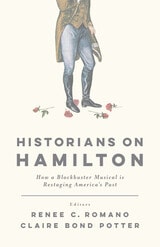
Historians on Hamilton
How a Blockbuster Musical Is Restaging America's PastRomano, Renee C
Rutgers University Press, 2018
Historians on Hamilton brings together a collection of top scholars to explain the Hamilton phenomenon and explore what it might mean for our understanding of America’s history. The contributors examine what the musical got right, what it got wrong, and why it matters. Does Hamilton’s hip-hop take on the Founding Fathers misrepresent our nation’s past, or does it offer a bold positive vision for our nation’s future? Can a musical so unabashedly contemporary and deliberately anachronistic still communicate historical truths about American culture and politics? And is Hamilton as revolutionary as its creators and many commentators claim?
Perfect for students, teachers, theatre fans, hip-hop heads, and history buffs alike, these short and lively essays examine why Hamilton became an Obama-era sensation and consider its continued relevance in the age of Trump. Whether you are a fan or a skeptic, you will come away from this collection with a new appreciation for the meaning and importance of the Hamilton phenomenon.
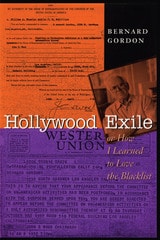
Hollywood Exile, or How I Learned to Love the Blacklist
By Bernard Gordon
University of Texas Press, 2000
The Hollywood blacklist, which began in the late 1940s and ran well into the 1960s, ended or curtailed the careers of hundreds of people accused of having ties to the Communist Party. Bernard Gordon was one of them. In this highly readable memoir, he tells a engrossing insider's story of what it was like to be blacklisted and how he and others continued to work uncredited behind the scenes, writing and producing many box office hits of the era.
Gordon describes how the blacklist cut short his screenwriting career in Hollywood and forced him to work in Europe. Ironically, though, his is a success story that includes the films El Cid, 55 Days at Peking, The Thin Red Line, Krakatoa East of Java, Day of the Triffids, Earth vs. the Flying Saucers, Horror Express, and many others. He recounts the making of many movies for which he was the writer and/or producer, with wonderful anecdotes about stars such as Charlton Heston, David Niven, Sophia Loren, Ava Gardner, and James Mason; directors Nicholas Ray, Frank Capra, and Anthony Mann; and the producer-studio head team of Philip Yordan and Samuel Bronston.
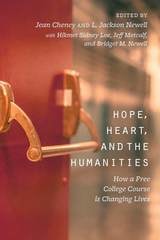
Hope, Heart, and the Humanities
How a Free College Course is Changing LivesJean Cheney and L. Jackson Newell, editors, with Hikmet Sidney Loe, Jeff Metcalf, and Bridget M. Newell
University of Utah Press, 2016
Hope, Heart, and the Humanities tells the story of how Venture, a free, interdisciplinary college humanities course inspired by the national Clemente Course, has helped open doors to improve the lives of people with low incomes who face barriers to attending college. For over a decade, this course has given hundreds of adults, some of them immigrants or refugees, the knowledge, confidence, and power to rechart their lives.
Readers will go inside Venture classrooms to see what occurs when adults enter serious discussions about literature, critical writing, art history, American history, and philosophy. Apparent also are the difficulties nontraditional students, who range in age from 18 to 60, often encounter in a college classroom and the hard choices they and their teachers make. What readers may remember most are the stories and words from people whose views of the world broaden and whose directions in life changed.
Interview with Tom Williams at Access Utah
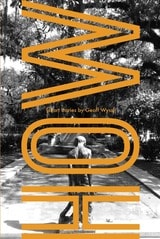
How
Geoff Wyss
The Ohio State University Press, 2012
If every story is born of a question—How did we get here? How do you make your arm do that?—the stories in Geoff Wyss’s How search for answers to the mysteries of an astonishing range of characters. The narrator of “How I Come to Be Here at the GasFast” explains why he hasn’t left a truck stop in the two days since he scratched a winning lottery ticket. In “How to Be a Winner,” a sports consultant browbeats a high school football team with his theory of history and a justification of his failed coaching career. Lost in the mazes they’ve made of themselves, Wyss’s characters search for exits on ground that shifts dizzyingly from humor to pathos, from cynicism to earnestness, from comedy to tragedy, often within the same sentence. Although propelled by a razor-sharp, contemporary voice, Wyss’s stories—many set in a New Orleans unknown to television and tourists—have more in common with Chekhov and O’Connor than with “Treme.”
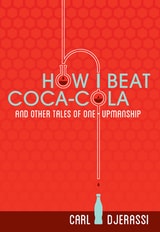
How I Beat Coca-Cola and Other Tales of One-Upmanship
Carl Djerassi
University of Wisconsin Press, 2013
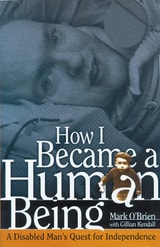
How I Became a Human Being
A Disabled Man’s Quest for IndependenceMark O’Brien, with Gillian Kendall
University of Wisconsin Press, 2003
For the first time in paperback, How I Became a Human Being is O’Brien’s account of his struggles to lead an independent life despite a lifelong disability. In 1955 he contracted polio and became permanently paralyzed from the neck down. O’Brien describes growing up without the use of his limbs, his adolescence struggling with physical rehabilitation and suffering the bureaucracy of hospitals and institutions, and his adult life as an independent student and writer. Despite his physical limitations, O’Brien crafts a narrative that is as rich and vivid as the life he led.
How I Became the Kind of Writer I Became
An Experiment in AutoethnographyCharles Bazerman
University Press of Colorado, 2024
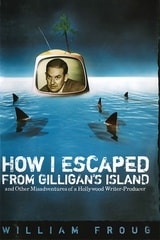
How I Escaped from Gilligan's Island
And Other Misadventures of a Hollywood Writer-ProducerWilliam Froug
University of Wisconsin Press, 2005
In the early 1950s writers were leaving radio en masse to try their hand at another promising medium—television. William Froug was in the thick of that exodus, a young man full of ideas in a Hollywood bursting with opportunities. In his forty-year career Froug would write and/or produce many of the shows that America has grown up with. From the drama of Playhouse 90 and the mind-bending premises of The Twilight Zone to the escapist scenarios of Adventures in Paradise, Gilligan’s Island, Bewitched, and Charlie’s Angels, Froug played a role in shaping his trade. He crossed paths with some of the memorable personalities in the industry, including Jack Benny, Lucille Ball, Agnes Moorehead, Elizabeth Montgomery, Robert Blake, Rod Serling, Gene Roddenberry, Aaron Spelling, and Sherwood Schwartz.
Froug reveals a post-WWII America giddy with the success of its newest medium—yet sobered at moments by strikes and union politics, McCarthyism and anti-Semitism. It was a world of hastily written scripts, sudden firings, thwarted creativity, and fickle tastes. And yet, while clearly exasperated with many aspects of Hollywood, Froug was a man utterly in his element, his frustration with the industry ultimately eclipsed by his dedication to his craft.
How I Got Cultured
A Nevada MemoirPhyllis Barber
University of Nevada Press, 1994
How I Got Cultured is a moving, candid, and sometimes hilarious account of an American adolescence, negotiated between the strictures of a demanding faith and the allures of one of the most flamboyant cities in the world.

How I Got Him Back
A NovelValerie Sayers
Northwestern University Press, 2013
How I Got Over
Clara Ward and the World-Famous Ward SingersWilla Ward-Royster
Temple University Press, 2000
How I Married Michele
and Other Journeys, EssaysGary Gildner
BkMk Press, 2021
Essays from this collection have appeared in such venues as the New York Times Magazine, The Southern Review, and New Letters.
How The Rural Poor Got Power
Narrative Of A Grass-Roots OrganizerPaul Wellstone
University of Minnesota Press, 2003
The gripping story behind Paul Wellstone’s progressive legacy
Before he was a senator, before he was a nationally known advocate for the disenfranchised and a tireless supporter of public policies to alleviate poverty, Paul Wellstone devoted his time and legendary energy to grassroots organizing. How the Rural Poor Got Power describes Wellstone’s experiences as a political activist in rural Minnesota. Working with senior citizens, struggling farmers, and single mothers, Wellstone created a coalition to address transportation, access to health care, and welfare benefits issues. This narrative features interviews with citizens and shows Wellstone observing and participating in the ideals to which he devoted his life: helping poor people gain a political voice.
How To Identify Plants
H. D. Harrington
Ohio University Press, 1957
First issued in 1957 by Swallow Press, this classic guide to the art of plant identification is now familiar to an entire generation of students. Harrington who was Professor of Botany and Curator of the Herbarium at Colorado State University, gives step-by-step instructions and definitions to help readers recognize and classify plants. The new printing has been reset and reformatted, and L.W. Durrell’s drawings and glossary—more than 500 images—have been digitally enhanced for clarity.
How To Read Descartes's Meditations
Zbigniew Janowski
St. Augustine's Press, 2019

How To Teach Your Children the Latin of the Church
Jack Clark
Catholic University of America Press, 2027

How a Century of War Changed the Lives of Women
Lindsey German
Pluto Press, 2013
How a Century of War Changed the Lives of Women looks at the remarkable impact of war on women in Britain. It shows how conflict has changed women’s lives and how those changes have put women at the centre of peace campaigning.
Lindsey German, one of the UK's leading anti-war activists and commentators, shows how women have played a central role in anti-war and peace movements, including the recent wars in Afghanistan and Iraq. The women themselves talk about how they overcame prejudice and difficulty to become active. The book integrates this experience with a historical overview, analysing the two world wars as catalysts of social change for women. It looks at how the changing nature of war, especially the involvement of civilians, increasingly involves significant numbers of women.
As well as providing an inspiring account of women's opposition to war, the book also tackles key contemporary developments, challenging negative assumptions about Muslim women and showing how anti-war movements are feeding into a broader desire to change society.
How a City Sings from November to November
Lorca on MusicFederico García Lorca
Swan Isle Press, 2026
“Yo ante todo, soy músico,” Federico García Lorca once remarked: “Before all else, I am a musician.” Whether seated at the piano, collecting folksongs on his travels through Spain, or composing music for his plays, few poets have lived music so deeply. For Lorca, songs were “living creatures.” How a City Sings from November to November: Lorca on Music brings together for the first time in English the poet’s writing on music and musicians. In these pages, through lectures, letters, and interviews, Lorca celebrates the musical seasons of Granada, “a city enclosed by mountains and made for music”; the sources of cante jondo (flamenco deep song); the haunting melodies of Spanish cradle songs; and the dance of La Argentina. He describes learning the guitar, staging Spanish ballads in Buenos Aires, and listening to spirituals in New York. In bed with a fever, he compares it to a “delicate tempo rubato of Chopin.” Based on recent archival research, edited and newly translated by noted Lorca scholar Christopher Maurer, this collection offers an intricate and enjoyable counterpoint to Lorca’s poetry and theater.
How a Revolutionary Art Became Official Culture
Murals, Museums, and the Mexican StateMary K. Coffey
Duke University Press, 2012
How and Why to Read and Create Children's Digital Books
A Guide for Primary PractitionersNatalia Kucirkova
University College London, 2018
How the Clinic Made Gender
The Medical History of a Transformative IdeaSandra Eder
University of Chicago Press, 2022
Today, a world without “gender” is hard to imagine. Gender is at the center of contentious political and social debates, shapes policy decisions, and informs our everyday lives. Its formulation, however, is lesser known: Gender was first used in clinical practice. This book tells the story of the invention of gender in American medicine, detailing how it was shaped by mid-twentieth-century American notions of culture, personality, and social engineering.
Sandra Eder shows how the concept of gender transformed from a pragmatic tool in the sex assignment of children with intersex traits in the 1950s to an essential category in clinics for transgender individuals in the 1960s. Following gender outside the clinic, she reconstructs the variable ways feminists integrated gender into their theories and practices in the 1970s. The process by which ideas about gender became medicalized, enforced, and popularized was messy, and the route by which gender came to be understood and applied through the treatment of patients with intersex traits was fraught and contested. In historicizing the emergence of the sex/gender binary, Eder reveals the role of medical practice in developing a transformative idea and the interdependence between practice and wider social norms that inform the attitudes of physicians and researchers. She shows that ideas like gender can take on a life of their own and may be used to question the normative perceptions they were based on. Illuminating and deeply researched, the book closes a notable gap in the history of gender and will inspire current debates on the relationship between social norms and medical practice.
How the Clinic Made Gender
The Medical History of a Transformative IdeaSandra Eder
University of Chicago Press, 2022
This is an auto-narrated audiobook edition of this book.
An eye-opening exploration of the medical origins of gender in modern US history.
Today, a world without “gender” is hard to imagine. Gender is at the center of contentious political and social debates, shapes policy decisions, and informs our everyday lives. Its formulation, however, is lesser known: Gender was first used in clinical practice. This book tells the story of the invention of gender in American medicine, detailing how it was shaped by mid-twentieth-century American notions of culture, personality, and social engineering.
Sandra Eder shows how the concept of gender transformed from a pragmatic tool in the sex assignment of children with intersex traits in the 1950s to an essential category in clinics for transgender individuals in the 1960s. Following gender outside the clinic, she reconstructs the variable ways feminists integrated gender into their theories and practices in the 1970s. The process by which ideas about gender became medicalized, enforced, and popularized was messy, and the route by which gender came to be understood and applied through the treatment of patients with intersex traits was fraught and contested. In historicizing the emergence of the sex/gender binary, Eder reveals the role of medical practice in developing a transformative idea and the interdependence between practice and wider social norms that inform the attitudes of physicians and researchers. She shows that ideas like gender can take on a life of their own and may be used to question the normative perceptions they were based on. Illuminating and deeply researched, the book closes a notable gap in the history of gender and will inspire current debates on the relationship between social norms and medical practice.
How the Dismal Science Got Its Name
Classical Economics and the Ur-Text of Racial PoliticsDavid M. Levy
University of Michigan Press, 2002
Economists of the time argued, on the other hand, that people of color were to be protected by the rule of law--hence the moniker "the dismal science."
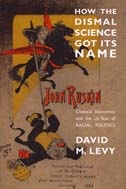
A startling image from 1893, which is reproduced in full color on this book's jacket, shows Ruskin killing someone who appears to be nonwhite. A close look reveals that the victim is reading "The Dismal Science."
Levy discusses this image at length and also includes in his text weblinks to Carlyle's "Occasional Discourse on the Negro Question" and to Mill's response, demonstrating that these are central documents in British classical economics. He explains Adam Smith's egalitarian foundations, contrasting Smith's approach to the hierarchical alternative proposed by Carlyle. Levy also examines various visual representations of this debate and provides an illuminating discussion of Smith's "katallactics," the science of exchange, comparing it with the foundations of modern neoclassical economics.
How the Dismal Science Got Its Name also introduces the notion of "rational choice scholarship" to explain how attacks on market economics from a context in which racial slavery was idealized have been interpreted as attacks on market economics from a humanistic or egalitarian context. Thus it will greatly appeal to economists, political scientists, philosophers, students of Victorian literature, and historians.
David M. Levy is Associate Professor of Economics and Research Associate, Center for Study of Public Choice, George Mason University.
How the Earth Feels
Geological Fantasy in the Nineteenth-Century United StatesDana Luciano
Duke University Press, 2024
How the Earth Turned Green
A Brief 3.8-Billion-Year History of PlantsJoseph E. Armstrong
University of Chicago Press, 2014
Using an evolutionary framework, How the Earth Turned Green addresses questions such as: Should all green organisms be considered plants? Why do these organisms look the way they do? How are they related to one another and to other chlorophyll-free organisms? How do they reproduce? How have they changed and diversified over time? And how has the presence of green organisms changed the Earth’s ecosystems? More engaging than a traditional textbook and displaying an astonishing breadth, How the Earth Turned Green will both delight and enlighten embryonic botanists and any student interested in the evolutionary history of plants.
How the End Begins
Cynthia Cruz
Four Way Books, 2016
How the End First Showed
D. M. Aderibigbe
University of Wisconsin Press, 2018
Widening his gaze to capture the moral rhythms of life in Lagos, he embraces themes of love, spirituality, poverty, compassion, sickness, and death. Aderibigbe offers both an extended elegy for his mother and poems addressed to children of the African continent, poems that speak to the past that has made them.
We salivated; slices of yam softened.
We chewed our teeth; slices of yam perished.
Mother smiled. Father arrived,
filled the room with curses;
his voice beat in our hearts,
as thunder on the walls of a building.
His empty stomach was a bowl of anger.
In a room built with our silence,
father was hitting mother.
—excerpt from "Hungry Man" D. M. Aderibigbe. All rights reserved.
How the Financial Crisis and Great Recession Affected Higher Education
Edited by Jeffrey R. Brown and Caroline M. Hoxby
University of Chicago Press, 2014
The studies in this volume explore how various practices at institutions of higher education, such as the drawdown of endowment resources, the awarding of financial aid, and spending on research, responded to the financial crisis. The studies examine universities as economic organizations that operate in a complex institutional and financial environment. The authors examine the role of endowments in university finances and the interaction of spending policies, asset allocation strategies, and investment opportunities. They demonstrate that universities’ behavior can be modeled using economic principles.
How the Incas Built Their Heartland
State Formation and the Innovation of Imperial Strategies in the Sacred Valley, PeruR. Alan Covey
University of Michigan Press, 2006
In How the Incas Built Their Heartland R. Alan Covey supplements an archaeological approach with the tools of a historian, forming an interdisciplinary study of how the Incas became sufficiently powerful to embark on an unprecedented campaign of territorial expansion and how such developments related to earlier patterns of Andean statecraft. In roughly a hundred years of military campaigns, Inca dominion spread like wildfire across the Andes, a process traditionally thought to have been set in motion by a single charismatic ruler, Pachacuti Inca Yupanqui. Taking nearly a century of archaeological research in the region around the Inca capital as his point of departure, Covey offers an alternative description of Inca society in the centuries leading up to imperial expansion. To do so, Covey proposes a new reading of the Spanish chronicles, one that focuses on processes, rather than singular events, occurring throughout the region surrounding Cusco, the Inca capital. His focus on long-term regional changes, rather than heroic actions of Inca kings, allows the historical and archaeological evidence to be placed on equal interpretive footing. The result is a narrative of Inca political origins linking Inca statecraft to traditions of Andean power structures, long-term ecological changes, and internal social transformations. By reading the Inca histories in a compatible way, Covey shows that it is possible to construct a unified theory of how the Inca heartland was transformed after AD 1000.
R. Alan Covey is Assistant Professor of Anthropology at Southern Methodist University.
How the Maya Built Their World
Energetics and Ancient ArchitectureBy Elliot M. Abrams
University of Texas Press, 1994
Maya architecture is often described as "massive" and "monumental," but experiments at Copan, Honduras, convinced Elliot Abrams that 300 people could have built one of the large palaces there in only 100 days.
In this groundbreaking work, Abrams explicates his theory of architectural energetics, which involves translating structures into volumes of raw and manufactured materials that are then multiplied by the time required for their production and assembly to determine the labor costs of past construction efforts. Applying this method to residential structures of the Late Classic period (A.D. 700-900) at Copan leads Abrams to posit a six-tiered hierarchic social structure of political decision making, ranging from a stratified elite to low-ranking commoners. By comparing the labor costs of construction and other economic activities, he also prompts a reconsideration of the effects of royal construction demands on commoners.
How the Maya Built Their World will interest a wide audience in New and Old World anthropology, archaeology, architecture, and engineering.
How the Military Remembers
Human Rights and Countermemories in Latin AmericaEdited by Cynthia E. Milton and Michael J. Lazzara
University of Wisconsin Press, 2025
With attention to the distinct cultural, political, and historical contexts across Latin America, the essays reveal how military figures and institutions appropriate mechanisms of truth-telling and accountability to reframe the past, blur the lines between perpetrator and victim, and weaponize memory itself.
Contributors: Mariana Achugar, Gabriela Fried Amilivia, Rebecca Atencio, Jo-Marie Burt, Rachel Hatcher, Nicolás Rodríguez Idárraga, Michael J. Lazzara, Cynthia E. Milton, Carla Granados Moya, María Emma Wills Obregón, Leith Passmore, Valentina Salvi, Gladys Vásquez Zevallos
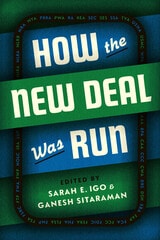
How the New Deal Was Run
Edited by Sarah E. Igo and Ganesh Sitaraman
University of Chicago Press, 2027
Notable historians delve into the brass tacks of launching and sustaining federal agencies.
Critics today complain that the United States government can’t do big things, can’t do them quickly, and certainly can’t do many of them at once. The New Deal offers a striking contrast. During the 1930s, the United States created a wealth of new agencies, departments, offices, and programs—all at once and in very short order—that enabled a stunning expansion of state capacity. The question is: how?
In this illuminating collection, leading American historians explore the nuts and bolts of New Deal implementation to offer answers. From the Civilian Conservation Corps to the Rural Electrification Administration to the Securities and Exchange Commission, they uncover exactly how the New Dealers did so much so quickly. They detail the choices before state builders who, operating under the pressure and immediacy of the era, made decisions that had momentous consequences in the longer term.
At a time when federal agencies are under stress as never before, the contributors suggest what future administrations can learn from the New Deal’s extraordinary achievements—and how they can build state capacity and deliver for Americans once again.
Features contributions by W. Tanner Allread, Mary Bridges, Brent Cebul, Sarah E. Igo, Meg Jacobs, Richard R. John, Neil M. Maher, Sharon Ann Musher, Sarah T. Phillips, Kathryn Olmsted and Eric Rauchway, Alex Platt, Jason Scott Smith, Ganesh Sitaraman, Abby Spinak, Chloe Thurston, and Mason B. Williams.
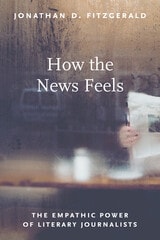
How the News Feels
The Empathic Power of Literary JournalistsJonathan D. Fitzgerald
University of Massachusetts Press, 2023
Literary journalism’s origins can be traced to the nineteenth century, when it developed alongside the era’s sentimental literature. Combining fact-based reporting with the sentimentality of popular fiction, literary journalism encouraged readers to empathize with subjects by presenting more nuanced and engaging stories than typical news coverage. While women writers were central to the formation and ongoing significance of the genre, literary journalism scholarship has largely ignored their contributions.
How the News Feels re-centers the work of a range of writers who were active from the nineteenth century until today, including Catharine Williams, Margaret Fuller, Nellie Bly, Winifred Black, Zora Neale Hurston, Joan Didion, Adrian Nicole LeBlanc, and Alexis Okeowo. Offering intimate access to their subjects’ thoughts, motivations, and yearnings, these journalists encouraged readers to empathize with society’s outcasts, from asylum inmates and murder suspects to “fallen women” and the working poor. As this carefully researched study shows, these writers succeeded in defining and developing the genre of literary journalism, with stories that inspire action, engender empathy, and narrow the gap between writer, subject, and audience.

How the North Won
A MILITARY HISTORY OF THE CIVIL WARHerman Hattaway and Archer Jones
University of Illinois Press, 1983
“To those unacquainted with military history, [this book] provides an elementary, instructive, and readable military account of the American Civil War. The basic concepts of war, its conduct, management, and support, are thoroughly explained and explicitly applied throughout in order to make clear what many authors often incorrectly take for granted that readers already know. . . .
We have tried to tell the military history of the war from the viewpoint of the higher commanders on both sides. We therefore emphasize strategy and logistics rather than tactics. . . .Strategy, management, and execution weigh more than superior numbers and resources in dictating the outcomes of wars, and the Civil War is no exception. The weaker side can win; the South almost did.”
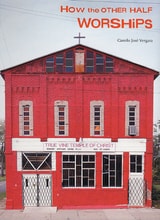
How the Other Half Worships
Camilo José Vergara
Rutgers University Press, 2005
Domestically and abroad, America is known as the richest country in the world. It is hard not to be impressed by the standard of living in the nation’s most affluent suburban and urban neighborhoods. Yet, scattered amid stretches that abound in wealth, the country is home to neighborhoods rife with violence, poverty, segregation, and decay. Within these blighted urban landscapes, however, there is at least one notable example of plenty: churches. They do not always appear as traditional houses of worship, but often emerge from the retrofitted shells of former storefronts, garages, factories, warehouses, domestic dwellings, and public institutions. Regardless of the façade, churches populate America’s poorest neighborhoods.
Bringing together more than 300 richly textured color photographs and a series of candid interviews with pastors, church officials, and congregation members, this extraordinary book explores the conditions, beliefs, and practices that shape the churches and the lives of the nation’s urban poor. Over a period of thirty years, sociologist and photographer Camilo José Vergara repeatedly visited these places of worship and the eclectic mix of buildings that house them. In twenty-one cities located in ten states across the country, photographic sequences coupled with insightful narrative show how ordinary structures assume, modify, and shed a religious character, how traditional churches—if they fail to adapt to new congregations—are demolished, and how new churches are designed and built from the ground up.
Vergara pays special attention to the objects, texts, and imagery that religious leaders make use of to create environments that inspire devotion. Pastors of developing congregations often arrive as crusaders, with missions that cannot be served by traditional religious iconography, and with budgets that force them to use inexpensive materials. In some cases, pastors bring objects of worship from their home towns in places such as Mexico, Puerto Rico, Africa, and the West Indies. Despite the idiosyncratic features and folk decoration that distinguish ghetto churches from one another, however, Vergara shows that, for the most part, they are driven by similar religious agendas. They tend to preach about resilience, avoid involving themselves in national and international events, and consider their truths to be absolute and eternal.
A powerful, poignant, and visually arresting portrait, How the Other Half Worships stands as a stark witness to how churches are being rebuilt in the dilapidated streets of America’s cities and how religion is being reinvented by the nation’s poor.

How the Rabbit Lost its Tail
A Haitian TaleLen Cabral
Parkhurst Brothers, Inc., 2020

How the Religious Right Shaped Lesbian and Gay Activism
Tina Fetner
University of Minnesota Press, 2008
An unexpected analysis of the battle between opposing activist movements
While gay rights are on the national agenda now, activists have spent decades fighting for their platform, seeing themselves as David against the religious right’s Goliath. At the same time, the religious right has continuously and effectively countered the endeavors of lesbian and gay activists, working to repeal many of the laws prohibiting discrimination based on sexual orientation and to progress a constitutional amendment “protecting” marriage.
In this accessible and grounded work, Tina Fetner uncovers a remarkably complex relationship between the two movements—one that transcends political rivalry. Fetner shows how gay activists and the religious right have established in effect a symbiotic relationship in which each side very much affects the development of its counterpart. As lesbian and gay activists demand an end to prejudice, inclusion in marriage, the right to serve in the military, and full citizenship regardless of sexual orientation, the religious right has responded with antigay planks in Republican party platforms and the blocking of social and political change efforts. Fetner examines how the lesbian and gay movement reacts to opposition by changing rhetoric, tone, and tactics and reveals how this connection has influenced—and made more successful—the evolution of gay activism in the United States. Fetner addresses debates that lie at the center of the culture wars and, ultimately, she demonstrates how the contentious relationship between gay and lesbian rights activists and the religious right—a dynamic that is surprisingly necessary to both—challenges assumptions about how social movements are significantly shaped by their rivals.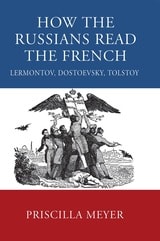
How the Russians Read the French
Lermontov, Dostoevsky, TolstoyPriscilla Meyer
University of Wisconsin Press, 2008

How the Soviet Union Disappeared
An Essay on the Causes of DissolutionWisla Suraska
Duke University Press, 1998
Using numerous secondary sources, recently published memoir literature, and new archival research, Suraska’s multidimensional study delves into the many factors involved in the dissolution of the Soviet empire—the role of Gorbachev and his contest with Yeltsin, the weakness of the Soviet state, and the poverty of ideas that informed perestroika. She also examines the complex relationship between the Communist Party, the KGB, and the military; the way Gorbachev dealt with the German question; and the rise of post-Marxist thought in the Soviet Union. Whether discussing how insufficient control over coercive forces or the growing strength of provincial barons impacted the collapse, Suraska furthers her argument that the explosion of nationalisms in the Soviet Union was as much activated by the breakdown of central structures as it actually contributed to the final demolition of the regime. In the end, How the Soviet Union Disappeared reveals Gorbachev’s perestroika as having been nothing short of a radical attempt to rebuild power that the Soviet center had lost in the post-Stalinist period.
In its questioning of the assumptions of most previous scholarship and discourse on the Soviet Union, this book will be of interest to Sovietologists, political scientists, and students of communism and nationalism.
How the States Shaped the Nation
American Electoral Institutions and Voter Turnout, 1920-2000Melanie Jean Springer
University of Chicago Press, 2014
With How the States Shaped the Nation, Melanie Jean Springer places contemporary reforms in historical context and systematically explores how state electoral institutions have been instrumental in shaping voting behavior throughout the twentieth century. Although reformers often assume that more convenient voting procedures will produce equivalent effects wherever they are implemented, Springer reveals that this is not the case. In fact, convenience-voting methods have had almost no effect in the southern states where turnout rates are lowest. In contrast, the adverse effects associated with restrictive institutions like poll taxes and literacy tests have been persistent and dramatic. Ultimately, Springer argues, no single institutional fix will uniformly resolve problems of low or unequal participation. If we want to reliably increase national voter turnout rates, we must explore how states’ voting histories differ and better understand the role of political and geographical context in shaping institutional effects.
How the Tea Party Captured the GOP
Insurgent Factions in American PoliticsRachel M. Blum
University of Chicago Press, 2020
In How the Tea Party Captured the GOP, Rachel Marie Blum approaches the Tea Party from the angle of party politics, explaining the Tea Party’s insurgent strategies as those of a party faction. Blum offers a novel theory of factions as miniature parties within parties, discussing how fringe groups can use factions to increase their political influence in the US two-party system. In this richly researched book, the author uncovers how the electoral losses of 2008 sparked disgruntled Republicans to form the Tea Party faction, and the strategies the Tea Party used to wage a systematic takeover of the Republican Party. This book not only illuminates how the Tea Party achieved its influence, but also provides a framework for identifying other factional insurgencies.
How the West Came to Rule
The Geopolitical Origins of CapitalismAlex Anievas and Kerem Nisancioglu
Pluto Press, 2015
***Winner, British International Studies Association International Political Economy Working Group Book Prize 2016***
Mainstream historical accounts of the development of capitalism describe a profess which is fundamentally European—a system that was born in the mills and factories of English and under the guillotines of the French Revolution. This groundbreaking book tells a very difference story.
How the West Came to Rule offers a unique interdisciplinary and international historical account of the origins of capitalism. It argues that, contrary to dominant wisdom, capitalism’s origins should not be understood as a development confined to the geographically and culturally sealed borders of Europe, but the outcome of a wider array of global processes in which non-European societies played a decisive role.
Here is a provocative, incisive explanation of how capitalism emerged in England and Europe through a dialectical intersocietal and geopolitical process. The authors’ aim to undermine a Eurocentric bias that has been prominent in the debate about capitalisms rise to supremacy, and their case is remarkably convincing. They provide a fundamental rethinking. Anievas and Nisancioglu contend that often cited assumptions are neither theoretically nor empirically tenable and deny the agency of non-Western societies to the emergence of capitalism. Topics covered include:
*The Problem of Eurocentrism
*The Problem of Historical Specificity
*The Brenner Thesis: Explanation and Critique
*The Geopolitical in the Making of Capitalism
*The Political Marxist Conception of Capitalism
*Rethinking the Origins of Capitalism
*And much more!
Through an outline of the uneven histories of Mongolian expansion, New World discoveries, Ottoman-Habsburg rivalry, the development of the colonies, and bourgeois revolutions, Alex Anievas and Kerem Nisancioglu offer an account of capitalism’s origins that convincingly argues against the prevailing Eurocentric narratives. It will change minds and open the eyes of historians, economists, and political thinkers.