Results by title
28164 books match the query 'History' and 906 start with h
Handbook of Latin American Studies, Vol. 75
Social SciencesKatherine D. McCann
University of Texas Press, 2021
Beginning with Number 41 (1979), the University of Texas Press became the publisher of the most comprehensive annual bibliography in the field. Compiled by the Hispanic Division of the Library of Congress and annotated by a corps of more than 140 specialists in various disciplines, the Handbook alternates from year to year between social sciences and humanities.
The Handbook annotates works on Mexico, Central America, the Caribbean and the Guianas, Spanish South America, and Brazil, as well as materials covering Latin America as a whole. Most of the subsections are preceded by introductory essays that serve as biannual evaluations of the literature and research under way in specialized areas.

Handbook of Latin American Studies, Vol. 77
Social SciencesKatherine D. McCann
University of Texas Press, 2024
The Handbook annotates works on Mexico, Central America, the Caribbean and the Guianas, Spanish South America, and Brazil, as well as materials covering Latin America as a whole. Most of the subsections are preceded by introductory essays that serve as biannual evaluations of the literature and research underway in specialized areas. Subject categories for the Social Sciences editions include anthropology; geography; government and politics; international relations; political economy; and sociology.

Handbook of Middle American Indians, Volume 13
Guide to Ethnohistorical Sources, Part TwoRobert Wauchope, series editor; Howard F. Cline, volume editor,; John B. Glass, assoc vol. ed.
University of Texas Press, 1973
Volume 13 of the Handbook of Middle American Indians, published in cooperation with the Middle American Research Institute of Tulane University under the general editorship of Robert Wauchope (1909–1979), constitutes Part 2 of the Guide to Ethnohistorical Sources. The Guide has been assembled under the volume editorship of the late Howard F. Cline, Director of the Hispanic Foundation in the Library of Congress, with Charles Gibson, John B. Glass, and H. B. Nicholson as associate volume editors. It covers geography and ethnogeography (Volume 12); sources in the European tradition (Volume 13); and sources in the native tradition (Volumes 14 and 15).
The present volume contains the following studies on sources in the European tradition:
- “Published Collections of Documents Relating
- to Middle American Ethnohistory,” by Charles Gibson
- “An Introductory Survey of Secular Writings in the European Tradition on Colonial Middle America, 1503–1818,” by J. Benedict Warren
- “Religious Chroniclers and Historians: A Summary with Annotated Bibliography,” by Ernest J.
- Burrus, S.J.
- “Bernardino de Sahagún,” by Luis Nicolau d’Olwer, Howard F. Cline, and H. B. Nicholson
- “Antonio de Herrera,” by Manuel Ballesteros Gaibrois
- “Juan de Torquemada,” by José Alcina Franch
- “Francisco Javier Clavigero,” by Charles E. Ronan, S.J.
- “Charles Etienne Brasseur de Bourbourg,” by Carroll Edward Mace
- “Hubert Howe Bancroft,” by Howard F. Cline
- “Eduard Georg Seler,” by H. B. Nicholson
- “Selected
The Handbook of Middle American Indians was assembled and edited at the Middle American Research Institute of Tulane University with the assistance of grants from the National Science Foundation and under the sponsorship of the National Research Council Committee on Latin American Anthropology.

Handbook of Patristic Exegesis
Charles Kannengiesser
SBL Press, 2016
Now in paperback!
This essential volume presents a balanced and cohesive picture of the Early Church. It gives an overall view of the reception, transmission, and interpretation of the Bible in the life and thought of the Church during the first five centuries of Christianity, the so-called patristic era. The handbook offers the context and presuppositions necessary for understanding the development of the interpretative traditions of the Early Church, in its catechesis, its liturgy and as a foundation of its systems of theology. The handbook presents a comprehensive overview of the history of patristic exegesis.
Features:

HandiLand
The Crippest Place on EarthElizabeth A. Wheeler
University of Michigan Press, 2019
HandiLand looks at young adult novels, fantasy series, graphic memoirs, and picture books of the last 25 years in which characters with disabilities take center stage for the first time. These books take what others regard as weaknesses—for instance, Harry Potter’s headaches or Hazel Lancaster’s oxygen tank—and redefine them as part of the hero’s journey. HandiLand places this movement from sidekick to hero in the political contexts of disability rights movements in the United States, the United Kingdom, and Ghana.
Elizabeth A. Wheeler invokes the fantasy of HandiLand, an ideal society ready for young people with disabilities before they get there, as a yardstick to measure how far we’ve come and how far we still need to go toward the goal of total inclusion. The book moves through the public spaces young people with disabilities have entered, including schools, nature, and online communities. As a disabled person and parent of children with disabilities, Wheeler offers an inside look into families who collude with their kids in shaping a better world. Moving, funny, and beautifully written, HandiLand: The Crippest Place on Earth is the definitive study of disability in contemporary literature for young readers.

Handmaid of the Holy Spirit
Dame Eleanor Davies, Never Soe Mad a LadieEsther S. Cope
University of Michigan Press, 1993

Hands Across the Sea?
U.S.-Japan Relations, 1961–1981Timothy P. Maga
Ohio University Press, 1997
In 1961, the U.S. economy and military remained unassailable in the eyes of the world. Within twenty years, America faced defeat in Vietnam and its economy had been shaken. Japan was now considered the great economic superpower, while the U.S. and Japan reversed roles as surplus and debtor nations. Hands across the Sea? examines this reversal of roles, determining how and why America and Japan became the post-World War II era’s most argumentative allies.
Through extensive research in a number of presidential libraries and author interviews with both American and Japanese policy-makers, Professor Maga finds a U.S.-Japan relationship forever troubled by cultural misunderstanding, America’s Cold War obsession, Japanese pride, and strangely conflicting goals in both trade and defense. Given the intensity of the arguments over some of these issues, it is remarkable that Washington and Tokyo continued a working dialogue during this critical time.
Hands across the Sea? represents the first in-depth study of the modern U.S.-Japan relationship. It especially discovers how serious the U.S.-Japan disagreements over trade, defense, the direction of the Cold War, nuclear policy, and the environment had become.
Whereas American observers of U.S.-Japan relations are quick to point out their fellow countrymen’s ignorance of other cultures and Japan’s brilliance in analyzing American policy and life, the evidence suggests otherwise. Steering far away from anyone’s political correctness, this book’s bottom line involves hard-hitting investigation and analysis.
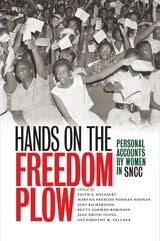
Hands on the Freedom Plow
Personal Accounts by Women in SNCCFaith S. Holsaert
University of Illinois Press, 2012
Handwriting in Early America
A Media HistoryEdited by Mark Alan Mattes, Foreword by Karen Sánchez-Eppler, Afterword by Christopher Hager
University of Massachusetts Press, 2023
As digital communication has become dominant, commentators have declared that handwriting is a thing of the past, a relic of an earlier age. This volume of original essays makes it clear that anxiety around handwriting has existed for centuries and explores writing practices from a variety of interdisciplinary fields, including manuscript studies, Native American studies, media history, African American studies, book history, bibliography, textual studies, and archive theory.
By examining how a culturally diverse set of people grappled with handwriting in their own time and weathered shifting relationships to it, Handwriting in Early America uncovers perspectives that are multiethnic and multiracial, transatlantic and hemispheric, colonial and Indigenous, multilingual and illiterate. Essays describe a future of handwriting as envisioned by practitioners, teachers, and even government officials of this time, revealing the tension between the anxiety of loss and the need to allow for variations going forward.
Contributors include James Berkey, Blake Bronson-Bartlett, John J. Garcia, Christopher Hager, Desirée Henderson, Frank Kelderman, Michelle Levy, Lisa Maruca, Christen Mucher, Alan Niles, Seth Perlow, Carla L. Peterson, Sarah Robbins, Patricia Jane Roylance, Karen Sánchez-Eppler, and Danielle Skeehan.

Hangin' Times in Fort Smith
A History of Executions in Judge Parker’s CourtJerry Akins
Butler Center for Arkansas Studies, 2012
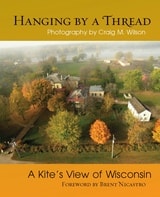
Hanging by a Thread
A Kite’s View of WisconsinCraig M. Wilson
University of Wisconsin Press, 2011
This full-color book of photographs records Wisconsin from an unusual viewpoint: a camera suspended from a kite and controlled by photographer Craig M. Wilson from the ground. Taken from fifty to a few hundred feet in the air, Wilson’s photos capture natural and man-made views that wouldn’t otherwise be possible. The result is a vibrant collection that captures Wisconsin in all its shifting beauty in landscapes and cityscapes, festivals, Door County’s lighthouses, Milwaukee’s neighborhoods, and the crowd at a Badger football game. Captions are provided in English, Spanish, German, and Mandarin Chinese.
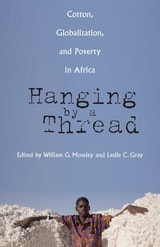
Hanging by a Thread
Cotton, Globalization, and Poverty in AfricaWilliam G. Moseley
Ohio University Press, 2008
The textile industry was one of the first manufacturing activities to become organized globally, as mechanized production in Europe used cotton from the various colonies. Africa, the least developed of the world’s major regions, is now increasingly engaged in the production of this crop for the global market, and debates about the pros and cons of this trend have intensified.
Hanging by a Thread: Cotton, Globalization, and Poverty in Africa illuminates the connections between Africa and the global economy. The editors offer a compelling set of linked studies that detail one aspect of the globalization process in Africa, the cotton commodity chain.
From global policy debates, to impacts on the natural environment, to the economic and social implications of this process, Hanging by a Thread explores cotton production in the postcolonial period from different disciplinary perspectives and in a range of national contexts. This approach makes the globalization process palpable by detailing how changes at the macroeconomic level play out on the ground in the world’s poorest region. Hanging by a Thread offers new insights on the region in a global context and provides a critical perspective on current and future development policy for Africa.
Contributors: Thomas J. Bassett, Jim Bingen, Duncan Boughton, Brian M. Dowd, Marnus Gouse, Leslie C. Gray, Dolores Koenig, Scott M. Lacy, William G. Moseley, Colin Poulton, Bhavani Shankar, Corinne Siaens, Colin Thirtle, David Tschirley, and Quentin Wodon.

Hanif Kureishi
Postcolonial StorytellerBy Kenneth C. Kaleta
University of Texas Press, 1997
"Hanif Kureishi is a proper Englishman. Almost." So observes biographer Kenneth Kaleta. Well known for his films My Beautiful Laundrette and Sammy and Rosie Get Laid, the Anglo-Asian screenwriter, essayist, and novelist has become one of the leading portrayers of Britain's multicultural society. His work raises important questions of personal and national identity as it probes the experience of growing up in one culture with roots in another, very different one.
This book is the first critical biography of Hanif Kureishi. Kenneth Kaleta interviewed Kureishi over several years and enjoyed unlimited access to all of his working papers, journals, and personal files. From this rich cache of material, he opens a fascinating window onto Kureishi's creative process, tracing such works as My Beautiful Laundrette, Sammy and Rosie Get Laid, The Buddha of Suburbia, London Kills Me, The Black Album, and Love in a Blue Time from their genesis to their public reception. Writing for Kureishi fans as well as film and cultural studies scholars, Kaleta pieces together a vivid mosaic of the postcolonial, hybrid British culture that has nourished Kureishi and his work.
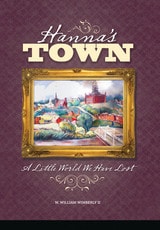
Hanna's Town
A Little World We Have LostW. William Wimberly II
Indiana Historical Society Press, 2010

Hannah Ryggen
Threads of DefianceMarit Paasche
University of Chicago Press, 2019
A widely recognized authority on Ryggen, Marit Paasche brings this important Scandinavian artist to the foreground in this biography, the first published on Ryggen in English. Paasche looks at Ryggen within the social, political, and cultural contexts of her time and explores how these issues informed her work, from her anti-fascist tapestry that depicted a spear piercing Mussolini’s head to one protesting the war in Vietnam. Published to correspond with a major retrospective in Frankfurt, of which Paasche is one of the curators, Hannah Ryggen is a foundational book that will provide a crucial introduction of this artist to a broader audience.

Hannah Whitman Heyde
The Complete CorrespondenceMaire Mullins
Bucknell University Press, 2022
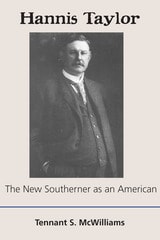
Hannis Taylor
The New Southerner as an AmericanTennant McWilliams
University of Alabama Press, 1978
During the late nineteenth and early twentieth centuries, American life took on contradictions that were later to surface with considerable poignancy. While many publicists and politicians foresaw an America of harmony and great opportunity, they also clung tenaciously to such doctrines as Anglo-Saxon racial superiority and the righteousness of liberal capitalism-notions that worked to defeat the progress they espoused. Here is a study of one of those persons, Hannis Taylor.
For a number of reasons Taylor’s life is uniquely useful for the historian interested in the paradoxes of American life at the turn of the century. Unlike many others of the era who have been examined through biography, Taylor pursued the multifaceted career of practicing attorney, constitutional historian, journalist, diplomat, and ever-aspiring politician. Hence he had occasion to write and speak on almost every intellectual and popular issue of the period. His record serves as a microcosm of many of the contradictions spanning American thought during that time. Further, Taylor was a Southerner. Before moving to Washington, D.C. in 1902, Taylor had grown up in a North Carolina torn by the Civil War and had taken an active role in Alabama affairs during the three decades following Reconstruction. His life shows how a proponent of the New South creed could move easily to advocate the nationalistic foreign and domestic policies often associated with Theodore Roosevelt. Finally, from a humanistic standpoint Taylor's life permits a study in human strivings for achievement. American historiography gravitates to the successful; here is an account of a more common stereotype, the man who worked relentlessly at becoming a noted American by supporting popular causes and who failed tragically.

Hanoi Jane
War, Sex, and Fantasies of BetrayalJerry Lembcke
University of Massachusetts Press, 2010
From Aristophanes' Lysistrata to the notorious Mata Hari and the legendary Tokyo Rose, stories of female betrayal during wartime have recurred throughout human history. The myth of Hanoi Jane, Jerry Lembcke argues, is simply the latest variation on this enduring theme. Like most of the iconic femmes fatales who came before, it is based on a real person, Jane Fonda. And also like its predecessors, it combines traces of fact with heavy doses of fiction to create a potent symbol of feminine perfidy—part erotic warrior-woman Barbarella, part savvy antiwar activist, and part powerful entrepreneur.
Hanoi Jane, the book, deconstructs Hanoi Jane, the myth, to locate its origins in the need of Americans to explain defeat in Vietnam through fantasies of home-front betrayal and the emasculation of the national will-to-war. Lembcke shows that the expression “Hanoi Jane” did not reach the eyes and ears of most Americans until five or six years after the end of the war in Vietnam. By then, anxieties about America's declining global status and deteriorating economy were fueling a populist reaction that pointed to the loss of the war as the taproot of those problems. Blaming the antiwar movement for undermining the military's resolve, many found in the imaginary Hanoi Jane the personification of their stab-in-the- back theories.
Ground zero of the myth was the city of Hanoi itself, which Jane Fonda had visited as a peace activist in July 1972. Rumors surrounding Fonda's visits with U.S. POWs and radio broadcasts to troops combined to conjure allegations of treason that had cost American lives. That such tales were more imagined than real did not prevent them from insinuating themselves into public memory, where they have continued to infect American politics and culture.
Hanoi Jane is a book about the making of Hanoi Jane by those who saw a formidable threat in the Jane Fonda who supported soldiers and veterans opposed to the war they fought, in the postcolonial struggle of the Vietnamese people to make their own future, and in the movements of women everywhere for gender equality.
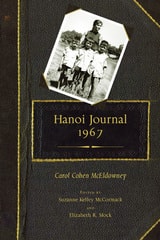
Hanoi Journal, 1967
Carol McEldowney
University of Massachusetts Press, 2007
McEldowney first gained the respect of her fellow activists as a student organizer at the University of Michigan. High regard for her intelligence, skill, and hard work with SDS's Economic Recovery Action Program during the years following her graduation in 1964 earned her an invitation to attend an international conference in Czechoslovakia and an offer to continue on to North Vietnam. Though her journal displays only traces of the feminist consciousness that would mark her later political activism, she recorded her observations of North Vietnam clearly aware that she was an outsider—a woman not subject to the military draft, not married to a soldier, and without the heartache of a brother or even a close friend serving in the war.
McEldowney searched for glimpses of everyday life that would help her to better relate to women in Hanoi and the hardships they faced during wartime. As she traveled in North Vietnam, she sought a deeper understanding of the events of her time. Her journal provides readers with a unique lens through which to study those events and gain a new perspective on the Vietnam War era.

Hans Staden's True History
An Account of Cannibal Captivity in BrazilHans Staden
Duke University Press, 2008
Staden’s narrative is a foundational text in the history and European “discovery” of Brazil, the earliest European account of the Tupi Indians, and a touchstone in the debates on cannibalism. Yet the last English-language edition of Staden’s True History was published in 1929. This new critical edition features a new translation from the sixteenth-century German along with annotations and an extensive introduction. It restores to the text the fifty-six woodcut illustrations of Staden’s adventures and final escape that appeared in the original 1557 edition.
In the introduction, Neil L. Whitehead discusses the circumstances surrounding the production of Staden’s narrative and its ethnological significance, paying particular attention to contemporary debates about cannibalism. Whitehead illuminates the value of Staden’s True History as an eyewitness account of Tupi society on the eve before its collapse, of ritual war and sacrifice among Native peoples, and of colonial rivalries in the region of Rio de Janeiro. He chronicles the history of the various editions of Staden’s narrative and their reception from 1557 until the present. Staden’s work continues to engage a wide range of readers, not least within Brazil, where it has recently been the subject of two films and a graphic novel.

Hansberry's Drama
COMMITMENT AMID COMPLEXITYSteven R. Carter
University of Illinois Press, 1991
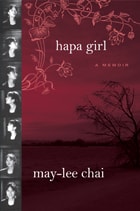
Hapa Girl
A MemoirMay-lee Chai
Temple University Press, 2008
In the mid-1960s, Winberg Chai, a young academic and the son of Chinese immigrants, married an Irish-American artist. In Hapa Girl ("hapa" is Hawaiian for "mixed") their daughter tells the story of this loving family as they moved from Southern California to New York to a South Dakota farm by the 1980s. In their new Midwestern home, the family finds itself the object of unwelcome attention, which swiftly escalates to violence. The Chais are suddenly socially isolated and barely able to cope with the tension that arises from daily incidents of racial animosity, including random acts of cruelty.
May-lee Chai's memoir ends in China, where she arrives just in time to witness a riot and demonstrations. Here she realizes that the rural Americans' "fears of change, of economic uncertainty, of racial anxiety, of the unknowable future compared to the known past were the same as China's. And I realized finally that it had not been my fault."
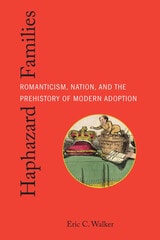
Haphazard Families
Romanticism, Nation, and the Prehistory of Modern AdoptionEric C. Walker
The Ohio State University Press, 2024
There are no provisions for adoption in English common law, and adoption wasn't legally formalized in England and Wales until 1926. But a century earlier, untimely adoptions navigated the new exceptionalism of childhood in Romanticism. In Haphazard Families, Eric C. Walker explores the history of the adopted child in Romantic-era England. Taking up the stories of both fictional and historical adoptees, he demonstrates how these children, diminished to nonpersons, shouldered the burden of social constructs of nation, family, gender, and class. Walker further demonstrates how Rousseau’s infamous failure to follow his own ideals of parenthood shaped British reactions in famous texts such as Frankenstein and Emma. Incorporating perspectives from Romantic scholarship and critical adoption studies and examining the stories of adopted children associated with Queen Caroline, Anna Letitia Barbauld, Jane Austen, the Wordsworth siblings, Mary Shelley, Charles and Mary Lamb, Letitia Landon, and others, Haphazard Families considers how Romantic constructions of childhood supply foundational structures of modern adoptee subjectivity.
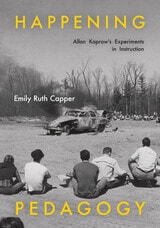
Happening Pedagogy
Allan Kaprow's Experiments in InstructionEmily Ruth Capper
University of Chicago Press, 2026
How Allan Kaprow’s happenings fused modernist pedagogy with an emerging college culture.
In Happening Pedagogy, art historian Emily Ruth Capper argues that Allan Kaprow’s famed invention of the happening brought together experimental traditions of modernist pedagogy with emerging forms of American undergraduate student culture—from hazing rituals to campus protests. Capper traces Kaprow’s trajectory from 1947 to 1968, following him through the classrooms of three of his instructors who were prominent figures in postwar American art—painter Hans Hofmann, art historian Meyer Schapiro, and composer John Cage—and across his own classrooms at institutions including Rutgers and Stony Brook University. Although Kaprow’s teachers were educated in the distinct disciplines of studio art, art history, and music, all three designed their classrooms to cultivate student creativity and critical reflection through forms of social exchange.
Capper shows that Kaprow transformed these modernist classrooms into new pedagogical environments that he developed within the novel context of the suburban state university. Drawing on archival sources, she describes how Kaprow engaged the culture and creative work of middle-class college students, whose rituals he took seriously as an avant-garde vernacular. In this way, Kaprow’s happenings represent a critical extension of modernism as a social practice of sensory attunement, experimentation, and philosophical critique. Through Kaprow’s work, modernist pedagogy became an artistic medium in itself, and his participation-based creative practices helped define the broad resurgence of the American neo-avant-garde after 1960.
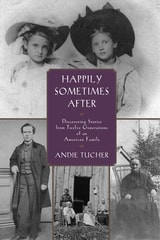
Happily Sometimes After
Discovering Stories from Twelve Generations of an American FamilyAndie Tucher
University of Massachusetts Press, 2014
A 2015 CHOICE Outstanding Academic Title
For more than four hundred years, members of the author's family have been telling stories about their American lives. They have told of impassioned elopements and heart-breaking kidnaps, of hairbreadth escapes and shocking murders, of bigamists, changelings, patriots, Indians, fires, floods, and how the great-grandmother of Chief Justice John Marshall married the pirate Blackbeard by mistake.
In this beautifully written work, Andie Tucher considers family stories as another way to look at history, neither from the top down nor the bottom up but from the inside out. She explores not just what happened—everywhere from Jamestown to Boonesborough, from the bloody field at Chickamauga to the metropolis of the Gilded Age—but also what the storytellers thought or wished or hoped or feared happened. She offers insights into what they valued, what they lost, how they judged their own lives and found meaning in them. The narrative touches on sorrow, recompense, love, pain, and the persistent tension between hope and disappointment in a nation that by making the pursuit of happiness thinkable also made unhappiness regrettable.
Based on extensive research in archives, local history societies, and family-history sources as well as conversations and correspondence, Happily Sometimes After offers an intimate and unusual perspective on how ordinary people used stories to imagine the world they wished for, and what those stories reveal about their relationships with the world they actually had.
Happiness in the Nordic World
Christian Bjørnskov
University of Wisconsin Press, 2021
Many experts attribute the region's high levels of happiness to factors such as greater relative national wealth and well-functioning institutions. Yet, a number of other countries in Europe and parts of Asia share those qualities and rank far lower in life satisfaction. Others credit the region's high levels of happiness to its welfare state model, but these have changed considerably over time—and Iceland does not share this feature.
Instead, economist Christian Bjørnskov argues that the most important factor to come out of international comparisons is the importance of social trust—the ability to trust other people one does not know personally. The populations in three of the five countries are also characterized by a very strong sense of personal freedom. These two key factors contribute to a fuller and richer life. Bjørnskov ends by discussing to what extent these factors can be exported to other parts of the world.
Happy Days and Wonder Years
The Fifties and the Sixties in Contemporary Cultural PoliticsMarcus, Daniel
Rutgers University Press, 2004
From Ronald Reagan's image as a Fifties Cold Warrior to Bill Clinton's fandom for Elvis Presley and John F. Kennedy, politicians have invoked the Fifties and the Sixties to connect to their public. Marcus shows how films, television, music, and memoirs have responded to the political nostalgia of today, and why our entertainment remains immersed in reruns, revivals, and references to earlier times. This book offers a new understanding of how politics and popular culture have influenced our notions of the past, and how events from long ago continue to shape our understanding of the present day.
Happy Days
Images of the Pre-Sixties Past in Seventies AmericaBenjamin L. Alpers
Rutgers University Press, 2024
Happy Days investigates how 1970s popular culture was obsessed with America’s past but often offered radically different interpretations of the same historical events and icons. Even the figure of the greaser, once an icon of juvenile delinquency, was made family-friendly by Henry Winkler’s Fonzie at the same time that he was being appropriated in more threatening ways by punk and gay subcultures. The cultural historian Benjamin Alpers discovers similar levels of ambivalence toward the past in 1970s neo-noir films, representations of America’s founding, and neo-slave narratives by Alex Haley and Octavia Butler. By exploring how Americans used the 1970s to construct divergent representations of their shared history, he identifies it as a pivotal moment in the nation’s ideological fracturing.
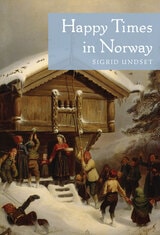
Happy Times in Norway
Sigrid Undset
University of Minnesota Press, 2013
Happy Timesin Norway is a moving and delicately humorous picture of Undset’s own blissful home life before her nation fell to the Nazi occupation. Captured here is the excitement of a Norwegian Christmas, the Seventeenth of May, and summer in the idyllic mountains, as well as the chaotic adventure of raising two energetic boys. With vivid detail and illuminating descriptions of the landscape, Happy Times in Norway is infused with the wish that those cherished days could come again.
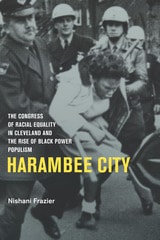
Harambee City
The Congress of Racial Equality in Cleveland and the Rise of Black Power PopulismNishani Frazier
University of Arkansas Press, 2017
BLACK POWER!
It was a phrase that consumed the American imagination in the 1960s and 70s and inspired a new agenda for black freedom. Dynamic and transformational, the black power movement embodied more than media stereotypes of gun-toting, dashiki-wearing black radicals; the movement opened new paths to equality through political and economic empowerment.
In Harambee City, Nishani Frazier chronicles the rise and fall of black power within the Congress of Racial Equality (CORE) by exploring the powerful influence of the Cleveland CORE chapter. Frazier explores the ways that black Clevelanders began to espouse black power ideals including black institution building, self-help, and self-defense. These ideals challenged CORE’s philosophy of interracial brotherhood and nonviolent direct action, spawning ideological ambiguities in the Cleveland chapter. Later, as Cleveland CORE members rose to national prominence in the organization, they advocated an open embrace of black power and encouraged national CORE to develop a notion of black community uplift that emphasized economic populism over political engagement. Not surprisingly, these new empowerment strategies found acceptance in Cleveland.
By providing an understanding of the tensions between black power and the mainstream civil rights movement as they manifested themselves as both local and national forces, Harambee City sheds new light on how CORE became one of the most dynamic civil rights organizations in the black power era.

Harbin and Manchuria
Place, Space, and Identity, Volume 99Thomas Lahusen, ed.
Duke University Press, 0
Crossing the boundaries of their specializations, contributors respond to the complexity of this history while considering the concrete concept of place and its relation to the more abstract idea of space. A rare encounter between scholars of East Asian and Slavic studies, this well-illustrated collections includes discussions of history, politics, economics, anthropology, sociology, cinema, and cultural studies. An eclectic and comprehensive exploration of memory and its reconstruction in the Harbin-Manchuria diaspora, Harbin and Manchuria provides the first full treatment of this colonial encounter.
Contributors. Olga Bakich, Sabine Breuillard, James Carter, Elena Chernolutskaya, Prasenjit Duara, Thomas Lahusen, Hyun-Ok Park, Andre Schmid, Mariko Asano Tamanoi, David Wolff
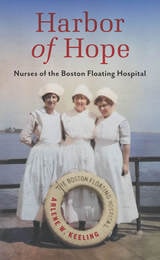
Harbor of Hope
Nurses of the Boston Floating HospitalArlene W. Keeling
University of Massachusetts Press, 2026
The untold story of Boston’s Floating Hospital and the nurses whose work redefined infant care
In late nineteenth-century Boston, nearly one in five babies did not survive infancy. Each summer, outbreaks of “summer complaint”—a deadly gastrointestinal illness caused by contaminated cow’s milk—swept through the city’s poorest neighborhoods. Infants born to immigrant families were especially vulnerable, trapped in stifling tenements with poor sanitation and little access to safe nutrition. Searching for a solution, reform-minded Bostonians looked to New York City’s hospital boats, which offered sick children relief from the heat. In the summer of 1894, Boston launched its own bold experiment: the Boston Floating Hospital.
What began as a modest charitable venture in Boston Harbor soon transformed pediatric care. While physicians have long received credit for the Floating Hospital’s success in reducing infant mortality, Harbor of Hope tells a deeper story. Historian Arlene W. Keeling reveals the essential and often overlooked role of nurses. It was nurses who translated medical theory into lifesaving practice: feeding and bathing fragile infants, administering treatments, calming anxious mothers, and carefully observing each child’s response. Serving as the vital link between doctors and families, they became the heart of the Floating Hospital’s mission.
Tracing the hospital’s story from its first voyage to its tragic destruction by fire in 1927, Harbor of Hope situates these nurses within a city undergoing dramatic change. Against the backdrop of rapid industrial growth, mass immigration, and emerging movements in public health and social reform, Keeling shows how skill, compassion, and persistence reshaped the fate of Boston’s most vulnerable children. Set afloat on Boston Harbor, this is a powerful story of caregiving, innovation, and the women who fought day after day to save babies’ lives.

Hard Aground
The Wreck of the USS Tennessee and the Rise of the US NavyAndrew C. A. Jampoler
University of Alabama Press, 2023
Three intertwined stories that reveal the challenges faced by the US Navy in its evolution between the Civil War and the First World War
Hard Aground brings together three intertwined stories documenting the US Navy’s strategic and matériel evolution from the end of Civil War through the First World War. These incidents had lasting consequences for how the navy would modernize itself throughout the rest of the twentieth century.
The first story focuses on the reconstruction of the US Navy following the swift and near-total dismantling of the Union Navy infrastructure after the Civil War. This reconstruction began with barely enough time for the navy’s campaigns in the Spanish-American War, and for its role in the First World War. Jampoler argues that the federal government discovered that the fleet requested by the navy, and paid for by Congress, was the wrong fleet. Focus was on battleships and cruisers rather than destroyers and other small combat vessels needed to hunt submarines and serve as convoy escorts.
The second story relates the short, tragic life of the USS Tennessee (later renamed Memphis), one of the steel-hulled ships of the new Armored Cruiser Squadron that was a centerpiece of the navy’s modernization effort. The USS Tennessee was ordered on two unusual missions in the early months of the First World War, long before the United States formally entered the war. These little-known missions and the ship's shocking destruction in a storm surge in the Caribbean serve as the centerpiece of the story. Threaded through the narrative are biographical sketches of the principal players in the drama that unfolded following the ship’s demise, including two of Tennessee’s commanding officers: Vice Admiral Sims, who commanded the US Navy squadrons deployed to Europe in support of the Royal Navy; Rear Admiral William Caperton, who commanded the Caribbean squadron before the Memphis (formerly the Tennessee) was lost; Charles Pond, squadron commander during the wreck; and the American ambassador to the Ottoman court, President Wilson’s enthusiastic supporter, Henry Morgenthau.
Jampoler rounds out this fascinating account with the story of how the USS Tennessee’s destruction prompted fierce deliberations about the US Navy’s operations and chains of command for the remainder of the First World War and the high-level political wrangling inside the Department of the Navy immediately after the war, as civilian appointees and senior officers wrestled to reshape the department in their image.
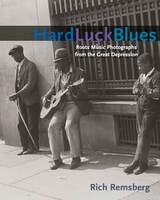
Hard Luck Blues
Roots Music Photographs from the Great DepressionRich Remsberg
University of Illinois Press, 2010
Showcasing American music and music making during the Great Depression, Hard Luck Blues presents more than two hundred photographs created by the New Deal's Farm Security Administration photography program. With an appreciation for the amateur and the local, FSA photographers depicted a range of musicians sharing the regular music of everyday life, from informal songs in migrant work camps, farmers' homes, barn dances, and on street corners to organized performances at church revivals, dance halls, and community festivals. Captured across the nation from the northeast to the southwest, the images document the last generation of musicians who learned to play without the influence of recorded sound, as well as some of the pioneers of Chicago's R & B scene and the first years of amplified instruments. The best visual representation of American roots music performance during the Depression era, Hard Luck Blues features photographs by Jack Delano, Dorothea Lange, Russell Lee, Arthur Rothstein, Ben Shahn, Marion Post Wolcott, and others.
Photographer and image researcher Rich Remsberg breathes life into the images by providing contextual details about the persons and events captured, in some cases drawing on interviews with the photographers' subjects. Also included are a foreword by author Nicholas Dawidoff and an afterword by music historian Henry Sapoznik.
Published in association with the Library of Congress.

Hard Places
Reading the Landscape of America's Historic Mining DistrictsRichard V. Francaviglia
University of Iowa Press, 1997
Working with the premise that there are much meaning and value in the "repelling beauty" of mining landscapes, Richard Francaviglia identifies the visual clues that indicate an area has been mined and tells us how to read them, showing the interconnections among all of America's major mining districts. With a style as bold as the landscape he reads and with photographs to match, he interprets the major forces that have shaped the architecture, design, and topography of mining areas. Covering many different types of mining and mining locations, he concludes that mining landscapes have come to symbolize the turmoil between what our society elects to view as two opposing forces: culture and nature.
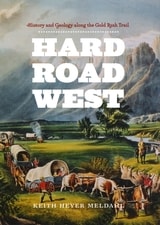
Hard Road West
History and Geology along the Gold Rush TrailKeith Heyer Meldahl
University of Chicago Press, 2007
“Alternates seamlessly between vivid accounts of the 19th-century journey and lucid explanations of the geological events that shaped the landscape traveled. . . . The reader comes away with both an appreciation for the arduous cross-continental wagon journey and an understanding of the events that created such a vast and difficult landscape.”—Library Journal
Hard Road to Freedom
The Story of African America, The Civil War to the MillenniumHorton, Lois E
Rutgers University Press, 2002
Hard Times in the Marvelous City
From Dictatorship to Democracy in the Favelas of Rio de JaneiroBryan McCann
Duke University Press, 2013
Hard Work
The Making of Labor HistoryMelvyn Dubofsky
University of Illinois Press, 2000
A career-spanning collection of writings by the legendary labor historian
One of American labor history's most prominent scholars, Melvyn Dubofsky curated an accessible style and historical reach that have long marked his work as required reading for students and scholars.
This collection juxtaposes Dubofsky's early writings with scholarship from the 1990s. Selections include work on western working-class radicalism, U.S. labor history in transnational and comparative settings, and the impact of technological change on American worker’s movements. Throughout, the writings provide an invaluable eyewitness perspective on the academic and political climate of the 1960s and 1970s while tracing the development of labor history as a discipline.
An exploration of important themes in labor history, Hard Work combines essential scholarship with the story of how past and present interact in the work of historians.
Hard as the Rock Itself
Place and Identity in the American Mining TownDavid Robertson
University Press of Colorado, 2006
Robertson documents the history of Toluca, Illinois; Cokedale, Colorado; and Picher, Oklahoma, from the mineral discovery phase through mine closure, telling for the first time how these century-old mining towns have survived and how sense of place has played a vital role.
Acknowledging the hardships that mining's social, environmental, and economic legacies have created for current residents, Robertson argues that the industry's influences also have contributed to the creation of strong, cohesive communities in which residents have always identified with the severe landscape and challenging, but rewarding way of life.
Robertson contends that the tough, unpretentious appearance of mining landscapes mirrors qualities that residents value in themselves, confirming that a strong sense of place in mining regions, as elsewhere, is not necessarily wedded to an attractive aesthetic or even to a thriving economy.
Mining historians, geographers, and other students of place in the American landscape will find fascinating material in Hard As the Rock Itself.

Hard-Boiled
Erin A. Smith
Temple University Press, 2000
Relying on pulp magazine advertising, the memoirs of writers and publishers, Depression-era studies of adult reading habits, social and labor history, Smith offers an innovative account of how these popular stories were generated and read. She shows that although the work of pulp fiction authors like Dashiell Hammett, Raymond Chandler, and Erle Stanley Gardner have become “classics” of popular culture, the hard-boiled genre was dominated by hack writers paid by the word, not self-styled artists. Pulp magazine editors and writers emphasized a gritty realism in the new genre. Unlike the highly rational and respectable British protagonists (Miss Marple and Hercule Poirot, for instance), tough-talking American private eyes relied as much on their fists as their brains as they made their way through tangled plotlines.
Casting working-class readers of pulp fiction as “poachers,” Smith argues that they understood these stories as parables about Taylorism, work, and manhood; as guides to navigating consumer culture; as sites for managing anxieties about working women. Engaged in re-creating white, male privilege for the modern, heterosocial world, pulp detective fiction shaped readers into consumers by selling them what they wanted to hear – stories about manly artisan-heroes who resisted encroaching commodity culture and the female consumers who came with it. Commenting on the genre’s staying power, Smith considers contemporary detective fiction by women, minority, and gay and lesbian writers.
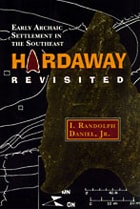
Hardaway Revisited
Early Archaic Settlement in the SoutheastI. Randolph Daniel, Jr.
University of Alabama Press, 1998
A landmark reassessment of Early Archaic settlement and adaptation in the southeastern United States.
Since the early 1970s, southeastern archaeologists have focused their attention on identifying the function of prehistoric sites and settlement practices during the Early Archaic period (ca. 9,000-10,500 B.P.). The Hardaway site in the North Carolina Piedmont, one of the most important archaeological sites in eastern North America, has not yet figured notably in this research. Daniel's reanalysis of the Hardaway artifacts provides a broad range of evidence—including stone tool morphology, intrasite distributions of artifacts, and regional distributions of stoneraw material types—that suggests that Hardaway played a unique role in Early Archaic settlement.
The Hardaway site functioned as a base camp where hunting and gathering groups lived for extended periods. From this camp they exploited nearby stone outcrops in the Uwharrie Mountains to replenish expended toolkits. Based on the results of this study, Daniel's new model proposes that settlement was conditioned less by the availability of food resources than by the limited distribution of high-quality knappable stone in the region. These results challenge the prevalent view of Early Archaic settlement that group movement was largely confined by the availability of food resources within major southeastern river valleys.

Hardboiled in Hollywood
Five Black Mask Writers and the MoviesUniversity of Wisconsin Press, 1991
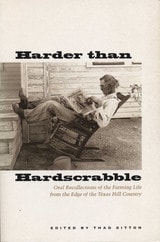
Harder than Hardscrabble
Oral Recollections of the Farming Life from the Edge of the Texas Hill CountryEdited by Thad Sitton
University of Texas Press, 2004
Winner, San Antonio Conservation Society Citation, 2005
Runner-up, Carr P. Collins Award, Best Book of Nonfiction, Texas Institute of Letters, 2005
Until the U.S. Army claimed 300-plus square miles of hardscrabble land to build Fort Hood in 1942, small communities like Antelope, Pidcoke, Stampede, and Okay scratched out a living by growing cotton and ranching goats on the less fertile edges of the Texas Hill Country. While a few farmers took jobs with construction crews at Fort Hood to remain in the area, almost the entire population—and with it, an entire segment of rural culture—disappeared into the rest of the state.
In Harder than Hardscrabble, oral historian Thad Sitton collects the colorful and frequently touching stories of the pre-Fort Hood residents to give a firsthand view of Texas farming life before World War II. Accessible to the general reader and historian alike, the stories recount in vivid detail the hardships and satisfactions of daily life in the Texas countryside. They describe agricultural practices and livestock handling as well as life beyond work: traveling peddlers, visits to towns, country schools, medical practices, and fox hunting. The anecdotes capture a fast-disappearing rural society—a world very different from today's urban Texas.

Harder than War
Catholic Peacemaking in Twentieth-Century AmericaMcNeal, Patricia F.
Rutgers University Press, 1992
During the Viet Nam War, Catholic Workers burned their draft cards and turned from nonviolence to resistance by practicing civil disobedience. Daniel and Philip Berrigan escalated that resistance when they destroyed draft files, and symbolically poured blood over and hammered nuclear weapons to awaken the national conscience to the life-ending effects of nuclear warfare.
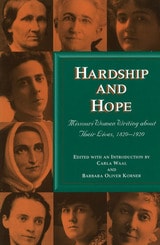
Hardship and Hope
Missouri Women Writing about Their Lives, 1820-1920Carla Waal and Barbara Oliver Korner, eds.
University of Missouri Press, 1997
Over the years Missouri women have endured many hardships: Civil War troops in their homes, the harshness of westward travel, the loneliness of the Gold Rush, and slavery. They have also greatly influenced the state's history. Marie Watkins Oliver made the state flag; Margaret Nelson Stephens was a gifted politician; Carry A. Nation fought for prohibition; and Mary Ezit Bulkley was active in the woman suffrage movement.
Hardship and Hope brings to life these and other known and unknown Missouri women through their own writings in journals, letters, diaries, and memoirs. Most of these pieces have never been published or have long been out of print. Carla Waal and Barbara Oliver Korner have skillfully crafted this anthology to represent myriad Missouri women. There are pieces representing the experiences of Jewish, Irish, and German immigrants, African Americans, well-educated women, and deeply religious women. Preceding each entry is a useful introduction that provides history and background on the woman and her work.
Readers will meet women like Phoebe Wilson Couzins, who was the first woman law graduate in Missouri. She went on to work with Susan B. Anthony for the suffrage movement but died in poverty, physically handicapped and emotionally unstable. Emma J. Ray was born a slave just before the Civil War. She and her husband did missionary work in jails and on the streets of Kansas City. Other women represented are Laura Ingalls Wilder, Kate Chopin, Fannie Hurst, and Henriette Geisberg Bruns.
Hardship and Hope began as a series of performances around the state of Missouri through which the book's editors demonstrated the roles women played in that state's past. Because of the enthusiastic response to their performances, Waal and Korner continued searching for documents by Missouri women and now share their discoveries in book form. Covering a little more than a century, from just before Missouri's admission to the Union in 1821 to the ratification of the Nineteenth Amendment that gave women the right to vote in 1920, the excerpts here both captivate and inform.
This anthology will appeal to those interested in women's studies, Missouri and midwestern history, and oral interpretation.

Hare Krishna
(Studies in Contemporary Religion)Federico Squarcini
Signature Books, 2004
When Bhaktivedanta arrived in America, it was a bold step because historically a guru who ventured outside of India was stripped of his Brahman status. However, the effort bore fruit—not the least of which was the type of intercultural understanding promoted by the current authors through their study of ISKCON’s place within the religion and culture of India.
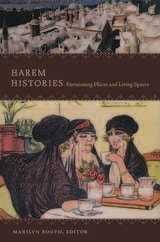
Harem Histories
Envisioning Places and Living SpacesMarilyn Booth, ed.
Duke University Press, 2010
Contributors. Asma Afsaruddin, Orit Bashkin, Marilyn Booth, Nadia Maria El Cheikh, Julia Clancy-Smith, Joan DelPlato, Jateen Lad, Nancy Micklewright, Yaseen Noorani, Leslie Peirce, Irvin Cemil Schick, A. Holly Schissler, Heghnar Zeitlian Watenpaugh
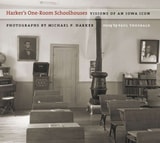
Harker's One-Room Schoolhouses
Visions of an Iowa IconPaul Theobald
University of Iowa Press, 2008
Michael Harker’s goal is to record Iowa’s historically significant architecture before it disappears forever. From Coon Center School no. 5 in Albert City to Pleasant Valley School in Kalona, North River School in Winterset to Douglas Center School in Sioux Rapids, and Iowa’s first school to Grant Wood’s first school, he has achieved this goal on a grand scale in Harker’s One-Room Schoolhouses.
Educational historian Paul Theobald tells the story of the rise and fall of Iowa’s one-room schools, whose numbers fell from close to 15,000 in 1918 to only 1,100 in 1960, all of which had ceased to function as schools by 1980. Moving from the state-wide story to the personal, he introduces us to George Coleman, son of a local farmer and school board director, who kept a sparse diary between December 1869 and June 1870. Young George’s words reveal the intimate way in which one-room schools interacted with the local community, including the local economic scene. Theobald ends by suggesting that these one-room relics of the past may again prove useful.
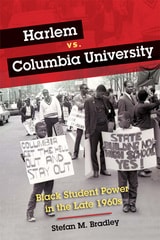
Harlem vs. Columbia University
Black Student Power in the Late 1960sStefan M. Bradley
University of Illinois Press, 2012