Results by title
28164 books match the query 'History' and 906 start with h
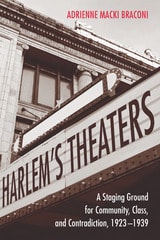
Harlem's Theaters
A Staging Ground for Community, Class, and Contradiction, 1923-1939Adrienne Macki Braconi
Northwestern University Press, 2015
Honorable Mention, 2016 Errol Hill Book Award for Outstanding Scholarship in African American Theater, Drama and/or Performance
Based on a vast amount of archival research, Adrienne Macki Braconi’s illuminating study of three important community-based theaters in Harlem shows how their work was essential to the formation of a public identity for African Americans and the articulation of their goals, laying the groundwork for the emergence of the Civil Rights movement. Macki Braconi uses textual analysis, performance reconstruction, and audience reception to examine the complex dynamics of productions by the Krigwa Players, the Harlem Experimental Theatre, and the Negro Theatre of the Federal Theatre Project. Even as these theaters demonstrated the extraordinary power of activist art, they also revealed its limits. The stage was a site in which ideological and class differences played out, theater being both a force for change and a collision of contradictory agendas. Macki Braconi’s book alters our understanding of the Harlem Renaissance, the roots of the Civil Rights movement, and the history of community theater in America.
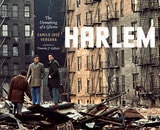
Harlem
The Unmaking of a GhettoCamilo José Vergara
University of Chicago Press, 2013
Photographer Camilo José Vergara has been chronicling the neighborhood for forty-three years, and Harlem: The Unmaking of a Ghetto is an unprecedented record of urban change. Vergara began his documentation of Harlem in the tradition of such masters as Helen Levitt and Aaron Siskind, and he later turned his focus on the neighborhood’s urban fabric, both the buildings that compose it and the life and culture embedded in them. By repeatedly returning to the same locations over the course of decades, Vergara is able to show us a community that is constantly changing—some areas declining, as longtime businesses give way to empty storefronts, graffiti, and garbage, while other areas gentrify, with corporate chain stores coming in to compete with the mom-and-pops. He also captures the ever-present street life of this densely populated neighborhood, from stoop gatherings to graffiti murals memorializing dead rappers to impersonators honoring Michael Jackson in front of the Apollo, as well as the growth of tourism and racial integration.
Woven throughout the images is Vergara’s own account of his project and his experience of living and working in Harlem. Taken together, his unforgettable words and images tell the story of how Harlem and its residents navigated the segregation, dereliction and slow recovery of the closing years of the twentieth century and the boom and racial integration of the twenty-first century. A deeply personal investigation, Harlem will take its place with the best portrayals of urban life.

Harley and the Davidsons
Motorcycle LegendsPete Barnes
Wisconsin Historical Society Press, 2007
This addition to the Badger Biographies series tells the story of four young inventors who shared a dream: to create the best motorized bicycle in America. Their turn of the century aspirations took them from a backyard machine shop to a highly successful business empire - and all in the span of just a few years. With grit, determination, and not a little elbow grease, Bill Harley and the Davidson brothers - Arthur, William, and Walter - used their engineering and machine-shop expertise to continually perfect their designs and present the best possible products to the American public. Along the way they made their mark on the racing circuit and introduced safety measures that continue to this day. After their deaths, their sons and daughters continued this legacy, buying back the company after it changed hands and re-establishing Harley-Davidson as the king of the motorcycle world. From the old Knucklehead, Panhead and Shovelhead motors to the Evolution, Revolution and Twin Cam engines that followed, the story of Harley and the Davidsons remains one of the great success stories of the 20th century.
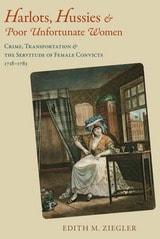
Harlots, Hussies, and Poor Unfortunate Women
Crime, Transportation, and the Servitude of Female Convicts, 1718-1783Edith M. Ziegler
University of Alabama Press, 2014
In Harlots, Hussies, and Poor Unfortunate Women, Edith M. Ziegler recounts the history of British convict women involuntarily transported to Maryland in the eighteenth century.
Great Britain’s forced transportation of convicts to colonial Australia is well known. Less widely known is Britain’s earlier program of sending convicts—including women—to North America. Many of these women were assigned as servants in Maryland. Titled using epithets that their colonial masters applied to the convicts, Edith M. Ziegler’s Harlots, Hussies, and Poor Unfortunate Women examines the lives of this intriguing subset of American immigrants.
Basing much of her powerful narrative on the experiences of actual women, Ziegler restores individual faces to women stripped of their basic freedoms. She begins by vividly invoking the social conditions of eighteenth-century Britain, which suffered high levels of criminal activity, frequently petty thievery. Contemporary readers and scholars will be fascinated by Ziegler’s explanation of how gender-influenced punishments were meted out to women and often ensnared them in Britain’s system of convict labor.
Ziegler depicts the methods and operation of the convict trade and sale procedures in colonial markets. She describes the places where convict servants were deployed and highlights the roles these women played in colonial Maryland and their contributions to the region’s society and economy. Ziegler’s research also sheds light on escape attempts and the lives that awaited those who survived servitude.
Mostly illiterate, convict women left few primary sources such as diaries or letters in their own words. Ziegler has masterfully researched the penumbra of associated documents and accounts to reconstruct the worlds of eighteenth-century Britain and colonial Maryland and the lives of these unwilling American settlers. In illuminating this little-known episode in American history, Ziegler also discusses not just the fact that these women have been largely forgotten, but why. Harlots, Hussies, and Poor Unfortunate Women makes a valuable contribution to American history, women’s studies, and labor history.
Harmful Eloquence
Ovid's Amores from Antiquity to ShakespeareM. L. Stapleton
University of Michigan Press, 1996
Harmonic Function in Chromatic Music
A Renewed Dualist Theory and an Account of Its PrecedentsDaniel Harrison
University of Chicago Press, 1994
One of Harrison's central innovations is his reconstruction of the notion of harmony. Harrison understands harmonic power to flow not from chords as such but from the constituents of chords, reckoned for the most part as scale degrees of a key. This insight proves especially useful in analyzing the unusual progressions and key relations that characterize chromatic music.
Complementing the theoretical ideas is a critical history of nineteenth-century German harmonic theory in which Harrison traces the development of Hugo Riemann's ideas on dualism and harmonic function and examines aspects of Riemannian theory in the work of later theorists. Combining theoretical innovations with a sound historical understanding of those innovations, Harmonic Function in Chromatic Music will aid anyone studying this pivotal period of Western music history.
Harmony and the Balance
An Intellectual History of Seventeenth-Century English Economic ThoughtAndrea Finkelstein
University of Michigan Press, 2000
Andrea Finkelstein is Assistant Professor of History, City University of New York.
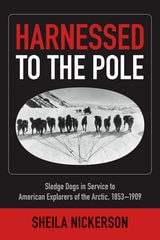
Harnessed to the Pole
Sledge Dogs in Service to American Explorers of the Arctic 1853-1909Sheila Nickerson
University of Alaska Press, 2014
Harnessed to the Pole follows the adventures of eight American explorers and their dog teams, starting with Elisha Kent Kane and ending with Robert Peary, controversial claimant of the title of first to reach the North Pole. While history has long forgotten these “little camels of the north,” Sheila Nickerson reveals how critical dogs were to the Arctic conquest. Besides providing transportation in extreme conditions, sledge dogs protected against wolves and polar bears, helped in hunting, found their way through storms, and provided warmth in extreme cold. They also faced rough handling, starvation, and the possibility of being left behind as expeditions plunged ahead. Harnessed to the Pole is an extraordinary—and unflinching—look at the dogs that raced to the top of the world.
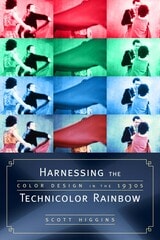
Harnessing the Technicolor Rainbow
Color Design in the 1930sBy Scott Higgins
University of Texas Press, 2007
Like Dorothy waking up over the rainbow in the Land of Oz, Hollywood discovered a vivid new world of color in the 1930s. The introduction of three-color Technicolor technology in 1932 gave filmmakers a powerful tool with which to guide viewers' attention, punctuate turning points, and express emotional subtext. Although many producers and filmmakers initially resisted the use of color, Technicolor designers, led by the legendary Natalie Kalmus, developed an aesthetic that complemented the classical Hollywood filmmaking style while still offering innovative novelty. By the end of the 1930s, color in film was thoroughly harnessed to narrative, and it became elegantly expressive without threatening the coherence of the film's imaginary world.
Harnessing the Technicolor Rainbow is the first scholarly history of Technicolor aesthetics and technology, as well as a thoroughgoing analysis of how color works in film. Scott Higgins draws on extensive primary research and close analysis of well-known movies, including Becky Sharp, A Star Is Born, Adventures of Robin Hood, and Gone with the Wind, to show how the Technicolor films of the 1930s forged enduring conventions for handling color in popular cinema. He argues that filmmakers and designers rapidly worked through a series of stylistic modes based on the demonstration, restraint, and integration of color—and shows how the color conventions developed in the 1930s have continued to influence filmmaking to the present day. Higgins also formulates a new vocabulary and a method of analysis for capturing the often-elusive functions and effects of color that, in turn, open new avenues for the study of film form and lay a foundation for new work on color in cinema.
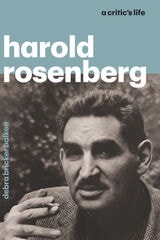
Harold Rosenberg
A Critic‘s LifeDebra Bricker Balken
University of Chicago Press, 2021
With Harold Rosenberg: A Critic’s Life, Debra Bricker Balken offers the first-ever complete biography of this great and eccentric man. Although he is now known mainly for his role as an art critic at the New Yorker from 1962 to 1978, Balken weaves together a complete tapestry of Rosenberg’s life and literary production, cast against the dynamic intellectual and social ferment of his time. She explores his role in some of the most contentious cultural debates of the Cold War period, including those over the commodification of art and the erosion of individuality in favor of celebrity, demonstrated in his famous essay “The Herd of Independent Minds.” An outspoken socialist and advocate for the political agency of art, he formed deep alliances with figures such as Hannah Arendt, Saul Bellow, Paul Goodman, Mary McCarthy, Jean-Paul Sartre, Willem de Kooning, and Jackson Pollock, all of whom Balken portrays with vivid accounts from Rosenberg’s life.
Thoroughly researched and captivatingly written, this book tells in full Rosenberg’s brilliant, fiercely independent life and the five decades in which he played a leading role in US cultural, intellectual, and political history.
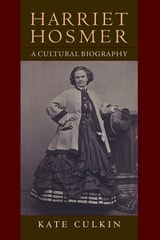
Harriet Hosmer
A Cultural BiographyKate Culkin
University of Massachusetts Press, 2010
In 1852 Hosmer moved from Boston to Rome, where she shared a house with actress Charlotte Cushman and soon formed close friendships with such prominent expatriates as Robert and Elizabeth Barrett Browning and fellow sculptors John Gibson, Emma Stebbins, and William Wetmore Story. References to Hosmer or characters inspired by her appear in the work of Nathaniel Hawthorne, Louisa May Alcott, and Kate Field among others. Culkin argues that Hosmer's success was made possible by her extensive network of supporters, including her famous friends, boosters of American gentility, and women's rights advocates. This unlikely coalition, along with her talent, ambition, and careful maintenance of her public profile, ultimately brought her great acclaim. Culkin also addresses Hosmer's critique of women's position in nineteenth-century culture through her sculpture, women's rights advocates' use of high art to promote their cause, the role Hosmer's relationships with women played in her life and success, and the complex position a female artist occupied within a country increasingly interested in proving its gentility.
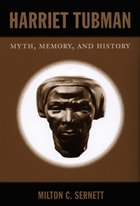
Harriet Tubman
Myth, Memory, and HistoryMilton C. Sernett
Duke University Press, 2007
Three biographies of Harriet Tubman were published within months of each other in 2003–04; they were the first book-length studies of the “Queen of the Underground Railroad” to appear in almost sixty years. Sernett examines the accuracy and reception of these three books as well as two earlier biographies first published in 1869 and 1943. He finds that the three recent studies come closer to capturing the “real” Tubman than did the earlier two. Arguing that the mythical Tubman is most clearly enshrined in stories told to and written for children, Sernett scrutinizes visual and textual representations of “Aunt Harriet” in children’s literature. He looks at how Tubman has been portrayed in film, painting, music, and theater; in her Maryland birthplace; in Auburn, New York, where she lived out her final years; and in the naming of schools, streets, and other public venues. He also investigates how the legendary Tubman was embraced and represented by different groups during her lifetime and at her death in 1913. Ultimately, Sernett contends that Harriet Tubman may be America’s most malleable and resilient icon.
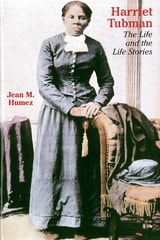
Harriet Tubman
The Life and the Life StoriesJean M. Humez
University of Wisconsin Press, 2005
Harriet Tubman’s name is known world-wide and her exploits as a self-liberated Underground Railroad heroine are celebrated in children’s literature, film, and history books, yet no major biography of Tubman has appeared since 1943. Jean M. Humez’s comprehensive Harriet Tubman is both an important biographical overview based on extensive new research and a complete collection of the stories Tubman told about her life—a virtual autobiography culled by Humez from rare early publications and manuscript sources. This book will become a landmark resource for scholars, historians, and general readers interested in slavery, the Underground Railroad, the Civil War, and African American women.
Born in slavery in Maryland in or around 1820, Tubman drew upon deep spiritual resources and covert antislavery networks when she escaped to the north in 1849. Vowing to liberate her entire family, she made repeated trips south during the 1850s and successfully guided dozens of fugitives to freedom. During the Civil War she was recruited to act as spy and scout with the Union Army. After the war she settled in Auburn, New York, where she worked to support an extended family and in her later years founded a home for the indigent aged. Celebrated by her primarily white antislavery associates in a variety of private and public documents from the 1850s through the 1870s, she was rediscovered as a race heroine by woman suffragists and the African American women’s club movement in the early twentieth century. Her story was used as a key symbolic resource in education, institutional fundraising, and debates about the meaning of "race" throughout the twentieth century.
Humez includes an extended discussion of Tubman’s work as a public performer of her own life history during the nearly sixty years she lived in the north. Drawing upon historiographical and literary discussion of the complex hybrid authorship of slave narrative literature, Humez analyzes the interactive dynamic between Tubman and her interviewers. Humez illustrates how Tubman, though unable to write, made major unrecognized contributions to the shaping of her own heroic myth by early biographers like Sarah Bradford. Selections of key documents illustrate how Tubman appeared to her contemporaries, and a comprehensive list of primary sources represents an important resource for scholars.
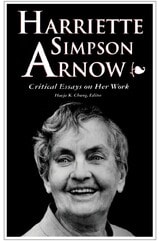
Harriette Simpson Arnow
Critical Essays on Her WorkHaeja K. Chung
Michigan State University Press, 1995
At her death in 1986, Harriette Simpson Arnow left a modest collection of published work: ten short stories, five novels, two non-fiction books, a short autobiography, and nineteen essays and book reviews. Although the sum is small, her writing has been examined from regionalist, Marxist, feminist, and other critical perspectives.
The 1970s saw the first serious attempts to revive interest in Arnow. In 1971, Tillie Olsen identified her as a writer whose "books of great worth suffer the death of being unknown, or at best, a peculiar eclipsing." Joyse Carol Oates wrote in The New York Times Book Review that Arnow's The Dollmaker is "our most unpretentious American masterpiece."
In the 1990s, it is appropriate to take stock of her earlier work and to prompt reexamination of this powerful yet poorly understood writer. This collection of critical essays examines traditional as well as new interpretations of Arnow and her work. It also suggests future directions for Arnow scholarship and includes studies of all of Arnow's writing, fiction and non-fiction, published and unpublished.
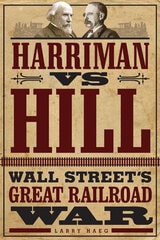
Harriman vs. Hill
Wall Street’s Great Railroad WarLarry Haeg
University of Minnesota Press, 2013
In 1901, the Northern Pacific was an unlikely prize: a twice-bankrupt construction of the federal government, it was a two-bit railroad (literally—five years back, its stock traded for twenty-five cents a share). But it was also a key to connecting eastern markets through Chicago to the rising West. Two titans of American railroads set their sights on it: James J. Hill, head of the Great Northern and largest individual shareholder of the Northern Pacific, and Edward Harriman, head of the Union Pacific and the Southern Pacific. The subsequent contest was unprecedented in the history of American enterprise, pitting not only Hill against Harriman but also Big Oil against Big Steel and J. P. Morgan against the Rockefellers, with a supporting cast of enough wealthy investors to fill the ballroom of the Waldorf Astoria.
The story, told here in full for the first time, transports us to the New York Stock Exchange during the unfolding of the earliest modern-day stock market panic. Harriman vs. Hill re-creates the drama of four tumultuous days in May 1901, when the common stock of the Northern Pacific rocketed from one hundred ten dollars a share to one thousand in a mere seventeen hours of trading—the result of an inadvertent “corner” caused by the opposing forces. Panic followed and then, in short order, a calamity for the “shorts,” a compromise, the near-collapse of Wall Street brokerages and banks, the most precipitous decline ever in American stock values, and the fastest recovery. Larry Haeg brings to life the ensuing stalemate and truce, which led to the forming of a holding company, briefly the biggest railroad combine in American history, and the U.S. Supreme Court ruling against the deal, launching the reputation of Justice Oliver Wendell Holmes as the “great dissenter” and President Theodore Roosevelt as the “trust buster.”
The forces of competition and combination, unfettered growth, government regulation, and corporate ambition—all the elements of American business at its best and worst—come into play in the account of this epic battle, whose effects echo through our economy to this day.
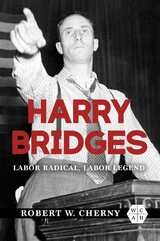
Harry Bridges
Labor Radical, Labor LegendRobert W. Cherny
University of Illinois Press, 2023
- Winner of a Silver Medal from the Independent Publisher Book Awards
- Won Honorable Mention for 2023 ILHA Book of the Year (International Labor History Association)
The iconic leader of one of America’s most powerful unions, Harry Bridges put an indelible stamp on the twentieth century labor movement. Robert Cherny’s monumental biography tells the life story of the figure who built the International Longshore and Warehouse Union (ILWU) into a labor powerhouse that still represents almost 30,000 workers.
An Australian immigrant, Bridges worked the Pacific Coast docks. His militant unionism placed him at the center of the 1934 West Coast Waterfront Strike and spurred him to expand his organizing activities to warehouse laborers and Hawaiian sugar and pineapple workers. Cherny examines the overall effectiveness of Bridges as a union leader and the decisions and traits that made him effective. Cherny also details the price paid by Bridges as the US government repeatedly prosecuted him for his left-wing politics.
Drawing on personal interviews with Bridges and years of exhaustive research, Harry Bridges places an extraordinary individual and the ILWU within the epic history of twentieth-century labor radicalism.
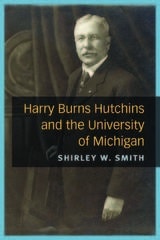
Harry Burns Hutchins and the University of Michigan
Shirley W. Smith
University of Michigan Press, 1951
Harry Huntt Ransom
Intellect in MotionBy Alan Gribben
University of Texas Press, 2008
Both a life story and a portrait of public higher education during the twentieth century, Harry Huntt Ransom captures the spirit of a dynamic individual who dedicated his talents to nurturing intellectual life in Texas and beyond. Tracing the details of Ransom's youth in Galveston and Tennessee and his education at Yale, where he earned a doctorate, Alan Gribben provides new insight into the factors that shaped Ransom's future as a renowned administrator and defender of the humanities.
Ransom's career at the University of Texas began in 1935, when he was hired as an instructor of English. He rose through the ranks to become chancellor, stepping down in 1971 during a volatile period when debates about the University's central mission raged—particularly over the question of commercializing higher education. The development of Ransom's lasting legacy, the Humanities Research Center bearing his name, is explored in depth as well. Bringing to life a legendary figure, Harry Huntt Ransom is a colorful testament to a singular man of letters who had the audacity to propose "that there be established somewhere in Texas—let's say in the capital city—a center of our cultural compass, a research center to be the Bibliothèque Nationale of the only state that started out as an independent nation."
Harry S. Truman and the Cold War Revisionists
Robert H. Ferrell
University of Missouri Press, 2006
Harry S. Truman and the News Media
Contentious Relations, Belated RespectFranklin D. Mitchell
University of Missouri Press, 1998
Based upon extensive research in the papers of President Harry S. Truman and in several journalistic collections, Harry S. Truman and the News Media recounts the story of a once unpopular chief executive who overcame the censure of the news media to ultimately win both the public's and the press's affirmation of his personal and presidential greatness.
Franklin D. Mitchell traces the major contours of journalism during the lifetime and presidency of Truman. Although newspapers and newsmagazines are given the most emphasis, reporters and columnists of the Washington news corps also figure prominently for their role in the president's news conferences and their continuing coverage of Truman and his family. Broadcast journalism's expanding coverage of the president is also explored through chapters dealing with radio and television.
President Truman's advocacy of a liberal Fair Deal for all Americans and a prudent and visible role for the nation in world affairs drew fire from the anti-administration news media, particularly the publishing empire of William Randolph Hearst, the McCormick-Patterson newspapers, the Scripps-Howard chain, and the Time-Life newsmagazines of Henry R. Luce. Despite press opposition and the almost universal prediction of defeat in the 1948 election, Truman was victorious in the greatest miscalled presidential election in journalistic history.
During his full term, Truman's relations with the news media became contentious over such matters as national security in the Cold War, the conduct of the Korean War, and the continuing charges of communism and corruption in the administration. Although Truman's career in politics was based on honesty and the welfare of the people, his early political alliance with Thomas Pendergast, Kansas City's notorious political boss, provided the opportunity for a portion of the press to charge Truman with subservience to Pendergast's own agenda of corrupt government.
The history and the dynamics of the Truman presidency and the American news media, combined with biographical and institutional sketches of key individuals and news organizations, make Harry S. Truman and the News Media a captivating and original investigation of an American president. Well written and researched, this book will be of great value to Truman scholars, journalists, and anyone interested in American history or presidential studies.

Harry S. Truman versus the Medical Lobby
The Genesis of MedicareMonte M. Poen
University of Missouri Press, 1996
Harry's Farewell
Interpreting and Teaching the Truman PresidencyEdited & Intro by Richard S. Kirkendall
University of Missouri Press, 2004

Harvest of Hazards
Family Farming, Accidents, and Expertise in the Corn Belt, 1940-1975Derek S. Oden
University of Iowa Press, 2017
In this study of the farm safety movement in the Corn Belt, historian Derek Oden examines why agriculture was so dangerous and why improvements were so difficult to achieve. Because farmers were self-employed business owners whose employees were mainly family members; because they lived far from aid such as hospitals and fire stations; and because they had to manage such a diverse array of new technologies, they could not easily adopt the workplace safety and public health reforms designed for factories and urban settings. In response, beginning in the 1940s, farmers and a new breed of farm safety specialists relied upon an increasingly elaborate educational campaign to lessen injuries and illnesses on the farm.
Several government, business, and nonprofit organizations—from the US Department of Agriculture to the National Safety Council and 4-H and the Future Farmers of America—worked together to publicize both the dangers of farming and the information farmers needed to stay safe while driving tractors, applying anhydrous ammonia, or repairing machinery. By the 1960s, however, the partnership began to break down, and by the 1970s the safety movement became increasingly contested as professional and policy divisions emerged. This groundbreaking study incorporates agriculture into the histories of occupational safety and public health.

Harvester of Hearts
Motherhood under the Sign of FrankensteinRachel Feder
Northwestern University Press, 2018
In the period between 1815 and 1820, Mary Shelley wrote her most famous novel, Frankenstein; or, The Modern Prometheus, as well as its companion piece, Mathilda, a tragic incest narrative that was confiscated by her father, William Godwin, and left unpublished until 1959. She also gave birth to four—and lost three—children.
In this hybrid text, Rachel Feder interprets Frankenstein and Mathilda within a series of provocative frameworks including Shelley’s experiences of motherhood and maternal loss, twentieth-century feminists’ interests in and attachments to Mary Shelley, and the critic’s own experiences of pregnancy, childbirth, and motherhood. Harvester of Hearts explores how Mary Shelley’s exchanges with her children—in utero, in birth, in life, and in death—infuse her literary creations. Drawing on the archives of feminist scholarship, Feder theorizes “elective affinities,” a term she borrows from Goethe to interrogate how the personal attachments of literary critics shape our sense of literary history. Feder blurs the distinctions between intellectual, bodily, literary, and personal history, reanimating the classical feminist discourse on Frankenstein by stepping into the frame.
The result—at once an experimental book of literary criticism, a performative foray into feminist praxis, and a deeply personal lyric essay—not only locates Mary Shelley’s monsters within the folds of maternal identity but also illuminates the connections between the literary and the quotidian.
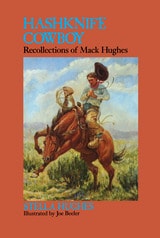
Hashknife Cowboy
Recollections of Mack HughesStella Hughes; Illustrated by Joe Beeler
University of Arizona Press, 1984
Stella Hughes, author of the best-selling Chuck Wagon Cookin' and a cowhand in her own right, has compiled from her husband's reminiscences an authentic look both at Arizona history and at cowboying as it really was. Illustrated by Joe Beeler, founding member of the Cowboy Artists of America.

Hasidic Pilgrimages and Local Identity
Stories from Four Eastern European TownsAlla Marchenko
Central European University Press, 2027
Drawing on ethnographic fieldwork, media analysis, and memory studies, the author examines how pilgrims, local residents, and institutions engage with the Jewish past in ways that are often parallel, contested, or only partially connected. Rather than forming a shared framework, these encounters produce multiple, coexisting interpretations of place and history.
By tracing patterns of cooperation, tension, and selective inclusion, this book reveals how collective memory is continuously negotiated in post-socialist contexts, offering new insights into pilgrimage, heritage, and the politics of memory in a changing Europe.

Hasidism on the Margin
Reconciliation, Antinomianism, and MessianismShaul Magid
University of Wisconsin Press, 2003
Hasidism on the Margin explores one of the most provocative and radical traditions of Hasidic thought, the school of Izbica and Radzin that Rabbi Gershon Henokh originated in nineteenth-century Poland. Shaul Magid traces the intellectual history of this strand of Judaism from medieval Jewish philosophy through centuries of Kabbalistic texts to the nineteenth century and into the present. He contextualizes the Hasidism of Izbica-Radzin in the larger philosophy and history of religions and provides a model for inquiry into other forms of Hasidism.
Hasidism
Writings on Devotion, Community, and Life in the Modern WorldEdited by Ariel Evan Mayse Editor and Sam Berrin Shonkoff
Brandeis University Press, 2020
While this volume focuses on Hasidism, it wrestles with a core set of questions that permeate modern Jewish thought and religious thought more generally: What is the relationship between God and the world? What is the relationship between God and the human being? But Hasidic thought is cast with mystical, psychological, and even magical accents, and offers radically different answers to core issues of modern concern. The editors draw selections from an array of genres including women’s supplications; sermons and homilies; personal diaries and memoirs; correspondence; stories; polemics; legal codes; and rabbinic response. These selections consciously move between everyday lived experience and the most ineffable mystical secrets, reflecting the multidimensional nature of this unusual religious and social movement. The editors include canonical texts from the first generation of Hasidic leaders up through present-day ultra-orthodox, as well as neo-Hasidic voices and, in so doing, demonstrate the unfolding of a rich and complex phenomenon that continues to evolve today.

Haskalah
The Romantic Movement in JudaismLitvak, Olga
Rutgers University Press, 2012
Commonly translated as the “Jewish Enlightenment,” the Haskalah propelled Jews into modern life. Olga Litvak argues that the idea of a Jewish modernity, championed by adherents of this movement, did not originate in Western Europe’s age of reason. Litvak contends that the Haskalah spearheaded a Jewish religious revival, better understood against the background of Eastern European Romanticism.
Based on imaginative and historically grounded readings of primary sources, Litvak presents a compelling case for rethinking the relationship between the Haskalah and the experience of political and social emancipation. Most importantly, she challenges the prevailing view that the Haskalah provided the philosophical mainspring for Jewish liberalism.
In Litvak’s ambitious interpretation, nineteenth-century Eastern European intellectuals emerge as the authors of a Jewish Romantic revolution. Fueled by contradictory longings both for community and for personal freedom, the poets and scholars associated with the Haskalah questioned the moral costs of civic equality and the achievement of middle-class status. In the nineteenth century, their conservative approach to culture as the cure for the spiritual ills of the modern individual provided a powerful argument for the development of Jewish nationalism. Today, their ideas are equally resonant in contemporary debates about the ramifications of secularization for the future of Judaism.
Hasmonean Realities behind Ezra, Nehemiah, and Chronicles
Archaeological and Historical PerspectivesIsrael Finkelstein
SBL Press, 2018
A thorough case for a later date for of Ezra, Nehemiah, and Chronicles
In this collection of essays, Israel Finkelstein deals with key topics in Ezra, Nehemiah, and 1 and 2 Chronicles, such as the list of returnees, the construction of the city wall of Jerusalem, the adversaries of Nehemiah, the tribal genealogies, and the territorial expansion of Judah in 2 Chronicles. Finkelstein argues that the geographical and historical realities cached behind at least parts of these books fit the Hasmonean period in the late second century BCE. Seven previously published essays are supplemented by maps, updates to the archaeological material, and references to recent publications on the topics.
Features:
- Analysis of geographical chapters of Ezra, Nehemiah, and Chronicles
- Study of the Hasmonean period in the late second century BCE
- Unique arguments regarding chronology and historical background
Hating Jazz
A History of Its Disparagement, Mockery, and Other Forms of AbuseAndrew S. Berish
University of Chicago Press, 2025
A rock guitarist plays four notes in front of one thousand people, while a jazz guitarist plays one thousand notes in front of four people. You might laugh or groan at this jazz joke, but what is it about jazz that makes people want to disparage it in the first place?
Andrew S. Berish’s Hating Jazz listens to the voices who have denounced, disparaged, and mocked the music. By focusing on the rejection of the music, Berish says, we see more holistically jazz’s complicated place in American cultural life. Jazz is a display of Black creativity and genius, an art form that is deeply embedded in African American life. Though the explicit racial tenor of jazz jokes has become muted over time, making fun of jazz, either in a lighthearted or aggressive way, is also an engagement with the place of Blackness in America. An individual’s taste in music may seem personal, but Berish’s analysis of jazz hatred demonstrates that musical preferences and trends are a social phenomenon. Criticism of jazz has become inextricable from the ways we understand race in America, past and present. In addition to this form of criticism, Berish also considers jazz hate as a form of taste discrimination and as a conflict over genre boundaries within different jazz cultures.
Both enlightening and original, Hating Jazz shows that our response to music can be a social act, unique to our historical moment and cultural context—we react to music in certain ways because of who we are, where we are, and when we are.

Hats
A Very UNnatural HistoryMalcolm Smith
Michigan State University Press, 2020
Hattie and Huey
An Arkansas TourDavid Malone
University of Arkansas Press, 1990
Haudenosaunee Women Lacrosse Players
Making Meaning through RematriationSharity L. Bassett
Michigan State University Press, 2024
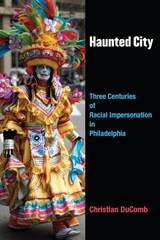
Haunted City
Three Centuries of Racial Impersonation in PhiladelphiaChristian DuComb
University of Michigan Press, 2017
Mummers have long worn blackface makeup during winter holiday celebrations in Europe and North America; in Philadelphia, mummers’ blackface persisted from the colonial period well into the twentieth century. The first annual Mummers Parade, a publicly sanctioned procession from the working-class neighborhoods of South Philadelphia to the city center, occurred in 1901. Despite a ban on blackface in the Mummers Parade after civil rights protests in 1963–64, other forms of racial and ethnic impersonation in the parade have continued to flourish unchecked. Haunted City combines detailed historical research with the author’s own experiences performing in the Mummers Parade to create a lively and richly illustrated narrative. Through its interdisciplinary approach, Haunted City addresses not only theater history and performance studies but also folklore, American studies, critical race theory, and art history. It also offers a fresh take on the historiography of the antebellum minstrel show.
Haunted Heartland
Michael Norman
University of Wisconsin Press, 2017
For decades, journalist Michael Norman has been tracking down spine-tingling tales that seem to arise from authentic incidents in Illinois, Indiana, Iowa, Kansas, Michigan, Minnesota, Missouri, Nebraska, Ohio, and Wisconsin. In Haunted Heartland he offers more than eighty entertaining, eerie stories. Are they true in the world that we know, or only in a dark vale of twilight?
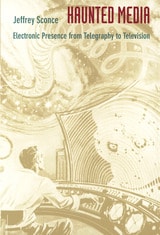
Haunted Media
Electronic Presence from Telegraphy to TelevisionJeffrey Sconce
Duke University Press, 2000
Sconce focuses on five important cultural moments in the history of telecommunication from the mid-nineteenth century to the present: the advent of telegraphy; the arrival of wireless communication; radio’s transformation into network broadcasting; the introduction of television; and contemporary debates over computers, cyberspace, and virtual reality. In the process of examining the trajectory of these technological innovations, he discusses topics such as the rise of spiritualism as a utopian response to the electronic powers presented by telegraphy and how radio, in the twentieth century, came to be regarded as a way of connecting to a more atomized vision of the afterlife. Sconce also considers how an early preoccupation with extraterrestrial radio communications tranformed during the network era into more unsettling fantasies of mediated annihilation, culminating with Orson Welles’s legendary broadcast of War of the Worlds. Likewise, in his exploration of the early years of television, Sconce describes how programs such as The Twilight Zone and The Outer Limits continued to feed the fantastical and increasingly paranoid public imagination of electronic media. Finally, Sconce discusses the rise of postmodern media criticism as yet another occult fiction of electronic presence, a mythology that continues to dominate contemporary debates over television, cyberspace, virtual reality, and the Internet.
As an engaging cultural history of telecommunications, Haunted Media will interest a wide range of readers including students and scholars of media, history, American studies, cultural studies, and literary and social theory.
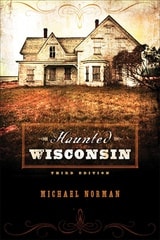
Haunted Wisconsin
Michael Norman
University of Wisconsin Press, 2011
Grab a cozy blanket, light a few flickering candles, and enjoy the unnerving tales of Haunted Wisconsin. Gathered from personal interviews with credible eyewitnesses, on-site explorations, historical archives, newspaper reports, and other sources, these scores of reports date from Wisconsin’s early settlement days to recent inexplicable events.
You’ll read about Wisconsin’s most famous haunted house, Summerwind; three Milwaukee men who encountered the beautiful ghost of National Avenue; a phantom basketball player; a spectral horse that signaled death in the pioneer era of the Wisconsin Dells; a poltergeist in St. Croix County who attracted a crowd of more than three hundred spectators; the Ridgeway Ghost who haunts the driftless valleys of southwestern Wisconsin; a swinging railroad lantern held by unseen hands; the Ghost Island of the Chippewa Flowage; and many others. Are ghosts real? That’s for you to decide!
Now available in a Third Edition with updates and several new accounts, Haunted Wisconsin remains a favorite collection of unexplained midwestern tales, enjoyed by readers of all ages.
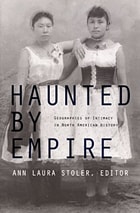
Haunted by Empire
Geographies of Intimacy in North American HistoryAnn Laura Stoler, ed.
Duke University Press, 2006
Haunted by Empire includes Ann Laura Stoler’s seminal essay “Tense and Tender Ties” as well as her bold introduction, which carves out the exciting new analytic and methodological ground animated by this comparative venture. The contributors engage in a lively cross-disciplinary conversation, drawing on history, anthropology, literature, philosophy, and public health. They address such topics as the regulation of Hindu marriages and gay sexuality in the early-twentieth-century United States; the framing of multiple-choice intelligence tests; the deeply entangled histories of Asian, African, and native peoples in the Americas; the racial categorizations used in the 1890 U.S. census; and the politics of race and space in French colonial New Orleans. Linda Gordon, Catherine Hall, and Nancy F. Cott each provide a concluding essay reflecting on the innovations and implications of the arguments advanced in Haunted by Empire.
Contributors. Warwick Anderson, Laura Briggs, Kathleen Brown, Nancy F. Cott, Shannon Lee Dawdy, Linda Gordon, Catherine Hall, Martha Hodes, Paul A. Kramer, Lisa Lowe, Tiya Miles, Gwenn A. Miller, Emily S. Rosenberg, Damon Salesa, Nayan Shah, Alexandra Minna Stern, Ann Laura Stoler, Laura Wexler
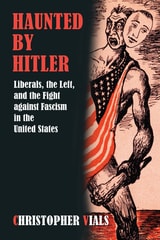
Haunted by Hitler
Liberals, the Left, and the Fight against Fascism in the United StatesChristopher Vials
University of Massachusetts Press, 2014
Although fascism is typically associated with Europe, the threat of fascism in the United States haunted the imaginations of activists, writers, and artists, spurring them to create a rich, elaborate body of cultural and political work. Traversing the Popular Front of the 1930s, the struggle against McCarthyism in the 1950s, the Black Power movement of the 1960s, and the AIDS activism of the 1980s, Haunted by Hitler highlights the value of “antifascist” cultural politics, showing how it helped to frame the national discourse.
Christopher Vials examines the ways in which anxieties about fascism in the United States have been expressed in the public sphere, through American television shows, Off-Broadway theater, party newspapers, bestselling works of history, journalism, popular sociology, political theory, and other media. He argues that twentieth-century liberals and leftists were more deeply unsettled by the problem of fascism than those at the center or the right and that they tirelessly and often successfully worked to counter America's fascist equivalents.
Haunted by Waters
A Journey through Race and Place in the American WestRobert T. Hayashi
University of Iowa Press, 2007
Even though race influenced how Americans envisioned, represented, and shaped the American West, discussions of its history devalue the experiences of racial and ethnic minorities. In this lyrical history of marginalized peoples in Idaho, Robert T. Hayashi views the West from a different perspective by detailing the ways in which they shaped the western landscape and its meaning.
As an easterner, researcher, angler, and third-generation Japanese American traveling across the contemporary Idaho landscape—where his grandfather died during internment during World War II—Hayashi reconstructs a landscape that lured emigrants of all races at the same time its ruling forces were developing cultured processes that excluded nonwhites. Throughout each convincing and compelling chapter, he searches for the stories of dispossessed minorities as patiently as he searches for trout.
Using a wide range of materials that include memoirs, oral interviews, poetry, legal cases, letters, government documents, and even road signs, Hayashi illustrates how Thomas Jefferson’s vision of an agrarian, all-white, and democratic West affected the Gem State’s Nez Perce, Chinese, Shoshone, Mormon, and particularly Japanese residents. Starting at the site of the Corps of Discovery’s journey into Idaho, he details the ideological, aesthetic, and material manifestations of these intertwined notions of race and place. As he ?y-?shes Idaho’s fabled rivers and visits its historical sites and museums, Hayashi reads the contemporary landscape in light of this evolution.
Haunting Biology
Science and Indigeneity in AustraliaEmma Kowal
Duke University Press, 2023
Haunting the Korean Diaspora
Shame, Secrecy, and the Forgotten WarGrace M. Cho
University of Minnesota Press, 2008
Grace M. Cho exposes how Koreans in the United States have been profoundly affected by the forgotten war and uncovers the silences and secrets that still surround it, arguing that trauma memories have been passed unconsciously through a process psychoanalysts call “transgenerational haunting.” Tracing how such secrets have turned into “ghosts,” Cho investigates the mythic figure of the yanggongju, literally the “Western princess,” who provides sexual favors to American military personnel. She reveals how this figure haunts both the intimate realm of memory and public discourse, in which narratives of U.S. benevolence abroad and assimilation of immigrants at home go unchallenged. Memories of U.S. violence, Cho writes, threaten to undo these narratives—and so they have been rendered unspeakable.
At once political and deeply personal, Cho’s wide-ranging and innovative analysis of U.S. neocolonialism and militarism under contemporary globalization brings forth a new way of understanding—and remembering—the impact of the Korean War.
Hausa Women in the Twentieth Century
Edited by Catherine M. Coles and Beverly Mack
University of Wisconsin Press, 1991
Hausa Women in the Twentieth Century refutes the notion that Hausa women are pawns in a patriarchal Muslim society. The contributors, all of whom have done field research in Hausaland, explore the ways Hausa women have balanced the demands of Islamic expectations and Western choices as their society moved from a precolonial system through British colonial administration to inclusion in the modern Nigerian nation. This volume examines the roles of a wide variety of women, from wives and workers to political activists and mythical figures, and it emphasizes that women have been educators and spiritual leaders in Hausa society since precolonial times. From royalty to slaves and concubines, in traditional Hausa cities and in newer towns, from the urban poor to the newly educated elite, the "invisible women" whose lives are documented here demonstrate that standard accounts of Hausa society must be revised.
Scholars of Hausa and neighboring West African societies will find in this collection a wealth of new material and a model of how research on women can be integrated with general accounts of Hausa social, religious, political, and economic life. For students and scholars looking at gender and women's roles cross-culturally, this volume provides an invaluable African perspective.
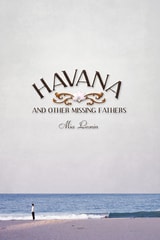
Havana and Other Missing Fathers
Mia Leonin
University of Arizona Press, 2009
Shortly after her sixteenth birthday, Leonin learned from her mother that her father, a Cuban exile, was very much alive and living in Florida. Her attempts to contact him, however, were thwarted until four years later, when she left home in search of her roots.
She meets her father, but trying to discover the truth behind him proves to be a more daunting task. Her journey takes her to Miami, Colombia, and Cuba, and her search for cultural identity leads her to create memories, friendships, and romances. She finds moments of connection and redemption, ending up in Havana not as a cultural tourist but as an illegitimate daughter of Cuba looking for validation. What she discovers is an island bereft of fathers and brimming with paternalism. As she becomes entangled with two different men, she descends further into the Havana of poverty, humiliation, and despair, as well as the ever-inventive city that is as passionate as it is contradictory.
Insightful, imaginative, and often poetic, Havana and Other Missing Fathers is Mia Leonin’s recollection of this journey and her longing to learn more about her origins. In the end, she must learn to accept the answers she discovers as well as the questions that remain.
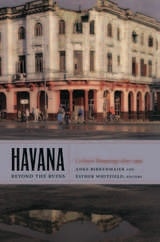
Havana beyond the Ruins
Cultural Mappings after 1989Anke Birkenmaier and Esther Whitfield, eds.
Duke University Press, 2011
Contributors
Emma Álvarez-Tabío Albo
Eric Felipe-Barkin
Anke Birkenmaier
Velia Cecilia Bobes
Mario Coyula-Cowley
Elisabeth Enenbach
Sujatha Fernandes
Jill Hamberg
Patricio del Real
Cecelia Lawless
Jacqueline Loss
Orlando Luis Pardo Lazo
Antonio José Ponte
Nicolás Quintana
Jose Quiroga
Laura Redruello
Rafael Rojas
Joseph L. Scarpaci
Esther Whitfield
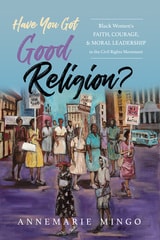
Have You Got Good Religion?
Black Women's Faith, Courage, and Moral Leadership in the Civil Rights MovementAnneMarie Mingo
University of Illinois Press, 2024
A depiction of moral imagination that resonates today, Have You Got Good Religion? reveals how Black Churchwomen’s understanding of God became action and transformed a nation.
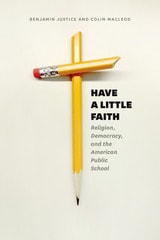
Have a Little Faith
Religion, Democracy, and the American Public SchoolBenjamin Justice and Colin Macleod
University of Chicago Press, 2016
From Bible readings and school prayer to teaching evolution and cultivating religious tolerance, Justice and Macleod consider the key issues and colorful characters that have shaped the way American schools have attempted to negotiate religious pluralism in a politically legitimate fashion. While schools and educational policies have not always advanced tolerance and understanding, Justice and Macleod point to the many efforts Americans have made to find a place for religion in public schools that both acknowledges the importance of faith to so many citizens and respects democratic ideals that insist upon a reasonable separation of church and state. Finally, they apply the lessons of history and political philosophy to an analysis of three critical areas of religious controversy in public education today: student-led religious observances in extracurricular activities, the tensions between freedom of expression and the need for inclusive environments, and the shift from democratic control of schools to loosely regulated charter and voucher programs.
Altogether Justice and Macleod show how the interpretation of educational history through the lens of contemporary democratic theory offers both a richer understanding of past disputes and new ways of addressing contemporary challenges.

Having People, Having Heart
Charity, Sustainable Development, and Problems of Dependence in Central UgandaChina Scherz
University of Chicago Press, 2014
Through detailed studies of two different orphan support organizations in Uganda, Scherz shows how many Ugandans view material forms of Catholic charity as deeply intertwined with their own ethics of care and exchange. With a detailed examination of this overlooked relationship in hand, she reassesses the generally assumed paradox of material aid as both promising independence and preventing it. The result is a sophisticated demonstration of the powerful role that anthropological concepts of exchange, value, personhood, and religion play in the politics of international aid and development.
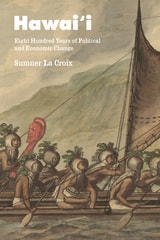
Hawai'i
Eight Hundred Years of Political and Economic ChangeSumner La Croix
University of Chicago Press, 2019
Building on new archaeological and historical research, Sumner La Croix assembles here the economic history of Hawai‘i from the first Polynesian settlements in 1200 through US colonization, the formation of statehood, and to the present day. He shows how the political and economic institutions that emerged and evolved in Hawai‘i during its three centuries of global isolation allowed an economically and culturally rich society to emerge, flourish, and ultimately survive annexation and colonization by the United States. The story of a small, open economy struggling to adapt its institutions to changes in the global economy, Hawai‘i offers broadly instructive conclusions about economic evolution and development, political institutions, and native Hawaiian rights.