Results by title
4917 books match the query 'Philosophy' and 205 start with h

History and Theory after the Fall
An Essay on InterpretationFred Weinstein
University of Chicago Press, 1990
In the wake of this collapse or "fall," the rival claims of fiction, psychoanalysis, sociology, anthropology, and history have created the dilemma of radical relativism, the prospect of multiple interpretations of any complex historical event. The basic strategy of social theory and the social sciences—the search for underlying unities—proves so inherently contradictory and has provided so little in the way of reliable knowledge of social and historical relationships that to many critics it seems no longer worth pursuing.
Weinstein enters the debate by rejecting any search for underlying structural unities, dynamic or social, through which historians have attempted to find continuity with the past. He looks instead to ideological processes, to the construction of successive and changing versions of reality that mediate between the power of fantasy on the one side and the power of the social world on the other. He argues further that the need to use ideological constructs in this way accounts for the heterogeneous and changing content of social movements and for the persistent need people have always had for authoritative leaders, even in democratized societies. He suggests that people have historically been able to take a step away from leaders only by substituting the possession of objects such as property or money. This book is a breakthrough in poststructuralist theory that is sure to stimulate considerable discussion, especially about the shape of the social sciences and the future of historical interpretation.
History and Truth
Paul Ricoeur
Northwestern University Press, 1965
History and Truth
Paul Ricoeur, Foreward by David M. Rasmussen, Introduction by Charles Kelbley
Northwestern University Press, 2007
History and Utopia
E. M. Cioran
University of Chicago Press, 1998
"A small masterwork . . . a stringent examination of some persistent and murky notions in human history. . . . It is best to read Cioran while sitting. The impact upon the intellect can be temporarily stunning, and motor systems may give way under the assault."—Joseph Patrick Kennedy, Houston Chronicle
"Cioran has a claim to be regarded as among the handful of original minds . . . writing today."—New York Times
"A sort of final philosopher of the Western world. [Cioran's] statements have the compression of poetry and the audacity of cosmic clowning."—Washington Post
E. M. Cioran (1911-1995) was born and educated in Romania and lived in Paris from 1937 until his death. He is the author of numerous works, including On the Heights of Despair, also available from the University of Chicago Press.
History as a Kind of Writing
Textual Strategies in Contemporary French HistoriographyPhilippe Carrard
University of Chicago Press, 2017
Carrard’s work here is expansive—examining the conventions historians draw on to produce their texts and casting light on views put forward by literary theorists, theorists of history, and historians themselves. Ranging from discussions of lengthy dissertations on 1960s social and economic history to a more contemporary focus on events, actors, memory, and culture, the book digs deep into the how of history. How do historians arrange their data into narratives? What strategies do they employ to justify the validity of their descriptions? Are actors given their own voice? Along the way, Carrard also readdresses questions fundamental to the field, including its necessary membership in the narrative genre, the presumed objectivity of historiographic writing, and the place of history as a science, distinct from the natural and theoretical sciences.
History as an Art of Memory
Patrick H. Hutton
Brandeis University Press, 1993
History of Christian Philosophy in the Middle Ages
Etienne Gilson
Catholic University of America Press, 2019
History of Political Ideas, Volume 1 (CW19)
Hellenism, Rome, and Early ChristianityEric Voegelin, Edited & Intro by Athanasios Moulakis
University of Missouri Press, 1997
Reaching from the decline of the Greek Polis to Saint Augustine, this first volume of Eric Voegelin's eagerly anticipated History of Political Ideas fills the gap left between volumes 3 and 4 of Order and History. The heart of the book is the powerful account of Apostolic Christianity's political implications and the work of the early church fathers. Voegelin's consideration of the political philosophy of Rome and his unique analysis of Greek and early Roman law are of particular interest.
Although History of Political Ideas was begun as a textbook for Macmillan, Voegelin never intended it to be a conventional "synthesis." He sought instead an original comprehensive interpretation, founded on primary materials and taking into account the most advanced specialist scholarship—or science as he called it—available to him. Because of this, the book grew well beyond the confines of an easily marketable college survey and until now remained unpublished.
In the process of writing it, Voegelin himself outgrew the conceptual frame of a "History of Political Ideas," turning to compose Order and History and the other works of his maturity. History of Political Ideas became the ordered collection of materials from which much of Voegelin's later theoretical elaboration grew, structured in a manner that reveals the conceptual intimations of his later thought. As such, it provides an unparalleled opportunity to observe the working methods and the intellectual evolution of one of our century's leading political thinkers. In its embracing scope, History of Political Ideas contains both analyses of themes Voegelin developed in his later works and discussions of authors and ideas to which he did not return or which he later approached from a different angle and with a different emphasis.
In Hellenism, Rome, and Early Christianity, Voegelin demonstrates that the "spiritual disintegration" of the Hellenic world inaugurated a long process of transition in the self- understanding of Mediterranean and European man. The reflections that emerge remain universal concerns regarding the order of human existence in society and history. Although one may come to different conclusions, Voegelin's responses to the problems of the period suggest avenues of investigation that are still little traveled.
History of Political Ideas, Volume 2 (CW20)
The Middle Ages to AquinasEric Voegelin, Edited & Intro by Peter von Sivers
University of Missouri Press, 1997
Voegelin's magisterial account of medieval political thought opens with a survey of the structure of the period and continues with an analysis of the Germanic invasions, the fall of Rome, and the rise of empire and monastic Christianity. The political implications of Christianity and philosophy in the period are elaborated in chapters devoted to John of Salisbury, Joachim of Flora (Fiore), Frederick II, Siger de Brabant, Francis of Assisi, Roman law, and climaxing in a remarkable study of Saint Thomas Aquinas's mighty thirteenth-century synthesis.
Although History of Political Ideas was begun as a textbook for Macmillan, Voegelin never intended it to be a conventional chronological account. He sought instead an original comprehensive interpretation, founded on primary materials and taking into account the most advanced specialist scholarship—or science as he called it—available to him. Because of this, the book grew well beyond the confines of an easily marketable college survey and until now remained unpublished.
In the process of writing it, Voegelin himself outgrew the conceptual frame of a "History of Political Ideas," turning to compose Order and History and the other works of his maturity. History of Political Ideas became the ordered collection of materials from which much of Voegelin's later theoretical elaboration grew, structured in a manner that reveals the conceptual intimations of his later thought. As such, it provides an unparalleled opportunity to observe the working methods and the intellectual evolution of one of our century's leading political thinkers. In its embracing scope, History of Political Ideas contains both analyses of themes Voegelin developed in his later works and discussions of authors and ideas to which he did not return or which he later approached from a different angle and with a different emphasis.
The Middle Ages to Aquinas has withstood the test of time. What makes it still highly valuable is its thoroughly revisionist approach, cutting through all the convenient clichés and generalizations and seeking to establish the experiential underpinnings that typified the medieval period.
History of Political Ideas, Volume 3 (CW21)
The Later Middle AgesEric Voegelin, Edited & Intro by David Walsh
University of Missouri Press, 1998
In The Later Middle Ages, the third volume of his monumental History of Political Ideas, Eric Voegelin continues his exploration of one of the most crucial periods in the history of political thought. Illuminating the great figures of the high Middle Ages, Voegelin traces the historical momentum of our modern world in the core evocative symbols that constituted medieval civilization. These symbols revolved around the enduring aspiration for the sacrum imperium, the one order capable of embracing the transcendent and immanent, the ecclesiastical and political, the divine and human. The story of the later Middle Ages is that of the "civilizational schism"—the movement in which not only the reality but the aspiration for the sacrum imperium gradually disappeared and the unification of faith and reason dissolved.
His recognition of this civilizational schism provides Voegelin with a unique perspective on medieval society. William of Ockham, Dante, Giles of Rome, and Marsilius of Padua all emerge in Voegelin's study as predecessors to modern thought; each turns to personal authority and intellectual analysis in an attempt to comprehend the loss of the sacrum imperium as an authoritative ideal. Voegelin is further drawn into investigations that, despite insufficient attention by scholars, still bear relevance to the study of the later Middle Ages. The mysticism apparent in Piers Plowman and the apocalyptic revolt of Cola di Rienzo are merely two reactions to the disintegration of wholeness.
Yet the story of the later Middle Ages does not merely revolve around disintegration. Voegelin recognizes the emergence of the constitutional political tradition as the most positive development of this period. He is at his best when explaining the difference between the presence of a representative institution and the growth of communal consciousness. Voegelin's study of the English political pattern is matched only by his unique perspective on the German imperial zone, culminating in a fitting conclusion on Nicholas of Cusa—the one political thinker with the ability to evoke the unity of mankind beyond fragmentation.
The Later Middle Ages is at once a brilliant examination of the symbols that characterized medieval society and a remarkable predecessor to Voegelin's study of the modern world, beginning with the Renaissance and the Reformation.
History of Political Ideas, Volume 4 (CW22)
Renaissance and ReformationEric Voegelin, Edited & Intro by David L. Morse & William M. Thompson
University of Missouri Press, 1998
By closely examining the sources, movements, and persons of the Renaissance and the Reformation, Voegelin reveals the roots of today's political ideologies in this fourth volume of his History of Political Ideas. This insightful study lays the groundwork for Voegelin's critique of the modern period and is essential to an understanding of his later analysis.
Voegelin identifies not one but two distinct beginnings of the movement toward modern political consciousness: the Renaissance and the Reformation. Historically, however, the powerful effects of the second have overshadowed the first. In this book, Voegelin carefully examines both periods and their presence in modern thought.
The Renaissance, represented by the works of Niccolò Machiavelli, Desiderius Erasmus, and Thomas More, is characterized by a struggle for balance. Machiavelli and Erasmus both looked to a virtuous prince to achieve order, one calling for brute force and the other for Christian spirituality to reach their goal. Also a participant in the first beginning of modernity, More was a complex thinker identified as a saint both of the church and of the communist movement. The issues he explored in Utopia, as Voegelin demonstrates, indirectly gave rise to concepts that have profoundly affected Western history: colonization, imperialism, national socialism, and communism.
Exploring the transition from the Renaissance to the Reformation is a brilliant chapter, "The People of God," which examines the sectarian movement. These pages contain the rich historical background that led to Voegelin's later conclusions about Gnosticism and its modern influences.
Voegelin offers a controversial view of the Reformation as well as the political and religious situation directly preceding it. Yet he sheds light on the strengths and inadequacies of its key figures, Martin Luther and John Calvin. The driving force behind the Reformation stemmed solely from the powerful personality of Luther. What began as an abstract, purely technical discussion developed into a full-blown revolt. Later in the period, Calvin confronted the problems left behind by Luther and endeavored to create his own universal church to supplant the Catholic Church. His theory of a new elite would have a distinct impact on history.
By examining the political ideas that first emerged during the Renaissance and Reformation, this fascinating volume provides a foundation for understanding the events of centuries to follow.
History of Political Ideas, Volume 7 (CW25)
The New Order and Last OrientationEric Voegelin, Edited & Intro by Jurgen Gebhardt & Thomas A. Hollweck
University of Missouri Press, 1999
In The New Order and Last Orientation, Eric Voegelin explores two distinctly different yet equally important aspects of modernity. He begins by offering a vivid account of the political situation in seventeenth-century Europe after the decline of the church and the passing of the empire. Voegelin shows how the intellectual and political disorder of the period was met by such seemingly disparate responses as Grotius's theory of natural right, Hobbes's Leviathan, the role of the Fronde in the formation of the French national state, Spinoza's Tractatus Theologico-Politicus, and Locke's Second Treatise, the blueprint of a modern middle-class society. By putting these responses and the thought of Montesquieu, Hume, and others in the context of the birth pains of the national state and the emergence of a new self-understanding of man, Voegelin achieves a brilliant mixture of political history and profound philosophical analysis.
Voegelin's verdict of modernity is pronounced most powerfully in the opening part of "Last Orientation," in the chapter entitled "Phenomenalism." His discussion of the intellectual confusion underlying the modern project of scientistic phenomenalism is the most original criticism leveled against modernity to date. It is at the same time the first step toward a recovery of reality through philosophy conceived as a science of substance in the spirit of Giordano Bruno. Voegelin's first example of such an effort at recovering reality is the chapter on Schelling, one of the spiritual realists who has not been affected by the prevailing rationalist or reductionist creeds that are part of the modern disorder. Schelling's indirect yet powerful influence on Schopenhauer, Nietzsche, and Freud more than justifies Voegelin's interest in his philosophy and character, even though Voegelin would later distance himself from some of Schelling's positions.
The volume's concluding chapter, "Nietzsche and Pascal," applies the understanding gained from the study of Schelling to the thought of the most powerful critic of the age, Nietzsche. Nietzsche's self-avowed affinity with Pascal provides the key to an analysis of the strengths and weaknesses of his thought and reaffirms the connection that links the beginning of modernity with its most recent crises and the efforts to overcome them.
History of Political Ideas, Volume 8 (CW26)
Crisis and the Apocalypse of ManEric Voegelin, Edited & Intro by David Walsh.
University of Missouri Press, 1999
Reaching into our own time, Crisis and the Apocalypse of Man confronts the disintegration of traditional sources of meaning and the correlative attempt to generate new sources of order from within the self. Voegelin allows us to contemplate the crisis in its starkest terms as the apocalypse of man that now seeks to replace the apocalypse of God. The totalitarian upheaval that convulsed Voegelin's world, and whose aftermath still defines ours, is only the external manifestation of an inner spiritual turmoil. Its roots have been probed throughout the eight volumes of History of Political Ideas, but its emergence is marked by the age of Enlightenment.
In our postmodern era, discussions of the collapse of the "enlightenment project" have become commonplace. Voegelin compels us to follow the great-souled individuals who sought to go from disintegration of the present toward evocations of order for the future. Such thinkers as Comte, Bakunin, and Marx suffered through the crisis and fully understood the need for a new outpouring of the spirit. They resolved to supply the deficiency themselves. As a consequence they launched us irrevocably on the path of the apocalypse of man.
One of the great merits of Voegelin's analysis is his exposition of the pervasive character of this crisis. It is not confined to the megalomaniacal dreamers of a revolutionary apocalypse; rather, echoes of it are found in the more moderate Enlightenment preoccupation with progress to be attained through application of the scientific method. Faith in the capacity of instrumental reason to answer the ultimate questions of human existence defined men such as Voltaire, Helvétius, Diderot, D'Alembert, and Condorcet. It remains the authoritative faith of our world today, Voegelin argues, demonstrated by our continuing inability to step outside the parameters of the Enlightenment. Are we condemned, then, to oscillate between the rational incoherence of a science that never delivers on its promises and a now discredited revolutionary idealism that wreaks havoc in practice? This is the question toward which Voegelin's final volume points. While not direct, his response is evident everywhere. Crisis and the Apocalypse of Man could have been written only by a man who had reached his own resolution of the crisis.
History of Political Philosophy
Edited by Leo Strauss and Joseph Cropsey
University of Chicago Press, 2001
History of Structuralism
Volume 1: The Rising Sign, 1945-1966Francois Dosse
University of Minnesota Press, 1998
The first comprehensive history of one of the most influential intellectual movements of the twentieth century.
Structuralism has had a profound impact on disciplines ranging from literary theory to sociology, from anthropology to philosophy, from history to psychoanalysis. François Dosse tells the story of structuralism from its beginnings in postwar Paris to its culmination as a movement that would reconfigure French intellectual life and reverberate throughout the Western world. This first volume of his study, The Rising Sign, 1945–1966, cogently maps the dizzying array of personalities and ideas of the early structuralist movement, paving the way for later developments.
History, the Human, and the World Between
R. Radhakrishnan
Duke University Press, 2008
Radhakrishnan develops his rationale of the “between” through three linked essays where he locates the terms “world,” “history,” “human,” and “subject” between phenomenology and poststructuralism, and in the process sets forth a nuanced reading of the politics of a gendered postcolonial humanism. Critically juxtaposing the works of thinkers such as Friedrich Nietzsche, Adrienne Rich, Frantz Fanon, Edward Said, Michel Foucault, Maurice Merleau-Ponty, Martin Heidegger, David Harvey, and Ranajit Guha, Radhakrishnan examines the relationship between systems of thought and their worldly situations. History, the Human, and the World Between is a powerful argument for a theoretical perspective that combines the existential urgency of phenomenology with the discursive rigor of poststructuralist practices.
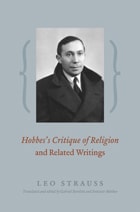
Hobbes's Critique of Religion and Related Writings
Leo Strauss
University of Chicago Press, 2011
Leo Strauss’s The Political Philosophy of Hobbes deservedly ranks among his most widely acclaimed works. In it Strauss argues that the basis for Hobbes’s natural and political science is his interest in “self-knowledge of man as he really is.” The writings collected in this book, each written prior to that classic volume, complement that account. Thus at long last, this book allows us to have a complete picture of Strauss’s interpretation of Hobbes, the thinker pivotal to the fundamental theme of his life’s work: the conflicting demands of philosophy and revelation, or as he termed it, “the theologico-political problem.”
It is no exaggeration to say that Strauss’s work on Hobbes’s critique of religion is essential to his analysis of Hobbes’s political philosophy, and vice versa. This volume will spark new interest in Hobbes’s explication of the Bible and in his understanding of religion by revealing previously neglected dimensions and motives of Hobbes’s “theology.” At the same time, scholars interested in the intellectual development of Leo Strauss will find in these writings the missing link, as it were, between his two early books,Spinoza’s Critique of Religion and The Political Philosophy of Hobbes.
In addition, this volume makes available for the first time in English a letter, a book outline, an extended review, an engagement with legal positivism, and an account of Strauss’s work on Hobbes by Heinrich Meier, all of which shed light on Strauss’s concerns and his approach to Hobbes in particular, as well as to modern political thought and life.
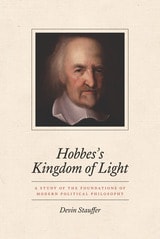
Hobbes's Kingdom of Light
A Study of the Foundations of Modern Political PhilosophyDevin Stauffer
University of Chicago Press, 2018
In Hobbes’s Kingdom of Light, Stauffer argues that Hobbes was engaged in a struggle on multiple fronts against forces, both philosophic and religious, that he thought had long distorted philosophy and destroyed the prospects of a lasting peace in politics. By exploring the twists and turns of Hobbes’s arguments, not only in his famous Leviathan but throughout his corpus, Stauffer uncovers the details of Hobbes’s critique of an older outlook, rooted in classical philosophy and Christian theology, and reveals the complexity of Hobbes’s war against the “Kingdom of Darkness.” He also describes the key features of the new outlook—the “Kingdom of Light”—that Hobbes sought to put in its place. Hobbes’s venture helped to prepare the way for the later emergence of modern liberalism and modern secularism. Hobbes’s Kingdom of Light is a wide-ranging and ambitious exploration of Hobbes’s thought.
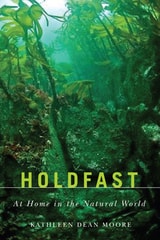
Holdfast
At Home in the Natural WorldKathleen Dean Moore
Oregon State University Press, 2013
Naturalist and philosopher Kathleen Dean Moore meditates on connection and separation in these twenty-one elegant, probing essays. Using the metaphor of holdfasts—the structures that attach seaweed to rocks with a grip strong enough to withstand winter gales—she examines our connections to our own bedrock.
“When people lock themselves in their houses at night and seal the windows shut to keep out storms, it is possible to forget, sometimes for years and years, that human beings are part of the natural world,” she writes. Holdfast passionately reclaims an awareness of the natural world, exploring the sense of belonging fostered by the communal howls of wolves; the inevitability of losing children to their own lives; the fear of bears and love of storms; the sublimity of life and longing in the creatures of the sea; her agonizing decision when facing her father’s bone-deep pain. As Moore travels philosophically and geographically—from Oregon’s shores to Alaska’s islands—she leaves no doubt of her virtuosity and range.
The new afterword is an important statement on the new responsibilities of nature writers as the world faces the consequences of climate change.
Holding On to Reality
The Nature of Information at the Turn of the MillenniumAlbert Borgmann
University of Chicago Press, 1999
"[Borgmann] has offered a stunningly clear definition of information in Holding On to Reality. . . . He leaves room for little argument, unless one wants to pose the now vogue objection: I guess it depends on what you mean by nothing."—Paul Bennett, Wired
"A superb anecdotal analysis of information for a hype-addled age."—New Scientist
"This insightful and poetic reflection on the changing nature of information is a wonderful antidote to much of the current hype about the 'information revolution.' Borgmann reminds us that whatever the reality of our time, we need 'a balance of signs and things' in our lives."—Margaret Wertheim, LA Weekly
Holistic Darwinism
Synergy, Cybernetics, and the Bioeconomics of EvolutionPeter Corning
University of Chicago Press, 2005
Holy Terrors, Second Edition
Thinking About Religion After September 11Bruce Lincoln
University of Chicago Press, 2006
Holy Terrors begins with a gripping dissection of the instruction manual given to each of the 9/11 hijackers. In their evocation of passages from the Quran, we learn how the terrorists justified acts of destruction and mass murder “in the name of God, the most merciful, the most compassionate.” Lincoln then offers a provocative comparison of President Bush’s October 7, 2001 speech announcing U.S. military action in Afghanistan alongside the videotaped speech released by Osama bin Laden just a few hours later. As Lincoln authoritatively demonstrates, a close analysis of the rhetoric used by leaders as different as George W. Bush and Osama bin Laden—as well as Mohamed Atta and even Jerry Falwell—betrays startling similarities. These commonalities have considerable implications for our understanding of religion and its interrelationships with politics and culture in a postcolonial world, implications that Lincoln draws out with skill and sensitivity.
With a chapter new to this edition, “Theses on Religion and Violence,” Holy Terrors remains one of the essential books on September 11 and a classic study on the character of religion.
“From time to time there appears a work . . . that serves to focus the wide-ranging, often contentious discussion of religion’s significance within broader cultural dynamics. Bruce Lincoln’s Holy Terrors is one such text. . . . Anyone still struggling toward a more nuanced comprehension of 9/11 would do well to spend time with this book.”—Theodore Pulcini, Middle East Journal
Holy Terrors
Thinking about Religion after September 11Bruce Lincoln
University of Chicago Press, 2002
Lincoln begins with a gripping dissection of the instruction manual given to each of the hijackers. In their evocation of passages from the Quran, we learn how the terrorists justified acts of destruction and mass murder "in the name of God, the most merciful, the most compassionate." Lincoln then offers a provocative comparison of President Bush's October 7 speech announcing U.S. military action in Afghanistan and Osama bin Laden's videotape released hours later. Each speech, he argues, betrays telling contradictions. Bin Laden, for instance, conceded implicitly that Islam is not unitary, as his religious rhetoric would have it, but is torn by deep political divisions. And Bush, steering clear of religious rhetoric for the sake of political unity, still reassured his constituents through coded allusions that American policy is firmly rooted in faith.
Lincoln ultimately broadens his discussion further to consider the role of religion since September 11 and how it came to be involved with such fervent acts of political revolt. In the postcolonial world, he argues, religion is widely considered the most viable and effective instrument of rebellion against economic and social injustices. It is the institution through which unified communities ensure the integrity and continuity of their culture in the wake of globalization. Brimming with insights such as these, Holy Terrors will become one of the essential books on September 11 and a classic study on the character of religion.
Home and Beyond
Generative Phenomenology after HusserlAnthony J. Steinbock
Northwestern University Press, 1995
Homeschooling
The History and Philosophy of a Controversial PracticeJames G. Dwyer and Shawn F. Peters
University of Chicago Press, 2019
Homeschooling
The History and Philosophy of a Controversial PracticeJames G. Dwyer and Shawn F. Peters
University of Chicago Press, 2019
This is an auto-narrated audiobook edition of this book.
Homesickness
Of Trauma and the Longing for Place in a Changing EnvironmentRyan Hediger
University of Minnesota Press, 2019
Introducing a posthumanist concept of nostalgia to analyze steadily widening themes of animality, home, travel, slavery, shopping, and war in U.S. literature after 1945
In the Anthropocene, as climate change renders environments less stable, the human desire for place underscores the weakness of the individual in the face of the world. In this book, Ryan Hediger introduces a distinctive notion of homesickness, one in which the longing for place demonstrates not only human vulnerability but also intersubjectivity beyond the human. Arguing that this feeling is unavoidable and characteristically posthumanist, Hediger studies the complex mix of attitudes toward home, the homely, and the familiar in an age of resurgent cosmopolitanism, especially eco-cosmopolitanism.
Homesickness closely examines U.S. literature mostly after 1945, including prominent writers such as Annie Proulx, Marilynne Robinson, and Ernest Hemingway, in light of the challenges and themes of the Anthropocene. Hediger argues that our desire for home is shorthand for a set of important hopes worth defending—serious and genuine relationships to places and their biotic regimes and landforms; membership in vital cultures, human and nonhuman; resistance to capital-infused forms of globalization that flatten differences and turn life and place into mere resources. Our homesickness, according to Hediger, is inevitable because the self is necessarily constructed with reference to the material past. Therefore, homesickness is not something to dismiss as nostalgic or reactionary but is rather a structure of feeling to come to terms with and even to cultivate.
Recasting an expansive range of fields through the lens of homesickness—from ecocriticism to animal studies and disability studies, (eco)philosophy to posthumanist theory—Homesickness speaks not only to the desire for a physical structure or place but also to a wide range of longings and dislocations, including those related to subjectivity, memory, bodies, literary form, and language.
Hommes, encore un effort…
Anthropogenèse, christianisme, sexuationThierry de Duve
Diaphanes, 2023
Homo Aestheticus
The Invention of Taste in the Democratic AgeLuc Ferry
University of Chicago Press, 1993
Ferry's treatise begins in the mid-1600s with the simultaneous invention of the notions of taste (the essence of art as subjective pleasure) and modern democracy (the idea of the State as a consensus among individuals). He explores the differences between subjectivity and individuality by examining aesthetic theory as developed first by Kant's predecessors and then by Kant, Hegel, Nietzsche, and proponents of the avant-garde. Ferry discerns two "moments" of the avant-garde aesthetic: the hyperindividualistic iconoclasm of creating something entirely new, and the hyperrealistic striving to achieve an extraordinary truth. The tension between these two, Ferry argues, preserves an essential element of the Enlightenment concern for reconciling the subjective and the objective—a problem that is at once aesthetic, ethical, and political.
Rejecting postmodern proposals for either a radical break with or return to tradition, Ferry embraces a postmodernism that recasts Enlightenment notions of value as a new intersubjectivity. His original analysis of the growth and decline of the twentieth-century avant-garde movement sheds new light on the connections between aesthetics, ethics, and political theory.
Homo Viator
Introduction to the Metaphysic of HopeGabriel Marcel
St. Augustine's Press, 2010
Honor
Frank Henderson Stewart
University of Chicago Press, 1994
In the first sustained comparative analysis of this elusive notion, Frank Stewart writes that none of these ideas is correct. Drawing on information about Western ideas of honor from sources as diverse as medieval Arthurian romances, Spanish dramas of the sixteenth and seventeenth centuries, and the writings of German jurists of the nineteenth and twentieth centuries, and comparing the European ideas with the ideas of a non-Western society—the Bedouin—Stewart argues that honor must be understood as a right, basically a right to respect. He shows that by understanding honor this way, we can resolve some of the paradoxes that have long troubled scholars, and can make sense of certain institutions (for instance the medieval European pledge of honor) that have not hitherto been properly understood.
Offering a powerful new way to understand this complex notion, Honor has important implications not only for the social sciences but also for the whole history of European sensibility.
Hope Draped in Black
Race, Melancholy, and the Agony of ProgressJoseph R. Winters
Duke University Press, 2016
Hope Now
The 1980 InterviewsJean-Paul Sartre and Benny Lévy
University of Chicago Press, 1996
Shortly before his death, Sartre confirmed the authenticity of the interviews and their puzzling content. Over the past fifteen years, it has become the task of Sartre scholars to unravel and understand them. Presented in this fresh, meticulous translation, the interviews are framed by two provocative essays from Benny Levy himself, accompanied by a comprehensive introduction from noted Sartre authority Ronald Aronson. Placing the interviews in proper biographical and philosophical perspective, Aronson demonstrates that the thought of both Sartre and Levy reveals multiple intentions that taken together nevertheless confirm and add to Sartre's overall philosophy. This absorbing volume at last contextualizes and elucidates the final thoughts of a brilliant and influential mind.
Jean-Paul Sartre (1906-1980) was offered, but declined, the Nobel Prize for literature in 1964. His many works of fiction, drama, and philosophy include the monumental study of Flaubert, The Family Idiot, and The Freud Scenario, both published in translation by the University of Chicago Press.
Hope in Hopeless Times
John Holloway
Pluto Press, 2022
Hope lies in our richness, in the joy of our collective creativity. But that richness exists in the peculiar form of money. The fact that we relate to one another through money causes tremendous social pain and destruction and is dragging us through pandemics and war towards extinction.
Richness against money: this battle will decide the future of humanity. If we cannot emancipate richness from money-capital profit, there is probably no hope. Money seems invincible but the constant expansion of debt shows that its rule is fragile. The fictitious expansion of money through debt is driven by fear, fear of us, fear of the rabble. Money contains, but richness overflows.
Hope, Trust, and Forgiveness
Essays in FinitudeJohn T. Lysaker
University of Chicago Press, 2023
As ethical beings, we strive for lives that are meaningful and praiseworthy. But we are finite. We do not know, so we hope. We need, so we trust. We err, so we forgive. In this book, philosopher John T. Lysaker draws our attention to the ways in which these three capacities—hope, trust, and forgiveness—contend with human limits. Each experience is vital to human flourishing, yet each also poses significant personal and institutional challenges as well as opportunities for growth. Hope, Trust, and Forgiveness explores these challenges and opportunities and proposes ways to best meet them. In so doing, Lysaker experiments with the essay as a form and advances an improvisational perfectionism to deepen and expand our ethical horizons.
Horn, or The Counterside of Media
Henning Schmidgen
Duke University Press, 2022
Hospitality, Volume I
Jacques Derrida
University of Chicago Press, 2023
Hospitality reproduces a two-year seminar series delivered by Jacques Derrida at the École des hautes études en sciences sociales in Paris between 1995 and 1997. In these lectures, Derrida asks a series of related questions about responsibility and “the foreigner”: How do we welcome or turn away the foreigner? What does the idea of the foreigner reveal about kinship and the state, particularly in relation to friendship, citizenship, migration, asylum, assimilation, and xenophobia? Derrida approaches these questions through readings of several classical texts as well as modern texts by Heidegger, Arendt, Camus, and others. Central to his project is a rigorous distinction between conventional, finite hospitality, with its many conditions, and the aspirational idea of hospitality as something offered unconditionally to the stranger. This volume collects the first year of the seminar.
Hospitality, Volume II
Jacques Derrida
University of Chicago Press, 2024
Hospitality reproduces a two-year seminar series delivered by Jacques Derrida at the École des hautes études en sciences sociales in Paris between 1995 and 1997. In these lectures, Derrida asks a series of related questions about responsibility and “the foreigner”: How do we welcome or turn away the foreigner? What does the idea of the foreigner reveal about kinship and the state, particularly in relation to friendship, citizenship, migration, asylum, assimilation, and xenophobia? Central to his project is a rigorous distinction between conventional, finite hospitality, with its many conditions, and the aspirational idea of hospitality as something offered unconditionally to the stranger. This volume collects the second year of the seminar, which considers an Islamic problematic of hospitality, the relevance of forgiveness, and the work of Emmanuel Levinas.
Hot Property
The Stakes and Claims of Literary OriginalityFrançoise Meltzer
University of Chicago Press, 1994
Freud, inventor of "dream work," turns a blind eye upon the dreams that were the starting point of his predecessor Descartes's famous methode, the one man's obsession with originality mirroring the other's fear of plagiarism. The Holocaust poet Paul Celan, whose sense of identity and place resided in his work, is devastated by a charge of plagiarism. Colette's husband Willy outdoes himself, and his "lazy" wife as well, with his enactment of literary seriousness. Walter Benjamin's early interpreters, notably Hannah Arendt and Theodor Adorno, insidiously undermine the originality of his project . In each of these cases, Meltzer shows how a threat to a writer's status as creator betrays the larger fraud of the originality myth itself.
Fascinating for its insights into the ways originality is both at risk and at work in Western literary culture, Hot Property will engage all those who have an interest in questions of authorship, textual soveriegnty, and the legitimacy of the critical establishment.
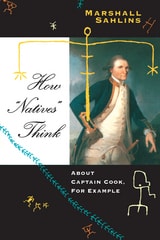
How "Natives" Think
About Captain Cook, For ExampleMarshall Sahlins
University of Chicago Press, 1995
In recent years, these questions have arisen in debates over the death and deification of Captain James Cook on Hawai'i Island in 1779. Did the Hawaiians truly receive Cook as a manifestation of their own god Lono? Or were they too pragmatic, too worldly-wise to accept the foreigner as a god? Moreover, can a "non-native" scholar give voice to a "native" point of view? In his 1992 book The Apotheosis of Captain Cook, Gananath Obeyesekere used this very issue to attack Sahlins's decades of scholarship on Hawaii. Accusing Sahlins of elementary mistakes of fact and logic, even of intentional distortion, Obeyesekere portrayed Sahlins as accepting a naive, enthnocentric idea of superiority of the white man over "natives"—Hawaiian and otherwise. Claiming that his own Sri Lankan heritage gave him privileged access to the Polynesian native perspective, Obeyesekere contended that Hawaiians were actually pragmatists too rational and sensible to mistake Cook for a god.
Curiously then, as Sahlins shows, Obeyesekere turns eighteenth-century Hawaiians into twentieth-century modern Europeans, living up to the highest Western standards of "practical rationality." By contrast, Western scholars are turned into classic custom-bound "natives", endlessly repeating their ancestral traditions of the White man's superiority by insisting Cook was taken for a god. But this inverted ethnocentrism can only be supported, as Sahlins demonstrates, through wholesale fabrications of Hawaiian ethnography and history—not to mention Obeyesekere's sustained misrepresentations of Sahlins's own work. And in the end, although he claims to be speaking on behalf of the "natives," Obeyesekere, by substituting a home-made "rationality" for Hawaiian culture, systematically eliminates the voices of Hawaiian people from their own history.
How "Natives" Think goes far beyond specialized debates about the alleged superiority of Western traditions. The culmination of Sahlins's ethnohistorical research on Hawaii, it is a reaffirmation for understanding difference.
How Do I Know Thee?
Theatrical and Narrative Cognition in Seventeenth-Century FranceRichard E. Goodkin
Northwestern University Press, 2015
The classical period in France presents a particularly lively battleground for the transition between oral-visual culture, on the one hand, and print culture on the other. The former depended on learning from sources of knowledge directly, in their presence, in a manner analogous to theatrical experience. The latter became characterized by the distance and abstraction of reading. How Do I Know Thee? explores the ways in which literature, philosophy, and psychology approach social cognition, or how we come to know others. Richard E. Goodkin describes a central opposition between what he calls “theatrical cognition” and “narrative cognition,” drawing both on scholarship on literary genre and mode, and also on the work of a number of philosophers and psychologists, in particular Descartes’s theory of cognition, Freudian psychoanalysis, mid‑twentieth‑century behaviorism, and the field of cognitive science. The result is a study that will be of interest not only to students of the classical period but also to those in the corresponding disciplines.
How Does Law Matter?
Fundamental Issues in Law And SocietyBryant G. Garth and Austin Sarat
Northwestern University Press, 1998
These essays show how law is relevant in both an "instrumental" and a "constitutive" sense, as a tool to accomplish particular purposes and as an important force in shaping the everyday worlds in which we live. Essays examine these issues by focusing on legal consciousness, the body, discrimination, and colonialism as well as on more traditional legal concerns such as juries and criminal justice.
How Experiments End
Peter Galison
University of Chicago Press, 1987
"Anyone who is seriously concerned with understanding how research is done should read this. There have been many books on one or another part of its subject matter but few giving such insights into how the research is done and how the consensus of discovery is arrived at."—Frank Close, New Scientist
"[Galison] is to be congratulated on producing a masterpiece in the field."—Michael Redhead, Synthese
"How Experiments End is a major historical work on an exciting topic."—Andy Pickering, Isis
How Is It Between Us?
Relational Ethics and Care for the WorldJarrett Zigon
HAU, 2024
In How Is It Between Us?, Jarrett Zigon puts anthropology and phenomenological hermeneutics in conversation to develop a new theory of relational ethics. This relational ethics takes place in the between, the interaction not just between people, but all existents. Importantly, this theory is utilized as a framework for considering some of today’s most pressing ethical concerns—for example, living in a condition of post-truth and worlds increasingly driven by algorithms and data extraction, various and competing calls for justice, and the ethical demands of the climate crisis. Written by one of the preeminent contributors to the anthropology of ethics, this is a ground-breaking book within that literature, developing a robust and systematic ethical theory to think through contemporary ethical problems.
How It Is
The Native American Philosophy of V. F. CordovaV. F. Cordova; Edited by Kathleen Dean Moore, Kurt Peters, Ted Jojola, and Amber Lacy, with a Foreword by Linda Hogan
University of Arizona Press, 2007
In three parts, Cordova sets out a complete Native American philosophy. First she explains her own understanding of the nature of reality itself—the origins of the world, the relation of matter and spirit, the nature of time, and the roles of culture and language in understanding all of these. She then turns to our role as residents of the Earth, arguing that we become human as we deepen our relation to our people and to our places, and as we understand the responsibilities that grow from those relationships. In the final section, she calls for a new reverence in a world where there is no distinction between the sacred and the mundane.
Cordova clearly contrasts Native American beliefs with the traditions of the Enlightenment and Christianized Europeans (what she calls “Euroman” philosophy). By doing so, she leads her readers into a deeper understanding of both traditions and encourages us to question any view that claims a singular truth. From these essays—which are lucid, insightful, frequently funny, and occasionally angry—we receive a powerful new vision of how we can live with respect, reciprocity, and joy.
How Lifeworlds Work
Emotionality, Sociality, and the Ambiguity of BeingMichael Jackson
University of Chicago Press, 2017
In How Lifeworlds Work, Jackson draws on years of ethnographic fieldwork in West Africa to highlight the dynamic quality of human relationships and reinvigorate the study of kinship and ritual. How, he asks, do we manage the perpetual process of accommodation between social norms and personal emotions, impulses, and desires? How are these two dimensions of lived reality joined, and how are the dual imperatives of individual expression and collective viability managed? Drawing on the pragmatist tradition, psychology, and phenomenology, Jackson offers an unforgettable, beautifully written account of how we make, unmake, and remake, our lifeworlds.
How Many Is Too Many?
The Progressive Argument for Reducing Immigration into the United StatesPhilip Cafaro
University of Chicago Press, 2015
Cafaro roots his argument in human rights, equality, economic security, and environmental sustainability—hallmark progressive values. He shows us the undeniable realities of mass migration to which we have turned a blind eye: how flooded labor markets in sectors such as meatpacking and construction have driven down workers’ wages and driven up inequality; how excessive immigration has fostered unsafe working conditions and political disempowerment; how it has stalled our economic maturity by keeping us ever-focused on increasing consumption and growth; and how it has caused our cities and suburbs to sprawl far and wide, destroying natural habitats, driving other species from the landscape, and cutting us off from nature.
In response to these hard-hitting truths, Cafaro lays out a comprehensive plan for immigration reform that is squarely in line with progressive political goals. He suggests that we shift enforcement efforts away from border control and toward the employers who knowingly hire illegal workers. He proposes aid and foreign policies that will help people create better lives where they are. And indeed he supports amnesty for those who have, at tremendous risk, already built their lives here. Above all, Cafaro attacks our obsession with endless material growth, offering in its place a mature vision of America, not brimming but balanced, where all the different people who constitute this great nation of immigrants can live sustainably and well, sheltered by a prudence currently in short supply in American politics.
How Noise Matters to Finance
N. Adriana Knouf
University of Minnesota Press, 2016
As scores of crises over the past century have shown, the stock market is manipulable and manipulated. The market is composed of human-made machines, which are affected by a lack of predictability more fundamental than the human: the noise of the material world. N. Adriana Knouf draws on historical and contemporary documents to show how noise—sonic, informatic, or otherwise—affects the ways in which financial markets function. How Noise Matters to Finance draws on different forms of financial noise, paying attention to how materiality and the interference of humans and machines causes the meanings of noise to shift over space and time.
Forerunners is a thought-in-process series of breakthrough digital works. Written between fresh ideas and finished books, Forerunners draws on scholarly work initiated in notable blogs, social media, conference plenaries, journal articles, and the synergy of academic exchange. This is gray literature publishing: where intense thinking, change, and speculation take place in scholarship.
How Not to Make a Human
Pets, Feral Children, Worms, Sky Burial, OystersKarl Steel
University of Minnesota Press, 2019
From pet keeping to sky burials, a posthuman and ecocritical interrogation of and challenge to human particularity in medieval texts
Mainstream medieval thought, like much of mainstream modern thought, habitually argued that because humans alone had language, reason, and immortal souls, all other life was simply theirs for the taking. But outside this scholarly consensus teemed a host of other ways to imagine the shared worlds of humans and nonhumans. How Not to Make a Human engages with these nonsystematic practices and thought to challenge both human particularity and the notion that agency, free will, and rationality are the defining characteristics of being human.
Recuperating the Middle Ages as a lost opportunity for decentering humanity, Karl Steel provides a posthuman and ecocritical interrogation of a wide range of medieval texts. Exploring such diverse topics as medieval pet keeping, stories of feral and isolated children, the ecological implications of funeral practices, and the “bare life” of oysters from a variety of disanthropic perspectives, Steel furnishes contemporary posthumanists with overlooked cultural models to challenge human and other supremacies at their roots.
By collecting beliefs and practices outside the mainstream of medieval thought, How Not to Make a Human connects contemporary concerns with ecology, animal life, and rethinkings of what it means to be human to uncanny materials that emphasize matters of death, violence, edibility, and vulnerability.
How Philosophers Saved Myths
Allegorical Interpretation and Classical MythologyLuc Brisson
University of Chicago Press, 2004
How Philosophers Saved Myths also describes how, during the first years of the modern era, allegory followed a more religious path, which was to assume a larger role in Neoplatonism. Ultimately, Brisson explains how this embrace of myth was carried forward by Byzantine thinkers and artists throughout the Middle Ages and Renaissance; after the triumph of Chistianity, Brisson argues, myths no longer had to agree with just history and philosophy but the dogmas of the Church as well.