Results by title
28164 books match the query 'History' and 906 start with h
Heartwood
The First Generation of Theravada Buddhism in AmericaWendy Cadge
University of Chicago Press, 2004
Wendy Cadge first provides a historical overview of Theravada Buddhism and considers its specific origins here in the United States. She then brings her findings to bear on issues of personal identity, immigration, cultural assimilation, and the nature of religion in everyday life. Her work is the first systematic comparison of the ways in which immigrant and convert Buddhists understand, practice, and adapt the Buddhist tradition in America. The men and women whom Cadge meets and observes speak directly to us in this work, both in their personal testimonials and as they meditate, pray, and practice Buddhism.
Creative and insightful, Heartwood will be of enormous value to sociologists of religion and anyone wishing to understand the rise of Buddhism in the Western world.
Heat Wave
A Social Autopsy of Disaster in ChicagoEric Klinenberg
University of Chicago Press, 2002
Heat waves in the United States kill more people during a typical year than all other natural disasters combined. Until now, no one could explain either the overwhelming number or the heartbreaking manner of the deaths resulting from the 1995 Chicago heat wave. Meteorologists and medical scientists have been unable to account for the scale of the trauma, and political officials have puzzled over the sources of the city's vulnerability. In Heat Wave, Eric Klinenberg takes us inside the anatomy of the metropolis to conduct what he calls a "social autopsy," examining the social, political, and institutional organs of the city that made this urban disaster so much worse than it ought to have been.
Starting with the question of why so many people died at home alone, Klinenberg investigates why some neighborhoods experienced greater mortality than others, how the city government responded to the crisis, and how journalists, scientists, and public officials reported on and explained these events. Through a combination of years of fieldwork, extensive interviews, and archival research, Klinenberg uncovers how a number of surprising and unsettling forms of social breakdown—including the literal and social isolation of seniors, the institutional abandonment of poor neighborhoods, and the retrenchment of public assistance programs—contributed to the high fatality rates. The human catastrophe, he argues, cannot simply be blamed on the failures of any particular individuals or organizations. For when hundreds of people die behind locked doors and sealed windows, out of contact with friends, family, community groups, and public agencies, everyone is implicated in their demise.
As Klinenberg demonstrates in this incisive and gripping account of the contemporary urban condition, the widening cracks in the social foundations of American cities that the 1995 Chicago heat wave made visible have by no means subsided as the temperatures returned to normal. The forces that affected Chicago so disastrously remain in play in America's cities, and we ignore them at our peril.
Heat Wave
A Social Autopsy of Disaster in ChicagoEric Klinenberg
University of Chicago Press, 2015
On Thursday, July 13, 1995, Chicagoans awoke to a blistering day in which the temperature would reach 106 degrees. The heat index, which measures how the temperature actually feels on the body, would hit 126 degrees by the time the day was over. Meteorologists had been warning residents about a two-day heat wave, but these temperatures did not end that soon. When the heat wave broke a week later, city streets had buckled; the records for electrical use were shattered; and power grids had failed, leaving residents without electricity for up to two days. And by July 20, over seven hundred people had perished-more than twice the number that died in the Chicago Fire of 1871, twenty times the number of those struck by Hurricane Andrew in 1992—in the great Chicago heat wave, one of the deadliest in American history.
Heat waves in the United States kill more people during a typical year than all other natural disasters combined. Until now, no one could explain either the overwhelming number or the heartbreaking manner of the deaths resulting from the 1995 Chicago heat wave. Meteorologists and medical scientists have been unable to account for the scale of the trauma, and political officials have puzzled over the sources of the city's vulnerability. In Heat Wave, Eric Klinenberg takes us inside the anatomy of the metropolis to conduct what he calls a "social autopsy," examining the social, political, and institutional organs of the city that made this urban disaster so much worse than it ought to have been.
Starting with the question of why so many people died at home alone, Klinenberg investigates why some neighborhoods experienced greater mortality than others, how the city government responded to the crisis, and how journalists, scientists, and public officials reported on and explained these events. Through a combination of years of fieldwork, extensive interviews, and archival research, Klinenberg uncovers how a number of surprising and unsettling forms of social breakdown—including the literal and social isolation of seniors, the institutional abandonment of poor neighborhoods, and the retrenchment of public assistance programs—contributed to the high fatality rates. The human catastrophe, he argues, cannot simply be blamed on the failures of any particular individuals or organizations. For when hundreds of people die behind locked doors and sealed windows, out of contact with friends, family, community groups, and public agencies, everyone is implicated in their demise.
As Klinenberg demonstrates in this incisive and gripping account of the contemporary urban condition, the widening cracks in the social foundations of American cities that the 1995 Chicago heat wave made visible have by no means subsided as the temperatures returned to normal. The forces that affected Chicago so disastrously remain in play in America's cities, and we ignore them at our peril.
For the Second Edition Klinenberg has added a new Preface showing how climate change has made extreme weather events in urban centers a major challenge for cities and nations across our planet, one that will require commitment to climate-proofing changes to infrastructure rather than just relief responses.
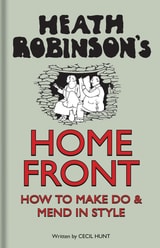
Heath Robinson's Home Front
How to Make Do and Mend in StyleW. Heath Robinson and Cecil Hunt
Bodleian Library Publishing, 2016
Heath Robinson was a household name in Britain, and millions of readers around the world continue to thoroughly enjoy his cartoons today. A classic military-themed compendium, Heath Robinson’s Home Front will be a favorite with fans of the cartoonist’s complicated, fanciful contraptions.

Heath Robinson's Second World War
The Satirical CartoonsW. Heath Robinson
Bodleian Library Publishing, 2015
Heath Robinson was a household name in Britain, and millions of readers around the world continue to thoroughly enjoy his cartoons today. This classic military-themed compendium will be a favorite with fans of the cartoonist’s complicated, fanciful contraptions.

Heath Robinson’s Great War
The Satirical CartoonsW. Heath Robinson
Bodleian Library Publishing, 2015
With Heath Robinson’s Great War, the cartoonist lampoons the German army and the hardships of war. What better antidote to the threat of popular German propaganda than drawings of the “Huns” disabling the British army not with mustard gas but laughing gas? In high demand among British civilians, Robinson’s WWI panels also provided respite to thousands of troops—many of whom sent the cartoonist letters suggesting future subjects or simply expressing their appreciation.
A side-splittingly funny collection from the man whose “absurd, beautiful drawings” H. G. Wells claimed “give me a peculiar pleasure of the mind like nothing else in the world,” this book make a perfect gift for anyone looking to have a laugh at our complicated and increasingly mechanical modern life.

Heather Raffo's 9 Parts of Desire
A PlayHeather Raffo
Northwestern University Press, 2006
As topical as today's newspaper headlines, these rich monologues bring to life nine distinct Iraqi women whose very different stories convey the complex and harrowing reality of being female in modern-day Iraq. Their monologues quickly become a series of overlapping conversations leading to a breakdown in communication as the chaos of Iraq intensifies. Layal is a sexy and impulsive painter favored by Saddam's regime, breezily bohemian one minute and defensive the next; another woman mourns the death of her family in a 1991 bunker, and another--a blond American of Iraqi descent--painfully recalls a telephone conversation with Baghdad relatives on the eve of the U. S. invasion. Other characters decry the savagery of Saddam Hussein in terrifying detail and express an ambivalent relief at the American presence; still others--like a Bedouin woman searching for love--transcend politics.
The title comes from the teachings of the seventh-century imam Ali ibn Abu Talib: "God created sexual desire in ten parts; then he gave nine parts to women and one part to men." Heather Raffo's monologues weave these nine parts into a finely textured, brilliantly colorful tapestry of feminine longing in dire times. This compassionate and heart-breaking work will forever change your view of Iraqi women and the people of the Middle East.
Heaven Born Merida and Its Destiny
The Book of Chilam Balam of ChumayelTranslated and annotated by Munro S. Edmonson
University of Texas Press, 1986
When the Spaniards conquered the Yucatan Peninsula in the early 1500s, they made a great effort to destroy or Christianize the native cultures flourishing there. That they were in large part unsuccessful is evidenced by the survival of a number of documents written in Maya and preserved and added to by literate Mayas up to the 1830s. The Book of Chilam Balam of Chumayel is such a document, literally the history of Yucatan written by and for Mayas, and it contains much information not available from Spanish sources because it was part of an underground resistance movement of which the Spanish were largely unaware.
Well known to Mayanists, The Book of Chilam Balam of Chumayel is presented here in Munro S. Edmonson's English translation, extensively annotated. Edmonson reinterprets the book as literature and as history, placing it in chronological order and translating it as poetry. The ritual nature of Mayan history clearly emerges and casts new light on Mexican and Spanish acculturation of the Yucatecan Maya in the post-Classic and colonial periods.
Centered in the city of Merida, the Chumayel provides the western (Xiu) perspective on Yucatecan history, as Edmonson's earlier book The Ancient Future of the Itza: The Book of Chilam Balam of Tizimin presented the eastern (Itza) viewpoint. Both document the changing calendar of the colonial period and the continuing vitality of pre-Columbian ritual thought down to the nineteenth century. Perhaps the biggest surprise is the survival of the long-count dating system down to the Baktun Ceremonial of 1618 (12.0.0.0.0). But there are others: the use of rebus writing, the survival of the tun until 1752, graphic if oblique accounts of Mayan ceremonial drama, and the depiction of the Spanish conquest as a long-term inter-Mayan civil war.
Heaven's Soldiers
Free People of Color and the Spanish Legacy in Antebellum FloridaFrank Marotti
University of Alabama Press, 2013
Heaven’s Soldiers chronicles the history of a community of free people of African descent who lived and thrived, while resisting the constraints of legal bondage, in East Florida in the four decades leading up to the Civil War.

Heaven, Hell, and Everything in Between
Murals of the Colonial AndesBy Ananda Cohen-Aponte
University of Texas Press, 2016
Examining the vivid, often apocalyptic church murals of Peru from the early colonial period through the nineteenth century, Heaven, Hell, and Everything in Between explores the sociopolitical situation represented by the artists who generated these murals for rural parishes. Arguing that the murals were embedded in complex networks of trade, commerce, and the exchange of ideas between the Andes and Europe, Ananda Cohen-Aponte also considers the ways in which artists and viewers worked through difficult questions of envisioning sacredness.
This study brings to light the fact that, unlike the murals of New Spain, the murals of the Andes possess few direct visual connections to a pre-Columbian painting tradition; the Incas’ preference for abstracted motifs created a problem for visually translating Catholic doctrine to indigenous congregations, as the Spaniards were unable to read Inca visual culture. Nevertheless, as Cohen Suarez demonstrates, colonial murals of the Andes can be seen as a reformulation of a long-standing artistic practice of adorning architectural spaces with images that command power and contemplation. Drawing on extensive secondary and archival sources, including account books from the churches, as well as on colonial Spanish texts, Cohen Suarez urges us to see the murals not merely as decoration or as tools of missionaries but as visual archives of the complex negotiations among empire, communities, and individuals.

Heavenly Supper
The Story of Maria JanisFulvio Tomizza
University of Chicago Press, 1991
So begins Fulvio Tomizza's absorbing account of the true story of Maria Janis, a devout peasant woman from the mountains north of Bergamo. Too poor to enter a convent, Maria had set out to serve God by relinquishing the little she had, through renunciation of all food but the bread and wine of communion. Encouraged by the restless village priest Pietro Morali, Maria claimed to have existed in this sanctified state for five years. During this time, she, Morali, and the weaver Pietro Palazzi travel from a little village in the Alps to Rome and then to Venice, where their alleged sacrilege is discovered and they are brought to trial. Both revered as a saint and reviled as a fraud, Maria with her "privilege" inspires and threatens believers within the Church. Combining the historian's precision with the novelist's imagination, Tomizza painstakingly reconstructs her story, crafting a fascinating portrait of sublimated love, ambition, and jealousy.
Heavenly Supper alternates a chronological account of the trial with analyses of each protagonist's life history. Along the way, Tomizza gives voice to the minds and hearts of his characters, allowing them to speak for themselves in their own words. The world he recreates resonates with the fervor of the Counter Reformation when faith and its consequences were rigidly controlled by the Church. As suspenseful as a detective novel, Tomizza's story goes beyond the trial to evoke a panoramic view of seventeenth-century Italian culture.
Heavy Ground
William Mulholland and the St. Francis Dam DisasterNorris Hundley
University of Nevada Press, 2020
Heavy Marching
The Civil War Letters of Lute Moseley, 22nd WisconsinLucius S. Moseley, edited by Sara DeLuca
University of Wisconsin Press, 2023
From 1862 to 1865, Moseley fought in the Civil War as an infantry soldier in Wisconsin’s 22nd Volunteers. Briefly captured and interred in a Confederate POW Camp, he returned to action and participated in Sherman’s Atlanta campaign. He marched in the Washington, D.C., Grand Review before returning to the Beloit area, where he remained for the rest of his life.
Mosely wrote detailed missives to his family in Beloit about his wartime experiences, demonstrating a flair for describing both camp life and battles. Frank and forthright, he was remarkably articulate, insightful, and thoughtful, whether describing mundane activities or the nearly unfathomable death of President Lincoln. These 125 letters, never before made available to scholars or students of the war, became touchstones and sources of pride for the Moseley family—and provide a uniquely candid and vivid view of this tumultuous period in US history.
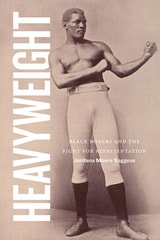
Heavyweight
Black Boxers and the Fight for RepresentationJordana Moore Saggese
Duke University Press, 2024

Hebrew Infusion
Language and Community at American Jewish Summer CampsSarah Bunin Benor, Jonathan B. Krasner, and Sharon Avni
Rutgers University Press, 2019
Each summer, tens of thousands of American Jews attend residential camps, where they may see Hebrew signs, sing and dance to Hebrew songs, and hear a camp-specific hybrid language register called Camp Hebraized English, as in: “Let’s hear some ruach (spirit) in this chadar ochel (dining hall)!” Using historical and sociolinguistic methods, this book explains how camp directors and staff came to infuse Hebrew in creative ways and how their rationales and practices have evolved from the early 20th century to today. Some Jewish leaders worry that Camp Hebraized English impedes Hebrew acquisition, while others recognize its power to strengthen campers’ bonds with Israel, Judaism, and the Jewish people. Hebrew Infusion explores these conflicting ideologies, showing how hybrid language can serve a formative role in fostering religious, diasporic communities. The insightful analysis and engaging descriptions of camp life will appeal to anyone interested in language, education, or American Jewish culture.
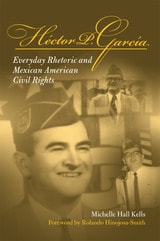
Hector P Garcia
Everyday Rhetoric and Mexican American Civil RightsMichelle Hall Kells. Foreword by Rolando Hinojosa-Smith
Southern Illinois University Press, 2006
Examining the Mexican American civil rights movement through the public rhetoric of a veteran activist
Héctor P. García: Everyday Rhetoric and Mexican American Civil Rights examines the transition of Mexican Americans from political and social marginalization to civic inclusion after World War II. Focusing on the public rhetoric of veteran rights activist and physician Dr. Héctor P. García, a Mexican immigrant who achieved unprecedented influence within the U.S. political system, author Michelle Hall Kells provides an important case study in the exercise of influence, the formation of civic identity, and the acquisition of social power among this underrepresented group.
As a major influence in national twentieth-century civil rights reform, García effectively operated between Anglo and Mexican American sociopolitical structures. The volume illustrates how García, a decorated World War II veteran and founder of the American GI Forum in Texas in 1948, successfully engendered a discourse that crossed geographical, political, and cultural borders, forming associations with the working poor as well as with prominent national figures such as John F. Kennedy and Lyndon B. Johnson. Through his rhetoric and action, García publicly revealed the plight of Mexican Americans, crossing class, regional, and racial lines to improve socioeconomic conditions for his people.
Héctor P. García, which is enhanced by sixteen illustrations, contributes to rhetorical, cultural, and historical studies and offers new scholarship establishing García’s role on the national front, effectively tracing Garcia’s legacy of resistance, the process of achieving enfranchisement, and the role of racism in the evolution from social marginalization to national influence.
Hedged
How Private Investment Funds Helped Destroy American Newspapers and Undermine DemocracyMargot Susca
University of Illinois Press, 2024
The ultrawealthy largely own and guide the newspaper system in the United States. Through entities like hedge funds and private equity firms, this investor class continues to dismantle the one institution meant to give voice to average citizens in a democracy.
Margot Susca reveals the little-known history of how private investment took over the newspaper industry. Drawing on a political economy of media, Susca’s analysis uses in-depth interviews and documentary evidence to examine issues surrounding ownership and power. Susca also traces the scorched-earth policies of layoffs, debt, cash-outs, and wholesale newspaper closings left behind by private investors and the effects of the devastation on the future of news and information. Throughout, Susca reveals an industry rocked less by external forces like lost ad revenue and more by ownership and management obsessed with profit and beholden to private fund interests that feel no responsibility toward journalism or the public it is meant to serve.

Hedstroms and the Bethel Ship Saga
Methodist Influence on Swedish Religious LifeHenry C. Whyman. Foreword by Kenneth E. Rowe
Southern Illinois University Press, 1992
The first book-length biographical treatment of Olof Gustaf Hedstrom and his brother Jonas documents their work in spreading Methodism among Swedish immigrants to America. Henry C. Whyman discusses the Bethel Ship Saga, a ministry unique in American immigrant history, and examines the larger picture of the role of religion in nineteenth-century European immigration to the United States.
The Bethel Ship, a floating chapel in New York Harbor, was the vehicle and headquarters for an effective ministry to immigrants arriving in America. Olof Hedstrom, a Methodist minister serving in the Catskill Mountain area, was called to New York to organize and lead this endeavor.
Hegel and the Freedom of Moderns
Domenico Losurdo
Duke University Press, 2004
Hegel and the Freedom of Moderns persuasively argues that the tug of war between “conservative” and “liberal” interpretations of Hegel has obscured and distorted the most important aspects of his political thought. Losurdo unravels this misleading dualism and provides an illuminating discussion of the relation between Hegel’s political philosophy and the thinking of Karl Marx and Friedrich Engels. He also discusses Hegel’s ideas in relation to the pertinent writings of other major figures of modern political philosophy such as Jean-Jacques Rousseau, John Locke, Edmund Burke, John Stuart Mill, Jeremy Bentham, Karl Popper, Norberto Bobbio, and Friedrich Hayek.

Hegel and the Problem of Multiplicity
Andrew Haas
Northwestern University Press, 2000

Hegel's Logic
Between Dialectic and HistoryClark Butler
Northwestern University Press, 2011
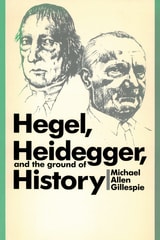
Hegel, Heidegger, and the Ground of History
Michael Allen Gillespie
University of Chicago Press, 1984
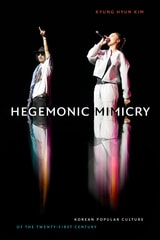
Hegemonic Mimicry
Korean Popular Culture of the Twenty-First CenturyKyung Hyun Kim
Duke University Press, 2021
Hegemonies of Language and Their Discontents
The Southwest North American Region Since 1540Carlos G. Vélez-Ibáñez
University of Arizona Press, 2017
Well-regarded author Carlos G. Vélez-Ibáñez details the linguistic and cultural processes used by penetrating imperial and national states. He argues that these impositions have been not linear but hydra-headed, complex and contradictory, sometimes accommodated and sometimes forcefully imposed. Such impositions have created discontent resulting in physical and linguistic revolts, translanguage versions, and multilayered capacities of use and misuse of imposed languages—even the invention of community-created trilingual dictionaries.
Vélez-Ibáñez gives particular attention to both sides of the border, explaining the consequences of the fragile splitting of the area through geopolitical border formation. He illustrates the many ways those discontents have manifested in linguistic, cultural, educational, political, and legal forms.
From revolt to revitalization, from silent objection to expressive defiance, people in the Southwest North American Region have developed arcs of discontent from the Spanish colonial period to the present. These narratives are supported by multiple sources, including original Spanish colonial documents and new and original ethnographic studies of performance rituals like the matachines of New Mexico. This unique work discusses the most recent neurobiological studies of bilingualism and their implications for cognitive development and language as it spans multiple disciplines. Finally, it provides the most important models for dual language development and their integration to the "Funds of Knowledge" concept as creative contemporary discontents with monolingual approaches.
Hegemony And Power
On the Relation between Gramsci and MachiavelliBenedetto Fontana
University of Minnesota Press, 1993
Presents a comparative and textual exploration of Gramsci's interpretation of Machiavelli's political analyses. This valuable contribution to our understanding of Gramsci includes a comparison of the major Machiavellian ideas such as the nature of political knowledge, the new principality, the concept of the people, and the relation between thought and action, to Gramsci's concepts of hegemony, moral and intellectual reform, and the collective will.
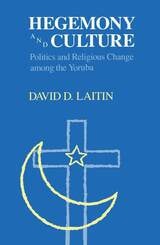
Hegemony and Culture
Politics and Religious Change among the YorubaDavid D. Laitin
University of Chicago Press, 1986

Heidegger And Nazism
Victor Farias
Temple University Press, 1991

Heidegger and the Myth of a Jewish World Conspiracy
Peter Trawny
University of Chicago Press, 2015
While Heidegger’s affiliation with National Socialism is well known, the anti-Semitic dimension of that engagement could not be fully told until now. Trawny traces Heidegger’s development of a grand “narrative” of the history of being, the “being-historical thinking” at the center of Heidegger’s work after Being and Time. Two of the protagonists of this narrative are well known to Heidegger’s readers: the Greeks and the Germans. The world-historical antagonist of this narrative, however, has remained hitherto undisclosed: the Jews, or, more specifically, “world Judaism.” As Trawny shows, world Judaism emerges as a racialized, destructive, and technological threat to the German homeland, indeed, to any homeland whatsoever. Trawny pinpoints recurrent, anti-Semitic themes in the Notebooks, including Heidegger’s adoption of crude cultural stereotypes, his assigning of racial reasons to philosophical decisions (even undermining his Jewish teacher, Edmund Husserl), his endorsement of a Jewish “world conspiracy,” and his first published remarks on the extermination camps and gas chambers (under the troubling aegis of a Jewish “self-annihilation”). Trawny concludes with a thoughtful meditation on how Heidegger’s achievements might still be valued despite these horrifying facets. Unflinching and systematic, this is one of the most important assessments of one of the most important philosophers in our history.
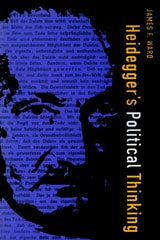
Heidegger's Political Thinking
James F. Ward
University of Massachusetts Press, 1995
In recent years there has been much controversy concerning Martin Heidegger’s politics, prompted by new research on the nature and extent of his engagement with National Socialism. Examining the political ideas embedded in Heidegger’s larger philosophical oeuvre, James F. Ward moves beyond the narrow preoccupation with Heidegger’s overtly pro-Nazi utterances and activities to show how the central theme of Heidegger’s philosophy—the question of Being—is itself inherently political.
Ward builds his case on close readings of texts drawn from nearly all of the writings published during Heidegger’s lifetime as well as from lectures, course transcripts, and other materials that appeared posthumously. With subtlety and insight, he uncovers the political content of Heidegger’s thinking on such topics as the temporality of Being, the role of science in the crisis of the West, and the presumed special status and destiny of the German people. In an epilogue, Ward reflects on the implications of Heidegger’s political thinking for postmodern political theory.

Heidegger, Strauss, and the Premises of Philosophy
On Original ForgettingRichard L. Velkley
University of Chicago Press, 2011
Heidegger
The Question of Being and HistoryJacques Derrida
University of Chicago Press, 2016
Derrida performs an almost surgical reading of the notoriously difficult text, marrying pedagogical clarity with patient rigor and acting as a lucid guide through the thickets of Heidegger’s prose. At this time in intellectual history, Heidegger was still somewhat unfamiliar to French readers, and Being and Time had only been partially translated into French. Here Derrida mostly uses his own translations, giving his own reading of Heidegger that directly challenges the French existential reception initiated earlier by Sartre. He focuses especially on Heidegger’s Destruktion (which Derrida would translate both into “solicitation” and “deconstruction”) of the history of ontology, and indeed of ontology as such, concentrating on passages that call for a rethinking of the place of history in the question of being, and developing a radical account of the place of metaphoricity in Heidegger’s thinking.
This is a rare window onto Derrida’s formative years, and in it we can already see the philosopher we’ve come to recognize—one characterized by a bravura of exegesis and an inventiveness of thought that are particularly and singularly his.
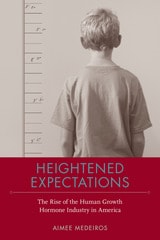
Heightened Expectations
The Rise of the Human Growth Hormone Industry in AmericaAimee Medeiros
University of Alabama Press, 2016
This book documents how the rise of modern capitalism and efforts to protect those most vulnerable to its harmful effects contributed to the social stigmatization of short statured children. Short boys bore the brunt of this discrimination by the mid-twentieth century, as cultural notions of masculinity deemed smallness a troubling trait in need of remedy. These boys became targets of growth hormone treatment, a trend accelerated by the development of effective HGH therapy in the late 1950s.
With a revisionist twist, Medeiros argues that HGH therapy was not plagued by a limited number of sources of the hormone but rather a difficult-to-access supply during the 1960s and 1970s. The advent of synthetic HGH remedied this situation. Therapy was available, however, only to those who could afford it. Very few could, which made short stature once again a mark of the underprivileged class.
Today, small boys with dreams of being taller remain the key customer base of the legitimate arm of the HGH industry. As gender and economic class disparities in treatment continue, some medical experts have alluded to patients’ parents as culprits of this trend. This book sheds light on how medicine’s attempt to make up for perceived physical shortcomings has deep roots in American culture.
Of interest to historians and scholars of medicine, gender studies, and disability studies, Heightened Expectations also offers much to policy makers and those curious about where standards and therapies originate.

Heimskringla
History of the Kings of NorwayBy Snorri Sturluson
University of Texas Press, 1964
Beginning with the dim prehistory of the mythical gods and their descendants, Heimskringla recounts the history of the kings of Norway through the reign of Olaf Haraldsson, who became Norway's patron saint. Once found in most homes and schools and still regarded as a national treasure, Heimskringla influenced the thinking and literary style of Scandinavia over several centuries.
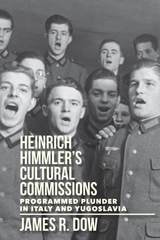
Heinrich Himmler's Cultural Commissions
Programmed Plunder in Italy and YugoslaviaJames R. Dow
University of Wisconsin Press, 2018
Drawing on extensive research in public and private archives and interviews with family members of fieldworkers, James R. Dow uncovers both details of the SS cultural commissions' work and the continuing vestiges of the materials they assembled. Teams of poorly qualified and ideologically motivated collectors were sent to South Tyrol in Italy and Gottschee in Slovenian Yugoslavia, from which ethnically German communities were to be resettled in the German Reich. Although a mass of information on narratives, songs and dances, beliefs, customs, local clothing and architecture, and folk speech was collected, the research was deeply tainted and skewed by racialist and nationalist preconditions. Dow sharply critiques the continued use of these ersatz archives.
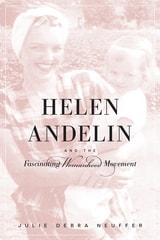
Helen Andelin and the Fascinating Womanhood Movement
Julie Debra Neuffer
University of Utah Press, 2014
Countering second-wave feminists in the 1960s, Andelin preached family values and urged women not to have careers, but to become good wives, mothers, and homemakers instead. A woman’s true happiness, taught Andelin, could only be realized if she admired, cared for, and obeyed her husband. As Andelin’s notoriety grew, so did the backlash from her critics. Undeterred, she became a national celebrity, who was interviewed extensively and appeared in sold-out speaking engagements.
Andelin’s message calling for the return to traditional roles appealed to many in a time of uncertainty and radical social change. This study provides an evenhanded and important look at a crucial, but often overlooked cross section of American women as they navigated their way through the turbulent decades following the post-war calm of the 1950s.
Winner of the Mormon History Association's Best Biography Award.
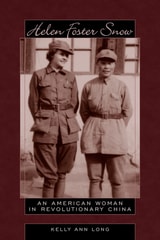
Helen Foster Snow
An American Woman in Revolutionary ChinaKelly Ann Long
University Press of Colorado, 2006
As Kelly Ann Long recounts in this engaging biography, Helen Foster Snow immersed herself in the social and political currents of a nation in turmoil. After marrying renowned journalist Edgar Snow, she developed her own writing talents and offered an important perspective on emerging events in China as that nation was wracked by Japanese invasion, the outbreak of World War II, and a continuing civil war. She supported the December Ninth Movement of 1935, broke boundaries to enter communist Yenan in 1937, and helped initiate the "gung ho" Chinese Industrial Cooperative movement.
Helen Foster Snow wrote about the people and events in China's remote communist territories during an important era. She relayed detailed portraits of female communist leaders and famous figures such as Mao Zedong and Zhu De, as well as common people struggling to survive in a period of increasing turmoil. Her informed, compassionate depictions built a bridge linking American interest to the welfare of the Chinese.
Long's account recovers the story of a controversial and important commentator on a critical period in U.S.-China relations and in Chinese history

Helen Ring Robinson
Colorado Senator and SuffragistPat Pascoe
University Press of Colorado, 2011

Hell Or High Water
James White's Disputed Passage through Grand Canyon, 1867Eilean Adams
Utah State University Press, 2001
Although John Wesley Powell and party are usually given credit for the first river descent through the Grand Canyon, the ghost of James White has haunted those claims. White was a Colorado prospector, who, almost two years before Powell's journey, washed up on a makeshift raft at Callville, Nevada. His claim to have entered the Colorado above the San Juan River with another man (soon drowned) as they fled from Indians was widely disseminated and believed for a time, but Powell and his successors on the river publically discounted it. Colorado River runners and historians have since debated whether White's passage through Grand Canyon even could have happened.
Hell or High Water is the first full account of White's story and how it became distorted and he disparaged over time. It is also a fascinating detective story, recounting how White's granddaughter, Eilean Adams, over decades and with the assistance of a couple of notable Colorado River historians who believed he could have done what he claimed, gradually uncovered the record of James White's adventure and put together a plausible narrative of how and why he ended up floating helplessly down a turbulent river, entrenched in massive cliffs, with nothing but a driftwood raft to carry him through.
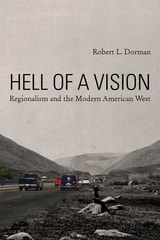
Hell of a Vision
Regionalism and the Modern American WestRobert L. Dorman
University of Arizona Press, 2012
The American West has taken on a rich and evocative array of regional identities since the late nineteenth century. Wilderness wonderland, Hispanic borderland, homesteader’s frontier, cattle kingdom, urban dynamo, Native American homeland. Hell of a Vision explores the evolution of these diverse identities during the twentieth century, revealing how Western regionalism has been defined by generations of people seeking to understand the West’s vast landscapes and varied cultures.
Focusing on the American West from the 1890s up to the present, Dorman provides us with a wide-ranging view of the impact of regionalist ideas in pop culture and diverse fields such as geography, land-use planning, anthropology, journalism, and environmental policy-making.
Going well beyond the realm of literature, Dorman broadens the discussion by examining a unique mix of texts. He looks at major novelists such as Cather, Steinbeck, and Stegner, as well as leading Native American writers. But he also analyzes a variety of nonliterary sources in his book, such as government reports, planning documents, and environmental impact studies.
Hell of a Vision is a compelling journey through the modern history of the American West—a key region in the nation of regions known as the United States.
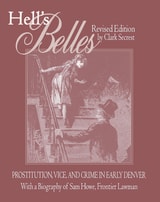
Hell's Belles, Revised Edition
Prostitution, Vice, and Crime in Early Denver, With a Biography of Sam Howe, Frontier LawmanClark Secrest
University Press of Colorado, 2001
The popular veneer of Denver's present-day Market Street - its fancy bars, posh restaurants, and Coors Field - is stripped away to reveal the street's former incarnation: a mecca of loose morals entrenched in prostitution, liquor, and money. Hell's Belles examines the neglected topics of vice and crime in Denver and utilizes a unique and invaluable historic source - the scrapbooks of Detective Sam Howe.
Hell's Not Far Off
Bruce Crawford and the Appalachian LeftJosh Howard
West Virginia University Press, 2024
A biography of Bruce Crawford, a southwest Virginia journalist-writer of the radical tradition and one of the first to interpret Appalachian labor history.
Hell’s Not Far Off is a grounded, politically engaged study of the Appalachian journalist and political critic Bruce Crawford, a scourge of coal and railway interests. Crawford fought injustices wherever he saw them at major risk to his own life and became an early interpreter of Appalachian labor history.
His writings and actions from the 1920s to the 1960s helped shape southwest Virginia and West Virginia. Through Crawford’s Weekly, a newspaper active from 1920 to 1935, Crawford challenged the Ku Klux Klan, lynch mobs, and the private police forces of coal barons. The wounds received for these efforts were the closing of his paper and a bullet to his leg during a Harlan County strike in the 1930s. In his work after journalism, he led the West Virginia branch of the Federal Writers’ Project during the political standoff over the contents of the state’s official guidebook.
In Hell’s Not Far Off, Josh Howard resurrects strands of a radical tradition centered especially on matters of labor, environment, and race, drawing attention to that tradition’s ongoing salience: “Present-day Appalachia’s fights were [Crawford’s], and his fights are still ours.”
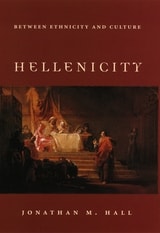
Hellenicity
Between Ethnicity and CultureJonathan M. Hall
University of Chicago Press, 2002
With Hellenicity, Jonathan M. Hall explores these questions in the context of ancient Greece, drawing on an exceptionally wide range of evidence to determine when, how, why, and to what extent the Greeks conceived themselves as a single people. Hall argues that a subjective sense of Hellenic identity emerged in Greece much later than is normally assumed. For instance, he shows that the four main ethnic subcategories of the ancient Greeks—Akhaians, Ionians, Aiolians, and Dorians—were not primordial survivals from a premigratory period, but emerged in precise historical circumstances during the eighth and seventh centuries B.C. Furthermore, Hall demonstrates that the terms of defining Hellenic identity shifted from ethnic to broader cultural criteria during the course of the fifth century B.C., chiefly due to the influence of Athens, whose citizens formulated a new Athenoconcentric conception of "Greekness."

Hellenism in Late Antiquity
G.W. Bowersock
University of Michigan Press, 1996
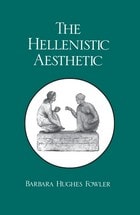
Hellenistic Aesthetic
Barbara Hughes Fowler
University of Wisconsin Press, 1989
“Fowler’s . . . own insights are apparent throughout, and they seem to distill the personal appreciation and understanding of a scholar who has devoted much of her career to both contemplating and enjoying Hellenistic poetry. . . . [This book] would make an excellent background text for courses in later Greek and Roman art, and it can be read with profit by anyone interested in exploring the character of Hellenistic culture.”—J. J. Pollitt, American Journal of Archaeology
“Outstanding is the range of examples discussed both in poetry and art. Theocritus, Callimachus, Appolonius, the epigrammatists, and others—that is, the major figures of the time—are considered at length and in several different contexts. Passages are quoted in the original Greek, translated, and analyzed. Fowler’s sensitivity to poetic forms, evident in her other published writings, is again evident here. In addition, however, the philosophical context is not overlooked. . . . Also highly commendable are the liberal references to works of art. Sculpture in the round and in relief, portraits, terracotta figurines, original paintings (grave stelai) and Campanian murals, mosaics, gold and silver vessels, and jewelry are introduced at various points. Every work of art discussed is illustrated in astonishingly clear photographs, which are interspersed in the body of the text.”—Christine Mitchell Havelock
“The Hellenistic Aesthetic provides classicists with their first thorough discussion of the aesthetic unity found in Hellenistic art and literature. . . . Fowler examines parallels both in subject matter and in artistic approach among a diverse group of literary genres and artistic forms. In twelve chapters, The Hellenistic Aesthetic surveys Alexandrian epigrams, pastorals, epics, sculptural groups, mosaics, paintings, and jewelry to supply a convincing, and frequently unexpected, picture of a unified aesthetic vision.”—Jeffrey Buller, Classical Outlook
Hellenistic Poetry
A SelectionDavid Sider, Editor
University of Michigan Press, 2017
The text of each poem is presented, together with basic help on obscure vocabulary, morphology, dialect, meter, syntax, and similar philological issues. The modern commentators also offer guidance on a poem’s literary significance and a brief introduction to the scholarship.
Among the 44 named and anonymous poets represented here are Apollonius of Rhodes, Archimedes, Aristotle, Callimachus, Cercidas, Corinna, Eratosthenes, Erinna, Ezekiel, Hermesianax, Herodas, Lycophron, and Phanocles.
Contributors to the volume in addition to David Sider include: Silvia Barbantani, James Clauss, Dee Clayman, Christophe Cusset, Claudio De Stefani, Marco Fantuzzi, Andrew Ford, Kathryn Gutzwiller, Johanna Hanink, Regina Hoeschele, Richard Hunter, David Konstan, Pauline LeVen, Kelly MacFarlane, Enrico Magnelli, Jackie Murray, Pura Nieto, Maria Noussia, Douglas Olson, Floris Overduin, Richard Rawles, Ralph Rosen, Chad Schroeder, Alexander Sens, Evina Sistakou, Michael Tueller, and Athanassios Vergados.
Although designed primarily as a textbook for graduate students and upper-level undergraduates, the book offers texts and subsidiary information not easily found (if at all) elsewhere. Since Latin poets made constant allusion to Hellenistic poetry, it will also be an important resource for Latinists.
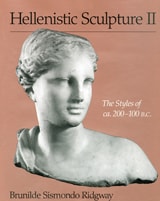
Hellenistic Sculpture II
The Styles of ca. 200–100 B.C.Brunilde Sismondo Ridgway
University of Wisconsin Press, 2008
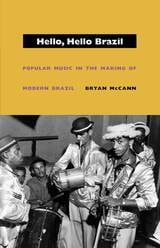
Hello, Hello Brazil
Popular Music in the Making of Modern BrazilBryan McCann
Duke University Press, 2004
McCann explores the links between the growth of the culture industry, rapid industrialization, and the rise and fall of Getúlio Vargas’s Estado Novo dictatorship. He argues that these processes opened a window of opportunity for the creation of enduring cultural patterns and demonstrates that the understandings of popular music cemented in the mid–twentieth century continue to structure Brazilian cultural life in the early twenty-first.
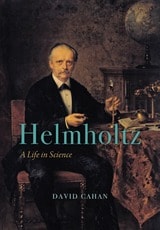
Helmholtz
A Life in ScienceDavid Cahan
University of Chicago Press, 2018
Utilizing all of Helmholtz’s scientific and philosophical writings, as well as previously unknown letters, this book reveals the forces that drove his life—a passion to unite the sciences, vigilant attention to the sources and methods of knowledge, and a deep appreciation of the ways in which the arts and sciences could benefit each other. By placing the overall structure and development of his scientific work and philosophy within the greater context of nineteenth-century Germany, Helmholtz also serves as cultural biography of the construction of the scientific community: its laboratories, institutes, journals, disciplinary organizations, and national and international meetings. Helmholtz’s life is a shining example of what can happen when the sciences and the humanities become interwoven in the life of one highly motivated, energetic, and gifted person.
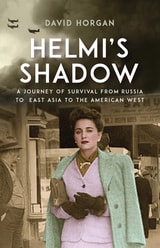
Helmi's Shadow
A Journey of Survival From Russia to East Asia to the American WestDavid Horgan
University of Nevada Press, 2021
Rachel Koskin was a middle-class Russian Jew born in Odessa, Ukraine, in 1896. Ten years later, her family fled from the murderous pogroms against Jews in the Russian Empire eastward to Harbin, a Russian-controlled city within China’s borders on the harsh plain of Manchuria. Full of lively detail and the struggles of being stateless in a time of war, the narrative follows Rachel through her life in Harbin, which became a center of Russian culture in the Far East; the birth of her daughter, Helmi, in Kobe, Japan; their life together in the slums of Shanghai and back in Japan during World War II, where they endured many more hardships; and their subsequent immigration to the United States.
This remarkable account uncovers a history of refugees living in war-torn China and Japan, a history that to this day remains largely unknown. It is also a story of survival during a long period of upheaval and war—from the Russian Revolution to the Holocaust—and an intimate portrait of an American immigrant family. David reveals both the joys and tragedies he experienced growing up in a multicultural household in post\-Second World War America with a Jewish mother, a live-in Russian grandmother, and a devout Irish Catholic American father.
As David develops a clearer awareness of the mysterious past lives of his mother and grandmother—and the impact of these events on his own understanding of the long-term effects of fear, trauma, and loss—he shows us that, even in times of peace and security, we are all shadows of our past, marked by our experiences, whether we choose to reveal them to others or not.
Helmi's Shadow
A Journey of Survival From Russia to East Asia to the American WestDavid Horgan
University of Nevada Press, 2021
Rachel Koskin was a middle-class Russian Jew born in Odessa, Ukraine, in 1896. Ten years later, her family fled from the murderous pogroms against Jews in the Russian Empire eastward to Harbin, a Russian-controlled city within China’s borders on the harsh plain of Manchuria. Full of lively detail and the struggles of being stateless in a time of war, the narrative follows Rachel through her life in Harbin, which became a center of Russian culture in the Far East; the birth of her daughter, Helmi, in Kobe, Japan; their life together in the slums of Shanghai and back in Japan during World War II, where they endured many more hardships; and their subsequent immigration to the United States.
This remarkable account uncovers a history of refugees living in war-torn China and Japan, a history that to this day remains largely unknown. It is also a story of survival during a long period of upheaval and war—from the Russian Revolution to the Holocaust—and an intimate portrait of an American immigrant family. David reveals both the joys and tragedies he experienced growing up in a multicultural household in post\-Second World War America with a Jewish mother, a live-in Russian grandmother, and a devout Irish Catholic American father.
As David develops a clearer awareness of the mysterious past lives of his mother and grandmother—and the impact of these events on his own understanding of the long-term effects of fear, trauma, and loss—he shows us that, even in times of peace and security, we are all shadows of our past, marked by our experiences, whether we choose to reveal them to others or not.