Results by title
2706 books match the query 'European' and 88 start with i
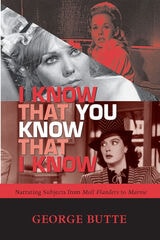
I KNOW THAT YOU KNOW THAT I KNOW
NARRATING SUBJECTS FROM MOLL FLANDERS TO MARNIEGeorge Butte
The Ohio State University Press, 2004
In I Know That You Know That I Know, Butte explores how stories narrate human consciousness. Butte locates a historical shift in the representation of webs of consciousnesses in narrative—what he calls “deep intersubjectivity”—and examines the effect this shift has since had on Western literature and culture. The author studies narrative practices in two ways: one pairing eighteenth-and nineteenth-century British novels (Moll Flanders and Great Expectations, for example), and the other studying genre practices—comedy, anti-comedy and masquerade—in written and film narratives (Jane Austen and His Girl Friday, for example, and Hitchcock’s Cary Grant films).
Butte’s second major claim argues for new ways to read representations of human consciousness, whether or not they take the form of deep intersubjectivity. Phenomenological criticism has lost its credibility in recent years, but this book identifies better reading strategies arising out of what the author calls poststructuralist phenomenology, grounded largely in the work of the French philosopher Merleau-Ponty. Butte criticizes the extreme of transcendental idealism (first-wave phenomenological criticism) and cultural materialism (when it rules out the study of consciousness). He also criticizes the dominant Lacanian framework of much academic film criticism.

I Will Mix Your Blood with Coal
Snapshots from the East of UkraineOleksandr Mykhed, Tanya Savchynska, and David Mossop
Northwestern University Press, 2025
In 2014, the Russian army, with support from local militants, occupied parts of Ukraine’s two easternmost regions—once the beating industrial heart of the Soviet Union—where coal extraction has since exhausted both the human population and the natural resources. In late 2016, Oleksandr Mykhed set out on a research trip to explore the deep history and contested present of the area from the perspective of a fellow countryman who’d never been there.
Mykhed brings us on a painful yet hopeful journey across the Ukrainian east, sharing conversations with locals, snippets from archival documents, and the complicated perspectives of prominent cultural figures, such as writer Serhiy Zhadan, historian Olena Stiazhkina, and philosopher Ihor Kozlovsky, who was imprisoned and tortured for nearly two years.
I Will Mix Your Blood with Coal invites us to meet generations of coal miners. To learn about the Belgian and British investors who founded the east’s industrial cities. To remember the harrowing events of the First and Second World Wars and the incalculable brutality of Soviet history. To see the activists who are even now working to improve the country. To hear sweet memories of a lost utopia that never existed. Mykhed provides a unique portrait of life in the east during the war, before the full-scale invasion that would change everything.
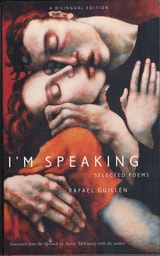
I'm Speaking
Selected PoemsRafael Guillen
Northwestern University Press, 2001
IN THE PRESENCE OF AUDIENCE
THE SELF IN DIARIES AND FICTIONDeborah Martinson
The Ohio State University Press, 2003
As a diary writer imagines shadow readers rifling diary pages, she tweaks images of the self, creating multiple readings of herself, fixed and unfixed. When the readers and potential readers are husbands and publishers, the writer maneuvers carefully in a world of men who are quick to judge and to take offense. She fills the pages with reflections, anecdotes, codes, stories, biographies, and fictions. The diary acts as a site for the writer’s tension, rebellion, and remaking of herself.
In this book Martinson examines the diaries of Virginia Woolf, Katherine Mansfield, Violet Hunt, and Doris Lessing’s fictional character Anna Wulf, and shows that these diaries (and others like them) are not entirely private writings as has been previously assumed. Rather, their authors wrote them knowing they would be read. In these four cases, the audience is the author’s male lover or husband, and Martinson reveals how knowledge of this audience affects the language and content in each diary. Ultimately, she argues, this audience enforces a certain “male censorship” which changes the shape of the revelations, the shape of the writer herself, making it impossible for the female author to be honest in writing about her true self.
Even sophisticated readers often assume that diaries are primarily private. This study interrogates the myth of authenticity and self-revelation in diaries written under the gaze of particular peekers.

INTERROGATING ORIENTALISM
Contextual Approaches and Pedagogical PracticesEdited by Diane Long Hoeveler and Jeffrey Cass
The Ohio State University Press, 2006
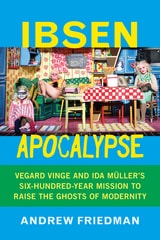
Ibsen Apocalypse
Vegard Vinge and Ida Müller’s Six-Hundred-Year Mission to Raise the Ghosts of ModernityAndrew Friedman
Northwestern University Press, 2026
Presenting a groundbreaking account of an audacious theatrical undertaking
Created by the Norwegian/German duo of Vegard Vinge and Ida Müller, the Ibsen-Saga (2006–present) is a six-hundred-year project to restage Henrik Ibsen’s entire oeuvre. Andrew Friedman presents a groundbreaking historical narrative of this project’s development and dramaturgy, through the theories and practices of modernism’s most influential and controversial artists, including Henrik Ibsen, Richard Wagner, F. T. Marinetti, Erwin Piscator, and Jackson Pollock. Vinge and Müller treat Ibsen’s plays as the urtexts of a mythical struggle between artistic vision and material limits, which they explore through analogous narratives ranging from Hamlet to World Cup soccer matches, all unified by a singular aesthetic that juxtaposes totalizing fiction and extreme reality. As Friedman shows, they mythologize Ibsen’s themes of artistic ambition to resurrect and test modernism’s fantasies of artistic autonomy, totality, creative license, and provocation.
By reading Vinge and Müller’s project through its modernist inspirations, Friedman demonstrates the material and ethical limits of modernist ideals in current theatrical practice, providing new perspectives on the legacy of these pioneering figures. Ibsen Apocalypse is a bold, cross-disciplinary reappraisal of the persistent power of modernity in contemporary performance.
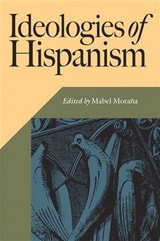
Ideologies of Hispanism
Mabel Moraña
Vanderbilt University Press, 2005
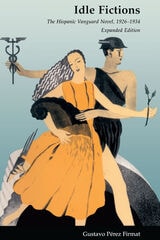
Idle Fictions
The Hispanic Vanguard Novel, 1926-1934, Expanded editionGustavo Pérez Firmat
Duke University Press, 1982
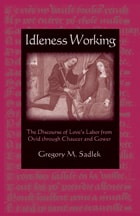
Idleness Working
the Discourse of Love's Labor from Ovid through Chaucer and GowerGregory M. Sadlek
Catholic University of America Press, 2004
Il Turco in Italia
Dramma buffo in Two Acts by Felice RomaniGioachino Rossini
University of Chicago Press, 1988
Iliad, Book 1
Homer
University of Michigan Press, 2002
Illustrating the Victorian Supernatural
Simon Cooke
Ohio University Press, 0
A detailed study of Victorian supernaturalism in book and magazine illustrations and cartoons
Illustrating the Victorian Supernatural explores written and visual texts through which the original Victorian readership encountered and navigated their experience of supernaturalism. Looking across the nineteenth century, Simon Cooke investigates illustrative responses to well-known texts by writers such as Charles Dickens and Henry James while also examining responses to less familiar ghost stories by female authors such as M. E. Braddon and Amelia Edwards. The mix of familiar and unfamiliar carries forward into the selection of artists, both those in the mainstream—John Leech, George Cruikshank, Dante Gabriel Rossetti, John Everett Millais—and others whose names are lost to modern readers and whose work deserves to be better known.
The study addresses two main questions: how illustration responded to key literary texts and how graphic designs related to contemporary contexts of race, gender, and class and to the workings of the supernatural itself. The first chapter focuses on satirical writings about ghosts and ghostliness and the various ways illustrators depicted that mockery. Chapter 2 traces artistic responses to Dickens’s writing of the supernatural as a mode of psychological investigation. Chapter 3 looks at class and gender and the problematic practice of male artists illustrating female-authored ghost stories. The fourth chapter examines satirical cartoons’ deployment of supernatural imagery to anatomize issues of imperialism and race. Finally, chapter 5 examines how neo-Victorian artists have revisited the classic texts and taken up the themes established by their forebears.
Image of Britain 1
Edited by Thomas Mabry Cranfill
University of Texas Press, 1961
Image of Britain 1, originally published in 1961, was the first of two special issues of The Texas Quarterly devoted to Britain. This volume contains three dozen selections, including essays, fiction, poetry, and illustrations, most of them specially commissioned. The editorial aim has been to achieve scope and variety. Surveyed in the articles are a dozen or more facets of British culture, among them politics, education, Anglo-American relations, religion, law, food, changes in class structure, pediatrics, the intellectual climate, scientific progress, and international relations.
Those who labor under the delusion that the British lack humor are advised to read Siriol Hugh-Jones's remarks on the subject, Henry Green's "Firefighting," William Sansom's "Dear Sir," and Willis W. Pratt's article on the great cartoonists Emett and Searle—whose cartoons should then be inspected carefully.
Their cartoons are only a part of the book’s handsome illustrations. In addition, the photographer Hans Beacham visited England at the Quarterly's invitation to depict for American readers distinguished figures in British arts and letters. His gallery of forty-one portraits of writers and other notables has historical as well as artistic importance. Beacham has also contributed twenty-one hauntingly beautiful photographs of the studio of the late great sculptor Sir Jacob Epstein.
Thirty-three of the contributors to this collection are British. There is much to be said for inviting members of this forthright, brilliantly self-critical race to comment extensively on themselves. Among the authors are the young and already noteworthy—Dom Moraes, Ted Hughes, and Alan Sillitoe, for example—as well as the firmly established and celebrated, such as John Wain, William Sansom, and Henry Green.
.
Image of Britain 2
Edited by Thomas Mabry Cranfill
University of Texas Press, 1961
Image of Britain 2, originally published in 1961, was the second of two special numbers of The Texas Quarterly devoted to Britain. This volume comprises some three dozen selections—essays, fiction, poetry, and illustrations, most of them specially commissioned. The editorial aim has been to achieve scope and variety.
The articles, essays in criticism on British themes, for the most part survey literature and the fine arts: poetry, theater, intellectual review, then-recent translations into English, the flood of military memoirs, British humor, architecture, painting and sculpture, and music. Other essays treat individual authors, among them Shakespeare, Trollope, Galsworthy, Forster, Wells, Yeats, Pound, Shaw, Muir, Green, Snow, Waugh, Amis, and Pinter.
All except a handful of the essayists are British. There is much to be said for inviting the forthright and brilliantly self-critical to comment extensively on their own literature and art. Stephen Spender and John Lehmann, two of Britain’s most distinguished editors, deal with British literary matters, both international and domestic; the novelist David Garnett discusses George Moore, Galsworthy, Forster, and H. G. Wells—the men and their works; and the poet Kathleen Raine appraises the verse of Edwin Muir.
Like the essayists, the contributors of fiction and poetry include the emerging and already noteworthy—Ted Hughes, Peter Redgrove, and Andrew Sinclair, for example—as well as the firmly established and celebrated, such as Angus Wilson, Stephen Spender, and Joyce Cary. Cary’s short story “The Ball” appeared here in print for the first time.
The photographer Hans Beacham, who visited England at the Quarterly’s invitation, contributed a gallery of portraits of important British painters and sculptors. The photographs complement David Sylvester’s article on contemporary British art. In addition, Edward Bawden’s drawings of the British scene run like a charming frieze throughout this number.

Imagination Transformed
The Evolution of the Female Character in Keat's PoetryKarla Alwes
Southern Illinois University Press, 1993
From the mortal maidens of 1817 to the omnipotent goddesses of 1819, Keats uses successive female characters as symbols portraying the salvation and destruction, the passion and fear that the imagination elicits. Karla Alwes traces the change in these female figures—multidimensional and mysteriously protean—and shows that they do more than comprise a symbol of the female as a romantic lover. They are the gauge of Keats’s search for identity. As Keats’s poetry changes with experience, from celebration to denial of the earth, the females change from meek to threatening to a final maternal and conciliatory figure.
Keats consistently maintained a strict dichotomy between the flesh-and-blood women he referred to in his letters and the created females of his poetry, in the same way that he rigorously sought to abandon the real for the ideal in his poetry. In her study of Keats’s poetry, Alwes dramatizes the poet’s struggle to come to terms with his two consummate ideals—women and poetry. She demonstrates how his female characters, serving as lovers, guides, and nemeses to the male heroes of the poems, embody not only the hope but also the disappointment that the poet discovers as he strives to reconcile feminine and masculine creativity. Alwes also shows how the myths of Apollo, which Keats integrated into his poetry as early as February 1815, point up his contradictory need for, yet fear of, the feminine. She argues that Keats’s attempt to overcome this fear, impossible to do by concentrating solely on Apollo as a metaphor for the imagination, resulted in his eventual use of maternal goddesses as poetic symbols.
The goddess Moneta in "The Fall of Hyperion" reclaims the power of the maternal earth to represent the final stage in the development of the female. In combining the wisdom of the Apollonian realm with the compassion of the feminine earth, Moneta is more powerful than Apollo and able to show the poet who does not recognize both realms that he is only a "dreamer," one who "venoms all his days, / Bearing more woe than all his sins deserve."
Because of Moneta’s admonishment, Keats becomes the poet capable of creating "To Autumn." In this final ode, Keats taps the transcendent power inherent in the temporal beauty of the earth. His imagination, once attempting to leave the earth, now goes beyond the Apollonian ideal into the realm of salvation—the human heart—that connects him to the earth. And because of his poetic reconciliation between heaven and earth, Keats is ultimately able to portray an earthly timelessness in which "summer has o’er-brimmed" the bees’ "clammy cells," making for "warm days [that] will never cease."
Imagination and the Arts in C.S. Lewis
Journeying to Narnia and Other WorldsPeter J. Schakel
University of Missouri Press, 2002
Imagination has long been regarded as central to C. S. Lewis's life and to his creative and critical works, but this is the first study to provide a thorough analysis of his theory of imagination, including the different ways he used the word and how those uses relate to each other. Peter Schakel begins by concentrating on the way reading or engaging with the other arts is an imaginative activity. He focuses on three books in which imagination is the central theme—Surprised by Joy, An Experiment in Criticism, and The Discarded Image—and shows the important role of imagination in Lewis's theory of education.
He then examines imagination and reading in Lewis's fiction, concentrating specifically on the Chronicles of Narnia, the most imaginative of his works. He looks at how the imaginative experience of reading the Chronicles is affected by the physical texture of the books, the illustrations, revisions of the texts, the order in which the books are read, and their narrative "voice," the "storyteller" who becomes almost a character in the stories.
Imagination and the Arts in C. S. Lewis also explores Lewis's ideas about imagination in the nonliterary arts. Although Lewis regarded engagement with the arts as essential to a well- rounded and satisfying life, critics of his work and even biographers have given little attention to this aspect of his life. Schakel reviews the place of music, dance, art, and architecture in Lewis's life, the ways in which he uses them as content in his poems and stories, and how he develops some of the deepest, most significant themes of his stories through them.
Schakel concludes by analyzing the uses and abuses of imagination. He looks first at "moral imagination." Although Lewis did not use this term, Schakel shows how Lewis developed the concept in That Hideous Strength and The Abolition of Man long before it became popularized in the 1980s and 1990s. While readers often concentrate on the Christian dimension of Lewis's works, equally or more important to him was their moral dimension.
Imagination and the Arts in C. S. Lewis will appeal to students and teachers of both children's literature and twentieth-century British writers. It will also be of value to readers who wish to compare Lewis's creations with more recent imaginative works such as the Harry Potter series.

Imagined Dialogues
Eastern European Literature in Conversation with American and English LiteratureGordana Crnkovic
Northwestern University Press, 1999
Imagined Spiritual Communities in Britain's Age of Print
Joshua King
The Ohio State University Press, 2015
Focusing primarily on the work of Anglicans between the 1820s and 1890s, this study begins by freshly interpreting reading and educational programs promoted by Samuel Taylor Coleridge, Frederick Denison Maurice, and Matthew Arnold. King then traces the emergence of John Keble’s Christian Year as a catalyst for competing visions of a Christian nation united by private reading. He argues that this phenomenon illuminates the structure and reception of best-selling poetic cycles as diverse as Alfred Tennyson’s In Memoriam and Christina Rossetti’s late Verses. Ultimately, Imagined Spiritual Communities reveals how dreams of print-mediated spiritual communion generated new poetic genres and rhetorical strategies, theories and theologies of media and reading, and ambitious schemes of education and church reform.
Imagining A Medieval English Nation
Kathy Lavezzo
University of Minnesota Press, 2003
The first comprehensive analysis of English national identity in the late Middle Ages
During the late Middle Ages, the increasing expansion of administrative, legal, and military systems by a central government, together with the greater involvement of the commons in national life, brought England closer than ever to political nationhood. Examining a diverse array of texts—ranging from Latin and vernacular historiography to Lollard tracts, Ricardian poetry, and chivalric treatises—this volume reveals the variety of forms “England” assumed when it was imagined in the medieval West.
These essays disrupt conventional thinking about the relationship between premodernity and modernity, challenge traditional preconceptions regarding the origins of the nation, and complicate theories about the workings of nationalism. Imagining a Medieval English Nation is not only a collection of new readings of major canonical works by leading medievalists, it is among the first book-length analyses on the subject and of critical interest. Contributors: Kathleen Davis, Bucknell U; L. O. Aranye Fradenburg, U of California, Santa Barbara; Andrew Galloway, Cornell U; Jill C. Havens, Baylor U; Peggy A. Knapp, Carnegie Mellon U; Larry Scanlon, Rutgers U; D. Vance Smith, Princeton U; Claire Sponsler, U of Iowa; Lynn Staley, Colgate U; Thorlac Turville-Petre, U of Nottingham.
Imagining Adoption
Essays on Literature and CultureMarianne Novy, Editor
University of Michigan Press, 2003
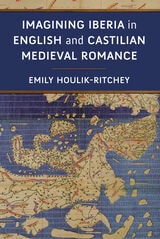
Imagining Iberia in English and Castilian Medieval Romance
Emily Houlik-Ritchey
University of Michigan Press, 2023

Imagining Mary Tudor, Queen of France
JoAnn DellaNeva
University of Delaware Press, 2027
This book examines early modern texts that portray Mary Tudor’s girlhood and betrothal to a foreign prince, her brief marriage to the aging king of France, and her untimely widowhood, as well as retrospective accounts that depict her life in France, her relationships with her husband and his heir apparent, and her surreptitious romance and clandestine marriage to an English duke. Here, texts from England are put into conversation with a significant body of work that was written in French, Spanish, Italian, and Latin, culminating in an examination of a novel from North America that passed itself off as a genuine sixteenth-century memoir. Author JoAnn DellaNeva also examines a spectrum of extra-literary texts—such as dialogues, popular songs, letters, speeches, portraiture, tapestries, fashion, jewelry, and book illuminations—for the ways they too helped shape Mary’s image. In so doing, she analyzes the intersection of history and literature, demonstrating how porous the borders between these disciplines can be. Through a series of close readings that are informed by an examination of the cultural context behind these texts, Imagining Mary Tudor, Queen of France seeks to explain how Mary’s fictional biography proved to be so slippery, vacillating between portrayals of her as a virtuous, generally powerless woman and as a wily and wicked minx.
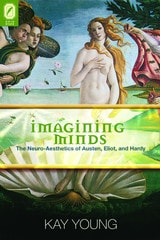
Imagining Minds
The Neuro-Aesthetics of Austen, Eliot, and HardyKay Young
The Ohio State University Press, 2010
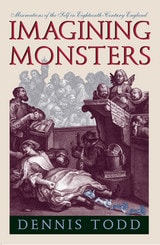
Imagining Monsters
Miscreations of the Self in Eighteenth-Century EnglandDennis Todd
University of Chicago Press, 1995
Mary Toft's outrageous claim was accepted because of a common belief that the imagination of a pregnant woman could deform her fetus, creating a monster within her. Drawing on largely unexamined material from medicine, embryology, philosophy, and popular "monster" exhibitions, Todd shows that such ideas about monstrous births expressed a fear central to scientific, literary, and philosophical thinking: that the imagination could transgress the barrier between mind and body.
In his analysis of the Toft case, Todd exposes deep anxieties about the threat this transgressive imagination posed to the idea of the self as stable, coherent, and autonomous. Major works of Pope and Swift reveal that they, too, were concerned with these issues, and Imagining Monsters provides detailed discussions of Gulliver's Travels and The Dunciad illustrating how these writers used images of monstrosity to explore the problematic nature of human identity. It also includes a provocative analysis of Pope's later work that takes into account his physical deformity and his need to defend himself in a society that linked a deformed body with a deformed character.
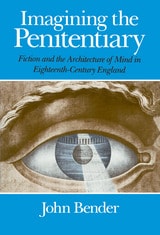
Imagining the Penitentiary
Fiction and the Architecture of Mind in Eighteenth-Century EnglandJohn Bender
University of Chicago Press, 1987
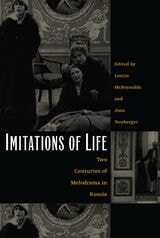
Imitations of Life
Two Centuries of Melodrama in RussiaLouise McReynolds and Joan Neuberger, eds.
Duke University Press, 2002
Drawing on a wide variety of sources, including plays, lachrymose novels, popular movies, and even highly publicized funerals and political trials, the essays in Imitations of Life argue that melodrama has consistently offered models of behavior for times of transition, and that contemporary televised versions of melodrama continue to help Russians cope with national events that they understand implicitly but are not yet able to articulate. In contrast to previous studies, this collection argues for a reading that takes into account the subtle but pointed challenges to national politics and to gender and class hierarchies made in melodramatic works from both the nineteenth and twentieth centuries. Collectively, the contributors shift and cross borders, illustrating how the cultural dismissal of melodrama as fundamentally escapist and targeted primarily at the politically disenfranchised has subverted the drama’s own intrinsically subversive virtues.
Imitations of Life will interest students and scholars of contemporary Russia, and Russian history, literature, and theater.
Contributors. Otto Boele, Julie Buckler, Julie Cassiday, Susan Costanzo, Helena Goscilo, Beth Holmgren, Lars Lih, Louise McReynolds, Joan Neuberger, Alexander Prokhorov, Richard Stites
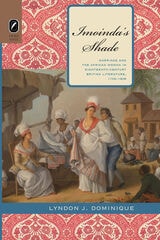
Imoinda’s Shade
Marriage and the African Woman in Eighteenth-Century British Literature, 1759–1808Lyndon J. Dominique
The Ohio State University Press, 2012
As the eighteenth century is entirely bereft of narratives written by African women, one might assume that these women had little to no impact on British literature and the national psyche of the period. Yet these kinds of assumptions are belied by the influence of one prominent African woman featured in the period’s literary texts.

Impact of Migration on Poland
EU Mobility and Social ChangeAnne White, Izabela Grabowska, Pawel Kaczmarczyk, and Krystyna Slany
University College London, 2018
The Impact of Migration on Poland offers a new approach for understanding how migration affects sending countries and provides a wide-ranging analysis of how Poland has changed, and continues to change, since accession to the European Union in 2004. The authors explore an array of social trends and their causes before using in-depth interview data to illustrate how migration contributes to those causes. They address fundamental questions about whether and how Polish society is becoming more equal and more cosmopolitan, arguing that for particular segments of society migration does make a difference. While the book focuses mainly on those who have stayed in Poland, and their contacts with Poles in other countries, it also analyzes Polish society abroad, a concept that is a far more accurate description than “community” in countries such as the UK.
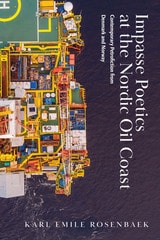
Impasse Poetics at the Nordic Oil Coast
Contemporary Petrofiction from Denmark and NorwayKarl Emil Rosenbaek Reetz
West Virginia University Press, 2026

Imperial Bibles, Domestic Bodies
Women, Sexuality, and Religion in the Victorian MarketMary Wilson Carpenter
Ohio University Press, 2003
Of the many literary phenomena that sprang up in eighteenth-century England and later became a staple of Victorian culture, one that has received little attention until now is the “Family Bible with Notes.” Published in serial parts to make it affordable, the Family Bible was designed to enhance the family’s status and sense of national and imperial identity.
Imperial Bibles, Domestic Bodies reveals in its study of the production and consumption of British commercial Family Bibles startling changes in “family values.” Advertised in the eighteenth century as providing the family with access to “universal knowledge,” these Bibles suddenly shifted in the early nineteenth century to Bibles with bracketed sections marked “to be omitted from family reading” and reserved for reading “in the closet” by the “Master of the family.” These disciplinary Bibles were paralleled by Family Bibles designed to appeal to the newly important female consumer. Illustrations featured saintly women and charming children, and “family registers” with vignettes of family life emphasized the prominent role of the “angel in the house.”
As Mary Wilson Carpenter documents in Imperial Bibles, Domestic Bodies, the elaborate notes and “elegant engravings” in these Bibles bring to light a wealth of detail about the English commonsense view of such taboo subjects as same-sex relations, masturbation, menstruation, and circumcision. Her reading of literary texts by Charlotte Brontë, George Eliot, and Elizabeth Barrett Browning in the context of these commercial representations of the “Authorized Version” or King James translation of the Bible indicates that when the Victorians spoke about religion, they were also frequently speaking about sex.

Imperial Desire
Dissident Sexualities And Colonial LiteraturePhilip Holden
University of Minnesota Press, 2003
Illuminates the intersections between colonial thought and homosexuality
An exploration of the intersection of colonialism and homosexuality in fiction and travel writing from Robinson Crusoe to the present, this volume brings together two dynamic fields of academic inquiry: colonial discourse analysis, which considers literary texts as expressions of colonial power; and queer theory, which interrogates the representation, enforcement, and subversions of sexualities in literature and culture.
These writers reexamine the work of Kipling, Conrad, Forster, Lessing, and others, ranging from male adventure stories to postcolonial novels. This volume will provoke and inform readers concerned with gender and sexuality, colonial history and literature, or with any of the works and authors revisited—and reexperienced—here. Contributors: Anjali Arondekar, U of California, Santa Cruz; John C. Beynon, California State U, Fresno; Joseph A. Boone, USC; Sarah Cole, Columbia U; Lois Cucullu, U of Minnesota; Maria Davidis, Cornell; Dennis Denisoff, Ryerson U; Mark Forrester, U of Maryland; Terry Goldie, York U; Christopher Lane, Northwestern U; Tim Middleton, Bath Spa U College, UK; Hans Turley, U of Connecticut.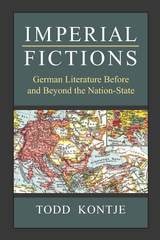
Imperial Fictions
German Literature Before and Beyond the Nation-StateTodd Kontje
University of Michigan Press, 2018
Imperial Media
Colonial Networks and Information Technologies in the British Literary Imagination, 1857–1918Aaron Worth
The Ohio State University Press, 2014
Imperial Media: Colonial Networks and Information Technologies in the British Literary Imagination, 1857–1918 brings together two of the most dynamic and productive approaches to the study of nineteenth-century literature in recent years—media studies and colonial studies—to illuminate the rich and enduring symbiosis that developed between information technologies and Empire. Over a century before Facebook and the iPhone, Britons relied on the electric media of their day for information about their global empire—but those media, which during Victoria’s reign stretched out its tentacles to form a true “world wide web,” not only delivered information but provided conceptual frames as well, helping to shape the way their users thought.
Ranging in space from the telegraph offices of Kipling’s India to the wireless transmitter on H.G. Wells’s Africanized moon, and in time from the Sepoy Rebellion to the Great War, Imperial Media reveals the extent to which British conceptions of imperial power were inflected by the new media of the nineteenth century: the telegraph, telephone, phonograph, radio, and cinema.
While focusing on the fiction of Kipling, Wells, Marie Corelli, H. Rider Haggard, and John Buchan (“the last Victorian,” in Gertrude Himmelfarb’s phrase), Aaron Worth also argues that the “imperial media” of the Victorians retain much of their imaginative life and power today, informing such popular entertainments of the twenty-first century as Bollywood cinema and the BBC’s science-fiction franchise Torchwood. This is a vital, engaging study that will shape future discussions of both colonial and information systems, as well as the relationship between the two, in Victorian studies and elsewhere.
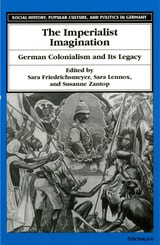
Imperialist Imagination
German Colonialism and Its LegacySara Friedrichsmeyer, Sara Lennox, and Susanne Zantop, Editors
University of Michigan Press, 1998
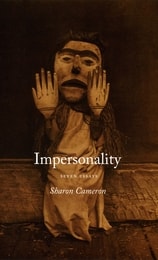
Impersonality
Seven EssaysSharon Cameron
University of Chicago Press, 2007
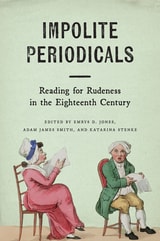
Impolite Periodicals
Reading for Rudeness in the Eighteenth CenturyEmrys D. Jones
Bucknell University Press, 2026
With an afterword by Manushag N. Powell.
Published by Bucknell University Press. Distributed worldwide by Rutgers University Press.
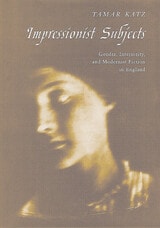
Impressionist Subjects
Gender, Interiority, and Modernist Fiction in EnglandTamar Katz
University of Illinois Press, 2000
Sophisticated and tightly argued, Impressionist Subjects is a substantial contribution to the reassessment and expansion of the modernist fiction canon.
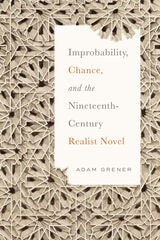
Improbability, Chance, and the Nineteenth-Century Realist Novel
Adam Grener
The Ohio State University Press, 2020
Contemporary thinking about probability came to recognize the variability and even randomness of the world while also discovering how patterns and order reemerge at scale. Reading chance as a tension between randomness and order, Grener shows how novels by Jane Austen, Sir Walter Scott, Charles Dickens, Anthony Trollope, and Thomas Hardy resist the demands of probabilistic representation and develop strategies for capturing cultural particularity and historical transformation. These authors served their visions of realism by tactically embracing improbability in the form of coincidences, fatalism, supernaturalism, and luck. Understanding this strategy helps us to appreciate how realist novels work to historicize the social worlds and experiences they represent and asks us to rethink the very foundation of realism.
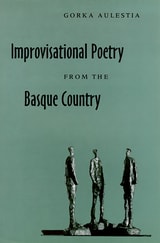
Improvisational Poetry from the Basque Country
Gorka Aulestia
University of Nevada Press, 1995
Foreword by William A. Douglass Translated by Lisa Corcostegui and Linda White.Improvisational Poetry from the Basque Country introduces the Basque bertsolari to the English-speaking world and provides an understanding of an interesting cultural phenomenon—the artist in Basque society who is capable of improvising verse on any subject spontaneously and setting it to music. The tradition is at least several centuries old and runs the gamut from amateurish efforts to periodic national championship competitions. These competitions draw thousands of listeners and pack theaters while many other thousands tune their radios to the broadcasts of the performances. Aulestia takes a scholarly and in-depth look at the art of the bertsolari. In a fascinating text, the author examines the history of a tradition that is truly unique and completely Basque. He introduces and analyzes the performing styles of great bertsolariak, including Xabier Amuriza and Jon Azpillaga. From the bertsolari’s roots in the old Basque Country to the social phenomenon it is today, Aulestia’s look at the improvisational oral literature of the Basques is an essential addition to their written history.
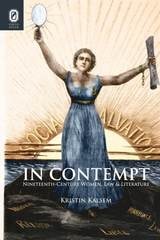
In Contempt
Nineteenth-Century Women, Law, and LiteratureKristin Kalsem
The Ohio State University Press, 2012
In Contempt: Nineteenth-Century Women, Law, and Literature, by Kristin Kalsem, explores the legal advocacy performed by nineteenth-century women writers in publications of nonfiction and fiction, as well as in real-life courtrooms and in the legal forum provided by the novel form.
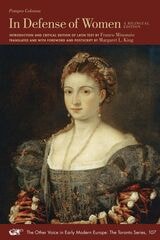
In Defense of Women
A Bilingual EditionPompeo Colonna
Iter Press, 2024
Pompeo Colonna’s In Defense of Women (1530), presented in this volume in Latin and English translation, is one of several important defenses of women composed in the fifteenth and sixteenth centuries by male advocates of women’s moral and intellectual worth. Known as a cardinal and a warrior, but also as an active participant in sixteenth-century Italian literary circles, Colonna addresses the work to his cousin Vittoria Colonna, the most renowned Italian woman poet of the era, who, he writes, had urged him to undertake it. His Defense not only refutes arguments of women’s inferiority and incapacity but, remarkably, asserts their ability to hold political office and govern. It contains original Latin text and a critical introduction by Franco Minonzio. It also features a foreword by Margaret L. King, as well as a postscript by King, tracing the separate male-authored and female-authored Renaissance defenses of women.
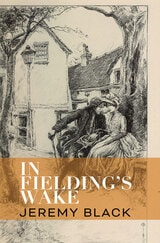
In Fielding’s Wake
Jeremy Black
St. Augustine's Press, 2022
Fielding's epic comic novel, Tom Jones, is unforgettable for many reasons, but the author must be credited with an aptitude for documenting contemporary cultural history and his contribution to a new species of writing. Black's treatment of Fielding draws to the fore a man who was of his time but not confined to it. "Philosophy in practice encompassed his stance as a man of action as well as a reflective writer of genius." Fielding is shown to provide across the breadth of his work extensive and invaluable commentary on issues as diverse as law and order, marriage, women, and the interplay of urban and rural life. Black, an historian, is here a student of storytelling and recovers Fielding's rich descriptions of the human heart and call to defy the vices with which circumstances might taunt it.
Black has done a service along many fronts at once: the science of the novel and genre, the history of a people and the figure of a memorable writer.
In Human Scale
Victorian Literature and the Planetary ImaginationBenjamin Morgan
University of Chicago Press, 2027
An innovative account of how literature has helped bridge the gap between ordinary human experience and the vast scale of the natural world.
Is it possible to connect our lived experience of time to the vast eons of the planet’s history? This question has perplexed writers and scientists for more than two hundred years, from Darwin’s account of natural selection through contemporary writing about climate change. Benjamin Morgan’s insightful study shows how literature of the nineteenth century helped readers leap from their everyday sense of time and space to the vast, inhuman scales of the natural world.
Exploring writings that range from Arctic voyage narratives to Thomas Hardy’s novels, utopian fiction of the 1880s, H. G. Wells’s The Time Machine, and beyond, Morgan situates scalar incommensurability in its deeper intellectual and cultural contexts. Victorians struggled to grasp senses of proportion not only through time scales but also through scales of aesthetic magnitude, of relative value, of social totality, and of the planet’s future. Morgan argues that a scale is not just a timeline; it is a way of finding order and proportion through many kinds of comparative measurement. His literary history of scale illuminates both the challenge of imagining the vastness of planetary time and the history of creating a human sense of proportion.
In Praise of Antiheroes
Figures and Themes in Modern European Literature, 1830-1980Victor Brombert
University of Chicago Press, 1999
Though they fail, by design, to live up to conventional expectations of mythic heroes, antiheroes are not necessarily "failures." They display different kinds of courage more in tune with our time and our needs: deficiency translated into strength, failure experienced as honesty, dignity achieved through humiliation. Brombert explores these paradoxes in the works of Büchner, Gogol, Dostoevsky, Flaubert, Svevo, Hašek, Frisch, Camus, and Levi. Coming from diverse cultural and linguistic traditions, these writers all use the figure of the antihero to question handed-down assumptions, to reexamine moral categories, and to raise issues of survival and renewal embodying the spirit of an uneasy age.
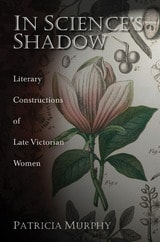
In Science's Shadow
Literary Constructions of Late Victorian WomenPatricia Murphy
University of Missouri Press, 2006
The Victorian era was characterized by great scientific curiosity—as exemplified by the publication of Darwin’s Descent of Man—as well as by new questions regarding the place of women in society. Patricia Murphy now explores the tenuous interplay of gender and science to show how the era’s literature both challenged and reinforced a constrictive role for Victorian women. Focusing on a specific body of literature involving women intensely associated with scientific pursuits, and examining selected noncanonical writings—both fictional and nonfictional representations of scientific women—Murphy demonstrates how these works informed the “Woman Question” by reinforcing or rejecting presumed truths about gender and science.
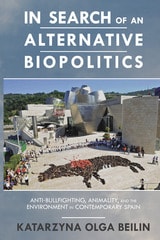
In Search of an Alternative Biopolitics
Anti-Bullfighting, Animality, and the Environment in Contemporary SpainKatarzyna Olga Beilin
The Ohio State University Press, 2015
Analyses of the synergy of press debates on bullfighting and the War on Terror, as well as media debates on King Juan Carlos’s hunt in Botswana and his resignation, reveal how the concepts structuring human/animal relations condition national biopolitics. Beilin traces a main principle, where sacrifice of some lives is deemed necessary for the sake of others, from bullfighting, through environmental destruction and immigration policies, to bioeconomy. Ultimately, In Search of an Alternative Biopolitics argues that to address ever-increasing threats of global warming and future catastrophes, we urgently need to redefine concepts structuring the human and the nonhuman realms.
In Space We Read Time
On the History of Civilization and GeopoliticsKarl Schlögel
Bard Graduate Center, 2016
Here is both a model for thinking about history within physical space and a stimulating history of thought about space, as Schlögel reads historical periods and events within the context of their geographical location. Discussions range from the history of geography in France to what a town directory from 1930s Berlin can say about professional trades that have since disappeared. He takes a special interest in maps, which can serve many purposes—one poignant example being the German Jewish community’s 1938 atlas of emigration, which showed the few remaining possibilities for escape. Other topics include Thomas Jefferson’s map of the United States; the British survey of India; and the multiple cartographers with Woodrow Wilson at the Paris Peace Conference, where the aim was to redraw Europe’s boundaries on the basis of ethnicity. Moving deftly from the Austro-Hungarian Empire to 9/11 and from Vermeer’s paintings to the fall of the Berlin Wall, this intriguing book presents history from a completely new perspective.

In a Cabin, in the Woods
Michael Krüger
Seagull Books, 2024
When the COVID-19 pandemic hit, Michael Krüger was suffering from severe shingles and just beginning treatment for leukemia. Because his immune system was so compromised that even a cough would have knocked him flat, he had to stay away from people. He retired to a wooden house near Lake Starnberg in Germany, and from there he dispatched his poetic messages. Krüger’s meditations from quarantine were printed for many months in the magazine of the Süddeutsche Zeitung and met with an enthusiastic response. In a Cabin, in the Woods collects fifty tableaux of nature, images of the immediate surroundings of a restricted life that also look beyond the horizon. At the same time, these poems look inward to explore transience, illness, and death. Humorous and melancholy, these are studies of the world made with the tiniest compass—meditations on nature and the nature of self that touch us all.
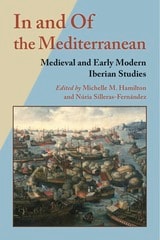
In and Of the Mediterranean
Medieval and Early Modern Iberian StudiesMichelle M. Hamilton
Vanderbilt University Press, 2014
In the Shadow's Light
Yves Bonnefoy
University of Chicago Press, 1991
"Included here is a very helpful and touchingly personal interview with the poet. . . . For readers with no prior knowledge of Bonnefoy's work, this volume would be an excellent place to start."—Stephen Romer, Times Literary Supplement