Results by title
4917 books match the query 'Philosophy' and 177 start with i
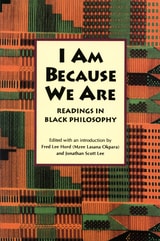
I Am Because We Are
Readings in Africana PhilosophyFred Lee Hord
University of Massachusetts Press, 2016
First published in 1995, I Am Because We Are has been recognized as a major, canon-defining anthology and adopted as a text in a wide variety of college and university courses. Bringing together writings by prominent Black thinkers from Africa, the Caribbean, and North America, Fred Lee Hord and Jonathan Scott Lee made the case for a tradition of “relational humanism” distinct from the philosophical preoccupations of the West.
Over the past twenty years, however, new scholarly research has uncovered other contributions to the discipline now generally known as “Africana philosophy” that were not included in the original volume. In this revised and expanded edition, Hord and Lee build on the strengths of the earlier anthology while enriching the selection of readings to bring the text into the twenty-first century. In a new introduction, the editors reflect on the key arguments of the book's central thesis, refining them in light of more recent philosophical discourse. This edition includes important new readings by Kwame Gyekye, Oyeronke Oy ewumi, Paget Henry, Sylvia Wynter, Toni Morrison, Charles Mills, and Tommy Curry, as well as extensive suggestions for further reading.

I Surf, Therefore I Am
A Philosophy of SurfingPeter Kreeft
St. Augustine's Press, 2008

I Think I Am
Philip K. DickLaurence A. Rickels
University of Minnesota Press, 2010

I Was More American than the Americans
Sylvère Lotringer in Conversation with Donatien GrauSylvère Lotringer and Donatien Grau
Diaphanes, 2021
In the mid-1970s, Sylvère Lotringer created Semiotext(e), a philosophical group that became a magazine and then a publishing house. Since its creation, Semio-text(e) has been a place of stimulating dialogue between artists and philosophers, and for the past fifty years, much of American artistic and intellectual life has depended on it. The model of the journal and the publishing house revolves around the notion of the collective, and Lotringer has rarely shared his personal journey: his existence as a hidden child during World War II; the liberating and then traumatic experience of the collective in the kibbutz; his Parisian activism in the 1960s; his time of wandering, that took him, by way of Istanbul, to the United States; and then, of course, his American years, the way he mingled his nightlife with the formal experimentation he invented with Semiotext(e) and with his classes. Since the early 2010s, Donatien Grau has developed the habit of visiting Lotringer during his trips to Los Angeles; some of their dialogs were published or held in public. This book is an entry into Lotringer's life, his friendships, his choices, and his admiration for some of the leading thinkers of our times. The conversations between Lotringer and Grau show bursts of life, traces of a journey, through texts and existence itself, with an unusual intensity.
Ibn Khaldun
An Essay in ReinterpretationAziz Al-Azmeh
Central European University Press, 2003
Since its publication in 1981, this book has established itself as the major new interpretation of the historical concept of Ibn Khaldûn, the great figure of Arab-Islamic letters and of historical thought overall--a figure generally thought to be on a par with Thucydides, Vico, Herder and others of similar stature.
The author has eschewed the ahistorical interpretations to which Ibn Khaldûn has normally been subjected, both by authors who have sought unduly to modernise his thought, and by those who sought to freeze it in stereotypical models of Islamic philosophy.
Ibn Khaldûn is not only a true historical source of his time; he is also taken as the unchallenged sociological and cultural interpreter of medieval North Africa and much of medieval and modern Arab-Islamic culture as well. The validity of his discourse is considered to be so universal as to confer upon his ideas the status of progenitor--or, at least, anticipator--of a great variety of modern ideas.
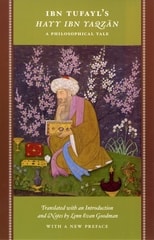
Ibn Tufayl's Hayy Ibn Yaqzan
A Philosophical TaleIbn Tufayl
University of Chicago Press, 2009
The Arabic philosophical fable Hayy Ibn Yaqzan is a classic of medieval Islamic philosophy. Ibn Tufayl (d. 1185), the Andalusian philosopher, tells of a child raised by a doe on an equatorial island who grows up to discover the truth about the world and his own place in it, unaided—but also unimpeded—by society, language, or tradition. Hayy’s discoveries about God, nature, and man challenge the values of the culture in which the tale was written as well as those of every contemporary society.
Goodman’s commentary places Hayy Ibn Yaqzan in its historical and philosophical context. The volume features a new preface and index, and an updated bibliography.
“One of the most remarkable books of the Middle Ages.”—Times Literary Supplement
“An enchanting and puzzling story. . . . The book transcends all historical and cultural environments to settle upon the questions of human life that perpetually intrigue men.”—Middle East Journal
“Goodman has done a service to the modern English reader by providing a readable translation of a philosophically significant allegory.”—Philosophy East and West
“Add[s] bright new pieces to an Islamic mosaic whose general shape is already known.”—American Historical Review

Icastes
Marsilio Ficino's Interpretation of Plato's SophistMichael J. B. Allen
Arizona Center for Medieval and Renaissance Studies, 2016
New 2016 paperback edition of the original 1989 printing (out-of-print).
Michael Allen's latest work on the profoundly influential Florentine thinker of the fifteenth century, Marsilio Ficino, will be welcomed by philosophers, literary scholars, and historians of the Renaissance, as well as by classicists. Ficino was responsible for inaugurating, shaping, and disseminating the wide-ranging philosophico-cultural movement known as Renaissance Platonism, and his views on the Sophist, which he saw as Plato's preeminent ontological dialogue, are of signal interest. This dialogue also served Ficino as a vehicle for exploring a number of other humanist, philosophical, and magical preoccupations, including the theme of man the artist and creator.
Iconology
Image, Text, IdeologyW. J. T. Mitchell
University of Chicago Press, 1986
Idea of Phenomenology
Husserlian ExemplarismAndre de Muralt
Northwestern University Press, 1988
Idealism and Liberal Education
James O. Freedman
University of Michigan Press, 2001
Idealization and the Aims of Science
Angela Potochnik
University of Chicago Press, 2017
Idealization and the Aims of Science shows just how crucial idealization is to science and why it matters. Beginning with the acknowledgment of our status as limited human agents trying to make sense of an exceedingly complex world, Angela Potochnik moves on to explain how science aims to depict and make use of causal patterns—a project that makes essential use of idealization. She offers case studies from a number of branches of science to demonstrate the ubiquity of idealization, shows how causal patterns are used to develop scientific explanations, and describes how the necessarily imperfect connection between science and truth leads to researchers’ values influencing their findings. The resulting book is a tour de force, a synthesis of the study of idealization that also offers countless new insights and avenues for future exploration.
Ideas Have Consequences
Richard M. Weaver
University of Chicago Press, 1984
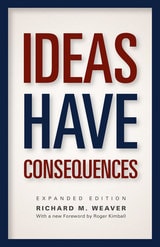
Ideas Have Consequences
Expanded EditionRichard M. Weaver
University of Chicago Press, 2013
In its pages, Richard M. Weaver argues that the decline of Western civilization resulted from the rising acceptance of relativism over absolute reality. In spite of increased knowledge, this retreat from the realist intellectual tradition has weakened the Western capacity to reason, with catastrophic consequences for social order and individual rights. But Weaver also offers a realistic remedy. These difficulties are the product not of necessity, but of intelligent choice. And, today, as decades ago, the remedy lies in the renewed acceptance of absolute reality and the recognition that ideas—like actions—have consequences.
This expanded edition of the classic work contains a foreword by New Criterion editor Roger Kimball that offers insight into the rich intellectual and historical contexts of Weaver and his work and an afterword by Ted J. Smith III that relates the remarkable story of the book’s writing and publication.
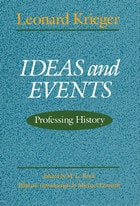
Ideas and Events
Professing HistoryLeonard Krieger
University of Chicago Press, 1992
This book reflects Krieger's conviction that the value of intellectual history is as a source of orientation in a world of information overload. In Krieger's hands, intellectual history has stressed "thinking-through" the relations between ideas and events rather than the compilation and recapitulation of mere facts and historical categories.
The essays in this collection cover a range of topics, including history of ideas, intellectual history, early modern political history, German political history, Hegel, Marx, and more. Many of these essays are already classics of historical scholarship. With the demise of the Soviet Union and state-sponsored Marxism, and with the reunification of Germany, Krieger's history takes on new relevance and a renewed importance.
With a splendid introduction by Michael Ermath, and an extensive bibliography of Krieger's most important books and essays, this is a "must read" for every serious student of modern history.
Leonard Krieger was University Professor Emeritus in the Department of History at the University of Chicago until his death in 1990.
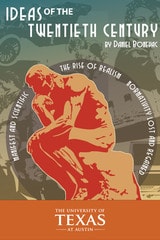
Ideas of the Twentieth Century
Daniel Bonevac
University of Texas Press, 2014
The twentieth century ushered in significant progress, as philosophers, scientists, artists, and poets across the world improved the way we lived. Yet the last century also brought increased levels of war, tyranny, and genocide, and people lost faith in values. Now, thinkers and leaders are reconstructing theories of value and creating institutions to embody them. In this thought-provoking, broad-sweeping course, you will learn how philosophy, art, literature, and history shaped the past century and continue to impact our world today.
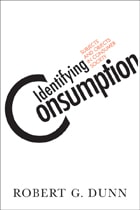
Identifying Consumption
Subjects and Objects in Consumer SocietyRobert G. Dunn
Temple University Press, 2008
Identifying Consumption illustrates how an individual’s buying habits are shaped by the dynamics of the consumer marketplace—and thus how consumption and identity inform each other. Robert Dunn brings together the various theories of spending and develops a mode of analysis concentrating on the individual subjectivity of consumption. By doing so, he addresses how we spend and its relationship with status and lifestyle.
Dunn provides a comprehensive guide to the study of modern consumer behavior before summarizing and critiquing the major theories of consumption. At this juncture, he proposes a method of analysis that focuses on the significance of status and lifestyle in social relations that can help explain how the consumer marketplace is shaped. He concludes by raising issues about different ways of consuming and the relationship between consumption and identity.
Identity and Difference
Martin Heidegger
University of Chicago Press, 2002
Two essential works by Heidegger on the nature of identity
Identity, Language, and Mind
An Introduction to the Philosophy of John PerryEdited by Albert Newen and Raphael van Riel
CSLI, 2012
Identity/Difference
Democratic Negotiations of Political ParadoxWilliam E. Connolly
University of Minnesota Press, 2002
A new edition of this classic work on the idea of difference.
In this foundational work in contemporary political theory, William Connolly makes a distinctive contribution to our understanding of the relationship between personal identity and democratic politics, particularly in the domains of religion, ethics, sexuality, and ethnicity. Every identity, Connolly argues, whether individual or social, presents us with a fundamental and troubling paradox: an identity establishes itself in relation to a set of differences, and it operates under powerful pressures to fix, regulate, or exclude some of these differences as otherness. The dignity of a people or political regime, and the quality of democratic culture, depends on the acknowledgment and ethos cultivated in response to these pressures.
In a substantial new essay, Connolly responds to the heated controversy surrounding his ideas when Identity\Difference was first published in 1991, while augmenting his discussion of the virtues of critical responsiveness. The issues of identity and difference cannot be ignored, he contends, and are ubiquitous in modern life.
Ideologies in Archaeology
Edited by Reinhard Bernbeck and Randall McGuire
University of Arizona Press, 2011
Contributors to this volume focus on elements of life in past societies that “went without saying” and that concealed different forms of power as obvious and unquestionable. From the use of burial rites as political theater in Iron Age Germany to the intersection of economics and elite power in Mississippian mound building, the contributors uncover complex manipulations of power that have often gone unrecognized. They show that Occam’s razor—the tendency to favor simpler explanations—is sometimes just an excuse to avoid dealing with the historical world in its full complexity.
Jean-Paul Demoule’s concluding chapter echoes this sentiment and moreover brings a continental European perspective to the preceding case studies. In addition to situating this volume in a wider history of archaeological currents, Demoule identifies the institutional and cultural factors that may account for the current direction in North American archaeology. He also offers a defense of archaeology in an era of scientific relativism, which leads him to reflect on the responsibilities of archaeologists.
Includes contributions by: Susan M. Alt, Bettina Arnold, Uzi Baram, Reinhard Bernbeck, Matthew David Cochran, Jean-Paul Demoule, Kurt A. Jordan, Susan Kus, Vicente Lull, Christopher N. Matthews, Randall H. McGuire, Rafael Micó, Cristina Rihuete Herrada, Paul Mullins, Sue Novinger, Susan Pollock, Victor Raharijaona, Roberto Risch, Kathleen Sterling, Ruth M. Van Dyke, and LouAnn Wurst
Ideology, Interrupted
A Theory of Political PrecarityRobin Truth Goodman
University of Minnesota Press, 2026
A powerful argument that the failure of ideology has created political disconnection and apathy
Political institutions increasingly fail to provide representations where citizens can recognize, identify, and imagine themselves as part of the institutions’ democratic project. Robin Truth Goodman argues that this disconnection is because ideology itself has gotten interrupted. Reversing Louis Althusser’s famous formulation of ideology as “calling” to citizens who, in response, turn toward the call, she argues that citizens now believe that ideology has turned away from them and stopped calling, endangering the most basic processes of modern democracies.
Deconstructing the widespread failure of democratic institutions to connect with individuals, Goodman examines recent works by authors such as Claire Vaye Watkins, Colson Whitehead, Ling Ma, Han Kang, and Ruth Ozeki that interrogate subjective agency within three different sites of social struggle: eco-catastrophe, pandemic, and food insecurity. She shows the themes that emerge from the novels reflecting and extending how the privatization and technologization of political decision-making have effectively cut off politicians and political institutions from the people they are supposed to serve.
Basing her study in the political philosophy of Judith Butler, Hannah Arendt, Julia Kristeva, and other prominent feminists, Goodman draws parallels with gender theory and argues that precarity in democratic societies has prevented citizens from finding points of engagement within politics. Diagnosing this widespread inability to translate private struggles into collective responses, Ideology, Interrupted is a powerful and inspiring call for new forms of societal bonds and political engagement to rejuvenate our democratic systems.
Retail e-book files for this title are screen-reader friendly.

Idiotism
Capitalism and the Privatisation of LifeNeal Curtis
Pluto Press, 2012
Constructing a new vocabulary with which to understand contemporary society, Curtis examines 'idiotism' across the spheres of economics, politics and culture, drawing on the philosophy and political theories of Martin Heidegger, Louis Althusser, Franco Berardi, Jacques Rancière and Cornelius Castoriadis.
Idiotism recasts our conception of the new neoliberal 'common sense', presenting it as not simply a case of false consciousness, but an ontological problem related to our being-in-the-world.
Idiots
The History of the Homo NullusLeonhard Emmerling
Seagull Books, 2026
Dostoevsky and Nietzsche wrote about him; Dadaists and punks idolized him; artists like Warhol and Beuys made him their icon. From holy fool to punk rebel, the idiot—a figure that traces its roots back to the Greek idiotes, a person who was alienated from public life—has always challenged society’s norms from the margins. Far from a simple madman, the idiot is a powerful subversive, a person who disregards norms and finds profound insight in a state of unmediated inspiration. Using a cross-disciplinary approach bridging literature, religion, art, and philosophy, this volume traces a rich journey up to the present, where the idiot reemerges in a dramatic twist: a public figure who inverts social norms, confounds the boundary between private and public, and declares a new, paradoxical view of the world.
If Einstein Had Been a Surfer
A Surfer, a Scientist, and a Philosopher Discuss a "Universal Wave Theory" or "Theory of Everything"Peter Kreeft
St. Augustine's Press, 2009
In this book all three dimensions of consciousness not only speak about a “theory of everything” but speak to each other in dialog. The three voices are incarnated in three characters from an upcoming novel, An Ocean Full of Angels: Evan Jellema is a theoretical physicist (and a clumsy Dutchman), ’Isa Ben Adam is a philosophical Muslim (and cantankerously clear), and Libby Rawls is a poet, mystic, and surfer (and a sassy, classy Black feminist).
Isn’t “surfer” a bit of a stretch? Not at all. Actually, the papers reported last year that an amateur scientist has in fact finally discovered, or claimed to have discovered, the “theory of everything” that Einstein failed to find and that scientists have been searching for ever since – and he is a surfer! Perhaps this is no accident, but a natural connection: the mind of the “soul surfer,” having become one with the sea, has awakened its “third eye” which alone gives the scientist the binocular vision, the synoptic perspective, that he lacks. And perhaps only a philosopher can mediate the two other modes of vision, as Aquinas mediated and synthesized the science of Albert the Great and Aristotle with the poetry and symbolism of mystics like Augustine.
This lively trialog, full of irony, intellectual surprise, and humor, is a serious call for a post-medieval synthesis. It does not claim to have arrived anywhere near the end of a journey to a “Theory of Everything,” only to have begun it. Even that modest ambition will certainly be criticized a priori as impossibly ambitious. Does that tell you anything about the book, or does it tell you something about the critic?
If Truth Be Told
The Politics of Public EthnographyDidier Fassin, editor
Duke University Press, 2017
Contributors. Jonathan Benthall, Lucas Bessire, João Biehl, Gabriella Coleman, Manuela Ivone Cunha, Vincent Dubois, Nadia Abu El-Haj, Didier Fassin, Kelly Gillespie, Ghassan Hage, Sherine Hamdy, Federico Neiburg, Unni Wikan
Ifá Priestcraft
Ifáyemí Elébuìbon and Yorùbá Ancestral Knowledge SystemsToyin Falola
University of Wisconsin Press, 2026
Born in 1947, Ifáyẹmí Ọ̀ṣúndàgbonù Ẹlẹ́buìbọn descends from a long line of Yorùbá healers, philosophers, and priests. A fervent disciple of Ifá from age four, Ẹlẹ́buìbọn grew to become both a living moral exemplar and an internationally recognized face of his religion. The first scholarly work to connect the biography of a devout Ifá practitioner to broader intellectual conversations around pluriversalism and Indigenous knowledge systems, Ifá Priestcraft analyzes the complexities of Yorùbá philosophy and religion and their lasting cultural impact in Nigeria and throughout the diaspora. Toyin Falola, a world-renowned scholar of African studies, employs a phenomenological approach that recognizes and solidifies the voice of the “guru” as an organic and authentic source of knowledge. The result is a wholly original and uniquely interdisciplinary study of Yorùbá spirituality and an extraordinary contribution to the field of ancestral studies.
Ill-Gotten Gains
Evasion, Blackmail, Fraud, and Kindred Puzzles of the LawLeo Katz
University of Chicago Press, 1996
"An ambitious and well-written book of legal and moral theory to overthrow both utilitarianism and its cousin, the economic approach to law."—Richard A. Posner, New Republic
"A good, well-written book full of interesting examples."—Library Journal
"[An] elegant defense of circumvention and subterfuge . . . a heroically counterintuitive book."—Malcolm Gladwell, New Yorker
Illiberal Justice
John Rawls vs. the American Political TraditionDavid Lewis Schaefer
University of Missouri Press, 2007

Illuminating the Life of the Buddha
An Illustrated Chanting Book from Eighteenth-Century SiamNaomi Appleton, Sarah Shaw, and Toshiya Unebe
Bodleian Library Publishing, 2013
Affording readers immense insight into a spectacular eighteenth-century manuscript, and Thai Buddhist manuscripts and temple culture as a whole, this book will be of great interest to art historians and scholars of Buddhism and Southeast Asia.
Image Science
Iconology, Visual Culture, and Media AestheticsW. J. T. Mitchell
University of Chicago Press, 2015
Continuing with this influential line of thought, Image Science gathers Mitchell’s most recent essays on media aesthetics, visual culture, and artistic symbolism. The chapters delve into such topics as the physics and biology of images, digital photography and realism, architecture and new media, and the occupation of space in contemporary popular uprisings. The book looks both backward at the emergence of iconology as a field and forward toward what might be possible if image science can indeed approach pictures the same way that empirical sciences approach natural phenomena.
Essential for those involved with any aspect of visual media, Image Science is a brilliant call for a method of studying images that overcomes the “two-culture split” between the natural and human sciences.
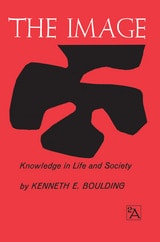
Image
Knowledge in Life and SocietyKenneth E. Boulding
University of Michigan Press, 1956
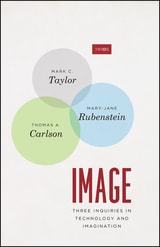
Image
Three Inquiries in Technology and ImaginationMark C. Taylor, Mary-Jane Rubenstein, and Thomas A. Carlson
University of Chicago Press, 2021
Modern life is steeped in images, image-making, and attempts to control the world through vision. Mastery of images has been advanced by technologies that expand and reshape vision and enable us to create, store, transmit, and display images. The three essays in Image, written by leading philosophers of religion Mark C. Taylor, Mary-Jane Rubenstein, and Thomas A. Carlson, explore the power of the visual at the intersection of the human and the technological. Building on Heidegger’s notion that modern humanity aims to master the world by picturing or representing the real, they investigate the contemporary culture of the image in its philosophical, religious, economic, political, imperial, and military dimensions, challenging the abstraction, anonymity, and dangerous disconnection of contemporary images.
Taylor traces a history of capitalism, focusing on its lack of humility, particularly in the face of mortality, and he considers art as a possible way to reconnect us to the earth. Through a genealogy of iconic views from space, Rubenstein exposes the delusions of conquest associated with extraterrestrial travel. Starting with the pressing issues of surveillance capitalism and facial recognition technology, Carlson extends Heidegger’s analysis through a meditation on the telematic elimination of the individual brought about by totalizing technologies. Together, these essays call for a consideration of how we can act responsibly toward the past in a way that preserves the earth for future generations. Attending to the fragility of material things and to our own mortality, they propose new practices of imagination grounded in love and humility.
Images of Bliss
Ejaculation, Masculinity, MeaningMurat Aydemir
University of Minnesota Press, 2007
Aristotle believed semen to be the purest of all bodily secretions, a vehicle for the spirit or psyche that gives form to substance. For Proust’s narrator in Swann’s Way, waking to find he has experienced a nocturnal emission, it is the product of “some misplacing of my thigh.” The heavy metal band Metallica used it to adorn an album cover. Beyond its biological function, semen has been applied with surprising frequency to metaphorical and narratological purposes.
In Images of Bliss, Murat Aydemir undertakes an original and extensive analysis of images of male orgasm and semen. In a series of detailed case studies—Aristotle’s On the Generation of Animals; Andres Serrano’s use of bodily fluids in his art; paintings by Holbein and Leonardo; Proust’s In Search of Lost Time; hard-core pornography (both straight and gay); and key texts from the poststructuralist canon, including Lacan on the phallus, Bataille on expenditure, Barthes on bliss, and Derrida on dissemination—Aydemir traces the complex and often contradictory possibilities for imagination, description, and cognition that both the idea and the reality of semen make available. In particular, he foregrounds the significance of male ejaculation for masculine subjectivity. More often than not, Aydemir argues, the event or object of ejaculation emerges as the instance through which identity, meaning, and gender are not so much affirmed as they are relentlessly and productively questioned, complicated, and displaced.
Combining close readings of diverse works with subtle theoretical elaboration and a keen eye for the cultural ideals and anxieties attached to sexuality, Images of Bliss offers a convincing and long overdue critical exploration of ejaculation in Western culture.
Murat Aydemir is assistant professor of comparative literature at the University of Amsterdam.
Images of Science
Essays on Realism and EmpiricismEdited by Paul M. Churchland and Clifford A. Hooker
University of Chicago Press, 1985

Imaginatelligence
Desire and Disaffection in Posthuman FuturesNatasha Lushetich
University of Minnesota Press, 2027
A new vision of imagination as a shared force across species, systems, and matter
Imaginatelligence addresses the contemporary “crisis” in imagination by advancing a nonanthropocentric, posthumanist account of this vital function. Rather than treating imagination as a uniquely human faculty, Natasha Lushetich presents it as an activity that stretches across species and remains inseparable from potentiality. If imagination arises from sensing, conjecturing, intelliging, and improvising, there is little reason to confine it to human experience alone. In this view, imagination becomes a distributed force, operating across biological, technological, and material domains.
Lushetich begins by considering the demise of human imagination alongside the neglect of other-than-human forms. She then considers creativity across nonhuman beings, examining cross-species intelligence and extending to iterative processes in what are typically regarded as inanimate objects. If the activities of organic and machinic agents are comparable, Lushetich argues, disciplinary divisions separating them become increasingly untenable.
Drawing on posthumanist approaches to liminality, distributed agency, and shared memory, Imaginatelligence proposes the emergence of a multispecies imaginatelligence. This perspective not only redefines imagination but also demonstrates how a cross-disciplinary configuration of imagination—linking critical thought, artistic practice, and scientific inquiry—is both possible and necessary. Lushetich reaffirms the relevance of critical posthumanism for everyday practice and for imagining the possibility of a future multispecies society.
Retail e-book files for this title are screen-reader friendly.

Imagination and Interpretation in Kant
The Hermeneutical Import of the Critique of JudgmentRudolf A. Makkreel
University of Chicago Press, 1990
Imagination and Invention
Gilbert Simondon
University of Minnesota Press, 2023
A radical rethinking of the theory and the experience of mental images
Here, in English translation for the first time, is Gilbert Simondon’s fundamental reconception of the mental image and the theory of imagination and invention. Drawing on a vast range of mid-twentieth-century theoretical resources—from experimental psychology, cybernetics, and ethology to the phenomenological reflections of Sartre and Merleau-Ponty—Imagination and Invention provides a comprehensive account of the mental image and adds a vital new dimension to the theory of psychical individuation in Simondon’s earlier, highly influential work.
Simondon traces the development of the mental image through four phases: first a bundle of motor anticipations, the image becomes a cognitive system that mediates the organism’s relation to its milieu, then a symbolic and abstract integration of motor and affective experience to, finally, invention, a solution to a problem of life that requires the externalization of the mental image and the creation of a technical object. An image cannot be understood from the perspective of one phase alone, he argues, but only within the trajectory of its progressive metamorphosis.

Imagination, Meditation, and Cognition in the Middle Ages
Michelle Karnes
University of Chicago Press, 2011

Imaginative Horizons
An Essay in Literary-Philosophical AnthropologyVincent Crapanzano
University of Chicago Press, 2003
Imagined Globalization
Néstor García Canclini
Duke University Press, 2014
García Canclini contrasts the imaginaries of previous migrants to the Americas with those who live in transnational circuits today. He integrates metaphor and narrative, working through philosophical, anthropological, and socioeconomically grounded interpretations of art, literature, crafts, media, and other forms of expression toward his conclusion that globalization is, in important ways, a collection of heterogeneous narratives. García Canclini advocates global imaginaries that generate new strategies for dealing with contingency and produce new forms of citizenship oriented toward multiple social configurations rather than homogenization. This edition of Imagined Globalization includes a significant new introduction by George Yúdice and an interview in which the cultural theorist Toby Miller and García Canclini touch on events including the Arab Spring and Occupy Wall Street.
Imagining Extinction
The Cultural Meanings of Endangered SpeciesUrsula K. Heise
University of Chicago Press, 2016
Ursula K. Heise argues that understanding these stories and symbols is indispensable for any effective advocacy on behalf of endangered species. More than that, she shows how biodiversity conservation, even and especially in its scientific and legal dimensions, is shaped by cultural assumptions about what is valuable in nature and what is not. These assumptions are hardwired into even seemingly neutral tools such as biodiversity databases and laws for the protection of endangered species. Heise shows that the conflicts and convergences of biodiversity conservation with animal welfare advocacy, environmental justice, and discussions about the Anthropocene open up a new vision of multispecies justice. Ultimately, Imagining Extinction demonstrates that biodiversity, endangered species, and extinction are not only scientific questions but issues of histories, cultures, and values.
Imagining Otherwise
Metapsychology and the Analytic A PosterioriAndrew Cutrofello
Northwestern University Press, 1997
Immanuel Kant
The Very Idea of a Critique of Pure ReasonJ. Colin McQuillan
Northwestern University Press, 2016
Immanuel Wallerstein and the Problem of the World
System, Scale, CultureDavid Palumbo-Liu, Bruce Robbins, and Nirvana Tanoukhi, eds.
Duke University Press, 2011
Contributors. Gopal Balakrishnan, Tani E. Barlow, Neil Brenner, Richard E. Lee, Franco Moretti, David Palumbo-Liu, Bruce Robbins, Helen Stacy, Nirvana Tanoukhi, Immanuel Wallerstein, Kären Wigen
Immersion Into Noise
Joseph Nechvatal
Michigan Publishing Services, 2011
By refining the definition of noise as that which addresses us outside of our preferred comfort zone, Joseph Nechvatal's Immersion Into Noise investigates multiple aspects of cultural noise by applying the audio understanding of noise to the visual, architectural and cognitive domains. Nechvatal expands and extends our understanding of the function of cultural noise by taking the reader through the immersive and phenomenal aspects of noise into algorithmic and network contexts, beginning with his experience in the Abside of the Grotte de Lascaux.
Immersion Into Noise is intended as a conceptual handbook useful for the development of a personal-political-visionary art of noise. On a planet that is increasingly technologically linked and globally mediated, how might noises break and re-connect in distinctive and productive ways within practices located in the world of art and thought? Joseph Nechvatal explores this intriguing question in Immersion Into Noise.
Imperfection and Defeat
The Role of Aesthetic Imagination in Human SocietyVirgil Nemoianu
Central European University Press, 2006
Imperial Plato
Albinus, Maximus, Apuleius: Text and Translation, with an Introduction and CommentaryRyan C. Fowler
Parmenides Publishing, 2016
Impermanence
Exploring Continuous Change across CulturesEdited by Haidy Geismar, Ton Otto, and Cameron David Warner
University College London, 2022
Nothing lasts forever. This common experience can be the source of much anxiety, but also of hope. The concept of impermanence or continuous change opens up a range of timely questions and discussions that speak to globally shared experiences of transformation and concerns for the future. Impermanence engages with an emergent body of social theory that emphasizes flux and transformation and brings it into a dialogue with other traditions of thought and practice, such as Buddhism, that have sustained a long-lasting and sophisticated meditation on impermanence.
In cases drawn from all over the world, this volume investigates the significance of impermanence in such diverse contexts as social death, atheism, alcoholism, migration, ritual, fashion, oncology, museums, cultural heritage, and art. The authors draw on a wide range of disciplines, including anthropology, archaeology, art history, Buddhist studies, cultural geography, and museology. This volume also includes numerous photographs, artworks, and poems that evocatively communicate notions and experiences of impermanence.
Impossible Presence
Surface and Screen in the Photogenic EraEdited by Terry Smith
University of Chicago Press, 2001
Framed by Terry Smith's introduction, the essays focus on two kinds of strangeness involved in experiencing visual images in the modern era. The first, explored in the book's first half, involves the appearance of oddities or phantasmagoria in early photographs and cinema. The second type of strangeness involves art from marginalized groups and indigenous peoples, and the communicative formations that result from the trafficking of images between people from vastly different cultures. With a stellar list of contributors, Impossible Presence offers a wide-ranging look at the fate of the visual image in modernity, modern art, and popular culture.
Contributors:
Jean Baudrillard
Marshall Berman
Jeremy Gilbert-Rolfe
Elizabeth Grosz
Tom Gunning
Peter Hutchings
Fred R. Myers
Javier Sanjines
Richard Shiff
Hugh J. Silverman
Terry Smith
Improper Life
Technology and Biopolitics from Heidegger to AgambenTimothy C. Campbell
University of Minnesota Press, 2011
Has biopolitics actually become thanatopolitics, a field of study obsessed with death? Is there something about the nature of biopolitical thought today that makes it impossible to deploy affirmatively? If this is true, what can life-minded thinkers put forward as the merits of biopolitical reflection? These questions drive Improper Life, Timothy C. Campbell’s dexterous inquiry-as-intervention.
Campbell argues that a “crypto-thanatopolitics” can be teased out of Heidegger’s critique of technology and that some of the leading scholars of biopolitics—including Michel Foucault, Giorgio Agamben, and Peter Sloterdijk—have been substantively influenced by Heidegger’s thought, particularly his reading of proper and improper writing. In fact, Campbell shows how all of these philosophers have pointed toward a tragic, thanatopolitical destination as somehow an inevitable result of technology. But in Improper Life he articulates a corrective biopolitics that can begin with rereadings of Foucault (especially his late work regarding the care and technologies of the self), Freud (notably his writings on the drives and negation), and Gilles Deleuze (particularly in the relation of attention to aesthetics).
Throughout Improper Life, Campbell insists that biopolitics can become more positive and productively asserts an affirmative technē not thought through thanatos but rather practiced through bíos.