Results by title
546 books match the query 'Semiotics & Theory' and 20 start with i
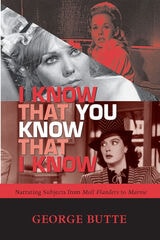
I KNOW THAT YOU KNOW THAT I KNOW
NARRATING SUBJECTS FROM MOLL FLANDERS TO MARNIEGeorge Butte
The Ohio State University Press, 2004
In I Know That You Know That I Know, Butte explores how stories narrate human consciousness. Butte locates a historical shift in the representation of webs of consciousnesses in narrative—what he calls “deep intersubjectivity”—and examines the effect this shift has since had on Western literature and culture. The author studies narrative practices in two ways: one pairing eighteenth-and nineteenth-century British novels (Moll Flanders and Great Expectations, for example), and the other studying genre practices—comedy, anti-comedy and masquerade—in written and film narratives (Jane Austen and His Girl Friday, for example, and Hitchcock’s Cary Grant films).
Butte’s second major claim argues for new ways to read representations of human consciousness, whether or not they take the form of deep intersubjectivity. Phenomenological criticism has lost its credibility in recent years, but this book identifies better reading strategies arising out of what the author calls poststructuralist phenomenology, grounded largely in the work of the French philosopher Merleau-Ponty. Butte criticizes the extreme of transcendental idealism (first-wave phenomenological criticism) and cultural materialism (when it rules out the study of consciousness). He also criticizes the dominant Lacanian framework of much academic film criticism.

I Think I Am
Philip K. DickLaurence A. Rickels
University of Minnesota Press, 2010
Iconology
Image, Text, IdeologyW. J. T. Mitchell
University of Chicago Press, 1986
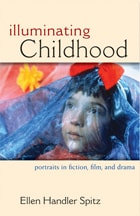
Illuminating Childhood
Portraits in Fiction, Film, and DramaEllen Handler Spitz
University of Michigan Press, 2012
"A brilliant and daring book on how art reveals life, how it illuminates childhood beyond what the sciences of development can tell us."
---Jerome Bruner, University Professor, New York University
"Combining the surgical precision of a psychoanalytically informed critic with the oracular eloquence of a brilliant close reader, Ellen Handler Spitz reads our cultural fortunes about childhood and parenting through works of art. Moving us (in both senses of the term) from the serene plenitude of Piero della Francesca's Madonna of Childbirth to the unsparing horror of Lessing's Fifth Child, she reveals just how powerfully art puts us in touch with the pulsing energies of real life."
---Maria Tatar, John L. Loeb Professor of Germanic Languages and Literatures, Harvard University
"Illuminating Childhood is a wonderfully well-written and researched interdisciplinary study of childhood in various media and mediums as well as through ethnicity, race, gender, cultures, and time."
---T. Denean Sharpley-Whiting, Distinguished Professor of French and Director of African American and Diaspora Studies, Vanderbilt University
While literature and the arts are rarely considered primary sources for knowledge about human motivation and behavior, people read novels, attend movies, watch television, and go to the theater not solely to be entertained but also to learn about one another and about themselves. Illuminating Childhood formalizes this quest for psychological knowledge in the domain of the arts.
Starting with the premise that a gifted writer, artist, or filmmaker has the ability to teach us as much in one scene as a theorist can in a treatise or a therapist in a session, the author shares her intimate experience of eight thematically linked works in film and literature from the second half of the twentieth century, touching on issues central to parent-child relations, including toxic intrafamilial secrets, the disjunction between love and understanding, and the lasting impact of deceased parents on their children. While the canon of literature about children and parent-child relations includes books that identify problems, propose solutions, and present statistical data, Illuminating Childhood offers a living out of experience via the arts, written for a general audience---parents, teachers, mental health professionals, those who engage with their students via the arts of literature and film, and others.
Ellen Handler Spitz holds the Honors College Professorship of Visual Arts at the University of Maryland. She is the author of a number of books on art, psychology, and imagery, including The Brightening Glance: Imagination and Childhood. Her abiding research interests are the cultural lives of young people; the relations between aesthetics and psychology; and the interconnections among literature, music, dance, and the visual arts.
Jacket photo: Courtesy of PhotoFest
Imagine the Sound
Experimental African American Literature after Civil RightsCarter Mathes
University of Minnesota Press, 2014
The post–Civil Rights era was marked by an explosion of black political thought and aesthetics. Reflecting a shifting horizon of expectations around race relations, the unconventional sounds of free jazz coupled with experimental literary creation nuanced the push toward racial equality and enriched the possibilities for aesthetic innovation within the Black Arts Movement. In Imagine the Sound, Carter Mathes demonstrates how African American writers used sound to further artistic resistance within a rapidly transforming political and racial landscape.
While many have noted the oral and musical qualities of African American poetry from the post–Civil Rights period, Mathes points out how the political implications of dissonance, vibration, and resonance produced in essays, short stories, and novels animated the ongoing struggle for equality. Situating literary works by Henry Dumas, Larry Neal, and Toni Cade Bambara in relation to the expansive ideas of sound proposed by free jazz musicians such as Marion Brown and Sun Ra, not only does this book illustrate how the presence of sound can be heard and read as political, but it recuperates critically neglected, yet important, writers and musicians. Ultimately, Mathes details how attempts to capture and render sound through the medium of writing enable writers to envision alternate realities and resistance outside of the linear frameworks offered by the Civil Rights and Black Power movements.
In precise and elegant prose, Mathes shows how in conceptualizing sound, African American writers opened up the political imaginations of their readers. By exploring this intellectual convergence of literary artistry, experimental music, and sound theory, Imagine the Sound reveals how taking up radically new forms of expression allows us to speak to the complexities of race and political resistance.
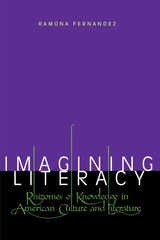
Imagining Literacy
Rhizomes of Knowledge in American Culture and LiteratureBy Ramona Fernandez
University of Texas Press, 2001
Defining the "common knowledge" a "literate" person should possess has provoked intense debate ever since the publication of E. D. Hirsch's controversial book Cultural Literacy: What Every American Needs to Know. Yet the basic concept of "common knowledge," Ramona Fernandez argues, is a Eurocentric model ill-suited to a society composed of many distinct cultures and many local knowledges.
In this book, Fernandez decodes the ideological assumptions that underlie prevailing models of cultural literacy as she offers new ways of imagining and modeling mixed cultural and non-print literacies. In particular, she challenges the biases inherent in the "encyclopedias" of knowledge promulgated by E. D. Hirsch and others, by Disney World's EPCOT Center, and by the Smithsonian Institution. In contrast to these, she places the writings of Zora Neale Hurston, Maxine Hong Kingston, Gloria Anzaldúa, and Leslie Marmon Silko, whose works model a cultural literacy that weaves connections across many local knowledges and many ways of knowing.
Immanuel Wallerstein and the Problem of the World
System, Scale, CultureDavid Palumbo-Liu, Bruce Robbins, and Nirvana Tanoukhi, eds.
Duke University Press, 2011
Contributors. Gopal Balakrishnan, Tani E. Barlow, Neil Brenner, Richard E. Lee, Franco Moretti, David Palumbo-Liu, Bruce Robbins, Helen Stacy, Nirvana Tanoukhi, Immanuel Wallerstein, Kären Wigen
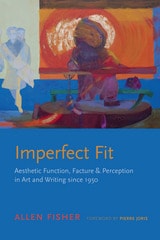
Imperfect Fit
Aesthetic Function, Facture, and Perception in Art and Writing since 1950Allen Fisher
University of Alabama Press, 2016
Rethinking art, poetry, and perception through the creative disruptions of contemporary culture.
Imperfect Fit: Aesthetic Function, Facture, and Perception in Art and Writing since 1950 is an expansive and incisive examination of the patterns of connectedness in contemporary art and poetry. Allen Fisher—a highly accomplished poet, painter, critic, and art historian as well as a key figure in the British poetry revival of the 1960s and 1970s—has a close and discerning connection to his subjects.
In Imperfect Fit, Fisher focuses on the role of fracturing, ruptures, and breakages in many traditional ties between art and poetry, as well as the resulting use of collage and assemblage by practitioners of those arts. Fisher addresses, among other subjects, destruction as a signifier in twentieth-century art; the poetic employment of bureaucratic vocabularies and “business speak”; and the roles of public performance and memory loss in the fashioning of human knowledge and art.
Commonplace notions of coherence, logic, and truth are reimagined and deconstructed in this study, and Fisher concludes by suggesting that contemporary culture offers a particularly robust opportunity—and even necessity—to engage in the production of art as a pragmatic act. Scholars of art, poetry, and aesthetics will be engaged and challenged by this insightful work.
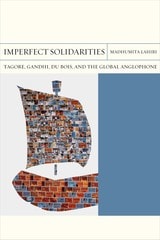
Imperfect Solidarities
Tagore, Gandhi, Du Bois, and the Global AnglophoneMadhumita Lahiri
Northwestern University Press, 2021
A century ago, activists confronting racism and colonialism—in India, South Africa, and Black America—used print media to connect with one another. Then, as now, the most effective medium for their undertakings was the English language. Imperfect Solidarities: Tagore, Gandhi, Du Bois, and the Global Anglophone tells the story of this interconnected Anglophone world. Through Rabindranath Tagore’s writings on China, Mahatma Gandhi’s recollections of South Africa, and W. E. B. Du Bois’s invocations of India, Madhumita Lahiri theorizes print internationalism. This methodology requires new terms within the worldwide hegemony of the English language (“the global Anglophone”) in order to encourage alternate geographies (such as the Global South) and new collectivities (such as people of color).
The women of print internationalism feature prominently in this account. Sonja Schlesin, born in Moscow, worked with Indians in South Africa. Sister Nivedita, an Irish woman in India, collaborated with a Japanese historian. Jessie Redmon Fauset, an African American, brought the world home to young readers through her work as an author and editor.
Reading across races and regions, genres and genders, Imperfect Solidarities demonstrates the utility of the neologism for postcolonial literary studies.
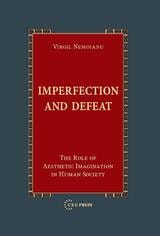
Imperfection and Defeat
The Role of Aesthetic Imagination in Human SocietyVirgil Nemoianu
Central European University Press, 2006
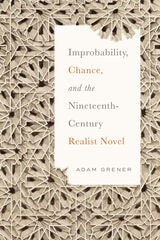
Improbability, Chance, and the Nineteenth-Century Realist Novel
Adam Grener
The Ohio State University Press, 2020
Contemporary thinking about probability came to recognize the variability and even randomness of the world while also discovering how patterns and order reemerge at scale. Reading chance as a tension between randomness and order, Grener shows how novels by Jane Austen, Sir Walter Scott, Charles Dickens, Anthony Trollope, and Thomas Hardy resist the demands of probabilistic representation and develop strategies for capturing cultural particularity and historical transformation. These authors served their visions of realism by tactically embracing improbability in the form of coincidences, fatalism, supernaturalism, and luck. Understanding this strategy helps us to appreciate how realist novels work to historicize the social worlds and experiences they represent and asks us to rethink the very foundation of realism.
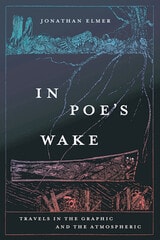
In Poe's Wake
Travels in the Graphic and the AtmosphericJonathan Elmer
University of Chicago Press, 2024
You’ll find his face everywhere, from coffee mugs, bobbleheads, and T-shirts to the cover of the Beatles’ Sergeant Pepper’s Lonely Hearts Club Band. Edgar Allan Poe is one of American culture’s most recognizable literary figures, his life and works inspiring countless derivations beyond the literary realm. Poe’s likeness and influence have been found in commercial illustration and kitsch, art installations, films, radio plays, children’s cartoons, and video games. What makes Poe so hugely influential in media other than his own? What do filmmakers, composers, and other artists find in Poe that suits their purposes so often and so variously?
In Poe’s Wake locates the source of the writer’s enduring legacy in two vernacular aesthetic categories: the graphic and the atmospheric. Jonathan Elmer uses Poe to explore these two terms and track some deep patterns in their use, not through theoretical labor but through close encounters with a wide sampling of aesthetic objects that avail themselves of Poe’s work. Poe’s writings are violent and macabre, memorable both for certain grisly images and for certain prevailing moods or atmospheres—dread, creepiness, and mournfulness. Furthermore, a bundle of Poe traits—his thematic emphasis on extreme sensation, his flexible sense of form, his experimental and modular method, and his iconic visage—amount to what could be called a Poe “brand,” one as likely to be found in music videos or comics as in novels and stories. Encompassing René Magritte, Claude Debussy, Lou Reed, Roger Corman, Spongebob Squarepants, and many others, Elmer’s book shows how the Poe brand opens trunk lines to aesthetic experiences fundamental to a multi-media world.
Infinite Conversation
Maurice Blanchot
University of Minnesota Press, 1992
“Blanchot waits for us still to come, to be read and reread. . . I would say that never as much as today have I pictured him so far ahead of us.” Jacques Derrida
Intangible Materialism
The Body, Scientific Knowledge, and the Power of LanguageRonald Schleifer
University of Minnesota Press, 2009
Taking as his point of departure Norbert Weiner’s statement that information is basic to understanding materialism in our era, Ronald Schleifer shows how discoveries of modern physics have altered conceptions of matter and energy and the ways in which both information theory and the study of literature can enrich these conceptions. Expanding the reductive notion of “the material” as simply matter and energy, he formulates a new, more inclusive idea of materialism.
Schleifer’s project attempts to bridge the divisions between the humanities and the sciences and to create a nonreductive materialism for the information age. He presents a materialistic account of human bodily experience by delving into language and literature that powerfully represents our faces, voices, hands, and pain. For example, he examines the material resources of poetic “literariness” as it is revealed in the condition of Tourette’s syndrome. Schleifer also investigates gestures of the hand in the formation of sociality, and he studies pain as both a physiological and phenomenological experience.
This ambitious work explores physiological analyses, evolutionary explanations, and semiotic descriptions of materialism to reveal how aspects of physical existence discover meaning in experience.
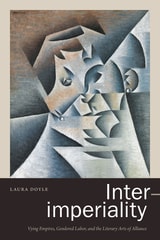
Inter-imperiality
Vying Empires, Gendered Labor, and the Literary Arts of AllianceLaura Doyle
Duke University Press, 2020
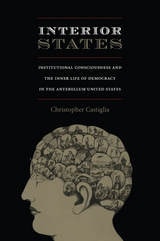
Interior States
Institutional Consciousness and the Inner Life of Democracy in the Antebellum United StatesChristopher Castiglia
Duke University Press, 2008
In the late eighteenth century and early nineteenth, as discourses of interiority gained prominence, so did powerful counter-narratives. Castiglia reveals the flamboyant pages of antebellum popular fiction to be an archive of unruly democratic aspirations. Through close readings of works by Maria Monk and George Lippard, Walt Whitman and Timothy Shay Arthur, Hannah Webster Foster and Hannah Crafts, and Nathaniel Hawthorne and Herman Melville, Castiglia highlights a refusal to be reformed or self-contained. In antebellum authors’ representations of nervousness, desire, appetite, fantasy, and imagination, he finds democratic strivings that refused to disappear. Taking inspiration from those writers and turning to the present, Castiglia advocates a humanism-without-humans that, denied the adjudicative power of interiority, promises to release democracy from its inner life and to return it to the public sphere where U.S. citizens may yet create unprecedented possibilities for social action.
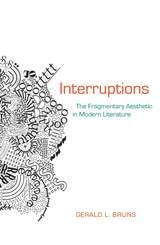
Interruptions
The Fragmentary Aesthetic in Modern LiteratureGerald L. Bruns
University of Alabama Press, 2018
A history of fragmentary—or interrupted—writing in avant-garde poetry and prose by a renowned literary critic.
In Interruptions: The Fragmentary Aesthetic in Modern Literature, Gerald L. Bruns explores the effects of parataxis, or fragmentary writing as a device in modern literature. Bruns focuses on texts that refuse to follow the traditional logic of sequential narrative. He explores numerous examples of self-interrupting composition, starting with Friedrich Schlegel's inaugural theory and practice of the fragment as an assertion of the autonomy of words, and their freedom from rule-governed hierarchies.
Bruns opens the book with a short history of the fragment as a distinctive feature of literary modernism in works from Gertrude Stein to Paul Celan to present-day authors. The study progresses to the later work of Maurice Blanchot and Samuel Beckett, and argues, controversially, that Blanchot's writings on the fragment during the 1950s and early 1960s helped to inspire Beckett’s turn toward paratactic prose.
The study also extends to works of poetry, examining the radically paratactic arrangements of two contemporary British poets, J. H. Prynne and John Wilkinson, focusing chiefly on their most recent, and arguably most abstruse, works. Bruns also offers a close study of the poetry and poetics of Charles Bernstein.
Interruptions concludes with two chapters about James Joyce. First, Bruns tackles the language of Finnegans Wake, namely the break-up of words themselves, its reassembly into puns, neologisms, nonsense, and even random strings of letters. Second, Bruns highlights the experience of mirrors in Joyce’s fiction, particularly in Dubliners, Portrait of the Artist as a Young Man, and Ulysses, where mirrored reflections invariably serve as interruptions, discontinuities, or metaphorical displacements and proliferations of self-identity.
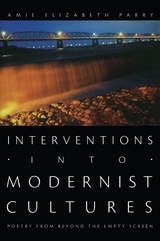
Interventions into Modernist Cultures
Poetry from Beyond the Empty ScreenAmie Elizabeth Parry
Duke University Press, 2007
Reading various works by US expatriates Ezra Pound and Gertrude Stein, Parry compares the cultural politics of U.S. canonical modernism with alternative representations of temporality, hybridity, erasure, and sexuality in the work of the Taiwanese writers Yü Kwang-chung and Hsia Yü and the Asian American immigrant author Theresa Hak Kyung Cha. Juxtaposing poems by Pound and Yü Kwang-chung, Parry shows how Yü’s fragmented, ambivalent modernist form reveals the effects of neocolonialism while Pound denies and obscures U.S. imperialism in Asia, asserting a form of nondevelopmental universalism through both form and theme. Stein appropriates discourses of American modernity and identity to represent nonnormative desire and sexuality, and Parry contrasts this tendency with representations of sexuality in the contemporary experimental poetry of Hsia Yü. Finally, Parry highlights the different uses of modernist forms by Pound in his Cantos—which incorporate a multiplicity of decontextualized and ahistorical voices—and by Cha in her 1982 novel Dictee, a historicized, multilingual work. Parry’s sophisticated readings provide a useful critical framework for apprehending how “minor modernisms” illuminate the histories erased by certain canonical modernist texts.
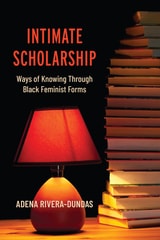
Intimate Scholarship
Ways of Knowing Through Black Feminist FormsAdena Rivera-Dundas
The Ohio State University Press, 2026
In recent years, scholars have turned to experimentations with form to imbue critiques of power with critiques of genre, discipline, and public accessibility. Yet these forays remain undertheorized. In Intimate Scholarship, Adena Rivera-Dundas proposes that experimental scholarship can perform a kind of intimacy that is enacted through the written form. Drawing on writing that brings together embodied epistemologies and experiential knowledge, she constructs an archive of intimate texts—a kaleidoscopic array of Black feminist output that blends scholarship and creative writing. Writers such as Saidiya Hartman, Claudia Rankine, and Jesmyn Ward articulate political and ethical relationships to privacy and intimacy, thinking through the role their bodies play in making sense of the world and connecting with readers in ways that are both intimate and resistive. Intimacy, defined here as a construction of connection made through the exchange of ideas, is necessary for envisioning a world that centers and celebrates Black life. Inviting readers to reflect and engage in pedagogical exercises throughout, Intimate Scholarship provides a sweeping historical framework for rethinking and reembracing contemporary scholarship.
Intransigent Imaginaries
Black Ambivalence in Media and CultureJerome P. Dent, Jr.
Rutgers University Press, 2027
Intransigent Imaginaries: Black Ambivalence in Media and Culture examines why Blackness continues to function as antagonism in fantasy, science fiction, and horror, even in contemporary films and television created by Black artists and celebrated for their progressive politics. Drawing on Afropessimism, psychoanalysis, and genre theory, Jerome P. Dent, Jr. argues that genre itself organizes desire, threat, and narrative closure in ways that consistently position Blackness as danger, excess, or containment. Rather than focusing on whether representations are positive or negative, the book shifts attention to the narrative architectures and visual economies that make those images possible in the first place. Through close readings of works such as Get Out, Us, Nope, Black Panther, A Wrinkle in Time, and major science fiction franchises, Intransigent Imaginaries challenges dominant assumptions about progress, representation, and repair. Refusing the consolations of uplift, the book insists on analytic clarity, asking what criticism looks like when redemption is structurally foreclosed.