Results by title
644 books match the query 'Wars & Conflicts' and 21 start with i
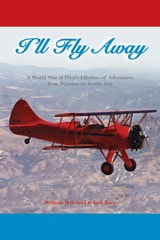
I'll Fly Away
A World War II Pilot's Lifetime of Adventures From Biplanes to Jumbo JetsWilliam Hallstead and Jack Race
University of Scranton Press, 2006
From his adventures flying for the Allies in World War II to his work as head pilot trainer for Ariana Afghan Airlines, Race has logged more than six decades in the air. I’ll Fly Away tracks his travels around the globe, encompassing his post-war job as crop duster and bush pilot, his thirty-four years as a commercial airline pilot for Pan American World Airways, his consultancy to King Hussein for Royal Jordanian Airlines, and the eight years in which he served as lead pilot for Orbis, an eye hospital on wings that served thirty-one countries. In 1989 Race notably retraced Charles Lindbergh’s 1927 20,000-mile goodwill tour, flying his Spirit of Orbis biplane to all forty-eight of the continental U.S. states.
A remarkable and wholly readable biography of an American original, I’ll Fly Away will be essential for the bookshelf of every aviation enthusiast.
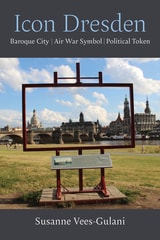
Icon Dresden
Baroque City, Air War Symbol, Political TokenSusanne Vees-Gulani
University of Michigan Press, 2026
Drawing on urban, heritage, and tourism studies, visual and memory studies, and environmental psychology, Icon Dresden examines Dresden’s history, identity, visual representations, and rebuilding decisions. It exposes the narratives that define its place in German and international memory and how, paradoxically, they support both Dresden’s current image as a symbol of peace and reconciliation and its backing of nativist and far-right movements.
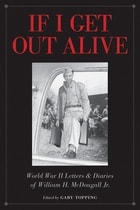
If I Get Out Alive
The World War II Letters and Diaries of William H McDougall JrGary Topping
University of Utah Press, 2007
McDougall’s letters to his family offer a rare and detailed look at daily life in Tokyo and in Japanese-occupied Shanghai during the months leading up to the Pearl Harbor attack. After his imprisonment in Sumatra, he began keeping a daily journal of his experiences as a POW. Published here for the first time are the journals he retrieved at the end of World War II.
Written by an articulate and perceptive professional reporter, McDougall's letters and diaries offer an intimate, personal narrative of conditions in wartime East Asia.

Ignacy Paderewski
PolandAnita Prazmowska
Haus Publishing, 2009
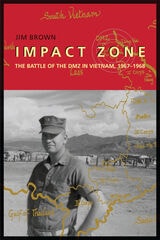
Impact Zone
The Battle of the DMZ in Vietnam, 1967–1968Jim Brown
University of Alabama Press, 2004
In the heart of the DMZ, one Marine faced the war—and the truth behind it.
Impact Zone documents Marine First Lieutenant James S. Brown's intense battle experiences, including those at Khe Sanh and Con Thien, throughout his thirteen months of service on the DMZ during 1967-68. This high-action account also reflects Brown's growing belief that the Vietnam War was mis-fought due to the unproductive political leadership of President Johnson and his administration. Brown's naiveté developed into hardening skepticism and cynicism as he faced the harsh realities of war, though he still managed to retain a sense of honor, pride, and patriotism for his country.
Impact Zone is a distinctive book on the Vietnam War because it is told from the perspective of an artilleryman, and the increasingly dangerous events gain momentum as they progress from one adventure to the next. Impact Zone is not only an important historical document of the Vietnam conflict, but also a moving record of the personal and emotional costs of war.
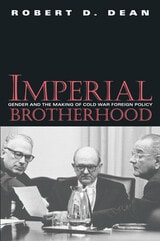
Imperial Brotherhood
Gender and the Making of Cold War Foreign PolicyRobert D. Dean
University of Massachusetts Press, 2001
This provocative book begins with a question about the Vietnam War. How is it, asks Robert D. Dean, that American policymakers—men who prided themselves on “hardheaded pragmatism” and shunned “fuzzy idealism”—could have committed the nation to such a ruinous, costly, and protracted war? The answer, he argues, lies not simply in the imperatives of anticommunist ideology or in any reasonable calculation of national interest. At least as decisive in determining the form and content of American Cold War foreign policy were the common background and shared values of its makers, especially their deeply ingrained sense of upper-class masculinity.
Dean begins by examining the institutions that shaped the members of the U.S. foreign policy establishment—all-male prep schools, Ivy League universities, collegiate secret societies, and exclusive men's clubs—that instilled stoic ideals of competition, duty, and loyalty. Service in elite military units during World War II further reinforced this pattern of socialization, eventually creating an “imperial brotherhood” imbued with a common global vision. More than that, according to Dean, the commitment to tough-minded masculinity shared by these men encouraged the pursuit of policies that were aggressively interventionist abroad and intolerant of dissent at home.
Applying his gendered analysis to the McCarthy era, Dean reveals how the purge of suspected homosexuals in the State Department not only paralleled the repression of the political left, but also reflected a bitter contest for power between the foreign policy elite and provincial Congressional conservatives. He then shows how issues of manliness similarly influenced the politics and policies of the Kennedy and Johnson administrations. Just as programs like the Peace Corps were grounded in ideals of masculine heroism, decisions about intervention in Vietnam were inextricably bound up with ideas about male strength and power. In the end, Dean makes a persuasive case that these elite constructions of male identity fundamentally shaped the course of American foreign policy during the early decades of the Cold War.
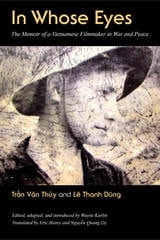
In Whose Eyes
The Memoir of a Vietnamese Filmmaker in War and PeaceTran Van Thuy
University of Massachusetts Press, 2016
Tran Van Thuy is a celebrated Vietnamese filmmaker of more than twenty award-winning documentaries. A cameraman for the People's Army of Vietnam during the Vietnam War, he went on to achieve international fame as the director of films that address the human costs of the war and its aftermath.
Thuy's memoir, when published in Vietnam in 2013, immediately sold out. In this translation, English-language readers are now able to learn in rich detail about the life and work of this preeminent artist. Written in a gentle and charming style, the memoir is filled with reflections on war, peace, history, freedom of expression, and filmmaking. Thuy also offers a firsthand account of the war in Vietnam and its aftermath from a Vietnamese perspective, adding a dimension rarely encountered in English-language literature.
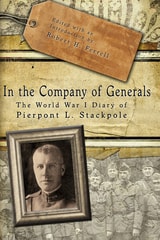
In the Company of Generals
The World War I Diary of Pierpont L. StackpoleEdited & Intro by Robert H. Ferrell
University of Missouri Press, 2009
Pierpont Stackpole was a Boston lawyer who in January 1918 became aide to Lieutenant General Hunter Liggett, soon to be commander of the first American corps in France. Stackpole’s diary, published here for the first time, is a major eyewitness account of the American Expeditionary Forces’ experience on the Western Front, offering an insider’s view into the workings of Liggett’s commands, his day-to-day business, and how he orchestrated his commands in trying and confusing situations.
Hunter Liggett did not fit John J. Pershing’s concept of the trim and energetic officer, but Pershing entrusted to him a corps and then an army command. Liggett assumed leadership of the U.S. First Army in mid-October of 1918, and after reorganizing, reinforcing, and resting, the battle-weary troops broke through the German lines in a fourth attack at the Meuse-Argonne—accomplishing what Pershing had failed to do in three previous attempts. The victory paved the way to armistice on November 11.
Liggett has long been a shadowy figure in the development of the American high command. He was “Old Army,” a veteran of Indian wars who nevertheless kept abreast of changes in warfare and more than other American officers was ready for the novelties of 1914–1918. Because few of his papers have survived, the diary of his aide—who rode in the general’s staff car as Liggett unburdened himself about fellow generals and their sometimes abysmal tactical notions—provides especially valuable insights into command within the AEF.
Stackpole’s diary also sheds light on other figures of the war, presenting a different view of the controversial Major General Clarence Edwards than has recently been recorded and relating the general staff’s attitudes about the flamboyant aviation figure Billy Mitchell. General Liggett built the American army in France, and the best measure of his achievement is this diary of his aide. That record stands here as a fascinating and authentic look at the Great War.
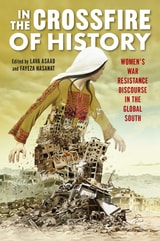
In the Crossfire of History
Women's War Resistance Discourse in the Global SouthLava Asaad
Rutgers University Press, 2022
The transformative mode of these examples expands the definition of heroism and defiance. To prevent these types of heroism from slipping into the abyss of history, this collection brings forth and celebrates women’s fortitude in conflict zones. In the Crossfire of History shines a light onwomen across the globe who are resisting the sociopolitical and economic injustices in their nation-states.
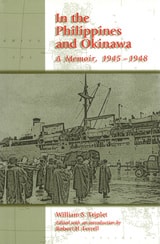
In the Philippines and Okinawa
A Memoir, 1945-1948William S. Triplet & Edited by Robert H. Ferrell
University of Missouri Press, 2001
In the Philippines and Okinawa, the third volume of Colonel William S. Triplet's memoirs, tells of Triplet's experiences during the American occupations in the early years after World War II. Continuing the story from the preceding books of his memoirs, A Youth in the Meuse-Argonne and A Colonel in the Armored Divisions, Triplet takes us to the Philippines, where his duties included rounding up isolated groups of Japanese holdouts, men who refused to believe or admit that their nation had lost the war, and holding them until the time came to transport them back to Japan.
Triplet also had to reorganize his battalions and companies to raise morale, which had plummeted with the end of the war and the seemingly dull tasks of occupation. When he took over his assignment of commanding a regiment in a division, he was dismayed to discover the unmilitary habits of almost everyone, regardless of rank. A strict disciplinarian himself, Colonel Triplet, who had served in both world wars, at one time commanding a four-thousand-man combat group, brought his regiment of garrison troops back into shape in a short time.
Okinawa presented the new challenge of bringing order to an island that had seen the deaths of one hundred thousand civilians. Virtually every building on the island had been leveled, and tens of thousands of Japanese defenders had been killed. Triplet was also obliged to oversee the temporary burial of thirteen thousand U.S. servicemen, both soldiers and sailors.
In the Philippines and Okinawa portrays the ever-changing, very human, and frequently dangerous occupation of two East Asian regions that are still important to American foreign policy. Any reader interested in military history or American history will find this memoir engaging.
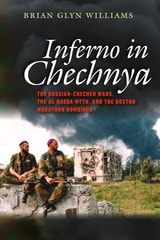
Inferno in Chechnya
The Russian-Chechen Wars, the Al Qaeda Myth, and the Boston Marathon BombingsBrian Glyn Williams
University Press of New England, 2015
Instructions for American Servicemen in Australia, 1942
Edited by the Bodleian Library
Bodleian Library Publishing, 2006
“Unlike cricket, which is a polite game, Australian Rules Football creates a desire on the part of the crowd to tear someone apart, usually the referee.” This is only one of the entertaining and astute observations the U.S. military provided in the pocket guides distributed to the nearly one million American soldiers who landed on the shores of Australia between 1942 and 1945. Although the Land Down Under felt more familiar than many of their assignments abroad, American GIs still needed help navigating the distinctly different Aussie culture, and coming to their rescue was Instruction for American Servicemen in Australia, 1942. The newest entry in the Bodleian Library’s bestselling series of vintage pocket guides, this pamphlet is filled with pithy notes on Australian customs, language, and other cultural facts the military deemed necessary for every American soldier.
From the native wildlife—a land of “funny animals”—to the nation’s colonial history to the general characteristics of Australians—“an outdoors sort of people, breezy and very democratic”—Instructions for American Servicemen in Australia gives a concise yet amazingly informative overview of the island nation. Regarding Aussie slang, it notes that “the Australian has few equals in the world at swearing. . . . The commonest swear words are ‘bastard’ (pronounced ‘barstud’), ‘bugger,’ and ‘bloody,’ and the Australians have a genius for using the latter nearly every other word.” The pamphlet also contains a humorous explanation of the country’s musical traditions—including an annotated text of “Waltzing Matilda”—as well as amusing passages on sports, politics, and the Aussies’ attitudes toward Yanks and Brits.
A fascinating look at a neglected Allied front in the Southern hemisphere, Instructions for American Servicemen in Australia, 1942 follows its successful predecessors as a captivating historical document of a pivotal era in history.
Instructions for American Servicemen in Britain, 1942
Reproduced from the original typescript, War Department, Washington, DCEdited by the Bodleian Library
Bodleian Library Publishing, 2004
The guide was intended to alleviate the culture shock for soldiers taking their first trip to Great Britain, or, for that matter, abroad. The handbook is punctuated with endearingly nostalgic advice and refreshingly candid quips such as: "The British don't know how to make a good cup of coffee. You don't know how to make a good cup of tea. It's an even swap." By turns hilarious and poignant, many observations featured in the handbook remain relevant even today.
Reproduced in a style reminiscent of the era, Instructions for American Servicemen in Britain is a powerfully evocative war-time memento that offers a unique perspective on the longstanding American-British relationship and reveals amusingly incisive American perceptions of the British character and country.
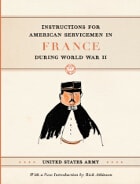
Instructions for American Servicemen in France during World War II
United States Army
University of Chicago Press, 2008
As American soldiers fanned out from their beachhead in Normandy in June of 1944 and began the liberation of France, every soldier carried that reminder in his kit. A compact trove of knowledge and reassurance, Instructions for American Servicemen in France during World War II was issued to soldiers just before they embarked for France to help them understand both why they were going and what they’d find when they got there. After lying unseen in Army archives for decades, this remarkable guide is now available in a new facsimile edition that reproduces the full text and illustrations of the original along with a new introduction by Rick Atkinson setting the book in context.
Written in a straightforward, personal tone, the pamphlet is equal parts guidebook, cultural snapshot, and propaganda piece. A central aim is to dispel any prejudices American soldiers may have about the French—especially relating to their quick capitulation in 1940. Warning soldiers that the defeat “is a raw spot which the Nazis have been riding” since the occupation began, Instructions is careful to highlight France’s long historical role as a major U.S. ally. Following that is a brief, fascinating sketch of the French character (“The French are mentally quick;” “Rich or poor, they are economical”) and stark reminders of the deprivation the French have endured under occupation. Yet an air of reassuring confidence pervades the final section of the pamphlet, which reads like a straightforward tourists’ guide to Paris and the provinces—like a promise of better days to come once the soldiers complete their mission.
Written by anonymous War Department staffers to meet the urgent needs of the moment, with no thought of its historical value, Instructionsfor American Servicemen in France during World War II nevertheless brings to vivid life the closing years of World War II—when optimism was growing, but a long, demanding road still lay ahead.
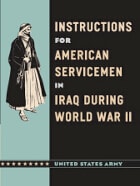
Instructions for American Servicemen in Iraq during World War II
United States Army
University of Chicago Press, 2007
The U.S. military could certainly have used that bit of wisdom in 2003, as violence began to eclipse the Iraq War’s early successes. Ironically, had the Army only looked in its own archives, they would have found it—that piece of advice is from a manual the U.S. War Department handed out to American servicemen posted in Iraq back in 1943.
The advice in Instructions for American Servicemen in Iraq during World War II,presented here in a new facsimile edition, retains a surprising, even haunting, relevance in light of today’s muddled efforts to win Iraqi hearts and minds. Designed to help American soldiers understand and cope with what was at the time an utterly unfamiliar culture—the manual explains how to pronounce the word Iraq, for instance—this brief, accessible handbook mixes do-and-don’t-style tips (“Always respect the Moslem women.” “Talk Arabic if you can to the people. No matter how badly you do it, they will like it.”) with general observations on Iraqi history and society. The book’s overall message still rings true—dramatically so—more than sixty years later: treat an Iraqi and his family with honor and respect, and you will have a strong ally; treat him with disrespect and you will create an unyielding enemy.
With a foreword by Lieutenant Colonel John A. Nagl reflecting on the manual’s continuing applicability—and lamenting that it was unknown at the start of the invasion—this new edition of Instructions for American Servicemen in Iraq will be essential reading for anyone who cares about the future of Iraq and the fate of the American soldiers serving there.
Instructions for British Servicemen in France, 1944
Edited by the Bodleian Library
Bodleian Library Publishing, 2006
Instructions for British Servicemen in France, 1944 reminds British soldiers of the common points of culture and history Britain shares with France, and, above all, their mutual aim of defeating Hitler. The pamphlet attempts to teach British soldiers the ways of the French and warns them not give in to their urges: “If you should happen to imagine that the first pretty French girl who smiles at you intends to dance the can-can or take you to bed, you risk stirring up a lot of trouble for yourself—and for our relations with the French.” The pamphlet also features a pronunciation guide (“Bonjewer, commont-allay-voo?”), a list of useful phrases, and an unflinching account of the diseases and poverty ravaging the citizens of battle-torn France.
Instructions for British Servicemen in France, 1944 captures the complex dynamics of Anglo-French relations during the Second World War on an intimate and often humorous level and reveals all the fascinating aspects of life off the battlefield. Essential for the shelf of every historian and history buff, Instructions for British Servicemen in France, 1944 is a small document that nonetheless speaks volumes about its era.
Intervention Narratives
Afghanistan, the United States, and the Global War on TerrorPurnima Bose
Rutgers University Press, 2020
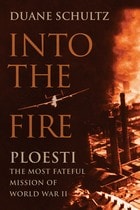
Into the Fire
Ploesti, the Most Fateful Mission of World War IIDuane Schultz
Westholme Publishing, 2007
A detailed and vivid account of the World War II disaster."—Booklist
"Into the Fire shimmers with historical parallels and modern resonances. . . . Schultz combed an impressive body of material for this account." —Washington Times
"This bittersweet tale of arrogance, wishful thinking, sacrifice, and heroism is recounted with grace and empathy." —Military.com
"Schultz combines a historian's meticulous research and a novelist's hypnotic prose to produce this memorable popular history... Shultz's intimate account of this controversial episode is a timely reminder of the horrors of war and a moving tribute to Ploestl's heroes." —Publishers Weekly
"We knew it was a disaster and knew that in the flames shooting up from those refineries we might be burned to death. But we went right in." —Lt. Norman Whalen
"We were dragged through the mouth of hell."—from a Ploesti Mission debriefing report
Planned by Winston Churchill, authorized by Dwight D. Eisenhower, and executed by five specially trained American bomber units, the attack on the oil refineries of Ploesti, Romania, was among the most daring and dangerous missions of World War II. If the raid succeeded, the Nazi war machine would suffer a devastating blow. On August 1, 1943, nearly two hundred B-24 bombers flew from Benghazi, North Africa, with directions to descend on Ploesti at treetop level, bomb the refineries, and return. The low-level bombers could evade enemy radar and were thought to be more difficult to shoot down. But despite warnings that a German heavy flak train had been moved into the area and that the secrecy of their mission had been compromised, the bombers were sent out. Minutes from the target, one of the commanders made a wrong turn, leading the formations away from Ploesti. Recovering from this mistake, most of the bombers relocated the refineries, but the mission was doomed. The ensuing air-ground battle claimed dozens of the bombers, and many of those that survived the ordeal were forced to ditch in the ocean or in remote areas due to lack of fuel or structural damage.
In Into the Fire: Ploesti, The Most Fateful Mission of World War II, Duane Schultz re-creates this great battle, combining original research and interviews with survivors in order to capture the tension, drama, and heroics of the warring sides. More Medals of Honor were awarded for this mission than any other aerial combat enterprise in the history of the United States. But the medals are bittersweet testimony to the courage of the 1,726 young men who risked all on a fateful attempt to cut off the Nazi supply of "black gold.
Invisible Enemies
The American War on Vietnam, 1975-2000Edwin A. Martini
University of Massachusetts Press, 2007
Beginning where most histories of the Vietnam War end, Invisible Enemies examines the relationship between the United States and Vietnam following the American pullout in 1975. Drawing on a broad range of sources, from White House documents and congressional hearings to comic books and feature films, Edwin Martini shows how the United States continued to wage war on Vietnam “by other means” for another twenty-five years. In addition to imposing an extensive program of economic sanctions, the United States opposed Vietnam's membership in the United Nations, supported the Cambodians, including the Khmer Rouge, in their decade-long war with the Vietnamese, and insisted that Vietnam provide a “full accounting” of American MIAs before diplomatic relations could be established. According to Martini, such policies not only worked against some of the stated goals of U.S. foreign policy, they were also in opposition to the corporate economic interests that ultimately played a key role in normalizing relations between the two nations in the late 1990s.
Martini reinforces his assessment of American diplomacy with an analysis of the “cultural front”—the movies, myths, memorials, and other phenomena that supported continuing hostility toward Vietnam while silencing opposing views of the war and its legacies. He thus demonstrates that the “American War on Vietnam” was as much a battle for the cultural memory of the war within the United States as it was a lengthy economic, political, and diplomatic campaign to punish a former adversary.
Ionel Bratianu
RomaniaKeith Hitchins
Haus Publishing, 2011
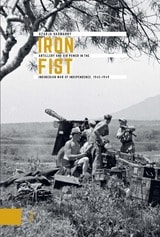
Iron Fist
Artillery and Air Power in the Indonesian War of Independence, 1945-1949Azarja Harmanny
Amsterdam University Press, 2026