Results by title
3258 books match the query 'Art' and 118 start with i

InDEBTed to Intervene
Critical Lessons in Debt, Communication, Art, and Theoretical PracticeOliver Vodeb and Nikola Janovic Kolenc
Intellect Books, 2013
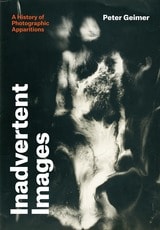
Inadvertent Images
A History of Photographic ApparitionsPeter Geimer
University of Chicago Press, 2018
Inclusion in New Danish Cinema
Sexuality and Transnational BelongingMeryl Shriver-Rice
Intellect Books, 2015
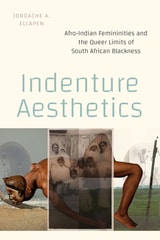
Indenture Aesthetics
Afro-Indian Femininities and the Queer Limits of South African BlacknessJordache A. Ellapen
Duke University Press, 2025

Indian Enough
EssaysPaul Chaat Smith
University of Minnesota Press, 2027
An acerbic, candid reckoning with Indigenous identity, visibility, and the messy realities of cultural change
In Indian Enough, curator and critic Paul Chaat Smith probes the paradox of contemporary Indigeneity: enormous, hard-won cultural visibility in museum exhibits, land acknowledgments, mascot removals, and more alongside persistent erasure in everyday life. Rejecting the easy comforts of identity politics (he was, he admits, a fan of the Land O’Lakes Butter Maiden), Smith brings “honest confusion” to his inquiry, using sharp wit and wry humor to confront the gap between symbolism and lived reality.
Both memoir and cultural critique, Indian Enough follows Smith from a suburban childhood in Washington, D.C., filled with Kurt Vonnegut and Vine Deloria Jr., through teenage years steeped in Native politics leading to a thrilling and eventually disillusioning stint with the American Indian Movement, to his pivotal role in creating the inaugural exhibitions at the National Museum of the American Indian. His insider account of NMAI exposes how well-meaning efforts to redress Native erasure can simply swap one set of stereotypes for another, and his candor shows how institutions and activists—himself included—all grapple with the tension between good intentions and political realities.
Irreverent and searching, Indian Enough tackles culture writ large—the rise of punk and the fall of AIM, pop culture as a battleground, Indigenous slaveowners and other histories we’d rather forget, MAGA Indians, and what it means to win when the ground keeps shifting. Together these essays reveal a truth that’s hard to reconcile in an era of “progress”: representation is everywhere, certainty is not.
Retail e-book files for this title are screen-reader friendly with images accompanied by short alt text and/or extended descriptions.
Indians Playing Indian
Multiculturalism and Contemporary Indigenous Art in North AmericaMonika Siebert
University of Alabama Press, 2015
Explores how American Indian artists have responded to the pervasive misunderstanding of indigenous peoples as cultural minorities in the United States and Canada
Contemporary indigenous peoples in North America confront a unique predicament. While they are reclaiming their historic status as sovereign nations, mainstream popular culture continues to depict them as cultural minorities similar to other ethnic Americans. These depictions of indigenous peoples as “Native Americans” complete the broader narrative of America as a refuge to the world’s immigrants and a home to contemporary multicultural democracies, such as the United States and Canada. But they fundamentally misrepresent indigenous peoples, whose American history has been not of immigration but of colonization.
Monika Siebert’s Indians Playing Indian first identifies this phenomenon as multicultural misrecognition, explains its sources in North American colonial history and in the political mandates of multiculturalism, and describes its consequences for contemporary indigenous cultural production. It then explores the responses of indigenous artists who take advantage of the ongoing popular interest in Native American culture and art while offering narratives of the political histories of their nations in order to resist multicultural incorporation.
Each chapter of Indians Playing Indian showcases a different medium of contemporary indigenous art—museum exhibition, cinema, digital fine art, sculpture, multimedia installation, and literary fiction—and explores specific rhetorical strategies artists deploy to forestall multicultural misrecognition and recover political meanings of indigeneity. The sites and artists discussed include the National Museum of the American Indian in Washington, DC; filmmakers at Inuit Isuma Productions; digital artists/photographers Dugan Aguilar, Pamela Shields, and Hulleah Tsinhnahjinnie; sculptor Jimmie Durham; and novelist LeAnne Howe.
Indie Cinema Online
Sarah E.S. Sinwell
Rutgers University Press, 2020
Indigenous Aesthetics
Native Art, Media, and IdentityBy Steven Leuthold
University of Texas Press, 1998
What happens when a Native or indigenous person turns a video camera on his or her own culture? Are the resulting images different from what a Westernized filmmaker would create, and, if so, in what ways? How does the use of a non-Native art-making medium, specifically video or film, affect the aesthetics of the Native culture?
These are some of the questions that underlie this rich study of Native American aesthetics, art, media, and identity. Steven Leuthold opens with a theoretically informed discussion of the core concepts of aesthetics and indigenous culture and then turns to detailed examination of the work of American Indian documentary filmmakers, including George Burdeau and Victor Masayesva, Jr. He shows how Native filmmaking incorporates traditional concepts such as the connection to place, to the sacred, and to the cycles of nature. While these concepts now find expression through Westernized media, they also maintain continuity with earlier aesthetic productions. In this way, Native filmmaking serves to create and preserve a sense of identity for indigenous people.
Indigenous Collections
Transformations in Stewardship and Conservation PracticesEllen Pearlstein
J. Paul Getty Trust, The, 0
A critical survey of the values, challenges, implications, history, and future of conserving Indigenous collections globally.
Once the exclusive realm of non-Indigenous curators and conservators, the care of Indigenous works in museums is now largely carried out either in collaboration with or by community members—a significant change from the colonial origins of museum collections and conservation practice.
This volume brings together over 100 readings—by Indigenous and non-Indigenous authors from around the world—that trace the development of the conservation of Indigenous collections. The writers provide a wide range of expertise, from archaeology and ethnography to law, and include community leaders, anthropologists, and art historians, as well as conservators and curators.
The book begins with an examination of the changes in terminology that reflect trust and respect, Indigenous care practices that predate the emergence of museums, and the impact of policy and legislation on Indigenous art and artifacts. Other readings explore the challenges associated with managing large, complex collections and the changes that resulted from addressing them: the development of specialized technical approaches, the incorporation of intangible heritage in conservation agendas, and a broadening view of what conservation means and how to practice it. Indigenous Collections concludes by looking at new approaches to museums—managed by or jointly with the people most closely connected to the holdings—and to the future, through innovations in conservation education.
Indigenous Visual Cultures in Latin America
Seeing, Being, and MeaningEdited by Tamara L. Bray and Carolyn Dean
University of Texas Press, 2026
Reframing the study of Indigenous visual cultures, this volume explores how images and objects generate affect and relation in non-Western contexts, foregrounding alternative modes of material engagement and meaning-making.
While traditional approaches to Indigenous visual cultures have often centered on iconography and representation, this volume turns toward other ways that images and objects act in the world. Indigenous Visual Cultures in Latin America explores how material productions function not merely as signs that point elsewhere but as agents that help shape relationships, environments, and affective experience.
Spanning Mesoamerica, the Andes, and Amazonia from 1500 BCE to the present, the chapters examine how meaning may reside in materials themselves; how making is a form of exchange between maker and matter; and how visual forms participate in configuring relations among humans, ancestors, deities, and place. These works are not passive containers of meaning, but charged presences—generative forces within ongoing worlds. Attuned to Indigenous ways of knowing and being, the volume invites readers to think beyond the frame, beyond the image, and beyond representation itself.
Indiscreet Fantasies
Iberian Queer CinemaAndrés Lema-Hincapié
Bucknell University Press, 2021
Published by Bucknell University Press. Distributed worldwide by Rutgers University Press.

Indonesian Buddhist Bronzes in the Making of Maritime Asia
Mathilde Mechling
National University of Singapore Press, 2027
Studies bronze icons of Hindu and Buddhist deities to better understand the flow of ideas across the sea routes of Maritime Asia in the first millennium.
While the great temples of Southeast Asia have inspired research in the past, the careful study of their smaller and more portable counterparts—bronze icons of Hindu and Buddhist deities—gives us a more dynamic understanding of the movement of beliefs and practices across Asia. These sacred images—found across Java, Sumatra, Kalimantan, and Sulawesi—rank alongside monumental temple complexes like Borobudur as among the most significant artistic and religious achievements of the region. Yet they have too often been treated as mere antiquities, prized for their beauty but stripped of their deeper historical meaning.
Mechling recovers what these bronzes can actually tell us. By tracing their distribution patterns alongside their artistic style, iconography, fabrication techniques, and metal compositions, she reconstructs the shared cults, ritual practices, and technological relationships that linked communities across the western Indonesian archipelago and beyond from the sixth to the tenth century. The picture that emerges overturns a long-held scholarly paradigm—inherited from the colonial era—of passive Southeast Asian reception of Indian cultural influence. In its place, Indonesian Buddhist Bronzes in the Making of Maritime Asia reveals a world of multi-directional exchange among active, cosmopolitan participants whose networks of creativity and devotion shaped one of history's most dynamic cultural crossroads.
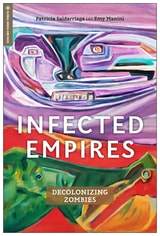
Infected Empires
Decolonizing ZombiesPatricia Saldarriaga
Rutgers University Press, 2022
Studying films from around the world, including Latin America, Asia, Africa, the US, and Europe, Infected Empires presents a vision of a global zombie that points toward a posthuman and feminist future.
Given the current moment—polarized populations, increasing climate fears, and decline of supranational institutions in favor of a rising tide of nationalisms—it is easy to understand the proliferation of apocalyptic and dystopian elements in popular culture. Infected Empires examines one of the most popular figures in contemporary apocalyptic film: the zombie. This harbinger of apocalypse reveals bloody truths about the human condition, the wounds of history, and methods of contending with them.
Infected Empires considers parallels in the zombie genre to historical and current events on different political, theological and philosophical levels, and proposes that the zombie can be read as a figure of decolonization and an allegory of resistance to oppressive structures that racialize, marginalize, disable, and dispose of bodies.
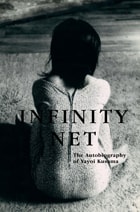
Infinity Net
The Autobiography of Yayoi KusamaYayoi Kusama
University of Chicago Press, 2011
In 1957, encouraged by Georgia O’Keeffe, artist Yayoi Kusama left Japan for New York City to become a star. By the time she returned to her home country in 1973, she had established herself as a leader of New York’s avant-garde movement, known for creating happenings and public orgies to protest the Vietnam War and for the polka dots that had become a trademark of her work. Her sculptures, videos, paintings, and installations are to this day included in major international exhibitions.
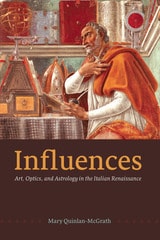
Influences
Art, Optics, and Astrology in the Italian RenaissanceMary Quinlan-McGrath
University of Chicago Press, 2013
Informatics of Domination
Zach Blas, Melody Jue, and Jennifer Rhee, editors
Duke University Press, 2025
Contributors. Dalida María Benfield, Zach Blas, Ama Josephine Budge Johnstone, micha cárdenas, Amy Sara Carroll, Shu Lea Cheang, Jian Neo Chen, Heather Dewey-Hagborg, Ranjodh Singh Dhaliwal, Stephanie Dinkins, Ricardo Dominguez, Ashley Ferro-Murray, Matthew Fuller, Jacob Gaboury, Jennifer Gabrys, Alexander R. Galloway, Jennifer Mae Hamilton, Donna J. Haraway, Eva Hayward, Stefan Helmreich, Kathy High, Leon J. Hilton, Ho Rui An, Hi'ilei Julia Kawehipuaakahaopulani Hobart, Tung-Hui Hu, Caroline A. Jones, Melody Jue, Homay King, Larissa Lai, Lawrence Lek, Esther Leslie, Alexis Lothian, Isadora Neves Marques, Radha May (Elisa Giardina-Papa, Nupur Mathur, and Bathsheba Okwenje), Shaka McGlotten, Mahan Moalemi, madison moore, Astrida Neimanis, Bahar Noorizadeh, Luciana Parisi, Thao Phan, Ana Teixeira Pinto, Luiza Prado de O. Martins, Rita Raley, Patricia Reed, Jennifer Rhee, Bassem Saad, Ashkan Sepahvand, Justin Talplacido Shoulder, Lucy Suchman, Ollie Zhang
Infrathin
An Experiment in MicropoeticsMarjorie Perloff
University of Chicago Press, 2021
The “infrathin” was Marcel Duchamp’s playful name for the most minute shade of difference: that between the report of a gunshot and the appearance of the bullet hole, or between two objects in a series made from the same mold. “Eat” is not the same thing as “ate.” The poetic, Marjorie Perloff suggests, can best be understood as the language of infrathin. For in poetry, whether in verse or prose, words and phrases that are seemingly unrelated in ordinary discourse are realigned by means of sound, visual layout, etymology, grammar, and construction so as to “make it new.”
In her revisionist “micropoetics,” Perloff draws primarily on major modernist poets from Stein and Yeats to Beckett, suggesting that the usual emphasis on what this or that poem is “about,” does not do justice to its infrathin possibilities. From Goethe’s eight-line “Wanderer’s Night Song” to Eliot’s Four Quartets, to the minimalist lyric of Rae Armantrout, Infrathin is designed to challenge our current habits of reading and to answer the central question: what is it that makes poetry poetry?
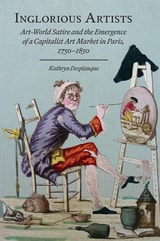
Inglorious Artists
Art World Satire and the Emergence of a Capitalist Art Market in Paris, 1750-1850Kathryn Desplanque
University of Delaware Press, 2025
This book is also freely available online as an open access digital edition.
Inhabiting the Impossible
Dance and Experimentation in Puerto RicoSusan Homar and nibia pastrana santiago, Editors
University of Michigan Press, 2023
Ink Studies
Everyday Practices of Calligraphy in Contemporary ChinaLaura Vermeeren
National University of Singapore Press, 2025
As handwriting fades in the digital age, calligraphy in China is caught between tradition and reinvention. Ink Studies deconstructs this paradox, determining how calligraphy is not simply an ancient art form, but more so a site of ongoing cultural negotiation. Laura Vermeeren investigates how calligraphy moves through five distinct visual and social fields, shaping and being shaped by its practitioners. While often framed as an act of repetition and tied to centuries of disciplined copying, calligraphy also emerges here as a force of creativity—one that is actively mobilized in contemporary China, whether through state-sponsored initiatives or the aesthetics of modern design.
Uniting contemporary art and media history, Ink Studies provides vital perspectives on how China’s past is continually reimagined in the present, portraying calligraphy’s enduring relevance in an era of rapid technological change.
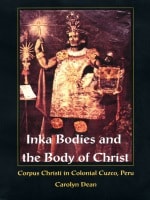
Inka Bodies and the Body of Christ
Corpus Christi in Colonial Cuzco, PeruCarolyn Dean
Duke University Press, 1999
As Dean clearly illustrates, the central rite of the festival—the taking of the Eucharist—symbolized both the acceptance of Christ and the power of the colonizers over the colonized. The most remarkable of Andean celebrants were those who appeared costumed as the vanquished Inka kings of Peru’s pagan past. Despite the subjugation of the indigenous population, Dean shows how these and other Andean nobles used the occasion of Corpus Christi as an opportunity to construct new identities through tinkuy, a native term used to describe the conjoining of opposites. By mediating the chasms between the Andean region and Europe, pagans and Christians, and the past and the present, these Andean elites negotiated a new sense of themselves. Dean moves beyond the colonial period to examine how these hybrid forms of Inka identity are still evident in the festive life of modern Cuzco.
Inka Bodies and the Body of Christ offers the first in-depth analysis of the culture and paintings of colonial Cuzco. This volume will be welcomed by historians of Peruvian culture, art, and politics. It will also interest those engaged in performance studies, religion, and postcolonial and Latin American studies.
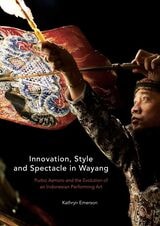
Innovation, Style and Spectacle in Wayang
Purbo Asmoro and the Evolution of an Indonesian Performing ArtKathryn Emerson
National University of Singapore Press, 2022
Wayang, the traditional puppet theater form of Java, fascinates and endures thanks to the many ways it works as a medium—bearing the weight of Javanese culture and tradition as a key component of rites of passage, as a medium of ritual and spiritual practice, as public spectacle, and as entertainment of the broadest sort, performed live, broadcast, or streamed. Over the past forty years, the form has been subject to a great deal of experimentation and innovation, pulled in many directions within an ever-changing media landscape. In this book, Kathryn Anne Emerson outlines both significant contributions by a number of key figures and the social and political influences propelling such innovations. She also describes deeper and more lasting changes in wayang, based on what the art form's most accomplished practitioners have to say about it. At the core of the book is one pivotal figure, Purbo Asmoro of the Indonesian Institute of the Arts in Surakarta, who, Emerson argues, has taken the individual and singular innovations of the era and integrated them into a new system of performance practice, one that has shaped the key Surakarta school of performance. Grounded in an unprecedented, decades-long participatory research project involving hundreds of interlocutors, the book is beautifully illustrated and will be of considerable interest in Indonesian studies.
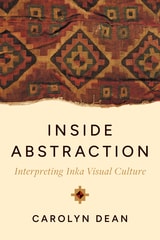
Inside Abstraction
Interpreting Inka Visual CultureCarolyn Dean
University of Texas Press, 2025
2026 PROSE Award for Art History And Criticism, Association of American Publishers
Illuminating the abstract art of the Inka, what it conveys about Inka values, and its relationship to those who view it.
Inka visual culture is unusual in its tendency toward abstraction. Public stonework, vessels used at state feasts, garments worn by the imperial elite—these objects announcing status and power are adorned with geometric designs that refuse figuration. After searching in vain for hidden referents, many scholars have largely given up the search for meaning.
Inside Abstraction develops a novel interpretation. Eminent art historian Carolyn Dean proposes that Inka geometries are neither ornamental nor coded depictions of other objects. Rather, Dean shows that in the Andean world, the designs were functionally self-aware, possessing perspectives of their own, quite literally looking back at and addressing viewers directly. Further, Dean contends that these agent-abstractions were teachers, conveying particular messages concerning social hierarchy: the relations among geometries and colors instructed viewers as to their own proper social relations. Inka designs thereby served imperial aims by wordlessly communicating the state’s values and demands for submission. Extensively illustrated and rigorously argued, Inside Abstraction is a dramatic step forward in our understanding of Inka art and political order.
Inside Culture
Art and Class in the American HomeDavid Halle
University of Chicago Press, 1993
"This is a first-class addition to what we know about culture in the specific rather than the abstract."—Howard S. Becker, Contemporary Sociology
"This book is well worth reading, especially in your own home."—Eugene Halton, American Journal of Sociology
"David Halle's researches earned him a license amateur voyeurs would kill for. . . . Refreshing for readers outside his discipline."—Peter Campbell, London Review of Books
"[This book] tells us interesting things about ourselves. . . . It affords us a birds-eye view of American culture from which we can see . . . unsuspected patterns of tastes and acquisitions."—James Gardner, Washington Times
"[A] voyeuristic thrill. . . . Lucid and entertaining. . . . A fascinating book that will open the eyes of anyone who's ever glibly said about art, 'I know what I like.' After reading Inside Culture, they'll also know a little bit more about why."—Maureen Corrigan, New York Observer
Inside an Ancient Assyrian Palace
Looking at Austen Henry Layard's ReconstructionAda Cohen and Steven E. Kangas
University Press of New England, 2016
Inside the Spiral
The Passions of Robert SmithsonSuzaan Boettger
University of Minnesota Press, 2022
An expansive and revelatory study of Robert Smithson’s life and the hidden influences on his iconic creations
This first biography of the major American artist Robert Smithson, famous as the creator of the Spiral Jetty, deepens understanding of his art by addressing the potent forces in his life that were shrouded by his success, including his suppressed early history as a painter; his affiliation with Christianity, astrology, and alchemy; and his sexual fluidity. Integrating extensive investigation and acuity, Suzaan Boettger uncovers Smithson’s story and, with it, symbolic meanings across the span of his painted and drawn images, sculptures, essays, and earthworks up to the Spiral Jetty and beyond, to the circumstances leading to what became his final work, Amarillo Ramp.
While Smithson is widely known for his monumental earthwork at the edge of the Great Salt Lake, Inside the Spiral delves into the arc of his artistic production, recognizing it as a response to his family’s history of loss, which prompted his birth and shaped his strange intelligence. Smithson configured his personal conflicts within painterly depictions of Christ’s passion, the rhetoric of science fiction, imagery from occult systems, and the impersonal posture of conceptual sculpture. Aiming to achieve renown, he veiled his personal passions and transmuted his professional persona, becoming an acclaimed innovator and fierce voice in the New York art scene.
Featuring copious illustrations never before published of early work that eluded Smithson’s destruction, as well as photographs of Smithson and his wife, the noted sculptor Nancy Holt, and recollections from nearly all those who knew him throughout his life, Inside the Spiral offers unprecedented insight into the hidden impulses of one of modern art’s most enigmatic figures. With great sensitivity to the experiences of loss and existential strife that defined his distinct artistic language, this biographical analysis provides an expanded view of Smithson’s iconic art pilgrimage site and the experiences and works that brought him to its peculiar blood red water.
Insights in Applied Theatre
The Early Days and OnwardsEdited by John O'Toole, Penny Bundy, and Peter O'Connor
Intellect Books, 2023
Insights in Applied Theatre offers an inside look into the advent of applied theater and its development as an area of practice and research. Much more than an archive, the texts in this collection present vivid, pertinent voices and messages from the pioneers of applied theater. The nineteen articles chosen by the editors of Applied Theatre Research represent key themes and elements from the start of the practice. The articles—many of which were influential in their own time—have much to say to the contemporary scene. They have been arranged in sections according to key themes and issues discovered, investigated, and stumbled across by the trailblazing writers in the collection. A vital new contribution to the field, the book raises questions about the contested issues of power, partnerships, and voice in applied theater.
Insignificant Things
Amulets and the Art of Survival in the Early Black AtlanticMatthew Francis Rarey
Duke University Press, 2023
Inspiring Writing in Art and Design
Taking a Line for a WritePat Francis
Intellect Books, 2009
When art and design students are asked for statements to accompany their work, reflective journals, or critiques, reviews and essays, they often freeze up because they have to put their thoughts in writing. Although these students are comfortable expressing themselves visually, they lack confidence working with words. Inspiring Writing in Art and Design is a practical aid for those students who are disheartened or overwhelmed by having to write. Pat Francis provides short writing exercises and creative writing techniques for tutors to use and which will help art and design students develop their ability to verbally articulate the concepts and aesthetics behind their art. Using Francis’s examples, students will build confidence and skills that can help them succeed in presenting their work and themselves in, and beyond, the studio world.
Institutions and Imaginaries
Edited by Stephanie Smith
School of the Art Institute of Chicago, 2014
This volume focuses on how artists and others have worked with, within, and sometimes in opposition to large Chicago institutions, such as public schools, universities, libraries, archives, museums, and other civic bodies. Drawing from a broad range of interdisciplinary sources, it explores the far-reaching effect of socially motivated art on urban life. It grounds recent history within a longer arc of civic self-fashioning, from the Columbian Exposition of 1893 to Jane Addams's Hull House to John Dewey's legacy in arts education. The collection also examines the relationship between the city’s image and the types of artistic work that flourish within its boundaries and resonate far beyond them.
Institutions and Imaginaries is part of the new Chicago Social Practice History series, edited by Mary Jane Jacob and Kate Zeller in the Department of Exhibitions and Exhibition Studies at the School of the Art Institute of Chicago (SAIC).
Instrumental Lives
Musical Instruments, Material Culture, and Social Networks in East and Southeast AsiaEdited by Helen Rees
University of Illinois Press, 2024
Original and expert, Instrumental Lives brings a new understanding of how musical instruments interact with their environments and societies. Contributors: Supeena Insee Adler, Marie-Pierre Lissoir, Terauchi Naoko, Jennifer C. Post, Helen Rees, Xiao Mei, Tyler Yamin, and Bell Yung
Insurgent Aesthetics
Security and the Queer Life of the Forever WarRonak K. Kapadia
Duke University Press, 2019
Intelligence Is the Art of Remaining Faithful under Shifting Circumstances
Alexander Kluge and Anselm Kiefer
Seagull Books, 2026
What holds us together in times of uncertainty? For decades, artist Anselm Kiefer and filmmaker-writer Alexander Kluge have explored this question—both as friends and collaborators. This latest volume is a bold and poetic exchange of images and texts in which they delve into the idea of reliability and its relationship to the four great forces that shape our lives: power, love, truth, and money.
Moving across history, myth, and the present day, Kiefer and Kluge ask: What is time? In a world of endless change, how do we hold on to what endures? Inspired by Hölderlin’s call “to remain faithful under shifting circumstances,” they use art to keep memory alive, invite the past into the present, and welcome the future before it arrives. Layered, provocative, and profoundly human, this new collaboration is a powerful meditation on what connects us—and what makes us endure.
Intelligent Action
A History of Artistic Research, Aesthetic Experience, and Artists in AcademiaTimothy Ridlen
Rutgers University Press, 2024
Interactive Cinema
The Ambiguous Ethics of Media ParticipationMarina Hassapopoulou
University of Minnesota Press, 2024
Connecting interactive cinema to media ethics and global citizenship
Interactive Cinema explores various cinematic practices that work to transform what is often seen as a primarily receptive activity into a participatory, multimedia experience. Surveying a multitude of unorthodox approaches throughout the history of motion pictures, Marina Hassapopoulou offers insight into a range of largely ephemeral and site-specific projects that consciously assimilate viewers into their production.
Analyzing examples of early cinema, Hollywood B movies, museum and gallery installations, virtual-reality experiments, and experimental web-based works, Hassapopoulou travels across numerous platforms, highlighting a diverse array of strategies that attempt to unsettle the allegedly passive spectatorship of traditional cinema. Through an exploration of these radically inventive approaches to the medium, many of which emerged out of sociopolitical crises and periods of historical transition, she works to expand notions of interactivity by considering it in both technological and phenomenological terms.
Deliberately revising and expanding Eurocentric scholarship to propose a much broader, transnational scope, the book emphasizes the ethical dimensions of interactive media and their links to larger considerations around community building, citizenship, and democracy. By combining cutting-edge theory with updated conventional film studies methodologies, Interactive Cinema presses at the conceptual limits of cinema and offers an essential road map to the rapidly evolving landscape of contemporary media.
Interfaces
Women, Autobiography, Image, PerformanceSidonie Smith and Julia Watson, Editors
University of Michigan Press, 2002
Editors Sidonie Smith and Julia Watson have been at the vanguard of the study of women's self-representation, and here have collected leading critics' and scholars' thoughts on artistic fusions of the visual and autobiographical. Marianne Hirsch, Linda Hutcheon, Linda Kauffman, Nellie McKay, Marjorie Perloff, Lee Quinby, and the other contributors offer new insights into the work of such artists as Laurie Anderson, Judy Chicago, Frida Kahlo, Orlan, and Cindy Sherman. From a painter's diary to a performance artist's ritualized enactments of kitchen domesticity, the many narratives of the self arising from these artists' negotiations of the visual and textual prove to be goldmines for analysis.
Art historians, artists, critics, literary scholars in women's studies, and anyone interested in the forms and implications of depicting the self will enjoy this richly illustrated collection.
Sidonie Smith is Professor of English, University of Michigan. Julia Watson is Associate Professor of Comparative Studies, The Ohio State University. They also edited Reading Autobiography: A Guide for Interpreting Life Narratives and Women, Autobiography, Theory: A Reader.
International Dialogues about Visual Culture, Education and Art
Edited by Teresa Eça and Rachel Mason
Intellect Books, 2008
International Horror Film Directors
Global FearEdited by Danny Shipka and Ralph Beliveau
Intellect Books, 2016
Interplay of Things
Religion, Art, and Presence TogetherAnthony B. Pinn
Duke University Press, 2021
Interpreting Art
Sam Rose
University College London, 2022
How do people make sense of works of art? And how do they write to make others see the same way? There are many guides to looking at art, histories of art history and art criticism, and accounts of various theories and methods, but this book offers something very unlike the normal search for difference and division: it examines the general and largely unspoken norms shared by interpreters of many kinds.
Interpreting Art highlights the norms, premises, and patterns that tend to guide interpretation along the way. Why, for example, is the concept of artistic intention at once so reviled and so hard to let go of? What is involved when an interpretation appeals to an artwork’s reception? How can context be used by some to keep things under control and by others to make the interpretation of art seem limitless? And how is it that artworks only seem to grow in complexity over time?
This volume reveals subtle features of art writing central to the often unnoticed interpretative practices through which we understand works of art. In doing so, the book also sheds light on possible alternatives, pointing to how writers on art might choose to operate differently in the future.
Interpreting and Experiencing Disney
Mediating the MouseEdited by Priscilla Hobbs
Intellect Books, 2022
It would be difficult to go through life without ever encountering a Disney product. Since the first Mickey Mouse cartoon premiered in 1928, Disney has played a central role in shaping American popular culture, and it has expanded to the global market. The company positioned itself as a titan of family entertainment, and many of its offerings, from films to consumable products, have become embedded in the minds of children and adults, woven into many of our life experiences. Fans of Disney build connections with their favorite characters and franchises, fueled by Disney’s marketing practices. Others have developed a near-cult-like relationship with the brand, equating its products with religious icons and theme park visits with pilgrimages.
This edited volume looks beyond the movies and merchandise to peer into the very heart of the Disney phenomenon: how the fan response drives the corporation’s massive marketing machine and how the corporate response, in turn, shapes the fan experience.
Intersecting Colors
Josef Albers and His ContemporariesVanja Malloy, editor
Amherst College Press, 2015
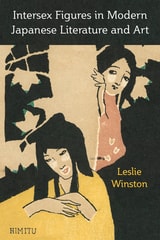
Intersex Figures in Modern Japanese Literature and Art
Leslie Winston
University of Michigan Press, 2025
Intersex Figures in Modern Japanese Literature and Art explores the history of intersex or futanari figures in modern Japanese literature and culture to examine the provocative discourses that defied a sexual regime as the modern nation-state of Japan advanced its national and imperial designs. As sexologists and medical practitioners continued reinforcing categories of “male” and “female,” “normal” and “pathological,” intersex literary figures garnered attention because the perceived subject was expected to be male or female—any variation was unintelligible. Many of the same century-old tropes and societal attitudes of needing to “cure” intersex persist. At the same time the 1991 novel Ringu by Suzuki Kōji testifies to a denial of futanari subjectivity, while the 1998 Japanese horror film (Ringu) and its 2002 American remake (The Ring) erase intersex all together.
Winston interrogates how the trope of the futanari is deployed for pragmatic or aesthetic purposes, thereby complicating the trajectory of the dominant sexological ideology of the time. Winston reads the figurative futanari in the works of Shimizu Shikin, Tanizaki Jun’ichirō, and Takabatake Kashō, and reveals how the artists’ different approaches to the futanari served their agendas and expressed views that challenged the dominant discourse on intersex.
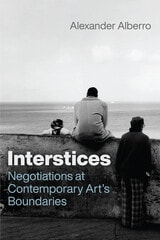
Interstices
Negotiations at Contemporary Art’s BoundariesAlexander Alberro
University of Chicago Press, 2025
With this book, Alexander Alberro engages decolonial theory to explore the dynamic exchanges that occur where the ideals and values of different artistic frameworks meet. Resisting notions of a singular art world and global contemporary art, Alberro explores what lies outside of Western art’s hegemonic presence, recognizing the rich multitude of art formations at its periphery, each with its own artistic narratives and conventions. Alberro brings into focus the complex negotiations that are cultivating innovation and transformation at the margins of Western art, showing how this seemingly monolithic framework is both crucial to and insufficient for a comprehensive understanding of contemporary art.
His examples include artists and collectives from around the world, including Iosu Aramburu, Subhankar Banerjee, Yto Barrada, Mabe Bethônico, El Colectivo, Maria Galindo and Mujeres Creando, Bouchra Khalili, Multiplicity, Lucy Orta, Raqs Media Collective, Tracey Rose, Doris Salcedo, Yinka Shonibare, World of Matter, and Yin Xiuzhen. As notions of transculturation and decoloniality continue to drive conversations about contemporary art, Interstices offers a critical explanation of what is at stake, showing how the tensions at the edges of the Western art framework are pushing it toward its discursive limits.
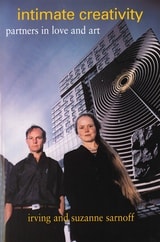
Intimate Creativity
Partners In Love And ArtIrving Sarnoff
University of Wisconsin Press, 2002
Integrating the psychology of love and creativity, this pioneering book explores both how a couple’s involvement as lovers influences their creative collaboration and how working together affects their relationship. Representing a variety of genres—painting, sculpture, photography, and installation art—the celebrated couples profiled here include, among others, Christo and Jeanne-Claude, Elizabeth Diller and Ricardo Scofidio, and Kristin Jones and Andrew Ginzel.
Intrigued by this process of "intimate creativity," psychologists Irving and Suzanne Sarnoff (themselves partners in love and work) decided to conduct in-depth interviews with partners in visual art because they defy the supremely individualistic tradition of their field. Whatever their age or sexual orientation, these artist-couples combine their talents to form a collective identity as a professional team. Passionately intense about their shared commitment, they communicate endlessly to resolve conflicts and reach consensus. Providing mutual validation and support, they increase their productivity and the quality of their work; they minimize their fear and frustration and enhance their pleasure in being together.
The authors also draw on historical and contemporary literature about similar couples, ranging from Jean Arp and Sophie Taeuber to Gilbert and George to Claes Oldenburg and Coosje van Bruggen. Stimulating and engaging, this book highlights the features of a unique collaborative process, considers the connection between creativity and sexuality, and suggests possibilities for any couple to expand their intimacy.
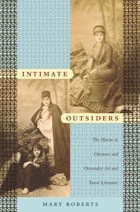
Intimate Outsiders
The Harem in Ottoman and Orientalist Art and Travel LiteratureMary Roberts
Duke University Press, 2007
Roberts draws on a range of sources, including paintings, photographs, and travelogues discovered in archives in Britain, Turkey, Egypt, and Denmark. She rethinks the influential harem works of the realist painter John Frederick Lewis, a British artist living in Cairo during the 1840s, whose works were granted an authoritative status by his British public despite the actual limits of his insider knowledge. Unlike Lewis, British women were able to visit Ottoman harems, and from the mid-nineteenth century on they did so in droves. Writing about their experiences in published travelogues, they undermined the idea that harems were the subject only of male fantasies. The elite Ottoman women who orchestrated these visits often challenged their guests’ misapprehensions about harem life, and a number of them exercised power as patrons, commissioning portraits from European artists. Their roles as art patrons defy the Western idea of the harem woman as passive odalisque.
Intimations
The Cinema of Wojciech HasAnnette Insdorf
Northwestern University Press, 2017
Wojciech Has’s films are still less known outside of his native Poland than those of his countrymen Andrzej Wajda, Krzysztof Zanussi, and Krzysztof Kieslowski. Yet thanks to his singular vision, many critics rank Has among the masters of world cinema. Some of his movies have developed a cult following, notably The Saragossa Manuscript, the favorite film of the Grateful Dead’s Jerry Garcia, which has been praised by directors such as Luis Buñuel, Francis Ford Coppola, and Roman Polanski.
Has’s films reveal the inner lives of his characters, which he portrays by giving free rein to his own wildly creative imagination. In addition toThe Saragossa Manuscript, his diverse and innovative filmography includes The Hourglass Sanatorium, a vividly surreal depiction of Hassidic life in Poland between the world wars; The Noose, a stark poetic drama about a lucid alcoholic who knows he will not be able to kick the habit; and How to Be Loved, in which an actress remembers her wartime past.
Has made disparate but formally striking movies infused with European strains of existentialism and the avant-garde. With many of his films being restored and rereleased, new generations of film lovers are discovering his artistic genius. Intimations: The Cinema of Wojciech Has is the definitive guide in English to his work.
Into Performance
Japanese Women Artists in New YorkYoshimoto, Midori
Rutgers University Press, 2005
The 1960s was a time of incredible freedom and exploration in the art world, particularly in New York City, which witnessed the explosion of New Music, Happenings, Fluxus, New Dance, pop art, and minimalist art. Also notable during this period, although often overlooked, is the inordinate amount of revolutionary art that was created by women.
Into Performance fills a critical gap in both American and Japanese art history as it brings to light the historical significance of five women artists-Yoko Ono, Yayoi Kusama, Takako Saito, Mieko Shiomi, and Shigeko Kubota. Unusually courageous and self-determined, they were among the first Japanese women to leave their country-and its male-dominated, conservative art world-to explore the artistic possibilities in New York. They not only benefited from the New York art scene, however, they played a major role in the development of international performance and intermedia art by bridging avant garde movements in Tokyo and New York.
This book traces the pioneering work of these five women artists and the socio-cultural issues that shaped their careers. Into Performance also explores the transformation of these artists' lifestyle from traditionally confined Japanese women to internationally active artists. Yoshimoto demonstrates how their work paved the way for younger Japanese women artists who continue to seek opportunities in the West today.
Into the Light of Things
The Art of the Commonplace from Wordsworth to John CageGeorge J. Leonard
University of Chicago Press, 1994
In recovering the links between such seemingly disparate figures, Leonard transforms our understanding of modern culture.
Selected by the American Library Association's journal, Choice, as "one of the Outstanding Academic Books of the Year"
"Leonard's book is a fine example of interdisciplinary studies. He shifts focus persuasively from art theory to literature to religious thought and biography, making his method seem the natural mode of inquiry into culture."—Kenneth Baker, San Francisco Chronicle Book Review
"Provocative and illuminating."—Library Journal
"Highly stimulating, impassioned."—Publisher's Weekly
"A rich and rewarding study written in a clear and accessible style with excellent references and a very useful index. Highly recommended."—Choice
Introduction to Metadata
Third EditionMurtha Baca
J. Paul Getty Trust, The, 2016
The third edition of Introduction to Metadata, first published in 1998, provides an overview of metadata, including its types, roles, and characteristics; a discussion of metadata as it relates to Web resources; and a description of methods, tools, standards, and protocols for publishing and disseminating digital collections. This revised edition is an indispensable resource in the field, addressing advances in standards such as Linked Open Data, changes in intellectual property law, and new computing technologies, and offering an expanded glossary of essential terms.