Results by title
5448 books match the query 'History and criticism' and 193 start with i

Inaugural Wounds
The Shaping of Desire in Five Nineteenth-Century English NarrativesRobert E. Lougy
Ohio University Press, 2004
Desire, Jacques Lacan suggests, is a condition or expression of our wounded nature. But because such desire is also unconscious, it can be expressed only indirectly, for what we consciously desire is hardly ever what we really want. Desire makes itself known, but disguises its presence—appearing, for example, in unconscious but repetitive, and sometimes even self-destructive, patterns of behavior.
Informed by the voices of Freud and Lacan regarding the nature of language and desire, Inaugural Wounds examines the ways in which five major nineteenth-century English writers explored the trajectories and shapes of desire. Arguing that we need to give to novels the same kind of close scrutiny we give to poetry, author Robert Lougy suggests that when we do so, we discover that they often astound us by the resonance and range of their language, as well as by their ability to take us to strange and haunting places.
The five narratives examined—Charles Dickens’s Martin Chuzzlewit, William Thackeray’s Journey from Cornhill to Grand Cairo, Elizabeth Gaskell’s Ruth, Wilkie Collins’s The Woman in White, and Thomas Hardy’s Jude the Obscure—testify to the mysterious origins of desire. Although each of the novels tells its own story in its own way, they share a fascination with the nature of desire itself.
Drawing upon recent work that has challenged historicist approaches toward nineteenth-century British literature, Professor Lougy uses the insights of psychoanalysis to enable us to more fully appreciate the depth and power of these novels. Of great value to Victorian and psychoanalytic scholars, Inaugural Wounds will be useful for teaching undergraduates as well.
Incapacity
Wittgenstein, Anxiety, and Performance BehaviorSpencer Golub
Northwestern University Press, 2014
In this highly original study of the nature of performance, Spencer Golub uses the insights of Ludwig Wittgenstein into the way language works to analyze the relationship between the linguistic and the visual in the work of a broad range of dramatists, novelists, and filmmakers, among them Richard Foreman, Mac Wellman, Peter Handke, David Mamet, and Alfred Hitchcock. Like Wittgenstein, these artists are concerned with the limits of language’s representational capacity. For Golub, it is these limits that give Wittgenstein’s thought a further, very personal significance—its therapeutic quality with respect to the Obsessive Compulsive Disorder from which he suffers.
Underlying what Golub calls “performance behavior” is Wittgenstein’s notion of “pain behavior”—that which gives public expression to private experience. Golub charts new directions for exploring the relationship between theater and philosophy, and even for scholarly criticism itself.
Incongruous Entertainment
Camp, Cultural Value, and the MGM MusicalSteven Cohan
Duke University Press, 2005
In addition to examining the spectatorship of the mgm musical, Cohan investigates the genre’s production and marketing, paying particular attention to the studio’s employment of a largely gay workforce of artists and craftspeople. He reflects on the role of the female stars—including Judy Garland, Debbie Reynolds, Esther Williams, and Lena Horne—and he explores the complex relationship between Gene Kelley’s dancing and his masculine persona. Cohan looks at how, in the decades since the 1950s, the marketing and reception of the mgm musical have negotiated the more publicly recognized camp value attached to the films. He considers the status of Singin’ in the Rain as perhaps the first film to be widely embraced as camp; the repackaging of the musicals as nostalgia and camp in the That’s Entertainment! series as well as on home video and cable; and the debates about Garland’s legendary gay appeal among her fans on the Internet. By establishing camp as central to the genre, Incongruous Entertainment provides a new way of looking at the musical.
Incorrigibles and Innocents
Constructing Childhood and Citizenship in Progressive Era ComicsSaguisag, Lara
Rutgers University Press, 2019
Histories and criticism of comics note that comic strips published in the Progressive Era were dynamic spaces in which anxieties about race, ethnicity, class, and gender were expressed, perpetuated, and alleviated. The proliferation of comic strip children—white and nonwhite, middle-class and lower class, male and female—suggests that childhood was a subject that fascinated and preoccupied Americans at the turn of the century. Many of these strips, including R.F. Outcault’s Hogan’s Alley and Buster Brown, Rudolph Dirks’s The Katzenjammer Kids and Winsor McCay’s Little Nemo in Slumberland were headlined by child characters. Yet no major study has explored the significance of these verbal-visual representations of childhood. Incorrigibles and Innocents addresses this gap in scholarship, examining the ways childhood was depicted and theorized in late nineteenth- and early twentieth-century comic strips. Drawing from and building on histories and theories of childhood, comics, and Progressive Era conceptualizations of citizenship and nationhood, Lara Saguisag demonstrates that child characters in comic strips expressed and complicated contemporary notions of who had a right to claim membership in a modernizing, expanding nation.
Increase And Multiply
Governing Cultural Reproduction In Early Modern EnglandDavid Glimp
University of Minnesota Press, 2003
A wide-ranging study of the ideology of population control in early modern England
Across the sixteenth and seventeenth centuries, a growing notion of the value of a large populace created a sense of urgency about reproduction; accordingly, a wide array of English writers of the time voiced the need not merely to add more people but also to ensure that England had an abundance of the right kinds of people. This need, in turn, called for a variety of institutions to train—and thus make, through a kind of nonbiological procreation—pious, enterprising, and dutiful subjects. In Increase and Multiply, David Glimp examines previously unexplored links between this emergent demographic mentality and Renaissance literature.
Glimp’s analysis centers on humanist pedagogy as a mechanism for creating people capable of governing both themselves and others. Acknowledging the ways in which authors such as Sidney, Shakespeare, and Milton advance their own work by appealing to this vision, Glimp argues that their texts allow us to read the scope and limits of this generative ideal, its capacity to reinforce order and to become excessive and destabilizing. His work provides unprecedented insight into the role of fantasies of nonbiological reproduction in early modern political theory, government practice, and literary production.
Indian Angles
English Verse in Colonial India from Jones to TagoreMary Ellis Gibson
Ohio University Press, 2011
A 2012 CHOICE “Outstanding Academic Title“
A new historical approach to Indian English literature
Mary Ellis Gibson shows that poetry, not fiction, was the dominant literary genre of Indian writing in English until 1860 and that poetry written in colonial situations can tell us as much or even more about figuration, multilingual literacies, and histories of nationalism than novels can. Gibson re-creates the historical webs of affiliation and resistance that were experienced by writers in colonial India—writers of British, Indian, and mixed ethnicities.
Advancing new theoretical and historical paradigms for reading colonial literatures, Indian Angles makes accessible many writers heretofore neglected or virtually unknown. Gibson recovers texts by British women, by nonelite British men, and by persons who would, in the nineteenth century, have been called Eurasian. Her work traces the mutually constitutive history of English-language poets from Sir William Jones to Toru Dutt and Rabindranath Tagore. Drawing on contemporary postcolonial theory, her work also provides new ways of thinking about British internal colonialism as its results were exported to South Asia.
In lucid and accessible prose, Gibson presents a new theoretical approach to colonial and postcolonial literatures.
Indian Nation
Native American Literature and Nineteenth-Century NationalismsCheryl Walker
Duke University Press, 1997
Walker examines the rhetoric and writings of nineteenth-century Native Americans, including William Apess, Black Hawk, George Copway, John Rollin Ridge, and Sarah Winnemucca. Demonstrating with unique detail how these authors worked to transform venerable myths and icons of American identity, Indian Nation chronicles Native American participation in the forming of an American nationalism in both published texts and speeches that were delivered throughout the United States. Pottawattomie Chief Simon Pokagon’s "The Red Man’s Rebuke," an important document of Indian oratory, is published here in its entirety for the first time since 1893.
By looking at this writing through the lens of the best theoretical work on nationality, postcoloniality, and the subaltern, Walker creates a new and encompassing picture of the relationship between Native Americans and whites. She shows that, contrary to previous studies, America in the nineteenth century was intercultural in significant ways.
Indian Sound Cultures, Indian Sound Citizenship
Laura Brueck, Jacob Smith, and Neil Verma, editors
University of Michigan Press, 2020
Indian Sound Cultures, Indian Sound Citizenship addresses the multifaceted roles sound plays in Indian cultures and media, and enacts a sonic turn in South Asian Studies by understanding sound in its own social and cultural contexts. “Scapes, Sites, and Circulations” considers the spatial and circulatory ways in which sound “happens” in and around Indian sound cultures, including diasporic cultures. “Voice” emphasizes voices that embody a variety of struggles and ambiguities, particularly around gender and performance. Finally, “Cinema Sound” make specific arguments about film sound in the Indian context, from the earliest days of talkie technology to contemporary Hindi films and experimental art installations.
Integrating interdisciplinary scholarship at the nexus of sound studies and South Asian Studies by questions of nation/nationalism, postcolonialism, cinema, and popular culture in India, Indian Sound Cultures, Indian Sound Citizenship offers fresh and sophisticated approaches to the sonic world of the subcontinent.
Indians and Mestizos in the "Lettered City"
Reshaping Justice, Social Hierarchy, and Political Culture in Colonial PeruAlcira Duenas
University Press of Colorado, 2010
Scholars have long assumed that Spanish rule remained largely undisputed in Peru between the 1570s and 1780s, but educated elite Indians and mestizos challenged the legitimacy of Spanish rule, criticized colonial injustice and exclusion, and articulated the ideas that would later be embraced in the Great Rebellion in 1781. Their movement extended across the Atlantic as the scholars visited the seat of the Spanish empire to negotiate with the king and his advisors for social reform, lobbied diverse networks of supporters in Madrid and Peru, and struggled for admission to religious orders, schools and universities, and positions in ecclesiastic and civil administration.
Indians and Mestizos in the "Lettered City" explores how scholars contributed to social change and transformation of colonial culture through legal, cultural, and political activism, and how, ultimately, their significant colonial critiques and campaigns redefined colonial public life and discourse. It will be of interest to scholars and students of colonial history, colonial literature, Hispanic studies, and Latin American studies.
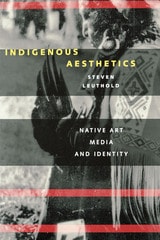
Indigenous Aesthetics
Native Art, Media, and IdentityBy Steven Leuthold
University of Texas Press, 1998
What happens when a Native or indigenous person turns a video camera on his or her own culture? Are the resulting images different from what a Westernized filmmaker would create, and, if so, in what ways? How does the use of a non-Native art-making medium, specifically video or film, affect the aesthetics of the Native culture?
These are some of the questions that underlie this rich study of Native American aesthetics, art, media, and identity. Steven Leuthold opens with a theoretically informed discussion of the core concepts of aesthetics and indigenous culture and then turns to detailed examination of the work of American Indian documentary filmmakers, including George Burdeau and Victor Masayesva, Jr. He shows how Native filmmaking incorporates traditional concepts such as the connection to place, to the sacred, and to the cycles of nature. While these concepts now find expression through Westernized media, they also maintain continuity with earlier aesthetic productions. In this way, Native filmmaking serves to create and preserve a sense of identity for indigenous people.
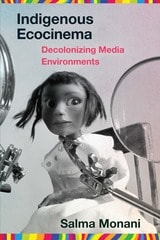
Indigenous Ecocinema
Decolonizing Media EnvironmentsSalma Monani
West Virginia University Press, 2024
This absorbing text is the first book-length exploration foregrounding the environmental dimensions of cinema made by Indigenous peoples, including a particularly fascinating discussion on how Indigenous cinema’s ecological entanglements are a crucial and complementary aspect of its agenda of decolonialism.
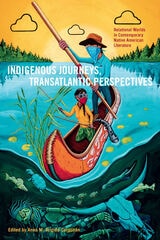
Indigenous Journeys, Transatlantic Perspectives
Relational Worlds in Contemporary Native American LiteratureAnna M Brígido-Corachán
Michigan State University Press, 2023
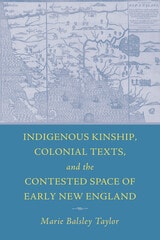
Indigenous Kinship, Colonial Texts, and the Contested Space of Early New England
Marie Balsley Taylor
University of Massachusetts Press, 2023
New England history often treats Indigenous people as minor or secondary actors within the larger colonial story. Focusing on those Native Americans who were sachems, or leaders, in local tribes when Europeans began arriving, Marie Balsley Taylor reframes stories of Indigenous and British interactions and illuminates the vital role that Indigenous kinship and diplomacy played in shaping the textual production of English colonial settlers in New England from the 1630s until King Philip’s War.
Taylor argues that genres like the conversion narrative, the post-sermon question and answer session, and scientific treatise—despite being written in English for European audiences—were jointly created by Indigenous sachems and settlers to facilitate interaction within the contested space of colonial New England. Analyzing the writings of Thomas Shepard, John Eliot, John Winthrop Jr., and Daniel Gookin and the relationships these English Protestants formed with Indigenous leaders like Wequash, Cutshamekin, Cassacinamon, and Waban, this innovative study offers a new approach to early American literature—indicating that Native thought and culture played a profound role in shaping the words and deeds of colonial writers.
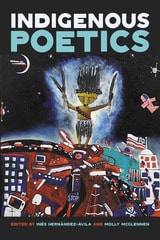
Indigenous Poetics
Inés Hernández-Ávila
Michigan State University Press, 2025
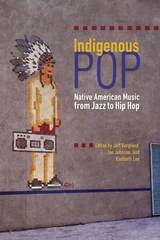
Indigenous Pop
Native American Music from Jazz to Hip HopEdited by Jeff Berglund, Jan Johnson, and Kimberli Lee
University of Arizona Press, 2016
From Joe Shunatona and the United States Indian Reservation Orchestra to Jim Pepper, from Buffy Saint-Marie to Robbie Robertson, from Joy Harjo to Lila Downs, Indigenous Pop vividly addresses the importance of Native musicians and popular musical genres, establishing their origins and discussing what they represent.
Arranged both chronologically and according to popular generic forms, the book gives Indigenous pop a broad new meaning. In addition to examining the transitive influences of popular music on Indigenous expressive forms, the contributors also show ways that various genres have been shaped by what some have called the “Red Roots” of American-originated musical styles. This recognition of mutual influence extends into the ways of understanding how music provides methodologies for living and survival.
Each in-depth essay in the volume zeros in on a single genre and in so doing exposes the extraordinary whole of Native music. This book showcases the range of musical genres to which Native musicians have contributed and the unique ways in which their engagement advances the struggle for justice and continues age-old traditions of creative expression.
Individual and Community
Variations on a Theme in American FictionKenneth H. Baldwin and David Kirby, eds.
Duke University Press, 1975
The essays are intended to point to the continuity of an important theme in American fiction and to offer insight into the variety of philosophical and literary strategies utilized in significant works of significant authors in dealing with the question of the individual and the community.
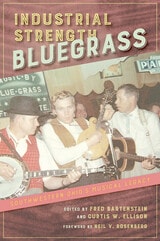
Industrial Strength Bluegrass
Southwestern Ohio's Musical LegacyEdited by Fred Bartenstein and Curtis W. Ellison
University of Illinois Press, 2021
Revelatory and multifaceted, Industrial Strength Bluegrass shares the inspiring story of a bluegrass hotbed and the people who created it.
Contributors: Fred Bartenstein, Curtis W. Ellison, Jon Hartley Fox, Rick Good, Lily Isaacs, Ben Krakauer, Mac McDivitt, Nathan McGee, Daniel Mullins, Joe Mullins, Larry Nager, Phillip J. Obermiller, Bobby Osborne, and Neil V. Rosenberg.
Industry and the Creative Mind
The Eccentric Writer in American Literature and Entertainment, 1790-1860Sandra Tomc
University of Michigan Press, 2012
Industry and the Creative Mind takes a radically new look at the figure of the eccentric, alienated writer in American literature and entertainment from 1790 to 1860. Traditional scholarship takes for granted that the eccentric writer, modeled by such Romantic beings as Lord Byron and brought to life for American audiences by the gloomy person of Edgar Allan Poe, was a figure of rebellion against the excesses of modern commercial culture and industrial life. By contrast, Industry and the Creative Mind argues that in the United States myths of writerly moodiness, alienation, and irresponsibility predated the development of a commercial arts and entertainment industry and instead of forming a site of rebellion from this industry formed a bedrock for its development. Looking at the careers of a number of early American writers---Joseph Dennie, Nathaniel Parker Willis, Edgar Allan Poe, Fanny Fern, as well as a host of now forgotten souls who peopled the twilight worlds of hack fiction and industrial literature---this book traces the way in which early nineteenth-century American arts and entertainment systems incorporated writerly eccentricity in their "logical" economic workings, placing the mad, rebellious writer at the center of the industry's productivity and success.
Inextricably Bonded
Israeli Arab and Jewish Writers Re-Visioning CultureRachel Feldhay Brenner
University of Wisconsin Press, 2003
Despite the tragic reality of the continuing Israeli-Arab conflict and deep-rooted beliefs that the chasm between Israeli Jews and Israeli Arabs is unbridgeable, this book affirms the bonds between the two communities. Rachel Feldhay Brenner demonstrates that the literatures of both ethnic groups defy the ideologies that have obstructed dialogue between the two peoples.
Brenner argues that literary critics have ignored the variety and the dissent in the novels of both Arab and Jewish writers in Israel, giving them interpretations that embrace the politics of exclusion and conform with Zionist ideology. Brenner offers insightful new readings that compare fiction by Jewish writers Amos Oz, A.B. Yehoshua, David Grossman, and others with fiction written in Hebrew by such Arab-Israeli writers as Atallah Mansour, Emile Habiby, and Anton Shammas. This parallel analysis highlights the moral and psychological dilemmas faced by both the Jewish victors and the Arab vanquished, and Brenner suggests that the hope for release from the historical trauma lies—on both sides—in reaching an understanding with and of the adversary.
Drawing upon the theories of Walter Benjamin, Jacques Lacan, Sigmund Freud, Emanuel Levinas, and others, Inextricably Bonded is an innovative and illuminating examination of literary dissent from dominant ideology.
Infidel Poetics
Riddles, Nightlife, SubstanceDaniel Tiffany
University of Chicago Press, 2009
Poetry has long been regarded as the least accessible of literary genres. But how much does the obscurity that confounds readers of a poem differ from, say, the slang that seduces listeners of hip-hop? Infidel Poetics examines not only the shared incomprensibilities of poetry and slang, but poetry's genetic relation to the spectacle of underground culture.
Charting connections between vernacular poetry, lyric obscurity, and types of social relations—networks of darkened streets in preindustrial cities, the historical underworld of taverns and clubs, the subcultures of the avant-garde—Daniel Tiffany shows that obscurity in poetry has functioned for hundreds of years as a medium of alternative societies. For example, he discovers in the submerged tradition of canting poetry and its eccentric genres—thieves’ carols, drinking songs, beggars’ chants—a genealogy of modern nightlife, but also a visible underworld of social and verbal substance, a demimonde for sale.
Ranging from Anglo-Saxon riddles to Emily Dickinson, from the icy logos of Parmenides to the monadology of Leibniz, from Mother Goose to Mallarmé, Infidel Poetics offers an exhilarating account of the subversive power of obscurity in word, substance, and deed.

Infinite Conversation
Maurice Blanchot
University of Minnesota Press, 1992
“Blanchot waits for us still to come, to be read and reread. . . I would say that never as much as today have I pictured him so far ahead of us.” Jacques Derrida
Influence and Intertextuality in Literary History
John B. Clayton
University of Wisconsin Press, 1991
This important collection explores and clarifies two of the most contested ideas in literary theory today, influence and intertextuality. The study of influence tends to center on major authors and canonical works, identifying prior documents as “sources” or “contexts” for a given author. Intertextuality, on the other hand, is a concept unconcerned with authors as individuals; it treats all texts as part of a network of discourse that includes culture, history, and social practices as well as other literary works. In thirteen essays drawing on the entire spectrum of English and American literary history, this volume considers the relationship between these two terms—their rivalry, their kinship, their range of uses.
Debates about these two concepts have been crucial to the “new historicism” and the resurgence of interest in literary history. The essays in this volume employ a refreshing array of examples from that history—poetry of the Renaissance and the twentieth century, novels of the eighteenth through twentieth centuries, Old English texts, and postmodernist productions that have served as recurrent “intertexts” for contemporary theory. The contributors treat such currently vital questions as the role of the author, canon formation, gender, causality, and the social dimension of texts. They illuminate old assumptions and new ideas about agency that lie behind notions of influence, and they examine models of an anonymous textual field that lie behind notions of intertextuality.
The volume takes much of its character from its own intertextual origin as a group project of the English faculty at the University of Wisconsin–Madison. Though diverse in their academic interests, concerns, and experience, the contributors particpated in an ongoing intellectual exchange that is a model of how new scholarship can arise from dialogue.
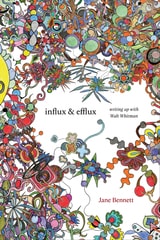
Influx and Efflux
Writing Up with Walt WhitmanJane Bennett
Duke University Press, 2020
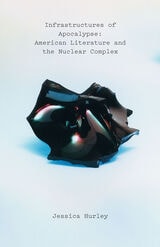
Infrastructures of Apocalypse
American Literature and the Nuclear ComplexJessica Hurley
University of Minnesota Press, 2020
A new approach to the vast nuclear infrastructure and the apocalypses it produces, focusing on Black, queer, Indigenous, and Asian American literatures
Since 1945, America has spent more resources on nuclear technology than any other national project. Although it requires a massive infrastructure that touches society on myriad levels, nuclear technology has typically been discussed in a limited, top-down fashion that clusters around powerful men. In Infrastructures of Apocalypse, Jessica Hurley turns this conventional wisdom on its head, offering a new approach that focuses on neglected authors and Black, queer, Indigenous, and Asian American perspectives.
Exchanging the usual white, male “nuclear canon” for authors that include James Baldwin, Leslie Marmon Silko, and Ruth Ozeki, Infrastructures of Apocalypse delivers a fresh literary history of post-1945 America that focuses on apocalypse from below. Here Hurley critiques the racialized urban spaces of civil defense and reads nuclear waste as a colonial weapon. Uniting these diverse lines of inquiry is Hurley’s belief that apocalyptic thinking is not the opposite of engagement but rather a productive way of imagining radically new forms of engagement.
Infrastructures of Apocalypse offers futurelessness as a place from which we can construct a livable world. It fills a blind spot in scholarship on American literature of the nuclear age, while also offering provocative, surprising new readings of such well-known works as Atlas Shrugged, Infinite Jest, and Angels in America. Infrastructures of Apocalypse is a revelation for readers interested in nuclear issues, decolonial literature, speculative fiction, and American studies.

Inhabitants of the Deep
The Blueness of BlacknessJonathan Howard
Duke University Press, 2025
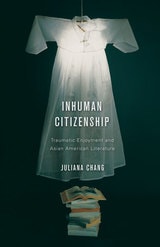
Inhuman Citizenship
Traumatic Enjoyment and Asian American LiteratureJuliana Chang
University of Minnesota Press, 2012
In Inhuman Citizenship, Juliana Chang claims that literary representations of Asian American domesticity may be understood as symptoms of America’s relationship to its national fantasies and to the “jouissance”—a Lacanian term signifying a violent yet euphoric shattering of the self—that both overhangs and underlies those fantasies. In the national imaginary, according to Chang, racial subjects are often perceived as the source of jouissance, which they supposedly embody through their excesses of violence, sexuality, anger, and ecstasy—excesses that threaten to overwhelm the social order.
To examine her argument that racism ascribes too much, rather than a lack of, humanity, Chang analyzes domestic accounts by Asian American writers, including Fae Myenne Ng’s Bone, Brian Ascalon Roley’s American Son, Chang-rae Lee’s Native Speaker, and Suki Kim’s The Interpreter. Employing careful reading and Lacanian psychoanalysis, Chang finds sites of excess and shock: they are not just narratives of trauma; they produce trauma as well. They render Asian Americans as not only the objects but also the vehicles and agents of inhuman suffering. And, claims Chang, these novels disturb yet strangely exhilarate the reader through characters who are objects of racism and yet inhumanly enjoy their suffering and the suffering of others.
Through a detailed investigation of “family business” in works of Asian American life, Chang shows that by identifying with the nation’s psychic disturbance, Asian American characters ethically assume responsibility for a national unconscious that is all too often disclaimed.
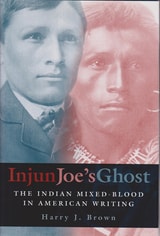
Injun Joe's Ghost
The Indian Mixed-Blood in American WritingHarry J. Brown
University of Missouri Press, 2004
Ink
The Indelible J. Mayo WilliamsClifford R. Murphy
University of Illinois Press, 2024
<p>Vivid and engaging, <i>Ink</i> brings to light the extraordinary journey of a Black businessman and athlete.</p>

Innocent Lens
Race and Visibility on the Swedish ScreenBenjamin Mier-Cruz
University of Wisconsin Press, 2027
Sweden, like other Nordic countries, prides itself on being “colorblind” or immune to the kinds of racism found in, for example, the United States. In the 1960s and 1970s, white Swedish documentarians, in the fashion of early anthropologists, recorded racial tensions amid the US civil rights movement. More recently, in the twenty-first century, short films produced by Swedes of color have tackled racism and bigotry within Sweden.
Benjamin Mier-Cruz offers a comparative study of these two periods of Swedish documentary filmmaking. “Racially innocent” white documentarians of the mid-twentieth century developed an “aesthetics of altruism” predicated on Sweden’s assumed racial equalitarianism—a notion that their documentaries in turn helped create and maintain. In contemporary films, on the other hand, Swedes of color use the same filmic format to challenge not only their predecessors’ reductionist, pseudo-anthropological presentations but also Sweden’s purportedly colorblind ideology. Mier-Cruz’s close readings of films from both eras demonstrate the possibilities and limitations of the documentary form and the ways in which it is motivated by politics and activism.
Innovation in Ethnographic Film
From Innocence to Self-Consciousness, 1955-1985Peter Loizos
University of Chicago Press, 1993
Loizos begins by reviewing works of John Marshall and Timothy Asch in the 1950s and moves through those of Jean Rouch, Robert Gardner, and many more recent filmmakers. He reveals a steady course of innovations along four dimensions: production technology, subject matter, strategies of argument, and ethnographic authentication. His analyses of individual films address questions of realism, authenticity, genre, authorial and subjective voice, and representation of the films' creators as well as their subjects.
Innovation in Ethnographic Film, as a systematic and iluminating review of developments in ethnographic film, will be an important resource for the growing number of anthropologists and other scholars who use such films as tools for research and teaching.
Innovation in the Italian Counter-Reformation
Shannon McHugh
University of Delaware Press, 2011
Published by University of Delaware Press. Distributed worldwide by Rutgers University Press.
Inscribing the Daily
Critical Essays on Women's DiariesSuzanne L. Bunkers
University of Massachusetts Press, 1996
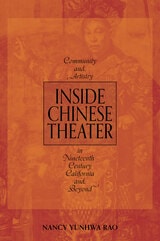
Inside Chinese Theater
Community and Artistry in Nineteenth-Century California and BeyondNancy Yunhwa Rao
University of Illinois Press, 2025
In the mid-nineteenth century, Chinese opera theater arrived as one of the significant performing art forms in California. Nancy Yunhwa Rao excavates and contextualizes the important history of Chinese Opera Theater, bringing to light the ways it became woven into the financial, political, social, and family life in California and beyond.
Chinese opera theater found brick-and-mortar homes with San Francisco theaters like the Hing Chuen Yuen and the Donn Qui Yuen. But troupes had already followed Chinese immigrants to mining and railroad towns, and across the American West. As Chinese theater became part of California and San Francisco culture, popular Chinese actors advocated for their art alongside appeals for civil rights. Rao draws on personal diaries, newspapers and artifacts to place Chinese theater within the everyday lives of San Francisco. She also examines the costumes, singing, staging, and storytelling that impacted mainstream reception and influenced how Chinese communities saw themselves.
Illustrated with seventy photographs, Inside Chinese Theater is an expert and eloquent journey into the early decades of Chinese opera in America.
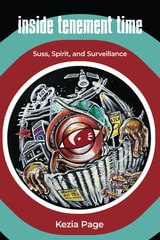
Inside Tenement Time
Suss, Spirit, and SurveillanceKezia Page
Rutgers University Press, 2025
Inside Tenement Time is the first comprehensive treatment of literary and cultural texts on surveillance in the Caribbean. Covering the long historical arc of the twentieth to the twenty-first centuries, Inside Tenement Time uses Jamaica as a case study to examine moments of crisis and particular spaces, especially urban yard enclaves and their environs, in the Caribbean encounter with surveillance. Making the argument that the Caribbean situation reveals flexible hegemonies rather than provinces of exclusive control, the book demonstrates the countervailing force of sussveillance and spiritveillance, Afro-Indigenous variations on surveillance. Sussveillance and spiritveillance are exemplars of vernacular arts and sciences that operate at and within the frangible borders of state power, exposing the unique dynamics of surveillance in the region and marshalling the acts of imagination with which it contends. For example, the Smile Jamaica concert of 1976, headlined by reggae Superstar Bob Marley, and the reputedly US government-backed 2010 Tivoli Gardens incursion in West Kingston, both moments that have dramatic, even mythic residue in Caribbean and global memory, are among the real-life events brought into conversation with literary representations of this history.
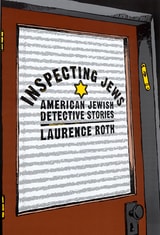
Inspecting Jews
American Jewish Detective StoriesRoth, Laurence
Rutgers University Press, 2003
Inthis book, Laurence Roth argues that the popular genre of Jewish detective stories offers new insights into the construction of ethnic and religious identity. Roth frames his study with the concept of “kosher hybridity” to look at the complex process of mediation between Jewish and American culture in which Jewish writers voice the desire to be both different from and yet the same as other Americans. He argues that the detective story, located at the intersection of narrative and popular culture in modern America, examines the need for order in a disorderly society, and thus offers a window into the negotiation of Jewish identity differing from that of literary fiction. The writers of these popular cultural texts, which are informed by contradiction and which thrive on intended and unintended ironies, formulate idioms for American Jewish identities that intentionally and unintentionally create social, ethnic, and religious syntheses in American Jewish life. Roth examines stories about American Jewish detectives—including Harry Kemelman’s Rabbi Small, Faye Kellerman’s Peter Decker and Rina Lazarus, Stuart Kaminsky’s Abe Lieberman, and Rochelle Krich’s Jessica Drake—not only as a genre of literature but also as a reflection of contemporary acculturation in the American Jewish popular arts.
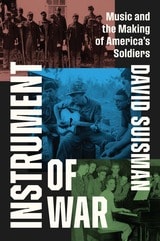
Instrument of War
Music and the Making of America's SoldiersDavid Suisman
University of Chicago Press, 2024
An original history of music in the lives of American soldiers.
Since the Civil War, music has coursed through the United States military. Soldiers have sung while marching, listened to records and armed forces radio, and packed the seats at large-scale USO shows. The bugle call “reveille” has roused soldiers in the morning, and “taps” has marked the end of a long day. Whether the sounds come from brass instruments, weary and homesick singers, or a pair of heavily used earbuds, where there has been war, there has been music, too.
Instrument of War is a first-of-its-kind study of music in the lives of American soldiers. Although musical activity has been part of war since time immemorial, the significance of the U.S. military as a musical institution has generally gone unnoticed. Historian David Suisman traces how the U.S. military has used—and continues to use—music to train soldiers and regulate military life, and how soldiers themselves have turned to music to cope with war’s emotional and psychological realities. Opening our ears to these practices, Suisman reveals how music has enabled more than a century and a half of American war-making. Instrument of War unsettles assumptions about music as a force of uplift and beauty, demonstrating how it has also been entangled in large-scale state violence.
From chanting “Sound off!” in basic training to switching on a phonograph or radio or cueing up an iPod playlist during a patrol, the sound of music has long resonated in soldiers’ wartime experiences. Now we all can finally hear it.
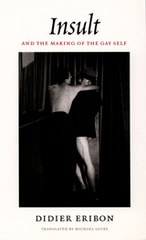
Insult and the Making of the Gay Self
Didier Eribon
Duke University Press, 2004
Eribon describes the emergence of homosexual literature in Britain and France at the turn of the last century and traces this new gay discourse from Oscar Wilde and the literary circles of late-Victorian Oxford to André Gide and Marcel Proust. He asserts that Foucault should be placed in a long line of authors—including Wilde, Gide, and Proust—who from the nineteenth century onward have tried to create spaces in which to resist subjection and reformulate oneself. Drawing on his unrivaled knowledge of Foucault’s oeuvre, Eribon presents a masterful new interpretation of Foucault. He calls attention to a particular passage from Madness and Civilization that has never been translated into English. Written some fifteen years before The History of Sexuality, this passage seems to contradict Foucault’s famous idea that homosexuality was a late-nineteenth-century construction. Including an argument for the use of Hannah Arendt’s thought in gay rights advocacy, Insult and the Making of the Gay Self is an impassioned call for critical, active engagement with the question of how gay life is shaped both from without and within.
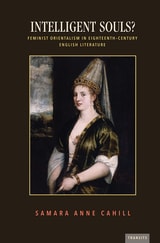
Intelligent Souls?
Feminist Orientalism in Eighteenth-Century English LiteratureSamara Anne Cahill
Bucknell University Press, 2019
Published by Bucknell University Press. Distributed worldwide by Rutgers University Press.
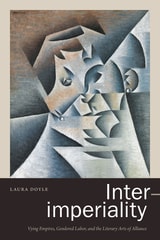
Inter-imperiality
Vying Empires, Gendered Labor, and the Literary Arts of AllianceLaura Doyle
Duke University Press, 2020
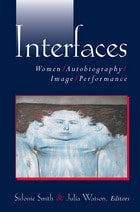
Interfaces
Women, Autobiography, Image, PerformanceSidonie Smith and Julia Watson, Editors
University of Michigan Press, 2002
Editors Sidonie Smith and Julia Watson have been at the vanguard of the study of women's self-representation, and here have collected leading critics' and scholars' thoughts on artistic fusions of the visual and autobiographical. Marianne Hirsch, Linda Hutcheon, Linda Kauffman, Nellie McKay, Marjorie Perloff, Lee Quinby, and the other contributors offer new insights into the work of such artists as Laurie Anderson, Judy Chicago, Frida Kahlo, Orlan, and Cindy Sherman. From a painter's diary to a performance artist's ritualized enactments of kitchen domesticity, the many narratives of the self arising from these artists' negotiations of the visual and textual prove to be goldmines for analysis.
Art historians, artists, critics, literary scholars in women's studies, and anyone interested in the forms and implications of depicting the self will enjoy this richly illustrated collection.
Sidonie Smith is Professor of English, University of Michigan. Julia Watson is Associate Professor of Comparative Studies, The Ohio State University. They also edited Reading Autobiography: A Guide for Interpreting Life Narratives and Women, Autobiography, Theory: A Reader.
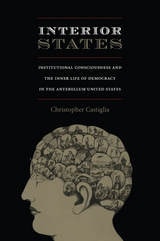
Interior States
Institutional Consciousness and the Inner Life of Democracy in the Antebellum United StatesChristopher Castiglia
Duke University Press, 2008
In the late eighteenth century and early nineteenth, as discourses of interiority gained prominence, so did powerful counter-narratives. Castiglia reveals the flamboyant pages of antebellum popular fiction to be an archive of unruly democratic aspirations. Through close readings of works by Maria Monk and George Lippard, Walt Whitman and Timothy Shay Arthur, Hannah Webster Foster and Hannah Crafts, and Nathaniel Hawthorne and Herman Melville, Castiglia highlights a refusal to be reformed or self-contained. In antebellum authors’ representations of nervousness, desire, appetite, fantasy, and imagination, he finds democratic strivings that refused to disappear. Taking inspiration from those writers and turning to the present, Castiglia advocates a humanism-without-humans that, denied the adjudicative power of interiority, promises to release democracy from its inner life and to return it to the public sphere where U.S. citizens may yet create unprecedented possibilities for social action.
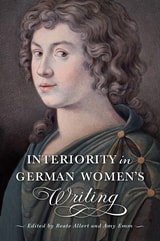
Interiority in German Women's Writing
Beate Allert
University of Delaware Press, 2026
Interiority in German Women’s Writing for the first time systematically gathers and engages with contributions of German women authors to the discourse on interiority (Innerlichkeit) from 1750 to 1850. This volume shifts the recent focus on abstract theoretical and medical discourses on inwardness to the origins of interiority in literature and philosophy as written and experienced by women from the Age of Sensibility (Empfindsamkeit) to the Romantic era. At the same time, it makes a claim for and explores the ramifications of understanding interiority as a feminine discourse. Contributors investigate the works of women authors who searched to find rescue from their cultural and personal entrapment via creative spaces and various modes of interiority in theatrical performances, poetic writings, letters, biographical narratives, prose, and fairy tales. From the case studies and literary analyses in the volume, interiority emerges as a spectrum of approaches to defining, resisting, and transforming the innermost self.

International Horror Film Directors
Global FearEdited by Danny Shipka and Ralph Beliveau
Intellect Books, 2016
Interpreting the Self
Two Hundred Years of American AutobiographyDiane Bjorklund
University of Chicago Press, 1998
"A refreshingly welcome approach to this intriguing topic. . . . [Bjorklund's] extensive and systematic approach to her source material is impressive and enriches our understanding of this essential subject."—Virginia Quarterly Review
"Bjorklund studies both famous and obscure writers, and her clear prose style and copious quotations provide insight into the many aspects of the changing American self." —Library Journal
Intersections in Turkish Literature
Essays in Honor of James Stewart-RobinsonWalter G. Andrews, Editor
University of Michigan Press, 2001
Intersections in Turkish Literature is a collection of essays on Turkish literature by former students of James Stewart-Robinson. The topics and methods cover a broad range--from a careful thematic analysis of a traditional Turkish folktale, which reveals its resemblance to well-known Western tales; to an analysis of the "saint tales" recounted by present-day Albanian Bektasi adepts; to a study of narrative rhythm in Nazim Hikhmet's rendition of an account of a fifteenth-century popular uprising.
Walter G. Andrews has assembled the writings of a number of scholars who bridge traditional chasms, inviting us to rethink our approaches to the study of Turkish and Ottoman literature. This collection forms a nucleus that clearly demonstrates the great potential now existing for study in this area, the essays displaying a variety of unusual approaches that bring together seemingly disparate materials: the Turkish story "The Pomegranate Seed" and Disney's "Snow White"; a fifteenth-century chronicle and the poetry of a modern socialist poet; Albanian dervishes in Detroit; a modern Turkish novel; Virginia Woolf; a Yale critic; traditional Japanese poetry; and Ottoman lyrics.
Intersections in Turkish Literature will provide an important stimulus to work that reaches beyond the limits of area studies, intersecting with the interests of scholars and students of literary theory, folklore studies, anthropology, French, Japanese, and Persian.
Walter G. Andrews is Affiliate Professor of Near Eastern Languages and Civilization, University of Washington.
Intersections of Harm
Narratives of Latina Deviance and DefianceHalperin, Laura
Rutgers University Press, 0

Intertextual Encounters in American Fiction, Film, and Popular Culture
Michael Dunne
University of Wisconsin Press, 2001
Interventions into Modernist Cultures
Poetry from Beyond the Empty ScreenAmie Elizabeth Parry
Duke University Press, 2007
Reading various works by US expatriates Ezra Pound and Gertrude Stein, Parry compares the cultural politics of U.S. canonical modernism with alternative representations of temporality, hybridity, erasure, and sexuality in the work of the Taiwanese writers Yü Kwang-chung and Hsia Yü and the Asian American immigrant author Theresa Hak Kyung Cha. Juxtaposing poems by Pound and Yü Kwang-chung, Parry shows how Yü’s fragmented, ambivalent modernist form reveals the effects of neocolonialism while Pound denies and obscures U.S. imperialism in Asia, asserting a form of nondevelopmental universalism through both form and theme. Stein appropriates discourses of American modernity and identity to represent nonnormative desire and sexuality, and Parry contrasts this tendency with representations of sexuality in the contemporary experimental poetry of Hsia Yü. Finally, Parry highlights the different uses of modernist forms by Pound in his Cantos—which incorporate a multiplicity of decontextualized and ahistorical voices—and by Cha in her 1982 novel Dictee, a historicized, multilingual work. Parry’s sophisticated readings provide a useful critical framework for apprehending how “minor modernisms” illuminate the histories erased by certain canonical modernist texts.
Interviews with American Composers
Barney Childs in ConversationBarney Childs. Edited by Virginia Anderson
University of Illinois Press, 2022
Virginia Anderson edits the first published collection of these conversations. She pairs each interview with a contextual essay by a contemporary expert that shows how the composer's discussion with Childs fits into his life and work. Together, the interviewees cover a broad range of ideas and concerns around topics like education, notation, developments in electronic music, changing demands on performers, and tonal music.
Innovative and revealing, Interviews with American Composers is an artistic and historical snapshot of American music at an important crossroads.
Interwar Itineraries
Authenticity in Anglophone and French Travel WritingEmily O. Wittman
Amherst College Press, 2022
“This book offers a valuable account of literary activity in a genre still inadequately covered in literary-critical history. Emily Witt- man organizes her material through pairings and contextualizing that are instructive and illuminating and often exciting . . . This is comparative literature at its best.” —Vincent Sherry, Washington University