Results by title
5448 books match the query 'History and criticism' and 193 start with i
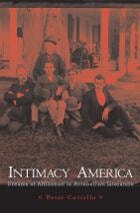
Intimacy in America
Dreams of Affiliation in Antebellum LiteraturePeter Coviello
University of Minnesota Press, 2005
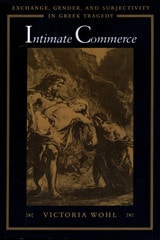
Intimate Commerce
Exchange, Gender, and Subjectivity in Greek TragedyBy Victoria Wohl
University of Texas Press, 1997
Exchanges of women between men occur regularly in Greek tragedy—and almost always with catastrophic results. Instead of cementing bonds between men, such exchanges rend them. They allow women, who should be silent objects, to become monstrous subjects, while men often end up as lifeless corpses. But why do the tragedies always represent the transferal of women as disastrous?
Victoria Wohl offers an illuminating analysis of the exchange of women in Sophocles' Trachiniae, Aeschylus' Agamemnon, and Euripides' Alcestis. She shows how the attempts of women in these plays to become active subjects rather than passive objects of exchange inevitably fail. While these failures seem to validate male hegemony, the women's actions, however futile, blur the distinction between male subject and female object, calling into question the very nature of the tragic self. What the tragedies thus present, Wohl asserts, is not only an affirmation of Athens' reigning ideologies (including its gender hierarchy) but also the possibility of resistance to them and the imagination of alternatives.

Intimate Communities
Representation and Social Transformation in Women's College Fiction, 1895–1910Sherrie A. Inness
University of Wisconsin Press, 1995
While other scholars have argued that the Progressive Era was the “golden age” for women’s single-sex education, pointing to the many positive depictions of the women’s college student, Inness suggests that these representations actually helped to perpetuate the status quo and did little to advance women’s social rights.

Intimate Distance
Andean Music in JapanMichelle Bigenho
Duke University Press, 2012
Bolivians and Japanese involved in these musical practices often express narratives of intimacy and racial belonging that reference shared but unspecified indigenous ancestors. Along with revealing the story of Bolivian music's route to Japan and interpreting the transnational staging of indigenous worlds, Bigenho examines these stories of closeness, thereby unsettling the East-West binary that often structures many discussions of cultural difference and exotic fantasy.
Intimate Empire
Collaboration and Colonial Modernity in Korea and JapanNayoung Aimee Kwon
Duke University Press, 2015
Intimate Grammars
An Ethnography of Navajo PoetryAnthony K. Webster
University of Arizona Press, 2015
Intimate Grammars takes an ethnographic and ethnopoetic approach to language and culture in contemporary time, in which poetry and poets are increasingly important and visible in the Navajo Nation. Webster uses interviews and linguistic analysis to understand the kinds of social work that Navajo poets engage in through their poetry.
Based on more than a decade of ethnographic and linguistic research, Webster’s book explores a variety of topics: the emotional value assigned to various languages spoken on the Navajo Nation through poetry (Navajo English, Navlish, Navajo, and English), why Navajo poets write about the “ugliness” of the Navajo Nation, and the way contemporary Navajo poetry connects young Navajos to the Navajo language. Webster also discusses how contemporary Navajo poetry challenges the creeping standardization of written Navajo and how boarding school experiences influence how Navajo poets write poetry and how Navajo readers appreciate contemporary Navajo poetry.
Through the work of poets such as Luci Tapahonso, Laura Tohe, Rex Lee Jim, Gloria Emerson, Blackhorse Mitchell, Esther Belin, Sherwin Bitsui, and many others, Webster provides new ways of thinking about contemporary Navajo poets and poetry. Intimate Grammars offers an exciting new ethnography of speaking, ethnopoetics, and discourse-centered examinations of language and culture.
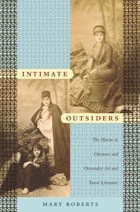
Intimate Outsiders
The Harem in Ottoman and Orientalist Art and Travel LiteratureMary Roberts
Duke University Press, 2007
Roberts draws on a range of sources, including paintings, photographs, and travelogues discovered in archives in Britain, Turkey, Egypt, and Denmark. She rethinks the influential harem works of the realist painter John Frederick Lewis, a British artist living in Cairo during the 1840s, whose works were granted an authoritative status by his British public despite the actual limits of his insider knowledge. Unlike Lewis, British women were able to visit Ottoman harems, and from the mid-nineteenth century on they did so in droves. Writing about their experiences in published travelogues, they undermined the idea that harems were the subject only of male fantasies. The elite Ottoman women who orchestrated these visits often challenged their guests’ misapprehensions about harem life, and a number of them exercised power as patrons, commissioning portraits from European artists. Their roles as art patrons defy the Western idea of the harem woman as passive odalisque.
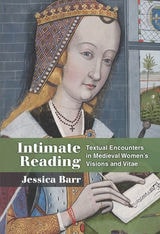
Intimate Reading
Textual Encounters in Medieval Women’s Visions and VitaeJessica Barr
University of Michigan Press, 2020
This new volume is structured around five case studies. Chapters consider the biographies of 13th-century holy women from Liège, the writings of Margery Kempe, Gertrude of Helfta, Mechthild of Magdeburg, Marguerite Porete, and Julian of Norwich. At the heart of Intimate Reading is the question of how reading works—what it means to enter imaginatively and intellectually into the words of another. The volume showcases the complexity of medieval understandings of the work of reading, deepening our perception of the written word’s capacity to signify something that lies even beyond rational comprehension.
Intimate Relations
Social Reform and the Late Nineteenth-Century South Asian NovelKrupa Shandilya
Northwestern University Press, 2017
Intricate Relations
Sexual and Economic Desire in American Fiction, 1789-1814Karen A. Weyler
University of Iowa Press, 2005
Intricate Relations charts the development of the novel in and beyond the early republic in relation to these two thematic and intricately connected centers: sexuality and economics. By reading fiction written by Americans between 1789 and 1814 alongside medical theory, political and economic tracts, and pedagogical literature of all kinds, Karen Weyler recreates and illuminates the larger, sometimes opaque, cultural context in which novels were written, published, and read.
In 1799, the novelist Charles Brockden Brown used the evocative phrase “intricate relations” to describe the complex imbrication of sexual and economic relations in the early republic. Exploring these relationships, he argued, is the chief job of the “moral historian,” a label that most novelists of the era embraced. In a republic anxious about burgeoning individualism in the 1790s and the first two decades of the nineteenth century, the novel foregrounded sexual and economic desires and explored ways to regulate the manner in which they were expressed and gratified.
In Intricate Relations, Weyler argues that understanding how these issues underlie the novel as a genre is fundamental to understanding both the novels themselves and their role in American literary culture. Situating fiction amid other popular genres illuminates how novelists such as Charles Brockden Brown, Hannah Foster, Samuel Relf, Susanna Rowson, Rebecca Rush, and Sally Wood synthesized and iterated many of the concerns expressed in other forms of public discourse, a strategy that helped legitimate their chosen genre and make it a viable venue for discussion in the decades following the revolution.
Weyler’s passionate and persuasive study offers new insights into the civic role of fiction in the early republic and will be of great interest to literary theorists and scholars in women’s and American studies.
Intricate Thicket
Reading Late Modernist PoetriesMark Scroggins
University of Alabama Press, 2015
In these essays, Scroggins reviews the legacy of Louis Zukofsky, delineates the exceptional influence of the Black Mountain poets, and provides close readings of a wealth of examples of poetic works from poets who have carried the modernist legacy into contemporary poetry. He traces with an insider’s keen observation the careers of many of the most dynamic, innovative, and celebrated poets of the past half-century, among them Ian Hamilton Finlay, Ronald Johnson, Rae Armantrout, Harryette Mullen, and Anne Carson.
In a concluding pair of essays, Scroggins situates his own practice within the broad currents he has described. He reflects on his own aesthetics as a contemporary poet and, drawing on his extensive study and writing about Louis Zukofsky, examines the practical and theoretical challenges of literary biography.
While the core of these essays is the interpretation of poetry, Scroggins also offers clear aesthetic evaluations of the successes and failures of the poetries he examines. Scroggins engages with complex and challenging works, and yet his highly accessible descriptions and criticisms avoid theoretical entanglements and specialized jargon. Intricate Thicket yields subtle and multifaceted insights to experts and newcomers alike.
Inventing High and Low
Literature, Mass Culture, and Uneven Modernity in SpainStephanie Sieburth
Duke University Press, 1994
Choosing two historical moments of sweeping material and cultural change in Spanish history, Sieburth reads two novels from the 1880s (by Benito Pérez Galdós) and two from the 1970s (by Juan Goytisolo and Carmen Martín Gaite) as fictional theories about the impact of modernity on culture and politics. Her analysis reveals that the high/low division in the cultural sphere reinforces other kinds of separations—between social classes or between men and women—dear to the elite but endangered by progress. This tension, she shows, is particularly evident in Spain, where modernization has been a contradictory and uneven process, rarely accompanied by political freedom, and where consumerism and mass culture coexist uneasily with older ways of life.
Weaving together a wide spectrum of diverse material, her work will be of interest to readers concerned with Spanish history and literature, literary theory, popular culture, and the relations between politics, economics, gender, and the novel.
Inventing Vietnam
The War in Film and Televisionedited by Michael Anderegg
Temple University Press, 1991
Inventing Womanhood
Gender and Language in Later Middle English WritingTara Williams
The Ohio State University Press, 2011
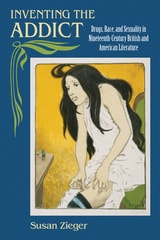
Inventing the Addict
Drugs, Race, and Sexuality in Nineteenth-Century British and American LiteratureSusan Zieger
University of Massachusetts Press, 2008
The notion of addiction has always conjured first-person stories, often beginning with an insidious seduction, followed by compulsion and despair, culminating in recovery and tentative hope for the future. We are all familiar with this form of individual life arrative, Susan Zieger observes, but we know far less about its history. “Addict” was not an available identity until the end of the nineteenth century, when a modernizing medical establishment and burgeoning culture of consumption updated the figure of the sinful drunkard popularized by the temperance movement.
In Inventing the Addict, Zieger tells the story of how the addict, a person uniquely torn between disease and desire, emerged from a variety of earlier figures such as drunkards, opium-eating scholars, vicious slave masters, dissipated New Women, and queer doctors. Drawing on a broad range of literary and cultural material, including canonical novels such as Uncle Tom's Cabin, The Strange Case of Dr. Jekyll and Mr. Hyde, and Dracula, she traces the evolution of the concept of addiction through a series of recurrent metaphors: exile, self-enslavement, disease, and vampirism. She shows how addiction took on multiple meanings beyond its common association with intoxication or specific habit-forming substances—it was an abiding desire akin to both sexual attraction and commodity fetishism, a disease that strangely failed to meet the requirements of pathology, and the citizen's ironic refusal to fulfill the promise of freedom.
Nor was addiction an ideologically neutral idea. As Zieger demonstrates, it took form over time through specific, shifting intersections of gender, race, class, and sexuality, reflecting the role of social power in the construction of meaning.
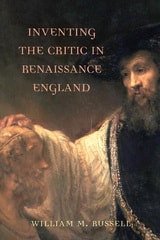
Inventing the Critic in Renaissance England
William Russell
University of Delaware Press, 2011
Published by University of Delaware Press. Distributed worldwide by Rutgers University Press.
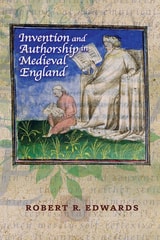
Invention and Authorship in Medieval England
Robert R. Edwards
The Ohio State University Press, 2017
Authorial invention in the Middle Ages is the base of a national tradition that English writers in the Renaissance saw as stable and capable of emulating the canons of classical languages and the Italian and French vernaculars. In Invention and Authorship in Medieval England, Robert R. Edwards brings new interpretive perspectives to Walter Map, Marie de France, John Gower, Geoffrey Chaucer, Thomas Hoccleve, and John Lydgate. He offers a critical reading of key moments that define the emergence of medieval English authorship by showing how writers adapt the commonplaces of authorship to define themselves and their works externally and to construct literary meaning internally.
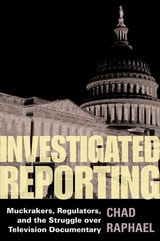
Investigated Reporting
Muckrakers, Regulators, and the Struggle over Television DocumentaryChad Raphael
University of Illinois Press, 2005
2006 History Division Book Award of the Association for Education in Journalism and Mass Communication,
2006 Frank Luther Mott/Kappa Tau Alpha Communications Award, and
2005 Donald McGannon Award for Social and Ethical Relevance in Communications Policy Research
The public often views television investigative reporting as a watchdog on the government. In fact, some of the centerpiece moments of TV muckraking relied heavily on official sources for inspiration, information, and regulatory protection from critics. At the same time, criticism by government officials and overt threats to regulate the television industry influenced the decision-making and content that went into some of broadcast news's iconic moments.
Chad Raphael's looks at the relationship between journalism and regulation during the celebrated period of muckraking that took place on American television between 1960 and 1975. Raphael offers new insights into the economic, political, and industrial forces that shaped documentaries like Harvest of Shame, Hunger in America, and Banks and the Poor while placing the investigative television documentary into its institutional, regulatory, and cultural context. Throughout, Raphael exposes the complex strands of influence used by government officials to shape--and attack--investigative reporting, and highlights how these tactics created a troubling legacy for the regulation of television news today.
Invisibility and Influence
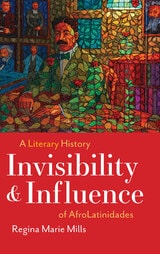
A Literary History of AfroLatinidadesRegina Marie Mills
University of Texas Press, 2024
2026 Honorable Mention, Latinx Studies Section, Social Sciences Category, Latin American Studies Association (LASA)
A rich literary study of AfroLatinx life writing, this book traces how AfroLatinxs have challenged their erasure in the United States and Latin America over the last century.
Invisibility and Influence demonstrates how a century of AfroLatinx writers in the United States shaped life writing, including memoir, collective autobiography, and other formats, through depictions of a wide range of “Afro-Latinidades.” Using a woman-of-color feminist approach, Regina Marie Mills examines the work of writers and creators often excluded from Latinx literary criticism. She explores the tensions writers experienced in being viewed by others as only either Latinx or Black, rather than as part of their own distinctive communities. Beginning with Arturo (Arthur) Schomburg, who contributed to wider conversations about autobiographical technique, Invisibility and Influence examines a breadth of writers, including Jesús Colón; members of the Young Lords; Piri Thomas; Lukumi santera and scholar Marta Moreno Vega; and Black Mexican American poet Ariana Brown. Mills traces how these writers confront the distorted visions of AfroLatinxs in the United States, Latin America, and the Caribbean, and how they created and expressed AfroLatinx spirituality, politics, and self-identity, often amidst violence. Mapping how AfroLatinx writers create their own literary history, Mills reveals how AfroLatinx life writing shapes and complicates discourses on race and colorism in the Western Hemisphere.
Dialogues in AfroLatinidad Podcast:https://www.youtube.com/watch?v=FIhF-pdeW3A
Invisible Darkness
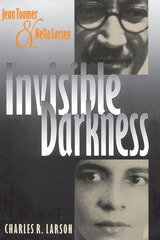
Jean Toomer and Nella LarsenCharles R. Larson
University of Iowa Press, 1993
Invisible Darkness offers a striking interpretation of the tortured lives of the two major novelists of the Harlem Renaissance: Jean Toomer, author of Cane (1923), and Nella Larsen, author of Quicksand (1928) and Passing (1929). Charles R. Larson examines the common belief that both writers "disappeared" after the Harlem Renaissance and died in obscurity; he dispels the misconception that they vanished into the white world and lived unproductive and unrewarding lives.
In clear, jargon-free language, Larson demonstrates the opposing views that both writers had about their work vis-à-vis the incipient black arts movement; he traces each writer's troubled childhood and describes the unresolved questions of race that haunted Toomer and Larsen all of their lives. Larson follows Toomer through the wreckage of his personal life as well as the troubled years of his increasingly quirky spiritual quest until his death in a nursing home in 1967. Using previously unpublished letters and documents, Larson establishes for the first time the details of Larsen's life, illustrating that virtually every published fact about her life is incorrect.
With an innovative chronology that breaks the conventions of the traditional biographical form, Larson narrates what happened to both of these writers during their supposed years of withdrawal. He demonstrates that Nella Larsen never really gave up her fight for creative and personal fulfillment and that Jean Toomer's connection to the Harlem Renaissance—and the black world—is at best a dubious one. This strong revisionist interpretation of two major writers will have a major i mpact on African American literary studies.

Invisible Presence
The Representation of Women in French-Language ComicsCatriona MacLeod
Intellect Books, 2022
MacLeod’s exploration focuses on the representation of female characters in French comics across genres, artistic styles, and time periods. Until now, these characters and their creators have received relatively little scholarly attention, or have only been considered individually, rather than within wider patterns of female representation; this book aims to correct that.
Invisible Work
Borges and TranslationEfrain Kristal
Vanderbilt University Press, 2002
Between the age of ten, when he translated Oscar Wilde, and the end of his life, when he prepared a Spanish version of the Prose Edda , Borges transformed the work of Poe, Kafka, Hesse, Kipling, Melville, Gide, Faulkner, Whitman, Woolf, Chesterton, and many others. In a multitude of essays, lectures, and interviews Borges analyzed the versions of others and developed an engaging view about translation. He held that a translation can improve an original, that contradictory renderings of the same work can be equally valid, and that an original can be unfaithful to a translation.
Borges's bold habits as translator and his views on translation had a decisive impact on his creative process. Translation is also a recurrent motif in Borges's stories. In "The Immortal," for example, a character who has lived for many centuries regains knowledge of poems he had authored, and almost forgotten, by way of modern translations. Many of Borges's fictions include actual or imagined translations, and some of his most important characters are translators. In "Pierre Menard, author of the Quixote," Borges's character is a respected Symbolist poet, but also a translator, and the narrator insists that Menard's masterpiece-his "invisible work"-adds unsuspected layers of meaning to Cervantes's Don Quixote. George Steiner cites this short story as "the most acute, most concentrated commentary anyone has offered on the business of translation."
In an age where many discussions of translation revolve around the dichotomy faithful/unfaithful, this book will surprise and delight even Borges's closest readers and critics.

Inwardness and Theater in the English Renaissance
Katharine Eisaman Maus
University of Chicago Press, 1995
Reading works by Kyd, Marlowe, Shakespeare, Jonson, and Milton in conjuction with sectarian polemics, gynecological treatises, and accounts of criminal prosecutions, Maus delineates unexplored connections among religious, legal, sexual, and theatrical ideas of inward truth. She reveals what was at stake—ethically, politically, epistemologically, and theologically—when a writer in early modern England appealed to the difference between external show and interior authenticity. Challenging the recent tendency to see early modern selfhood as defined in wholly public terms, Maus argues that Renaissance dramatists continually payed homage to aspects of inner life they felt could never be manifested onstage.
Ionesco's Imperatives
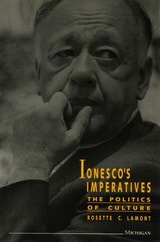
The Politics of CultureRosette C. Lamont
University of Michigan Press, 1993
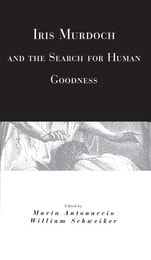
Iris Murdoch and the Search for Human Goodness
Edited by Maria Antonaccio and William Schweiker
University of Chicago Press, 1996
Inspired by Murdoch's tenacious wrestling with basic questions of human existence, these essays not only clarify her thoughts on human goodness, but also move beyond the academy to reflect on how we can and ought to undertake the human adventure in our daily lives.
Contributors are Charles Taylor, Martha Nussbaum, David Tracy, Cora Diamond, Maria Antonaccio, Elizabeth Dipple, Franklin I. Gamwell, Stanley Hauerwas, and William Schweiker. This volume also includes "Metaphysics and Ethics," a classic essay by Iris Murdoch.
Irish Drama in Poland
Staging and Reception, 1900-2000Barry Keane
Intellect Books, 2016
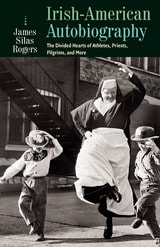
Irish-American Autobiography
James Silas Rogers
Catholic University of America Press, 2016
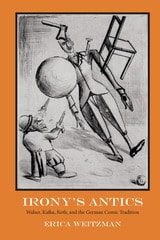
Irony's Antics
Walser, Kafka, Roth, and the German Comic TraditionErica Weitzman
Northwestern University Press, 2014
Combining theoretical breadth with close textual analysis, Erica Weitzman shows how irony, a key term for the German romantics, reemerged in the early twentieth century from a postromantic relegation to the nonsensical and the nihilistic in a way that both rethought romantic irony and dramatically extended its reach.
Through readings of works by Robert Walser, Franz Kafka, and Joseph Roth against the rich history of comic theory (particularly Hegel and Freud), Weitzman traces the development of a specifically comic irony in modern German-language literature and philosophy, a play with the irony that is itself the condition for all play. She thus provides a crucial reevaluation of German literary history and offers new insights into the significance of irony and the comic from the Enlightenment to the present day.
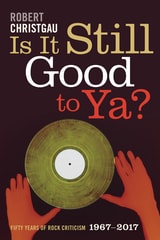
Is It Still Good to Ya?
Fifty Years of Rock Criticism, 1967-2017Robert Christgau
Duke University Press, 2018

Is There God after Prince?
Dispatches from an Age of Last ThingsPeter Coviello
University of Chicago Press, 2023
This is a book about loving things—books, songs, people—in the shadow of a felt, looming disaster. Through lyrical, funny, heart-wrenching essays, Peter Coviello considers pieces of culture across a fantastic range, setting them inside the vivid scenes of friendship, dispute, romance, talk, and loss, where they enter our lives. Alongside him, we reencounter movies like The Shining, shows like The Sopranos; videos; poems; novels by Sam Lipsyte, Sally Rooney, and Paula Fox; as well as songs by Joni Mitchell, Gladys Knight, Steely Dan, Pavement, and the much-mourned saint of Minneapolis, Prince.
Navigating an overwhelming feeling that Coviello calls “endstrickenness,” he asks what it means to love things in calamitous times, when so much seems to be shambling toward collapse. Balancing comedy and anger, exhilaration and sorrow, Coviello illuminates the strange ways the things we cherish help us to hold on to life and to its turbulent joys. Is There God after Prince? shows us what twenty-first-century criticism can be, and how it might speak to us, in a time of ruin, in an age of “Last Things.”
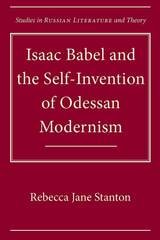
Isaac Babel and the Self-Invention of Odessan Modernism
Rebecca Jane Stanton
Northwestern University Press, 2012
In what marks an exciting new critical direction, Rebecca Stanton contends that the city of Odessa—as a canonical literary image and as a kaleidoscopic cultural milieu—shaped the narrative strategies developed by Isaac Babel and his contemporaries of the Revolutionary generation. Modeling themselves on the tricksters and rogues of Odessa lore, Babel and his fellow Odessans Valentin Kataev and Yury Olesha manipulated their literary personae through complex, playful, and often subversive negotiations of the boundary between autobiography and fiction. In so doing, they cannily took up a place prepared for them in the Russian canon and fostered modes of storytelling that both reflected and resisted the aesthetics of Socialist Realism. Stanton concludes with a rereading of Babel’s “autobiographical” stories and examines their legacy in post-Thaw works by Kataev, Olesha, and Konstantin Paustovsky.
Isabel Rules
Constructing Queenship, Wielding PowerBarbara F. Weissberger
University of Minnesota Press, 2003
A deconstruction of the strategies used to shape the image of a powerful woman ruler
As queen of Spain, Isabel I of Castile (known to history as Isabella the Catholic, 1474–1504) oversaw the creation of Europe’s first nation-state and laid the foundations for its emergence as the largest empire the West has ever known—nearly a century before the better-known and more widely studied Elizabeth I of England.
What we know of this remarkable ruler is typically gleaned from hagiographic texts that negate her power and accept her own propagandistic self-fashioning as legitimate heir, pious princess, devoted wife, and heaven-sent healer of the wounds inflicted on Spain’s body politic by impotent kings, seditious nobles, and such undesirable others as Jews, Muslims, and sodomites. Isabel Rules is the first book to examine the formation of the queen’s public image, focusing on strategies designed to cope with the ideological and cultural dissonance created by the combination of her gender and her profoundly patriarchal political program for unifying and purifying Spain.Barbara Weissberger identifies two primary and interrelated strategies among the supporters of the queen—often writing in her employ—and her critics. Her loyalists use Marian imagery to portray Isabel as a pious, chaste, and submissive queen consort to her husband Ferdinand, while her opponents imagine the queen as a voracious and lascivious whore whose illicit power threatens the virility of her male subjects and inverts the traditional gender hierarchy. Weissberger applies a materialist feminist perspective to a wide array of texts of the second half of the fifteenth century in order to uncover and study the masculine psychosexual anxiety created by Isabel’s anomalous power. She then demonstrates the persistence of the two sides of the propagandistic construction of the Catholic queen, reviewing modern treatments in Francoist schoolbooks and in the fiction of Juan Goytisolo, Alejo Carpentier, and Salman Rushdie.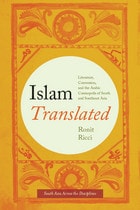
Islam Translated
Literature, Conversion, and the Arabic Cosmopolis of South and Southeast AsiaRonit Ricci
University of Chicago Press, 2011
In Islam Translated, Ronit Ricci uses the Book of One Thousand Questions—from its Arabic original to its adaptations into the Javanese, Malay, and Tamil languages between the sixteenth and twentieth centuries—as a means to consider connections that linked Muslims across divides of distance and culture. Examining the circulation of this Islamic text and its varied literary forms, Ricci explores how processes of literary translation and religious conversion were historically interconnected forms of globalization, mutually dependent, and creatively reformulated within societies making the transition to Islam.
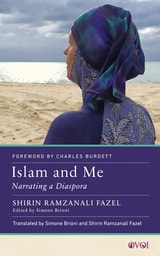
Islam and Me
Narrating a DiasporaShirin Ramzanali Fazel
Rutgers University Press, 2023
In Islam and Me, Fazel tells her story and shares the experiences of other Muslim women living in Italy, revealing the wide variety of Muslim identities and the common prejudices they encounter. Looking at Italian school textbooks, newspapers, and TV programs, she invites us to change the way Muslim immigrants, and especially women, are depicted in both news reports and scholarly research. Islam and Me is a meditation on our multireligious, multiethnic, and multilingual reality, as well as an exploration of how we might reimagine national culture and identity so that they become more diverse, inclusive, and anti-racist.
Islam and Travel in the Middle Ages
Houari Touati
University of Chicago Press, 2010
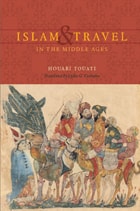
In the Middle Ages, Muslim travelers embarked on a rihla, or world tour, as surveyors, emissaries, and educators. On these journeys, voyagers not only interacted with foreign cultures—touring Greek civilization, exploring the Middle East and North Africa, and seeing parts of Europe—they also established both philosophical and geographic boundaries between the faithful and the heathen. These voyages thus gave the Islamic world, which at the time extended from the Maghreb to the Indus Valley, a coherent identity.
Islam and Travel in the Middle Ages assesses both the religious and philosophical aspects of travel, as well as the economic and cultural conditions that made the rihla possible. Houari Touati tracks the compilers of the hadith who culled oral traditions linked to the prophet, the linguists and lexicologists who journeyed to the desert to learn Bedouin Arabic, the geographers who mapped the Muslim world, and the students who ventured to study with holy men and scholars. Travel, with its costs, discomforts, and dangers, emerges in this study as both a means of spiritual growth and a metaphor for progress. Touati’s book will interest a broad range of scholars in history, literature, and anthropology.
Islamic Architecture on the Move
Motion and ModernityEdited by Christiane Gruber
Intellect Books, 2016
This book brings together scholars from architectural studies, design, art history, and other fields to challenge and expand concepts of Islamic architecture. Ranging from eighteenth-century Ottoman tents to manifestations of Islamic motifs in 1960s Hawaii, this richly illustrated volume raises key questions about Islamic architecture, and, more broadly, about how we can rethink our understanding of material, artistic, and cultural mobility in the modern world.
Island Time
Speed and the Archipelago from St. Kitts and NevisJessica Swanston Baker
University of Chicago Press, 2024
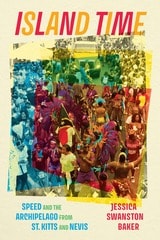
In Island Time, ethnomusicologist Jessica Swanston Baker examines wylers, a musical form from St. Kitts and Nevis that is characterized by speed. Baker argues that this speed becomes a useful and highly subjective metric for measuring the relationship between Caribbean aspirations and the promises of economic modernity; women’s bodily autonomy and the nationalist fantasies that would seek to curb that autonomy; and the material realities of Kittitian-Nevisian youth living in the disillusionment following postcolonial independence. She traces the wider Caribbean musical, cultural, and media-based resonances of wylers, posing an alternative model to scholarship on Caribbean music that has tended to privilege the big islands—Trinidad, Jamaica, and Haiti—thus neglecting not only the unique cultural worlds of smaller nations but also the unbounded nature of musical exchange in the region. The archipelago emerges as a useful model for apprehending the relationality across scales that governs the temporal and spatial logics that undergird Caribbean performance. The archipelago and its speeds ultimately emerge as a meaningful medium for postcolonial, postmodern world-making.
Isocrates and Civic Education
Edited by Takis Poulakos and David Depew
University of Texas Press, 2004
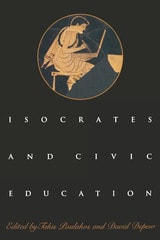
Civic virtue and the type of education that produces publicly minded citizens became a topic of debate in American political discourse of the 1980s, as it once was among the intelligentsia of Classical Athens. Conservatives such as former National Endowment for the Humanities chairman William Bennett and his successor Lynn Cheney held up the Greek philosopher Aristotle as the model of a public-spirited, virtue-centered civic educator. But according to the contributors in this volume, a truer model, both in his own time and for ours, is Isocrates, one of the preeminent intellectual figures in Greece during the fourth century B.C.
In this volume, ten leading scholars of Classics, rhetoric, and philosophy offer a pathfinding interdisciplinary study of Isocrates as a civic educator. Their essays are grouped into sections that investigate Isocrates' program in civic education in general (J. Ober, T. Poulakos) and in comparison to the Sophists (J. Poulakos, E. Haskins), Plato (D. Konstan, K. Morgan), Aristotle (D. Depew, E. Garver), and contemporary views about civic education (R. Hariman, M. Leff). The contributors show that Isocrates' rhetorical innovations carved out a deliberative process that attached moral choices to political questions and addressed ethical concerns as they could be realized concretely. His notions of civic education thus created perspectives that, unlike the elitism of Aristotle, could be used to strengthen democracy.

Israel in Exile
Jewish Writing and the DesertRanen Omer-Sherman
University of Illinois Press, 2006
In contrast to other ethnic and national representations, Jewish writers since antiquity have not constructed a neat antithesis between the desert and the city or nation; rather, the desert becomes a symbol against which the values of the city or nation can be tested, measured, and sometimes found wanting. This book examines how the ethical tension between the clashing Mosaic and Davidic paradigms of the desert still reverberate in secular Jewish literature and produce fascinating literary rewards. Omer-Sherman ultimately argues that the ancient encounter with the desert acquires a renewed urgency in response to the crisis brought about by national identities and territorial conflicts.
Israeli Culture between the Two Intifadas
A Brief RomanceBy Yaron Peleg
University of Texas Press, 2008
Over the past two decades, profound changes in Israel opened its society to powerful outside forces and the dominance of global capitalism. As a result, the centrality of Zionism as an organizing ideology waned, prompting expressions of anxiety in Israel about the coming of a post-Zionist age. The fears about the end of Zionism were quelled, however, by the Palestinian uprising in 2000, which spurred at least a partial return to more traditional perceptions of homeland. Looking at Israeli literature of the late twentieth century, Yaron Peleg shows how a young, urban class of Israelis felt alienated from the Zionist values of their forebears, and how they adopted a form of escapist romanticism as a defiant response that replaced traditional nationalism.
One of the first books in English to identify the end of the post-Zionist era through inspired readings of Hebrew literature and popular media, Israeli Culture between the Two Intifadas examines Israel's ambivalent relationship with Jewish nationalism at the end of the twentieth century.
It's Just the Normal Noises
Marcus, Guralnick, No Depression, and the Mystery of Americana MusicTimothy Gray
University of Iowa Press, 2017
In It’s Just the Normal Noises, Timothy Gray examines a wide array of writing about roots music from the 1960s to the 2000s. In addition to chapters on the genre-defining work of Guralnick and Marcus, he explores the influential writings of Grant Alden and Peter Blackstock, the editors of No Depression magazine, and the writers who contributed to its pages, Bill Friskicks-Warren, Ed Ward, David Cantwell, and Allison Stewart among them. A host of memoirists and novelists, from Patti Smith and Ann Powers to Eleanor Henderson and Dana Spiotta, shed light on the social effects and personal attachments of the music’s many manifestations, from punk to alt country to hardcore. The ambivalent attitudes of rock musicians toward success and failure, the meaning of soul, the formation of alternative communities through magazine readership, and the obsession of Generation X scenes with DIY production values wend through these works.
Taking a personal approach to the subject matter, Gray reads criticism and listens to music as though rock ‘n’ roll not only explains American culture, but also shores up his life. This book is for everyone who’s heard in roots rock the sound of an individual and a nation singing themselves into being.
Italian Signs, American Streets
The Evolution of Italian American NarrativeFred L. Gardaphé
Duke University Press, 1996
Gardaphé draws on Vico’s concept of history, as well as the work of Gramsci, to establish a culture-specific approach to reading Italian American literature. He begins his historical reading with narratives informed by oral traditions, primarily autobiography and autobiographical fiction written by immigrants. From these earliest social–realist narratives, Gardaphé traces the evolution of this literature through tales of “the godfather” and the mafia; the “reinvention of ethnicity” in works by Helen Barolini, Tina DeRosa, and Carole Maso; the move beyond ethnicity in fiction by Don DeLillo and Gilbert Sorrentino; to the short fiction of Mary Caponegro, which points to a new direction in Italian American writing.
The result is both an ethnography of Italian American narrative and a model for reading the signs that mark the “self-fashioning” inherent in literary and cultural production. Italian Signs, American Streets promises to become a landmark in the understanding of literature and culture produced by Italian Americans. It will be of interest not only to students, critics, and scholars of this ethnic experience, but also to those concerned with American literature in general and the place of immigrant and ethnic literatures within that wide framework.
Italy and American Female Imagination
Debra Bernardi
The Ohio State University Press, 2025