Results by title
8113 books match the query 'Literary Criticism' and 256 start with i
Individual and Community
Variations on a Theme in American FictionKenneth H. Baldwin and David Kirby, eds.
Duke University Press, 1975
The essays are intended to point to the continuity of an important theme in American fiction and to offer insight into the variety of philosophical and literary strategies utilized in significant works of significant authors in dealing with the question of the individual and the community.
Individualism and Its Discontents
Appropriations of Emerson, 1880-1950Charles E. Mitchell
University of Massachusetts Press, 1997
The work of Ralph Waldo Emerson has long been synonymous with the American ideals of self-reliance and individualism. Like those ideals, it has come to mean different things, at different times, to different people. Emerson has been identified as the source of both the best and worst in the American intellectual tradition, his authority invoked by back-to-the-landers and industrial capitalists, the philosopher Nietzsche, as well as the promoters of Nike footwear.
This book explores the intertwined history of Emerson and individualism. Charles E. Mitchell begins by examining those who regarded Emersonian individualism with ambivalence or hostility, focusing on the comments of such diverse figures as Henry James, Sr., Oliver Wendell Holmes, Van Wyck Brooks, and H.L. Mencken. He then offers an alternative view as reflected in the work of William James, John Dewey, W.E.B. Du Bois, and William Carlos Williams. Each of these figures embraced Emerson’s claim for the sanctity of the individual and wove it into a social vision that sought to reconcile the paradox at the heart of American life: a simultaneous devotion to the community and the individual, tradition and innovation, order and freedom.
While indirectly answering Emerson’s more fervent critics, James, Dewey, Du Bois, and Williams also constructed a vibrant tradition of their own, one that offers guidance as Americans continue to struggle with these competing claims.
Individuality Incorporated
Indians and the Multicultural ModernJoel Pfister
Duke University Press, 2004
Indonesian Notebook
A Sourcebook on Richard Wright and the Bandung ConferenceBrian Russell Roberts and Keith Foulcher, editors
Duke University Press, 2016
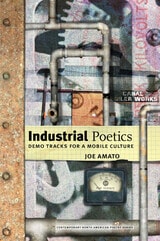
Industrial Poetics
Demo Tracks for a Mobile CultureJoe Amato
University of Iowa Press, 2006
Through a dizzying array of references to subjects ranging from engineering to poetry, on-the-job experiences in academia and industry, conflicts between working-class and intellectual labor, the privatization of universities, and the contradictions of the modern environment, Joe Amato’s Industrial Poetics mounts a boisterous call for poetry communities to be less invested in artistic self-absorption and more concerned about social responsibility.
As Amato focuses on the challenges faced by American poets in creating a poetry that speaks to a public engineered into complacency by those industrial technologies, practices, and patterns of thought that we cannot seem to do without, he brings readers face to face with the conflicting realities of U.S. intellectual, academic, and poetic culture.
Formally adventurous and rhetorically lively, Industrial Poetics is best compared with the intellectually exploratory, speculative, risky, polemical work of other contemporary poet-critics including Kathleen Fraser, Joan Retallack, Bruce Andrews, Susan Howe, and Allen Grossman. Amato uses an exhilarating range of structural and rhetorical strategies: conventionally developed argument, abruptly juxtaposed aphorisms, personal narrative, manifesto-like polemic, and documentary reportage. With a critic’s sharply analytical mind, a poet’s verve, and a working-class intellectual’s sense of social justice, Amato addresses the many nonliterary institutions and environments in which poetry is inextricably embedded.
By connecting poetry to industry in a lively demonstration against the platitudes and habitudes of the twentieth century, Amato argues for a reenergized and socially forceful poetics—an industrial poetics, rough edges and all. Jed Rasula writes, “I can't say I pay much attention to talk radio, but this is what I imagine it might be like if the deejay were really smart, enviably well read, yet somehow retained the snarling moxie of the AM format.”
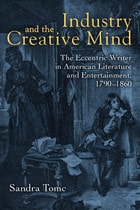
Industry and the Creative Mind
The Eccentric Writer in American Literature and Entertainment, 1790-1860Sandra Tomc
University of Michigan Press, 2012
Industry and the Creative Mind takes a radically new look at the figure of the eccentric, alienated writer in American literature and entertainment from 1790 to 1860. Traditional scholarship takes for granted that the eccentric writer, modeled by such Romantic beings as Lord Byron and brought to life for American audiences by the gloomy person of Edgar Allan Poe, was a figure of rebellion against the excesses of modern commercial culture and industrial life. By contrast, Industry and the Creative Mind argues that in the United States myths of writerly moodiness, alienation, and irresponsibility predated the development of a commercial arts and entertainment industry and instead of forming a site of rebellion from this industry formed a bedrock for its development. Looking at the careers of a number of early American writers---Joseph Dennie, Nathaniel Parker Willis, Edgar Allan Poe, Fanny Fern, as well as a host of now forgotten souls who peopled the twilight worlds of hack fiction and industrial literature---this book traces the way in which early nineteenth-century American arts and entertainment systems incorporated writerly eccentricity in their "logical" economic workings, placing the mad, rebellious writer at the center of the industry's productivity and success.
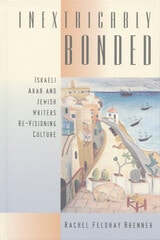
Inextricably Bonded
Israeli Arab and Jewish Writers Re-Visioning CultureRachel Feldhay Brenner
University of Wisconsin Press, 2003
Despite the tragic reality of the continuing Israeli-Arab conflict and deep-rooted beliefs that the chasm between Israeli Jews and Israeli Arabs is unbridgeable, this book affirms the bonds between the two communities. Rachel Feldhay Brenner demonstrates that the literatures of both ethnic groups defy the ideologies that have obstructed dialogue between the two peoples.
Brenner argues that literary critics have ignored the variety and the dissent in the novels of both Arab and Jewish writers in Israel, giving them interpretations that embrace the politics of exclusion and conform with Zionist ideology. Brenner offers insightful new readings that compare fiction by Jewish writers Amos Oz, A.B. Yehoshua, David Grossman, and others with fiction written in Hebrew by such Arab-Israeli writers as Atallah Mansour, Emile Habiby, and Anton Shammas. This parallel analysis highlights the moral and psychological dilemmas faced by both the Jewish victors and the Arab vanquished, and Brenner suggests that the hope for release from the historical trauma lies—on both sides—in reaching an understanding with and of the adversary.
Drawing upon the theories of Walter Benjamin, Jacques Lacan, Sigmund Freud, Emanuel Levinas, and others, Inextricably Bonded is an innovative and illuminating examination of literary dissent from dominant ideology.
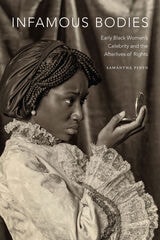
Infamous Bodies
Early Black Women’s Celebrity and the Afterlives of RightsSamantha Pinto
Duke University Press, 2020
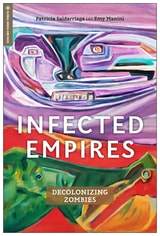
Infected Empires
Decolonizing ZombiesPatricia Saldarriaga
Rutgers University Press, 2022
Studying films from around the world, including Latin America, Asia, Africa, the US, and Europe, Infected Empires presents a vision of a global zombie that points toward a posthuman and feminist future.
Given the current moment—polarized populations, increasing climate fears, and decline of supranational institutions in favor of a rising tide of nationalisms—it is easy to understand the proliferation of apocalyptic and dystopian elements in popular culture. Infected Empires examines one of the most popular figures in contemporary apocalyptic film: the zombie. This harbinger of apocalypse reveals bloody truths about the human condition, the wounds of history, and methods of contending with them.
Infected Empires considers parallels in the zombie genre to historical and current events on different political, theological and philosophical levels, and proposes that the zombie can be read as a figure of decolonization and an allegory of resistance to oppressive structures that racialize, marginalize, disable, and dispose of bodies.
Infidel Poetics
Riddles, Nightlife, SubstanceDaniel Tiffany
University of Chicago Press, 2009
Poetry has long been regarded as the least accessible of literary genres. But how much does the obscurity that confounds readers of a poem differ from, say, the slang that seduces listeners of hip-hop? Infidel Poetics examines not only the shared incomprensibilities of poetry and slang, but poetry's genetic relation to the spectacle of underground culture.
Charting connections between vernacular poetry, lyric obscurity, and types of social relations—networks of darkened streets in preindustrial cities, the historical underworld of taverns and clubs, the subcultures of the avant-garde—Daniel Tiffany shows that obscurity in poetry has functioned for hundreds of years as a medium of alternative societies. For example, he discovers in the submerged tradition of canting poetry and its eccentric genres—thieves’ carols, drinking songs, beggars’ chants—a genealogy of modern nightlife, but also a visible underworld of social and verbal substance, a demimonde for sale.
Ranging from Anglo-Saxon riddles to Emily Dickinson, from the icy logos of Parmenides to the monadology of Leibniz, from Mother Goose to Mallarmé, Infidel Poetics offers an exhilarating account of the subversive power of obscurity in word, substance, and deed.

Infinite Conversation
Maurice Blanchot
University of Minnesota Press, 1992
“Blanchot waits for us still to come, to be read and reread. . . I would say that never as much as today have I pictured him so far ahead of us.” Jacques Derrida
Infinitely Determinable
Children and Childhood in Modern LiteratureDavide Giuriato
Diaphanes, 2021

Infinity (Stage)
Spencer Golub
University of Michigan Press, 2001
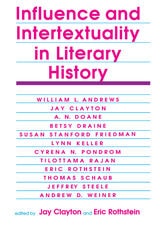
Influence and Intertextuality in Literary History
John B. Clayton
University of Wisconsin Press, 1991
This important collection explores and clarifies two of the most contested ideas in literary theory today, influence and intertextuality. The study of influence tends to center on major authors and canonical works, identifying prior documents as “sources” or “contexts” for a given author. Intertextuality, on the other hand, is a concept unconcerned with authors as individuals; it treats all texts as part of a network of discourse that includes culture, history, and social practices as well as other literary works. In thirteen essays drawing on the entire spectrum of English and American literary history, this volume considers the relationship between these two terms—their rivalry, their kinship, their range of uses.
Debates about these two concepts have been crucial to the “new historicism” and the resurgence of interest in literary history. The essays in this volume employ a refreshing array of examples from that history—poetry of the Renaissance and the twentieth century, novels of the eighteenth through twentieth centuries, Old English texts, and postmodernist productions that have served as recurrent “intertexts” for contemporary theory. The contributors treat such currently vital questions as the role of the author, canon formation, gender, causality, and the social dimension of texts. They illuminate old assumptions and new ideas about agency that lie behind notions of influence, and they examine models of an anonymous textual field that lie behind notions of intertextuality.
The volume takes much of its character from its own intertextual origin as a group project of the English faculty at the University of Wisconsin–Madison. Though diverse in their academic interests, concerns, and experience, the contributors particpated in an ongoing intellectual exchange that is a model of how new scholarship can arise from dialogue.

Influenza and Inequality
One Town's Tragic Response to the Great Epidemic of 1918Patricia J. Fanning
University of Massachusetts Press, 2010
By 1918, Norwood was a small, ethnically diverse, industrialized, and stratified community. Ink, printing, and tanning factories were owned by wealthy families who lived privileged lives. These industries attracted immigrant laborers who made their homes in several ethnic neighborhoods and endured prejudice and discrimination at the hands of native residents. When the epidemic struck, the immigrant neighborhoods were most affected; a fact that played a significant role in the town's response—with tragic results.
This close analysis of one town's struggle illuminates how even well-intentioned elite groups may adopt and implement strategies that can exacerbate rather than relieve a medical crisis. It is a cautionary tale that demonstrates how social behavior can be a fundamental predictor of the epidemic curve, a community's response to crisis, and the consequences of those actions.
Influx and Efflux
Writing Up with Walt WhitmanJane Bennett
Duke University Press, 2020
Informal Empire
Mexico And Central America In Victorian CultureRobert D. Aguirre
University of Minnesota Press, 2004
Behind the ancient artifacts exhibited in our museums lies a secret past—of travel, desire, the quest for knowledge, and even theft. Such is the case with the objects of Mesoamerican culture so avidly collected, cataloged, and displayed by the British in the nineteenth century. Informal Empire recaptures the history of those artifacts from Mexico and Central America that stirred Victorian interest—a history that reveals how such objects and the cultures they embodied were incorporated into British museum collections, panoramas, freak shows, adventure novels, and records of imperial administrators.
Robert D. Aguirre draws on a wealth of previously untapped historical information to show how the British colonial experience in Africa and the Near East gave rise to an “informal imperialism” in Mexico and Central America. Aguirre’s work helps us to understand what motivated the British to beg, borrow, buy, and steal from peripheral cultures they did not govern. With its original insights, Informal Empire points to a new way of thinking about British imperialism and, more generally, about the styles and forms of imperialism itself.
Infrastructures of Apocalypse
American Literature and the Nuclear ComplexJessica Hurley
University of Minnesota Press, 2020
A new approach to the vast nuclear infrastructure and the apocalypses it produces, focusing on Black, queer, Indigenous, and Asian American literatures
Since 1945, America has spent more resources on nuclear technology than any other national project. Although it requires a massive infrastructure that touches society on myriad levels, nuclear technology has typically been discussed in a limited, top-down fashion that clusters around powerful men. In Infrastructures of Apocalypse, Jessica Hurley turns this conventional wisdom on its head, offering a new approach that focuses on neglected authors and Black, queer, Indigenous, and Asian American perspectives.
Exchanging the usual white, male “nuclear canon” for authors that include James Baldwin, Leslie Marmon Silko, and Ruth Ozeki, Infrastructures of Apocalypse delivers a fresh literary history of post-1945 America that focuses on apocalypse from below. Here Hurley critiques the racialized urban spaces of civil defense and reads nuclear waste as a colonial weapon. Uniting these diverse lines of inquiry is Hurley’s belief that apocalyptic thinking is not the opposite of engagement but rather a productive way of imagining radically new forms of engagement.
Infrastructures of Apocalypse offers futurelessness as a place from which we can construct a livable world. It fills a blind spot in scholarship on American literature of the nuclear age, while also offering provocative, surprising new readings of such well-known works as Atlas Shrugged, Infinite Jest, and Angels in America. Infrastructures of Apocalypse is a revelation for readers interested in nuclear issues, decolonial literature, speculative fiction, and American studies.
Infrathin
An Experiment in MicropoeticsMarjorie Perloff
University of Chicago Press, 2021
The “infrathin” was Marcel Duchamp’s playful name for the most minute shade of difference: that between the report of a gunshot and the appearance of the bullet hole, or between two objects in a series made from the same mold. “Eat” is not the same thing as “ate.” The poetic, Marjorie Perloff suggests, can best be understood as the language of infrathin. For in poetry, whether in verse or prose, words and phrases that are seemingly unrelated in ordinary discourse are realigned by means of sound, visual layout, etymology, grammar, and construction so as to “make it new.”
In her revisionist “micropoetics,” Perloff draws primarily on major modernist poets from Stein and Yeats to Beckett, suggesting that the usual emphasis on what this or that poem is “about,” does not do justice to its infrathin possibilities. From Goethe’s eight-line “Wanderer’s Night Song” to Eliot’s Four Quartets, to the minimalist lyric of Rae Armantrout, Infrathin is designed to challenge our current habits of reading and to answer the central question: what is it that makes poetry poetry?

Inhabitants of the Deep
The Blueness of BlacknessJonathan Howard
Duke University Press, 2025

Inheriting The Land
Contemporary Voices from the MidwestMark Vinz
University of Minnesota Press, 1993
Inhuman Citizenship
Traumatic Enjoyment and Asian American LiteratureJuliana Chang
University of Minnesota Press, 2012
In Inhuman Citizenship, Juliana Chang claims that literary representations of Asian American domesticity may be understood as symptoms of America’s relationship to its national fantasies and to the “jouissance”—a Lacanian term signifying a violent yet euphoric shattering of the self—that both overhangs and underlies those fantasies. In the national imaginary, according to Chang, racial subjects are often perceived as the source of jouissance, which they supposedly embody through their excesses of violence, sexuality, anger, and ecstasy—excesses that threaten to overwhelm the social order.
To examine her argument that racism ascribes too much, rather than a lack of, humanity, Chang analyzes domestic accounts by Asian American writers, including Fae Myenne Ng’s Bone, Brian Ascalon Roley’s American Son, Chang-rae Lee’s Native Speaker, and Suki Kim’s The Interpreter. Employing careful reading and Lacanian psychoanalysis, Chang finds sites of excess and shock: they are not just narratives of trauma; they produce trauma as well. They render Asian Americans as not only the objects but also the vehicles and agents of inhuman suffering. And, claims Chang, these novels disturb yet strangely exhilarate the reader through characters who are objects of racism and yet inhumanly enjoy their suffering and the suffering of others.
Through a detailed investigation of “family business” in works of Asian American life, Chang shows that by identifying with the nation’s psychic disturbance, Asian American characters ethically assume responsibility for a national unconscious that is all too often disclaimed.

Ink Trails II
Michigan's Famous and Forgotten AuthorsDave Dempsey
Michigan State University Press, 2016
Exploring the hidden treasures of otherwise forgotten authors while also acknowledging the Michigan-set stories of giants like Hemingway, Dave and Jack Dempsey delve into the state’s literary heritage, as robust, diverse, and inexhaustible as the natural beauty of the place that nurtured it. This second volume of “ink trails” continues to tell the story of the remarkable writers, powerful words, and sublime nature of Michigan in the same well-researched and entertaining prose as the first.

Ink Trails
Michigan's Famous and Forgotten AuthorsDave Dempsey
Michigan State University Press, 2012
Long revered as the birthplace of many of the nation’s best-known authors, Michigan has also served as inspiration to countless others. In this entertaining and well-researched book—the first of its kind—the secrets, legends, and myths surrounding some of Michigan’s literary luminaries are explored. Which Michigan poet inspired a state law requiring teachers to assign at least one of his compositions to all students? Which young author emerged from the University of Michigan with a bestselling novel derided by some critics as “vulgar”? And from what Michigan city did Arthur Miller, Robert Frost, and Jane Kenyon draw vital inspiration? The answers to these questions and more are revealed in this rich literary history that highlights the diversity of those whose impact on letters has been indelible and distinctly Michiganian.
Innovation and Tradition in the Writings of the Venerable Bede
SCOTT DEGREGORIO
West Virginia University Press, 2006
Works prior to this book focused on Bede as not only a European, but also as an English scholar, historian, scientist, or a biographer of saints, and have used a traditional approach towards his explanation of the Bible. Bede's interpretation of his work, its continuous progress, and the reasons behind his hurried appointment to an authority almost as high as the Church Fathers are all topics examined within the text. Essays are by Roger Ray, Faith Wallis, Calvin B. Kendall, George Hardin Brown, Scott DeGregorio, Arthur G. Holder, Lawrence T. Martin, Walter Goffart, and Joyce Hill.
Innovation in the Italian Counter-Reformation
Shannon McHugh
University of Delaware Press, 2011
Published by University of Delaware Press. Distributed worldwide by Rutgers University Press.
Innovative Women Poets
An Anthology of Contemporary Poetry and InterviewsElisabeth A. Frost
University of Iowa Press, 2007
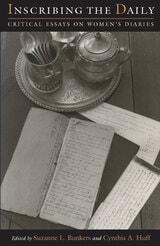
Inscribing the Daily
Critical Essays on Women's DiariesSuzanne L. Bunkers
University of Massachusetts Press, 1996
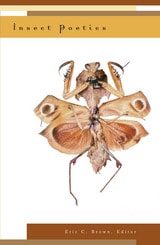
Insect Poetics
Eric C. Brown
University of Minnesota Press, 2006
In Insect Poetics, the first book to comprehensively explore the cultural and textual meanings of bugs, editor Eric Brown argues that insects are humanity’s “other.” In order to be experienced, the insect world must be mediated by art or technology (as in the case of an ant farm or Kafka’s Metamorphoses) while humans observe, detached and fascinated.
In eighteen original essays, this book illuminates the ways in which our human intellectual and cultural models have been influenced by the natural history of insects. Through critical readings contributors address such topics as performing insects in Shakespeare’s Coriolanus, the cockroach in the contemporary American novel, the butterfly’s “voyage out” in Virginia Woolf, and images of insect eating in literature and popular culture. In surprising ways, contributors tease out the particularities of insects as cultural signifiers and propose ways of thinking about “insectivity,” suggesting fertile cross-pollinations between entomology and the arts, between insects and the humanities.
Contributors: May Berenbaum, Yves Cambefort, Marion W. Copeland, Nicky Coutts, Bertrand Gervais, Sarah Gordon, Cristopher Hollingsworth, Heather Johnson, Richard J. Leskosky, Tony McGowan, Erika Mae Olbricht, Marc Olivier, Roy Rosenstein, Rachel Sarsfield, Charlotte Sleigh, Andre Stipanovic.
Eric C. Brown is assistant professor of English at the University of Maine at Farmington. He has written previously about insects and eschatology in Edmund Spenser’s Muiopotmos.
Inside Tenement Time
Suss, Spirit, and SurveillanceKezia Page
Rutgers University Press, 2025
Inside Tenement Time is the first comprehensive treatment of literary and cultural texts on surveillance in the Caribbean. Covering the long historical arc of the twentieth to the twenty-first centuries, Inside Tenement Time uses Jamaica as a case study to examine moments of crisis and particular spaces, especially urban yard enclaves and their environs, in the Caribbean encounter with surveillance. Making the argument that the Caribbean situation reveals flexible hegemonies rather than provinces of exclusive control, the book demonstrates the countervailing force of sussveillance and spiritveillance, Afro-Indigenous variations on surveillance. Sussveillance and spiritveillance are exemplars of vernacular arts and sciences that operate at and within the frangible borders of state power, exposing the unique dynamics of surveillance in the region and marshalling the acts of imagination with which it contends. For example, the Smile Jamaica concert of 1976, headlined by reggae Superstar Bob Marley, and the reputedly US government-backed 2010 Tivoli Gardens incursion in West Kingston, both moments that have dramatic, even mythic residue in Caribbean and global memory, are among the real-life events brought into conversation with literary representations of this history.
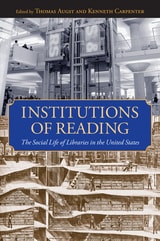
Institutions of Reading
The Social Life of Libraries in the United StatesThomas Augst
University of Massachusetts Press, 2007
Tracing the evolution of the library as a modern institution from the late eighteenth century to the digital era, this book explores the diverse practices by which Americans have shared reading matter for instruction, edification, and pleasure. Writing from a rich variety of perspectives, the contributors raise important questions about the material forms and social shapes of American culture. What is a library? How have libraries fostered communities of readers and influenced the practice of reading in particular communities? How did the development of modern libraries alter the boundaries of individual and social experience, and define new kinds of public culture? To what extent have libraries served as commercial enterprises, as centers of power, and as places of empowerment for African Americans, women, and immigrants? Institutions of Reading offers at once a social history of literacy and leisure, an intellectual history of institutional and technological innovations that facilitated the mass distribution and consumption of printed books and periodicals, and a cultural history of the symbolic meanings and practical uses of reading in American life. In addition to the editors, contributors include Elizabeth Amann, Michael Baenen, James Green, Elizabeth McHenry, Barbara Mitchell, Christine Pawley, Janice Radway, James Raven, Karin Roffman, and Roy Rosenzweig.
Instrument of Memory
Encounters with the Wandering JewLisa Lampert-Weissig
University of Michigan Press, 2024
Intangible Materialism
The Body, Scientific Knowledge, and the Power of LanguageRonald Schleifer
University of Minnesota Press, 2009
Taking as his point of departure Norbert Weiner’s statement that information is basic to understanding materialism in our era, Ronald Schleifer shows how discoveries of modern physics have altered conceptions of matter and energy and the ways in which both information theory and the study of literature can enrich these conceptions. Expanding the reductive notion of “the material” as simply matter and energy, he formulates a new, more inclusive idea of materialism.
Schleifer’s project attempts to bridge the divisions between the humanities and the sciences and to create a nonreductive materialism for the information age. He presents a materialistic account of human bodily experience by delving into language and literature that powerfully represents our faces, voices, hands, and pain. For example, he examines the material resources of poetic “literariness” as it is revealed in the condition of Tourette’s syndrome. Schleifer also investigates gestures of the hand in the formation of sociality, and he studies pain as both a physiological and phenomenological experience.
This ambitious work explores physiological analyses, evolutionary explanations, and semiotic descriptions of materialism to reveal how aspects of physical existence discover meaning in experience.
Intelligent Souls?
Feminist Orientalism in Eighteenth-Century English LiteratureSamara Anne Cahill
Bucknell University Press, 2019
Published by Bucknell University Press. Distributed worldwide by Rutgers University Press.
Intention Interpretation
edited by Gary Iseminger
Temple University Press, 1995
Inter-imperiality
Vying Empires, Gendered Labor, and the Literary Arts of AllianceLaura Doyle
Duke University Press, 2020
Interacting with Print
Elements of Reading in the Era of Print SaturationThe Multigraph Collective
University of Chicago Press, 2018
Each entry builds on its term in order to resituate print and book history within a broader media ecology throughout the eighteenth and nineteenth centuries. The central theme is interactivity, in three senses: people interacting with print; print interacting with the non-print media that it has long been thought, erroneously, to have displaced; and people interacting with each other through print. The resulting book will introduce new energy to the field of print studies and lead to considerable new avenues of investigation.

Intercultural and Intertextual Encounters in Michael Roes's Travel Fiction
Seiriol Dafydd
University of London Press, 2015
Interior States
Institutional Consciousness and the Inner Life of Democracy in the Antebellum United StatesChristopher Castiglia
Duke University Press, 2008
In the late eighteenth century and early nineteenth, as discourses of interiority gained prominence, so did powerful counter-narratives. Castiglia reveals the flamboyant pages of antebellum popular fiction to be an archive of unruly democratic aspirations. Through close readings of works by Maria Monk and George Lippard, Walt Whitman and Timothy Shay Arthur, Hannah Webster Foster and Hannah Crafts, and Nathaniel Hawthorne and Herman Melville, Castiglia highlights a refusal to be reformed or self-contained. In antebellum authors’ representations of nervousness, desire, appetite, fantasy, and imagination, he finds democratic strivings that refused to disappear. Taking inspiration from those writers and turning to the present, Castiglia advocates a humanism-without-humans that, denied the adjudicative power of interiority, promises to release democracy from its inner life and to return it to the public sphere where U.S. citizens may yet create unprecedented possibilities for social action.
Interiority in German Women's Writing
Beate Allert
University of Delaware Press, 2026
Interiority in German Women’s Writing for the first time systematically gathers and engages with contributions of German women authors to the discourse on interiority (Innerlichkeit) from 1750 to 1850. This volume shifts the recent focus on abstract theoretical and medical discourses on inwardness to the origins of interiority in literature and philosophy as written and experienced by women from the Age of Sensibility (Empfindsamkeit) to the Romantic era. At the same time, it makes a claim for and explores the ramifications of understanding interiority as a feminine discourse. Contributors investigate the works of women authors who searched to find rescue from their cultural and personal entrapment via creative spaces and various modes of interiority in theatrical performances, poetic writings, letters, biographical narratives, prose, and fairy tales. From the case studies and literary analyses in the volume, interiority emerges as a spectrum of approaches to defining, resisting, and transforming the innermost self.
Internal Evidence and Elizabethan Dramatic Authorship
An Essay in Literary History and MethodS. Schoenbaum
Northwestern University Press, 1966
Interpreting the Self
Two Hundred Years of American AutobiographyDiane Bjorklund
University of Chicago Press, 1998
"A refreshingly welcome approach to this intriguing topic. . . . [Bjorklund's] extensive and systematic approach to her source material is impressive and enriches our understanding of this essential subject."—Virginia Quarterly Review
"Bjorklund studies both famous and obscure writers, and her clear prose style and copious quotations provide insight into the many aspects of the changing American self." —Library Journal
Interruptions
The Fragmentary Aesthetic in Modern LiteratureGerald L. Bruns
University of Alabama Press, 2018
A history of fragmentary—or interrupted—writing in avant-garde poetry and prose by a renowned literary critic.
In Interruptions: The Fragmentary Aesthetic in Modern Literature, Gerald L. Bruns explores the effects of parataxis, or fragmentary writing as a device in modern literature. Bruns focuses on texts that refuse to follow the traditional logic of sequential narrative. He explores numerous examples of self-interrupting composition, starting with Friedrich Schlegel's inaugural theory and practice of the fragment as an assertion of the autonomy of words, and their freedom from rule-governed hierarchies.
Bruns opens the book with a short history of the fragment as a distinctive feature of literary modernism in works from Gertrude Stein to Paul Celan to present-day authors. The study progresses to the later work of Maurice Blanchot and Samuel Beckett, and argues, controversially, that Blanchot's writings on the fragment during the 1950s and early 1960s helped to inspire Beckett’s turn toward paratactic prose.
The study also extends to works of poetry, examining the radically paratactic arrangements of two contemporary British poets, J. H. Prynne and John Wilkinson, focusing chiefly on their most recent, and arguably most abstruse, works. Bruns also offers a close study of the poetry and poetics of Charles Bernstein.
Interruptions concludes with two chapters about James Joyce. First, Bruns tackles the language of Finnegans Wake, namely the break-up of words themselves, its reassembly into puns, neologisms, nonsense, and even random strings of letters. Second, Bruns highlights the experience of mirrors in Joyce’s fiction, particularly in Dubliners, Portrait of the Artist as a Young Man, and Ulysses, where mirrored reflections invariably serve as interruptions, discontinuities, or metaphorical displacements and proliferations of self-identity.
Intersections of Harm
Narratives of Latina Deviance and DefianceHalperin, Laura
Rutgers University Press, 0

Intersections
Fantasy and Science FictionEdited by George E. Slusser and Eric S. Rabkin
Southern Illinois University Press, 1987
These 17 essays from the seventh annual J. Lloyd Eaton Conference examine the relationship between fantasy and science fiction.
They propose that fantasy and science fiction are not isolated commercial literary forms, but instead are literary forms worthy of the recognition reserved for traditional literature. Discussion of genre identification ranges from the standard forms of literary criticism embodied in Aristotle’s mimesis and poesis to innovative and possibly controversial points of view such as a theory of humor, a philosophy of time, and a detailed analysis of Dr. Seuss’s Cat in the Hat.
The essays provide not only a detailed study of literary elements but also the historical treatment of the material, its commercial use, and its relationship to similar literary forms such as the gothic tale and horror fiction. While few of the essayists agree with one another, they all contribute creative insights to the debate.
Intersex Figures in Modern Japanese Literature and Art
Leslie Winston
University of Michigan Press, 2025
Intersex Figures in Modern Japanese Literature and Art explores the history of intersex or futanari figures in modern Japanese literature and culture to examine the provocative discourses that defied a sexual regime as the modern nation-state of Japan advanced its national and imperial designs. As sexologists and medical practitioners continued reinforcing categories of “male” and “female,” “normal” and “pathological,” intersex literary figures garnered attention because the perceived subject was expected to be male or female—any variation was unintelligible. Many of the same century-old tropes and societal attitudes of needing to “cure” intersex persist. At the same time the 1991 novel Ringu by Suzuki Kōji testifies to a denial of futanari subjectivity, while the 1998 Japanese horror film (Ringu) and its 2002 American remake (The Ring) erase intersex all together.
Winston interrogates how the trope of the futanari is deployed for pragmatic or aesthetic purposes, thereby complicating the trajectory of the dominant sexological ideology of the time. Winston reads the figurative futanari in the works of Shimizu Shikin, Tanizaki Jun’ichirō, and Takabatake Kashō, and reveals how the artists’ different approaches to the futanari served their agendas and expressed views that challenged the dominant discourse on intersex.
Interventions into Modernist Cultures
Poetry from Beyond the Empty ScreenAmie Elizabeth Parry
Duke University Press, 2007
Reading various works by US expatriates Ezra Pound and Gertrude Stein, Parry compares the cultural politics of U.S. canonical modernism with alternative representations of temporality, hybridity, erasure, and sexuality in the work of the Taiwanese writers Yü Kwang-chung and Hsia Yü and the Asian American immigrant author Theresa Hak Kyung Cha. Juxtaposing poems by Pound and Yü Kwang-chung, Parry shows how Yü’s fragmented, ambivalent modernist form reveals the effects of neocolonialism while Pound denies and obscures U.S. imperialism in Asia, asserting a form of nondevelopmental universalism through both form and theme. Stein appropriates discourses of American modernity and identity to represent nonnormative desire and sexuality, and Parry contrasts this tendency with representations of sexuality in the contemporary experimental poetry of Hsia Yü. Finally, Parry highlights the different uses of modernist forms by Pound in his Cantos—which incorporate a multiplicity of decontextualized and ahistorical voices—and by Cha in her 1982 novel Dictee, a historicized, multilingual work. Parry’s sophisticated readings provide a useful critical framework for apprehending how “minor modernisms” illuminate the histories erased by certain canonical modernist texts.
Interwar Itineraries
Authenticity in Anglophone and French Travel WritingEmily O. Wittman
Amherst College Press, 2022
“This book offers a valuable account of literary activity in a genre still inadequately covered in literary-critical history. Emily Witt- man organizes her material through pairings and contextualizing that are instructive and illuminating and often exciting . . . This is comparative literature at its best.” —Vincent Sherry, Washington University

Intimacies
Leo Bersani and Adam Phillips
University of Chicago Press, 2008
In pursuit of new forms of intimacy they take up a range of concerns across a variety of contexts. To test the hypothesis that the essence of the analytic exchange is intimate talk without sex, they compare Patrice Leconte’s film about an accountant mistaken for a psychoanalyst, Intimate Strangers, with Henry James’s classic novella The Beast in the Jungle. A discussion of the radical practice of barebacking—unprotected anal sex between gay men—delineates an intimacy that rejects the personal. Even serial killer Jeffrey Dahmer and the Bush administration’s war on terror enter the scene as the conversation turns to the way aggression thrills and gratifies the ego. Finally, in a reading of Socrates’ theory of love from Plato’s Phaedrus, Bersani and Phillips call for a new form of intimacy which they term “impersonal narcissism”: a divestiture of the ego and a recognition of one’s non-psychological potential self in others. This revolutionary way of relating to the world, they contend, could lead to a new human freedom by mitigating the horrifying violence we blithely accept as part of human nature.
Charmingly persuasive and daringly provocative, Intimacies is a rare opportunity to listen in on two brilliant thinkers as they explore new ways of thinking about the human psyche.
Intimacy in America
Dreams of Affiliation in Antebellum LiteraturePeter Coviello
University of Minnesota Press, 2005