Results by title
28164 books match the query 'History' and 997 start with i
Immigrants in the Far West
Historical Identities and ExperiencesJessie L. Embry
University of Utah Press, 2014
Immigrants in the Valley
Irish, Germans, and Americans in the Upper Mississippi Country, 1830-1860Mark Wyman
Southern Illinois University Press, 1984
Immigration and Nationalism
Argentina and Chile, 1890–1914By Carl Solberg
University of Texas Press, 1970
“Dirtier than the dogs of Constantinople.” “Waves of human scum thrown upon our beaches by other countries.” Such was the vitriolic abuse directed against immigrant groups in Chile and Argentina early in the twentieth century. Yet only twenty-five years earlier, immigrants had encountered a warm welcome. This dramatic change in attitudes during the quarter century preceding World War I is the subject of Carl Solberg’s study. He examines in detail the responses of native-born writers and politicians to immigration, pointing out both the similarities and the significant differences between the situations in Argentina and Chile.
As attitudes toward immigration became increasingly nationalistic, the European was no longer pictured as a thrifty, industrious farmer or as an intellectual of superior taste and learning. Instead, the newcomer commonly was regarded as a subversive element, out to destroy traditional creole social and cultural values. Cultural phenomena as diverse as the emergence of the tango and the supposed corruption of the Spanish language were attributed to the demoralizing effects of immigration.
Drawing his material primarily from writers of the pre–World War I period, Solberg documents the rise of certain forms of nationalism in Argentina and Chile by examining the contemporary press, journals, literature, and drama. The conclusions that emerge from this study also have obvious application to the situation in other countries struggling with the problems of assimilating minority groups.
Immigration and the Politics of American Sovereignty, 1890-1990
Cheryl Shanks
University of Michigan Press, 2001
Immigration, Diversity, and Broadcasting in the United States 1990—2001
Vibert C. Cambridge
Ohio University Press, 2004
Immortal River
The Upper Mississippi in Ancient and Modern TimesCalvin R. Fremling
University of Wisconsin Press, 2005
Like the Mississippi itself, Immortal River often leaves the main channel to explore the river's backwaters, floodplain, and drainage basin. The book's focus is the Upper Mississippi, from Minneapolis, Minnesota, to Cairo, Illinois. But it also includes information about the river's headwaters in northern Minnesota and about the Lower Mississippi from Cairo south to the river's mouth ninety miles below New Orleans. It offers an understanding of the basic geology underlying the river's landscapes, ecology, environmental problems, and grandeur.
Impact Zone
The Battle of the DMZ in Vietnam, 1967–1968Jim Brown
University of Alabama Press, 2004
In the heart of the DMZ, one Marine faced the war—and the truth behind it.
Impact Zone documents Marine First Lieutenant James S. Brown's intense battle experiences, including those at Khe Sanh and Con Thien, throughout his thirteen months of service on the DMZ during 1967-68. This high-action account also reflects Brown's growing belief that the Vietnam War was mis-fought due to the unproductive political leadership of President Johnson and his administration. Brown's naiveté developed into hardening skepticism and cynicism as he faced the harsh realities of war, though he still managed to retain a sense of honor, pride, and patriotism for his country.
Impact Zone is a distinctive book on the Vietnam War because it is told from the perspective of an artilleryman, and the increasingly dangerous events gain momentum as they progress from one adventure to the next. Impact Zone is not only an important historical document of the Vietnam conflict, but also a moving record of the personal and emotional costs of war.
Imperfect Creatures
Vermin, Literature, and the Sciences of Life, 1600-1740Lucinda Cole
University of Michigan Press, 2016
As Cole illustrates, human health and demographic problems—notably those of feeding populations periodically stricken by hunger, disease, and famine—were tied to larger questions about food supplies, property laws, national identity, and the theological imperatives that underwrote humankind’s claim to dominion over the animal kingdom. In this context, Cole’s study indicates, so-called “vermin” occupied liminal spaces between subject and object, nature and animal, animal and the devil, the devil and disease—even reason and madness. This verminous discourse formed a foundational category used to carve out humankind’s relationship to an unpredictable, irrational natural world, but it evolved into a form for thinking about not merely animals but anything that threatened the health of the body politic—humans, animals, and even thoughts.
Imperfect Fit
Aesthetic Function, Facture, and Perception in Art and Writing since 1950Allen Fisher
University of Alabama Press, 2016
Rethinking art, poetry, and perception through the creative disruptions of contemporary culture.
Imperfect Fit: Aesthetic Function, Facture, and Perception in Art and Writing since 1950 is an expansive and incisive examination of the patterns of connectedness in contemporary art and poetry. Allen Fisher—a highly accomplished poet, painter, critic, and art historian as well as a key figure in the British poetry revival of the 1960s and 1970s—has a close and discerning connection to his subjects.
In Imperfect Fit, Fisher focuses on the role of fracturing, ruptures, and breakages in many traditional ties between art and poetry, as well as the resulting use of collage and assemblage by practitioners of those arts. Fisher addresses, among other subjects, destruction as a signifier in twentieth-century art; the poetic employment of bureaucratic vocabularies and “business speak”; and the roles of public performance and memory loss in the fashioning of human knowledge and art.
Commonplace notions of coherence, logic, and truth are reimagined and deconstructed in this study, and Fisher concludes by suggesting that contemporary culture offers a particularly robust opportunity—and even necessity—to engage in the production of art as a pragmatic act. Scholars of art, poetry, and aesthetics will be engaged and challenged by this insightful work.
Imperfection and Defeat
The Role of Aesthetic Imagination in Human SocietyVirgil Nemoianu
Central European University Press, 2006
Imperial Affects
Sensational Melodrama and the Attractions of American CinemaEagle, Jonna
Rutgers University Press, 2017

Imperial Bibles, Domestic Bodies
Women, Sexuality, and Religion in the Victorian MarketMary Wilson Carpenter
Ohio University Press, 2003
Of the many literary phenomena that sprang up in eighteenth-century England and later became a staple of Victorian culture, one that has received little attention until now is the “Family Bible with Notes.” Published in serial parts to make it affordable, the Family Bible was designed to enhance the family’s status and sense of national and imperial identity.
Imperial Bibles, Domestic Bodies reveals in its study of the production and consumption of British commercial Family Bibles startling changes in “family values.” Advertised in the eighteenth century as providing the family with access to “universal knowledge,” these Bibles suddenly shifted in the early nineteenth century to Bibles with bracketed sections marked “to be omitted from family reading” and reserved for reading “in the closet” by the “Master of the family.” These disciplinary Bibles were paralleled by Family Bibles designed to appeal to the newly important female consumer. Illustrations featured saintly women and charming children, and “family registers” with vignettes of family life emphasized the prominent role of the “angel in the house.”
As Mary Wilson Carpenter documents in Imperial Bibles, Domestic Bodies, the elaborate notes and “elegant engravings” in these Bibles bring to light a wealth of detail about the English commonsense view of such taboo subjects as same-sex relations, masturbation, menstruation, and circumcision. Her reading of literary texts by Charlotte Brontë, George Eliot, and Elizabeth Barrett Browning in the context of these commercial representations of the “Authorized Version” or King James translation of the Bible indicates that when the Victorians spoke about religion, they were also frequently speaking about sex.
Imperial Blues
Geographies of Race and Sex in Jazz Age New YorkFiona I. B. Ngô
Duke University Press, 2013
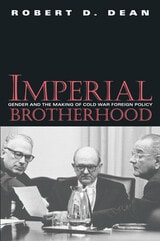
Imperial Brotherhood
Gender and the Making of Cold War Foreign PolicyRobert D. Dean
University of Massachusetts Press, 2001
This provocative book begins with a question about the Vietnam War. How is it, asks Robert D. Dean, that American policymakers—men who prided themselves on “hardheaded pragmatism” and shunned “fuzzy idealism”—could have committed the nation to such a ruinous, costly, and protracted war? The answer, he argues, lies not simply in the imperatives of anticommunist ideology or in any reasonable calculation of national interest. At least as decisive in determining the form and content of American Cold War foreign policy were the common background and shared values of its makers, especially their deeply ingrained sense of upper-class masculinity.
Dean begins by examining the institutions that shaped the members of the U.S. foreign policy establishment—all-male prep schools, Ivy League universities, collegiate secret societies, and exclusive men's clubs—that instilled stoic ideals of competition, duty, and loyalty. Service in elite military units during World War II further reinforced this pattern of socialization, eventually creating an “imperial brotherhood” imbued with a common global vision. More than that, according to Dean, the commitment to tough-minded masculinity shared by these men encouraged the pursuit of policies that were aggressively interventionist abroad and intolerant of dissent at home.
Applying his gendered analysis to the McCarthy era, Dean reveals how the purge of suspected homosexuals in the State Department not only paralleled the repression of the political left, but also reflected a bitter contest for power between the foreign policy elite and provincial Congressional conservatives. He then shows how issues of manliness similarly influenced the politics and policies of the Kennedy and Johnson administrations. Just as programs like the Peace Corps were grounded in ideals of masculine heroism, decisions about intervention in Vietnam were inextricably bound up with ideas about male strength and power. In the end, Dean makes a persuasive case that these elite constructions of male identity fundamentally shaped the course of American foreign policy during the early decades of the Cold War.
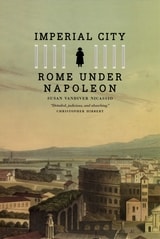
Imperial City
Rome under NapoleonSusan Vandiver Nicassio
University of Chicago Press, 2009
In 1798, the armies of the French Revolution tried to transform Rome from the capital of the Papal States to a Jacobin Republic. For the next two decades, Rome was the subject of power struggles between the forces of the Empire and the Papacy, while Romans endured the unsuccessful efforts of Napoleon’s best and brightest to pull the ancient city into the modern world. Against this historical backdrop, Nicassio weaves together an absorbing social, cultural, and political history of Rome and its people. Based on primary sources and incorporating two centuries of Italian, French, and international research, her work reveals what life was like for Romans in the age of Napoleon.
“A remarkable book that wonderfully vivifies an understudied era in the history of Rome. . . . This book will engage anyone interested in early modern cities, the relationship between religion and daily life, and the history of the city of Rome.”—Journal of Modern History
“An engaging account of Tosca’s Rome. . . . Nicassio provides a fluent introduction to her subject.”—History Today
“Meticulously researched, drawing on a host of original manuscripts, memoirs, personal letters, and secondary sources, enabling [Nicassio] to bring her story to life.”—History

Imperial Creatures
Humans and Other Animals in Colonial Singapore, 1819-1942Timothy P. Barnard
National University of Singapore Press, 2019
Through a multidisciplinary consideration of fauna, Imperial Creatures weaves together a series of tales to document how animals were cherished, monitored, employed, and slaughtered in a colonial society. All animals, including humans, Barnard shows, have been creatures of imperialism in Singapore. Their stories teach us lessons about the structures that upheld such a society and how it developed over time, lessons of relevance to animal historians, to historians of Singapore, and to urban historians and imperial historians with an interest in environmental themes.
Imperial Debris
On Ruins and RuinationAnn Laura Stoler, ed.
Duke University Press, 2013
Contributors. Ariella Azoulay, John F. Collins, Sharad Chari, E. Valentine Daniel, Gastón Gordillo, Greg Grandin, Nancy Rose Hunt, Joseph Masco, Vyjayanthi Venuturupalli Rao, Ann Laura Stoler
Imperial Decline
Russia’s Changing Role in AsiaStephen J. Blank and Alvin Z. Rubinstein, eds.
Duke University Press, 1997
The essays in Imperial Decline describe the major changes that have occurred in Russia’s relations with China, Japan, and South Korea under Boris Yeltin’s presidency, speculating about both Russia’s future in the region and the impact this future could have on relations with the United States. Contributors to this volume demonstrate how incoherent taxation and investment, uncoordinated and contradictory economic policies, runaway inflation and currency instability, and problems of defense now constrain the possibility of Russia expanding its economic influence in the region. This book is essential for students and scholars of international relations, foreign policy, and Russian history.
Contributors. Stephen J. Blank, Bruce A. Elleman, Harry Gelman, Hongchan Chun , Rajan Menon, Alvin Z. Rubinstein, Oles M. Smolansky, Henry Trofimenko, Charles E. Ziegler
Imperial Designs, Postimperial Extremes
Studies in Interdisciplinary and Comparative History of Russia and Eastern EuropeAndrei Cusco
Central European University Press, 2023
Anchored in the Russian Empire, but not limited to it, the eight studies in this volume explore the nineteenth-century imperial responses to the challenge of modernity, the dramatic disruptions of World War I, the radical scenarios of the interwar period and post-communist endgames at the different edges of Eurasia. The book continues and amplifies the historiographic momentum created by Alfred J. Rieber’s long and fruitful scholarly career.
First, the volume addresses the attempts of Russian imperial rulers and elites to overcome the economic backwardness of the empire with respect to the West. The ensuing rivalry of several interest groups (entrepreneurs, engineers, economists) created new social forms in the subsequent rounds of modernization. The studies explore the dynamics of the metamorphoses of what Rieber famously conceptualized as a “sedimentary society” in the pre-revolutionary and early Soviet settings.
Second, the volume also expands and dwells on the concept of frontier zones as dynamic, mutable, shifting areas, characterized by multi-ethnicity, religious diversity, unstable loyalties, overlapping and contradictory models of governance, and an uneasy balance between peaceful co-existence and bloody military clashes. In this connection, studies pay special attention to forced and spontaneous migrations, and population politics in modern Eurasia.
Imperial Entanglements of Policing
Julian Go and Stuart Schrader
Duke University Press, 2026
Imperial Fictions
German Literature Before and Beyond the Nation-StateTodd Kontje
University of Michigan Press, 2018
Imperial Gullies
Soil Erosion and Conservation in LesothoKate B. Showers
Ohio University Press, 2005
Once the grain basket for South Africa, much of Lesotho has become a scarred and degraded landscape. The nation’s spectacular erosion and gullying have concerned environmentalists and conservationists for more than half a century. In Imperial Gullies: Soil Erosion and Conservation in Lesotho, Kate B. Showers documents the truth behind this devastation.
Showers reconstructs the history of the landscape, beginning with a history of the soil. She concludes that Lesotho’s distinctive erosion chasms, called dongas—often cited as an example of destructive land-use practices by African farmers—actually were caused by colonial and postcolonial interventions. The residents of Lesotho emerge as victims of a failed technology. Their efforts to mitigate or resist implementation of destructive soil conservation engineering works were thwarted, and they were blamed for the consequences of policies promoted by international soil conservationists since the 1930s.
Imperial Gullies calls for an observational, experimental, and, most important, a fully consultative and participatory approach to address Lesotho’s serious contemporary problems of soil erosion. The first book to bring to center stage the historical practice of colonial soil science—and a cautionary tale of western science in unfamiliar terrain—it will interest a broad, interdisciplinary audience in African and environmental studies, social sciences, and history.

Imperial Israel and the Palestinians
The Politics of ExpansionNur Masalha
Pluto Press, 2000
Masalha argues that the heart of the conflict between Zionist immigrants/settlers and the native Palestinians has always been about land, territory, demography and water. He documents how Israeli policy has made it a priority to expel the Palestinians, either by war or peaceful measures. But these imperialist tendencies are not restricted to extremist zealots. The author uncovers the expansionist policies found in Labour Zionism and Kookist ideology.
Chapters cover the Whole Land of Israel Movement, Zionist Revisionism and the Likud Party, Gush Emunim and the religious fundamentalists, parties and movements of the far right and the evolution of Israeli Jewish public attitudes since 1967.
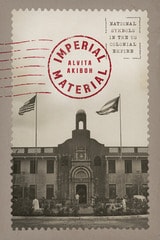
Imperial Material
National Symbols in the US Colonial EmpireAlvita Akiboh
University of Chicago Press, 2023
In Imperial Material, Alvita Akiboh reveals how US national identity has been created, challenged, and transformed through embodiments of empire found in US territories, from the US dollar bill to the fifty-star flag. These symbolic objects encode the relationships between territories—including the Philippines, the Hawaiian Islands, Puerto Rico, and Guam—and the empire with which they have been entangled. Akiboh shows how such items became objects of local power, their original intent transmogrified. For even if imperial territories were not always front and center for federal lawmakers and administrators, their inhabitants remained continuously aware of the imperial United States, whose presence announced itself on every bit of currency, every stamp, and the local flag.
Imperial Nature
Joseph Hooker and the Practices of Victorian ScienceJim Endersby
University of Chicago Press, 2008
By analyzing Hooker’s career, Endersby offers vivid insights into the everyday activities of nineteenth-century naturalists, considering matters as diverse as botanical illustration and microscopy, classification, and specimen transportation and storage, to reveal what they actually did, how they earned a living, and what drove their scientific theories. What emerges is a rare glimpse of Victorian scientific practices in action. By focusing on science’s material practices and one of its foremost practitioners, Endersby ably links concerns about empire, professionalism, and philosophical practices to the forging of a nineteenth-century scientific identity.
Imperial Peripheries in the Neo-Assyrian Period
Craig W. Tyson
University Press of Colorado, 2018
An international team of archaeologists and historians draws upon both new and existing evidence from excavations, surveys, texts, and material culture to highlight the strategies that the Neo-Assyrian Empire applied to manage its diverse and widespread empire as well as the mixed reception of those strategies by subjects close to and far from the center. Case studies from around the ancient Near East illustrate a remarkable variety of responses to Assyrian aggression, economic policies, and cultural influences. As a whole, the volume demonstrates both the destructive and constructive roles of empire, including unintended effects of imperialism on socioeconomic and cultural change.
Imperial Peripheries in the Neo-Assyrian Period aligns with the recent movement in imperial studies to replace global, top-down materialist models with theories of contingency, local agency, and bottom-up processes. Such approaches bring to the foreground the reality that the development and lifecycles of empires in general, and the Neo-Assyrian Empire in particular, cannot be completely explained by the activities of the core. The book will be welcomed by archaeologists of the Ancient Near East, Assyriologists, and scholars concerned with empires and imperial power in history.
Contributors: Stephanie H. Brown, Anna Cannavò, Megan Cifarelli, Erin Darby, Bleda S. Düring, Avraham Faust, Guido Guarducci, Bradley J. Parker
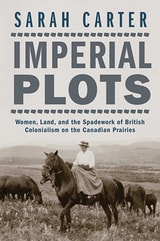
Imperial Plots
Women, Land, and the Spadework of British Colonialism on the Canadian PrairiesSarah Carter
University of Manitoba Press, 2016
Imperial Rule
Alfred J. Rieber
Central European University Press, 2004
Imperial Russia and the Struggle for Latin American Independence, 1808–1828
By Russell H. Bartley
University of Texas Press, 1978
This study, the first of its kind in English, examines Russian responses to the independence movement in Latin America during the early nineteenth century. From a strictly presentist perspective, the investigation of this subject contributes to the historiography of colonialism and of Latin America's relations with the major world powers. In addition, it rounds out the story of foreign interests in the emancipation of Spanish and Portuguese America, while at the same time shedding new light on the history of Russian overseas expansion.
The study probes the major determinants of Russian responses to the struggle for independence of colonial Latin America and evaluates, from a European perspective, the actual impact of tsarist policy on the course of those historic events. Drawing on a wide range of printed materials and on hitherto unused manuscript sources from the archives and libraries of Spain, Portugal, Brazil, and the USSR, it isolates Russian New World objectives during the first decades of the nineteenth century and relates those objectives to the formulation of tsarist policy toward the insurgent Iberian colonies.
Imperial Science, the Organic Movement and the Path to Shangri La, 1900–1969
Ashok Malhotra
University College London, 2026
A global history project that examines the diffusion of scientific and environmental discourses from India to Britain and the US.
This book examines how imperial agendas and colonial stereotyping shaped dietary and agricultural research carried out in the 1920s in British India, from soil protection initiatives to studies of diet and healthy living. It also discusses how a selective interpretation of this research, which focused on the supposed vigor of one community, the Hunzas, influenced the organic and lifestyles movements that later emerged in Britain and the US from the 1940s to the 1960s.
Imperial Screen
Japanese Film Culture In The Fifteen Years War,Peter B. High
University of Wisconsin Press, 2003
Imperial Subjects
Race and Identity in Colonial Latin AmericaAndrew B. Fisher and Matthew D. O Hara, eds.
Duke University Press, 2009
Whether analyzing cases in which the Inquisition found that the individuals before it were “legally” Indians and thus exempt from prosecution, or considering late-eighteenth- and early-nineteenth-century petitions for declarations of whiteness that entitled the mixed-race recipients to the legal and social benefits enjoyed by whites, the book’s contributors approach the question of identity by examining interactions between imperial subjects and colonial institutions. Colonial mandates, rulings, and legislation worked in conjunction with the exercise and negotiation of power between individual officials and an array of social actors engaged in countless brief interactions. Identities emerged out of the interplay between internalized understandings of self and group association and externalized social norms and categories.
Contributors. Karen D. Caplan, R. Douglas Cope, Mariana L. R. Dantas, María Elena Díaz, Andrew B. Fisher, Jane Mangan, Jeremy Ravi Mumford, Matthew D. O’Hara, Cynthia Radding, Sergio Serulnikov, Irene Silverblatt, David Tavárez, Ann Twinam
Imperial Texas
An Interpretive Essay in Cultural GeographyBy D. W. Meinig
University of Texas Press, 1969
Imperial Texas examines the development of Texas as a human region, from the simple outline of the Spanish colony to the complex patterns of the modern state. In this study in cultural geography set into a historical framework, D. W. Meinig discusses the "various peoples of Texas, who they are, where they came from, where they settled, and how they are proportioned one to another from place to place." After examining the historical framework, he then presents detailed analyses of the major regions of modem Texas and an over-all characterization of the state and its people. He concludes that, although Texas has never been the empire that it has sometimes been called, "nevertheless... Texas is something more than just one-fourteenth of the American area, one-twentieth of the American people, and one-fiftieth of the American union."
Imperial Transformations in Sixteenth-Century Yucay, Peru
Transcribed and edited by R. Alan Covey and Donato Amado González
University of Michigan Press, 2008

Imperial White
Race, Diaspora, and the British EmpireRadhika Mohanram
University of Minnesota Press, 2007
Radhika Mohanram shows not just how British imperial culture shaped the colonies, but how the imperial rule of colonies shifted—and gave new meanings to—what it meant to be British.
Imperial White looks at literary, social, and cultural texts on the racialization of the British body and investigates British whiteness in the colonies to address such questions as: How was the whiteness in Britishness constructed by the presence of Empire? How was whiteness incorporated into the idea of masculinity? Does heterosexuality have a color? And does domestic race differ from colonial race? In addition to these inquiries on the issues of race, class, and sexuality, Mohanram effectively applies the methods of whiteness studies to British imperial material culture to critically racialize the relationship between the metropole and the peripheral colonies.
Considering whether whiteness, like theory, can travel, Mohanram also provides a new perspective on white diaspora, a phenomenon of the nineteenth century that has been largely absent in diaspora studies, ultimately rereading—and rethinking—British imperial whiteness.
Radhika Mohanram teaches postcolonial cultural studies in the School of English, Communication and Philosophy at Cardiff University, Wales. She is the author of Black Body: Women, Colonialism, Space (Minnesota, 1999) and edits the journal Social Semiotics.
Imperialism
J. A. Hobson
University of Michigan Press, 1964
Imperialism and the Corruption of Democracies
Herman Lebovics
Duke University Press, 2006
Some essays explore why modern Western democratic societies needed colonialism. Among these is an examination of the seventeenth-century philosopher John Locke’s prescient conclusion that liberalism could only control democratic forces with the promise of greater wealth enabled by empire. In other essays Lebovics considers the relation between overseas rule and domestic life. Discussing George Orwell’s tale “Shooting an Elephant” and the careers of two colonial officers (one British and one French), he contemplates the ruinous authoritarianism that develops among the administrators of empire. Lebovics considers Pierre Bourdieu’s thinking about how colonialism affected metropolitan French life, and he reflects on the split between sociology and ethnology, which was partly based on a desire among intellectuals to think one way about metropolitan populations and another about colonial subjects. Turning to the arts, Lebovics traces how modernists used the colonial “exotic” to escape the politicized and contested modernity of the urban West. Imperialism and the Corruption of Democracies is a compelling case for cultural history as a key tool for understanding the injurious effects of imperialism and its present-day manifestations within globalization.
Imperialist Imagination
German Colonialism and Its LegacySara Friedrichsmeyer, Sara Lennox, and Susanne Zantop, Editors
University of Michigan Press, 1998
Imperium and Cosmos
Augustus and the Northern Campus MartiusPaul Rehak; Edited by John G. Younger
University of Wisconsin Press, 2006
Rehak closely examines the artistic imagery on these monuments, providing numerous illustrations, tables, and charts. In an analysis firmly contextualized by a thorough discussion of the earlier models and motifs that inspired these Augustan monuments, Rehak shows how the princeps used these on such an unprecedented scale as to truly elevate himself above the common citizen.
Imperium in Imperio
Sutton E. Griggs
West Virginia University Press, 2022
A new critical edition of Sutton Griggs’s turn-of-the-twentieth-century novel, which continues to shed light on understandings of Black politics.
Sutton E. Griggs’s first novel, originally published in 1899, paints a searing picture of the violent enforcement of disfranchisement and Jim Crow racial segregation. Based on events of the time, including US imperial policies, revolutionary movements, and racial protests, Imperium in Imperio introduces the fictional Belton Piedmont and Bernard Belgrave as “future leaders of their race” and uses these characters to make sense of the violence that marked the dawn of the twentieth century. Taking on contemporary battles over separatism and integration, Griggs’s novel continues to play a crucial role in understandings of Black politics.
Edited and introduced by Tess Chakkalakal and Kenneth W. Warren, this new critical edition offers not only an incisive biographical and historical introduction to the novel and its author but also a wealth of references that make the events and characters of Griggs’s Imperium in Imperio, and its aftermath, accessible to readers today.
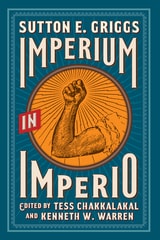
Imperium in Imperio
Tess Chakkalakal
University of Delaware Press, 0
Edited and introduced by Tess Chakkalakal and Kenneth W. Warren, this new critical edition offers not only an incisive biographical and historical introduction to the novel and its author but also a wealth of references that make the events and characters of Griggs’s Imperium in Imperio, and its aftermath, accessible to readers today.
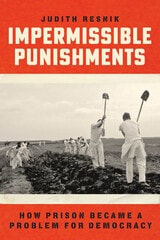
Impermissible Punishments
How Prison Became a Problem for DemocracyJudith Resnik
University of Chicago Press, 2025
An original transatlantic history of the invention of the corrections profession and of ensuing debates about punishment’s purposes and prisoners’ rights.
Impermissible Punishments explores the history of punishment inside prisons and how governments grappled with obligations to justify the punishments they impose. Legal scholar Judith Resnik charts the creation of the corrections profession and weaves together the stories of people who made rules for prisons and the stories of those living under the resulting regimes.
Resnik maps three centuries of shifting ideas, norms, and legal standards aiming to draw lines between permissible and impermissible punishments. Her account documents the impact of World War II, the United Nations, the US Civil Rights movement, and the pioneering prisoners who insisted that law should protect their individual dignity. Taking us to the present, Resnik analyzes the expansion of imprisonment, the inability of public and private prisons to provide safe housing, and the impact of abolition politics.
Exploring the interdependency of people in and out of prisons, Impermissible Punishments examines what governments committed to equality owe to the people they detain and argues that many contemporary forms of punishment need to end.
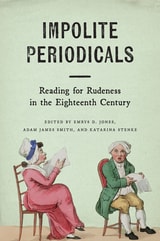
Impolite Periodicals
Reading for Rudeness in the Eighteenth CenturyEmrys D. Jones
Bucknell University Press, 2026
With an afterword by Manushag N. Powell.
Published by Bucknell University Press. Distributed worldwide by Rutgers University Press.
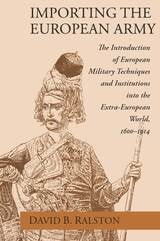
Importing the European Army
The Introduction of European Military Techniques and Institutions in the Extra-European World, 1600-1914David B. Ralston
University of Chicago Press, 1996
Following the same format in his discussion of each country, Ralston makes this central theme in world history easily accessible to students while offering scholars a sophisticated understanding of the exact nature of the changes brought about by Europeanizing military reforms.
David B. Ralston, associate professor of history at the Massachusetts Institute of Technology, is the author of The Army of the Republic.
Imports and Immigrants
Near Eastern Contacts with Iron Age CreteGail L. Hoffman
University of Michigan Press, 1998
Drawing together all the evidence and arguments for Near Eastern immigrants in Crete, Hoffman demonstrates there are basic problems with the accepted interpretations. Evidence of continued technical expertise casts doubt on the necessity of reintroduction, while careful scrutiny of the evidence supporting immigrant craftsmen reveals many inadequacies in the currently accepted analyses.
Imports and Immigrants identifies the need for reassessing all dimensions of the question of artistic relationships between ancient Greece and other regions of the Aegean basin and suggests new avenues of inquiry in this important debate. The volume also reassesses arguments made for the presence of Near Eastern immigrants in Crete. This book includes a catalogue indispensable for future work on these issues and illustrations of most of the known imports to Crete.
Gail L. Hoffman is Associate Professor of Greek Art and Archaeology, Department of Classics, Yale University.
Imposing Decency
The Politics of Sexuality and Race in Puerto Rico, 1870–1920Eileen J. Suárez Findlay
Duke University Press, 2000
In showing how political projects and alliances in Puerto Rico were affected by racially contingent definitions of “decency” and “disreputability,” Findlay argues that attempts at moral reform and the state’s repression of “sexually dangerous” women were weapons used in batttles between elite and popular, American and Puerto Rican, and black and white. Based on a thorough analysis of popular and elite discourses found in both literature and official archives, Findlay contends that racialized sexual norms and practices were consistently a central component in the construction of social and political orders. The campaigns she analyzes include an attempt at moral reform by elite male liberals and a movement designed to enhance the family and cleanse urban space that ultimately translated into repression against symbollically darkened prostitutes. Findlay also explores how U.S. officials strove to construct a new colonial order by legalizing divorce and how feminist, labor, and Afro-Puerto Rican political demands escalated after World War I, often focusing on the rehabilitation and defense of prostitutes.
Imposing Decency forces us to rethink previous interpretations of political chronologies as well as reigning conceptualizations of both liberalism and the early working-class in Puerto Rico. Her work will appeal to scholars with an interest in Puerto Rican or Latin American studies, sexuality and national identity, women in Latin America, and general women’s studies.
Imposing Harmony
Music and Society in Colonial CuzcoGeoffrey Baker
Duke University Press, 2008
Building on recent scholarship by social historians and urban musicologists and drawing on extensive archival research, Baker highlights European music as a significant vehicle for reproducing and contesting power relations in Cuzco. He examines how Andean communities embraced European music, creating an extraordinary cultural florescence, at the same time that Spanish missionaries used the music as a mechanism of colonialization and control. Uncovering a musical life of considerable and unexpected richness throughout the diocese of Cuzco, Baker describes a musical culture sustained by both Hispanic institutional patrons and the upper strata of indigenous society. Mastery of European music enabled elite Andeans to consolidate their position within the colonial social hierarchy. Indigenous professional musicians distinguished themselves by fulfilling important functions in colonial society, acting as educators, religious leaders, and mediators between the Catholic Church and indigenous communities.
Imposing Order without Law
American Expansion to the Eastern Sierra, 1850–1865Michael J. Makley
University of Nevada Press, 2022
In the 1850s, early Euro-American settlers established two remote outposts on the slopes of the eastern Sierra Nevada, both important way stations on the central emigrant trail. The Carson Valley settlement was located on the western edge of the Utah Territory, while the Honey Lake Valley hamlet, 120 miles north, fell within California’s boundaries but was separated from the rest of the state by the formidable mountain range. Although these were some of the first white communities established in the region, both areas had long been inhabited by Indigenous Americans. Carson Valley had been part of Washoe Indian territory, and Honey Lake Valley was a section of Northern Paiute land.
Michael Makley explores the complexities of this turbulent era, when the pioneers’ actions set the stage for both valleys to become part of national incorporation. With deft writing and meticulously researched portrayals of the individuals involved, including the Washoe and Northern Paiute peoples, Imposing Order Without Law focuses on the haphazard evolution of “frontier justice” in these remote outposts. White settlers often brought with them their own ideas of civil order. Makley’s work contextualizes the extralegal acts undertaken by the settlers to enforce edicts in their attempt to establish American communities.
Makley’s book reveals the use and impact of group violence, both within the settlements and within the Indigenous peoples’ world, where it transformed their lives.
Impossible Citizens
Dubai's Indian DiasporaNeha Vora
Duke University Press, 2013
While their legal status defines them as perpetual outsiders, Indians are integral to the Emirati nation-state and its economy. At the same time, Indians—even those who have established thriving diasporic neighborhoods in the emirate—disavow any interest in formally belonging to Dubai and instead consider India their home. Vora shows how these multiple and conflicting logics of citizenship and belonging contribute to new understandings of contemporary citizenship, migration, and national identity, ones that differ from liberal democratic models and that highlight how Indians, rather than Emiratis, are the quintessential—yet impossible—citizens of Dubai.

Impossible Purities
Blackness, Femininity, and Victorian CultureJennifer DeVere Brody
Duke University Press, 1998
Opening with a reading of Daniel Defoe’s “A True-Born Englishman,” which posits the mixed origins of English identity, Brody goes on to analyze mulattas typified by Rhoda Swartz in William Thackeray’s Vanity Fair, whose mixed-race status reveals the “unseemly origins of English imperial power.” Examining Victorian stage productions from blackface minstrel shows to performances of The Octoroon and Uncle Tom’s Cabin, she explains how such productions depended upon feminized, “black” figures in order to reproduce Englishmen as masculine white subjects. She also discusses H.G. Wells’s The Island of Dr. Moreau in the context of debates about the “new woman,” slavery, and fears of the monstrous degeneration of English gentleman. Impossible Purities concludes with a discussion of Bram Stoker’s novella, “The Lair of the White Worm,” which brings together the book’s concerns with changing racial representations on both sides of the Atlantic.
This book will be of interest to scholars in Victorian studies, literary theory, African American studies, and cultural criticism.