Results by title
104 books match the query 'Japanese' and 23 start with j
Jacy
An Implemented Grammar of JapaneseMelanie Siegel, Emily M. Bender, and Francis Bond
CSLI, 2017
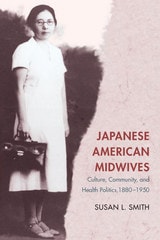
Japanese American Midwives
Culture, Community, and Health Politics, 1880-1950Susan L. Smith
University of Illinois Press, 2005
In the late nineteenth century, Japan's modernizing quest for empire transformed midwifery into a new woman's profession. With the rise of Japanese immigration to the United States, Japanese midwives (sanba) served as cultural brokers as well as birth attendants for Issei women. They actively participated in the creation of Japanese American community and culture as preservers of Japanese birthing customs and agents of cultural change.
Japanese American Midwives reveals the dynamic relationship between this welfare state and the history of women and health. Susan L. Smith blends midwives' individual stories with astute analysis to demonstrate the impossibility of clearly separating domestic policy from foreign policy, public health from racial politics, medical care from women's caregiving, and the history of women and health from national and international politics. By setting the history of Japanese American midwives in this larger context, Smith reveals little-known ethnic, racial, and regional aspects of women's history and the history of medicine.
Japanese Brazilian Saudades
Diasporic Identities and Cultural ProductionIgnacio López-Calvo
University Press of Colorado, 2019
López-Calvo addresses the complex creation of Japanese Brazilian identities and the history of immigration, showing how the community has used writing as a form of reconciliation and affirmation of their competing identities as Japanese, Brazilian, and Japanese Brazilian. Japanese in Brazil have employed a twofold strategic, rhetorical engineering: the affirmation of ethno-cultural difference on the one hand, and the collective assertion of citizenship and belonging to the Brazilian nation on the other. López-Calvo also grapples with the community’s inclusion and exclusion in Brazilian history and literature, using the concept of “epistemicide” to refer to the government’s attempt to impose a Western value system, Brazilian culture, and Portuguese language on the Nikkeijin, while at the same time trying to destroy Japanese language and culture in Brazil by prohibiting Japanese language instruction in schools, Japanese-language publications, and even speaking Japanese in public.
Japanese Brazilian Saudades contributes to the literature criticizing the “cognitive injustice” that fails to acknowledge the value of the global South and non-Western ways of knowing and being in the world. With important implications for both Latin American studies and Nikkei studies, it expands discourses of race, ethnicity, nationality, and communal belonging through art and narrative.
Japanese Counterculture
The Antiestablishment Art of Terayama ShujiSteven C. Ridgely
University of Minnesota Press, 2010
Ridgely places Terayama at the center of Japanese and global counterculture and finds in his work a larger story about the history of postwar Japanese art and culture. He sees Terayama as reflecting the most significant events of his day: young poets seizing control of haiku and tanka in the 1950s, radio drama experimenting with form and content after the cultural shift to television around 1960, young assistant directors given free rein in the New Wave as cinema combated television, underground theatre in the politicized late 1960s, and experimental short film through the 1970s after both the studio system and art house cinema had collapsed.
Featuring close readings of Terayama's art, Ridgely demonstrates how across his oeuvre there are patterns that sidestep existing power structures, never offering direct opposition but nevertheless making the opposition plain. And, he claims, there is always in Terayama's work a broad call for seeking out or creating pockets of fiction-where we are made aware that things are not what they seem-and to use otherness in those spaces to take a clearer view of reality.
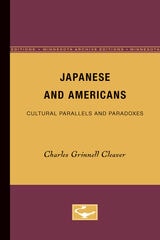
Japanese and Americans
Cultural Parallels and ParadoxesCharles Cleaver
University of Minnesota Press, 1976
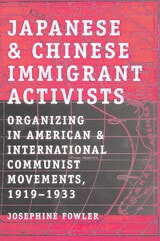
Japanese and Chinese Immigrant Activists
Organizing in American and International Communist Movements, 1919–1933Fowler, Josephine
Rutgers University Press, 2007
Japanese and Chinese immigrants in the United States have traditionally been characterized as hard workers who are hesitant to involve themselves in labor disputes or radical activism. How then does one explain the labor and Communist organizations in the Asian immigrant communities that existed from coast to coast between 1919 and 1933? Their organizers and members have been, until now, largely absent from the history of the American Communist movement. In Japanese and Chinese Immigrant Activists, Josephine Fowler brings us the first in-depth account of Japanese and Chinese immigrant radicalism inside the United States and across the Pacific.
Drawing on multilingual correspondence between left-wing and party members and other primary sources, such as records from branches of the Japanese Workers Association and the Chinese Nationalist Party, Fowler shows how pressures from the Comintern for various sub-groups of the party to unite as an “American” working class were met with resistance. The book also challenges longstanding stereotypes about the relationships among the Communist Party in the United States, the Comintern, and the Soviet Party.
Japanese/Korean Linguistics, Volume 1
Edited by Hajime Hoji
CSLI, 1990
Japanese/Korean Linguistics, Volume 16
Edited by Yukinori Takubo, Tomohide Kinuhata, Szymon Grzelak, and Kayo Nagai
CSLI, 2009
The annual Japanese/Korean Linguistics Conference provides a forum for presenting research that will broaden the understanding of these two languages, especially through comparative study. The sixteenth Japanese/Korean Linguistics Conference, held in October of 2006 at Kyoto University, was the first in the history of the conference to be held outside of the United States. The thirty-six papers in this volume encompass a variety of areas, such as phonetics; phonology; morphology; syntax; semantics; pragmatics; discourse analysis; and the geographical and historical factors that influence the development of languages, sociolinguistics, and psycholinguistics.
Japanese/Korean Linguistics, Volume 17
Edited by Shoishi Iwasaki, Haejime Hoji, Patricia M. Clancy, and Sung-Ock Sohn
CSLI, 2009
The papers in this volume are from the seventeenth Japanese/Korean Linguistics Conference, which was held at the University of California, Los Angeles in November of 2007. The articles cover a broad range of topics in Japanese and Korean linguistics, including phonology, morphology, syntax, semantics, historical linguistics, discourse analysis, prosody, psycholinguistics, sociolinguistics, acquisition, and grammaticalization.
Japanese/Korean Linguistics, Volume 18
Edited by William McClure and Marcel den Dikken
CSLI, 2011
Because Japanese and Korean are typologically quite similar, a linguistic phenomenon in one language often has a counterpart in the other. The annual Japanese/Korean Linguistics Conference provides a forum for presenting research that will deepen our understanding of these two languages, especially through comparative study. The papers in this volume are from the eighteenth Japanese/Korean Linguistics Conference, which was held at the Graduate Center of the City University of New York in 2008. The papers cover a broad range of topics in Japanese/Korean linguistics, including phonology, morphology, syntax, semantics, historical linguistics, discourse analysis, prosody, and psycholinguistics.
Japanese/Korean Linguistics, Volume 19
Edited by Ho-Min Sohn, Haruko Minegishi Cook, William O'Grady, Leon A. Serafim, and Sang Yee Cheon
CSLI, 2011
Japanese/Korean Linguistics, Volume 2
Edited by Patricia Clancy
CSLI, 1993
Japanese/Korean Linguistics, Volume 20
Peter Sells
CSLI, 2013
Japanese/Korean Linguistics, Volume 21
Seungho Nam, Heejeong Ko, and Jongho Jun
CSLI, 2015
Japanese/Korean Linguistics, Volume 22
Edited by Mikio Griko, Naonori Nagaya, Akiko Takemura, and Timothy J. Vance
CSLI, 2014
Japanese/Korean Linguistics, Volume 23
Edited by Theodore Levin, Ryo Masuda, and Michael Kenstowicz
CSLI, 2014
Japanese/Korean Linguistics, Volume 24
Edited by Kenshi Funakoshi, et al.
CSLI, 2017
Japanese/Korean Linguistics, Volume 25
Edited by Shinichiro Fukuda et al.
CSLI, 2018
Japanese and Korean are typologically similar, with linguistic phenomena in one often having counterparts in the other. The Japanese/Korean Linguistics Conference provides a forum for research, particularly through comparative study, on both languages. The papers in this volume are from the twenty-fifth conference, which was held at the University of Hawai’i at Mānoa. They include essays on the phonology, morphology, syntax, semantics, historical linguistics, discourse analysis, prosody, and psycholinguistics of both languages. Such comparative studies deepen our understanding of both languages and will be a useful reference for students and scholars in either field.
Japanese/Korean Linguistics, Volume 26
Edited by Shoichi Iwasaki, Susan Strauss, Shin Fukuda, and Sun-Ah Jun
CSLI, 2020
Japanese/Korean Linguistics, Volume 5
Edited by Noriko Akatsuka, Shoichi Iwasaki, and Susan Strauss
CSLI, 1996
Japanese/Korean Linguistics, Volume 6
Edited by Ho-min Sohn and John Haig
CSLI, 1997
Japanese/Korean Linguistics, Volume 7
Edited by Noriko Akatsuka, et al
CSLI, 1998
Johnson in Japan
Kimiyo Ogawa
Bucknell University Press, 2021
Published by Bucknell University Press. Distributed worldwide by Rutgers University Press.