Results by title
92 books match the query 'Judges' and 11 start with j
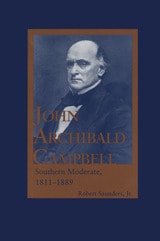
John Archibald Campbell
Southern Moderate, 1811–1889Robert Saunders Jr.
University of Alabama Press, 1997
The first full biography of the southern U.S. Supreme Court justice who championed both the U.S. Constitution and states’ rights.
The life of John Archibald Campbell reflects nearly every major development of 19th-century American history. He participated either directly or indirectly in events ranging from the Indian removal process of the 1830s, to sectionalism and the Civil War, to Reconstruction and redemption. Although not a defender of slavery, he feared that abrupt abolition would produce severe economic and social dislocation. He urged southerners to reform their labor system and to prepare for the eventual abolition of slavery. In the early 1850s he proposed a series of reforms to strengthen slave families and to educate the slaves to prepare them for assimilation into society as productive citizens. These views distinguished him from many southerners who steadfastly maintained the sanctity of the peculiar institution.
Born and schooled in Georgia, Campbell moved to Montgomery, Alabama, in the early 1830s, where he joined a successful law practice. He served in the Alabama legislature for a brief period and then moved with his family to Mobile to establish a law practice. In 1853 Campbell was appointed an associate justice of the U.S. Supreme Court. His concurring opinion in the Dred Scott case in 1857 derived not from the standpoint of protecting slavery but from an attempt to return political power to the states. As the sectional crisis gathered heat, Campbell counseled moderation. He became widely detested in the North because of his defense of states’ rights, and he was distrusted in the South because of his moderate views on slavery and secession. In May 1861 Campbell resigned from the Court and later became the Confederacy's assistant secretary of war. After the war, Campbell moved his law practice to New Orleans. Upon his death in 1889, memorial speakers in Washington, D.C., and New Orleans recognized him as one of the nation's most gifted lawyers and praised his vast learning and mastery of both the common law and the civil law.
In this first full biography of Campbell, Robert Saunders, Jr., reveals the prevalence of anti-secession views prior to the Civil War and covers both the judicial aspects and the political history of this crucial period in southern history.
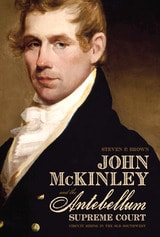
John McKinley and the Antebellum Supreme Court
Circuit Riding in the Old SouthwestSteven P. Brown
University of Alabama Press, 2012
A Southern voice on a national bench—McKinley’s legacy in antebellum law.
John McKinley and the Antebellum Supreme Court offers the first comprehensive biography of Justice John McKinley (1780–1852), a largely forgotten figure in American legal history who played a pivotal role during a formative period of the U.S. Supreme Court. Steven P. Brown rescues McKinley from historical obscurity, presenting a compelling portrait of a man deeply embedded in the political, legal, and financial life of the early 19th-century South.
Born in Kentucky and later settling in northern Alabama, McKinley served in both the U.S. Senate and House of Representatives before being appointed to the Supreme Court by President Martin Van Buren in 1837. His tenure on the bench coincided with the creation of the Ninth Circuit, a vast and challenging judicial territory encompassing Alabama, Arkansas, Louisiana, and Mississippi. Brown details McKinley’s arduous circuit-riding duties, which required extensive travel and exposed him to the legal complexities of a rapidly expanding frontier.
More than a biography, the book provides a penetrating analysis of antebellum legal culture, Alabama state politics, and the internal workings of the Supreme Court during a time of national transformation. Brown challenges the prevailing view of McKinley as a mediocre jurist, arguing instead that his contributions—particularly his dissents defending states’ rights—deserve renewed scholarly attention. With rich historical context and meticulous research, John McKinley and the Antebellum Supreme Court sheds light on the burdens of justice in a divided nation and the legacy of a justice whose career mirrored the tensions of his time.

Judge Dee at Work
Eight Chinese Detective StoriesRobert van Gulik
University of Chicago Press, 1992
The eight short stories in Judge Dee at Work cover a decade during which the judge served in four different provinces of the T’ang Empire. From the suspected treason of a general in the Chinese army to the murder of a lonely poet in his garden pavilion, the cases here are among the most memorable in the Judge Dee series.
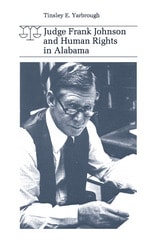
Judge Frank Johnson and Human Rights in Alabama
Tinsley E. Yarbrough
University of Alabama Press, 1981
Where courage meets the gavel: One judge’s relentless fight for justice and human rights in Alabama.
Judge Frank M. Johnson, Jr., Chief Judge of the United States District Court for the Middle District of Alabama until his elevation to the Court of Appeals for the Fifth Circuit in 1979, was perhaps President Dwight D. Eisenhower’s most significant appointment to a lower court. His selection to the bench in 1955 followed by only a few months the Supreme Court’s historic decision in Brown vs. Board of Education.
During Judge Johnson’s tenure, his court invalidated segregation and other forms of racial discrimination in Alabama’s transportation facilities, voter registration processes, school and colleges, administrative agencies, system of jury selection, prisons, mental institutions, political parties, and government grant programs. In fact, most of the state’s major racial crises were resolved in his courtroom. However, his impact on human rights policy in Alabama was not confined to a racial context. Among other significant developments, the Middle District Court ordered reapportionment of the state’s governing bodies and invalidated its grossly inequitable property tax systems.
Judge Johnson’s decisions made him one of the most widely respected and controversial trial judges in the country. Until recently, however, his name was anathema to many white Alabamians, and he and his family were subject to ostracism, threats, violence, and verbal abuse.
Yarbrough examines Judge Johnson’s life through the end of the Wallace era and the Judge’s appointment to the Fifth Circuit Court. More broadly, the book is a history of modern human rights reform in Alabama, cast in the biographical idiom. For, in a real sense, the history of the reform and of Judge Johnson’s judicial career have been synonymous.
Judges and Unjust Laws
Common Law Constitutionalism and the Foundations of Judicial ReviewDouglas E. Edlin
University of Michigan Press, 2010
"With keen insight into the common law mind, Edlin argues that there are rich resources within the law for judges to ground their opposition to morally outrageous laws, and a legal obligation on them to overturn it, consequent on the general common law obligation to develop the law. Thus, seriously unjust laws pose for common law judges a dilemma within the law, not just a moral challenge to the law, a conflict of obligations, not just a crisis of conscience. While rooted firmly in the history of common law jurisprudence, Edlin offers an entirely fresh perspective on an age-old jurisprudential conundrum. Edlin's case for his thesis is compelling."
---Gerald J. Postema, Cary C. Boshamer Professor of Philosophy and Professor of Law, University of North Carolina at Chapel Hill, and author of Bentham and the Common Law Tradition
"Douglas Edlin builds a powerful historical, conceptual, and moral case for the proposition that judges on common law grounds should refuse to enforce unjust legislation. This is sure to be controversial in an age in which critics already excoriate judges for excessive activism when conducting constitutional judicial review. Edlin's challenge to conventional views is bold and compelling."
---Brian Z. Tamanaha, Chief Judge Benjamin N. Cardozo Professor of Law, St. John's University, and author of Law as a Means to an End: Threat to the Rule of Law
"Professor Edlin's fascinating and well-researched distinction between constitutional review and common law review should influence substantially both scholarship on the history of judicial power in the United States and contemporary jurisprudential debates on the appropriate use of that power."
---Mark Graber, Professor of Law and Government, University of Maryland, and author of Dred Scott and the Problem of Constitutional Evil
Is a judge legally obligated to enforce an unjust law?
In Judges and Unjust Laws, Douglas E. Edlin uses case law analysis, legal theory, constitutional history, and political philosophy to examine the power of judicial review in the common law tradition. He finds that common law tradition gives judges a dual mandate: to apply the law and to develop it. There is no conflict between their official duty and their moral responsibility. Consequently, judges have the authority---perhaps even the obligation---to refuse to enforce laws that they determine unjust. As Edlin demonstrates, exploring the problems posed by unjust laws helps to illuminate the institutional role and responsibilities of common law judges.
Douglas E. Edlin is Associate Professor of Political Science at Dickinson College.

Judges and the Cities
Interpreting Local AutonomyGordon L. Clark
University of Chicago Press, 1985
As concrete examples, Clark analyzes four court disputes in depth, showing that the concept of local autonomy has very different meanings and implications in each of them. These cases—Boston's defense of resident-preference hiring policies, conflict over urban land-use zoning in Toronto, a Chicago's suburb's fight against a sewage treatment plant, and the evolution of the City of Denver's power since 1900—demonstrate that legal reasoning is not impervious to other kinds of reasoning, and the solutions provided by the courts are not unique. To ground his explorations, Clark investigates both liberalism and structuralism, showing that both are inadequate bases for determining social policy. He mounts provocative critiques of the works of de Tocqueville, Nozick, Tiebout, and Posner on the one hand and Castells and Poulantzas on the other.
This ambitious and important work will command the interest of geographers, political scientists, economists, sociologists, and legal scholars.
Judicial Merit Selection
Institutional Design and Performance for State CourtsGreg Goelzhauser
Temple University Press, 2019
The judicial selection debate continues. Merit selection is used by a majority of states but remains the least well understood method for choosing judges. Proponents claim that it emphasizes qualifications and diversity over politics, but there is little empirical evidence regarding its performance.
In Judicial Merit Selection, Greg Goelzhauser amasses a wealth of data to examine merit selection’s institutional performance from an internal perspective. While his previous book, Choosing State Supreme Court Justices, compares outcomes across selection mechanisms, here he delves into what makes merit selection unique—its use of nominating commissions to winnow applicants prior to gubernatorial appointment.
Goelzhauser’s analyses include a rich case study from inside a nominating commission’s proceedings as it works to choose nominees; the use of public records to examine which applicants commissions choose and which nominees governors choose; evaluation of which attorneys apply for consideration and which judges apply for promotion; and examination of whether design differences across systems impact performance in the seating of qualified and diverse judges.
The results have critical public policy implications.
Judicial Reputation
A Comparative TheoryNuno Garoupa and Tom Ginsburg
University of Chicago Press, 2015
In Judicial Reputation, Nuno Garoupa and Tom Ginsburg explain how reputation is not only an essential quality of the judiciary as a whole, but also of individual judges. Perceptions of judicial systems around the world range from widespread admiration to utter contempt, and as judges participate within these institutions some earn respect, while others are scorned. Judicial Reputation explores how judges respond to the reputational incentives provided by the different audiences they interact with—lawyers, politicians, the media, and the public itself—and how institutional structures mediate these interactions. The judicial structure is best understood not through the lens of legal culture or tradition, but through the economics of information and reputation. Transcending those conventional lenses, Garoupa and Ginsburg employ their long-standing research on the latter to examine the fascinating effects that governmental interactions, multicourt systems, extrajudicial work, and the international rule-of-law movement have had on the reputations of judges in this era.
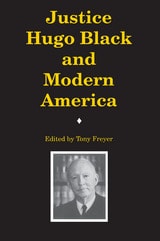
Justice Hugo Black and Modern America
Tony Freyer
University of Alabama Press, 1990
Reexamining the Justice Who Helped Shape Modern Constitutional America.
The struggle to accommodate both individual freedom and community welfare shaped modern America. American have disagreed about whether federal protection of national welfare could be reconciled with defense of individual rights; however, no public figure worked longer or more consistently to meet this challenge than Alabama’s Hugo L. Black
This collection of essays, reprints of the spring 1985 and winter 1987 issues of the Alabama Law Review with a new introduction and minor revisions, suggests that Black’s constitutional principles and personal values provided a means to achieve a balance between majority will and individual freedom. Black’s life and career are reexamined here by leading scholars and jurors in the first major study in twenty years, tracing his relationship to the South, to the development of American liberalism, and to the constitutional revolution in individual rights.
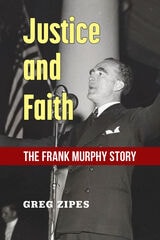
Justice and Faith
The Frank Murphy StoryGreg Zipes
University of Michigan Press, 2021
Murphy is best remembered for his immense legal contributions supporting individual liberty and fighting discrimination, particularly discrimination against the most vulnerable. Despite being a loyal ally of Franklin Delano Roosevelt, when FDR ordered the removal of Japanese Americans during World War II, Supreme Court Justice Murphy condemned the policy as “racist” in a scathing dissent to the Korematsu v. United States decision—the first use of the word in a Supreme Court opinion. Every American, whether arriving by first class or in chains in the galley of a slave ship, fell under Murphy’s definition of those entitled to the full benefits of the American dream.
Justice and Faith explores Murphy’s life and times by incorporating troves of archive materials not available to previous biographers, including local newspaper records from across the country. Frank Murphy is proof that even in dark times, the United States has extraordinary resilience and an ability to produce leaders of morality and courage.
Justices of the Indiana Supreme Court
Linda C. Gugin and James E. St. Clair
Indiana Historical Society Press, 2010