Results by title
2335 books match the query 'Modern' and 40 start with j
J'étais plus américain que les Américains
Sylvère Lotringer en conversation avec Donatien GrauSylvère Lotringer and Donatien Grau
Diaphanes, 2021
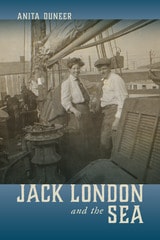
Jack London and the Sea
Anita Duneer
University of Alabama Press, 2022
The first book-length study of London as a maritime writer
Jack London’s fiction has been studied previously for its thematic connections to the ocean, but Jack London and the Sea marks the first time that his life as a writer has been considered extensively in relationship to his own sailing history and interests. In this new study, Anita Duneer claims a central place for London in the maritime literary tradition, arguing that for him romance and nostalgia for the Age of Sail work with and against the portrayal of a gritty social realism associated with American naturalism in urban or rural settings. The sea provides a dynamic setting for London’s navigation of romance, naturalism, and realism to interrogate key social and philosophical dilemmas of modernity: race, class, and gender. Furthermore, the maritime tradition spills over into texts that are not set at sea.
Jack London and the Sea does not address all of London’s sea stories, but rather identifies key maritime motifs that influenced his creative process. Duneer’s critical methodology employs techniques of literary and cultural analysis, drawing on extensive archival research from a wealth of previously unpublished biographical materials and other sources. Duneer explores London’s immersion in the lore and literature of the sea, revealing the extent to which his writing is informed by travel narratives, sensational sea yarns, and the history of exploration, as well as firsthand experiences as a sailor in the San Francisco Bay and Pacific Ocean.
Organized thematically, chapters address topics that interested London: labor abuses on “Hell-ships” and copra plantations, predatory and survival cannibalism, strong seafaring women, and environmental issues and property rights from San Francisco oyster beds to pearl diving in the Paumotos. Through its examination of the intersections of race, class, and gender in London’s writing, Jack London and the Sea plumbs the often-troubled waters of his representations of the racial Other and positions of capitalist and colonial privilege. We can see the manifestation of these socioeconomic hierarchies in London’s depiction of imperialist exploitation of labor and the environment, inequities that continue to reverberate in our current age of global capitalism.
Jacques Derrida
Geoffrey Bennington and Jacques Derrida
University of Chicago Press, 1993
"Bennington is a shrewd and well-informed commentator whose book should do something to convince the skeptics . . . that Jacques Derrida's work merits serious attention."—Christopher Norris, New Statesman & Society
"Geoffrey Bennington and Jacques Derrida have presented a fascinating example of what might be called post-structuralist autobiography."—Laurie Volpe, French Review
"Bennington's account of what Derrida is up to is better in almost all respects—more intelligent, more plausible, more readable, and less pretentious—than any other I have read."—Richard Rorty, Contemporary Literature
Jacques Lacan
Jonathan Scott Lee
University of Massachusetts Press, 1991
Originally published as part of Twayne's World Authors Series, Jacques Lacan offers a comprehensive and rigorous introduction to the life and work of the French psychoanalyst Jacques Lacan, one of the most influential and challenging thinkers of the twentieth century. Written by a philosopher with a deep engagement in both continental philosophy and psychoanalytic theory, Jonathan Scott Lee traces the development of Lacan's theoretical project from his early psychiatric writings through the landmark Écrits and the renowned seminars that Lacan delivered over more than two decades.
Lee's approach is distinctive in its philosophical clarity, making complex Lacanian ideas available to readers in the humanities and social sciences. His careful analysis of the mirror stage, the role of the Other, and Lacan's three fundamental registers—the Imaginary, the Symbolic, and the Real— provides new insight into the ways they structure human subjectivity, language, and desire. This book situates Lacan within the broader intellectual currents of twentieth-century French thought, drawing connections to structuralism, post-structuralism, and the philosophical traditions that shaped and were shaped by Lacan's radical "return to Freud."
Widely cited in scholarly literature across disciplines, including literary criticism, philosophy, theology, film studies, and cultural theory, Jacques Lacan remains a valued introduction for students, scholars, and general readers seeking a careful and comprehensive guide to one of the most formidable intellectual figures of the modern era.
Jacques Rancière
History, Politics, AestheticsGabriel Rockhill and Philip Watts, eds.
Duke University Press, 2009
The contributors to this collection do not simply elucidate Rancière’s project; they also critically respond to it from their own perspectives. They consider the theorist’s engagement with the writing of history, with institutional and narrative constructions of time, and with the ways that individuals and communities can disturb or reconfigure what he has called the “distribution of the sensible.” They examine his unique conception of politics as the disruption of the established distribution of bodies and roles in the social order, and they elucidate his novel account of the relationship between aesthetics and politics by exploring his astute analyses of literature and the visual arts. In the collection’s final essay, Rancière addresses some of the questions raised by the other contributors and returns to his early work to provide a retrospective account of the fundamental stakes of his project.
Contributors. Alain Badiou, Étienne Balibar, Bruno Bosteels, Yves Citton, Tom Conley, Solange Guénoun, Peter Hallward, Todd May, Eric Méchoulan, Giuseppina Mecchia, Jean-Luc Nancy, Andrew Parker, Jacques Rancière, Gabriel Rockhill, Kristin Ross, James Swenson, Rajeshwari Vallury, Philip Watts
James Joyce and the Irish Revolution
The Easter Rising as Modern EventLuke Gibbons
University of Chicago Press, 2023
When revolutionaries seized Dublin during the 1916 Easter Rising, they looked back to unrequited pasts to point the way toward radical futures—transforming the Celtic Twilight into the electric light of modern Dublin in James Joyce’s Ulysses. For Luke Gibbons, the short-lived rebellion converted the Irish renaissance into the beginning of a global decolonial movement. James Joyce and the Irish Revolution maps connections between modernists and radicals, tracing not only Joyce’s projection of Ireland onto the world stage, but also how revolutionary leaders like Ernie O’Malley turned to Ulysses to make sense of their shattered worlds. Coinciding with the centenary of both Ulysses and Irish independence, this book challenges received narratives about the rebellion and the novel that left Ireland changed, changed utterly.
James the Minimalist
An Essay on the Late NovelsJohn Brenkman
University of Chicago Press, 2026
An experiment in criticism that explores Henry James’s late works through the lens of minimalism.
Henry James’s last completed novels—The Ambassadors, The Wings of the Dove, and The Golden Bowl—are among the greatest and most demanding achievements of modern fiction. The stories they tell are perverse: characters are compelling even at their most cruel, their actions often calculating and loving at the same time. The novels draw on deep-seated myths but end with an unsettling lack of finality. And their dense, involuted language tracks the movements of consciousness with uncompromising artistry—the ultimate flowering of the late James style.
In this work of experimental criticism, John Brenkman is concerned with minimalism in two senses. First, with James’s own minimalism—his intense scrutiny of couples and their erotic energies to the exclusion of so much else. And second, through a kind of minimalization in literary critical reading, Brenkman cuts through James’s amplifications to find the essence that churns beneath the intricate prose of the late novels. Showing how James evokes not only protagonists’ subjectivity but more importantly what only exists in between—that is, between lovers, between spouses, between rivals—Brenkman reveals James’s transformation of the marriage novel and excavation of the couple form itself.
Jamón and Halal
Lessons in Tolerance from Rural AndalucíaChristina Civantos
Amherst College Press, 2022
“This is a book that is both a personal account and a rigorous academic study. It is a model for the kind of engaged humanistic work we are now beginning to see as a hallmark of the post-theory moment, and one that remembers the hard lessons of ethnographic fieldwork as well as the challenging foundational work from philosophically-tinged theory.” —Debra A. Castillo, Cornell University
“Filled with rich descriptions and interwoven personal anecdotes of both Civantos and her interlocuters that complement scholarly analysis.” —Jessica R. Boll, Carroll University

Jan Compagnie in the Straits of Malacca, 1641–1795
Mis Sea#96Dianne Lewis
Ohio University Press, 1995
In 1500 Malay Malacca was the queen city of the Malay Archipelago, one of the great trade centers of the world. Its rulers, said to be descendents of the ancient line of Srivijaya, dominated the lands east and west of the straits. The Portuguese, unable to compete in the marketplace, captured the town. They were followed a hundred years later by the Dutch who, lured in their turn by Malacca as symbol of the wealth and luxury of the east, were to rule this port city for more than a hundred and fifty years.
It proved to be, in many ways, an empty conquest. Portuguese and Dutch governments imposed restrictions on Malacca’s trade, driving it to the newer ports in the north and south. Moreover, by the time the Dutch finally secured the town, they had established their own port at Batavia, in Java. Dutch Malacca was, by 1701, “a place of little trade.” Why then did the Dutch maintain their occupation of the port? Lewis draws on the extensive correspondence of the Dutch East India Company to examine the role the Dutch played as Malacca’s rulers in the eighteenth-century Malay world, arguing that their presence, though generally too weak to secure their own interests, disrupted the traditional political and economic organization of the Malay polities, contributing significantly to the disarray that beset the Malay world at the beginning of the nineteenth century.
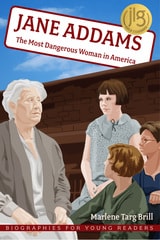
Jane Addams
The Most Dangerous Woman in AmericaMarlene Targ Brill
Ohio University Press, 2024
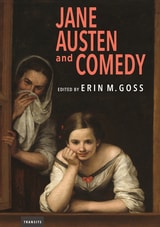
Jane Austen and Comedy
Erin Goss
Bucknell University Press, 2019
Published by Bucknell University Press. Distributed worldwide by Rutgers University Press.
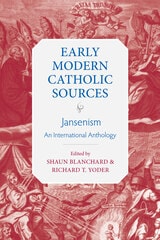
Jansenism
An International AnthologyShaun Blanchard
Catholic University of America Press, 2024
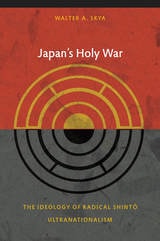
Japan's Holy War
The Ideology of Radical Shinto UltranationalismWalter A. Skya
Duke University Press, 2009
Skya documents a transformation in the ideology of State Shintō in the late nineteenth century and the early twentieth. He shows that within the religion, support for the German-inspired theory of constitutional monarchy that had underpinned the Meiji Constitution gave way to a theory of absolute monarchy advocated by the constitutional scholar Hozumi Yatsuka in the late 1890s. That, in turn, was superseded by a totalitarian ideology centered on the emperor: an ideology advanced by the political theorists Uesugi Shinkichi and Kakehi Katsuhiko in the 1910s and 1920s. Examining the connections between various forms of Shintō nationalism and the state, Skya demonstrates that where the Meiji oligarchs had constructed a quasi-religious, quasi-secular state, Hozumi Yatsuka desired a traditional theocratic state. Uesugi Shinkichi and Kakehi Katsuhiko went further, encouraging radical, militant forms of extreme religious nationalism. Skya suggests that the creeping democracy and secularization of Japan’s political order in the early twentieth century were the principal causes of the terrorism of the 1930s, which ultimately led to a holy war against Western civilization.
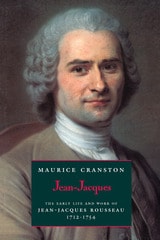
Jean-Jacques
The Early Life and Work of Jean-Jacques Rousseau, 1712-1754Maurice Cranston
University of Chicago Press, 1991
"[An] admirable biography which is as meticulous, calm, reasonable, and judicious as its subject is passionate and tumultuous."—Keith Michael Baker, Washington Post Book World
"The definitive biography, as scholarly as it is entertaining."—The Economist
"Exceptionally fresh . . . . [Cranston] seems to know exactly what his readers need to know, and thoughtfully enriches the background—both physical and intellectual—of Rousseau's youthful peregrinations . . . . He makes the first part of Rousseau's life as absorbing as a picaresque novel. His fidelity to Rousseau's ideas and to his life as it was lived is a triumph of poise."—Naomi Bliven, The New Yorker
"The most outstanding achievement of Professor Cranston's own distinguished career."—Robert Wokler, Times Literary Supplement
Maurice Cranston (1920-1993), a distinguished scholar and recipient of the James Tait Black Memorial Prize for his biography of John Locke, was professor of political science at the London School of Economics. His numerous books include The Romantic Movement and Philosophers and Pamphleteers, and translations of Rousseau's The Social Contract and Discourse on the Origins of Inequality.

Jesuit Letters From China, 1583-84
M. Howard Rienstra, EditorTranslated by M. Howard Rienstra
University of Minnesota Press, 1986
Jesuit Letters From China, 1583–84 was first published in 1986. Minnesota Archive Editions uses digital technology to make long-unavailable books once again accessible, and are published unaltered from the original University of Minnesota Press editions.
The first eight letters from Jesuit missionaries on mainland China were written in 1583–84 and published in Europe in 1586. M Howard Rienstra's translated marks their first appearance in English. The letters chronicle the patient efforts of Michele Ruggieri and the famed Matteo Ricci to learn Chinese, to gain acceptance in Chinese society, and to explain Christianity to a highly sophisticated non-Christian culture. They also described the China of the late Ming dynasty (1368–1644), a country whose immense size and population had excited the imagination of Europeans for generations.
It was Francis Xavier's dream that this mighty kingdom and civilization be opened to the Christian gospel. His dream was at least tentatively fulfilled when Michele Ruggieri was granted residence first in Canton and then in Chao-ch'ing in 1583. Accompanied first by Francesco Pasio and later by Matteo Ricci, Ruggieri initiated the Christian mission in China. Their letters, published initially as an appendix to a volume of Jesuit letters from Japan, were abbreviated and censored by their European editor. In edited form, the letters appeared in 1586 in one French, on German, and three Italian editions.
The China of Ruggieri and Matteo Ricci had remained, however, both suspicious of, and closed to, foreigners - a fact which the original letters do not gloss over. Rienstra was carefully compared the abbreviated and censored versions of these letters in their originals, still preserved in the Jesuit archives in Rome. The letters in general indicate how tenuous the Jesuits' situation was and note candidly that only two baptisms had been performed on the mainland during their stay. These results stand in marked contracts to the reports from Japan of tens of thousands of baptisms and to the reports from Portuguese Macao, where Chinese converts were compelled to wear European cloths and to take European names.
Such Europeanization was thought to be inappropriate to a successful Christian mission in China. Though criticized at the time by their colleagues in Macao, Ruggieri, Pasio, and Ricci committed themselves to a program of cultural respect and accommodation. They learned both written and spoken Chinese, ingratiated themselves with the ruling classes by exhibiting their learning and courtesy, and appeared to have become Chinese themselves. When Matteo Ricci became Ruggieri's successor and his name became synonymous with the success of the Jesuit mission in China, it was to these methods that its success was owed. Unfortunately, the prevailing European ethnocentrism could not accept the concept of cultural accommodation. The editors thus censored the letters to convey the impression of a triumphant and culturally superior Christian mission in China.
Jesuit Letters From China is a publication of the James Ford Bell Library at the University of Minnesota.
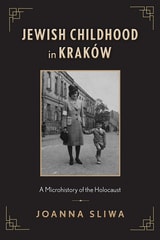
Jewish Childhood in Kraków
A Microhistory of the HolocaustJoanna Sliwa
Rutgers University Press, 2021
Jewish Childhood in Kraków is the first book to tell the history of Kraków in the second World War through the lens of Jewish children’s experiences. Here, children assume center stage as historical actors whose recollections and experiences deserve to be told, analyzed, and treated seriously.
Sliwa scours archives to tell their story, gleaning evidence from the records of the German authorities, Polish neighbors, Jewish community and family, and the children themselves to explore the Holocaust in German-occupied Poland and in Kraków in particular. A microhistory of a place, a people, and daily life, this book plumbs the decisions and behaviors of ordinary people in extraordinary times.
Offering a window onto human relations and ethnic tensions in times of rampant violence, Jewish Childhood in Kraków is an effort both to understand the past and to reflect on the position of young people during humanitarian crises.
Jewish Claims Against East Germany
Angelika Timm
Central European University Press, 1998
This is the first comprehensive history of Jewish negotiations with East Germany regarding restitution and reparations for Nazi war crimes. Angelika Timm analyzes the politics of old and new anti-Semitism and the context in which they grew under the officially propagated ideology of antifascism.
Investigating the mass of unpublished, newly available archival data from the United States, Israel, and the former German Democratic Republic, and more than forty personal interviews, Timm fills a critical gap in the scholarship on postwar Germany. She analyzes the role of the Holocaust and the image of Jews in the historical consciousness and political culture of East Germany and chronicles the efforts of Jewish organizations, especially the Conference on Jewish Material Claims Against Germany, to negotiate reparations with the East German state. The unique relationship between ideology and Realpolitik defined the manner in which East Germany confronted the crimes of its past and allowed anti-Semitism to reemerge.
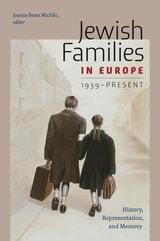
Jewish Families in Europe, 1939-Present
History, Representation, and MemoryEdited by Joanna Beata Michlic
Brandeis University Press, 2017
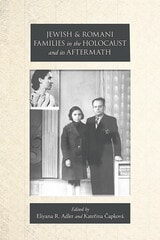
Jewish and Romani Families in the Holocaust and its Aftermath
Eliyana R. Adler
Rutgers University Press, 2021
In this work, scholars from the United States, Israel, and across Europe bring a variety of backgrounds and disciplines to their study of the Holocaust and its aftermath from the family perspective. Drawing on research from Belarus to Great Britain, and examining both Jewish and Romani families, they demonstrate the importance of recognizing how people continued to function within family units—broadly defined—throughout the war and afterward.
John Leland
De uiris illustribus / On Famous MenJohn Leland
Bodleian Library Publishing, 2010
John Stuart Mill and the Religion of Humanity
Linda C. Raeder
University of Missouri Press, 2002
Johnson in Japan
Kimiyo Ogawa
Bucknell University Press, 2021
Published by Bucknell University Press. Distributed worldwide by Rutgers University Press.
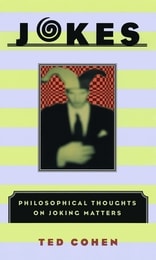
Jokes
Philosophical Thoughts on Joking MattersTed Cohen
University of Chicago Press, 1999
Sol sits on the sidewalk bench and waits patiently for nearly half an hour. Finally, Abe reappears.
"Well," asks Sol, "what are they up to? Who are they trying to convert? Why do they care? Did you get the $1,000?"
Indignantly Abe replies, "Money. That's all you people care about."
Ted Cohen thinks that's not a bad joke. But he also doesn't think it's an easy joke. For a listener or reader to laugh at Abe's conversion, a complicated set of conditions must be met. First, a listener has to recognize that Abe and Sol are Jewish names. Second, that listener has to be familiar with the widespread idea that Jews are more interested in money than anything else. And finally, the listener needs to know this information in advance of the joke, and without anyone telling him or her. Jokes, in short, are complicated transactions in which communities are forged, intimacy is offered, and otherwise offensive stereotypes and cliches lose their sting—at least sometimes.
Jokes is a book of jokes and a book about them. Cohen loves a good laugh, but as a philosopher, he is also interested in how jokes work, why they work, and when they don't. The delight at the end of a joke is the result of a complex set of conditions and processes, and Cohen takes us through these conditions in a philosophical exploration of humor. He considers questions of audience, selection of joke topics, the ethnic character of jokes, and their morality, all with plenty of examples that will make you either chuckle or wince. Jokes: more humorous than other philosophy books, more philosophical than other humor books.
"Befitting its subject, this study of jokes is . . . light, funny, and thought-provoking. . . . [T]he method fits the material, allowing the author to pepper the book with a diversity of jokes without flattening their humor as a steamroller theory might. Such a book is only as good as its jokes, and most of his are good. . . . [E]ntertainment and ideas in one gossamer package."—Kirkus Reviews
"One of the many triumphs of Ted Cohen's Jokes-apart from the not incidental fact that the jokes are so good that he doesn't bother to compete with them-is that it never tries to sound more profound than the jokes it tells. . . . [H]e makes you feel he is doing an unusual kind of philosophy. As though he has managed to turn J. L. Austin into one of the Marx Brothers. . . . Reading Jokes makes you feel that being genial is the most profound thing we ever do-which is something jokes also make us feel-and that doing philosophy is as natural as being amused."—Adam Phillips, London Review of Books
"[A] lucid and jargon-free study of the remarkable fact that we divert each other with stories meant to make us laugh. . . . An illuminating study, replete with killer jokes."—Kevin McCardle, The Herald (Glasgow)
"Cohen is an ardent joke-maker, keen to offer us a glimpse of how jokes are crafted and to have us dwell rather longer on their effects."—Barry C. Smith, Times Literary Supplement
"Because Ted Cohen loves jokes, we come to appreciate them more, and perhaps think further about the quality of good humor and the appropriateness of laughter in our lives."—Steve Carlson, Christian Science Monitor
Jonathan Swift
Irish Blow-InEugene Hammond
University of Delaware Press, 2016
Jonathan Swift: Irish Blow-in covers the arc of the first half of Jonathan Swift’s life, offering fresh details of the contentment and exuberance of his childhood, of the support he received from his grandmother, of his striking affection for Esther Johnson from the time she was ten years old (his pet name for her in her twenties was “saucebox”), of his precocious entry into English politics with his Contests and Dissensions pamphlet, of his brilliant and much misunderstood Tale of a Tub, and of his naive determination to do well both as a vicar of the small parish of Laracor in Ireland and as a writer for the Tory administration trying to pull England out of debt by ending the war England was engaged in with France.
I do not share with past biographers the sense that Swift had a deprived childhood. I do not share the suspicion that most of Swift’s enmities were politically motivated. I do not feel critical of him because he was often fastidious with his money. I do not think he was insincere about his religious faith. His pride, his sexual interests, his often shocking or uninhibited language, his instinct for revenge – emphasized by many previous biographers – were all fundamental elements of his being, but elements that he either used for rhetorical effect, or that he tried to keep in check, and that he felt that religion helped him to keep in check. Swift had as firm a conviction as did Freud that we are born with wayward tendencies; unlike Freud, though, he saw both religion and civil society as necessary and helpful checks on those wayward tendencies, and he (frequently, but certainly not always) acknowledged that he shared those tendencies with the rest of us.
This biography, in two books, Jonathan Swift: Irish Blow-in and Jonathan Swift: Our Dean, will differ from most literary biographies in that it does not aim to show how Swift’s life illuminates his writings, but rather how and why Swift wrote in order to live the life he wanted to live. I have liberally quoted Swift’s own words in this biography because his inventive expression of ideas, both in his public works and in his private letters, was what has made him a unique and compelling figure in the history of literature. I hope in these two books to come closer than past biographies to capturing how it felt to Swift himself to live his life.
Published by University of Delaware Press. Distributed worldwide by Rutgers University Press.
Jonathan Swift
Our DeanEugene Hammond
University of Delaware Press, 2016
Jonathan Swift: Our Dean details the political climax of his remarkable career—his writing and publication of The Drapier’s Letters (1724), Gulliver’s Travels (1726), and A Modest Proposal (1729)—stressing the relentless political opposition he faced and the numerous ways, including through his sermons, that he worked from his political base as Dean of St. Patrick’s Cathedral, psychologically as well as physically just outside the Dublin city walls, to attempt to rouse the Irish people to awareness of the ways that England was abusing them.
This book faces squarely the likelihood that Swift had a physical affair with Esther Vanhomrigh between 1719 and 1723, and reassesses in the light of that likelihood his conflicting relations with Esther Vanhomrigh and Esther Johnson. It traces the many loving friendships with both men and women in Ireland that sustained Swift during the years when his health gradually failed him, enabling him to continue indefatiguably, both through his writings and his authority as Dean of St. Patrick’s, to contribute to the public welfare in the face of relentless British attempts to squeeze greater and greater profits out of their Irish colony. Finally, it traces how Swift’s political indignation led to his treating many people, friends and enemies, cruelly during the 1730s, even while his humor and his ability to make and attract new friends sustained themselves until his memory finally failed him in 1742.
This biography, in two books, Jonathan Swift: Irish Blow-in and Jonathan Swift:Our Dean, comes closer than past biographies to capturing how it felt to Swift himself to live his life.
Published by University of Delaware Press. Distributed worldwide by Rutgers University Press.

Josef Guttmann
The Fates of Central Europe Between Hitler and Stalin: Selected WritingEdited by Jacques Rupnik
Karolinum Press, 2026
Two lives, two names, two perspectives on Soviet communism and its postwar expansion into Eastern Europe.
In the 1930s, Guttmann was a leader of the Communist Party of Czechoslovakia before he broke with the party over the Comintern's strategy of helping Hitler to power. A harsh critic of Stalin's dictatorship and foreign policy, Guttmann became a prominent leftist opponent, outcast by the Party. To escape nazism, he exiled and settled in New York, where he worked under a pseudonym as a leading expert on events in the Soviet bloc and a critic of totalitarianism. Featured in this book are his Czech texts from the 1930s as well as studies and essays he later wrote on the nature of communist regimes, genocide, and anti-Semitism.
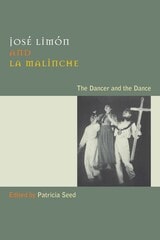
José Limón and La Malinche
The Dancer and the DanceEdited by Patricia Seed
University of Texas Press, 2008
José Limón (1908-1972) was one of the leading figures of modern dance in the twentieth century. Hailed by the New York Times as "the finest male dancer of his time" when the José Limón Dance Company debuted in 1947, Limón was also a renowned choreographer who won two Dance Magazine Awards and a Capezio Dance Award, two of dance's highest honors. In addition to directing his own dance company, Limón served as artistic director of the Lincoln Center's American Dance Theater and also taught choreography at the Juilliard School for many years.
In this volume, scholars and artists from fields as diverse as dance history, art history, Mesoamerican ethnohistory, Mexican American studies, music studies, and Mexican history come together to explore one of José Limón's masterworks, the ballet La Malinche. Offering many points of entry into the dance, they examine La Malinche from various angles, such as Limón's life story and the influence of his Mexican heritage on his work, an analysis of the dance itself, the musical score composed by Norman Lloyd, the visual elements of props and costumes, the history and myth of La Malinche (the indigenous woman who served the Spanish conquistador Hernán Cortés as interpreter and mistress), La Malinche's continuing presence in Mexican American culture, and issues involved in a modern restaging of the dance.
Also included in the book is a DVD written and directed by Patricia Harrington Delaney that presents the ballet in its entirety, accompanied by expert commentary that sets La Malinche within its artistic and historical context.
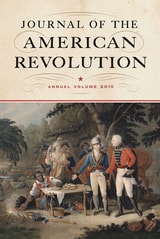
Journal of the American Revolution 2015
Annual VolumeTodd Andrlik
Westholme Publishing, 2015
The Journal of the American Revolution, Annual Volume 2015, presents the journal’s best historical research and writing over the past calendar year. The volume is designed for institutions, scholars, and enthusiasts to provide a convenient overview of the latest research and scholarship in American Revolution studies. The sixty articles in the 2015 edition include:
How Samuel Adams Recruited Sons of Liberty by J. L. Bell
A Patriot–Loyalist: Playing Both Sides by Todd W. Braisted
How Old Were Redcoats? Age and Experience of British Soldiers in America by Don N. Hagist
The Great West Point Chain by Hugh T. Harrington
Raid Across the Ice: The British Operation to Capture Washington by Benjamin Huggins
So Heavy a Trial: The Burning of New York’s First Capital by Jack Kelly
An Elegant Dinner with General Washington at Valley Forge Headquarters by Nancy K. Loane
Mount Vernon: A Landscape for the New Cincinnatus by Joseph Manca
The British Spy Plot to Capture Fort Ticonderoga by John A. Nagy
The Top Ten British Losers by Andrew O’Shaughnessy
Honorable Lords and Pretend Barons: Sorting Out the Noblemen of the American Revolution by Jim Piecuch
Paul Revere’s Other Riders and Rides by Ray Raphael
William Lee and Oney Judge: A Look at George Washington and Slavery by Mary V. Thompson.
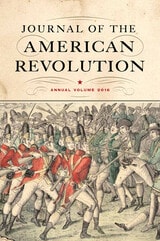
Journal of the American Revolution 2016
Annual VolumeTodd Andrlik
Westholme Publishing, 2016
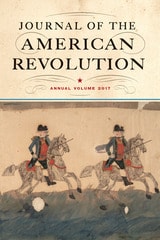
Journal of the American Revolution 2017
Annual VolumeTodd Andrlik
Westholme Publishing, 2017
The forty-six articles in the 2017 edition include:
Why the British Lost the Battle of Sullivan’s Island by C. L. Bragg
The Tiger Aids the Eaglet: How India Secured America’s Independence by Richard Sambasivam
How Yorktown Almost Couldn’t Afford to Happen by John Smith
Was Richard Stockton a Hero? by Christian M. McBurney
The Southern Expedition of 1776: The American Revolution’s Best Kept Secret by Roger Smith
Religious Liberty and Its Virginia Roots by Alex Colvin
Mount Vernon During the American Revolution by Mary V. Thompson
Why God is in the Declaration but not the Constitution by Anthony J. Minna
Colonel Tench Tilghman: George Washington’s Eyes and Ears by Jeff Dacus
The Stockbridge-Mohican Community, 1775–1783 by Bryan Rindfleisch
Two Years Aboard the Welcome: The American Revolution on Lake Huron by Tyler Rudd Putman
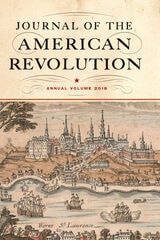
Journal of the American Revolution 2018
Annual VolumeDon N. Hagist
Westholme Publishing, 2018
The Journal of the American Revolution, Annual Volume 2018, presents the journal’s best historical research and writing over the past calendar year. The volume is designed for institutions, scholars, and enthusiasts to provide a convenient overview of the latest research and scholarship in American Revolution studies. The forty-one articles in the 2018 edition include:
Anti-Indian Radicalization in the Early American West, 1774–1795 by Darren R. Reid
The Setauket Raid, December 1777 by Phillip R. Giffin
The 3rd New Jersey Regiment’s Plundering of Johnson Hall by Philip D. Weaver
A Proposed Alliance of the Knights of Malta and the United States of America by Bruce Ware Allen
Country Crowds in Revolutionary Massachusetts: Mobs and Militia by Ray Raphael
Lafayette: An Acerbic Tongue or an Incisive Judge of Character? by Gene Procknow
Admiral Rodney Ousts the Jews from St. Eustatius by Louis Arthur Norton
Preventing Slave Insurrection in South Carolina & Georgia, 1775–1776 by Jim Piecuch
The “P” is for Profit: Revolutionary War Privateers and the Slave Trade by Michael Thomin
The Remarkable Spanish Pilgrimage of John Adams by John L. Smith, Jr.
Thomas Paine, Deism, and the Masonic Fraternity by Shai Afsai
A Fresh Look at Major Patrick Ferguson by Wayne Lynch
Displaced: The Donation People of 1775 by Katie Turner Getty
Journal of the American Revolution 2021
Annual VolumeDon N. Hagist
Westholme Publishing, 2021
The Journal of the American Revolution, Annual Volume 2021, presents the journal’s best historical research and writing over the past calendar year. The volume is designed for institutions, scholars, and enthusiasts to provide a convenient overview of the latest research and scholarship in American Revolution and Founding Era studies. The thirty-four articles in the 2021 edition include:
Alexander Hamilton’s Missing Years: New Discoveries and Insights into the Little Lion’s Caribbean Childhood by Ruud Stelten and Alexandre Hinton
The Lenape Origins of an Independent America: The Catalyst of Pontiac’s War, 1763–1765 by Kevin A. Conn
Impeachment: The Framers Debate and Discuss by Ray Raphael
The First Efforts to Limit the African Slave Trade by Christian M. McBurney
What Killed Prisoners of War?—A Medical Investigation by Brian Patrick O'Malley
The Mysterious March of Horatio Gates by Andrew Waters
Minorcans, New Smyrna, and the American Revolution in East Florida by George Kotlik
Stony Point: The Second Occupation, July–October 1779 by Michael J. F. Sheehan
A Demographic View of North Carolina Militia and State Troops, 1775–1783 by Douglas R. Dorney, Jr.
The Revolutionary War Origin of the Whistleblower Law by Louis Arthur Norton
Mapping the Battle of Eutaw Springs: Modern GIS Solves a Historic Mystery by Stephen John Katzberg
Journal of the American Revolution 2022
Annual VolumeDon N. Hagist
Westholme Publishing, 2022
The year’s best articles from the leading on-line source of new research on the Revolution and Founding eras
The Journal of the American Revolution, Annual Volume 2022, presents the journal’s best historical research and writing over the past calendar year. The volume is designed for institutions, scholars, and enthusiasts to provide a convenient overview of the latest research and scholarship in American Revolution and Founding Era studies. This year's articles are:
Massachusettensis and Novanglus: The Last Great Debate Prior to the War by James M. Smith
Wampum Belts to Canada: Stockbridge Indian Ambassadors’ Dangerous 1775 Peace Mission by Mark R. Anderson
Ethan Allen’s “Motley Parcel of Soldiery” at Montreal by Mark R. Anderson
The Devil at the Helm: A Quote That Went Astray by Don N. Hagist
Thomas Knowlton’s Revolution by David Price
Major Robert Rogers and the American Revolution by Scott M. Smith
La Petite Guerre and Indian Irregular Manner of War: Siblings, But Not Twins by Brian Gerring
George Washington and the First Mandatory Immunization by Richard J. Werther
French Adventurers, Patriots, and Pretentious Imposters in the Fight for American Independence by Arthur S. Lefkowitz
The Cherokee-American War from the Cherokee Perspective by Jordan Baker
The Numerical Strength of George Washington’s Army During the 1777 Philadelphia Campaign by Gary Ecelbarger and Michael C. Harris
A Reconsideration of Continental Army Numerical Strength at Valley Forge by Gary Ecelbarger and Michael C. Harris
American Indians at Valley Forge by Joseph Lee Boyle
The Discovery of a Letter from a Soldier of the First Rhode Island Regiment by Christian McBurney
“The Predicament We Are In”: How Paperwork Saved the Continental Army by Mike Matheny
Sir Henry Clinton’s Generalship by John Ferling
The Varick Transcripts and the Preservation of the War by Justin McHenry
“A Mere Youth”: James Monroe’s Revolutionary War by John A. Ruddima
Haitian Soldiers at the Siege of Savannah by Robert S. Davis
George Washington’s Culper Spy Ring: Separating Fact from Fiction by Bill Bleyer
Texas, Cattle, Cowboys, Ranchers, Indian Raids, and the American Revolution by George Kotlik
The Odyssey of Loyalist Colonel Samuel Bryan by Douglas R. Dorney, Jr.
“She Had Gone to the Army . . . to Her Husband”: Judith Lines’s Unremarked Life by John U. Rees
The Yorktown Tragedy: George Washington’s Slave Roundup by Gregory J. W. Urwin
Such as are Absolutely Free: Benjamin Thompson’s Black Troopers by Todd W. Braisted
The King of Sweden: Friendly Foe of the United States by Richard Werther
Shifting Indian Policy of the Articles of Confederation by John DeLee
Justice, Mercy, and Treason: John Marshall’s and Mercy Otis Warren’s Treatments of Benedict Arnold by Ray Mirante
A Chance Amiss: George Washington and the Fiasco of Spain’s Gift Diplomacy by Elisa Vargas
The Constitutional Convention Debates the Electoral College by Jason Yonce
Respected Citizen of Washington City: The Mystery of Will Costin, Freed Mount Vernon Slave by David O. Stewart
The Impeachment of Senator William Blount by Andrew A. Zellers-Frederick
Instinctive Temporary Unity: Examining Public Opinion During the Whiskey Rebellion by Jonathan Curran
“Good and Sufficient Testimony”: The Development of the Revolutionary War Pension Plan by Michael Barbieri
Journal of the American Revolution 2023
Annual VolumeDon N. Hagist
Westholme Publishing, 2023
The year’s best articles from the leading on-line source of new research on the American Revolution and Founding Eras
The Journal of the American Revolution, Annual Volume 2023, presents the journal’s best historical research and writing over the past calendar year. The volume is designed for institutions, scholars, and enthusiasts to provide a convenient overview of the latest research and scholarship in American Revolution and Founding Era studies. Chosen by the Journal's editorial board, this year's articles are:
Charles Thomson and the Delaware by James M. Smith
Benjamin Franklin’s Unconventional Marriage to Deborah Read by Nancy Rubin Stuart
Governor William Franklin: Sagorighweyoghsta, “Great Arbiter” or “Doer of Justice” by Joseph E. Wroblewski
One of the “Powers for Good in the World:” Mercy Otis Warren by James M. Deitch
The British Soldiers Who Marched to Concord, April 19, 1775 by Don N. Hagist
Virginian Ned Streater, African American Minute Man by Patrick H. Hannum
The 1775 Duel Between Henry Laurens and John Faucheraud Grimké by Aaron J. Palmer
Washington’s Final Retreat: Asylum? by Alexander Lenarchyk
George III’s (Implicit) Sanction of the American Revolution by M. Andrew Holowchak
Edward Hand’s American Journey by David Price
Jemima Howe, Frontier Pioneer to Wealthy Widow by Jane Strachan
Hell’s Half-Acre: The Fall of Loyalist Crean Brush by Eric Wiser
Thomas Plumb, British Soldier, Writes Home from Rhode Island by Don N. Hagist
Unraveling the Beginning and Final Phasesin the Emergence of the French Alliance by Marvin L. Simner
Marinus Willett: The Exploits of an Unheralded War Hero by Richard J. Werther
Point/Counterpoint, 1777 Style: Dueling Proclamations from Israel Putnam and William Tryon by Todd W. Braisted
Did George Washington Swear at Charles Lee During the Battle of Monmouth? by Christian McBurney
Black Drummers in a Redcoat Regiment by Don N. Hagist
Under the Banner of War: Frontier Militia and Uncontrolled Violence by Timothy C. Hemmis
Rhode Island Acts to Prevent an Enslaved Family from Being Transported to the South by Christian McBurney
British Soldier John Ward Wins Back His Pocketbook by Don N. Hagist
Anthony Wayne’s Repulse at Bull’s Ferry, July 21, 1780 by Jim Piecuch
Two Hurricanes One Week Apart in 1780 by Bob Ruppert
Top Ten Weather Interventions by Don N. Hagist
The Fruits of Victory: Loyalist Prisoners in the Aftermath of Kings Mountain by William Caldwell
Top Ten Quotes by Francis Lord Rawdon by Todd W. Braisted
Russia and the Armed Neutrality of 1780 by Eric Sterner
Prelude to Yorktown: Washington and Rochambeau in New York by Benjamin Huggins
The Abdication(s) of King George III by Bob Ruppert
Jemima Howe: Two Competing Captivity Narratives by Jane Strachan
The Articles of Confederation—A Silver Lining by Richard J. Werther
Undeceived: Who Would Write the Political Story of the Revolution? by James M. Smith
Partisan Politics and the Laws Which Shaped the First Congress by Samuel T. Lair
“Characters Pre-eminent for Virtue and Ability”: The First Partisan Application of the Electoral College by Shawn David McGhee
Weaponizing Impeachment: Justice Samuel Chase and President Thomas Jefferson’s Battle Over the Process by Al Dickenson
Insurrection and Speculation: A Farmer, Financier, and a Surprising “Sharper” Seeded the Constitution by Scott M. Smith
Natural History in Revolutionary and Post-Revolutionary America by Matteo Giuliani
A Great Englishman? British Views of George Washington, from Revolution to Rapprochement by Sam Edwards
Journal of the Warburg and Courtauld Institutes, volume 86 number 1 (2023)
The University of Chicago Press
University of Chicago Press Journals, 2023
Journal of the Warburg and Courtauld Institutes, volume 87 number 1 (2024)
The University of Chicago Press
University of Chicago Press Journals, 2024
Journal of the Warburg and Courtauld Institutes, volume 88 number 1 (2025)
The University of Chicago Press
University of Chicago Press Journals, 2025
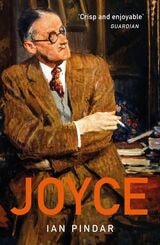
Joyce
Second EditionIan Pindar
Haus Publishing, 2025
James Joyce (1882–1941) is hailed as one of the greatest writers of the twentieth century. Rejecting his homeland and its religion as a young man, Joyce went on to reinvent the Dublin of his youth in his fiction. His masterpiece, Ulysses—once banned in Britain and the United States—redefined the modern novel and has become a canonical classic. Finnegans Wake, written as Joyce’s eyesight deteriorated, cemented his legacy as one of the founding figures of modernist literature.
In a revised edition of this lucid and compelling biography, containing a new foreword from the author, crucial events in Joyce’s life, from his self-imposed exile to his creative triumphs, are explored vividly. Ian Pindar reveals how Joyce’s work carefully blends the abstract and the mundane, capturing the great human comedy of which we are all part.
Just Gaming
Jean-Francois Lyotard
University of Minnesota Press, 1985
Juvenescence
A Cultural History of Our AgeRobert Pogue Harrison
University of Chicago Press, 2014
Like all of Robert Pogue Harrison's books, Juvenescence ranges brilliantly across cultures and history, tracing the ways that the spirits of youth and age have inflected each other from antiquity to the present. Drawing on the scientific concept of neotony, or the retention of juvenile characteristics through adulthood, and extending it into the cultural realm, Harrison argues that youth is essential for culture’s innovative drive and flashes of genius. At the same time, however, youth—which Harrison sees as more protracted than ever—is a luxury that requires the stability and wisdom of our elders and the institutions. “While genius liberates the novelties of the future,” Harrison writes, “wisdom inherits the legacies of the past, renewing them in the process of handing them down.”
A heady, deeply learned excursion, rich with ideas and insights, Juvenescence could only have been written by Robert Pogue Harrison. No reader who has wondered at our culture's obsession with youth should miss it.