Results by title
5550 books match the query 'Biography & Autobiography' and 204 start with j
John H. Burdakin and the Grand Trunk Western Railroad
Mary Sharp
Michigan State University Press, 2016

John H. Burdakin
RailroaderDon L. Hofsommer
Michigan State University Press, 2015
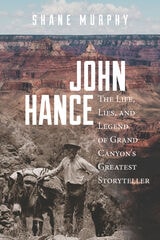
John Hance
The Life, Lies, and Legend of Grand Canyon's Greatest StorytellerShane Murphy
University of Utah Press, 2020
A legend in his own lifetime, John Hance (1837–1919) was synonymous with early Grand Canyon tourism. Between the late 1880s and early 1900s, to say “John Hance” was to say “Grand Canyon.” Hance was well known to travelers and visiting dignitaries alike, men such as William “Buffalo Bill” Cody and Theodore Roosevelt, the president who affectionately referred to him as “the greatest liar on earth.” It was said that Hance tried to jump the canyon on his horse Darby only to turn back when he was halfway over and realized he would never make it across.
The truth behind Hance’s life is remarkable even without embellishment. In this book, Shane Murphy chronicles Hance’s childhood in Tennessee and Missouri, his service in the Confederacy during the Civil War, his time in Union prisons as a POW, and his later adventures with the Hickok brothers crossing the plains. Settling in Arizona’s fruitful Verde Valley, Hance farmed and filled military contracts before taking up residence as Grand Canyon’s first permanent Euro-American settler, trail builder, guide, and renowned storyteller.
Hance left no correspondence, personal memoirs, or other writings. Only informal portraits from magazines and newspaper accounts remain. Murphy investigated assessors’ rolls, rare mercantile ledgers, and mining claims to create a full and compelling narrative of a man who was once an icon of the American West and should be remembered as the founding father of Grand Canyon tourism.

John Henry Livingston and the Dutch Reformed Tradition in the Early American Nation
John W. Coakley
Rutgers University Press, 2027
John Henry Livingston (1746-1825) was from a prominent New York family of merchants, lawyers and statesmen but chose to become a minister in the Dutch Reformed Church. In his twenties he studied in the Netherlands, absorbing ideas that upheld simultaneously the authority of the individual conscience and the traditional Reformed beliefs rooted in the authority of a state-supported church. Returning to New York City he served as a pastor, as his denomination’s professor charged with educating students for ministry, and eventually, president of the American Dutch church’s college, then called Queens (but later called Rutgers). Throughout his career he articulated, and defended what he saw as the harmony between the traditional body of Reformed belief and the ideals of the American state.
John Heyl Vincent's Reminiscences
Autobiographical Writings of the Founding Superintendent of ChautauquaTimothy S. Binkley
Bridwell Press, 2024
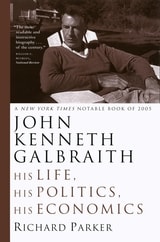
John Kenneth Galbraith
His Life, His Politics, His EconomicsRichard Parker
University of Chicago Press, 2006
John Kenneth Galbraith (1908-2006) was one of America’s most famous economists for good reason. From his acerbic analysis of America’s “private wealth and public squalor” to his denunciation of the wars in Vietnam and Iraq, Galbraith consistently challenged “conventional wisdom” (a phrase he coined). He did so as a witty commentator on America’s political follies and as a versatile author of bestselling books—such as The Affluent Society and The New Industrial State—that warn of the dangers of deregulated markets, corporate greed, and inattention to the costs of our military power. Here, in the first full-length biography of Galbraith and his times, Richard Parker provides not only a nuanced portrait of this extraordinary man, but also an important reinterpretation of twentieth-century public policy and economic practices.
“Whatever you may think of his ideas, John Kenneth Galbraith has led an extraordinary life. . . . Doing justice to this life story requires an outsize biography, one that not only tells Mr. Galbraith’s tale but sets it on the broader canvas of America’s political and economic evolution. And Richard Parker’s book does just that.”—Economist
“Parker’s book is more than a chronicle of Galbraith’s life; it’s a history of American politics and policy from FDR through George W. Bush. . . . It will make readers more economically and politically aware.”—USA Today
“The most readable and instructive biography of the century.”—William F. Buckley, National Review
“The story of this man’s life and work is wonderfully rendered in this magnum opus, and offers an antidote to the public ennui, economic cruelty, and government malfeasance that poison life in America today.”—James Carroll, Boston Globe
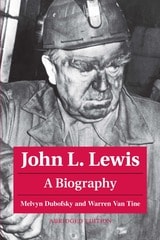
John L. Lewis
A BiographyMelvyn Dubofsky and Warren Van Tine
University of Illinois Press, 1986
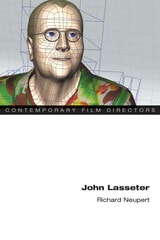
John Lasseter
Richard Neupert
University of Illinois Press, 2016
Richard Neupert explores Lasseter's signature aesthetic and storytelling strategies and details how he became the architect of Pixar's studio style. Neupert contends that Lasseter's accomplishments emerged from a unique blend of technical skill and artistic vision, as well as a passion for working with collaborators. In addition, Neupert traces the director's career arc from the time Lasseter joined Pixar in 1984. As Neupert shows, Lasseter's ability to keep a foot in both animation and CGI allowed him to thrive in an unconventional corporate culture that valued creative interaction between colleagues. The ideas that emerged built an animation studio that updated and refined classical Hollywood storytelling practices--and changed commercial animation forever.
John Letcher of Virginia
The Story of Virginia's Civil War GovernorFrancis N. Boney
University of Alabama Press, 1967
John Letcher, governor of Virginia from 1860 through 1863, is one of the significant leaders of the Confederacy who is still virtually unknown. This study, covering Letcher’s entire life with emphasis on his governorship, attempts to fill an obvious gap in American history. For the first time, Letcher’s lengthy career is examined in detail: early development as a local Virginia politician during the Jacksonian era, maturity as an influential congressman in the rising sectionalism of the 1850s, the crucial governorship, and finally a gradual fading away in the postwar period.
Letcher’s story is only a fragment of the epic of the transformation of the United States from a weak, uncertain confederation into a powerful, confident nation. The emergence of the colossus of the New World is a spectacular and critical event in world history, full of grandeur and suffering, idealism and disillusionment. To trace the course of Letcher's life is to follow one small current in a torrential flood-but a significant one, for Letcher was not only a leader but also in many ways a typical American of his time.
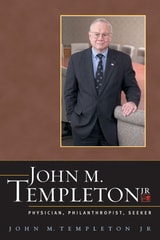
John M. Templeton Jr.
Physician, Philanthropist, SeekerJohn M. Templeton
Templeton Press, 2008
Candidly, with a mixture of joy, poignancy, and gratitude, the chairman and president of the John Templeton Foundation reflects on the learning and growing he has experienced and the perspectives he has gained throughout his life. In so doing, he continues the legacy of his father, Sir John Templeton, who has used stories from his life to provide instruction for his children, grandchildren, and other future descendants, just as he has drawn on those stories in his many books of inspiration and guidance for the general public.
Dr. Templeton shares stories about his personal life, his career in medicine, his early involvement with philanthropy, and his commitment to the John Templeton Foundation and its mission. Events and circumstances in his youth opened him to spirituality, taught him about altruistic love, and introduced him to values he would cultivate throughout his life: thrift, saving, hard work, creativity, and responsibility.
His journey takes him from his early life in Winchester, Tennessee, to New Jersey, Yale University, medical school, the Navy, the Children's Hospital of Philadelphia, and the John Templeton Foundation. Along the way, there were lessons learned from his disruptive behavior in elementary school; the deaths of his grandmother and mother; travel to Europe, Africa, and throughout the U.S.; marriage and fatherhood; his growing commitment as a Christian; and his family's experience with an armed robbery. It continues with his experiences in pediatric surgery at the Children's Hospital of Philadelphia, including work with conjoined twins; experience with the mutual fund industry and a role with the Templeton Growth Fund; an intensely rewarding medical specialty in trauma; philanthropy and fund-raising efforts, including a sad experience with fraud; the pride of professorship; and serving as chairman and president of the John Templeton Foundation.
With gratitude he credits his many mentors for the wisdom they passed on to him. Among them are John Galbraith, Dr. C. Everett Koop, Dr. Albert Schweitzer, and, of course, always and above all, his father. With appreciation, he recounts the blessings of a full and productive life that continue today as he provides leadership to the diverse programs and initiatives of the John Templeton Foundation.
John Mackay
Silver King in the Gilded AgeMichael J. Makley
University of Nevada Press, 2015
John Mackay offers new insight into the life and achievements of this remarkable man. It also places Mackay in the broader context of his time, an era of robber barons and rampant corruption, rapidly advancing technology, national and international capitalism, and flagrant displays of newfound wealth. Even in this context, he stood out, not only for his contributions to Nevada and mining history, but also for his reputation as an important business leader fighting the consolidation and venality of corporate power in the Gilded Age. His actions freed the Comstock from a financial monopoly, resulting in moderated rates for the milling, timber, shipping, transportation, and water that made mining possible and precipitated the discovery and development of the ore field known as the “Big Bonanza.”
Makley’s book recounts the life and career of one of the most successful men of his age, a capitalist of immense wealth who generously helped those around him and worked diligently in the public interest. This engaging biography will appeal to readers interested in the Comstock Lode and mining in the West during the latter part of the nineteenth century as well as general western history enthusiasts.
John Maclean
Hero of Red ClydesideHenry Bell
Pluto Press, 2018
Feared by the government, adored by workers, celebrated by Lenin and Trotsky. The head of British Military Intelligence called John Maclean (1879–1923) “the most dangerous man in Britain.”
This new biography explores the events that shaped the life of a momentous man—from the Great War and the Great Unrest to the Rent Strike and the Russian Revolution. It examines his work as an organizer and educator, his imprisonment and hunger strike, and his rise to the position of Britain’s most famous revolutionary. At a moment when radical politics is drawing renewed attention and support, Maclean’s example of activism and commitment is as timely as ever.
John McDonnell
The Most Successful Coach in NCAA HistoryAndrew Maloney
University of Arkansas Press, 2013
John McIntosh Kell of the Raider Alabama
Norman C. Delaney
University of Alabama Press, 2003
A vivid portrait of the man credited as a driving force behind the most successful of the Confederate raiders, the legendary C.S.S. Alabama.
John McIntosh Kell was an experienced, proven military man, a graduate of Annapolis, a veteran of the Mexican War and of Admiral Perry’s voyage to Japan. As a Confederate officer, Kell served first on the raider Sumter and then on the Alabama. At sea for only 22 months, the Alabama engaged nearly 300 northern merchant vessels, burning 55 of these transport ships along with their million-dollar cargoes.
Though First Lieutenant ("Luff") Kell was apparently content to let his captain, Raphael Semmes, take credit for their accomplishments, Semmes acknowledged that his successes were due largely to the energy and resourcefulness of his second in command. Life on the commerce cruisers was hard and tedious, and much of the responsibility for running the day-to-day operations, including the disciplining of a largely mercenary crew, rested on Kell, whose sense of duty and loyalty did not waver.
Norman C. Delaney bases his account of this remarkable naval officer’s experiences on the interviews Kell granted to news reporters during the 1880s and 1890s (previously neglected by historians) and his memoirs, published in 1900 as Recollections of a Naval Life. He supplements these materials with records from Kell’s earlier years, including letters, journals, diaries, and contemporary observations. First published in 1973 by The University of Alabama Press, this new edition of an award-winning biography will be welcomed by Civil War historians and enthusiasts around the world, naval institutions and museums, and general readers alike.
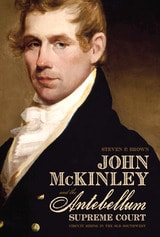
John McKinley and the Antebellum Supreme Court
Circuit Riding in the Old SouthwestSteven P. Brown
University of Alabama Press, 2012
A Southern voice on a national bench—McKinley’s legacy in antebellum law.
John McKinley and the Antebellum Supreme Court offers the first comprehensive biography of Justice John McKinley (1780–1852), a largely forgotten figure in American legal history who played a pivotal role during a formative period of the U.S. Supreme Court. Steven P. Brown rescues McKinley from historical obscurity, presenting a compelling portrait of a man deeply embedded in the political, legal, and financial life of the early 19th-century South.
Born in Kentucky and later settling in northern Alabama, McKinley served in both the U.S. Senate and House of Representatives before being appointed to the Supreme Court by President Martin Van Buren in 1837. His tenure on the bench coincided with the creation of the Ninth Circuit, a vast and challenging judicial territory encompassing Alabama, Arkansas, Louisiana, and Mississippi. Brown details McKinley’s arduous circuit-riding duties, which required extensive travel and exposed him to the legal complexities of a rapidly expanding frontier.
More than a biography, the book provides a penetrating analysis of antebellum legal culture, Alabama state politics, and the internal workings of the Supreme Court during a time of national transformation. Brown challenges the prevailing view of McKinley as a mediocre jurist, arguing instead that his contributions—particularly his dissents defending states’ rights—deserve renewed scholarly attention. With rich historical context and meticulous research, John McKinley and the Antebellum Supreme Court sheds light on the burdens of justice in a divided nation and the legacy of a justice whose career mirrored the tensions of his time.

John Mercer Langston and the Fight for Black Freedom, 1829-65
William and Aimee Lee Cheek
University of Illinois Press, 1989
Privileged beyond other members of his race, yet sharing their disadvantages, the young John Mercer Langston stood in an uncertain position in the years before the Civil War. His confrontation with a critical personal question was tempered by a crucial national reality: from what sources could he derive his model of manhood and human dignity? This book explores John Mercer Langston's decisions to work out his destiny through the resources and fortunes of the northern black community.
Although Langston, who died in 1897, was a black Politician, orator, lawyer, intellectual, diplomat, and congressman, he has never before been accorded fullscale biographical treatment. Born free on a Virginia plantation, Langston graduated from Oberlin College in 1849, gained admission to the Ohio bar, and by the age of twenty-five, became the first black American to hold elective office. Still in the years of his political apprenticeship, he promoted black civil rights, helped shape the nascent Republican party, aided in the Oberlin-Wellington Rescue and John Brown's raid, and recruited black soldier for the Union cause. In 1864 he became the first president of the National Equal Rights League.
From an extensive search of primary sources, the authors construct a richly textured picture of the beginnings of Langston's career as a national black leader. More than a biography, the work also incorporates social and political history. Embedded firmly in a study of northern black community life and activism, it reveals the degree to which Langston and his cohorts set the terms of the fight for freedom and citizenship.
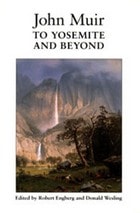
John Muir To Yosemite And Beyond
Robert Engberg
University of Utah Press, 1999
When John Muir died in 1914, the pre-eminent American naturalist, explorer, and conservationist had not yet written the second volume of his autobiography, in which he planned to cover his Yosemite years. Editors Robert Engberg and Donald Wesling have here provided a remedy.
Their account begins in 1863, the year Muir left the University of Wisconsin for what he termed the "University of the Wilderness." Following an accident in 1867 that nearly left him blind, he vowed to turn from machines and continue to study nature. That led, in 1868, to his first visit to Yosemite Valley, where he began his glacier studies. Muir spent much time exploring the Yosemite region, Tuolumne, and both the southern and northern Sierras, publishing articles, and keeping extensive journals through 1875, when he began to write for the San Francisco Bulletin and expanded his travels to areas throughout the west.
Mining a rich vein of sources—Muir’s letters, journals, articles, and unpublished manuscripts, as well as selections drawn from biographical pieces written about Muir by people who met him in Yosemite in the early 1870s—Engberg and Wesling have assembled what they term a "composite autobiography," providing brief interpretive and transitional passages throughout the book. This work is especially valuable because it documents Muir’s formative years, when he is maturing away from "conventional cultural paradigms of work and materialism toward new ways of thinking about nature and its impact on human development."
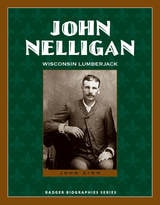
John Nelligan
Wisconsin LumberjackJohn Zimm
Wisconsin Historical Society Press, 2015
Born in 1852, Nelligan rose through the lumberjack ranks, starting out as a humble laborer and working his way up to foreman. He worked and lived in Maine, Pennsylvania, and even Canada before coming to Wisconsin in 1871. Learn what surviving and sawing wood for a living was like many years ago—from the story of one Wisconsin man who lived it!
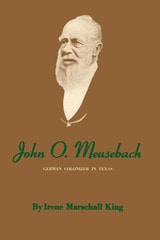
John O. Meusebach
German Colonizer in TexasBy Irene Marschall King
University of Texas Press, 1967
Otfried Hans Freiherr von Meusebach chose a life of hardship and freedom in Texas rather than a life of comfort and influence in his native Germany, where he had lived his formative years within a framework of unconstitutional government.
In 1845 the young liberal relinquished his hereditary German title, left behind his close family ties and his various intellectual and political associations, and arrived in Texas as John O. Meusebach, commissioner-general for the Society for the Protection of German Immigrants. His background enabled him to assume an enlightened leadership of fellow immigrants who were pouring in from Germany. Lacking adequate financial backing, he nevertheless led the settling of some five thousand people in a land that was largely occupied by Indians.
Irene Marschall King presents the full sweep of Meusebach's vigorous life: Meusebach as the young liberal in Germany, as the colonizer in the 1840s, as a Texas senator and, later, an observer of the Civil War, and as a Texan who devoted his later years to bringing the Texas soil to fruition—all set against a background of the immigration movement and frontier life.
"Freedom is not free; it is costly," Meusebach believed. In Texas he found for himself and others freedom worth the price he paid.
Rich in historic detail, King's story recounts the founding of Fredericksburg, the crippling effect of the Mexican War upon the mass of immigrants huddled in illness on the coast, the signing of the Indian Treaty, which opened to settlement over three million acres of land, and the final collapse of the Society for the Protection of German Immigrants. Also depicted is the colonists' influence on the land—the gardens and orchards of south central Texas, the "Easter Fires" that blaze on the hills surrounding Fredericksburg, the mixture of German custom with American necessity that created a unique culture. Throughout the narrative Mrs. King presents a fascinating cast of characters: the noble Prince Solms, who tries to establish a German military outpost in Texas; Henry Fisher, who attempts by devious methods to control the colonists and their land and finally incites a mob which tries to hang Meusebach; Philip Cappes, a special commissioner and Meusebach's assistant, who plots through intriguing correspondence with Count Castell, the executive secretary in Germany, to overthrow Meusebach; and the colorful and courageous Indian fighter and Texas Ranger, Colonel Jack Hays.
Primarily, however, this is the story of a man who found strength in his family's motto, "Perseverance in Purpose," and gave of his energies to build Texas.

John O’Hara - American Writers 80
University of Minnesota Pamphlets on American WritersCharles Child Walcutt
University of Minnesota Press, 1969
John O'Hara - American Writers 80 was first published in 1969. Minnesota Archive Editions uses digital technology to make long-unavailable books once again accessible, and are published unaltered from the original University of Minnesota Press editions.
John P. Marquand - American Writers 46
University of Minnesota Pamphlets on American WritersC. Hugh Holman
University of Minnesota Press, 1965
John P. Marquand - American Writers 46 was first published in 1965. Minnesota Archive Editions uses digital technology to make long-unavailable books once again accessible, and are published unaltered from the original University of Minnesota Press editions.
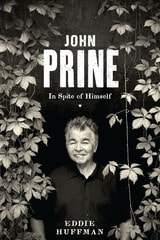
John Prine
In Spite of HimselfBy Eddie Huffman
University of Texas Press, 2015
With a range that spans the lyrical, heartfelt songs “Angel from Montgomery,” “Sam Stone,” and “Paradise” to the classic country music parody “You Never Even Called Me by My Name,” John Prine is a songwriter’s songwriter. Across five decades, Prine has created critically acclaimed albums—John Prine (one of Rolling Stone’s 500 Greatest Albums of All Time), Bruised Orange, and The Missing Years—and earned many honors, including two Grammy Awards, a Lifetime Achievement Award for Songwriting from the Americana Music Association, and induction into the Nashville Songwriters Hall of Fame. His songs have been covered by scores of artists, from Johnny Cash and Miranda Lambert to Bette Midler and 10,000 Maniacs, and have influenced everyone from Roger McGuinn to Kacey Musgraves. Hailed in his early years as the “new Dylan,” Prine still counts Bob Dylan among his most enthusiastic fans.
In John Prine, Eddie Huffman traces the long arc of Prine’s musical career, beginning with his early, seemingly effortless successes, which led paradoxically not to stardom but to a rich and varied career writing songs that other people have made famous. He recounts the stories, many of them humorous, behind Prine’s best-known songs and discusses all of Prine’s albums as he explores the brilliant records and the ill-advised side trips, the underappreciated gems and the hard-earned comebacks that led Prine to found his own successful record label, Oh Boy Records. This thorough, entertaining treatment gives John Prine his due as one of the most influential songwriters of his generation.
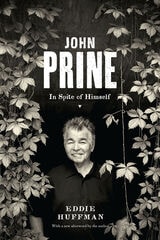
John Prine
In Spite of HimselfEddie Huffman
University of Texas Press, 2022
With a range that spans the lyrical, heartfelt songs “Angel from Montgomery,” “Sam Stone,” and “Paradise” to the classic country music parody “You Never Even Called Me by My Name,” John Prine is a songwriter’s songwriter. Across five decades, Prine has created critically acclaimed albums—John Prine (one of Rolling Stone’s 500 Greatest Albums of All Time), Bruised Orange, and The Missing Years—and earned many honors, including two Grammy Awards, a Lifetime Achievement Award for Songwriting from the Americana Music Association, and induction into the Nashville Songwriters Hall of Fame. His songs have been covered by scores of artists, from Johnny Cash and Miranda Lambert to Bette Midler and 10,000 Maniacs, and have influenced everyone from Roger McGuinn to Kacey Musgraves. Hailed in his early years as the “new Dylan,” Prine still counts Bob Dylan among his most enthusiastic fans.
In John Prine, Eddie Huffman traces the long arc of Prine’s musical career, beginning with his early, seemingly effortless successes, which led paradoxically not to stardom but to a rich and varied career writing songs that other people have made famous. He recounts the stories, many of them humorous, behind Prine’s best-known songs and discusses all of Prine’s albums as he explores the brilliant records and the ill-advised side trips, the underappreciated gems and the hard-earned comebacks that led Prine to found his own successful record label, Oh Boy Records. This thorough, entertaining treatment gives John Prine his due as one of the most influential songwriters of his generation.
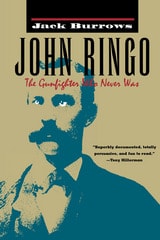
John Ringo
The Gunfighter Who Never WasJack Burrows
University of Arizona Press, 1987
John Robert Shaw
An Autobiography of Thirty Years, 1777–1807Oressa M. Teagarden
Ohio University Press, 1992
In the summer of 1807 more than a thousand subscribers from New England to Tennessee paid for the initial printing of The Life and Travels of John Robert Shaw: A Narrative of the Life and Travels of the Well-Digger, now resident of Lexington, Kentucky, Written by Himself. Shaw had come to Rhode Island as a British redcoat to put down the colonial rebellion. Through various quirks of fate, including being taken a prisoner of war, he ended up fighting with the Americans. Shaw was an exuberant spirit whose rowdy drinking bouts and related predicaments alternated with periods of wholehearted efforts at reform. His autobiography, written while he recuperated from injuries from one of several explosions (an occupational hazard for the frontier well-digger), is an articulate and entertaining record of the Revolutionary War era.
A 1930 printing of Shaw’s autobiography was rescued from the trash by an alert librarian in Kentucky in 1950. She passed the tattered copy on to journalist Oressa M. Teagarden, who became intrigued with Shaw’s story and spent much of her free time over the next two decades finding out more about the ebullient American. On Teagarden’s death, co-editor Jeanne Crabtree assumed the task of making Shaw’s authentic and colorful view of early America available to a new generation of readers.
John Sayles
David R. Shumway
University of Illinois Press, 2012
John Spring's Arizona
A. M. Gustafson
University of Arizona Press, 1966
John Spring first saw Arizona from an encampment on the west side of the Colorado River at "a small town called Yuma . . . then called Arizona City . . . it did a thriving fandango and saloon business during the period of continual going and coming of troops and teamsters." Southern Arizona, as Spring first saw and described it, was "a country where every highway, every path, every hamlet, and nearly every rancho could tell (had they the gift of speech) of devilish deeds, of crafty ambuscade, murdered settlers and travellers."
Supported by knowledge of several languages and wide reading, John Spring was able to extend his reporting to geographical and botanical description, to detailed reports of agriculture in the Santa Cruz Valley, and mercantile activity in Tucson. But he returned always to people--an irresistible center of interest for John Spring.
The lively and authentic serial reports of John Spring to the National Tribune in Washington, D.C., have been assembled and edited in this volume by A. M. Gustafson.
John Steinbeck - American Writers 94
University of Minnesota Pamphlets on American WritersJames Gray
University of Minnesota Press, 1971
John Steinbeck - American Writers 94 was first published in 1971. Minnesota Archive Editions uses digital technology to make long-unavailable books once again accessible, and are published unaltered from the original University of Minnesota Press editions.

John Tracey Ellis
An American Church ReformerThomas J. Shelley
Catholic University of America Press, 2023
John Updike - American Writers 79
University of Minnesota Pamphlets on American WritersCharles Thomas Samuels
University of Minnesota Press, 1969
John Updike - American Writers 79 was first published in 1969. Minnesota Archive Editions uses digital technology to make long-unavailable books once again accessible, and are published unaltered from the original University of Minnesota Press editions.

John Venn
A Life in LogicLukas M. Verburgt
University of Chicago Press, 2022
John Venn (1834–1923) is remembered today as the inventor of the famous Venn diagram. The postmortem fame of the diagram has until now eclipsed Venn’s own status as one of the most accomplished logicians of his day. Praised by John Stuart Mill as a “highly successful thinker” with much “power of original thought,” Venn had a profound influence on nineteenth-century scientists and philosophers, ranging from Mill and Francis Galton to Lewis Carroll and Charles Sanders Peirce. Venn was heir to a clerical Evangelical dynasty, but religious doubts led him to resign Holy Orders and instead focus on an academic career. He wrote influential textbooks on probability theory and logic, became a fellow of the Royal Society, and advocated alongside Henry Sidgwick for educational reform, including that of women’s higher education. Moreover, through his students, a direct line can be traced from Venn to the early analytic philosophy of G. E. Moore and Bertrand Russell, and family ties connect him to the famous Bloomsbury group.
This essential book takes readers on Venn’s journey from Evangelical son to Cambridge don to explore his life and work in context. Drawing on Venn’s key writings and correspondence, published and unpublished, Lukas M. Verburgt unearths the legacy of the logician’s wide-ranging thinking while offering perspective on broader themes in religion, science, and the university in Victorian Britain. The rich picture that emerges of Venn, the person, is of a man with many sympathies—sometimes mutually reinforcing and at other times outwardly and inwardly contradictory.
John Wesley North and the Reform Frontier
Merlin Stonehouse
University of Minnesota Press, 1965
John Wesley North and the Reform Frontier was first published in 1965. Minnesota Archive Editions uses digital technology to make long-unavailable books once again accessible, and are published unaltered from the original University of Minnesota Press editions.
This biography is the absorbing and significant story of a frontier life in America in the nineteenth century. John Wesley North was a carpetbagger in the best sense of the word, and professor Stonehouse points out that no fallacy is more persistent in American history than the generalization that carpetbaggers were evil opportunists peculiar to the southward movement after the Civil War. North's aims, ambitions, and ideas were typical of many carpetbaggers whose common aspiration was the evangelical humanism that flourished in all of the English-speaking world at that time except in the slave-holding South.
Born in upstate New York in 1815, North migrated westward. For the rest of his life he pursued business and political interests with equal zest and championed many social causes. He went to Minnesota, Nevada, and California without enough money to live on, yet contributed significantly to their early history. He was a founder of Minneapolis, proprietor of Fairbault and Northfield, a founder of the University of Minnesota and of the Republican party in Minnesota, and a leader in the state's constitutional convention. In Nevada he helped shape land policy and mining law and found its cities and was president of the 1863 constitutional convention. He helped develop Southern California, where he established Oleander and Riverside. These three states welcomed him as a penniless dreamer, and he added much to the development of each. But in Tennessee, where he arrived with a fortune, eager to help rebuild the war-torn state, his best efforts resulted only in recrimination and his financial ruin. Thus North's life illustrates the sorry truth of General Sherman's comment that the carpetbaggers built the West but were not permitted to build the South.
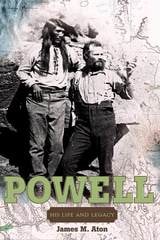
John Wesley Powell
His Life and LegacyJames M Aton
University of Utah Press, 2010
“John Wesley Powell: explorer, writer, geologist, anthropologist, land planner, bureaucrat. Which one do we focus on?” This is the question author James M. Aton poses at the beginning of his biography of Powell, though he soon decides that it is impossible to ignore any facet of Powell’s life. Powell was a polymath, one whose “divergent interests resemble one of those braided streambeds in his beloved canyon country, branching out in many directions, but ultimately beginning and ending in the same stream."
Aton beautifully tells the multidimensional stories of Powell’s childhood, his military and teaching careers, his famous and exciting explorations of the Colorado River, and the battles he waged from his influential positions within the Smithsonian’s Bureau of Ethnology and the United States Geological Survey. This new edition of John Wesley Powell: His Life and Legacy, first printed as an issue of the Boise State University Western Writers Series, includes the original biography, but also features Aton’s new interpretations of Powell’s writings on exploration, land-planning, anthropology, and irrigation, and incorporates the author’s distinguished faculty lecture on Powell and cash-register dams in the Colorado River Basin.
John Williams Walker
A Study in the Political, Social, and Cultural Life of the Old SouthwestHugh C. Bailey
University of Alabama Press, 1964
A biography of Alabama’s first Senator, this book is also the fascinating story of Southern frontier life as portrayed in contemporary letters and documents. When Madison County, Alabama, was still wilderness, Walker trekked across the mountains from Georgia with his bride, Matilda Pope, his slaves, and all his household possessions, to build a plantation near Huntsville. Here he began his extraordinary political career: member of the first territorial legislature; speaker of the house in the second; U.S. territorial judge; president of Alabama’s Constitutional Convention; and when statehood was won, first U.S. Senator.

John Xántus
The Fort Tejon Letters, 1857–1859Ann Zwinger
University of Arizona Press, 1986
John and Sebastian Cabot
The Discovery of North AmericaCharles Raymond Beazley
Westholme Publishing, 2015
John Cabot, Giovanni Caboto in his native Italian, led an expedition to the New World in 1497 on behalf of King Henry VII of England. He is considered the first European to explore North America since the Viking voyages five hundred years earlier. Although Cabot’s exact landfall on his first voyage is not known—it could have been Nova Scotia, Newfoundland, or even Maine—his claim for England to this territory countered the Spanish and Portuguese explorations to the south, and changed world history. Cabot made three roundtrips between Bristol, England, and North America, and later, his son Sebastian, made two similar voyages. John and Sebastian Cabot: The Discovery of North America by historian Sir Charles Raymond Beazley was first published in 1898. Its enduring value in addition to its lucid, well-balanced and researched narrative is the author’s detailed history of prior voyages to the North American continent, including those from China and the Pacific Islands as well as those from the realms of mythology. The author also includes all extant references to the Cabots in historical documents.
John of the Mountains
The Unpublished Journals of John MuirEdited by Linnie Marsh Wolfe
University of Wisconsin Press, 1979
The sixty extant journals and numerous notes in this volume were written from 1867 to 1911. They start seven years after the time covered in The Story of My Boyhood and Youth, Muir’s uncompleted autobiography. The earlier journals capture the essence of the Sierra Nevada and Alaska landscapes. The changing appearance of the Sierras from Sequoia north and beyond the Yosemites enthralled Muir, and the first four years of the journals reveal his dominating concern with glacial action. The later notebooks reflect his changes over the years, showing a mellowing of spirit and a deep concern for human rights.
Like all his writings, the journals concentrate on his observations in the wilderness. His devotion to his family, his many warm friendships, and his many-sided public life are hardly mentioned. Very little is said about the quarter-century battle for national parks and forest reserves. The notebooks record, in language fuller and freer than his more formal writings, the depth of his love and transcendental feeling for the wilderness. The rich heritage of his native Scotland and the unconscious music of the poetry of Burns, Milton, and the King James Bible permeate the language of his poetic fancy.
In his later life, Muir attempted to sort out these journals and, at the request of friends, published a few extracts. A year after his death in 1914, his literary executor and biographer, William Frederick Badè, also published episodes from the journals. Linnie Marsh Wolfe set out to salvage the best of his writings still left unpublished in 1938 and has thus added to our understanding of the life and thought of a complex and fascinating American figure.
Joining Africa
From Anthills to AsmaraCharles Cantalupo
Michigan State University Press, 2012
This eye-opening personal history tells the story of an American college professor’s twenty-year engagement with a thriving Africa rarely encountered by Western visitors, including an extraordinary connection to poets across the continent. At once adventurous, spiritual, political, dreamlike, and humorous, Joining Africa is a unique documentary of a journey through the continent, including an intense five-year encounter with economically struggling but culturally fertile Eritrea. The Africa presented here is neither a postcolonial study nor an exotic tourist destination. It is rich with the voices of its people, whose languages, Cantalupo argues, have greater potential to effect change than any NGO or high-profile celebrity. In vibrant prose, Cantalupo’s book extends a stirring invitation to reevaluate how we engage—both individually and collectively—with this remarkable part of the world.
Jonathan Edwards - American Writers 97
University of Minnesota Pamphlets on American WritersEdward M. Griffin
University of Minnesota Press, 1971
Jonathan Edwards - American Writers 97 was first published in 1971. Minnesota Archive Editions uses digital technology to make long-unavailable books once again accessible, and are published unaltered from the original University of Minnesota Press editions.

Jonathan Edwards and the Gospel of Love
Ronald Story
University of Massachusetts Press, 2012
Jonathan Edwards has long epitomized the Puritan preacher as fiery scold, fixated on the inner struggle of the soul and the eternal flames of hell. In this book, Ronald Story offers a fundamentally different view of Edwards, revealing a profoundly social minister who preached a gospel of charity and community bound by love.
The first chapters trace Edwards's life and impact, examine his reputation as an intellectual, Calvinist, and revivalist, and highlight the importance for him of the gentler, more compassionate concepts of light, harmony, beauty, and sweetness. Story then explains what Edwards means by the “Gospel of Love”—a Christian faith that is less individual than interpersonal, and whose central feature is the practice of charity to the poor and the quest for loving community in this world, the chief signs of true salvation. As Edwards preached in his sermon “Heaven Is a World of Love,” the afterlife itself is social in nature because love is social.
Drawing on Edwards's own sermons and notebooks, Story reveals the minister's belief that divine love expressed in the human family should take us beyond tribalism, sectarianism, provincialism, and nationality. Edwards offers hope, in the manner of Walter Rauschenbusch, Karl Barth, Martin Luther King Jr., and other great “improvers,” for the coming of a world without want and war. Gracefully and compellingly written, this book represents a new departure in Edwards studies, revising the long-standing yet misleading stereotype of a man whose lessons of charity, community, and love we need now more than ever.
Jonathan Fisher of Blue Hill, Maine
Commerce, Culture, and Community on the Eastern FrontierKevin D. Murphy
University of Massachusetts Press, 2010
Murphy shows how Fisher, as pastor of the Congregational church in Blue Hill from 1796 to 1837, helped spearhead the transformation of a frontier settlement on the eastern shores of the Penobscot Bay into a thriving port community; how he used his skills as an architect, decorative painter, surveyor, and furniture maker not only to support himself and his family, but to promote the economic growth of his village; and how the fluid professional identity that enabled Fisher to prosper on the eastern frontier could only have existed in early America where economic relations were far less rigidly defined than in Europe.
Among the most important artifacts of Jonathan Fisher's life is the house he designed and built in Blue Hill. The Jonathan Fisher Memorial, as it is now known, serves as a point of departure for an examination of social, religious, and cultural life in a newly established village at the turn of the nineteenth century. Fisher's house provided a variety of spaces for agricultural and domestic work, teaching, socializing, artmaking, and more.
Through the eyes of Jonathan Fisher, we see his family grow and face the challenges of the new century, responding to religious, social, and economic change—sometimes succeeding and sometimes failing. We appreciate how an extraordinarily energetic man was able to capitalize on the wide array of opportunities offered by the frontier to give shape to his personal vision of community.

Jonathan Odell
The Loyalist Poet of the American RevolutionCynthia Dubin Edelberg
Duke University Press, 1987
One of the best-educated of the colonialists, Odell, a physician turned Anglican minister and then writer, lived the gamut of experience: powerful friends sustained him and the British commanders-in-chief Sir William Howe, Henry Clinton, and Sir Guy Carleton employed him; nevertheless, during the war he was a lonely exile ("Tory hunters" forced him from his home in 1775), and, at the end of the war, when his hope for reconciliation between the Loyalists and the Americans came to nothing, he reluctantly emigrated to Canada.
Here is a voice, all but silenced for over two hundred years, that must now be heard if we are to better understand the American Revolution.
Jonathan Swift
Irish Blow-InEugene Hammond
University of Delaware Press, 2016
Jonathan Swift: Irish Blow-in covers the arc of the first half of Jonathan Swift’s life, offering fresh details of the contentment and exuberance of his childhood, of the support he received from his grandmother, of his striking affection for Esther Johnson from the time she was ten years old (his pet name for her in her twenties was “saucebox”), of his precocious entry into English politics with his Contests and Dissensions pamphlet, of his brilliant and much misunderstood Tale of a Tub, and of his naive determination to do well both as a vicar of the small parish of Laracor in Ireland and as a writer for the Tory administration trying to pull England out of debt by ending the war England was engaged in with France.
I do not share with past biographers the sense that Swift had a deprived childhood. I do not share the suspicion that most of Swift’s enmities were politically motivated. I do not feel critical of him because he was often fastidious with his money. I do not think he was insincere about his religious faith. His pride, his sexual interests, his often shocking or uninhibited language, his instinct for revenge – emphasized by many previous biographers – were all fundamental elements of his being, but elements that he either used for rhetorical effect, or that he tried to keep in check, and that he felt that religion helped him to keep in check. Swift had as firm a conviction as did Freud that we are born with wayward tendencies; unlike Freud, though, he saw both religion and civil society as necessary and helpful checks on those wayward tendencies, and he (frequently, but certainly not always) acknowledged that he shared those tendencies with the rest of us.
This biography, in two books, Jonathan Swift: Irish Blow-in and Jonathan Swift: Our Dean, will differ from most literary biographies in that it does not aim to show how Swift’s life illuminates his writings, but rather how and why Swift wrote in order to live the life he wanted to live. I have liberally quoted Swift’s own words in this biography because his inventive expression of ideas, both in his public works and in his private letters, was what has made him a unique and compelling figure in the history of literature. I hope in these two books to come closer than past biographies to capturing how it felt to Swift himself to live his life.
Published by University of Delaware Press. Distributed worldwide by Rutgers University Press.
Jonathan Swift
Our DeanEugene Hammond
University of Delaware Press, 2016
Jonathan Swift: Our Dean details the political climax of his remarkable career—his writing and publication of The Drapier’s Letters (1724), Gulliver’s Travels (1726), and A Modest Proposal (1729)—stressing the relentless political opposition he faced and the numerous ways, including through his sermons, that he worked from his political base as Dean of St. Patrick’s Cathedral, psychologically as well as physically just outside the Dublin city walls, to attempt to rouse the Irish people to awareness of the ways that England was abusing them.
This book faces squarely the likelihood that Swift had a physical affair with Esther Vanhomrigh between 1719 and 1723, and reassesses in the light of that likelihood his conflicting relations with Esther Vanhomrigh and Esther Johnson. It traces the many loving friendships with both men and women in Ireland that sustained Swift during the years when his health gradually failed him, enabling him to continue indefatiguably, both through his writings and his authority as Dean of St. Patrick’s, to contribute to the public welfare in the face of relentless British attempts to squeeze greater and greater profits out of their Irish colony. Finally, it traces how Swift’s political indignation led to his treating many people, friends and enemies, cruelly during the 1730s, even while his humor and his ability to make and attract new friends sustained themselves until his memory finally failed him in 1742.
This biography, in two books, Jonathan Swift: Irish Blow-in and Jonathan Swift:Our Dean, comes closer than past biographies to capturing how it felt to Swift himself to live his life.
Published by University of Delaware Press. Distributed worldwide by Rutgers University Press.

Josef Frank
Life and WorkChristopher Long
University of Chicago Press, 2002
Educated in Vienna just after the turn of the century, Frank became the leader of the younger generation of architects in Austria after the First World War. But Frank fell from grace when he emerged as a forceful critic of the extremes of modern architecture and design during the early 1930s. Dismissing the demands for a unified modern style, Frank insisted that it was pluralism, not uniformity, that most characterized life in the new machine age. He called instead for a more humane modernism, one that responded to people's everyday needs and left room for sentimentality and historical influences. He was able to put these ideas into practice when, in 1933, he was forced to leave Vienna for Sweden. There his work came to define Swedish (or Scandinavian) modern design. For more than thirty years he was the chief designer for the Stockholm furnishings firm Svenskt Tenn, producing colorful, cozy, and eclectic designs that provided a refreshing alternative to the architectural mainstream of the day and presaged the coming revolt against modernism in the 1960s.
In this sensitive study of one of the twentieth century's seminal architects and thinkers, Christopher Long offers new insight into Josef Frank's work and ideas and provides an important contribution to the understanding of modernist culture and its history.

Josef Guttmann
The Fates of Central Europe Between Hitler and Stalin: Selected WritingEdited by Jacques Rupnik
Karolinum Press, 2026
Two lives, two names, two perspectives on Soviet communism and its postwar expansion into Eastern Europe.
In the 1930s, Guttmann was a leader of the Communist Party of Czechoslovakia before he broke with the party over the Comintern's strategy of helping Hitler to power. A harsh critic of Stalin's dictatorship and foreign policy, Guttmann became a prominent leftist opponent, outcast by the Party. To escape nazism, he exiled and settled in New York, where he worked under a pseudonym as a leading expert on events in the Soviet bloc and a critic of totalitarianism. Featured in this book are his Czech texts from the 1930s as well as studies and essays he later wrote on the nature of communist regimes, genocide, and anti-Semitism.
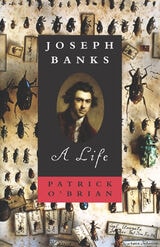
Joseph Banks
A LifePatrick O'Brian
University of Chicago Press, 1997
"It is in his description of that arduous three-year voyage [on the ship Endeavor] that Mr. O'Brian is at his most brilliant. . . . He makes us understand what life within this wooden world was like, with its 94 male souls, two dogs, a cat and a goat."—Linda Colley, New York Times
"An absorbing, finely written overview, meant for the general reader, of a major figure in the history of natural science."—Frank Stewart, Los Angeles Times
"[This book is] the definitive biography of an extraordinary subject."—Robert Taylor, Boston Globe
"His skill at narrative and his extensive knowledge of the maritime history . . . give him a definite leg up in telling this . . . story."—Tom Clark, San Francisco Chronicle

Joseph Carter Corbin
Educator Extraordinaire and Founder of the University of Arkansas at Pine BluffGladys Turner Finney
Butler Center for Arkansas Studies, 2017
Having operated now for more than 140 years, the University of Arkansas at Pine Bluff (UAPB) was founded in 1875 as Branch Normal College by Joseph Carter Corbin, a native of Ohio and the son of former slaves. Corbin, who had a classical education, was the first African American superintendent of public education in Arkansas and literally built the school from the ground up. There was a desperate need for teachers in Arkansas, as there was a great desire for education by former slaves who had been prohibited from learning to read and write.
Corbin himself cleared the land that would soon house the college and then set about to create a school that would produce the first African American teachers following the Reconstruction years. For almost three decades, he worked tirelessly on behalf of Arkansas’s black community to meet the need for educators.
In the early days, Corbin worked both as the president and the janitor so that he could control costs and keep the school going. He often waived matriculation fees and other expenses to allow impoverished students the opportunity to graduate and become qualified to teach throughout Arkansas.
Although he might not have realized it at the time, Corbin was a member of the so-called aristocrats of color, the African American elite of national prominence and a group that included such luminaries as Booker T. Washington. Corbin was a true giant in the history of education in Arkansas. His story, told by a former UAPB student, is monumental for the scope of what one man was able to accomplish.

Joseph Conrad
Martin Ray
University of Iowa Press, 1990

Joseph Fielding Smith
A Mormon TheologianMatthew Bowman
University of Illinois Press, 2024
Incisive and illuminating, Joseph Fielding Smith examines the worldview and development of an influential theologian and his place in American religious and intellectual history.