Results by title
8812 books match the query 'Political Science' and 176 start with j
Journal of Political Economy, volume 132 number 5 (May 2024)
The University of Chicago Press
University of Chicago Press Journals, 2024
Journal of Political Economy, volume 132 number 6 (June 2024)
The University of Chicago Press
University of Chicago Press Journals, 2024
Journal of Political Economy, volume 132 number 7 (July 2024)
The University of Chicago Press
University of Chicago Press Journals, 2024
Journal of Political Economy, volume 132 number 8 (August 2024)
The University of Chicago Press
University of Chicago Press Journals, 2024
Journal of Political Economy, volume 132 number 9 (September 2024)
The University of Chicago Press
University of Chicago Press Journals, 2024
Journal of Political Economy, volume 133 number 1 (January 2025)
The University of Chicago Press
University of Chicago Press Journals, 2025
Journal of Political Economy, volume 133 number 10 (October 2025)
The University of Chicago Press
University of Chicago Press Journals, 2025
Journal of Political Economy, volume 133 number 11 (November 2025)
The University of Chicago Press
University of Chicago Press Journals, 2025
Journal of Political Economy, volume 133 number 12 (December 2025)
The University of Chicago Press
University of Chicago Press Journals, 2025
Journal of Political Economy, volume 133 number 2 (February 2025)
The University of Chicago Press
University of Chicago Press Journals, 2025
Journal of Political Economy, volume 133 number 3 (March 2025)
The University of Chicago Press
University of Chicago Press Journals, 2025
Journal of Political Economy, volume 133 number 4 (April 2025)
The University of Chicago Press
University of Chicago Press Journals, 2025
Journal of Political Economy, volume 133 number 5 (May 2025)
The University of Chicago Press
University of Chicago Press Journals, 2025
Journal of Political Economy, volume 133 number 6 (June 2025)
The University of Chicago Press
University of Chicago Press Journals, 2025
Journal of Political Economy, volume 133 number 8 (August 2025)
The University of Chicago Press
University of Chicago Press Journals, 2025
Journal of Political Economy, volume 133 number 9 (September 2025)
The University of Chicago Press
University of Chicago Press Journals, 2025
Journal of Political Economy, volume 134 number 1 (January 2026)
The University of Chicago Press
University of Chicago Press Journals, 2026
Journal of Political Economy, volume 134 number 10 (October 2026)
The University of Chicago Press
University of Chicago Press Journals, 2026
Journal of Political Economy, volume 134 number 2 (February 2026)
The University of Chicago Press
University of Chicago Press Journals, 2026
Journal of Political Economy, volume 134 number 3 (March 2026)
The University of Chicago Press
University of Chicago Press Journals, 2026
Journal of Political Economy, volume 134 number 4 (April 2026)
The University of Chicago Press
University of Chicago Press Journals, 2026
Journal of Political Economy, volume 134 number 5 (May 2026)
The University of Chicago Press
University of Chicago Press Journals, 2026
Journal of Political Economy, volume 134 number 6 (June 2026)
The University of Chicago Press
University of Chicago Press Journals, 2026
Journal of Political Economy, volume 134 number 7 (July 2026)
The University of Chicago Press
University of Chicago Press Journals, 2026
Journal of Political Economy, volume 134 number 8 (August 2026)
The University of Chicago Press
University of Chicago Press Journals, 2026
Journal of Political Economy, volume 134 number 9 (September 2026)
The University of Chicago Press
University of Chicago Press Journals, 2026

Journal of Practical Ethics, Vol. 11, No. 1
Liz Sanders
Michigan Publishing Services, 2023
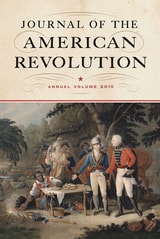
Journal of the American Revolution 2015
Annual VolumeTodd Andrlik
Westholme Publishing, 2015
The Journal of the American Revolution, Annual Volume 2015, presents the journal’s best historical research and writing over the past calendar year. The volume is designed for institutions, scholars, and enthusiasts to provide a convenient overview of the latest research and scholarship in American Revolution studies. The sixty articles in the 2015 edition include:
How Samuel Adams Recruited Sons of Liberty by J. L. Bell
A Patriot–Loyalist: Playing Both Sides by Todd W. Braisted
How Old Were Redcoats? Age and Experience of British Soldiers in America by Don N. Hagist
The Great West Point Chain by Hugh T. Harrington
Raid Across the Ice: The British Operation to Capture Washington by Benjamin Huggins
So Heavy a Trial: The Burning of New York’s First Capital by Jack Kelly
An Elegant Dinner with General Washington at Valley Forge Headquarters by Nancy K. Loane
Mount Vernon: A Landscape for the New Cincinnatus by Joseph Manca
The British Spy Plot to Capture Fort Ticonderoga by John A. Nagy
The Top Ten British Losers by Andrew O’Shaughnessy
Honorable Lords and Pretend Barons: Sorting Out the Noblemen of the American Revolution by Jim Piecuch
Paul Revere’s Other Riders and Rides by Ray Raphael
William Lee and Oney Judge: A Look at George Washington and Slavery by Mary V. Thompson.
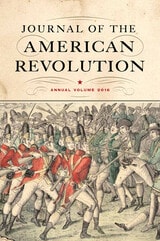
Journal of the American Revolution 2016
Annual VolumeTodd Andrlik
Westholme Publishing, 2016
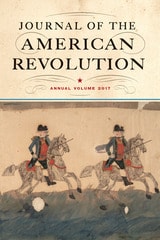
Journal of the American Revolution 2017
Annual VolumeTodd Andrlik
Westholme Publishing, 2017
The forty-six articles in the 2017 edition include:
Why the British Lost the Battle of Sullivan’s Island by C. L. Bragg
The Tiger Aids the Eaglet: How India Secured America’s Independence by Richard Sambasivam
How Yorktown Almost Couldn’t Afford to Happen by John Smith
Was Richard Stockton a Hero? by Christian M. McBurney
The Southern Expedition of 1776: The American Revolution’s Best Kept Secret by Roger Smith
Religious Liberty and Its Virginia Roots by Alex Colvin
Mount Vernon During the American Revolution by Mary V. Thompson
Why God is in the Declaration but not the Constitution by Anthony J. Minna
Colonel Tench Tilghman: George Washington’s Eyes and Ears by Jeff Dacus
The Stockbridge-Mohican Community, 1775–1783 by Bryan Rindfleisch
Two Years Aboard the Welcome: The American Revolution on Lake Huron by Tyler Rudd Putman
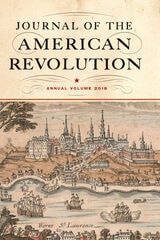
Journal of the American Revolution 2018
Annual VolumeDon N. Hagist
Westholme Publishing, 2018
The Journal of the American Revolution, Annual Volume 2018, presents the journal’s best historical research and writing over the past calendar year. The volume is designed for institutions, scholars, and enthusiasts to provide a convenient overview of the latest research and scholarship in American Revolution studies. The forty-one articles in the 2018 edition include:
Anti-Indian Radicalization in the Early American West, 1774–1795 by Darren R. Reid
The Setauket Raid, December 1777 by Phillip R. Giffin
The 3rd New Jersey Regiment’s Plundering of Johnson Hall by Philip D. Weaver
A Proposed Alliance of the Knights of Malta and the United States of America by Bruce Ware Allen
Country Crowds in Revolutionary Massachusetts: Mobs and Militia by Ray Raphael
Lafayette: An Acerbic Tongue or an Incisive Judge of Character? by Gene Procknow
Admiral Rodney Ousts the Jews from St. Eustatius by Louis Arthur Norton
Preventing Slave Insurrection in South Carolina & Georgia, 1775–1776 by Jim Piecuch
The “P” is for Profit: Revolutionary War Privateers and the Slave Trade by Michael Thomin
The Remarkable Spanish Pilgrimage of John Adams by John L. Smith, Jr.
Thomas Paine, Deism, and the Masonic Fraternity by Shai Afsai
A Fresh Look at Major Patrick Ferguson by Wayne Lynch
Displaced: The Donation People of 1775 by Katie Turner Getty
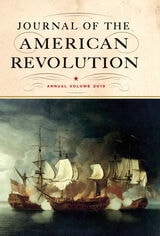
Journal of the American Revolution 2019
Annual VolumeDon N. Hagist
Westholme Publishing, 2019
The Journal of the American Revolution, Annual Volume 2019, presents the journal’s best historical research and writing over the past calendar year. The volume is designed for institutions, scholars, and enthusiasts to provide a convenient overview of the latest research and scholarship in American Revolution and Founding Era studies. The thirty-eight articles in the 2019 edition include:
Join, or Die: Political and Religious Controversy Over Franklin’s Snake Cartoon by Daniel P. Stone
The Connecticut Captivity of William Franklin, Loyalist by Louis Arthur Norton
Revisiting the Prayer at Valley Forge by Blake McGready
John the Painter: Terrorist for America by Lars Hedbor
Who Picked the Committees at the Constitutional Convention? by David O. Stewart
Norfolk, Virginia, Sacked by North Carolina and Virginia Troops by Patrick H. Hannum
Elias Hasket Derby: The Privateer Who Pioneered the Russian Trade by Nick Deluca
Benedict Arnold’s Master Plan (for British) Victory by John Knight
China and the American Revolution by Simon Hill
Moravians in the Middle: The Gnadenhutten Massacre by Eric Sterner
Slavery Through the Eyes of Revolutionary Generals by Gene Procknow
Our Man in Minorca: Lewis Littlepage, American Volunteer with the Spanish Armed Forces by Larrie D. Ferreiro
Patrick Tonyn: Britain’s Most Effective Revolutionary-Era Royal Governor by Jim Piecuch
Jefferson’s Reckoning: The Sage of Monticello’s Haunting Final Years by Geoff Smock
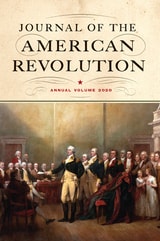
Journal of the American Revolution 2020
Annual VolumeDon N. Hagist
Westholme Publishing, 2020
The Journal of the American Revolution, Annual Volume 2020, presents the journal’s best historical research and writing over the past calendar year. The volume is designed for institutions, scholars, and enthusiasts to provide a convenient overview of the latest research and scholarship in American Revolution and Founding Era studies. The thirty-six articles in the 2020 edition include:
Bernard E. Griffiths: Trumpeter Barney of the Queen’s Rangers, Chelsea Pensioner—and Freed Slave by Todd W. Braisted
The Declaration of Independence: Did John Hancock Really Say that about his Signature?—and Other Signing Stories by J. L. Bell
Les Habitants: Collaboration and Pro-American Violence in Canada, 1774–1776 by Sebastian van Bastelaer
Misadventures in the Countryside: Escape from a British Prison Ship by Katie Turner Getty
The Revolutionary Memories of New York Loyalists: Thomas Jones and William Smith, Jr. by Cho-Chien Feng
The East India Company and Parliament’s “Fateful Decision” of 1767 by Steven Neill
Massachusetts Privateers During the Siege of Boston by Alexander Cain
The Constitution Counted Free Women and Children—And It Mattered by Andrew M. Schocket, with Kinzey M. McLaren-Czerr and Colin J. Spicer
How Magna Carta Influenced the American Revolution by Jason Yonce
Putting a Price on Loyalty: Mary Loring’s List of Losses by John Knight
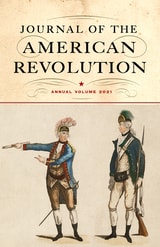
Journal of the American Revolution 2021
Annual VolumeDon N. Hagist
Westholme Publishing, 2021
The Journal of the American Revolution, Annual Volume 2021, presents the journal’s best historical research and writing over the past calendar year. The volume is designed for institutions, scholars, and enthusiasts to provide a convenient overview of the latest research and scholarship in American Revolution and Founding Era studies. The thirty-four articles in the 2021 edition include:
Alexander Hamilton’s Missing Years: New Discoveries and Insights into the Little Lion’s Caribbean Childhood by Ruud Stelten and Alexandre Hinton
The Lenape Origins of an Independent America: The Catalyst of Pontiac’s War, 1763–1765 by Kevin A. Conn
Impeachment: The Framers Debate and Discuss by Ray Raphael
The First Efforts to Limit the African Slave Trade by Christian M. McBurney
What Killed Prisoners of War?—A Medical Investigation by Brian Patrick O'Malley
The Mysterious March of Horatio Gates by Andrew Waters
Minorcans, New Smyrna, and the American Revolution in East Florida by George Kotlik
Stony Point: The Second Occupation, July–October 1779 by Michael J. F. Sheehan
A Demographic View of North Carolina Militia and State Troops, 1775–1783 by Douglas R. Dorney, Jr.
The Revolutionary War Origin of the Whistleblower Law by Louis Arthur Norton
Mapping the Battle of Eutaw Springs: Modern GIS Solves a Historic Mystery by Stephen John Katzberg
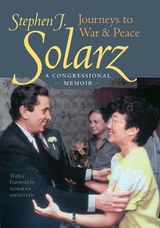
Journeys to War and Peace
A Congressional MemoirStephen J. Solarz
Brandeis University Press, 2011

Judging Children As Children
A Proposal for a Juvenile Justice SystemMichael A. Corriero
Temple University Press, 2007

Judging Credentials
Nonlawyer Judges and the Politics of ProfessionalismDoris Marie Provine
University of Chicago Press, 1986
Provine presents a persuasive argument that the case against nonlawyer judges has been weighted in favor of the professional interests of lawyers, not public concerns. Her examination reveals as much about the presuppositions of legal professionals as it does about the competency of nonlawyer judges to old judicial office. To substantiate her claims, Provine has conducted the most comprehensive survey of nonlawyer and lawyer judges yet undertaken, augmenting this material with court observations and extensive interviews of judges. She integrates the results of this survey into the historical context of the lay versus lawyer judge debate, showing how the legally trained judge came to predominate in the American judicial system and analyzing in detail the campaign both in and out of the courts to make legal training a prerequisite for being a judge. Ultimately, Provine suggests, Americans are too committed to the significance of credentials and to the legal profession's vision of the judicial process to respond very favorably to nonlawyer judges, however well they might perform.
Judging Credentials will force lawyers, judges, scholars, and the public to reconsider the role nonlawyer judges play in the American judicial system. Provine's provocative views and exhaustive research adds new dimensions to our understanding of the ethics of professionalism and its consequences.
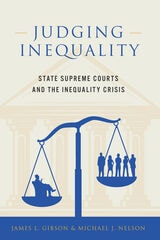
Judging Inequality
State Supreme Courts and the Inequality CrisisJames L. Gibson
Russell Sage Foundation, 2021
Drawing on an analysis of an original database of nearly 6,000 decisions made by over 900 judges on 50 state supreme courts over a quarter century, Judging Inequality documents two ways that state high courts have crafted policies relevant to inequality: through substantive policy decisions that fail to advance equality and by rulings favoring more privileged litigants (typically known as “upperdogs”). The authors discover that whether court-sanctioned policies lead to greater or lesser inequality depends on the ideologies of the justices serving on these high benches, the policy preferences of their constituents (the people of their state), and the institutional structures that determine who becomes a judge as well as who decides whether those individuals remain in office.
Gibson and Nelson decisively reject the conventional theory that state supreme courts tend to protect underdog litigants from the wrath of majorities. Instead, the authors demonstrate that the ideological compositions of state supreme courts most often mirror the dominant political coalition in their state at a given point in time. As a result, state supreme courts are unlikely to stand as an independent force against the rise of inequality in the United States, instead making decisions compatible with the preferences of political elites already in power. At least at the state high court level, the myth of judicial independence truly is a myth.
Judging Inequality offers a comprehensive examination of the powerful role that state supreme courts play in shaping public policies pertinent to inequality. This volume is a landmark contribution to scholarly work on the intersection of American jurisprudence and inequality, one that essentially rewrites the “conventional wisdom” on the role of courts in America’s democracy.
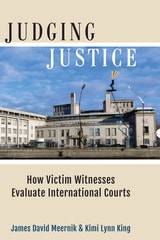
Judging Justice
How Victim Witnesses Evaluate International CourtsJames David Meernik and Kimi Lynn King
University of Michigan Press, 2019
In order to understand the meaning of justice, James David Meernik and Kimi Lynn King studied the perspective of witnesses who have testified before the International Criminal Tribunal for the Former Yugoslavia (ICTY). Using a unique survey, Meernik and King look at the identity of the victims and their perception of the fairness of ICTY. Because of the need to justify the practical and emotional difficulties involved in testifying before an international tribunal, witnesses look not just to the institution to judge its effectiveness, but also to their own contribution, by testifying effectively. The central elements of the theory Meernik and King develop—identity, fairness, and experience—transcend specific conflicts and specific countries and are of importance to people everywhere.

Judicial Institutions in Nineteenth-Century Latin America
Edited by Eduardo Zimmermann
University of London Press, 1999
Judicial Merit Selection
Institutional Design and Performance for State CourtsGreg Goelzhauser
Temple University Press, 2019
The judicial selection debate continues. Merit selection is used by a majority of states but remains the least well understood method for choosing judges. Proponents claim that it emphasizes qualifications and diversity over politics, but there is little empirical evidence regarding its performance.
In Judicial Merit Selection, Greg Goelzhauser amasses a wealth of data to examine merit selection’s institutional performance from an internal perspective. While his previous book, Choosing State Supreme Court Justices, compares outcomes across selection mechanisms, here he delves into what makes merit selection unique—its use of nominating commissions to winnow applicants prior to gubernatorial appointment.
Goelzhauser’s analyses include a rich case study from inside a nominating commission’s proceedings as it works to choose nominees; the use of public records to examine which applicants commissions choose and which nominees governors choose; evaluation of which attorneys apply for consideration and which judges apply for promotion; and examination of whether design differences across systems impact performance in the seating of qualified and diverse judges.
The results have critical public policy implications.
Judicial Politics in Polarized Times
Thomas M. Keck
University of Chicago Press, 2014
Drawing on a sweeping survey of litigation on abortion, affirmative action, gay rights, and gun rights across the Clinton, Bush, and Obama eras, Thomas M. Keck argues that, while each of these stories captures part of the significance of judicial politics in polarized times, each is also misleading. Despite judges’ claims, actual legal decisions are not the politically neutral products of disembodied legal texts. But neither are judges “tyrants in robes,” undermining democratic values by imposing their own preferences. Just as often, judges and the public seem to be pushing in the same direction. As for the argument that the courts are powerless institutions, Keck shows that their decisions have profound political effects. And, while advocates on both the left and right engage constantly in litigation to achieve their ends, neither side has consistently won. Ultimately, Keck argues, judges respond not simply as umpires, activists, or political actors, but in light of distinctive judicial values and practices.

Judicial Review in Mexico
A Study of the Amparo SuitBy Richard D. Baker
University of Texas Press, 1971
The amparo suit is a Mexican legal institution similar in its effects to such Anglo-American procedures as habeas corpus, error, and the various forms of injunctive relief. It has undergone a long evolution since it was incorporated into the Constitution of 1857. Today, its principal purpose is to protect private individuals in the enjoyment of the rights guaranteed by the first twenty-nine articles of the Constitution.
Mexico after its independence produced many constitutions. One of the earliest problems was to find an adequate means of defending the Constitution against ill-founded interpretations of its precepts. Like the United States, Mexico has developed a system of constitutional defense in which the judiciary is the supreme interpreter of what this document means. Unlike the United States Supreme Court, however, the Mexican Supreme Court has not been innovative in its decisions or contradicted the administration on major policy decisions. This difference must be attributed to the civil law system of Mexico as well as to the political climate.
The first part of Richard D. Baker’s book describes the historical background of amparo and other methods of constitutional defense in Mexico. The three men most closely associated with creating a judicial form of constitutional defense in Mexico were Manuel Crescencio Rejón, José Fernando Ramírez, and Mariano Otero. Their own writings indicate that the immediate source of amparo must be found in the American institution of judicial review that was transmitted to Mexicans through Alexis de Tocqueville’s Democracy in America.
The second part is an exposition of the workings of the amparo suit in the twentieth century and the constitutional and statutory provisions affecting it. Since 1857, when it was incorporated into article 102 of the Constitution, the amparo suit has evolved into a highly complex institution performing three functions: the defense of the civil liberties enumerated in the first twenty-nine articles of the Constitution, the determination of the constitutionality of federal and state legislation, and cassation. The Supreme Court is primarily limited to defending civil liberties through the amparo suit; it remains less innovative and more restricted than the United States system of judicial review, especially in the effect of its judgments on political agencies.
Baker’s study is the first one in English dealing with this subject and is one of the most extensive in any language. It should be welcome as a valuable tool to all students of Mexican law, history, and political thought.
Judicial Territory
Law, Capital, and the Expansion of American EmpireShaina Potts
Duke University Press, 2024
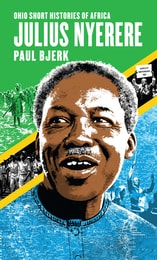
Julius Nyerere
Paul Bjerk
Ohio University Press, 2017
With vision, hard-nosed judgment, and biting humor, Julius Nyerere confronted the challenges of nation building in modern Africa. Constructing Tanzania out of a controversial Cold War union between Tanganyika and Zanzibar, Nyerere emerged as one of independent Africa’s most influential leaders. He pursued his own brand of African socialism, called Ujamaa, with unquestioned integrity, and saw it profoundly influence movements to end white minority rule in Southern Africa. Yet his efforts to build a peaceful nation created a police state, economic crisis, and a war with Idi Amin’s Uganda. Eventually—unlike most of his contemporaries—Nyerere retired voluntarily from power, paving the way for peaceful electoral transitions in Tanzania that continue today.
Based on multinational archival research, extensive reading, and interviews with Nyerere’s family and colleagues, as well as some who suffered under his rule, Paul Bjerk provides an incisive and accessible biography of this African leader of global importance. Recognizing Nyerere’s commitment to participatory government and social equality while also confronting his authoritarian turns and policy failures, Bjerk offers a portrait of principled leadership under the difficult circumstances of postcolonial Africa.
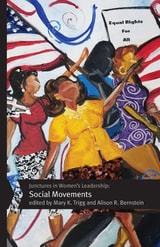
Junctures in Women's Leadership
Social MovementsTrigg, Mary K
Rutgers University Press, 2016
From Eleanor Roosevelt to feminist icon Gloria Steinem to HIV/AIDS activist Dazon Dixon Diallo, women have assumed leadership roles in struggles for social justice. How did these remarkable women ascend to positions of influence? And once in power, what leadership strategies did they use to deal with various challenges?
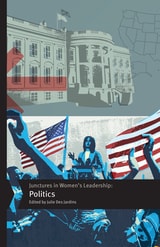
Junctures in Women’s Leadership
PoliticsJulie Des Jardins
Rutgers University Press, 2027
This collection profiles women in American politics who have demonstrated true leadership over the past 150 years—though this leadership has not always been recognized as such. These women have defied stereotypical caricatures and modeled effective ways to lead, even when they have not enjoyed formal access to voting or party politics, lost campaigns, or suffered scrutiny and harassment as public figures. Many of them have championed people and causes that their male counterparts have neglected, lending their lived experiences as women to fight for political action for underrepresented groups, and showing time and again that the personal really is political. Here we assess their political careers, not in terms of wins and losses, but rather in their ability to negotiate identity politics and shift conventional rules about how politicians lead.
This collection profiles such varied women as Jeannette Rankin, Shirley Chrisholm, Nancy Pelosi, Kamala Harris, Stacy Abrams, and Alexandria Ocasio-Cortez, among others. Whether they have recast gendered meanings around political ambition, broadened access to the political process, privileged principles over party loyalty, or prioritized issues over incumbency, each woman profiled here has wisdom to impart to new generations of American women who aspire to run for office or be involved in American politics.

Jungle Heart of the Khmer Rouge
The memoirs of Phi Phuon, Pol Pot’s Jarai aide-de-camp, and the role of Ratanakiri and its tribal minorities in the Cambodian revolutionHenri Locard
National University of Singapore Press, 2023

Jurgen Habermas
Democracy and the Public SphereLuke Goode
Pluto Press, 2005
For Habermas, the 'public sphere' was a social forum that allowed people to debate -- whether it was the town hall or the coffee house, maintaining a space for public debate was an essential part of democracy. Habermas’s controversial work examines the erosion of these spaces within consumer society and calls for new thinking about democracy today.
Drawing on Habermas’s early and more recent writings, this book examines the ‘public sphere’ in its full complexity, outlining its relevance to today’s media and culture. It will be of interest to students and scholars in a range of disciplines across the social sciences and humanities.

Jurors' Stories of Death
How America's Death Penalty Invests in InequalityBenjamin Fleury-Steiner
University of Michigan Press, 2004
-David Cole, from the Foreword
"Perhaps the most powerful, routinely enacted civic ritual in American public life is that of capital punishment. This state-sanctioned extirpation of human life in the collective pursuit of justice is a searing act of civic pedagogy, made legitimate only by the deliberative endorsement of a small group of ordinary citizens-the jury. In Jurors' Stories of Death, Benjamin Fleury-Steiner has taken a cold, hard look at how these ordinary citizens come to terms with their extraordinary role, and how they rationalize their irreversible decisions. The result is a chilling portrait of how we---that is, all of us Americans---constitute ourselves as a political community."
-Glenn Loury, Director, Institute on Race and Social Division
"This illuminating and insightful examination of jury deliberations makes a terrific contribution to the study of capital punishment. Fleury-Steiner's synthesis of sociological, legal and theoretical concepts with vivid juror narratives and statistical data, thoughtfully animates and details how race and class consciousness continue to shape America's death penalty."
---Bryan Stevenson, Professor of Clinical Law, NYU School of Law, Executive Director, Equal Justice Initiative of Alabama
Jurors' Stories of Death is more than just another book on the death penalty; it is the first systematic survey of how death penalty decisions are made.
Benjamin Fleury-Steiner draws on real-life accounts of white and black jurors in capital punishment trials to discuss the effect of race on the sentencing process. He finds that race is invariably a factor in sentencing, with jurors relying on accounts that deny the often marginalized defendants their individuality and complexity, while reinforcing the jurors' own identities as superior, moral, and law-abiding citizens-a system that punishes in the name of dominance. This biased story of "us versus them" continues to infuse political rhetoric on crime and punishment in the United States even today.
Jurors' Stories of Death concludes with an original argument for abolition of the death penalty: If America values multiculturalism and cultural diversity, it must do away with institutions such as state-sanctioned capital punishment in order to begin to free itself from the racism and classicism that so insidiously plague social relations today.