Results by title
18284 books match the query 'United States' and 274 start with j
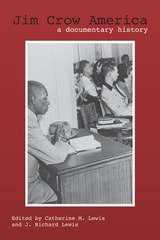
Jim Crow America
A Documentary HistoryCatherine M. Lewis
University of Arkansas Press, 2009
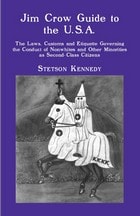
Jim Crow Guide to the U.S.A.
The Laws, Customs and Etiquette Governing the Conduct of Nonwhites and Other Minorities as Second-Class CitizensStetson Kennedy
University of Alabama Press, 2011
“A history of the United States that is almost incredible.” —Jean-Paul Sartre, Les Temps Modernes
Jim Crow Guide to the U.S.A. by Stetson Kennedy is a bold exposé of America’s institutionalized racism, originally published in 1959 and hailed as a landmark in civil rights literature. With unflinching clarity, Kennedy documents the laws, customs, and social codes that relegated nonwhite citizens to second-class status under the Jim Crow system. From the mistreatment of Native Americans to the exclusionary immigration policies targeting Asians and Africans, the book maps the presence of race-based politics across every facet of American life—housing, education, employment, and even burial.
What makes this work especially influential is its international resonance. The famed French existentialist Jean-Paul Sartre championed the book’s publication in Europe, recognizing its power to illuminate the contradictions between American democratic ideals and racial realities. Sartre’s endorsement helped position the book as a global indictment of racial injustice, aligning it with anti-colonial and human rights movements worldwide. Provocative, meticulously researched, and deeply human, Jim Crow Guide to the U.S.A. remains a vital historical document and a call to conscience. It is not merely a guide—it is a mirror held up to a nation, reflecting truths that later generations were called on to address.
Jim Crow Networks
African American Periodical CulturesEurie Dahn
University of Massachusetts Press, 2021
As Eurie Dahn demonstrates, authors like James Weldon Johnson, Nella Larsen, William Faulkner, and Jean Toomer wrote in the context of interracial and black periodical networks, which shaped the literature they produced and their concerns about racial violence. This original study also explores the overlooked intersections between the black press and modernist and Harlem Renaissance texts, and highlights key sites where readers and writers worked toward bottom-up sociopolitical changes during a period of legalized segregation.
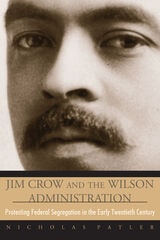
Jim Crow and the Wilson Administration
Protesting Federal Segregation in the Early Twentieth CenturyNicholas Patler
University Press of Colorado, 2007
This protest campaign, carried out on a level not seen since the abolitionist movement, galvanized a vast community of men and women. Blacks and whites, professionals and laymen, signed petitions, wrote protest letters, participated in organized mass meetings, lobbied public officials, directly confronted Wilson, made known their plight through publicity campaigns, and, in at least one case, marched to express their opposition. Patler provides a thorough examination of the two national organizations that led these protests efforts - the National Association for the Advancement of Colored People and William Monroe Trotter's National Equal Rights League - and deftly contextualizes the movement, while emphasizing the tragic, enduring consequences of the Wilson administration's actions.
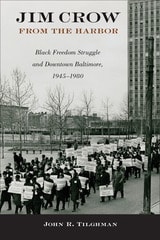
Jim Crow from the Harbor
Black Freedom Struggle and Downtown Baltimore, 1945–1980John R. Tilghman
Temple University Press, 2026
How do poor Black communities co-exist with downtown revitalization? How do Black social movements respond to urban renewal to ensure access to better housing and city spaces? John Tilghman investigates these interlocking questions in Jim Crow from the Harbor. Looking at Baltimore, Maryland’s redevelopment in the post-war era of deindustrialization and population decline through white flight, Tilghman tells the story of how Black activists clashed with urban regimes.
Tilghman follows the money—redevelopment profits—which created tensions that prompted anti-freeway campaigns and affirmative action efforts. Through grassroots activism, protests, and community building, participants in the Black Freedom Struggle undermined downtown interests’ efforts to reinforce racial segregation as well as other civil, political, and economic inequalities.
While their efforts met with both success and limitations, Tilghman emphasizes the strengths of this minority majority population as they strove for urban equality. Jim Crow from the Harbor provides a new perspective that helps explain what has provoked today’s struggles in Baltimore for Black Americans.

Job Loss, Identity, and Mental Health
Norris, Dawn R
Rutgers University Press, 2016
Job Man
My Life in Professional WrestlingChris Multerer
Wisconsin Historical Society Press, 2019
In Job Man, Multerer, along with his friend Larry Widen, shows what life was like for wrestlers outside the spotlight. Long nights on the road, thoughtful takes on some the biggest personalities in the business, and, perhaps most of all, a love for the sport, are as much a part of Multerer’s revealing and remarkable story as his time in the ring.
Job Queues, Gender Queues
Explaining Women's Inroads into Male OccupationsBarbara F. Reskin and Patricia A. Roos
Temple University Press, 1990
Since 1970, women have made widely publicized gains in several customarily male occupations. Many commentators have understood this apparent integration as an important step to sexual equality in the workplace. Barbara F. Reskin and Patricia A. Roos read a different lesson in the changing gender composition of occupations that were traditionally reserved for men. With persuasive evidence, Job Queues, Gender Queues offers a controversial interpretation of women's dramatic inroads into several male occupations based on case studies of "feminizing" male occupation.
The authors propose and develop a queuing theory of occupations' sex composition. This theory contends that the labor market comprises a "gender queue" with employers preferring male to female workers for most jobs. Workers also rank jobs into a "job queue." As a result, the highest-ranked workers monopolize the most desirable jobs. Reskin and Roos use this queuing perspective to explain why several male occupations opened their doors to women after 1970. The second part of the book provides evidence for this queuing analysis by presenting case studies of the feminization of specific occupations. These include book editor, pharmacist, public relations specialist, bank manager, systems analyst, insurance adjuster, insurance salesperson, real estate salesperson, bartender, baker, and typesetter/compositor.
Jobless Future
Sci-Tech and the Dogma of WorkStanley Aronowitz
University of Minnesota Press, 1995
Jobs Aren't Enough
Toward a New Economic Mobility for Low-Income FamiliesRoberta Rehner Iversen and Annie Laurie Armstrong
Temple University Press, 2006
Jobs and Economic Development in Minority Communities
edited by Paul Ong and Anastasia Loukaitou-Sideris
Temple University Press, 2006
Jobs for the Poor
Can Labor Demand Policies Help?Timothy J. Bartik
Russell Sage Foundation, 2001
Joe McCarthy and the Press
Edwin R. Bayley
University of Wisconsin Press, 2003
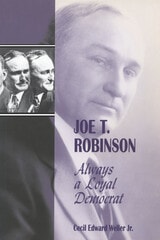
Joe T. Robinson
Always a Loyal DemocratCecil Weller
University of Arkansas Press, 1998
Senate majority leader Joseph Taylor Robinson was undoubtedly one of the most powerful U.S. senators of the early twentieth century. An important political figure in Arkansas from the time he was elected to the state legislature in 1895, Joe T., as he was popularly called became nationally prominent when he ascended to the Democratic leadership of the U.S. Senate in 1923.
Robinson’s career spanned momentous legislative debates in the chambers of the Senate, such as the League of Nations charter, the Teapot Dome Scandal, and FDR’s plan to “pack” the Supreme Court. His run for the vice-presidency in 1928, the first Southerner on a major ticket after the Civil War, and his three terms as chairman of the Democratic National Convention, in 1920, 1928, and 1936, are all covered in this perceptive study.
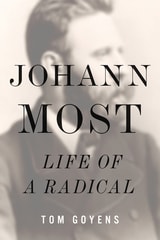
Johann Most
Life of a RadicalTom Goyens
University of Illinois Press, 2025

Johanna Beyer
Amy C. Beal
University of Illinois Press, 2015
Amy C. Beal chronicles Beyer's life from her early participation in New York's contemporary music scene through her performances at the Federal Music Project's Composers' Forum-Laboratory concerts to her unfortunate early death in 1944. This book is a portrait of a passionate and creative woman underestimated by her music community even as she tirelessly applied her gifts with compositional rigor.
The first book-length study of the composer's life and music, Johanna Beyer reclaims a uniquely innovative artist and body of work for a new generation.
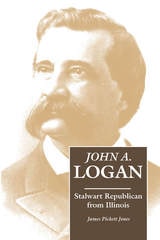
John A. Logan
Stalwart Republican from IllinoisJames Pickett Jones
Southern Illinois University Press, 2001
Not available.
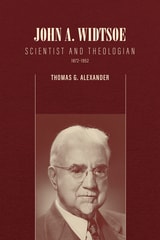
John A. Widtsoe
Scientist and Theologian, 1872-1952Alexander, Thomas G.
Signature Books, 2023
Born in Norway, John A. Widtsoe (1872–1952), was renowned for his expertise in irrigation and dry farming. His pioneering work pushed the boundaries of and contributed significantly to advancements in agricultural practices. Moreover, his forays into the field of biochemistry exemplified his relentless pursuit of scientific understanding.
Widtsoe’s journey came with challenges especially after he was called as an apostle in the Church of Jesus Christ of Latter-day Saints. As president of both Utah State Agricultural College (1907–16) and the University of Utah (1916–21), he faced controversies and obstacles head-on. Additionally, he played a significant role in overseeing the expansion of the LDS gospel in both Europe and the United States. He was highly esteemed within his church due to his ability to provide thorough and insightful explanations of various aspects of church doctrine and reconcile them with scientific truths. Throughout the early-to-mid-twentieth century, he symbolized to many members the successful integration of religious faith with secular knowledge, inspiring countless individuals to embrace both realms in harmony.
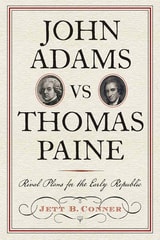
John Adams vs Thomas Paine
Rival Plans for the Early RepublicJett B. Conner
Westholme Publishing, 2018
Initially admiring Thomas Paine’s efforts for independence, John Adams nevertheless was rattled by the political philosophy of Common Sense and responded to it by publishing his Thoughts on Government to counteract Paine’s proposals, which Adams said were far too “democratical.” Although John Adams is given credit for his substantive contributions to American constitutionalism, especially his notions of separation of powers, checks and balances, and representation, in John Adams vs Thomas Paine: Rival Plans for the Early Republic, historian Jett B. Conner makes the case that Thomas Paine was more than just a revolutionary figure who spurred Americans toward declaring independence. Common Sense made important contributions to American constitutional thought, too, particularly its call for more equal representation, popular sovereignty, a constitutional convention, and a federal system of governance with a strong central government. The book explores how the two rivals helped shape America’s first constitutions—the Articles of Confederation and those of several states— and how they continued contributing to American political thought as it developed during the so-called “critical period” between the adoption of the Articles of Confederation and the start of the Constitutional Convention of 1787. It also focuses on the creation of our democratic republic and compares Paine’s and Adams’s approaches to structuring constitutions to ensure free government while guarding against abuses of power and the excesses of democratic majorities. An abridged version of Common Sense and the short but complete Thoughts on Government are included in an appendix for easy reader reference.
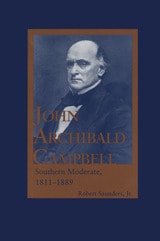
John Archibald Campbell
Southern Moderate, 1811–1889Robert Saunders Jr.
University of Alabama Press, 1997
The first full biography of the southern U.S. Supreme Court justice who championed both the U.S. Constitution and states’ rights.
The life of John Archibald Campbell reflects nearly every major development of 19th-century American history. He participated either directly or indirectly in events ranging from the Indian removal process of the 1830s, to sectionalism and the Civil War, to Reconstruction and redemption. Although not a defender of slavery, he feared that abrupt abolition would produce severe economic and social dislocation. He urged southerners to reform their labor system and to prepare for the eventual abolition of slavery. In the early 1850s he proposed a series of reforms to strengthen slave families and to educate the slaves to prepare them for assimilation into society as productive citizens. These views distinguished him from many southerners who steadfastly maintained the sanctity of the peculiar institution.
Born and schooled in Georgia, Campbell moved to Montgomery, Alabama, in the early 1830s, where he joined a successful law practice. He served in the Alabama legislature for a brief period and then moved with his family to Mobile to establish a law practice. In 1853 Campbell was appointed an associate justice of the U.S. Supreme Court. His concurring opinion in the Dred Scott case in 1857 derived not from the standpoint of protecting slavery but from an attempt to return political power to the states. As the sectional crisis gathered heat, Campbell counseled moderation. He became widely detested in the North because of his defense of states’ rights, and he was distrusted in the South because of his moderate views on slavery and secession. In May 1861 Campbell resigned from the Court and later became the Confederacy's assistant secretary of war. After the war, Campbell moved his law practice to New Orleans. Upon his death in 1889, memorial speakers in Washington, D.C., and New Orleans recognized him as one of the nation's most gifted lawyers and praised his vast learning and mastery of both the common law and the civil law.
In this first full biography of Campbell, Robert Saunders, Jr., reveals the prevalence of anti-secession views prior to the Civil War and covers both the judicial aspects and the political history of this crucial period in southern history.

John Barleycorn Must Die
The War Against Drink in ArkansasBen F. Johnson III
University of Arkansas Press, 2005
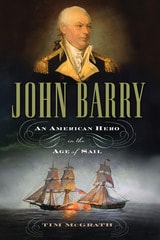
John Barry
An American Hero in the Age of SailTimothy McGrath
Westholme Publishing, 2010
The Life of the First Captain of the United States Navy
Finalist for the Rear Admiral Samuel Eliot Morison Award for Excellence in Naval Literature
“Ashore as well as at sea, Tim McGrath paints an informative, engaging and highly entertaining portrait of this worthy but neglected hero of American independence. The author shows us a man who was a magnificent embodiment of common sense—and uncommon courage and dedication. That such a work is long overdue makes its achievement all the more pleasurable.”—Wall Street Journal
“Combining sophisticated use of sources with a pleasing writing style, McGrath masterfully rescues a father of the U.S. Navy from unmerited eclipse.”—Publishers Weekly
“A nearly indispensable addition to U.S. Navy collections.”—Booklist“McGrath employs exemplary narrative style in this work. . . . In John Barry, the author adroitly juxtaposes maritime history, narratives of naval combat, and early U.S. social history.”—New England Quarterly
“McGrath is a compelling and lucid writer. He brings Barry to life, makes battles understandable, and provides the clearest description of Barry's 1778 capture of the British transport ships Mermaid and Kitty that this reviewer has seen.”—Pennsylvania Magazine of History and Biography
“A great read and an absorbing account of a drama-filled life.”—Naval History
“Well researched, well written, and a pleasure to read, this book restores John Barry to the important place he once held as one of our nation’s great heroes. It is a tale of high adventure and personal courage and you will not want to put it down.” —JAMES L. NELSON, author of George Washington’s Secret Navy
“Readers of this vivid biography will imagine they smell the ocean’s salt air and the sulfurous fumes of gunpowder as they navigate these action-packed pages. Fans of Horatio Hornblower and Lucky Jack Aubrey will rejoice in discovering their real-life American counterpart.”—GREGORY J. URWIN, author of Facing Fearful Odds: The Siege of Wake Island
The man regarded as “the Father of the American Navy” returns to the quarterdeck in John Barry: An American Hero in the Age of Sail, the first comprehensive biography of this legendary officer in generations. Son of a hardscrabble Irish farmer from County Wexford, Barry was sent to sea as a child, arriving in Philadelphia during the restless decade before the American Revolution. Brave and ambitious, he ascended the ratlines to become a successful merchant captain at a young age, commanding the most prestigious ship in the colonies and recording the fastest known day of sail in the century.
Volunteering to fight for the Continental cause, Barry saw his star rise during the War for Independence. As captain of the Lexington, Raleigh, and Alliance, Barry faced down broadsides, mutinies, and even a fleet of icebergs. He captured the first enemy warship taken by a Continental vessel and fought the last battle of the American Revolution. His hard-won victory over two British warships simultaneously garnered him international notoriety, while his skill as a seafarer and cool temper established Barry as a worthy foe among British captains. Without a ship during the winter of 1776-77, the ever resourceful Barry lead a battery of naval artillery at the battle of Princeton. With peace came a historic voyage to China, where Barry helped open trade with that reclusive empire. In 1794, President Washington named Barry as the first commissioned officer in the new United States Navy. Given the title of commodore, Barry ended his career during America’s naval war with France, teaching the ropes to a new generation of officers, most notably Stephen Decatur.
Drawn from primary source documents from around the world, John Barry: An American Hero in the Age of Sail by Tim McGrath brings the story of this self-made American back to life in a major new biography.
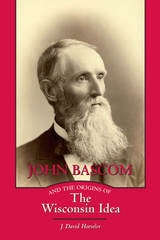
John Bascom and the Origins of the Wisconsin Idea
J. David Hoeveler Jr.
University of Wisconsin Press, 2017
During his term as governor (1901–1906), Robert La Follette routinely consulted with University of Wisconsin researchers to devise groundbreaking programs and legislation. Although the Wisconsin Idea is often attributed to a 1904 speech by Charles Van Hise, then president of the University of Wisconsin, David Hoeveler argues that it originated decades earlier, in the creative and fertile mind of John Bascom.
A philosopher, theologian, and sociologist, Bascom (1827–1922) deeply influenced a generation of students at the University of Wisconsin, including La Follette and Van Hise. Hoeveler documents how Bascom drew concepts from German idealism, liberal Protestantism, and evolutionary theory, transforming them into advocacy for social and political reform. He was a champion of temperance, women's rights, and labor, all of which brought him controversy as president of the university from 1874 to 1887. In a way unmatched by any of his peers at other institutions, Bascom outlined a social gospel that called for an expanded role for state governments and universities as agencies of moral improvement.
Hoeveler traces the intellectual history of the Wisconsin Idea from the nineteenth century to such influential Progressive Era thinkers as Richard T. Ely and John R. Commons, who believed university researchers should be a vital source of expertise for government and citizens.

John Brown
A BiographyW. E. B. Du Bois
Westholme Publishing, 2024
This edition is introduced by John Brown scholar William S. King, who provides the background to the writing of the biography which took place during a turbulent time of race relations and competing visions from Booker T. Washington and Du Bois for the future of Black Americans. “Du Bois,” King reminds us, “remains one of the best writers on this phase of American history, which is still at our core.”
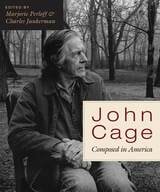
John Cage
Composed in AmericaEdited by Marjorie Perloff and Charles Junkerman
University of Chicago Press, 1994
John Cage: Composed in America is the first book-length work to address the "other" John Cage, a revisionist treatment of the way Cage himself has composed and been "composed" in America. Cage, as these original essays testify, is a contradictory figure. A disciple of Duchamp and Schoenberg, Satie and Joyce, he created compositions that undercut some of these artists' central principles and then attributed his own compositional theories to their "tradition." An American in the Emerson-Thoreau mold, he paradoxically won his biggest audience in Europe. A freewheeling, Californian artist, Cage was committed to a severe work ethic and a firm discipline, especially the discipline of Zen Buddhism.
Following the text of Cage's lecture-poem "Overpopulation and Art," delivered at Stanford shortly before his death and published here for the first time, ten critics respond to the challenge of the complexity and contradiction exhibited in his varied work. In keeping with Cage's own interdisciplinarity, the critics approach that work from a variety of disciplines: philosophy (Daniel Herwitz, Gerald L. Bruns), biography and cultural history (Thomas S. Hines), game and chaos theory (N. Katherine Hayles), music culture (Jann Pasler), opera history (Herbert Lindenberger), literary and art criticism (Marjorie Perloff), cultural poetics (Gordana P. Crnkovic, Charles Junkerman), and poetic practice (Joan Retallack). But such labels are themselves confining: each of the essays sets up boundaries only to cross them at key points. The book thus represents, to use Cage's own phrase, a much needed "beginning with ideas."
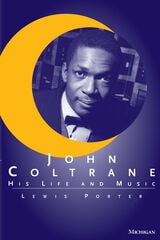
John Coltrane
His Life and MusicLewis Porter
University of Michigan Press, 1998
“One of the great biographies of anyone ever written.”—Steve O’Keefe, Counterpunch.org
Coltrane’s saxophonist son Ravi writes: “…[T]he most compelling and meticulously documented history of John Coltrane…This is a beautiful book.”
In honor of John Coltrane's Centennial, 1926-2026: Lewis Porter's Classic Biography Is Available for the First Time in Digital Format!
John Coltrane was a key figure in jazz, a pioneer in world music, and an intensely emotional force whose following continues to grow. This biography, the first by a professional jazz scholar and performer, presents a huge amount of never-before-published material, including interviews with Coltrane, photos, genealogical documents, and innovative musical analysis that offers a fresh view of Coltrane's genius. Compiled from scratch with the assistance of dozens of Coltrane's colleagues, friends, and family, John Coltrane: His Life and Music corrects numerous errors from previous biographies. The significant people in Coltrane's life were reinterviewed, yielding new insights; some were interviewed for the first time ever. The musical analysis, which is accessible to the nonspecialist, makes its own revelations--for example, that some of Coltrane's well-known pieces are based on previously unrecognized sources. The Appendix is the most detailed chronology of Coltrane's performing career ever compiled, listing scores of previously unknown performances from the 1940s and early 1950s. Coltrane has become a musical inspiration for thousands of fans and musicians and a personal inspiration to as many more. For all of these, Porter's book will become the definitive resource--a reliable guide to the events of Coltrane's life and an insightful look into his musical practices. With illustrations and previously unseen photographs!
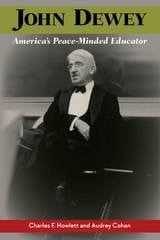
John Dewey, America's Peace-Minded Educator
Charles F. Howlett and Audrey Cohan
Southern Illinois University Press, 2016
In John Dewey, America’s Peace-Minded Educator, authors Charles F. Howlett and Audrey Cohan take a close look at John Dewey’s many undertakings on behalf of world peace. This volume covers Dewey’s support of, and subsequent disillusionment with, the First World War as well as his postwar involvement in trying to prevent another world war. Other topics include his interest in peace movements in education, his condemnation of American military intervention in Latin America and of armaments and munitions makers during the Great Depression, his defense of civil liberties during World War II, and his cautions at the start of the atomic age. The concluding epilogue discusses how Dewey fell out of favor with some academics and social critics in the 1950s and explores how Dewey’s ideas can still be useful to peace education today.
Exploring Dewey’s use of pragmatic philosophy to build a consensus for world peace, Howlett and Cohan illuminate a previously neglected aspect of his contributions to American political and social thought and remind us of the importance of creating a culture of peace through educational awareness.
John Dooley, Confederate Soldier
His War JournalJohn Dooley
University of Alabama Press, 2005
One of the best primary accounts of the Civil War by a Confederate.
John Dooley was the youngest son of Irish immigrants to Richmond, Virginia, where his father prospered, and the family took a leading position among Richmond’s sizeable Irish community. Early in 1862, John left his studies at Georgetown University to serve in the First Virginia Infantry Regiment, in which his father John and brother James also served. John’s service took him to Second Manassas, South Mountain, Sharpsburg (Antietam), Fredericksburg, and Gettysburg; before that last battle, Dooley was elected a lieutenant. On the third day at Gettysburg, Dooley swept up the hill in Pickett’s charge, where he was shot through both legs and lay all night on the field, to be made a POW the next day. Held until February 27, 1865, Dooley made his way back south to arrive home very near the Confederacy’s final collapse.
Dooley’s account is valuable for the content of his service and because most of the material came from his diary, with some interpolations (which are indicated as such) that he made shortly after the war’s end when his memory was still fresh. Dooley’s health seems to have been permanently compromised by his wounds; he entered a Roman Catholic seminary after the war and died in 1873 several months before his ordination was to take place.
John Doyle Lee
Juanita Brooks
Utah State University Press, 1992
John D. Lee is most often remembered as the only man executed for his role in the infamous 1857 massacre by Mormons of a California-bound emigrant train at Mountain Meadows in southern Utah. This classic biography examines the circumstances and events which brought Lee to that end. It also, however, looks at the other dimensions of his active life, showing that he was a far more important and complex man than subsequent generations, eager for a dark symbol, have acknowledged. He was a leader in the Mormon colonization of southern Utah and northern Arizona. With the title Indian Farmer, he became his church's emissary to Indians in the area. During and prior to the Mormon migration west, he participated in and kept detailed accounts of the conflicts and other events in Missouri, Illinois, and along the trail. An early practitioner, and recorder, of the custom of plural marriage, he was the adopted son of Brigham Young and a close associate of other Mormon leaders. His occupations included builder, farmer, missionary, ferry operator, town founder, and faith leader.
Using Lee's extensive diaries, bolstered by numerous supporting accounts, Juanita Brooks has not only written a thorough and objective portrait of one man's life, a life which would be worthy of study even if it were not controversial, she also has provided numerous insights into early Mormon society and culture. Anyone interested in Mormon polygamy, family life, leadership, relations with Indians, or other aspects of their frontier existence will find this a storehouse of information.
This classic biography is now in its fourth Utah State University Press printing. It is unparalleled in providing a thorough and accurate account of John D. Lee's involvement in the tragic 1857 Mountain Meadows Massacre.
John F. Kennedy and the Liberal Persuasion
John M. Murphy
Michigan State University Press, 2019
John H. Burdakin and the Grand Trunk Western Railroad
Mary Sharp
Michigan State University Press, 2016
John Hance
The Life, Lies, and Legend of Grand Canyon's Greatest StorytellerShane Murphy
University of Utah Press, 2020
A legend in his own lifetime, John Hance (1837–1919) was synonymous with early Grand Canyon tourism. Between the late 1880s and early 1900s, to say “John Hance” was to say “Grand Canyon.” Hance was well known to travelers and visiting dignitaries alike, men such as William “Buffalo Bill” Cody and Theodore Roosevelt, the president who affectionately referred to him as “the greatest liar on earth.” It was said that Hance tried to jump the canyon on his horse Darby only to turn back when he was halfway over and realized he would never make it across.
The truth behind Hance’s life is remarkable even without embellishment. In this book, Shane Murphy chronicles Hance’s childhood in Tennessee and Missouri, his service in the Confederacy during the Civil War, his time in Union prisons as a POW, and his later adventures with the Hickok brothers crossing the plains. Settling in Arizona’s fruitful Verde Valley, Hance farmed and filled military contracts before taking up residence as Grand Canyon’s first permanent Euro-American settler, trail builder, guide, and renowned storyteller.
Hance left no correspondence, personal memoirs, or other writings. Only informal portraits from magazines and newspaper accounts remain. Murphy investigated assessors’ rolls, rare mercantile ledgers, and mining claims to create a full and compelling narrative of a man who was once an icon of the American West and should be remembered as the founding father of Grand Canyon tourism.

John Henry Livingston and the Dutch Reformed Tradition in the Early American Nation
John W. Coakley
Rutgers University Press, 2027
John Henry Livingston (1746-1825) was from a prominent New York family of merchants, lawyers and statesmen but chose to become a minister in the Dutch Reformed Church. In his twenties he studied in the Netherlands, absorbing ideas that upheld simultaneously the authority of the individual conscience and the traditional Reformed beliefs rooted in the authority of a state-supported church. Returning to New York City he served as a pastor, as his denomination’s professor charged with educating students for ministry, and eventually, president of the American Dutch church’s college, then called Queens (but later called Rutgers). Throughout his career he articulated, and defended what he saw as the harmony between the traditional body of Reformed belief and the ideals of the American state.
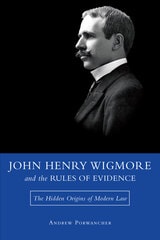
John Henry Wigmore and the Rules of Evidence
The Hidden Origins of Modern LawAndrew Porwancher
University of Missouri Press, 2024
Honorable Mention, 2017 Scribes Book Award, The American Society of Legal Writers
At the dawn of the twentieth century, the United States was reeling from the effects of rapid urbanization and industrialization. Time-honored verities proved obsolete, and intellectuals in all fields sought ways to make sense of an increasingly unfamiliar reality. The legal system in particular began to buckle under the weight of its anachronism. In the midst of this crisis, John Henry Wigmore, dean of the Northwestern University School of Law, single-handedly modernized the jury trial with his 1904-5 Treatise onevidence, an encyclopedic work that dominated the conduct of trials. In so doing, he inspired generations of progressive jurists—among them Oliver Wendell Holmes, Jr., Benjamin Cardozo, and Felix Frankfurter—to reshape American law to meet the demands of a new era. Yet Wigmore’s role as a prophet of modernity has slipped into obscurity. This book provides a radical reappraisal of his place in the birth of modern legal thought.
John Horry Dent
South Carolina Aristocrat On Alabama FrontierRay Mathis
University of Alabama Press, 1979
Jonah Horry Dent was born on 5 August 1815 in Newport, Rhode Island, the son of John Herbert Dent and Elizabeth Anne Horry Dent. Dent grew up in Charleston, South Carolina, and spent summers with his family on a plantation in Colleton County, South Carolina. When he was still a young child, his name was changed from “Jonah” to “John” when an older brother, named John, died, leaving little Jonah as the oldest living son. He was known as John Horry Dent the rest of his life.
Dent married Mary Elizabeth Morrison in 1835 and moved to Barbour County, Alabama, in 1836. He purchased 360 acres of land on Cowikee Creek, paying $15 an acre, and named the new plantation “Good Hope.” Dent amassed a good fortune but lost most of it after the Civil War when slavery was abolished and his slaves became freemen. In 1866 he sold his properties in Barbour County and moved to Cave Springs, Floyd County, Georgia.
Dent kept detailed records about his crops and properties until very late in life. He died in Cave Springs on 17 May 1892.
John Josselyn, Colonial Traveler
A Critical Edition of Two Voyages to New-England.John. Josselyn and Paul J. Lindholdt
Brandeis University Press, 1988
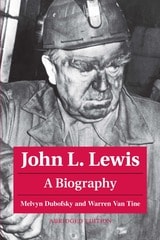
John L. Lewis
A BiographyMelvyn Dubofsky and Warren Van Tine
University of Illinois Press, 1986
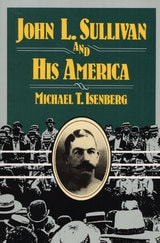
John L. Sullivan and His America
Michael T. Isenberg
University of Illinois Press, 1988
The "Great John L." reigned supreme as world heavyweight champion from his victory over Paddy Ryan in 1882 until James J. Corbett knocked him out in 1892. A drunkard, a wastrel, an adulterer, a wife beater, and a bully, Sullivan still became American's first national sports hero and represented the hopes and aspirations of millions of people.
Michael Isenberg traces Sullivan's eventful life from his humble beginnings in Boston to the height of his immense popularity. The boxer moved as easily in the world of reputable workingmen as he did in the shadowlands on the margins of the sport while his success played a major role in transforming boxing into a profitable and ultimately legitimate business. Tapping previously unexplored archival material--including the notorious National Police Gazette and the other sporting papers of the day--Isenberg tells us why presidents, princes, and turn-of-the-century Americans accepted Sullivan as a hero, even as others vilified him for his drunken and belligerent behavior.
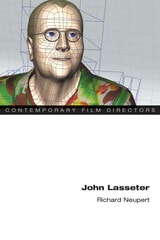
John Lasseter
Richard Neupert
University of Illinois Press, 2016
Richard Neupert explores Lasseter's signature aesthetic and storytelling strategies and details how he became the architect of Pixar's studio style. Neupert contends that Lasseter's accomplishments emerged from a unique blend of technical skill and artistic vision, as well as a passion for working with collaborators. In addition, Neupert traces the director's career arc from the time Lasseter joined Pixar in 1984. As Neupert shows, Lasseter's ability to keep a foot in both animation and CGI allowed him to thrive in an unconventional corporate culture that valued creative interaction between colleagues. The ideas that emerged built an animation studio that updated and refined classical Hollywood storytelling practices--and changed commercial animation forever.
John Letcher of Virginia
The Story of Virginia's Civil War GovernorFrancis N. Boney
University of Alabama Press, 1967
John Letcher, governor of Virginia from 1860 through 1863, is one of the significant leaders of the Confederacy who is still virtually unknown. This study, covering Letcher’s entire life with emphasis on his governorship, attempts to fill an obvious gap in American history. For the first time, Letcher’s lengthy career is examined in detail: early development as a local Virginia politician during the Jacksonian era, maturity as an influential congressman in the rising sectionalism of the 1850s, the crucial governorship, and finally a gradual fading away in the postwar period.
Letcher’s story is only a fragment of the epic of the transformation of the United States from a weak, uncertain confederation into a powerful, confident nation. The emergence of the colossus of the New World is a spectacular and critical event in world history, full of grandeur and suffering, idealism and disillusionment. To trace the course of Letcher's life is to follow one small current in a torrential flood-but a significant one, for Letcher was not only a leader but also in many ways a typical American of his time.
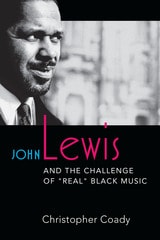
John Lewis and the Challenge of "Real" Black Music
Christopher Coady
University of Michigan Press, 2016
For critics and listeners, the reception of the 1950s jazz-classical hybrid Third Stream music has long been fraught. In John Lewis and the Challenge of “Real” Black Music, Christopher Coady explores the work of one of the form’s most vital practitioners, following Lewis from his role as an arranger for Miles Davis’s Birth of the Cool sessions to his leadership of the Modern Jazz Quartet, his tours of Europe, and his stewardship of the Lenox School of Jazz.
Along the way Coady shows how Lewis’s fusion works helped shore up a failing jazz industry in the wake of the 1940s big band decline, forging a new sound grounded in middle-class African American musical traditions. By taking into account the sociocultural milieu of the 1950s, Coady provides a wider context for understanding the music Lewis wrote for the Modern Jazz Quartet and sets up new ways of thinking about Cool Jazz and Third Stream music more broadly.
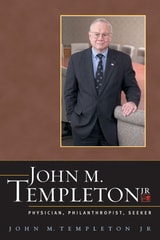
John M. Templeton Jr.
Physician, Philanthropist, SeekerJohn M. Templeton
Templeton Press, 2008
Candidly, with a mixture of joy, poignancy, and gratitude, the chairman and president of the John Templeton Foundation reflects on the learning and growing he has experienced and the perspectives he has gained throughout his life. In so doing, he continues the legacy of his father, Sir John Templeton, who has used stories from his life to provide instruction for his children, grandchildren, and other future descendants, just as he has drawn on those stories in his many books of inspiration and guidance for the general public.
Dr. Templeton shares stories about his personal life, his career in medicine, his early involvement with philanthropy, and his commitment to the John Templeton Foundation and its mission. Events and circumstances in his youth opened him to spirituality, taught him about altruistic love, and introduced him to values he would cultivate throughout his life: thrift, saving, hard work, creativity, and responsibility.
His journey takes him from his early life in Winchester, Tennessee, to New Jersey, Yale University, medical school, the Navy, the Children's Hospital of Philadelphia, and the John Templeton Foundation. Along the way, there were lessons learned from his disruptive behavior in elementary school; the deaths of his grandmother and mother; travel to Europe, Africa, and throughout the U.S.; marriage and fatherhood; his growing commitment as a Christian; and his family's experience with an armed robbery. It continues with his experiences in pediatric surgery at the Children's Hospital of Philadelphia, including work with conjoined twins; experience with the mutual fund industry and a role with the Templeton Growth Fund; an intensely rewarding medical specialty in trauma; philanthropy and fund-raising efforts, including a sad experience with fraud; the pride of professorship; and serving as chairman and president of the John Templeton Foundation.
With gratitude he credits his many mentors for the wisdom they passed on to him. Among them are John Galbraith, Dr. C. Everett Koop, Dr. Albert Schweitzer, and, of course, always and above all, his father. With appreciation, he recounts the blessings of a full and productive life that continue today as he provides leadership to the diverse programs and initiatives of the John Templeton Foundation.
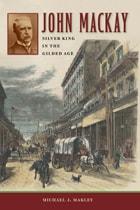
John Mackay
Silver King in the Gilded AgeMichael J. Makley
University of Nevada Press, 2015
John Mackay offers new insight into the life and achievements of this remarkable man. It also places Mackay in the broader context of his time, an era of robber barons and rampant corruption, rapidly advancing technology, national and international capitalism, and flagrant displays of newfound wealth. Even in this context, he stood out, not only for his contributions to Nevada and mining history, but also for his reputation as an important business leader fighting the consolidation and venality of corporate power in the Gilded Age. His actions freed the Comstock from a financial monopoly, resulting in moderated rates for the milling, timber, shipping, transportation, and water that made mining possible and precipitated the discovery and development of the ore field known as the “Big Bonanza.”
Makley’s book recounts the life and career of one of the most successful men of his age, a capitalist of immense wealth who generously helped those around him and worked diligently in the public interest. This engaging biography will appeal to readers interested in the Comstock Lode and mining in the West during the latter part of the nineteenth century as well as general western history enthusiasts.
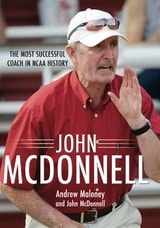
John McDonnell
The Most Successful Coach in NCAA HistoryAndrew Maloney
University of Arkansas Press, 2013
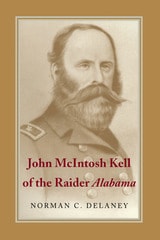
John McIntosh Kell of the Raider Alabama
Norman C. Delaney
University of Alabama Press, 2003
A vivid portrait of the man credited as a driving force behind the most successful of the Confederate raiders, the legendary C.S.S. Alabama.
John McIntosh Kell was an experienced, proven military man, a graduate of Annapolis, a veteran of the Mexican War and of Admiral Perry’s voyage to Japan. As a Confederate officer, Kell served first on the raider Sumter and then on the Alabama. At sea for only 22 months, the Alabama engaged nearly 300 northern merchant vessels, burning 55 of these transport ships along with their million-dollar cargoes.
Though First Lieutenant ("Luff") Kell was apparently content to let his captain, Raphael Semmes, take credit for their accomplishments, Semmes acknowledged that his successes were due largely to the energy and resourcefulness of his second in command. Life on the commerce cruisers was hard and tedious, and much of the responsibility for running the day-to-day operations, including the disciplining of a largely mercenary crew, rested on Kell, whose sense of duty and loyalty did not waver.
Norman C. Delaney bases his account of this remarkable naval officer’s experiences on the interviews Kell granted to news reporters during the 1880s and 1890s (previously neglected by historians) and his memoirs, published in 1900 as Recollections of a Naval Life. He supplements these materials with records from Kell’s earlier years, including letters, journals, diaries, and contemporary observations. First published in 1973 by The University of Alabama Press, this new edition of an award-winning biography will be welcomed by Civil War historians and enthusiasts around the world, naval institutions and museums, and general readers alike.
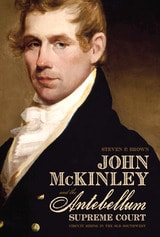
John McKinley and the Antebellum Supreme Court
Circuit Riding in the Old SouthwestSteven P. Brown
University of Alabama Press, 2012
A Southern voice on a national bench—McKinley’s legacy in antebellum law.
John McKinley and the Antebellum Supreme Court offers the first comprehensive biography of Justice John McKinley (1780–1852), a largely forgotten figure in American legal history who played a pivotal role during a formative period of the U.S. Supreme Court. Steven P. Brown rescues McKinley from historical obscurity, presenting a compelling portrait of a man deeply embedded in the political, legal, and financial life of the early 19th-century South.
Born in Kentucky and later settling in northern Alabama, McKinley served in both the U.S. Senate and House of Representatives before being appointed to the Supreme Court by President Martin Van Buren in 1837. His tenure on the bench coincided with the creation of the Ninth Circuit, a vast and challenging judicial territory encompassing Alabama, Arkansas, Louisiana, and Mississippi. Brown details McKinley’s arduous circuit-riding duties, which required extensive travel and exposed him to the legal complexities of a rapidly expanding frontier.
More than a biography, the book provides a penetrating analysis of antebellum legal culture, Alabama state politics, and the internal workings of the Supreme Court during a time of national transformation. Brown challenges the prevailing view of McKinley as a mediocre jurist, arguing instead that his contributions—particularly his dissents defending states’ rights—deserve renewed scholarly attention. With rich historical context and meticulous research, John McKinley and the Antebellum Supreme Court sheds light on the burdens of justice in a divided nation and the legacy of a justice whose career mirrored the tensions of his time.

John Mercer Langston and the Fight for Black Freedom, 1829-65
William and Aimee Lee Cheek
University of Illinois Press, 1989
Privileged beyond other members of his race, yet sharing their disadvantages, the young John Mercer Langston stood in an uncertain position in the years before the Civil War. His confrontation with a critical personal question was tempered by a crucial national reality: from what sources could he derive his model of manhood and human dignity? This book explores John Mercer Langston's decisions to work out his destiny through the resources and fortunes of the northern black community.
Although Langston, who died in 1897, was a black Politician, orator, lawyer, intellectual, diplomat, and congressman, he has never before been accorded fullscale biographical treatment. Born free on a Virginia plantation, Langston graduated from Oberlin College in 1849, gained admission to the Ohio bar, and by the age of twenty-five, became the first black American to hold elective office. Still in the years of his political apprenticeship, he promoted black civil rights, helped shape the nascent Republican party, aided in the Oberlin-Wellington Rescue and John Brown's raid, and recruited black soldier for the Union cause. In 1864 he became the first president of the National Equal Rights League.
From an extensive search of primary sources, the authors construct a richly textured picture of the beginnings of Langston's career as a national black leader. More than a biography, the work also incorporates social and political history. Embedded firmly in a study of northern black community life and activism, it reveals the degree to which Langston and his cohorts set the terms of the fight for freedom and citizenship.
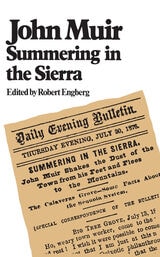
John Muir Sierra
Robert E. Engberg
University of Wisconsin Press, 1984
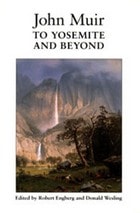
John Muir To Yosemite And Beyond
Robert Engberg
University of Utah Press, 1999
When John Muir died in 1914, the pre-eminent American naturalist, explorer, and conservationist had not yet written the second volume of his autobiography, in which he planned to cover his Yosemite years. Editors Robert Engberg and Donald Wesling have here provided a remedy.
Their account begins in 1863, the year Muir left the University of Wisconsin for what he termed the "University of the Wilderness." Following an accident in 1867 that nearly left him blind, he vowed to turn from machines and continue to study nature. That led, in 1868, to his first visit to Yosemite Valley, where he began his glacier studies. Muir spent much time exploring the Yosemite region, Tuolumne, and both the southern and northern Sierras, publishing articles, and keeping extensive journals through 1875, when he began to write for the San Francisco Bulletin and expanded his travels to areas throughout the west.
Mining a rich vein of sources—Muir’s letters, journals, articles, and unpublished manuscripts, as well as selections drawn from biographical pieces written about Muir by people who met him in Yosemite in the early 1870s—Engberg and Wesling have assembled what they term a "composite autobiography," providing brief interpretive and transitional passages throughout the book. This work is especially valuable because it documents Muir’s formative years, when he is maturing away from "conventional cultural paradigms of work and materialism toward new ways of thinking about nature and its impact on human development."
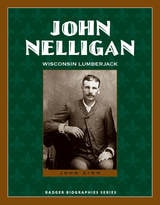
John Nelligan
Wisconsin LumberjackJohn Zimm
Wisconsin Historical Society Press, 2015
Born in 1852, Nelligan rose through the lumberjack ranks, starting out as a humble laborer and working his way up to foreman. He worked and lived in Maine, Pennsylvania, and even Canada before coming to Wisconsin in 1871. Learn what surviving and sawing wood for a living was like many years ago—from the story of one Wisconsin man who lived it!