Results by title
28164 books match the query 'History' and 406 start with j

John B. Denton
The Bigger-Than-Life Story of the Fighting Parson and Texas RangerMike Cochran
University of North Texas Press, 2021
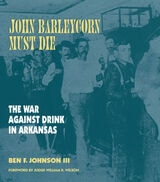
John Barleycorn Must Die
The War Against Drink in ArkansasBen F. Johnson III
University of Arkansas Press, 2005
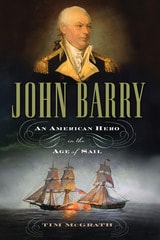
John Barry
An American Hero in the Age of SailTimothy McGrath
Westholme Publishing, 2010
The Life of the First Captain of the United States Navy
Finalist for the Rear Admiral Samuel Eliot Morison Award for Excellence in Naval Literature
“Ashore as well as at sea, Tim McGrath paints an informative, engaging and highly entertaining portrait of this worthy but neglected hero of American independence. The author shows us a man who was a magnificent embodiment of common sense—and uncommon courage and dedication. That such a work is long overdue makes its achievement all the more pleasurable.”—Wall Street Journal
“Combining sophisticated use of sources with a pleasing writing style, McGrath masterfully rescues a father of the U.S. Navy from unmerited eclipse.”—Publishers Weekly
“A nearly indispensable addition to U.S. Navy collections.”—Booklist“McGrath employs exemplary narrative style in this work. . . . In John Barry, the author adroitly juxtaposes maritime history, narratives of naval combat, and early U.S. social history.”—New England Quarterly
“McGrath is a compelling and lucid writer. He brings Barry to life, makes battles understandable, and provides the clearest description of Barry's 1778 capture of the British transport ships Mermaid and Kitty that this reviewer has seen.”—Pennsylvania Magazine of History and Biography
“A great read and an absorbing account of a drama-filled life.”—Naval History
“Well researched, well written, and a pleasure to read, this book restores John Barry to the important place he once held as one of our nation’s great heroes. It is a tale of high adventure and personal courage and you will not want to put it down.” —JAMES L. NELSON, author of George Washington’s Secret Navy
“Readers of this vivid biography will imagine they smell the ocean’s salt air and the sulfurous fumes of gunpowder as they navigate these action-packed pages. Fans of Horatio Hornblower and Lucky Jack Aubrey will rejoice in discovering their real-life American counterpart.”—GREGORY J. URWIN, author of Facing Fearful Odds: The Siege of Wake Island
The man regarded as “the Father of the American Navy” returns to the quarterdeck in John Barry: An American Hero in the Age of Sail, the first comprehensive biography of this legendary officer in generations. Son of a hardscrabble Irish farmer from County Wexford, Barry was sent to sea as a child, arriving in Philadelphia during the restless decade before the American Revolution. Brave and ambitious, he ascended the ratlines to become a successful merchant captain at a young age, commanding the most prestigious ship in the colonies and recording the fastest known day of sail in the century.
Volunteering to fight for the Continental cause, Barry saw his star rise during the War for Independence. As captain of the Lexington, Raleigh, and Alliance, Barry faced down broadsides, mutinies, and even a fleet of icebergs. He captured the first enemy warship taken by a Continental vessel and fought the last battle of the American Revolution. His hard-won victory over two British warships simultaneously garnered him international notoriety, while his skill as a seafarer and cool temper established Barry as a worthy foe among British captains. Without a ship during the winter of 1776-77, the ever resourceful Barry lead a battery of naval artillery at the battle of Princeton. With peace came a historic voyage to China, where Barry helped open trade with that reclusive empire. In 1794, President Washington named Barry as the first commissioned officer in the new United States Navy. Given the title of commodore, Barry ended his career during America’s naval war with France, teaching the ropes to a new generation of officers, most notably Stephen Decatur.
Drawn from primary source documents from around the world, John Barry: An American Hero in the Age of Sail by Tim McGrath brings the story of this self-made American back to life in a major new biography.
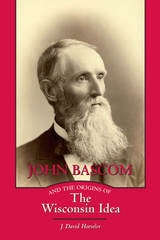
John Bascom and the Origins of the Wisconsin Idea
J. David Hoeveler Jr.
University of Wisconsin Press, 2017
During his term as governor (1901–1906), Robert La Follette routinely consulted with University of Wisconsin researchers to devise groundbreaking programs and legislation. Although the Wisconsin Idea is often attributed to a 1904 speech by Charles Van Hise, then president of the University of Wisconsin, David Hoeveler argues that it originated decades earlier, in the creative and fertile mind of John Bascom.
A philosopher, theologian, and sociologist, Bascom (1827–1922) deeply influenced a generation of students at the University of Wisconsin, including La Follette and Van Hise. Hoeveler documents how Bascom drew concepts from German idealism, liberal Protestantism, and evolutionary theory, transforming them into advocacy for social and political reform. He was a champion of temperance, women's rights, and labor, all of which brought him controversy as president of the university from 1874 to 1887. In a way unmatched by any of his peers at other institutions, Bascom outlined a social gospel that called for an expanded role for state governments and universities as agencies of moral improvement.
Hoeveler traces the intellectual history of the Wisconsin Idea from the nineteenth century to such influential Progressive Era thinkers as Richard T. Ely and John R. Commons, who believed university researchers should be a vital source of expertise for government and citizens.
John Brown
A BiographyW. E. B. Du Bois
Westholme Publishing, 2024
This edition is introduced by John Brown scholar William S. King, who provides the background to the writing of the biography which took place during a turbulent time of race relations and competing visions from Booker T. Washington and Du Bois for the future of Black Americans. “Du Bois,” King reminds us, “remains one of the best writers on this phase of American history, which is still at our core.”
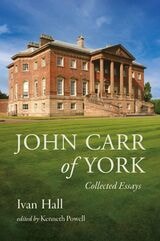
John Carr of York
Collected EssaysIvan Hall
Paul Holberton Publishing, 2023
John Carr of York (1723–1807) was one of the most prolific and significant architects of the eighteenth century, with an output of more than four hundred designs, which range from simple gateways to the grandest schemes. Highly successful in his day, he had a recognizable style that was sensitive to the latest fashions as they continued to change. His ability to create beautiful buildings and marry this with a practical approach to both the purpose of the building and the budget of his clients won him many commissions.
Carr was born in Yorkshire in the North of England and remained there for the duration of his career. Because of this, he has often been overlooked as an architect, and his extensive output has defeated many attempts to write a complete study of his work. Although not a comprehensive review, John Carr of York seeks to situate Carr as an architect of national significance. It includes photographs and covers overarching themes such as landscape and color and some commissions in more detail.
John Chrysostom on Paul
Praises and Problem PassagesMargaret M. Mitchell
SBL Press, 2022
A readily accessible text and translation for scholars and students of Paul, ancient Christian history, and biblical reception.
In this new volume in the Writings from the Greco-Roman World series, Margaret M. Mitchell collects twenty-five of John Chrysostom's lesser-known sermons on Pauline passages as well as some that focus on Paul himself. Mitchell presents the Greek text and an original translation of each of these fascinating sermons in a fresh, engaging style that seeks to recapture the vibrancy and dynamism of the live oratory behind the homilies. Extensive notes to each homily evaluate how Chrysostom dealt with some of the ethical, theological, historical, political, and literary problems present in Paul's writings. Mitchell's work on Chrysostom offers a model for scholars to explore and understand how ancient Christian interpreters found in Paul’s letters a legacy that was as problematic as it was precious.
John Chrysostom, Homilies on 1 and 2 Timothy
Pauline Allen
SBL Press, 2026
John Chrysostom, Homilies on Colossians
Pauline Allen
SBL Press, 2021
John Chrysostom, Homilies on Titus and Philemon
Pauline Allen
SBL Press, 2024
John Chrysostom, Theologian of the Eucharist
Kenneth J. Howell
Catholic University of America Press, 2024
John Dee
The Politics of Reading and Writing in the English RenaissanceWilliam H. Sherman
University of Massachusetts Press, 1995
John Dewey, America's Peace-Minded Educator
Charles F. Howlett and Audrey Cohan
Southern Illinois University Press, 2016
In John Dewey, America’s Peace-Minded Educator, authors Charles F. Howlett and Audrey Cohan take a close look at John Dewey’s many undertakings on behalf of world peace. This volume covers Dewey’s support of, and subsequent disillusionment with, the First World War as well as his postwar involvement in trying to prevent another world war. Other topics include his interest in peace movements in education, his condemnation of American military intervention in Latin America and of armaments and munitions makers during the Great Depression, his defense of civil liberties during World War II, and his cautions at the start of the atomic age. The concluding epilogue discusses how Dewey fell out of favor with some academics and social critics in the 1950s and explores how Dewey’s ideas can still be useful to peace education today.
Exploring Dewey’s use of pragmatic philosophy to build a consensus for world peace, Howlett and Cohan illuminate a previously neglected aspect of his contributions to American political and social thought and remind us of the importance of creating a culture of peace through educational awareness.
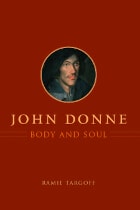
John Donne, Body and Soul
Ramie Targoff
University of Chicago Press, 2008
For centuries readers have struggled to fuse the seemingly scattered pieces of Donne’s works into a complete image of the poet and priest. In John Donne, Body and Soul, Ramie Targoff offers a way to read Donne as a writer who returned again and again to a single great subject, one that connected to his deepest intellectual and emotional concerns.
Reappraising Donne’s oeuvre in pursuit of the struggles and commitments that connect his most disparate works, Targoff convincingly shows that Donne believed throughout his life in the mutual necessity of body and soul. In chapters that range from his earliest letters to his final sermon, Targoff reveals that Donne’s obsessive imagining of both the natural union and the inevitable division between body and soul is the most continuous and abiding subject of his writing.
“Ramie Targoff achieves the rare feat of taking early modern theology seriously, and of explaining why it matters. Her book transforms how we think about Donne.”—Helen Cooper, University of Cambridge
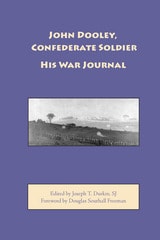
John Dooley, Confederate Soldier
His War JournalJohn Dooley
University of Alabama Press, 2005
One of the best primary accounts of the Civil War by a Confederate.
John Dooley was the youngest son of Irish immigrants to Richmond, Virginia, where his father prospered, and the family took a leading position among Richmond’s sizeable Irish community. Early in 1862, John left his studies at Georgetown University to serve in the First Virginia Infantry Regiment, in which his father John and brother James also served. John’s service took him to Second Manassas, South Mountain, Sharpsburg (Antietam), Fredericksburg, and Gettysburg; before that last battle, Dooley was elected a lieutenant. On the third day at Gettysburg, Dooley swept up the hill in Pickett’s charge, where he was shot through both legs and lay all night on the field, to be made a POW the next day. Held until February 27, 1865, Dooley made his way back south to arrive home very near the Confederacy’s final collapse.
Dooley’s account is valuable for the content of his service and because most of the material came from his diary, with some interpolations (which are indicated as such) that he made shortly after the war’s end when his memory was still fresh. Dooley’s health seems to have been permanently compromised by his wounds; he entered a Roman Catholic seminary after the war and died in 1873 several months before his ordination was to take place.
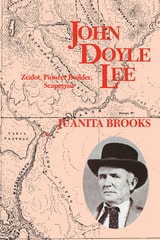
John Doyle Lee
Juanita Brooks
Utah State University Press, 1992
John D. Lee is most often remembered as the only man executed for his role in the infamous 1857 massacre by Mormons of a California-bound emigrant train at Mountain Meadows in southern Utah. This classic biography examines the circumstances and events which brought Lee to that end. It also, however, looks at the other dimensions of his active life, showing that he was a far more important and complex man than subsequent generations, eager for a dark symbol, have acknowledged. He was a leader in the Mormon colonization of southern Utah and northern Arizona. With the title Indian Farmer, he became his church's emissary to Indians in the area. During and prior to the Mormon migration west, he participated in and kept detailed accounts of the conflicts and other events in Missouri, Illinois, and along the trail. An early practitioner, and recorder, of the custom of plural marriage, he was the adopted son of Brigham Young and a close associate of other Mormon leaders. His occupations included builder, farmer, missionary, ferry operator, town founder, and faith leader.
Using Lee's extensive diaries, bolstered by numerous supporting accounts, Juanita Brooks has not only written a thorough and objective portrait of one man's life, a life which would be worthy of study even if it were not controversial, she also has provided numerous insights into early Mormon society and culture. Anyone interested in Mormon polygamy, family life, leadership, relations with Indians, or other aspects of their frontier existence will find this a storehouse of information.
This classic biography is now in its fourth Utah State University Press printing. It is unparalleled in providing a thorough and accurate account of John D. Lee's involvement in the tragic 1857 Mountain Meadows Massacre.

John Dygon's Proportiones practicabiles secundum Gaffurium
New Critical Text, Translation, Annotations, and Indices by Theodor Dumitrescu
University of Illinois Press, 2006
A rare example of musical scholarship from the Tudor period, in translation and fully annotated
John Dygon was the prior of St. Augustine’s monastery in Canterbury when Henry VIII boldly dissolved the English Catholic Church during the 1530s and reorganized it under royal control. Only a single copy of Dygon’s manuscript on music theory has survived, held by Trinity College, Cambridge. This volume will be the first publication of these two treatises, providing both a scholarly transcription and English translation.
Dygon’s treatise provides a rare and important example of musical scholarship from the early Tudor period, demonstrating the status of music education at the time, the affiliations of English scholarship with music study in Europe, and the music that was actually performed in England. The treatises address questions of musical notation, especially regarding rhythmic proportions, as well as practical issues about performance. Theodor Dumitrescu’s introduction situates Dygon’s treatises within the larger history of European music, paying close attention to its borrowings from and adaptations of prior treatises.
John Fuller and the Sycamore Press
A Bibliographic HistoryRyan Roberts
Bodleian Library Publishing, 2010
John Gower
Poems on Contemporary EventsDavid R. Carlson
Bodleian Library Publishing, 2011
John H. Burdakin and the Grand Trunk Western Railroad
Mary Sharp
Michigan State University Press, 2016
John H. Burdakin
RailroaderDon L. Hofsommer
Michigan State University Press, 2015
John Hance
The Life, Lies, and Legend of Grand Canyon's Greatest StorytellerShane Murphy
University of Utah Press, 2020
A legend in his own lifetime, John Hance (1837–1919) was synonymous with early Grand Canyon tourism. Between the late 1880s and early 1900s, to say “John Hance” was to say “Grand Canyon.” Hance was well known to travelers and visiting dignitaries alike, men such as William “Buffalo Bill” Cody and Theodore Roosevelt, the president who affectionately referred to him as “the greatest liar on earth.” It was said that Hance tried to jump the canyon on his horse Darby only to turn back when he was halfway over and realized he would never make it across.
The truth behind Hance’s life is remarkable even without embellishment. In this book, Shane Murphy chronicles Hance’s childhood in Tennessee and Missouri, his service in the Confederacy during the Civil War, his time in Union prisons as a POW, and his later adventures with the Hickok brothers crossing the plains. Settling in Arizona’s fruitful Verde Valley, Hance farmed and filled military contracts before taking up residence as Grand Canyon’s first permanent Euro-American settler, trail builder, guide, and renowned storyteller.
Hance left no correspondence, personal memoirs, or other writings. Only informal portraits from magazines and newspaper accounts remain. Murphy investigated assessors’ rolls, rare mercantile ledgers, and mining claims to create a full and compelling narrative of a man who was once an icon of the American West and should be remembered as the founding father of Grand Canyon tourism.
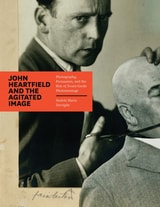
John Heartfield and the Agitated Image
Photography, Persuasion, and the Rise of Avant-Garde PhotomontageAndrés Mario Zervigón
University of Chicago Press, 2012

John Henry Livingston and the Dutch Reformed Tradition in the Early American Nation
John W. Coakley
Rutgers University Press, 2027
John Henry Livingston (1746-1825) was from a prominent New York family of merchants, lawyers and statesmen but chose to become a minister in the Dutch Reformed Church. In his twenties he studied in the Netherlands, absorbing ideas that upheld simultaneously the authority of the individual conscience and the traditional Reformed beliefs rooted in the authority of a state-supported church. Returning to New York City he served as a pastor, as his denomination’s professor charged with educating students for ministry, and eventually, president of the American Dutch church’s college, then called Queens (but later called Rutgers). Throughout his career he articulated, and defended what he saw as the harmony between the traditional body of Reformed belief and the ideals of the American state.
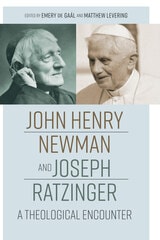
John Henry Newman and Joseph Ratzinger
A Theological EncounterEmery de Gaal
Catholic University of America Press, 2024
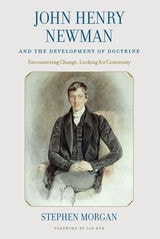
John Henry Newman and the Development of Doctrine
Encountering Change, Looking for ContinuityStephen Morgan
Catholic University of America Press, 2022
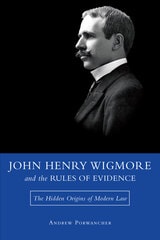
John Henry Wigmore and the Rules of Evidence
The Hidden Origins of Modern LawAndrew Porwancher
University of Missouri Press, 2024
Honorable Mention, 2017 Scribes Book Award, The American Society of Legal Writers
At the dawn of the twentieth century, the United States was reeling from the effects of rapid urbanization and industrialization. Time-honored verities proved obsolete, and intellectuals in all fields sought ways to make sense of an increasingly unfamiliar reality. The legal system in particular began to buckle under the weight of its anachronism. In the midst of this crisis, John Henry Wigmore, dean of the Northwestern University School of Law, single-handedly modernized the jury trial with his 1904-5 Treatise onevidence, an encyclopedic work that dominated the conduct of trials. In so doing, he inspired generations of progressive jurists—among them Oliver Wendell Holmes, Jr., Benjamin Cardozo, and Felix Frankfurter—to reshape American law to meet the demands of a new era. Yet Wigmore’s role as a prophet of modernity has slipped into obscurity. This book provides a radical reappraisal of his place in the birth of modern legal thought.
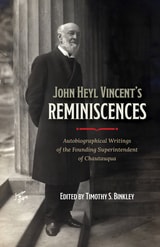
John Heyl Vincent's Reminiscences
Autobiographical Writings of the Founding Superintendent of ChautauquaTimothy S. Binkley
Bridwell Press, 2024
John Horry Dent
South Carolina Aristocrat On Alabama FrontierRay Mathis
University of Alabama Press, 1979
Jonah Horry Dent was born on 5 August 1815 in Newport, Rhode Island, the son of John Herbert Dent and Elizabeth Anne Horry Dent. Dent grew up in Charleston, South Carolina, and spent summers with his family on a plantation in Colleton County, South Carolina. When he was still a young child, his name was changed from “Jonah” to “John” when an older brother, named John, died, leaving little Jonah as the oldest living son. He was known as John Horry Dent the rest of his life.
Dent married Mary Elizabeth Morrison in 1835 and moved to Barbour County, Alabama, in 1836. He purchased 360 acres of land on Cowikee Creek, paying $15 an acre, and named the new plantation “Good Hope.” Dent amassed a good fortune but lost most of it after the Civil War when slavery was abolished and his slaves became freemen. In 1866 he sold his properties in Barbour County and moved to Cave Springs, Floyd County, Georgia.
Dent kept detailed records about his crops and properties until very late in life. He died in Cave Springs on 17 May 1892.
John Josselyn, Colonial Traveler
A Critical Edition of Two Voyages to New-England.John. Josselyn and Paul J. Lindholdt
Brandeis University Press, 1988
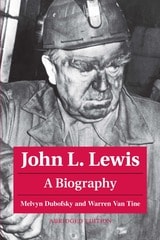
John L. Lewis
A BiographyMelvyn Dubofsky and Warren Van Tine
University of Illinois Press, 1986
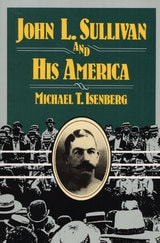
John L. Sullivan and His America
Michael T. Isenberg
University of Illinois Press, 1988
The "Great John L." reigned supreme as world heavyweight champion from his victory over Paddy Ryan in 1882 until James J. Corbett knocked him out in 1892. A drunkard, a wastrel, an adulterer, a wife beater, and a bully, Sullivan still became American's first national sports hero and represented the hopes and aspirations of millions of people.
Michael Isenberg traces Sullivan's eventful life from his humble beginnings in Boston to the height of his immense popularity. The boxer moved as easily in the world of reputable workingmen as he did in the shadowlands on the margins of the sport while his success played a major role in transforming boxing into a profitable and ultimately legitimate business. Tapping previously unexplored archival material--including the notorious National Police Gazette and the other sporting papers of the day--Isenberg tells us why presidents, princes, and turn-of-the-century Americans accepted Sullivan as a hero, even as others vilified him for his drunken and belligerent behavior.
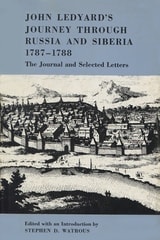
John Ledyard's Journey through Russia and Siberia, 1787–1788
The Journal and Selected LettersStephen D. Watrous
University of Wisconsin Press, 1966
Stephen D. Watrous provides a complete volume of pertinent information by and about John Ledyard, one of the most amazing explorers of all time. Including Ledyard’s own journal, letters between him and others, particularly Thomas Jefferson, and biographical information on eighteenth-century Siberia, Watrous offers an exceptional look at history, geography, and travel.
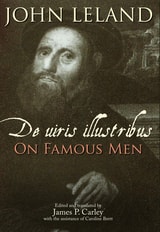
John Leland
De uiris illustribus / On Famous MenJohn Leland
Bodleian Library Publishing, 2010
John Letcher of Virginia
The Story of Virginia's Civil War GovernorFrancis N. Boney
University of Alabama Press, 1967
John Letcher, governor of Virginia from 1860 through 1863, is one of the significant leaders of the Confederacy who is still virtually unknown. This study, covering Letcher’s entire life with emphasis on his governorship, attempts to fill an obvious gap in American history. For the first time, Letcher’s lengthy career is examined in detail: early development as a local Virginia politician during the Jacksonian era, maturity as an influential congressman in the rising sectionalism of the 1850s, the crucial governorship, and finally a gradual fading away in the postwar period.
Letcher’s story is only a fragment of the epic of the transformation of the United States from a weak, uncertain confederation into a powerful, confident nation. The emergence of the colossus of the New World is a spectacular and critical event in world history, full of grandeur and suffering, idealism and disillusionment. To trace the course of Letcher's life is to follow one small current in a torrential flood-but a significant one, for Letcher was not only a leader but also in many ways a typical American of his time.
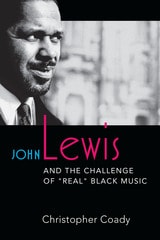
John Lewis and the Challenge of "Real" Black Music
Christopher Coady
University of Michigan Press, 2016
For critics and listeners, the reception of the 1950s jazz-classical hybrid Third Stream music has long been fraught. In John Lewis and the Challenge of “Real” Black Music, Christopher Coady explores the work of one of the form’s most vital practitioners, following Lewis from his role as an arranger for Miles Davis’s Birth of the Cool sessions to his leadership of the Modern Jazz Quartet, his tours of Europe, and his stewardship of the Lenox School of Jazz.
Along the way Coady shows how Lewis’s fusion works helped shore up a failing jazz industry in the wake of the 1940s big band decline, forging a new sound grounded in middle-class African American musical traditions. By taking into account the sociocultural milieu of the 1950s, Coady provides a wider context for understanding the music Lewis wrote for the Modern Jazz Quartet and sets up new ways of thinking about Cool Jazz and Third Stream music more broadly.
John Locke
Economist and Social ScientistKaren Iversen Vaughn
University of Chicago Press, 1980
John Logie Baird
Television pioneerRussell W. Burns
The Institution of Engineering and Technology, 2000
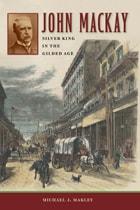
John Mackay
Silver King in the Gilded AgeMichael J. Makley
University of Nevada Press, 2015
John Mackay offers new insight into the life and achievements of this remarkable man. It also places Mackay in the broader context of his time, an era of robber barons and rampant corruption, rapidly advancing technology, national and international capitalism, and flagrant displays of newfound wealth. Even in this context, he stood out, not only for his contributions to Nevada and mining history, but also for his reputation as an important business leader fighting the consolidation and venality of corporate power in the Gilded Age. His actions freed the Comstock from a financial monopoly, resulting in moderated rates for the milling, timber, shipping, transportation, and water that made mining possible and precipitated the discovery and development of the ore field known as the “Big Bonanza.”
Makley’s book recounts the life and career of one of the most successful men of his age, a capitalist of immense wealth who generously helped those around him and worked diligently in the public interest. This engaging biography will appeal to readers interested in the Comstock Lode and mining in the West during the latter part of the nineteenth century as well as general western history enthusiasts.
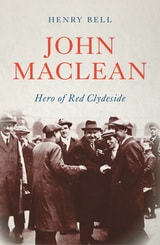
John Maclean
Hero of Red ClydesideHenry Bell
Pluto Press, 2018
Feared by the government, adored by workers, celebrated by Lenin and Trotsky. The head of British Military Intelligence called John Maclean (1879–1923) “the most dangerous man in Britain.”
This new biography explores the events that shaped the life of a momentous man—from the Great War and the Great Unrest to the Rent Strike and the Russian Revolution. It examines his work as an organizer and educator, his imprisonment and hunger strike, and his rise to the position of Britain’s most famous revolutionary. At a moment when radical politics is drawing renewed attention and support, Maclean’s example of activism and commitment is as timely as ever.
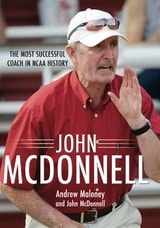
John McDonnell
The Most Successful Coach in NCAA HistoryAndrew Maloney
University of Arkansas Press, 2013
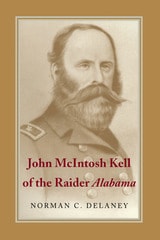
John McIntosh Kell of the Raider Alabama
Norman C. Delaney
University of Alabama Press, 2003
A vivid portrait of the man credited as a driving force behind the most successful of the Confederate raiders, the legendary C.S.S. Alabama.
John McIntosh Kell was an experienced, proven military man, a graduate of Annapolis, a veteran of the Mexican War and of Admiral Perry’s voyage to Japan. As a Confederate officer, Kell served first on the raider Sumter and then on the Alabama. At sea for only 22 months, the Alabama engaged nearly 300 northern merchant vessels, burning 55 of these transport ships along with their million-dollar cargoes.
Though First Lieutenant ("Luff") Kell was apparently content to let his captain, Raphael Semmes, take credit for their accomplishments, Semmes acknowledged that his successes were due largely to the energy and resourcefulness of his second in command. Life on the commerce cruisers was hard and tedious, and much of the responsibility for running the day-to-day operations, including the disciplining of a largely mercenary crew, rested on Kell, whose sense of duty and loyalty did not waver.
Norman C. Delaney bases his account of this remarkable naval officer’s experiences on the interviews Kell granted to news reporters during the 1880s and 1890s (previously neglected by historians) and his memoirs, published in 1900 as Recollections of a Naval Life. He supplements these materials with records from Kell’s earlier years, including letters, journals, diaries, and contemporary observations. First published in 1973 by The University of Alabama Press, this new edition of an award-winning biography will be welcomed by Civil War historians and enthusiasts around the world, naval institutions and museums, and general readers alike.
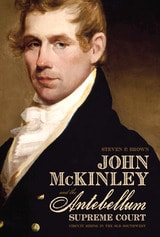
John McKinley and the Antebellum Supreme Court
Circuit Riding in the Old SouthwestSteven P. Brown
University of Alabama Press, 2012
A Southern voice on a national bench—McKinley’s legacy in antebellum law.
John McKinley and the Antebellum Supreme Court offers the first comprehensive biography of Justice John McKinley (1780–1852), a largely forgotten figure in American legal history who played a pivotal role during a formative period of the U.S. Supreme Court. Steven P. Brown rescues McKinley from historical obscurity, presenting a compelling portrait of a man deeply embedded in the political, legal, and financial life of the early 19th-century South.
Born in Kentucky and later settling in northern Alabama, McKinley served in both the U.S. Senate and House of Representatives before being appointed to the Supreme Court by President Martin Van Buren in 1837. His tenure on the bench coincided with the creation of the Ninth Circuit, a vast and challenging judicial territory encompassing Alabama, Arkansas, Louisiana, and Mississippi. Brown details McKinley’s arduous circuit-riding duties, which required extensive travel and exposed him to the legal complexities of a rapidly expanding frontier.
More than a biography, the book provides a penetrating analysis of antebellum legal culture, Alabama state politics, and the internal workings of the Supreme Court during a time of national transformation. Brown challenges the prevailing view of McKinley as a mediocre jurist, arguing instead that his contributions—particularly his dissents defending states’ rights—deserve renewed scholarly attention. With rich historical context and meticulous research, John McKinley and the Antebellum Supreme Court sheds light on the burdens of justice in a divided nation and the legacy of a justice whose career mirrored the tensions of his time.

John Mercer Langston and the Fight for Black Freedom, 1829-65
William and Aimee Lee Cheek
University of Illinois Press, 1989
Privileged beyond other members of his race, yet sharing their disadvantages, the young John Mercer Langston stood in an uncertain position in the years before the Civil War. His confrontation with a critical personal question was tempered by a crucial national reality: from what sources could he derive his model of manhood and human dignity? This book explores John Mercer Langston's decisions to work out his destiny through the resources and fortunes of the northern black community.
Although Langston, who died in 1897, was a black Politician, orator, lawyer, intellectual, diplomat, and congressman, he has never before been accorded fullscale biographical treatment. Born free on a Virginia plantation, Langston graduated from Oberlin College in 1849, gained admission to the Ohio bar, and by the age of twenty-five, became the first black American to hold elective office. Still in the years of his political apprenticeship, he promoted black civil rights, helped shape the nascent Republican party, aided in the Oberlin-Wellington Rescue and John Brown's raid, and recruited black soldier for the Union cause. In 1864 he became the first president of the National Equal Rights League.
From an extensive search of primary sources, the authors construct a richly textured picture of the beginnings of Langston's career as a national black leader. More than a biography, the work also incorporates social and political history. Embedded firmly in a study of northern black community life and activism, it reveals the degree to which Langston and his cohorts set the terms of the fight for freedom and citizenship.
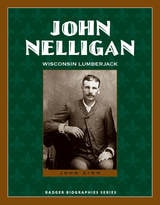
John Nelligan
Wisconsin LumberjackJohn Zimm
Wisconsin Historical Society Press, 2015
Born in 1852, Nelligan rose through the lumberjack ranks, starting out as a humble laborer and working his way up to foreman. He worked and lived in Maine, Pennsylvania, and even Canada before coming to Wisconsin in 1871. Learn what surviving and sawing wood for a living was like many years ago—from the story of one Wisconsin man who lived it!
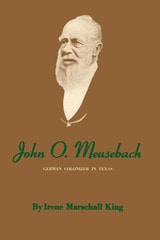
John O. Meusebach
German Colonizer in TexasBy Irene Marschall King
University of Texas Press, 1967
Otfried Hans Freiherr von Meusebach chose a life of hardship and freedom in Texas rather than a life of comfort and influence in his native Germany, where he had lived his formative years within a framework of unconstitutional government.
In 1845 the young liberal relinquished his hereditary German title, left behind his close family ties and his various intellectual and political associations, and arrived in Texas as John O. Meusebach, commissioner-general for the Society for the Protection of German Immigrants. His background enabled him to assume an enlightened leadership of fellow immigrants who were pouring in from Germany. Lacking adequate financial backing, he nevertheless led the settling of some five thousand people in a land that was largely occupied by Indians.
Irene Marschall King presents the full sweep of Meusebach's vigorous life: Meusebach as the young liberal in Germany, as the colonizer in the 1840s, as a Texas senator and, later, an observer of the Civil War, and as a Texan who devoted his later years to bringing the Texas soil to fruition—all set against a background of the immigration movement and frontier life.
"Freedom is not free; it is costly," Meusebach believed. In Texas he found for himself and others freedom worth the price he paid.
Rich in historic detail, King's story recounts the founding of Fredericksburg, the crippling effect of the Mexican War upon the mass of immigrants huddled in illness on the coast, the signing of the Indian Treaty, which opened to settlement over three million acres of land, and the final collapse of the Society for the Protection of German Immigrants. Also depicted is the colonists' influence on the land—the gardens and orchards of south central Texas, the "Easter Fires" that blaze on the hills surrounding Fredericksburg, the mixture of German custom with American necessity that created a unique culture. Throughout the narrative Mrs. King presents a fascinating cast of characters: the noble Prince Solms, who tries to establish a German military outpost in Texas; Henry Fisher, who attempts by devious methods to control the colonists and their land and finally incites a mob which tries to hang Meusebach; Philip Cappes, a special commissioner and Meusebach's assistant, who plots through intriguing correspondence with Count Castell, the executive secretary in Germany, to overthrow Meusebach; and the colorful and courageous Indian fighter and Texas Ranger, Colonel Jack Hays.
Primarily, however, this is the story of a man who found strength in his family's motto, "Perseverance in Purpose," and gave of his energies to build Texas.
John Reed and the Writing of Revolution
Daniel W. Lehman
Ohio University Press, 2002
John Reed (1887-1920) is best known as the author of Ten Days That Shook the World and as champion of the communist movement in the United States. Still, Reed remains a writer almost systematically ignored by the literary critical establishment, even if alternately vilified and lionized by historians and by films like Warren Beatty’s Reds.
John Reed and the Writing of Revolution examines Reed’s writing from a different critical perspective—one informed by a theoretical and practical understanding of literary nonfiction. In both politics and writing, John Reed defied fashion. In his short career, Reed transcended the traditional creative arts of fiction, poetry, and drama in favor of deeply researched histories composed with the cadence of fiction and the power of fact. Reed thereby alienated literary critics who had idealized timeless artistry against the rough-and-tumble world of historical details and political implications.
Working from a close investigation of rare articles, manuscripts, and the Reed papers at Harvard as well as from Reed’s published work, Daniel W. Lehman offers the first detailed literary study of the man who followed Pancho Villa into battle; wrote literary profiles of such characters as Henry Ford, William Jennings Bryan, and Billy Sunday; explicated the Byzantine factionalism of Eastern Europe; and witnessed the storming of the Winter Palace and the birth of Soviet Russia.
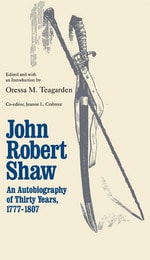
John Robert Shaw
An Autobiography of Thirty Years, 1777–1807Oressa M. Teagarden
Ohio University Press, 1992
In the summer of 1807 more than a thousand subscribers from New England to Tennessee paid for the initial printing of The Life and Travels of John Robert Shaw: A Narrative of the Life and Travels of the Well-Digger, now resident of Lexington, Kentucky, Written by Himself. Shaw had come to Rhode Island as a British redcoat to put down the colonial rebellion. Through various quirks of fate, including being taken a prisoner of war, he ended up fighting with the Americans. Shaw was an exuberant spirit whose rowdy drinking bouts and related predicaments alternated with periods of wholehearted efforts at reform. His autobiography, written while he recuperated from injuries from one of several explosions (an occupational hazard for the frontier well-digger), is an articulate and entertaining record of the Revolutionary War era.
A 1930 printing of Shaw’s autobiography was rescued from the trash by an alert librarian in Kentucky in 1950. She passed the tattered copy on to journalist Oressa M. Teagarden, who became intrigued with Shaw’s story and spent much of her free time over the next two decades finding out more about the ebullient American. On Teagarden’s death, co-editor Jeanne Crabtree assumed the task of making Shaw’s authentic and colorful view of early America available to a new generation of readers.
John Spring's Arizona
A. M. Gustafson
University of Arizona Press, 1966
John Spring first saw Arizona from an encampment on the west side of the Colorado River at "a small town called Yuma . . . then called Arizona City . . . it did a thriving fandango and saloon business during the period of continual going and coming of troops and teamsters." Southern Arizona, as Spring first saw and described it, was "a country where every highway, every path, every hamlet, and nearly every rancho could tell (had they the gift of speech) of devilish deeds, of crafty ambuscade, murdered settlers and travellers."
Supported by knowledge of several languages and wide reading, John Spring was able to extend his reporting to geographical and botanical description, to detailed reports of agriculture in the Santa Cruz Valley, and mercantile activity in Tucson. But he returned always to people--an irresistible center of interest for John Spring.
The lively and authentic serial reports of John Spring to the National Tribune in Washington, D.C., have been assembled and edited in this volume by A. M. Gustafson.
John Steinbeck Goes to War
The Moon is Down as PropagandaDonald V. Coers
University of Alabama Press, 2005
WINNER OF THE ELIZABETH AGEE PRIZE IN AMERICAN LITERATURE
When words became weapons—Steinbeck’s novel and the underground war for freedom.
In March 1942, a desperate period for the allies in World War II, John Steinbeck published his propaganda novel The Moon is Down—the story of ruthless invaders who overrun a militarily helpless country. Throughout the novel, Steinbeck underscored both the fatal weakness of the “invincible” unnamed aggressors and the inherent power of the human values shard by the “conquered” people.
The Moon is Down created an immediate sensation among American literary critics; fierce debate erupted over Steinbeck’s uncommonly sympathetic portrayal of the enemy and the novel’s power as a vehicle for propaganda. Fifty years later, Coers continues the debate, relying heavily on unpublished letters and personal interviews with the lawyers, book dealers, actors, publishers, and housewives associated with the resistance movements in Western Europe. Clandestine translations of The Moon Is Down quickly appeared and were widely circulated under the noses of the Gestapo. Coers documents the fate of Steinbeck’s novel in the hands of World War II resistance fighters and deepens our appreciation of Steinbeck’s unique ability to express the feelings of oppressed peoples.