Results by title
118 books match the query 'Epistemology' and 8 start with k
Kant and Phenomenology
Tom Rockmore
University of Chicago Press, 2010
Phenomenology, together with Marxism, pragmatism, and analytic philosophy, dominated philosophy in the twentieth century—and Edmund Husserl is usually thought to have been the first to develop the concept. His views influenced a variety of important later thinkers, such as Heidegger and Merleau-Ponty, who eventually turned phenomenology away from questions of knowledge. But here Tom Rockmore argues for a return to phenomenology’s origins in epistemology, and he does so by locating its roots in the work of Immanuel Kant.
Kant and Phenomenology traces the formulation of Kant’s phenomenological approach back to the second edition of Kant’s Critique of Pure Reason. In response to various criticisms of the first edition, Kant more forcefully put forth a constructivist theory of knowledge. This shift in Kant’s thinking challenged the representational approach to epistemology, and it is this turn, Rockmore contends, that makes Kant the first great phenomenologist. He then follows this phenomenological line through the work of Kant’s idealist successors, Fichte and Hegel. Steeped in the sources and literature it examines, Kant and Phenomenology persuasively reshapes our conception of both of its main subjects.
Kant's Organicism
Epigenesis and the Development of Critical PhilosophyJennifer Mensch
University of Chicago Press, 2013
Kant’s Critical Philosophy
The Doctrine of the FacultiesGilles Deleuze
University of Minnesota Press, 1985
Kenneth Burke and Contemporary European Thought
Rhetoric in TransitionBernard L. Brock
University of Alabama Press, 1995
Kenneth Burke and Contemporary European Thought: A Rhetoric in Transition reflects the present transitional nature of rhetoric and society. Its purpose is to relate the rhetorical theory of Burke to the theories of four major European philosophers—Jürgen Habermas, Ernesto Grassi, Foucault, and Jacques Derrida—as they discuss the nature of language and its central role in society.
This book describes a rhetorical world in transition but not a world in chaos. It points to the centrality of symbolism in theories of language and rhetoric and illustrates Burke’s influence as a pivotal things and theorist in the communication arts and sciences, suggesting that the observations regarding shifting paradigms and perspectives made by other scholars are indeed emergent in the realm of rhetoric. It also regards the powerful impact of language and symbolic action in both the critique and construction of human knowledge and augurs a central role for rhetoric in the intellectual and social transformations of this and the next century.
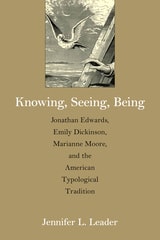
Knowing, Seeing, Being
Jonathan Edwards, Emily Dickinson, Marianne Moore, and the American Typological TraditionJennifer L. Leader
University of Massachusetts Press, 2016
Scholars no longer see Jonathan Edwards as the fire-and-brimstone preacher who deemed his parishioners “sinners in the hands of an angry god.” Edwards now figures as caring and socially conscious and exerts increased influence as a philosopher of the American school of Protestantism. In this study, he becomes the progenitor of an alternative tradition in American letters.
In Knowing, Seeing, Being, Jennifer L. Leader argues that Edwards, the nineteenth-century poet Emily Dickinson, and the twentieth-century poet Marianne Moore share a heretofore underrecognized set of religious and philosophical preoccupations. She contends that they represent an alternative tradition within American literature, one that differs from Transcendentalism and is grounded in Reformed Protestantism and its ways of reading and interpreting the King James Bible and the natural world. According to Leader, these three writers' most significant commonality is the Protestant tradition of typology, a rigorous mode of interpreting scripture and nature through which certain figures or phenomena are read as the fulfillment of prophecy and of God's work. Following from their similar ways of reading, they also share philosophical and spiritual questions about language, epistemology (knowing), perception (seeing), and physical and spiritual ontology (being). In connecting Edwards to these two poets, in exploring each writer's typological imagination, and through a series of insightful readings, this innovative book reevaluates three major figures in American intellectual and literary history and compels a reconsideration of these writers and their legacies.
Knowledge and Computing
Computer Epistemology and Constructive SkepticismTibor Vámos
Central European University Press, 2010
Knowledge and Knowing in Media and Film Studies
Steve Connolly
University College London, 2025
The nature of knowledge in the curriculum is well-defined for traditional subjects like History and Science, but for newer disciplines like Media and Film Studies, the boundaries are far less clear. Knowledge and Knowing in Media and Film Studies is the first book to explore this question in depth, tracing the epistemological foundations of these subjects and their place in the English school curriculum.
Steve Connolly argues that while both Media and Film Studies have distinct intellectual traditions, their inclusion of craft skills alongside theoretical and factual knowledge has shaped a different set of criteria for what counts as valuable knowledge. Consisting of historical sources and interviews with teachers, this work goes against the assumption that these are novel subjects and shows their deep parallels with more established fields. Essential reading for educators and researchers, the book provides a necessary framework for understanding how knowledge in these disciplines is taught and legitimized in schools today.
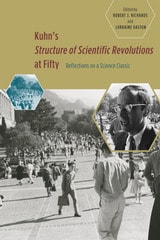
Kuhn's 'Structure of Scientific Revolutions' at Fifty
Reflections on a Science ClassicEdited by Robert J. Richards and Lorraine Daston
University of Chicago Press, 2016
In Kuhn’s “Structure of Scientific Revolutions” at Fifty, leading social scientists and philosophers explore the origins of Kuhn’s masterwork and its legacy fifty years on. These essays exhume important historical context for Kuhn’s work, critically analyzing its foundations in twentieth-century science, politics, and Kuhn’s own intellectual biography: his experiences as a physics graduate student, his close relationship with psychologists before and after the publication of Structure, and the Cold War framework of terms such as “world view” and “paradigm.”