Results by title
4154 books match the query 'State & Local' and 18 start with k
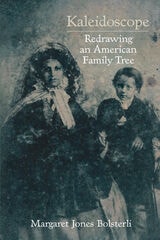
Kaleidoscope
Redrawing an American Family TreeMargaret Jones Bolsterli
University of Arkansas Press, 2015
Kaleidoscope is the story of this discovery, and it is the story, too, of the rise and fall of the Chavis fortunes in Mississippi, from the family’s first appearance on a frontier farm in 1829 to ownership of over a thousand acres and the slaves to work them by 1860. Bolsterli learns that in the 1850s, when all free colored people were ordered to leave Mississippi or be enslaved, Jordan Chavis’s white neighbors successfully petitioned the legislature to allow him to remain, unmolested, even as three of his sons and a daughter moved to Arkansas and Illinois. She learns about the agility with which the old man balanced on a tightrope over chaos to survive the war and then take advantage of the opportunities of newly awarded citizenship during Reconstruction. The story ends with the family’s loss of everything in the 1870s, after one of the exiled sons returns to Mississippi to serve in the Reconstruction legislature and a grandson attempts unsuccessfully to retain possession of the land. In Kaleidoscope, long-silenced truths are revealed, inviting questions about how attitudes toward race might have been different in the family and in America if the truth about this situation and thousands of others like it could have been told before.
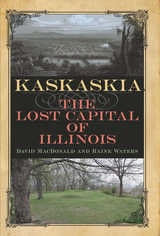
Kaskaskia
The Lost Capital of IllinoisDavid MacDonald and Raine Waters
Southern Illinois University Press, 2019
At the outset the Kaskaskia tribe, along with Jesuit missionaries and French traders, settled near the confluence of the Kaskaskia and Mississippi rivers, about sixty miles south of modern-day St. Louis. The town quickly became the largest French town and most prosperous settlement in the Illinois Country. After French control ended, Kaskaskia suffered under corrupt British and then inept American rule. In the 1790s the town revived and became the territorial capital, and in 1818 it became the first state capital. Along the way Kaskaskia was beset by disasters: crop failures, earthquakes, tornadoes, floods, epidemics, and the loss of the capital-city title to Vandalia. Likewise, human activity and industry eroded the river’s banks, causing the river to change course and eventually wash away the settlement. All that remains of the state’s first capital today is a village several miles from the original site.
MacDonald and Waters focus on the town’s growth, struggles, prosperity, decline, and obliteration, providing an overview of its domestic architecture to reveal how its residents lived. Debunking the notion of a folklore tradition about a curse on the town, the authors instead trace those stories to late nineteenth-century journalistic inventions. The result is a vibrant, heavily illustrated, and highly readable history of Kaskaskia that sheds light on the entire early history of Illinois.
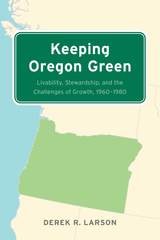
Keeping Oregon Green
Livability, Stewardship, and the Challenges of Growth, 1960–1980Derek R. Larson
Oregon State University Press, 2016
Keeping Oregon Green is a new history of the signature accomplishments of Oregon’s environmental era: the revitalization of the polluted Willamette River, the Beach Bill that preserved public access to the entire coastline, the Bottle Bill that set the national standard for reducing roadside litter, and the nation’s first comprehensive land use zoning law, colloquially known as LDCD. To these case studies is added the largely forgotten tale of what would have been Oregon’s second National Park, intended to preserve the Oregon Dunes as one of the country’s first National Seashores.
Through the detailed study of the historical, political, and cultural contexts of these environmental conflicts the author uncovers new dimensions in familiar stories linked to the concepts of “livability” and environmental stewardship. Linking events in Oregon to the national environmental awakening of the 1960s-1970s, the innovative environmental policies that carried Oregon to a position of national leadership are shown to be products of place and culture as much as politics. While political leaders played critical roles in framing new laws, the advocacy of ordinary citizens-- farmers, students, business leaders, and factory workers --drove a movement that crossed partisan, geographic, and class lines to make Oregon the nation’s environmental showplace of the 1970s.
Drawing on extensive archival research, source materials ranging from poetry to congressional hearings, and firmly rooted in the cultural, economic, and political history of the Pacific Northwest, Keeping Oregon Green argues that the state’s environmental legacy is not just the product of visionary leadership, but rather a complex confluence of events, trends, and personalities that could only have happened when and where it did. The linked concepts of livability and stewardship behind Oregon’s success were not transferrable to other places or times, dooming efforts to repeat the state’s signature achievements elsewhere to failure.

Keeping the Faith
Ordinary People, Extraordinary LivesWayne Flynt
University of Alabama Press, 2011
Keewaydinoquay, Stories from My Youth
Keewaydinoquay Peschel
University of Michigan Press, 2006
Michael Blake's Dances with Wolves transformed denigrating Indian sterotypes and created widespread interest in Native American culture. The subsequent popularity of books on this topic underscores the power of a tale well told. While Blake's story relates the early chapters of Native Americans' survival struggles, later accounts of this struggle remain untold.
The Indians of Hungry Hollow authentically presents these later chapters. The days of Hungry Hollow have long passed, but the opportunity to capture its lessons of community, strong values, and an urge to thrive in matters of the heart and soul are still very much with us.
These are stories of survival, community, sharing, and caring. The situations are often dire: winter in the middle of the Depression; an Indian settlement illegally taken from its inhabitants and set on fire; boaters stranded by bad weather and threatened with death. But if the situations are extreme, the telling of the stories is consistently optimistic yet completely without self-pity or sentimentality, and the characters always find a way through the darkness.
Dunlop's unique style of storytelling is compelling and informative, and these historically significant stories help to elucidate the transition of the American Indian culture from post-tribal days to the present.
Bill Dunlop is a respected Ottawa elder and storyteller. Marcia Fountain-Blacklidge is a professional writer, counselor, and consultant.
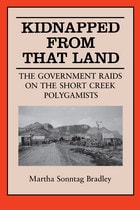
Kidnapped From That Land
The Government Raids on the Short Creek PolygamistMartha S Bradley
University of Utah Press, 1993
In the early morning hours of July 26, 1953, several hundred Arizona state officials and police officers moved into the polygamist community of Short Creek, Arizona, to serve warrants on thirty-six men and eighty-six women. Officials staging the raid believed they were rescuing the community’s 263 children from a life of bondage and immorality.
Kidnapped from that Land is the first book to bring together the story of the 1953 raid and two previous raids in 1935 and 1944. Martha Bradley tells the story with insight and compassion for the families that were fragmented by the arrests. She also deals with the complex legal issues that persist in both Arizona and Utah, where the practice of polygamy is a felony that is no longer prosecuted.
Kidnapped from that Land will appeal to those interested in the study of Mormon history, of polygamy, and of western regional and American social history.

Killer Show
The Station Nightclub Fire, America’s Deadliest Rock ConcertJohn Barylick
University Press of New England, 2015
King Cotton Diplomacy
Foreign Relations of the Confederate States of AmericaFrank L. Owsley Sr., revised by Harriet Chappell Owsley, and with a new Preface by Howard Jones
University of Alabama Press, 2008
The exhaustive, definitive study of Southern attempts to gain international support for the Confederacy by leveraging the cotton supply for European intervention during the Civil War. Using previously untapped sources from Britain and France, along with documents from the Confederacy’s state department, Frank Owsley’s King Cotton Diplomacy is the first archival-based study of Confederate diplomacy.
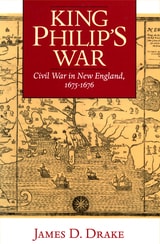
King Philip's War
Civil War in New England, 1675-1676James D. Drake
University of Massachusetts Press, 1999
Sometimes described as “America's deadliest war,” King Philip's War proved a critical turning point in the history of New England, leaving English colonists decisively in command of the region at the expense of native peoples. Although traditionally understood as an inevitable clash of cultures or as a classic example of conflict on the frontier between Indians and whites, in the view of James D. Drake it was neither. Instead, he argues, King Philip's War was a civil war, whose divisions cut across ethnic lines and tore apart a society composed of English colonizers and Native Americans alike. According to Drake, the interdependence that developed between English and Indian in the years leading up to the war helps explain its notorious brutality. Believing they were dealing with an internal rebellion and therefore with an act of treason, the colonists and their native allies often meted out harsh punishments. The end result was nothing less than the decimation of New England's indigenous peoples and the consequent social, political, and cultural reorganization of the region. In short, by waging war among themselves, the English and Indians of New England destroyed the world they had constructed together. In its place a new society emerged, one in which native peoples were marginalized and the culture of the New England Way receded into the past.
Kinship with the Land
Regionalist Thought In Iowa, 1894-1942E. Bradford Burns
University of Iowa Press, 1996
Pioneers moving into Iowa in the nineteenth century created a distinctly rural culture: family, farm, church, and school were its dominant institutions. After decades of settlement, however, several lively and perceptive generations interpreted their political, economic, and cultural environment—their Iowa—much more imaginatively; they offered such abundant insight, understanding, meaning, and mission that they mentally and spiritually recreates Iowa. In Kinship with the Land historian Brad Burns celebrates this intense period of intellectual and cultural development.
Through their novels, short stories, poems, essays, drawings, and paintings, Iowa's regionalists expressed a rich abstraction of people and place. They conferred meaning, imparted understanding, defined the soil and the folk, conveyed a sense of place. Grant Wood in his overalls—the quintessential symbol of sophisticated talent and rural values—clearly represented regionalism's spiritual solidarity with the land and the people who worked it. Burns lets these Iowans speak for themselves, then interprets their distinctive voices to present a cogent case for and an understanding of the rural in an overwhelming urban America.
Kinship with the Land emphasizes the importance of Iowa's intellectual and cultural history and reaffirms the state's identity at the very moment that standardization threatened to eradicate it. By endowing Iowa with vibrant, independent art and literature, regionalists made refreshing sense of their environment. Readers from every state will appreciate their generous legacy.
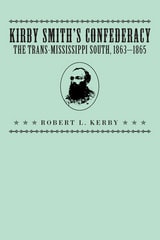
Kirby Smith's Confederacy
The TransMississippi South, 1863-1865Robert L. Kerby
University of Alabama Press, 1991
Cut off, but not surrendered—one region’s desperate stand in the twilight of the Confederacy.
With the surrender of Vicksburg in July 1863, the Confederacy’s TransMississippi Department, which included Texas, Arkansas, Missouri, western Louisiana, and Indian Territory, was cut off from the remainder of the South. Robert Kerby’s insightful volume, originally published in 1972, “has gone far toward filling one of the most conspicuous gaps in the literature on the Confederacy,” according to The Journal of Southern History.
Kerby investigates the many factors that led to the Department’s disintegrating and offers a case study of a segment of American society that consumed itself by surrendering everything, including its principles and ideals, in pursuit of an unattainable military victory.
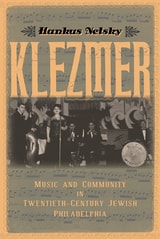
Klezmer
Music and Community in Twentieth-Century Jewish PhiladelphiaHankus Netsky
Temple University Press, 2017
Netsky defines what klezmer music is, how it helped define Jewish immigrant culture in Philadelphia, and how its current revival has changed klezmer’s meaning historically. Klezmer also addresses the place of musicians and celebratory music in Jewish society, the nature of klezmer culture, the tensions between sacred and secular in Jewish music, and the development of Philadelphia's distinctive “Russian Sher” medley, a unique and masterfully crafted composition.
Including a significant amount of musical transcriptions, Klezmer chronicles this special musical genre from its heyday in the immigrant era, through the mid-century period of its decline through its revitalization from the 1980s to today.

Klondike Saga
The Chronicle of a Minnesota Gold Mining CompanyCarl L. Lokke
University of Minnesota Press, 1965
Klondike Saga was first published in 1965. Minnesota Archive Editions uses digital technology to make long-unavailable books once again accessible, and are published unaltered from the original University of Minnesota Press editions.
This is the story of the Monitor Gold Mining and Trading Company, an organization of sixteen Minnesotans who went to the Canadian Klondike region in the late 1890's to prospect for gold. It is based on diaries and letters written by the men during their venture. Most of the company members were of Scandinavian origin, recent immigrants to America, and a number of the letters were written to Nye Normanden, a Norwegian-language newspaper published in Minneapolis at the time.
The leader of the company, Lars Gunderson, was the grandfather of the late Carl L. Lokke, author of the book. Mr. Lokke, a historian, was chief of the foreign affairs branch of the National Archives at the time of his death in 1960.
This is the first book issued under a joint publishing arrangement between the University of Minnesota Press and the Norwegian-American Historical Association. It is Volume 7 in the association's Travel and Description Series. There is a preface by Kenneth O. Bjork, editor of the association, and Senator Ernest Gruening of Alaska writes a foreword.

Klondike Women
True Tales of the 1897–1898 Gold RushMelanie J. Mayer
Ohio University Press, 1989
Challenging the myth that the only women who participated in gold rushes were prostitutes and gold-diggers of the euphemistic sort, Melanie Mayer shows us that Klondike women came from all walks of life—socialites to poor immigrants, single women, wives, widows, and children. They planned to make their money through many different undertakings including mining, business, entertainment, professional, and service enterprises. Their approaches to life were as varied as their roles—optimistic or skeptical; cautious or adventuresome; gregarious or self-contained; contemplative or active. There was no typical Klondike woman. Individually, their stories can be funny, hopeful, tragic, or poignant. Taken together, they give rich, complex images of the people, times, and places of the gold rush.
A visually exciting book, Klondike Women features over 150 photographs and illustrations. This volume should appeal not only to the general reader, but to those interested in history, women’s studies, and the Pacific Northwest as well.
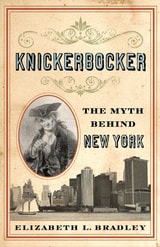
Knickerbocker
The Myth behind New YorkBradley, Elizabeth L
Rutgers University Press, 2009
Includes a gallery of images that brings Diedrich Knickerbocker, his myth, time, and place to life Knickerbocker engagingly traces the creation, evolution, and prevalence of Irving's imaginary historian in New York literature and history, art and advertising, from the early nineteenth century to the present day. Who would imagine this satiric character, at once a snob and a champion of the people, would endure for two hundred years? In Elizabeth L. Bradley's words, "Whether you call it 'blood,' style, attitude, or moxie, the little Dutchman could deliver." And, from this engaging work, it is clear that he does.
Bradley's stunning volume offers a surprising and delightful glimpse behind the scenes of New York history, and invites readers into the world of Knickerbocker, the antihero who surprised everyone by becoming the standard-bearer for the city's exceptional sense of self, or what we now call a New York "attitude."
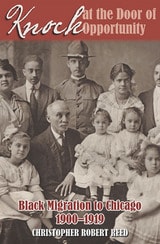
Knock at the Door of Opportunity
Black Migration to Chicago, 1900-1919Christopher Robert Reed
Southern Illinois University Press, 2014
Disputing the so-called ghetto studies that depicted the early part of the twentieth century as the nadir of African American society, this thoughtful volume by Christopher Robert Reed investigates black life in turn-of-the-century Chicago, revealing a vibrant community that grew and developed on Chicago’s South Side in the early 1900s. Reed also explores the impact of the fifty thousand black southerners who streamed into the city during the Great Migration of 1916–1918, effectively doubling Chicago’s African American population. Those already residing in Chicago’s black neighborhoods had a lot in common with those who migrated, Reed demonstrates, and the two groups became unified, building a broad community base able to face discrimination and prejudice while contributing to Chicago’s growth and development.
Reed not only explains how Chicago’s African Americans openly competed with white people for jobs, housing and an independent political voice but also examines the structure of the society migrants entered and helped shape. Other topics include South Side housing, black politics and protest, the role of institutionalized religion, the economic aspects of African American life, the push for citizenship rights and political power for African Americans, and the impact of World War I and the race riot of 1919. The first comprehensive exploration of black life in turn-of-the-century Chicago beyond the mold of a ghetto perspective, this revealing work demonstrates how the melding of migrants and residents allowed for the building of a Black Metropolis in the 1920s.
2015 ISHS Superior Achievement Award
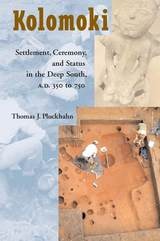
Kolomoki
Settlement, Ceremony, and Status in the Deep South, A.D. 350 to 750Thomas J. Pluckhahn
University of Alabama Press, 2003
A Dan Josselyn Memorial Publication
The first comprehensive and systematic investigation of a Woodland period ceremonial center.
Kolomoki, one of the most impressive archaeological sites in the southeastern United States, includes at least nine large earthen mounds in the lower Chattahoochee River valley of southwest Georgia. The largest, Mound A, rises approximately 20 meters above the terrace that borders it. From its flat-topped summit, a visitor can survey the string of smaller mounds that form an arc to the south and west.
Archaeological research had previously placed Kolomoki within the Mississippian period (ca. A.D. 1000-1500) primarily because of the size and form of the mounds. But this book presents data for the main period of occupation and mound construction that confirm an earlier date, in the Woodland period (ca. A.D. 350-750). Even though the long-standing confusion over Kolomoki’s dating has now been settled, questions remain regarding the lifeways of its inhabitants. Thomas Pluckhahn's research has recovered evidence concerning the level of site occupation and the house styles and daily lives of its dwellers. He presents here a new, revised history of Kolomoki from its founding to its eventual abandonment, with particular attention to the economy and ceremony at the settlement.
This study makes an important contribution to the understanding of middle range societies, particularly the manner in which ceremony could both level and accentuate status differentiation within them. It provides a readable overview of one of the most important but historically least understood prehistoric Native American sites in the United States.

Korea Letters in the William Elliot Griffis Collection
An Annotated SelectionYoung-mee Yu Cho
Rutgers University Press, 2024
The Korean materials in the Griffis Collection at Rutgers University consist of journals, correspondence, articles, maps, prints, photos, postcards, manuscripts, scrapbooks, and ephemera. These papers reflect Griffis's interests and activities in relation to Korea as a historian, scholar, and theologian. They provide a rare window into the turbulent period of late nineteenth- and twentieth-century Korea, witnessed and evaluated by Griffis and early American missionaries in East Asia. The Korea Letters in the William Elliot Griffis Collection are divided into two parts: letters from missionaries and letters from Japanese and Korean political figures. Newly available and accessible through this collection, these letters develop a multifaceted history of early American missionaries in Korea, the Korean independence movement, and Griffis's views on Korean culture.